




Abstract
By analyzing the differences between the corporate and public governance, theoretical and empirical research seems to indicate that the two domains of governance are far too different to share any common aspect. However, in this particular research, it has been argued that public governance is an application of corporate governance. Thus, the research question entails the description and analysis of this possible convergence of the two. Extensive research from literature on corporate governance has been undertaken to establish a relationship between the boards process and the roles that acts as a framework to bridge the gap separating corporate governance from public governance. Corporate governance, at a global level, exists in the for-profit as well as nonprofit organizations. Thus, the definition of this concept needs to be viewed from “an innovative” eye, considering the relationship between the process of the board and roles as characteristic of the public organization and private ones. As the private as well as public organizations are an application of corporate governance, the difference between the two gets narrowed. For the purpose of this research, the case of the French hospitals’ board has been taken into consideration. The members of the public board have been considered for the board process to perform their roles.
Introduction
The French Hospital Case: An Adoption of the Bicephalous Governance System
The instance of the French Public Hospital has been taken into consideration primarily for two reasons; first the present reforms in the governance of the French hospital industry having a national topicality, and second, the adoption of the dual board structure in the form of the new two-tier governance system by the French board hospital.
The current reforms in the governance of hospitals in France under the French Health Care Code 2010 (from the Article L6143-1 to the Article L6143-8) have a nationwide implication. By introducing a change in the ruling board, the reforms have instigated a debate among the physicians, patients, and authorities.
Industry in France has been the main reason for choosing this industry for the purpose of this research. The recent French Health Care Code 2010 (from the Article L6143-1 to the Article L6143-8) requires public hospitals to substitute the unitary system (the board of directors) with the dual one (the supervisory and the management boards) under the aegis of the reform known as “Loi, Hopital, Santé, Patients, Territoire” (The HSPT). This change in the structure of governance is one of the most important reforms in the history of the French hospital governance structure change. Until recently, the governance of organizations (public and private) in France has been predominantly characterized by the unitary board system. As the private firms have benefited from the option of the dual board structure (Mallin, 2007, p. 172) since the reform of the “droit des societies” (the Companies Law) in 1966, the French legislator is keen on adopting the dual system for the public hospital board, as well. According to the health care authorities, by changing the governance system, the public hospitals would be able to achieve the desired performance objectives. The main point is that the supervisory board (SUB hereinafter) and the management board (MGB/Mgt. hereinafter) constitute the basis of the hospital governance reforms. As far as the SUB is concerned, some observers of the French hospitals’ governance say that the decision-making power, as determined by the law, seems to be in favor of the MGB and precisely the director. It is felt that the role of SUB is being undermined as the government wants the director to be the highest ruling authority within the French public hospital.
In the light of this French public hospital topicality, the research aims to establish that the board process can create a convergence between public and private governance. The research first describes the theoretical background for this convergence, and then offers the board making process as a practical suitable alternative.
Theoretical Background
The Nonprofit and the Public Governance as “an Application” of Corporate Governance
In the first stage, the public sector is considered as a set of production units including firms, programs, agencies, and departments such as the social security administration, railways, national health care, education, and national defense. Each unit is supposed to use a limited number of resources within a particular institutional and geographical setting and produce a number of outputs, quantitative and qualitative. Those outputs are related to the objectives that have been assigned to the production unit by the principal, the authority in charge, that is, the government. However, private-sector organizations are entities that operate on a for-profit basis and include the private industry or commercial sector units like the large- and medium-sized pharmaceutical companies, small firms, and biotechnology start-ups.
Corporate governance refers to the mechanism by which the owner of the corporation governs and regulates the activities of the managers. Another way to understand the concept of corporate governance is the manner in which the suppliers of finance to corporations assure the flow of a return on their investment. This conceptualization remains valid for the public as well as the private sectors. Even though this definition of corporate governance concurs with the objective of the private sector, it is equally valid for the public organizations. In the public sector, the suppliers of finance are the tax payers who assure a safe return in the form of services of the public administration.
Gortner, Nicols, and Ball (2006) argued that “Thus, far we’ve addressed the differences between public sector, non-profit organizations and the for-profit organizations. This is the key to understanding organization theory from the public and non-profit organization’s perspective” (p. 44). This citation is in concordance with the Figure 1 that implies that when authors conduct research on the nonprofit organization governance, they generally evoke the cases of the public and the private sectors simultaneously. However, researchers deal with the private sector when they take an interest in the for-profit organization governance. Thus, this categorization highlights a kind of “governance profiling,” and the classification of organizations as public, nonprofit, or private, in which each category is supposed to adopt a specific governance model.
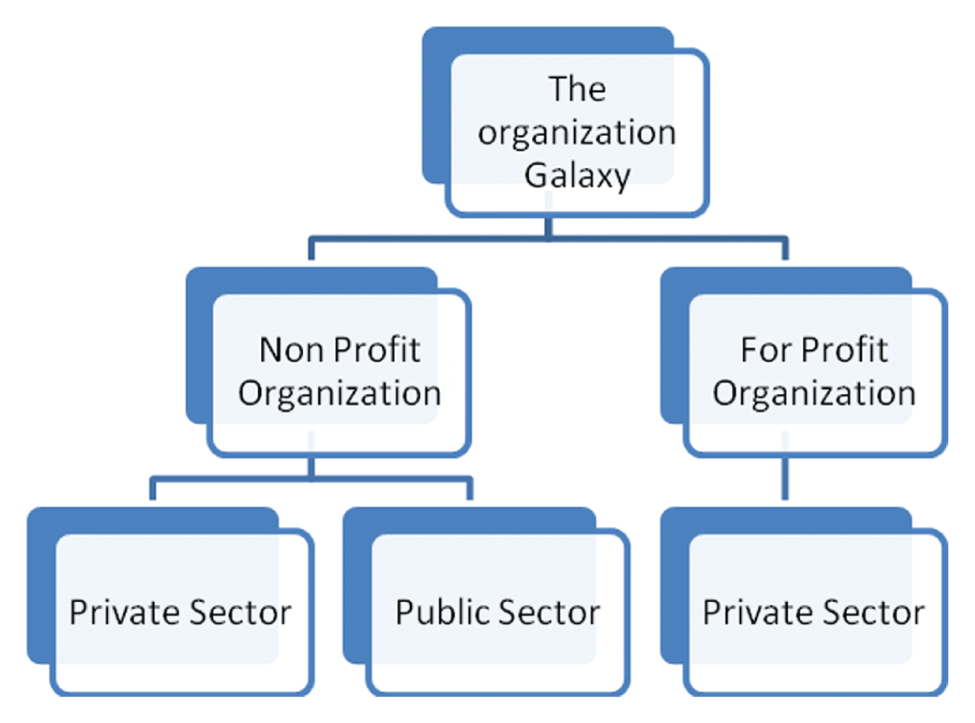
The possible spheres of the corporate governance.
Again, researchers define corporate governance in relation with “the corporation” (Shleifer & Vishny, 1997, p. 737; Zingales, 1998, p. 498). Therefore, if Jegers (2009, p. 144) states that “the word ‘Corporate’ in Corporate Governance is no longer restricted to Non-profit and For-profit Organizations,” that is, the corporations, he defends “Corporate Governance as confined to non-profit Governance.” This necessitates the assessment of corporate governance at a global perspective. Moreover, this change in the interpretation of the term Corporate, transforms the importance of the concept as a theory, as it considers all the possible spheres of an organization. In fact, the passing from the for-profit arena to the nonprofit or public one underlines the prevalence of corporate governance as a theory. Following the definition of the term “application” given by the Oxford Dictionary (4th edition, p. 47), as the “Act of putting a theory, discovery, etc. to practical use,” the corporate governance that emanates from corporation studies or practices can also be applied to any organization. Thus, with some precautions, corporate governance can be identified as a theory that embraces the nonprofit as well as the for-profit organizations.
These precautions are not inferred from the theory, but, depend on the specific characteristics of each organization found in Figure 1. The first precaution may be defined in terms of conceptualization: For example, authors analyze the governance of nonprofit or/and for-profit organizations in the light of the stakeholders, which forms an important branch of corporate governance. They specify that each organization has its stakeholders and with a small distinction of shareholders as “a denomination” of those who try to defend their own interests on behalf of the owners of the firm, as a for-profit organization.
The second precaution may be defined in terms of implications such as problems; as given by Glaeser (2002), “the non-profit organizations have governance problems that resemble the problems faced by for-profit firms, but are often more extreme” (p. 54).
The third precaution relates to safeguarding the interests of the stakeholders as the statute of the organization is changed, for instance, transforming the organization from a public entity to a private one (privatization). According to the stakeholder’s approach, this may increase, decrease, or even change the nature of the stakeholders, without changing their ultimate goal, which is defending their own interests.
In addition, in terms of the adoption of corporate governance insights by the nonprofit organizations, Alexander and Weiner (1998) tried to determine the required conditions within the nonprofit hospital industry. Likewise, Alexander, Young, Weiner, and Herald (2008) have studied the possibility of applying the Sarbanes–Oxley Committee’s firm governance codes to the same industry. According to the committee’s codes, private companies listed in the United States and their directors have to obey various norms relating to disclosure and internal control, subject to significant penalties, including imprisonment. As it is applicable to all public-listed companies, U.S. companies and non-U.S.-listed companies in the United States, these companies are now required to submit an annual report of the internal accounting controls to the U.S. Securities and Exchange Commission. The authors recognize that Although Sarbanes-Oxley does not apply to non-profit corporations, the legislation has been an impetus to policy makers to consider whether non-profit should be subject to similar types of governance requirements, as a number of these organizations have also been involved in widely publicized scandals. (Alexander, Young, Weiner, & Herald, 2008, pp. 199-200)
This reasoning further establishes that the overlapping and the distinguishing zones between nonprofit and for-profit arenas, even with governance theories, other than the stakeholders’ theory, point toward the application of corporate governance to the for-profit as well as the nonprofit organizations. The corporatization of an organization is the adoption of those assumptions, and therefore, it is different from the concept of privatization, in the sense that organizations may corporatize their governance mechanisms without privatization (Aivazian, Ge, & Qiu, 2005). Consequently, this research on corporate governance proposes to study different mechanisms that are applicable to nonprofit as well as for-profit organizations. Moreover, when authors have to classify these mechanisms, they choose the organization as a frontier between external mechanisms (the market, law and economy) and internal mechanisms (the board, committees and managerial incentives). Given that this research article does not propose to analyze all of these mechanisms and/or their efficiencies or inefficiencies (Walsh & Seward, 1990), it is herein suggested to emphasize the possibility of applying some of the corporate governance insights from the private sector to the public organization’s board. It can be argued that the public and the private governance can interchange between them some of the mechanisms of governance. In this sense, Benz and Frey (2007) contended that the firm’s governance can learn and gain from the public governance and vice versa. Indeed, the two authors encourage the private field, under the scandals—which infected earlier its Governance—to adopt some lessons from the public domain in terms of “manager compensation,” “the division of power within firms,” “rules of succession in top positions,” and “institutionalized competition in core areas of the corporation.”
This research first deals with some specificities of public governance concerning the board of directors. Then, the research evokes how the board process, as described by the corporate governance literature, influences the performance of the public board by analyzing the functioning of the French Hospital Board.
In What Ways Is the Public Board Specific?
The term “governance,” in the public sphere, has been emphasized through the doctrine of “New Public Management” (NPM), with Hood (1991) stating that “it is the result of the marriage between the Neo-Institutional Economic approaches (public choice, transactions cost and principal-agent theories) and the Managerialism perspective” (p. 6). According to Kickert (1997) “The Public Management should be broadened into Public Governance” (p. 732). This implies that the NPM and the governance theory in general, share some of the institutional, economic, and theoretical roots such as the Transactions’ Cost Theory and the agency theory. While those theories are an emanation of corporate governance, they seem to constitute the basis of the nonprofit governance as well. In fact, Cornforth (2006) remarked that the nonprofit and public governance are “relatively under-theorised” and enunciates a panel of corporate governance theories likely to explain some aspects of the nonprofit and public boards (p. 6). Besides, in their work, Stone and Ostrower (2007) argued that the Nonprofit governance and public governance are “fluid and overlapping,” and the breakable limits between the two spheres get manifested by the fact that the governance literatures of both firms are almost the same, and drawn from the for-profit governance research. Thus, the corporate governance research has a certain theoretical leg up as compared with the nonprofit and public governance ones. And, if Benz and Frey (2007) stated that the corporate governance may “learn from Public Governance,” this means otherwise that the “lessons” are about the governance practices and not the governance theories (p. 92). These practices constitute the specificities of public governance. The same authors defend the idea of the existence of some differences between corporate and public governance, in terms of “manager compensation, the division of power within firms, rules of succession in top positions and institutionalized competition in core areas of Governance.” In addition, the board of directors can be taken as a mechanism of governance to look for a certain convergence between corporate and public governance. As researchers have already explored the effectiveness of the board of directors of the for-profit organizations, the nonprofit domain seems to be fertile to lead an investigation about the decision process within it. Thus, the nonprofit organizations in Europe adopt the dual system of management and supervisory boards, unlike the prevalence of the Unitary Board system in the for-profit organizations, leading to the consideration of the case of the French public hospital, and the possibility of the adoption of the dual system in the for-profit as well as the nonprofit organizations.
The board’s demography acts as the input in the input-process-output Model emphasizing the relationship between the characteristics of the incumbents of the board and the performance and efficiency of the organization. This particular research adds another dimension by establishing the relationship between the board’s demography and board’s process, as well as that between the board’s process and board’s performance.
The Public Organization’s Board Demography
Generally, matters relating to the board like that of the determination and change of tenure, the size, and the colleges of the public board are always defined by the law. However, the subject of the research on board governance analyzes the demography of the board as follows.
The board size
As has been stated above, the law determines the different components of the supervisory board. The size of the board is determined according to the number and size of colleges that compose the supervisory board of the French public hospital. The three colleges are (a) at most five representatives of the territorial authority, (b) at most five representatives of the medical and nonmedical staff, and (c) at most five qualified personalities, including two representatives of the patients. As put by the law, the number of the SUB members logically should not exceed 15. Prior to the reforms, the number of the board of directors permitted by the law was 30. All things held constant, the size of the SUB can affect the extent of deliberation on the decision, as a higher number of members in the SUB implies that it will be more difficult to arrive at a consensus. Assuming that the size of the Board is another side of the board composition, Zahra and Pearce (1989) proposed to incorporate the board size within the board composition. This Board size will not be evoked, later during the course of this research, when the French public hospital’s SUB composition is described.
The board composition
Almost all academic researchers have approximately a similar description of the board composition, an important part of the board’s demography. According to them, the duality outsiders/insiders distinguish between individuals who operate the strategic Apex of the organization (the insiders) and those who do not (the outsiders; Huse, 2007). With regard to this distinction, the French public hospital SUB is composed mostly by outsiders. This is normally related to the nature of the SUB, unlike the MGB, which is constituted completely by the insiders. Therefore, compared with the proposed composition of the board of directors, there is a quasi-separation between the insiders and the outsiders. Thus, the question is about the effect of this isolation on the decision-making process of the outsiders (i.e., the SUB). Does this autonomy from the insiders insure the requisite performance of roles by the members of the SUB?
The board diversity
The third demography—the “board diversity”—implies the presence of diverse skills and knowledge within the Board (Forbes & Milliken, 1999). The French public hospital SUB is composed of qualified personalities having competencies in several domains (law, finance, management, and accounting). It has also added representatives of patients with expert knowledge in social matters. Then, there is the trade union with field-experience of the actual work conditions. Again, the presence of physician’s representative within those trade unions manifests a possession of skills in terms of functioning of the hospital’s internal process. For instance, the public university hospital, a public hospital, has the dean of the university as a member of the SUB, who has full knowledge about the state of medical research. Consequently, the presence of this diverse mosaic of knowledge and skills is imperative for the apt performance of roles of the French public hospital’s SUB.
The three factors of board size, board composition, and board diversity make up the demography of the public organizations. As this research assumes the effect of demography on the board process and the similar relation between the board process and the board performance, it becomes imperative to understand the board performance through its roles.
The Public Organization’s Board Roles
According to the literature review of Hinna, Nito, and Mangia (2010) concerning the public organization board, the members of the board have a few governing roles that vary with the corporate governance theories (see Table 1).
The Roles of Public Organization Supervisory (SUB) and Management (MGB) Boards Members.

Source. Adapted and Adopted from Hinna, Nito, and Mangia (2010, p. 143).
Note. SUB = supervisory board; MGB = Management Board.
Within the context of the French public hospital, several roles are supposed to be played by the SUB. As this article constitutes almost the first contribution after the reforms, the research has been based on the French health care code for the purpose of defining and describing the SUB tasks and roles. Therefore, the only basis to answer the question about the public and nonprofit organizations’ boards—“What does the Board do?”(Cornforth, 2006)—lies with the law. However, as stated above, this source does not clearly classify the different roles of the SUB. Such clarification is supposed necessary according to the board’s behavior process, to appreciate how the members of the SUB contribute to the creation of value. In fact, the multitheory approach (Macus, 2008) explains the variety of roles as shown in Table 1.
However, the common roles of the board cited in the theoretical researches (Forbes & Milliken, 1999; Huat & Tai Wai, 2001; Ong & David, 2008; Stiles & Taylor, 2001; Zahra & Pearce, 1989) and the empirical researches (Kula, 2005; Wan & Ong, 2005; Zona & Zattoni, 2007) are the strategy, service, and control roles.
The strategy public board role
This part of the research establishes the scope of the strategic arena for the public boards. In fact, the term strategy emanates from the extent of responsibility of the MGB, across a wide array of analysis and decisions from the financial documents like the “Projected State of the Incomes and Expenses,” Annual Activity Report, to the planning, deliberating, and framing of the medical and social projects. Therefore, the responsibility of the strategy decision process has to be shared by both of the organs, the MGB and the SUB, where the latter plays the role of discussing and analyzing the plans.
The service public board role
The SUB is required to offer its consultation and opinion on documents like the quality improvement policy, reception patients’ condition, land policy, internal policies, and procedures prepared by the MGB. Similarly, the board governance literature indicates that the board service role includes the advice given by the board of directors to the CEO (chief executive officer). In fact, Douma (1997), the SUB, with an outsider’s vision, is supposed to have a lesser involvement in the running of the organization as compared with the MGB, which is more concerned about the day-to-day operations. This underlines the paramount importance of assigning an autonomous service role to the public board; wherein the SUB creates value by offering its independent advice and consultancy.
The control public board role
As laid down by the law, while realizing the board strategy role, the SUB controls the actual execution of plans to be implemented by the MGB. And, if necessary, the SUB’s members can also nominate an auditor to check whether the MGB is carrying on the Hospital’s strategy according to the terms stipulated by the SUB. In fact, his task probably is the most important one. The corporate governance theories intervention lets the stakeholders of the hospital empowers the SUB to play the role of the principal toward the MGB that is considered as the agent, according to the agency theory (Fama & Jensen, 1983) and the stakeholder-agency theory (Hill & Jones, 1992).
As is evident, the literature on the relationship between board demography or its characteristics and the board roles of the public Board shows some ambiguity. This research banks on recent works in corporate governance, relating to the behavior of the board, arguing that the board process can bring some ideas to the public board, therein redefining the relationship between the board demography and the roles performance.
The research further moves to the assessment of a possible convergence between the corporate and public governance.
Are Some of the Corporate Governance Insights Applicable in the Public Arena?
As has been shown, the French hospital SUB demography and roles can be described similarly as is done in the private sector. However, while the public services were considered as an image of the bureaucratic regime, the emergence of the new public governance is supposed to bring a new vision of the public organization policy (Hood, 1991).
In fact, the agency theory with its roots in economic theories acted as the foundation of the disciplinary board governance approach. This was subsequently influenced by the behavioral side of the board. The elites within the governing board would eventually substitute performance with conformance (Figure 2), under the aegis of value creation (Huse, 2007).

The public board governance: Passing from disciplinary to behavior approach of the board.
Hambrick, Werder, and Zajac (2008) dealt with “New Directions in Corporate Governance Research” among others with the behavioral process within the board of directors. This matter constitutes a serious pathway of research to counter the ambiguity about the relationship between board characteristics and the organization’s performance. In fact, Eldenburg, Hermalin, Weisbach, and Wosinska (2004) found a little evidence about this relationship within the nonprofit hospital industry.
The board process issue is inspired from the group social psychology approach and precisely the input-process-output model (McGrath, 1964). In the particular research, the group taken into consideration is the SUB. The inputs are its characteristics (composition and diversity), while the output is the performance of its roles, and the process is “the decision-making related activities and styles of the board” (Zahra & Pearce, 1989, p. 292).
Why does the decision-making process matter, given that the public board members do not expect any material compensation compared with their for-profit counterparts? The answer to this question lies in the link between the Public Hospital SUB’s characteristics and its roles via certain propositions.
In fact, to apprehend this board process clearly, Forbes and Milliken (1999) classified it into three main parts, namely (a) the use of skills and knowledge, (b) the cognitive conflict, and (c) the effort norms.
The use of knowledge and skills
The public hospital’s SUB comprises of qualified personalities and other experts in several domains such as medicine, medical research, social affairs, political matters, and hospital management. These experts, coming from varied backgrounds, apply their knowledge and skills to the tasks of strategy, service, and control. In fact, the medical and nonmedical staff representatives can ratify the medical and social projects based on their social and medical affairs’ expertise. Other qualified personalities can use their managerial competencies to approve the projected state of incomes and expenses. Moreover, the capital of those skills and knowledge should be utilized to ensure the fulfillment of the roles of control and service. The favorable aspect is that the Law also allows the SUB members’ experts to criticize and give their opinions about the orientations of the MGB. Thus,
Proposition 1: The research affirms that skills and knowledge are present within the public hospital SUB and, if used effectively, can perform the three roles of strategy, service, and control.
The effort norms
Wageman (1995; as cited in Forbes & Milliken, 1999) argued that “Effort norms are a group-level construct that refer to the group’s shared beliefs regarding the level of effort everyone is expected to put towards a task” (p. 493). These norms are shared expectations about how the members of a group ought to behave (Levin & Moreland, 1990). This element plays the role of the catalyst, in the sense that the board should be accomplished by the direction of the hospital and the members of the board themselves. This well-laid direction of the hospital should ensure the best conditions before, during, and after the course meetings. In reality, the effort norms can be manifested by the preparations like sending the required documents to the board members before the meetings, framing an effective agenda, and training members in matters of governance. From the point of view of the members, there should be a certain level of vigilance on the preparation of elements to be discussed, members should consecrate with ample time assigned to do it and participate actively during the gatherings. By doing this, the SUB members and hospital’s directions provide a favorable environment to ensure that the meetings go on smoothly. Then,
Proposition 2: Enhancing effort norms by the SUB and the Hospital direction provide favorable conditions to perform the service, strategy, and control roles.
The cognitive conflict
According to Forbes and Milliken (1999) the cognitive conflict “refers to task-oriented differences in judgment among group members” (p. 494). In fact, the diversity that characterizes the public hospital SUB may open a dialog between ideas about the eventual strategic orientations. As experts discuss and debate conflicting ideas, the alternatives discussed among the different representatives are insured within a kind of “positive” interaction. Therefore, “the brewing” of ideas enhances the debate about critical issues. In a way, the SUB members prove a capability to review all management orientations with some hindsight. They can advise, monitor, and ratify decisions of the MGB, based on their dynamism. Given that they are supposed to be acting separately from the Hospital’s managers, this avoids the rubber stamp role of MGB’s management decisions. Accordingly,
Proposition 3: The presence of cognitive conflict within the French hospital SUB performs its strategy, service, and control roles.
Conclusion
The corporatization of the French public hospital: Gortner et al. (2007) drew a line while linking the private and public organizations (positioning in the extremities) via the nonprofit organizations. This conception seems to underline a state of organization metamorphosis.
Researchers, from various administrative and managerial approaches, usually differentiate between the processes of privatization and publicization (Heilman & Watson, 1993) and try to argue which of them may be more efficient for the organization. Then, the governance approach takes over and opens the pathway to study the nonprofit (including public) and for-profit sectors in the light of the governance board theory. This research shows how public governance may be an application of the corporate governance through the board process approach. Generally, under the conditions of autonomy of the SUB, there will be a concrete expression of the corporatization of the French public hospital. In addition, the study reveals that the MGB and SUB include reputed physicians, a fact that seems to create an ambiguity: Some of them make a decision (within the MGB) and the others who ratify (within the SUB; Laouer, 2011).
Future Research Possibility
The incidence of corporatization when analyzed under the perspective of the board process, within the French hospital industry can also be applied to the public universities in the same country, which are also in the process of privatization. Like the public hospitals, the governance of the universities in France faces the same choices in corporatization or publicization. Just like the public hospitals, the universities have the board of directors with varied stakes and opinions, making the board process an integral part in decision making, strategic as well as regular.
Footnotes
Declaration of Conflicting Interests
The author(s) declared no potential conflicts of interest with respect to the research, authorship, and/or publication of this article.
Funding
The author(s) received no financial support for the research and/or authorship of this article.
Author Biographies