




Abstract
There are inconsistencies in the published findings on the association of variant rs556621 in an intergenic region on Chromosome 6p21.1 with the risk of developing ischemic stroke (IS) and a major IS subtype (large artery atherosclerosis, LAA) in Chinese populations. We conducted a meta-analysis to evaluate the association of variant rs556621 with IS/LAA risk using ten studies involving 3644 IS cases and 3692 controls (including seven studies involving 2268 LAA cases and 2268 controls) from China. The AA genotype increased IS risk (AA versus CC: odds ratio [OR] 1.19, 95% confidence interval [CI] 1.03-1.36, P = 0.015; AA versus CA + CC: OR 1.23, 95% CI 1.09-1.39, P = 0.001). Subgroup analysis also suggested that rs556621 contributed to the risk of IS both in Chinese Han and the miscellaneous group. However, these results were stable in Chinese Han but not in the miscellaneous group. When restricting our analysis to the LAA subtype, similar results were obtained. This meta-analysis is the first meta-analysis on the correlation between rs556621 and the susceptibility of IS/LAA and demonstrates that rs556621 is associated with IS/LAA risk in Chinese populations. Further meta-analysis warrants larger well-designed investigations to assess these effects.
Introduction
Stroke is one of the principal causes of morbidity and mortality worldwide. 1 The prevalence, incidence and death rate of stroke have risen faster in China than in other countries over the past three decades. 2 Ischemic stroke (IS) accounts for about 80% of stroke cases.3,4 It is thought to be a complex disease with multiple genetic and environmental factors. 3 IS is classified into different subtypes: large artery atherosclerosis (LAA), cardio embolic, small vessel occlusion, and stroke of other determined and undetermined etiologies.
In 2012, a genome-wide association study (GWAS) first detected a LAA susceptibility variant (ie rs556621) on chromosome 6p21.1 in Caucasians. 5 And again, in 2015, GWAS identified another variant rs11572061 on chromosome 6p21.1 related to IS in African Americans. 6 Variants rs556621 and rs11572061 are located within the same intergenic region. Rs556621 is located in a small genomic sequence that contains B cell leukemia/lymphoma 3 (BCL3) and pre-B-cell leukemia homeobox 3 (PBX3) transcription factor binding motifs, and is enriched with histone-modified enhancer- and/or promoter-related marks. BCL3 is an IƙB protein that regulates the expression of NF-ƙB target genes.7,8 NF-ƙB is an important nuclear transcription factor that exists in almost all cells. 9 Studies have shown that NF-ƙB activation plays an important role in the occurrence and development of cerebral ischemia and IS. 10 PBX3 may be a neuroprotective candidate gene for stroke. 11 Therefore, rs556621 or genetic variants in linkage disequilibrium (LD) with it may regulate gene expression by changing the responsiveness of key transcription factor binding sites. 12 That is, it may increase the risk of IS by regulating transcription factors. In addition, many microRNAs located near rs556621 are predicted. MicroRNAs can regulate gene expression by inhibiting translation or degrading messenger RNA transcripts. 13 This indicates that rs556621 or genetic variants in LD with it may also regulate gene expression by changing microRNA sequences, thereby affecting the susceptibility to IS.
Data from 1000 Genomes Project Phase 3 showed that (1) the frequency of Allele A of rs556621 (A/C) differs among populations and races, ranging from 0.06 to 0.10 in Africans, 0.25 to 0.35 in Caucasians, and up to 0.40 to 0.60 among East Asians, and (2) rs11572061 is uncommon with the frequency of Allele G of rs11572061 between 0.00 and 0.07. Therefore, until now, most studies have investigated the association between common variant rs556621, not rs11572061, and susceptibility of IS/LAA. However, in the last few years, there were controversies about the actual relationship between rs556621 and IS/LAA, especially in Chinese populations. For example, in Chinese Han populations, Liu et al. 14 reported no significant association of rs556621 with LAA risk in 2014, but later Zhang et al. 15 detected a significant association between them.
Meta-analysis provides a powerful means to overcome problems in genetic studies of complex diseases, such as small sample size, insufficient statistical power, etc Thus, in the current study, a meta-analysis of obtainable studies was performed to assess the association of variant rs556621 with IS/LAA risk in Chinese populations.
Methods
Literature Search
We searched the PubMed, Embase, Public Health Genomics and Precision Health Knowledge Base (PHGKB), ISI Web of Science, Weipu, China National Knowledge Infrastructure (CNKI), Chinese Biomedical (CBM) and Wanfang databases from the earliest collection date of the databases until September 2, 2021 to identify studies investigating the association of variant rs556621 with IS/LAA risk. The combination of terms used were: “rs556621”, “6p21.1”, “stroke”, “infarction”, “ischemia”, and their synonyms. The search strategy was available upon the authors’ request. The references of all retrieved literatures, including related reviews, were also read through to find out potential studies.
In the present study, a meta-analysis was conducted to examine the association of variant rs556621 with IS/LAA risk only in Chinese populations. We did not consider populations from other Asian countries because few studies on them are available. The search terms “Chinese” or “China” were not used. We searched the literatures of the association of variant rs556621 with IS/LAA risk regardless of race/ethnicity and selected the literatures conducted in Chinese. We also carefully screened the literatures conducted in multiple races where Chinese was counted as a separate comparison in the subgroup stratified by race.
Study Selection Criteria
Qualified studies were those using case-control, nested case-control, or cohort designs and verified genotyping techniques for investigating the association of variant rs556621 with IS/LAA risk in Chinese populations. We excluded reviews, editorials, and other articles without primary study findings. Family-based studies were not considered because they were designed and analyzed differently from population-based studies.
Data Extraction
The information carefully collected from eligible studies included: first author, year of publication, country of origin, ethnic background, number of cases and controls, age of cases and controls, match criteria of controls, IS subtypes, allele and genotype counts in cases and controls (if no data was provided, the calculation was based on the raw data of the cases and controls), as well as genotyping methods. Besides, if the required full text or information was not available, the authors were contacted by email and/ or telephone.
Two authors (L. C. and G. Z.) searched the literatures, extracted the data and assessed the study qualities independently. The third author (R. L.) resolved the discrepancies by consensus.
Statistical Analyses
A χ2 test was used to examine whether observed genotypic frequencies are consistent with Hardy-Weinberg equilibrium (HWE). The strength of association between rs556621 and IS/LAA risk was measured by odds ratios (ORs) and corresponding 95% confidence intervals (CIs) for two comparisons of different genotypes (CA versus CC, and AA versus CC), and three genetic models (dominant: CA+AA versus CC, additive: A versus C, and recessive: AA versus CA+CC). Stratification analyses were also conducted based on ethnicities.
A χ2-based Q-test was used to estimate the heterogeneity between studies, which is regarded as significant when P < 0.10, and I2 for assessment of inconsistency in meta-analyses. The statistic I2 = 0 to 25% indicates no heterogeneity, I2 = 25 to 50% moderate heterogeneity, I2 = 50 to 75% large heterogeneity, and I2 = 75 to 100% extreme heterogeneity. If the result of the heterogeneity test was P > 0.1, the fixed-effects model (Mantel–Haenszel method) was applied. Otherwise, the random-effects model (DerSimonian–Laird method) was adopted. The potential sources of heterogeneity were explored by meta-regression analysis.
Publication bias was accessed using Begg's test and Egger's linear regression test by visual inspection of the funnel plot. Sensitivity analyses involving the sequential removal of individual studies were carried out to evaluate the stability of the meta-analysis’ results. All statistical tests were implemented by the STATA software (Release 11.0, Stata Corporation, College Station, TX).
Results
Eligible Studies
As shown in Figure 1, 527 records were initially retrieved, and 22 remained after screening the titles and abstracts. A total of 14 articles were recognized as possibly relevant for screening and inclusion. Among these articles, seven were subsequently excluded: three reported on non-Asians,5,16,17 two reported on overlapping populations18,19 and two were reviews.20,21 The authors of 3 articles (Liu et al.14,22 and Wu et al. 23 ) needed to be contacted, and the authors of only two articles (Liu et al.14,22) provided detailed data. Finally, ten studies (in seven articles involving 3644 IS patients and 3692 controls) were included in the meta-analysis on rs556621 and IS risk (Table 1).14,15,22–26 All study designs were case-control. There were six studies in Chinese Han,14,15,22,24–26 and four in other Chinese ethnic populations14,22,23,26 which were sorted into a miscellaneous group (Table 1).

Flow diagram—process of study selection.
Characteristics of Selected Studies in the Meta-analysis of the Association between Variant Rs556621 and Ischemic Stroke Risk.

Abbreviations: SD, standard deviation; HRM, high resolution melting; PCR-SSCP, polymerase chain reaction-single-strand conformation polymorphism; MALDI-TOF MS, matrix-assisted laser desorption/ionization-time of flight mass spectrometry; iMLDR, improved multiple ligase detection reaction; SNP, single nucleotide polymorphism; IS, ischemic stroke; LAA, large artery atherosclerosis.
The proportion of participants ≤70 years old.
We first included nine studies except the study of Wu et al., 23 for we only obtained the allele data, not genotype data, from this study. Later, we included this study in the additive model. The results were essentially unchanged after the inclusion of this study (Table 2). The genotype frequencies of each study were in agreement with HWE expectation in the control group (Supplementary Table S1).
Meta-analysis of the Association between Variant Rs556621 and Ischemic Stroke Risk.

POR and PH represent the P values of the odds ratio and heterogeneity from Q-test, respectively.
POR values significant at P < 0.05 and PH values significant at P < 0.10 are indicated in bold.
Except for cells labeled with F using fixed-effects models, other pooled ORs were calculated using random-effects models.
The meta-analysis included the study of Wu et al. (2017).
Variant Rs556621 and the Risk of IS
As shown in Table 2 and Figures 2–3, compared with the CC genotype, the AA genotype was associated with an increased IS risk (OR 1.19, 95% CI 1.03-1.36, P = 0.015) whereas the CA genotype was not (OR 1.01, 95% CI 0.82-1.24, P = 0.946) in the overall population. Large heterogeneity was found in the comparison between CA versus CC genotype (I2 = 63.80%, P = 0.005). A meta-regression analysis indicated that 100.00% of the heterogeneity was explained by the ethnic background (P = 0.005). When stratified by ethnicity, both the CA and AA genotypes had a higher IS risk in the miscellaneous group (CA versus CC, OR 1.56, 95% CI 1.16-2.11, P = 0.004; AA versus CC, OR 1.54, 95% CI 1.04-2.29, P = 0.033) but not in Chinese Han.
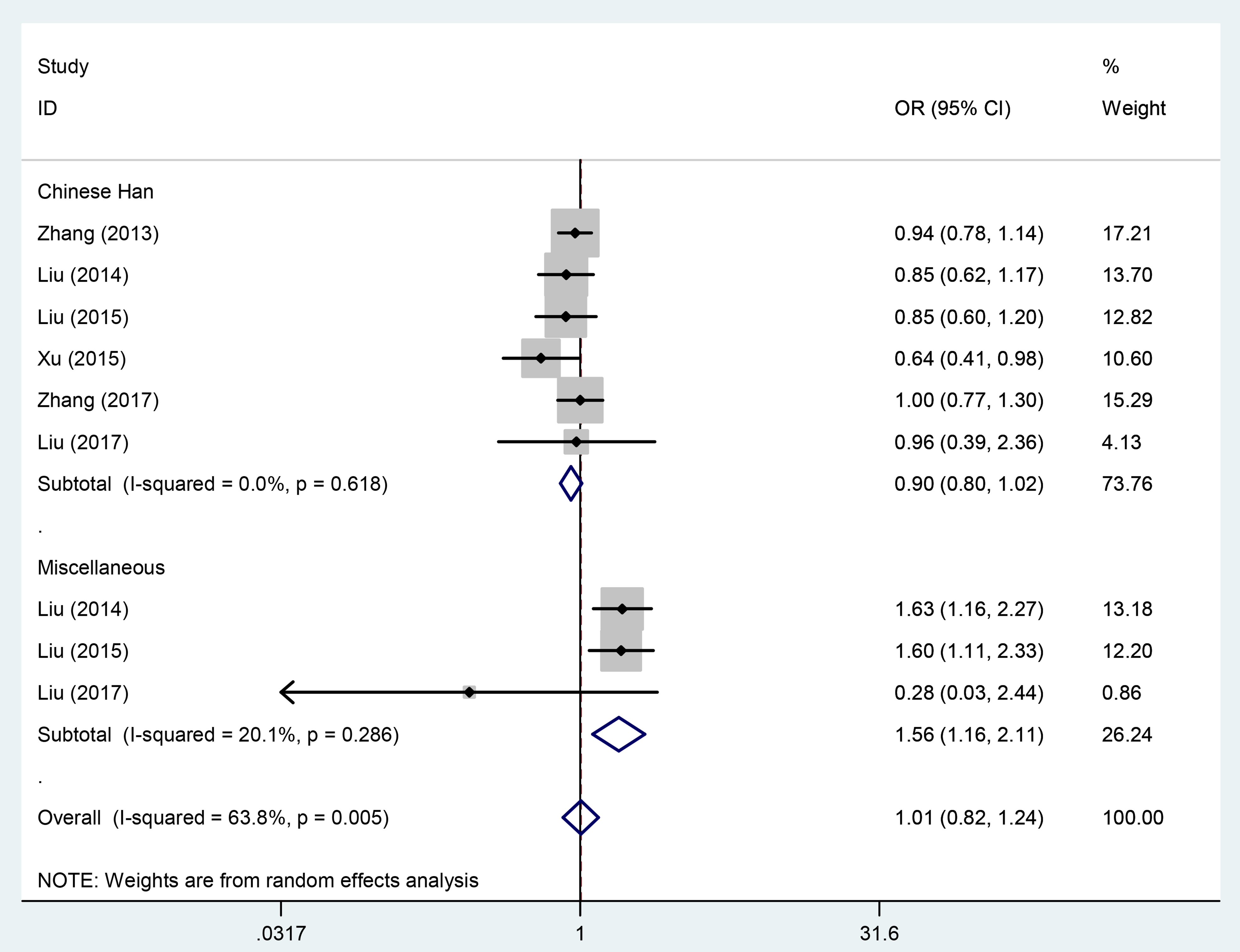
Forest plot for the association between ischemic stroke risk and rs556621 (CA versus CC) (random effects).
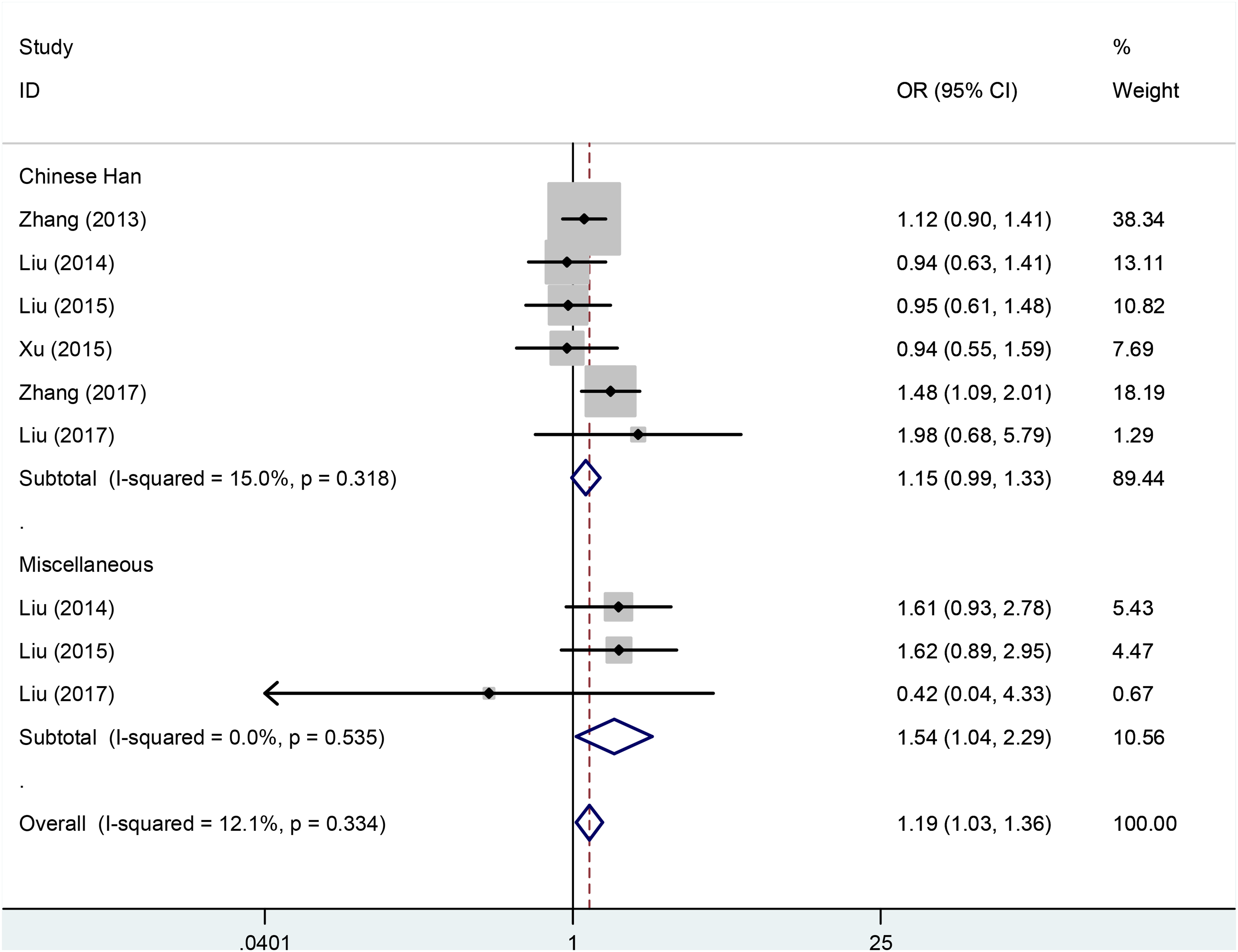
Forest plot for the association between ischemic stroke risk and rs556621 (AA versus CC) (fixed effects).
Under the dominant model, an increased IS risk was observed in the A allele carriers only in the miscellaneous group (OR 1.58, 95% CI 1.21-2.05, P = 0.001) (Table 2 and Figure 4). The heterogeneity was large across all studies (I2 = 61.40%, P = 0.008). A meta-regression analysis indicated that the ethnic background could account for 100.00% of the heterogeneity (P = 0.008).

Forest plot for the association between ischemic stroke risk and rs556621 under the dominant model (CA+AA versus CC) (random effects).
Under the additive model, the A allele showed an increased risk for IS in the miscellaneous group (OR 1.34, 95% CI 1.13-1.59, P = 0.001) and the overall population (OR 1.11, 95% CI 1.00-1.23, P = 0.043) but not in Chinese Han (Table 2 and Figure 5). The heterogeneity was moderate across all studies (I2 = 43.30%, P = 0.079). A meta-regression analysis indicated that 82.63% of the heterogeneity might be explained by the ethnic background (P = 0.053). When stratified by ethnicity, no obvious heterogeneity was found in the miscellaneous and Chinese Han groups (Table 2), also suggesting the ethnic background was the major source of the heterogeneity across all studies.
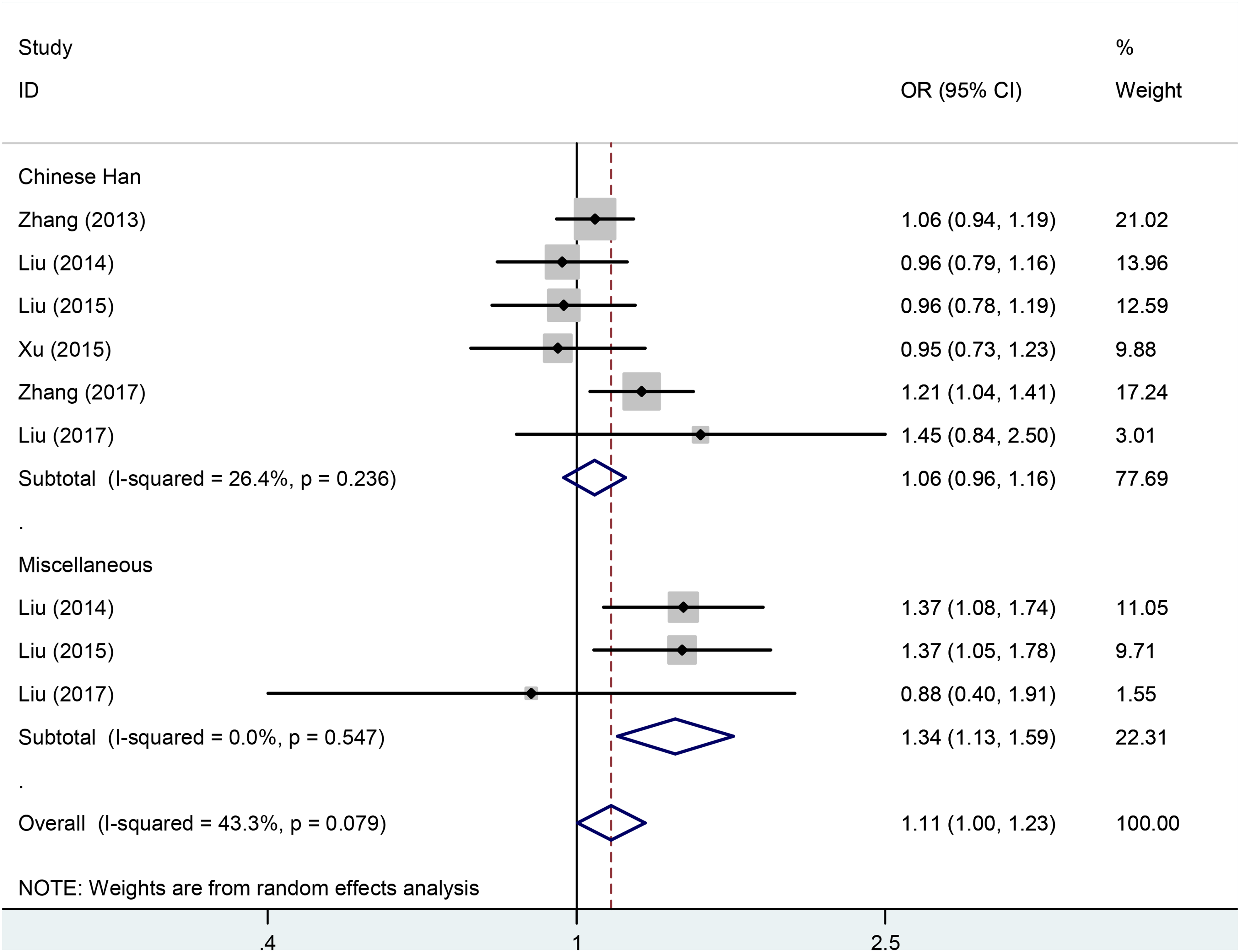
Forest plot for the association between ischemic stroke risk and rs556621 under the additive model (A versus C) (random effects).
Under the recessive model, significant associations were found in Chinese Han (OR 1.23, 95% CI 1.08-1.39, P = 0.001) and the overall population (OR 1.23, 95% CI 1.09-1.39, P = 0.001) but not in the miscellaneous group (Table 2 and Figure 6). No heterogeneity was observed across all studies (I2 = 0.00%, P = 0.763).

Forest plot for the association between ischemic stroke risk and rs556621 under the recessive model (AA versus CA+CC) (fixed effects).
Variant Rs556621 and the Risk of LAA
Among these ten studies, four studies focused on IS, of which only one had data on the LAA subtype, and the other six studies only focused on the LAA subtype. So a meta-analysis was also conducted on seven studies focusing on the LAA subtype (in five articles involving 2268 LAA patients and 2268 controls) (Supplementary Table S2).14,15,22,25,26 All findings remained similar (Supplementary Tables S3–S4).
Sensitivity Analyses
In the sensitivity analyses, in the miscellaneous group, the pooled ORs and 95% CIs were materially altered after removal of the study of Liu et al. 14 or Liu et al. 22 in the two comparisons (CA versus CC, and AA versus CC) and under the dominant and additive models (Supplementary Figures S1–S4); for the comparison between AA versus CC genotype, the positive association was lost after excluding the study from Zhang et al. 15 (OR 1.12, 95% CI 0.96-1.31, P = 0.146) in the overall population (Supplementary Figure S5); under the additive model, five studies made the positive correlation lost in the overall population when they were individually deleted (Supplementary Figure S6). Other pooled ORs and 95% CIs estimate were not materially influenced.
Publication Bias
Begg's and Egger's tests revealed no obvious publication bias in the two comparisons (CA versus CC, and AA versus CC) and under all three genetic models.
To summarize, in the overall population, significant associations of rs556621 with IS/LAA risk were observed in the comparison between AA versus CC genotype and under the additive and recessive models but only stable under the recessive model; in Chinese Han, a significant relation was found and stable under the recessive model; in the miscellaneous group, positive associations were detected in the two comparisons (CA versus CC, and AA versus CC) and under the dominant and additive models but all unstable. In the overall analyses, significant heterogeneities across all studies were observed in the comparison between CA versus CC genotype and under the dominant and additive models, and most of them might be explained by the ethnic background. To be noted, the recessive model had little heterogeneity and higher stability (Supplementary Figures S7–S9) and then fitted the observed data well.
Discussion
The current meta-analysis revealed that rs556621 was associated with the development of IS/LAA in Chinese populations. It is the first meta-analysis to evaluate the association between rs556621 and the risk of IS/LAA in Chinese populations.
In the overall population, significant correlations between rs556621 and IS/LAA risk were detected in the comparison between AA versus CC genotype and under the additive and recessive models. The heterogeneities across all studies were found in the comparison between CA versus CC genotype and under the dominant and additive models, and most of them might be explained by the ethnic background. Sensitivity analyses via deletion of each individual study reflected that the comparison between AA versus CC genotype and the additive model were not stable. For the recessive model, almost no heterogeneity was detected, and the results of sensitivity analysis were not materially changed, and no different conclusions were drawn, suggesting that the results were reliable. In addition, no publication bias was detected.
There were four ethnic groups: Chinese Han, Uygur, Kazak and Mongolian, in the present meta-analysis. The Chinese Han people are the largest ethnic group among the 56 ethnic groups in China, making up about 91.6% of the total population. The Chinese Uyghur, Kazakh and Mongolian people are the ethnic minority groups, accounting for about 0.8%, 0.1% and 0.4% of the total population, respectively.
Further subgroup analysis by ethnicity discovered a significant relationship between rs556621 and IS/LAA risk under the recessive models in Chinese Han. Likewise, the recessive model in Chinese Han had little heterogeneity, and the result withstood the sensitivity analysis, so it fitted the observed data well.
In the miscellaneous group, positive associations were detected in two comparisons (CA versus CC, and AA versus CC), as well as under the dominant and additive models but all unstable. This group involved only four studies, one of which was included only under the additive model, and the pooled sample size was moderate (761 cases and 784 controls). Furthermore, this group consisted of three ethnic populations, and they were Chinese Uygur, Kazakh, and Mongolian. All three ethnic populations are admixture populations with different proportions of genetic components of Mongoloids and Caucasians.27–29 Different genetic background may lead to different disease susceptibility. Therefore, it may not be appropriate to mix them for analysis. More refined stratified analysis by ethnicity is necessary to be performed but could not for retrieved studies were limited. More studies with larger sample sizes regarding the relationship are essential to be conducted in Chinese Uygur, Kazakh and Mongolian populations.
That is to say, one of the limitations of the current meta-analysis is the limited number of cases and controls. In the current meta-analysis, only ten studies with 3644 IS cases and 3692 controls were included for the analysis of IS, and seven studies with 2268 LAA cases and 2268 controls were included for the analysis of LAA. Most of the studies were in Chinese Han. 79.1% of cases and 78.8% of controls are Chinese Han. Such a sample size may not have very strong statistical power to confirm the relations. Therefore, more studies in larger samples are still required to further verify ethnic differences in the impact of rs556621 on IS risk, especially in Chinese Uygur, Kazakh and Mongolian populations.
In most of the studies involved, the disease subtypes are limited. We only made meta-analysis for the LAA subtype because of few studies on other subtypes. Whether rs556621 was related to other IS subtypes needs further investigation. A variety of genetic and environmental factors affect IS. Gene-gene and gene-environment interactions may have important effects on the functions of the variants. Still, most available studies did not contain the information about environmental exposure and multiple variants in haplotypes, which limit more detailed subgroup analysis. We only included studies published in Chinese or English, which is one of the reasons for the lack of studies of other Asians such as Koreans and Japanese. So this current meta-analysis was not a good manifestation of Asians.
Conclusion
This study showed that variant rs556621 was related to IS and the LAA subtype in Chinese populations. It provides pooled data for better understanding the association between rs556621 and IS/LAA risk in Chinese populations, although the sample size is not large enough. Larger sample-size and multi-ethnic studies with homogeneous IS cases and well-matched controls are needed in the future.
Supplemental Material
sj-doc-1-cath-10.1177_10760296221076479 - Supplemental material for Variant Rs556621 on Chromosome 6p21.1 and the Risk of Ischemic Stroke in Chinese Populations: A Meta-Analysis
Supplemental material, sj-doc-1-cath-10.1177_10760296221076479 for Variant Rs556621 on Chromosome 6p21.1 and the Risk of Ischemic Stroke in Chinese Populations: A Meta-Analysis by Langxin Chen, Guiying Zhang, Qifu Li and Rong Lin in Clinical and Applied Thrombosis/Hemostasis
Footnotes
Author Contributions
Langxin Cheng and Guiying Zhang searched the literatures, collected the data, evaluated the study qualities and analyzed data. Qifu Li carefully reviewed and revised the manuscript. Rong Lin designed the study, analyzed data, performed statistical analysis, wrote and revised the manuscript. All authors (Langxin Cheng, Guiying Zhang, Qifu Li, Rong Lin) edited the manuscript and approved the final manuscript.
Declaration of Conflicting Interests
The author(s) declared no potential conflicts of interest with respect to the research, authorship, and/or publication of this article.
Funding
The National Natural Science Foundation of China, Grant/Award Number: 31660309; the Special Project of Science and Technology of Social Development of Hainan Province, Grant/Award Number: 2015SF13.

Supplemental Material
Supplemental material for this article is available online.
References
Supplementary Material
Please find the following supplemental material available below.
For Open Access articles published under a Creative Commons License, all supplemental material carries the same license as the article it is associated with.
For non-Open Access articles published, all supplemental material carries a non-exclusive license, and permission requests for re-use of supplemental material or any part of supplemental material shall be sent directly to the copyright owner as specified in the copyright notice associated with the article.
