




Abstract
Various parameters in 91 adult participants with vascular malformations and 91 controls were studied. The mean of the participants' platelet volumes was 8.5 fL and that of their controls was 9.1 (P < .001). The mean of the participants' platelet mass was 2145 µL/L of blood and that of their controls was 2351 (P = .006). The other parameters studied were not significantly different than the controls. It is suggested that the lower platelet volume might be related to a compensatory mechanism to keep the total body platelet mass stable despite the increased vasculature.
Introduction
This retrospective review studied various parameters, including mean platelet volume (MPV) and platelet mass, recorded over a 3-year period in the electronic medical records of 91 adult participants (at least 20 years of age) with vascular malformations seen in a tertiary care vascular anomalies clinic which serves a health plan population of approximately 3 million members. The vascular malformations included venous malformations, arteriovenous malformations, Klippel-Trenaunay syndrome, lymphatic malformations, mixed vascular malformations, and vascular malformations where the specific type could not be determined from the medical record. They did not include simple port wine stains (whether flat, cobblestoned, or nodular), Sturge-Weber syndrome, hereditary hemorrhagic telangiectasia, or hemangiomas. The original intent of the study was to find parameters commonly tested that might be markers of thrombosis in vascular malformation participants. Venous malformations have been associated with thrombosis, 1 and thrombosis has been associated with the metabolic syndrome. 2
Methods
Study Participants
We retrospectively studied 91 participants with vascular malformations seen in the Kaiser Permanente Southern California Vascular Anomalies Clinic from March 2007 through February 2010. The study was approved by our institutional review board. The parameters studied were MPV, platelet count, platelet mass, low-density lipoprotein, total cholesterol, high-density lipoprotein, triglyceride, body mass index, systolic blood pressure, and diastolic blood pressure. The controls were randomly selected sex- and age-matched patients seen in the Kaiser Permanente Los Angeles Dermatology Clinic during the year 2009. For each parameter (other than platelet mass) in each participant and control, the mean of the most recent 3 entries in the medical record was recorded. The mean of 2 entries was recorded where only 2 were present. Where there was only 1 entry, it was recorded. The platelet mass for each participant and control was determined by multiplying MPV × platelet count and expressing the result as microliters per liter.
Statistical Analysis
Distributions of each of the parameters: MPV, platelet count, platelet mass, low-density lipoprotein, total cholesterol, high-density lipoprotein, triglyceride, body mass index, systolic blood pressure, and diastolic blood pressure were examined. Comparison between participant and control groups was carried out using the paired t test. A test that resulted in a P value <.05 indicated that the means of the parameters were statistically and significantly different between the 2 groups. Results were based on complete case analysis. All analyses were conducted using SAS 9.2 (SAS Institute, Inc, Cary, North Carolina).
Results
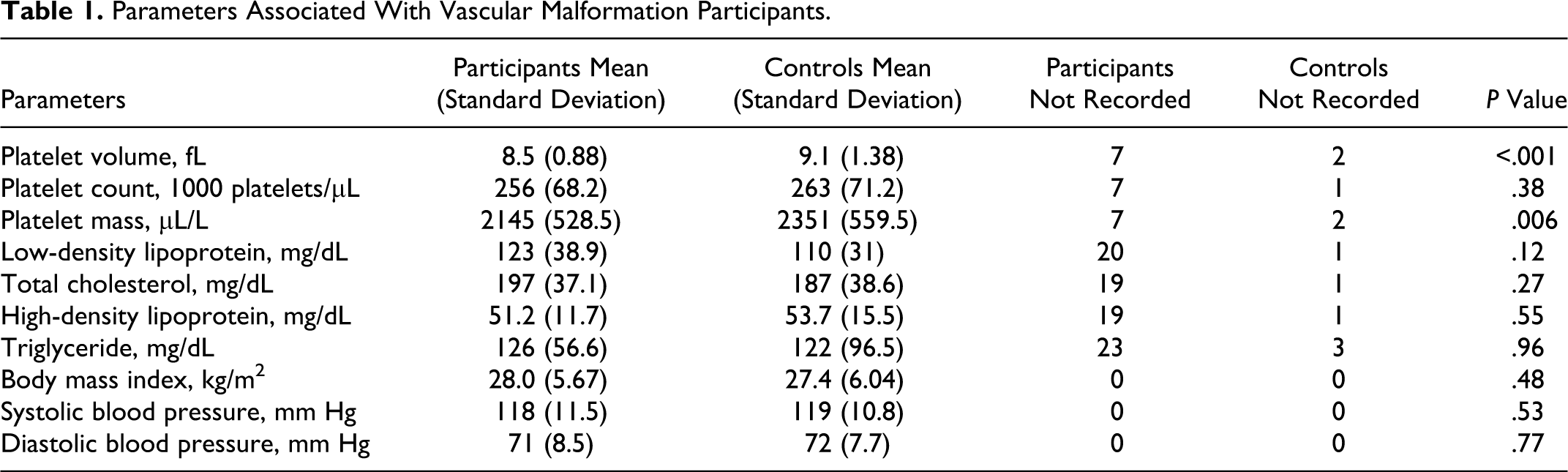
The study included 91 participants with vascular malformations and 91 age- and sex-matched controls. Of the 91 vascular malformation participants, 44 were diagnosed as venous malformation, 19 as arteriovenous malformation, 6 as Klippel-Trenaunay syndrome, and 7 as lymphatic malformations. Fifteen were mixed or the specific diagnosis could not be determined from the medical record. The mean age of the participants was 40.5 years. Fifty-eight participants were female and 33 were male. The controls had the same age and sex distribution as the participants. The mean of the participants' MPVs was 8.5 fL with a standard deviation (SD) of 0.88, median 8.4, and range 6.7 to 11.5 which was significantly lower than that of the controls which was 9.1 fL with SD 1.38, median 8.8, and range 7.1 to 12.3 (P < .001). The mean of the participants' platelet mass was 2145 µL/L of blood with SD 528.5, median 2128, and range 639 to 4190 which was also significantly lower than that of the controls which was 2351 with SD 559.5, median 2289, range 950 to 4082 (P = .006). The mean of the participants' platelet counts was lower than that of the controls but not significantly (P = .383). The means of the low-density lipoprotein, total cholesterol, and body mass index were higher and the high-density lipoprotein and systolic blood pressure were lower in the participants than that of the controls but not significantly (Table 1).
Parameters Associated With Vascular Malformation Participants.
Discussion
This study began as a search for changes in various parameters associated with vascular malformations that might be associated with metabolism or thrombosis. Thrombosis has been associated specifically with venous malformations. 1 In this study, 44 of the 91 participants were definitely diagnosed as venous malformations. The higher low-density lipoprotein, total cholesterol, and body mass index as well as the lower high-density lipoprotein found in the participants compared to controls were not numerically significant. The lack of significance might have been due to a true lack of difference or to the heterogeneity of the types of vascular malformation and the numbers of participants being too small. However, serendipitously the MPV and to a lesser extent the platelet mass were found to be significantly lower in the participants with vascular malformations than their controls. There was no significant difference in platelet count although the mean of the platelet counts in the participants was slightly lower than in the controls. If the MPV finding in vascular malformations were related to metabolism or a tendency to thrombosis, one would expect the MPV to be higher, not lower. 3 In looking for a different explanation for our finding, we considered various possibilities. A compensatory mechanism seemed the most plausible to us. Normally, there is an inverse relation between the platelet count and the MPV (thus keeping the platelet mass the same) if there is no other factor influencing the MPV. 4 The platelet mass calculated as a function of platelet count and MPV 5 does not take into account the total vasculature of the body in relation to the body's size. If the vasculature were greater in relation to the size of the body because of the vascular malformation without any compensatory mechanism, one would expect the total body platelet mass to be increased in relation to the size of the body. The decreased MPV found in this study might be related to the body's mechanism for keeping the total body platelet mass stable. 6 Although the vascular malformations studied were heterogeneous in their types, they all shared the property of increased vasculature which is consistent with the proposal that the relatively smaller platelet size might be related to a compensatory mechanism. We considered a genomic linkage, but a literature search could not demonstrate a genomic linkage between vascular malformations and MPV. Where an association could be found between MPV and a specific genetic marker, no association could be found between any type of vascular malformation and that genetic marker.7,8
Conclusion
In conclusion, the MPV was significantly lower in participants with vascular malformations than their age- and sex-matched controls. We postulate that this relationship might be related to a compensatory mechanism to keep the total body platelet mass stable in the face of an increased vasculature caused by the vascular malformation in relation to the body size.
Footnotes
Declaration of Conflicting Interests
The author(s) declared no potential conflicts of interest with respect to the research, authorship, and/or publication of this article.
Funding
The author(s) received no financial support for the research, authorship, and/or publication of this article.