



Abstract
A Study of the Translation of the Self-Monitoring and Regulation Training Strategy (SMARTS) Intervention for Self-Regulation From an Elementary to Middle School Setting
Schools serve as a critical setting for identifying, preventing, and addressing the social, emotional, and behavioral challenges that emerge in childhood and teenage years. A growing body of educational and psychological research has shaped our understanding of youth mental health and promoted the development of evidence-based programs and practices (EBPs; Centers for Disease Control and Prevention, 2024; García-Carrión et al., 2019; National Association of School Psychologists, NASP, 2020). EBPs offer significant advantages, including improved treatment outcomes, standardized care, and increased accountability across clinical and educational settings (Chorpita & Daleiden, 2009; Fixsen et al., 2005). The vehicle for increasing dissemination of EBPs has been through the advent of treatment manuals. The development of treatment manuals for EBPs has facilitated improved access, training, fidelity, and replicability, allowing practitioners to deliver interventions with greater consistency (Weisz et al., 2013).
Regardless of these advantages, scrutiny persists regarding the rigid application of treatment manuals. Critics argue that strict adherence to manualized content can constrain professional autonomy, limit responsiveness to culturally and developmentally diverse students, and diminish opportunities for innovation (Bernal & Sáez-Santiago, 2006; Greenhalgh et al., 2014). Additionally, EBPs are often developed in controlled settings and may not account for the practical realities of schools, such as competing demands on personnel, variability in implementation support, and misalignment with existing routines (Lawson et al., 2022; Long et al., 2016). Addressing these barriers requires flexible yet systematic adaptation strategies that preserve the core mechanisms of the intervention while ensuring developmental and contextual relevance. When surface features of an intervention are modified—such as examples, delivery format, or language, the essential components must remain intact to maintain program integrity and effectiveness (Stirman et al., 2019).
To support long-term sustainability, interventions must be individualized to the specific needs of employees and students while remaining feasible within the constraints of school environments (Baweja et al., 2016; Hughes, 2003; Powell et al., 2017). This article presents a case study describing the upward developmental translation of an elementary self-regulation intervention, SMARTS, for middle school students. The adaptation process followed a stepwise approach rooted in empirical guidelines for intervention translation and was grounded in participatory research and co-production (CP) methodologies. The following sections describe the rationale, method, and outcomes of this adaptation process.
Manualized Interventions in Schools
Manualized interventions have become a cornerstone of research-supported practice in schools, offering structured, replicable programs that support treatment fidelity and outcome evaluation (Kazdin, 2001). These manuals are especially valuable for large-scale dissemination efforts, ensuring that intervention procedures can be implemented consistently across settings and by various providers. Proponents highlight the benefits of manuals in maintaining program integrity, supporting practitioner training, and facilitating rigorous research design, including randomized controlled trials (RCTs; Addis et al., 1999; Nezu & Nezu, 2008; Rounsaville et al., 2001).
Nevertheless, the debate surrounding manualized treatments continues. Opponents caution that manuals may be too rigid to account for the nuanced and diverse needs of real-world participants. Opponents argue that over-reliance on structured content can diminish the role of practitioner judgment and reduce opportunities to adapt interventions in response to individual or cultural differences (Addis et al., 1999; Carroll & Nuro, 2002). Others point out that some manuals prioritize technical components at the expense of therapeutic alliance or contextual fit (Wilson, 1998). Despite these critiques, manualized interventions remain the most widely accepted vehicle for delivering empirically supported treatments, particularly in school settings where standardized approaches are often needed for feasibility, funding, and scalability (Mann, 2009; Shapiro et al., 2009).
Manual development plays a crucial role in the design and evaluation of treatment protocols for research purposes. A well-constructed manual enables operationalization of treatment components, allows for fidelity monitoring, and facilitates consistent delivery across providers and contexts (Lichstein et al., 1994; Moncher & Prinz, 1991). Experts recommend that manuals include clearly defined intervention principles, session objectives, structured facilitator guidelines, case illustrations, and training recommendations (Bellg et al., 2004; Carroll & Nuro, 2002; Chambless & Ollendick, 2001). These features ensure the replicability of findings and support scalability efforts. In educational environments, where interventions must be compatible with academic goals and institutional routines, manuals serve as a critical bridge between research and practice.
Adapting School-Based Interventions
To extend the reach and relevance of research-supported interventions, researchers and practitioners often face the challenge of adapting existing programs for new populations, developmental levels, or delivery contexts. Guidelines for manual development offer a foundational framework for this work. One widely recognized model is the three-stage approach to treatment manual development (Carroll & Nuro, 2002), which outlines a progressive process of manual creation, refinement, and evaluation. In Stage I, developers conduct initial pilot work, draft the manual, and assess feasibility. Stage II involves refining the manual for use in RCTs and identifying mechanisms of change. Stage III includes broad dissemination, multiple efficacy trials, and the development of training protocols for implementation in naturalistic settings. At this final stage, manuals should address transportability and applicability across diverse populations and diagnostic groups.
Applying a similarly rigorous process is essential when modifying existing manualized interventions for a new developmental group or context. Adaptation efforts must strike a balance between tailoring content to fit the new audience and maintaining the theoretical foundations and active ingredients responsible for intervention effects. While surface modifications—such as changes in language, examples, or delivery format—are often necessary to increase relevance and engagement, the intervention's core principles and mechanisms of change must remain intact (Stirman et al., 2017; Wiltsey Stirman et al., 2022). Ensuring this balance requires both theoretical and methodological precision.
Adapting an intervention for a new population often necessitates additional research and pilot testing to maintain the intervention's empirical integrity and enhance its contextual fit. Responsiveness to the needs of students, educators, and schools requires developers to account for local constraints, cultural context, developmental readiness, and practitioner preferences. For instance, modifications might include updating activities to reflect age-appropriate themes, restructuring incentives to align with motivational factors, or incorporating digital tools that facilitate implementation in modern classrooms. However, these changes must not compromise the program's structure, fidelity, or underlying logic model. Grounding adaptation efforts in established theory and implementation science helps safeguard these elements (Carroll & Nuro, 2002; Rounsaville et al., 2001).
Although robust guidance exists for developing original school-based interventions, there is a relative paucity of structured frameworks for adapting interventions across developmental stages. The present paper seeks to address this gap by documenting the upward developmental adaptation of a school-based intervention—SMARTS—originally designed for elementary school students. This four-year project aimed to refine the intervention materials, content, and delivery procedures to meet the cognitive, social, and contextual needs of middle school students and personnel. The translational process drew on best practices in intervention adaptation and was informed by a stepwise model of developmental translation adapted from Goldstein et al. (2012).
The Current Study
This study used a multi-method approach to highlight the SMARTS middle school intervention developed using participatory action research (PAR) and CP methods and describe the stepwise approach used to translate the manualized self-monitoring SMARTS intervention. This is achieved in the remaining sections by examining the translational process utilized for this project. Future manuscripts will showcase later stages of the study; explain the impact of SMARTS on proximal outcomes of student autonomy, peer and teacher relations, and social competencies to promote distal behavior, academic engagement, and performance outcomes.
Similar to the original SMARTS intervention (Thompson, 2012), this project employed a PAR framework and incorporated principles of CP to guide the developmental adaptation of the SMARTS intervention (Holmes et al., 2021). These methodological approaches were selected to ensure key stakeholders’ (i.e., school personnel, students, and implementation experts) perspectives were meaningfully integrated throughout all phases of intervention development, pilot testing, and refinement (McIsaac et al., 2018; Nastasi et al., 2000). This inclusive approach promotes ownership, enhances contextual fit, and supports implementation by aligning intervention components with the practical realities of school settings (Hawkins et al., 2017; Palinkas et al., 2018). PAR and CP are well-aligned with school-based intervention design, offering collaborative, iterative processes prioritizing contextual relevance, stakeholder engagement, and long-term sustainability (Hughes, 2003; Mertler, 2019).
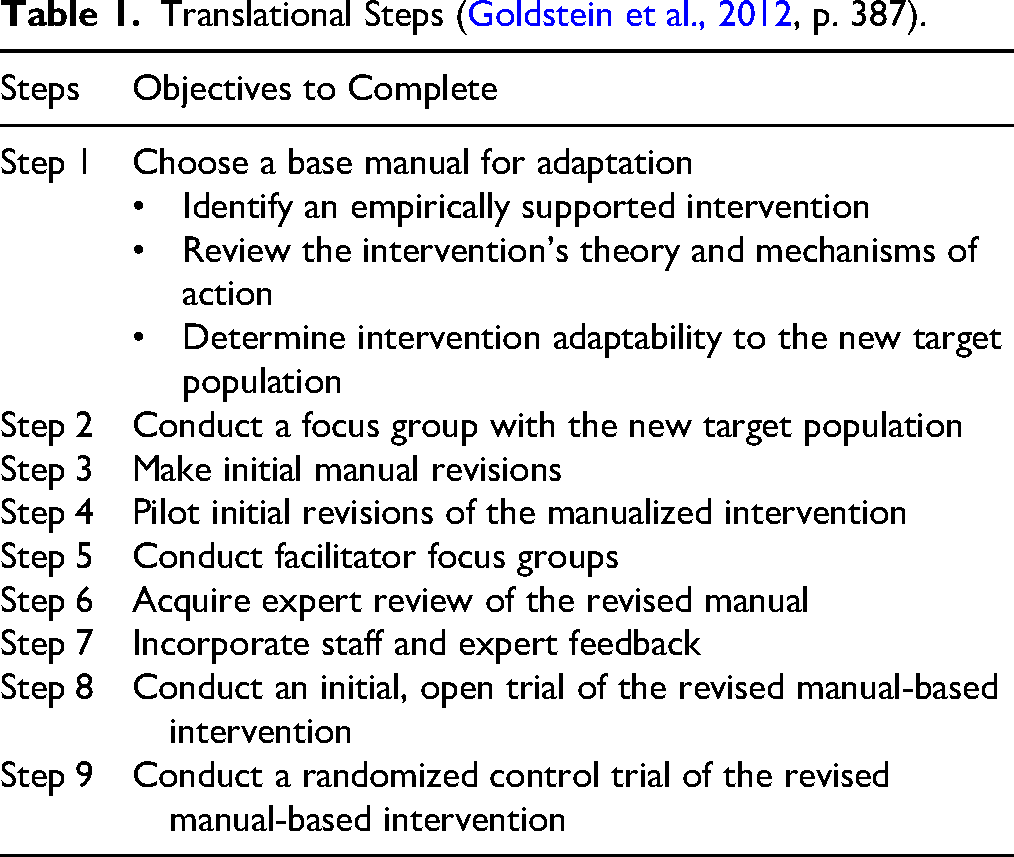
Our research team includes social work researchers, educators, and practitioners with extensive experience with research methods and participant engagement. We received university-sponsored Institutional Review Board approval to conduct this study and obtained informed consent from all participants. The current study was completed over four years (see Table 1) and was supported in part by the Institute of Education Sciences of the US Department of Education through Grant R305A200111 to the University of Missouri (Principal Investigator: Aaron M. Thompson).
Translational Steps (Goldstein et al., 2012, p. 387).
The Translation Process
PAR and CP methodologies were embedded throughout the four-year adaptation and testing process to inform the development and refinement of the revised SMARTS curriculum, web-based goal monitoring application, and implementation procedures. Additionally, we applied a structured, stepwise adaptation model based on Goldstein et al. (2012) to guide the translation of SMARTS from elementary to middle school settings. Each step was designed to preserve the core components of the intervention while ensuring developmental appropriateness and contextual fit. The full sequence of adaptation activities is outlined in Table 2, which presents the translational steps adopted from Goldstein et al. (2012, p. 387).
Chronological Overview: STARS to SMARTS.


Note. STARS = self-management training and regulation strategy; SMARTS = self-monitoring and regulation training strategy.
In Year 1, PAR methods were used to gather input from students, teachers, and student support professionals (e.g., social workers, psychologists, and counselors) regarding necessary adaptations to the SMARTS elementary materials. Participants reviewed existing lessons, online tools, and self-monitoring procedures and contributed feedback via structured focus groups. These data informed the initial surface-level adaptations to align the intervention with the developmental and environmental characteristics of middle school.
In Year 2, project staff conducted an alpha test of the revised materials. This phase involved 10 national experts and middle school students, teachers, and counselors. Participants reviewed and tested updated SMARTS lessons, curriculum materials, and the initial version of the web-based application. Feedback from these sessions was used to make targeted revisions prior to broader field testing.
In Year 3, the team conducted a beta test of the revised intervention with middle school stakeholders (students [n = 9], teachers [n = 13], and support personnel [n = 12]). Additionally, graduate student facilitators from a local university were utilized from the fields of social work and school psychology (n = 8). Using a multiple baseline design, participants engaged in the SMARTS intervention and then participated in focus groups to evaluate feasibility, usability, and implementation barriers. Data collected during this phase included feedback on curriculum content, fidelity measures, and user experience with the SMARTS website and app. These findings informed additional modifications prior to a trial of the intervention effects. In Year 4, this project received a two-year no-cost extension and will culminate with a quasi-experimental, staggered multiple baseline trial across numerous middle schools to evaluate the effects of the adapted SMARTS curriculum under real-world conditions in diverse school settings.
Participants
The current study was conducted in collaboration with nine school districts located in suburban and rural communities throughout Missouri. A convenience sampling method was employed, with participants selected because they supported the elementary version of the intervention, and their districts also supported the adaptation work needed for the project. Participants were selected from multiple schools and districts, serving a range of adequately and under-resourced communities; seemingly representative of other districts and students served. All participants provided active consent and/or assent where appropriate. Study oversight was provided by both the university and the school district's institutional review boards, wherein the study originated.
Demographically, the largest community had a 2020 population of 183,610 residents and was composed of individuals identifying as European American (75%), African American (9.7%), Asian American (4.23%), Hispanic/Latinx (4.4%), Native American (0.3%), and Multiracial (6.3%). These distributions reflect the student population from which participants were recruited. Across the first three years of the study, a total of 102 individuals participated in the developmental and formative phases of the intervention adaptation process (see Table 3 for participant demographics information). Participants were involved in various stages of focus groups, alpha and beta testing, curriculum review, and feedback sessions. These diverse contributors provided essential insights that informed the developmental translation of the SMARTS intervention.
Participant Demographics (Years 1–3).
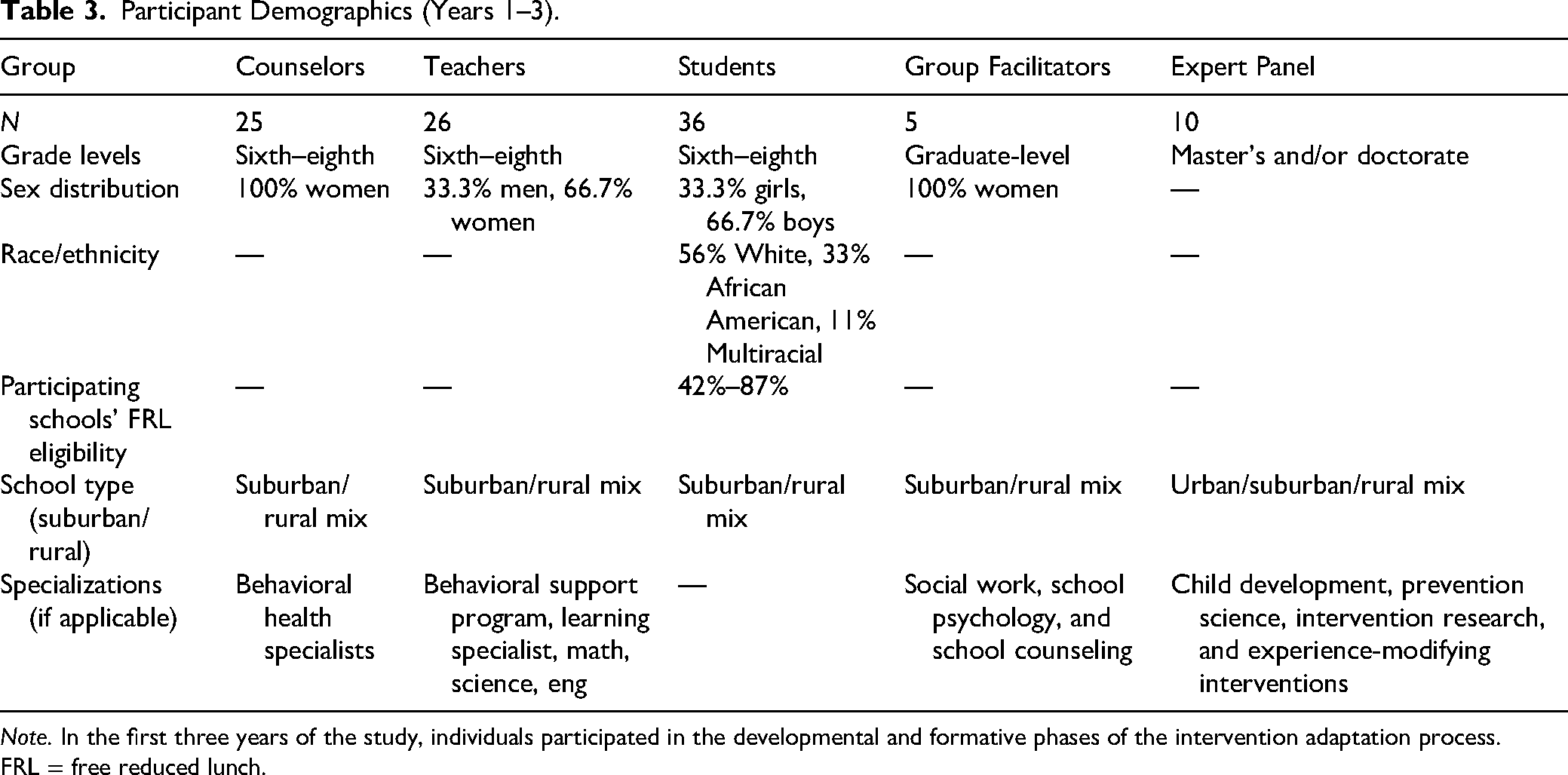
Note. In the first three years of the study, individuals participated in the developmental and formative phases of the intervention adaptation process.
FRL = free reduced lunch.
The Process Results
The following section presents the nine-step developmental translation process used to adapt the SMARTS intervention from its original elementary school format to a version appropriate for middle school students and settings. This structure follows the stepwise framework proposed by Goldstein et al. (2012), with each step accompanied by corresponding results from the current project.
Emotion dysregulation, characterized by an inability to manage emotional responses, leading to intense outbursts, low frustration tolerance, and high-risk behaviors, affects up to 20% of children and adolescents (Baroud et al., 2024). Teaching emotional regulation to students through manualized interventions, such as SMARTS, provides notable benefits (i.e., improved mental health, boosted cognitive function, enhanced academic performance, better social competence, and decreased risky behaviors) while promoting resiliency and positive adaptation to adolescent stressors such as peer pressure and academic demands (Baroud et al., 2024).
The original SMARTS curriculum is grounded in the SAFE instructional framework (Durlak & Weissberg, 2011), which emphasizes Sequenced skill-building, Active engagement, Focused instruction, and Explicit skill development. Lessons are organized around progressively complex self-regulation strategies and incorporate individual goal setting, active student participation, and frequent performance feedback. Delivered in three phases—training, self-monitoring, and processing—the program helps students develop key competencies including emotional regulation, decision-making, and goal pursuit.
Central to SMARTS is the integration of self-monitoring procedures, in which students track progress toward self-defined behavioral goals and engage in structured reflection with support personnel. Goals are recorded in measurable language, approved collaboratively by students and teachers, and iteratively revised based on progress data and teacher feedback. The process culminates in goal contracts signed by the student, teacher, and support staff, reinforcing accountability and motivation.
Previous research and published reports show the SMARTS intervention reduced challenging behaviors within elementary schools and improved students’ social competencies and teacher relationships (Thompson, 2014). An RCT with fourth and fifth grade students at-risk for emotional behavioral disturbance (n = 108) showed SMARTS students (n = 60) displayed improvements in teacher-rated disruptive behaviors (ES = 0.46), authority acceptance (ES = 0.47), social competence (ES = 0.55), and quality of student relations (ES = 0.39; Thompson, 2014), with social competence fully mediated the behavior changes (Thompson et al., 2020). The RCT showed students randomized to SMARTS (n = 168), compared to control students (n = 166), displayed significant improvements in student-rated efficacy, teacher-rated relations (ES = .26–.28), and favorable readiness response from teacher feedback (Thompson et al., 2020). Additionally, a multiple baseline, single-subject design observed improvements in teacher-rated daily performance over an 18-week intervention phase with 10 students meeting criteria for emotional disturbance compared to baseline (Thompson & Webber, 2010).
Theoretical grounding for SMARTS leans heavily on the self-determination theory (SDT; Ryan & Deci, 2000), which emphasizes the importance of autonomy, competence, and relatedness for intrinsic motivation. The intervention explicitly cultivates autonomy through student-driven goal setting, builds competence through structured practice and feedback, and supports relatedness through regular interactions with supportive adults. These features are developmentally appropriate for elementary students and serve as a foundation for adaptation to older youth (see Figure 1: Theory of change).

Theory of change impacting SEL, behavioral, and academic performance.

Initial revisions to the self-monitoring and regulation training strategy (SMARTS) intervention.
Participants reviewed the full elementary curriculum, including the pre-group instructions and nine core lessons, and provided structured feedback on its language, structure, tone, examples, and delivery format. Throughout study phases, data were coded and analyzed by a qualitative team expert using content analysis methods (Hsieh & Shannon, 2005). Several key themes emerged across focus groups, which directly informed the adaptation process. Participants emphasized several developmental distinctions between elementary and middle school settings:
Cognitive Maturity: Middle school students were perceived to require more sophisticated language and logic, as well as opportunities for autonomy and critical thinking. Structural Complexity: Unlike elementary students, middle schoolers rotate among classes and teachers throughout the day, reducing the influence of any single adult. Social Dynamics: Peer relationships and social identity take on greater significance, requiring interventions that are sensitive to social standing and group norms. Motivational Shifts: Students in this age group respond differently to reinforcement systems, preferring individualized or tech-integrated incentives over classroom-based tools such as marble jars.
These findings underscored the need to adjust not only content and examples but also the underlying delivery systems, teacher roles, and reinforcement mechanisms to better match middle school developmental, social, and structural demands.
evaluating the developmental appropriateness of the revised lessons; identifying any remaining barriers to implementation; gathering user reactions to the app interface and functionality; and refining strategies to support real-time goal tracking across different school schedules and classroom structures.
Feedback from these sessions was instrumental in identifying small but meaningful improvements. Students reported that the app was engaging and easy to use but suggested enhancements such as clearer data visualization (e.g., more vibrant charts and confetti animations), more nuanced teacher feedback options, and greater flexibility in goal-setting prompts. They emphasized the importance of seeing positive encouragement from teachers, especially during low-performance periods, and suggested including automated motivational messages (e.g., “Tomorrow is a new day—keep going!”).
Teachers and support staff appreciated the digital platform's potential to streamline data collection and enhance student accountability. However, they requested updates to the dashboard interface, additional visuals to represent student growth, and improved absence tracking features. Counselors highlighted the usefulness of the tool for facilitating data-driven conversations and advocated for expanded encouragement of options through the digital badge system. Overall, pilot feedback indicated that the curriculum and digital tools were well-received but required further refinement to meet users’ expectations and implementation realities.
structural clarity and coherence, usability in busy school environments, materials’ appeal to both students and implementers, and alignment with existing school routines and educator responsibilities.
These sessions provided nuanced insights into the realities of school-based implementation. Facilitators validated many of the changes made during the initial adaptation and pilot phase, but emphasized the need for:
streamlined lesson plans that minimize prep time, clear guidance on using the web platform with minimal technical training, troubleshooting materials for technical difficulties, and scripts and modeling videos help new implementers feel confident in delivering content.
The facilitator feedback was used to refine implementation procedures and revise training materials. Importantly, it highlighted the tension between intervention fidelity and implementer autonomy—reinforcing the need for materials that are both structured and adaptable.
developmental alignment with early adolescents, conceptual fidelity to the original SMARTS model, operationalization of core constructs (e.g., self-monitoring and goal revision), potential barriers to implementation at scale, and opportunities for increased cultural responsiveness and contextual sensitivity.
Feedback from the panel was overwhelmingly positive, with several reviewers commenting on the curriculum's developmental sensitivity and strong theoretical grounding. However, the panel also provided actionable recommendations:
clarify goal-setting language to better scaffold student understanding, incorporate more culturally responsive examples and activities, and address recent shifts in media representation, particularly around celebrity stories and historical content, to ensure cultural empathy and relevance.
These suggestions led to additional updates in both content and delivery formats. For example, some initial stories used to illustrate personal growth and goal setting were replaced to avoid unintended messaging. Similarly, curriculum content referencing historical topics (e.g., Lewis and Clark) was revised in response to broader conversations around inclusive education.
lessons were streamlined to reduce preparation time, additional scaffolding and clarification were added to goal-setting activities, printable materials were reorganized and simplified, the web-based platform was updated to include more intuitive dashboards and support features, and culturally sensitive content revisions were implemented, including replacing or reframing examples that may have unintentionally excluded or alienated some students.
Special care was taken to ensure that these updates preserved the core components of the SMARTS intervention, while increasing its acceptability, feasibility, and equity of access for diverse stakeholders.
recruitment and retention capacity, unanticipated logistical barriers, implementation consistency across sites, and the practicality of proposed evaluation protocols (Grady & Hulley, 2007).
In this case, the pilot included two middle schools in central Missouri. Participants consisted of middle school students (n = 15), teachers (n = 5), school counselors (n = 5), and graduate-level social work and school psychology students (n = 4). School counselors led student recruitment and conducted processing meetings. The four graduate students served as SMARTS facilitators across the three groups, ranging from two to three students each. All school counselors and graduate students were identified as female. Students were sixth and seventh graders, with most identified as male (71.43%) and Black (57.1%). Data were collected through observations, interviews, fidelity checklists, and user feedback on both the curriculum and app. Mixed-methods data revealed generally strong acceptability but highlighted a need for additional training supports for staff and small refinements in lesson pacing and app navigation. Although underpowered for a formal statistical analysis, the pilot yielded promising indicators of feasibility and allowed iterative improvements before proceeding to large-scale evaluation.
Discussion and Application to Practice
Several limitations should be acknowledged. First, while the multi-phase design allowed for iterative testing, the beta test sample size was small and likely underpowered to detect statistically significant group differences. As such, the generalizability of early outcome data is limited. The primary goal of this phase, however, was to assess feasibility, acceptability, and usability—all of which were supported by participant feedback.
Second, implementation challenges emerged throughout the study. School personnel frequently cited limited time, staff capacity, and competing responsibilities as barriers to full engagement with the intervention. These challenges are well-documented in school-based implementation science (Powell et al., 2017) and highlight the importance of designing interventions that are efficient, intuitive, and well-integrated into daily routines.
Finally, although stakeholder engagement was extensive, future research should continue to explore strategies for enhancing cultural relevance, including deeper engagement with historically marginalized groups, culturally responsive storytelling, and materials co-developed with youth from underrepresented backgrounds. Despite these limitations, the findings contribute to a growing body of work focused on enhancing the translation and scalability of school-based mental health interventions.
Implications for Social Work Practice
Despite decades of research-supported practices, schools often struggle to implement programs with fidelity, longevity, and contextual fit (Forman et al., 2013; Long et al., 2016). A central challenge is that many interventions, while effective under controlled conditions, lack developmental flexibility or practical alignment with the daily realities of school systems. Though it would be useful to compare the adaptation work of SMARTS reported here with other existing and impactful SEL programs, it is difficult to do so, as adaptations of many existing and popular SEL programs are rarely reported. In this study, we applied a stepwise translational framework (Goldstein et al., 2012) to guide the adaptation of the SMARTS self-regulation intervention from its effective elementary version to a middle school version—a framework that could be applied to any school- or community-based intervention. Key to these developmental adaptation efforts was to ensure SMARTS remained socially acceptable by middle school students and remained feasible and appropriate for school personnel and contexts while also maintaining the primary drivers or mechanisms of change of the SMARTS intervention.
A key contribution of this project is its transparent documentation of a developmental translation that balances fidelity to the core mechanisms with strategic steps to adapt the surface features and delivery modalities. This developmental translation was informed by PAR and CP principles, which promoted deep stakeholder engagement, ensuring that adaptations were responsive to the cognitive, social, and logistical needs of early adolescents and the educators who serve them. The approach used herein aligns well with social work values, collaboration, and inclusion practices, as well as reflecting national standards recommended by the Evidence-Based Intervention Network at the University of Missouri's Missouri Prevention Science Institute and the National Center for Rural School Mental Health (NCRSMH, 2025). Our approach here also converges with the adaptation reporting emphasis in frameworks such as FRAME by specifying what changed, why, and how these changes relate to underlying theory and implementation challenges.
Notably, the use of iterative focus groups, efforts to identify and protect SMARTS core components (i.e., relations, competency, and autonomy) to differentiate between minor and major changes, systematic approach to alpha and beta testing of technical changes, and expert review enabled a robust and flexible adaptation process while preserving the integrity of the intervention's theoretical foundations—specifically, its grounding in SDT and the SAFE instructional model. The work completed herein is important as it addresses key developmental differences between elementary-aged students and middle school students. That is, the changes to the lesson plans and student training ensconced developmental shifts in metacognition identify development, increased autonomy needs, and increasing influence of peers for middle school students as compared to where elementary students are, developmentally speaking. The changes to the intervention included a number of technical alterations to adapt the intervention to the middle school setting, where students visit numerous teachers rather than remain in a single home room, as elementary students frequently experience. In the end, the SMARTS intervention folded in the developmental needs of students as identified by students and teachers, as well as changed technical aspects of how the intervention is delivered, adaptations that were evidence-driven and identified through the adaptation framework.
The findings from this multi-year project suggest that structured, collaborative translation processes can yield interventions that are both theoretically sound and contextually responsive. By explicitly applying the stepwise translational framework, the work explained here offers a replicable path for other school-based interventions that are effective in one developmental stage to be adapted and offered to another group of developmentally different students. The adaptations that were implemented were directly informed by stakeholder feedback and emphasized the importance of balancing structure and flexibility—allowing fidelity in implementation while accommodating diverse student experiences and varying school constraints. The integration of more sophisticated language, increased student choice and autonomy support, restructuring incentives for greater flexibility, and leveraging multimedia and digital self-monitoring tools that graph student and teacher feedback further enhanced the feasibility of intervention delivery in middle school settings, where multiple transitions and time pressures are the norm.
Ultimately, this study demonstrates that upward developmental adaptation is possible and can be guided by empirical frameworks prioritizing both scientific rigor and real-world applicability. The framework presented here can be used to make various forms of adaptation to interventions, including cultural changes, so long as the key components or core mechanisms of change are culturally valued and effective at achieving the desired outcomes. That is, by relying on the PAR and CP strategies with careful attention to maintaining the core intervention components—interventions considered effective in one cultural context may be adapted to meet the needs in other cultural contexts through the use of focus groups and stepwise adaptations and testing of those adaptations. By embedding adaptation within a CP model, social workers, schools, and researchers can collaboratively design programs that are not only research-supported but also sustainable, acceptable, and meaningful to those they aim to serve.
Conclusion
The study presented a framework and related findings from an upwards developmental adaptation of SMARTS, a targeted, school-based intervention originally designed for elementary students that was adapted to fit the needs of middle school students, educators, and contexts. The adaptation framework relied on participatory research methods to directly involve the expertise and voices of those who use the SMARTS intervention in school settings to ensure that feasibility and utility were maintained. Important to this process to ensure that SMARTS also maintains its effectiveness as well. CP methods were followed, which permits end-users to inform the design and development of intervention materials and processes in concert with researchers who ensure the changes do not alter the key ingredients that make the intervention effective. Across the past few years of this study, primary changes to the SMARTS intervention have largely addressed surface-level changes without altering the structural mediators or mechanisms of change that are theoretically relevant to the desired outcome. To achieve these changes, we relied on user-centered feedback from students, teachers, and student support personnel in focus groups. Cataloging these inputs on changes, we then proved the changes to the materials through iterative feedback and testing, all the while ensuring that fidelity and feasibility remained a priority.
Footnotes
Acknowledgments
The authors wish to thank the students, teachers, social workers, and school counsellors who contributed to the development of SMARTS as an intervention. This work has been driven by you, and we feel it is a strong program because of your input. The opinions expressed are those of the authors and do not represent the views of the Institute of Education Sciences. The study was approved by the University of Missouri Institutional Review Board and participating schools' internal Institutional Review Board processes.

Informed Consent
Written informed consent and assent were obtained from all participants prior to study involvement.
Funding
The authors disclosed receipt of the following financial support for the research, authorship, and/or publication of this article: The research reported here was supported in part by the Institute of Education Sciences of the US Department of Education through Grant R305A200111 to the University of Missouri (Principal Investigator: Aaron M. Thompson).
Declaration of Conflicting Interests
The authors declared no potential conflicts of interest with respect to the research, authorship, and/or publication of this article.
Data Availability Statement
The data are available from the corresponding author and/or principal investigator upon reasonable request.