




Abstract
Participatory action research (PAR) and Community-based participatory research (CBPR) prioritize collaborative research approaches with the goal of social transformation. Themes from this qualitative study of 15 early career social work PAR and CBPR scholars indicate that they are strongly motivated to pursue these methodologies because of their own experiences with disempowerment as well as their connection to social work values. Participants reflected upon their experiences with marginalization (due to observed and unobserved identities/experiences), which fostered a commitment to emphasizing power sharing and elevating marginalized voices. Additionally, identity played a role in how researchers experienced doing PAR/CBPR. Researchers described being simultaneously an insider and outsider in the communities in which they worked, especially the ways that their status as university researchers impacted their positioning in the communities they considered their own. This article explores how identity motivates and presents challenges that scholars must navigate when pursuing PAR/CBPR. Additionally, findings indicate that some scholars who hold marginalized identities experience increased vulnerability within academia when they engage in PAR/CBPR. Such experiences may impact whose voices are represented in the body of social work literature.
Keywords
Feminist and critical theorists argue that knowledge production is never apolitical (DeVault, 1999; Griffin & Phoenix, 1994). Social sciences are embedded within the experiences, paradigms and values of researchers and participants, and the social context in which research occurs. Nonetheless, academia disproportionately values a belief in objectivity and the disentanglement of self (researcher) and study (topic of research). This article presents research highlighting the relationship between researchers’ personal identities and lived experiences and their interest in using emancipatory research methodologies such as participatory action research and community-based participatory research (PAR/CBPR). The findings are part of a broader interpretative phenomenological analysis (IPA) examining the experiences of social work doctoral students and pre-tenured faculty in their pursuit of PAR/CBPR. The study focuses on the United States; however, two participants are from universities located outside of the United States. The study identified facilitators and barriers that participants faced as they pursued PAR/CBPR while navigating academic careers. In addition, the personal and professional identities of participants played a significant role in motivating them to pursue PAR/CBPR. This article unpacks the identity-related reasons why 15 early career social work scholars (ECSs) do PAR/CBPR and explores the unique identity-related issues that emerged in their work.
Background
PAR/CBPR shifts research from a practice of observing society for the purpose of analysis toward observing, collaborating, and acting in the interest of social transformation. PAR/CBPR is inspired by the fact that, at times, the voices of individual and community stakeholders are not considered by conventional research methods (Lawson et al., 2015). While PAR focuses on working with groups of individuals, the related CBPR focuses on working with entire communities (Lawson et al., 2015). Individuals and communities who experience issues firsthand, according to PAR/CBPR, have the best understanding of these issues, and their voices should therefore be elevated (Kemmis & McTaggart, 2000; Lawson et al., 2015). Using processes that engage participants as co-researchers, PAR/CBPR aims to build knowledge through action, and it strives to conduct research aimed at creating change.
With a commitment to action-oriented community-led leadership and knowledge generation, PAR/CBPR aligns with social work’s espoused values of addressing social problems, challenging social injustices, and respecting the dignity and worth of individuals (Newman & McNamara, 2016). However, the degree to which these values manifest in social work practice is undermined by (1) the historical function of social work as a form of social control with roots in Charity Organization Societies (COS; e.g., Gitterman, 2014) and (2) the rise of neoliberalism and New Public Management (Soss et al., 2011), which reinforced the medicalization of social work first embraced by the COS.
Two opposing approaches to the provision of social welfare emerged in the early 1900s (Stuart, 2013) and continue to shape social work today (Gitterman, 2014). First, the COS promoted by Mary Richmond viewed poverty as an individual problem that could be alleviated by educating and developing the skills of those living in poverty (Gitterman, 2014; Stuart, 2013). Social workers operating from this perspective acted as “friendly visitors” determining who was and was not deserving of social welfare benefits (Stuart, 2013). Seeking professional status and recognition, social workers in the COS tradition embraced medical and scientific methods to inform casework with individuals (Gitterman, 2014). Throughout the 20th century, casework has been used as a method for social control, with workers serving as gatekeeper to services and requirements mandating that individuals adapt and conform to social conditions rather than transforming them (Soss et al., 2011).
Second, in contrast to the COS, the settlement house tradition, embodied by Jane Addams and Hull House, focused on community building, rejected means testing for services, and sought to systemically address social problems (Stuart, 2013). Social workers from the settlement house tradition perceived social problems as the consequence of structural inequalities, which necessitated transformation at the community level (Stuart, 2013).
The medicalization of social work first embraced by the COS has increasingly dominated practice as a result of the emergence of neoliberalism in the 1970s. Neoliberalism asserts that the well-being of society is realized when resources are allocated through free markets. The result has been the commodification of social services with an emphasis on productivity and accountability-based management (e.g., Soss et al., 2011). Similarly, the neoliberal perspective has surfaced in academic settings as researchers are constrained by an emphasis on outputs (e.g., Boice, 2000) to support the development of standardized, individual-centric interventions that are generalizable (Hanesworth, 2017).
We argue that PAR/CBPR is consistent with an idealized version of social work as defined by our profession’s values and that it provides a practical path forward for realizing these values in both social work practice and research. Application of PAR/CBPR in social work research is emerging, with recent examples in international disaster relief (Pyles, 2015), food insecurity (Jacobson & Rugeley, 2007), and lesbian, gay, bisexual, transgender and queer (LGBTQ) youth-led community change (Wernick et al., 2014). These examples of PAR/CBPR, like the settlement house tradition, have sought to engage individuals and communities in addressing structural oppression and local concerns. Despite this promising and growing body of PAR/CBPR research in social work, its use is not widespread, especially compared to fields such as public health, nursing, and education.
Theoretical Framework
This work is grounded in critical and intersectional feminist theories as well as IPA. The construction of our theoretical framework reflects approaches to knowledge production that are historically aligned with PAR/CBPR while also drawing from traditions that examine the contextual and personal interpretative meaning-making of participant experiences (Pyles & Svistova, 2015; J. A. Smith et al., 2009).
Feminist Standpoint Theory
Emerging in the 1970s, feminist standpoint theory argues that knowledge is informed by one’s social location, and as such, the experiences of marginalized people are not accessible to those holding power (Harding, 2004; D. E. Smith, 1974). It seeks to understand the nature of things from the perspective of those experiencing them (Harding, 2004). However, some postmodernists and intersectional feminists critique standpoint theory by raising concerns that it inadvertently endorses essentialism by generalizing the experiences of women as well as creating and reinforcing existing dichotomies (Paradies, 2018). Furthermore, standpoint theory has been criticized as “ill-equipped to deal with the rising fluidity of singular identities themselves” (Paradies, 2018, p. 121). Therefore, identity is not a fixed experience, as identities shift and can change over time (e.g., age, socioeconomic status; Paradies, 2018).
We acknowledge these criticisms yet include standpoint theory in our theoretical framework because it nevertheless assists us in situating ourselves as researchers and the participants in this study. Collectively, those engaged in this study can only understand and experience work as PAR/CBPR scholars from the vantage of individual positionalities. While we as researchers (discussed more below) and our participants all share a point of view tied to holding limited power within academia (e.g., ECSs), we all share different and intersecting identities as scholars of color, queer scholars, and those who are women. Even for those of us with shared identities, our experiences may be divergent. We view standpoint theory’s contribution as orienting us to how what we see is shaped by where we stand in relation to others.
Intersectionality
To address the limitations of standpoint theory, we also draw upon intersectionality because it pushes identity beyond a “single axis of power or oppression” (Paradies, 2018, p. 120). As scholars, we are committed to inquiry that not only recognizes the multidimensional nature of identity but also prioritizes the need to examine these dimensions to understand people’s experiences. While the term intersectionality was popularized by Crenshaw (1989), its origins lay with the Combahee River Collective (Taylor, 2017). The Collective is a group of black lesbian feminists who formed the Boston-based group in the 1970s (S. Smith, 2013). The group’s founding statement explained that they sought to resist, among others, gender, sexuality, and class oppression (S. Smith, 2013).
Critically examining the tendency to view gender and race as mutually exclusive categories, Crenshaw (1989) drew attention to the ways in which both legal systems and political movements often erase and fail those whose identities cannot be mapped along the single-axis framework (p. 139). While race, ethnicity, class, and gender have traditionally been considered the major salient identities that structure the social worlds of individuals, there is now greater awareness that a range of different identities also plays a role in shaping experience. This expanded understanding includes sexuality, religion, nationality, and other factors which all intersect to shape the collective experience of an individual. Crenshaw draws attention to the multiple identities that people hold and the ways in which these identities interact within power systems, producing unique experiences, needs, and strengths.
Many, if not most or all, hold power in some areas of their identity and lack power in others. In composite, some hold primarily highly privileged identities, while others hold primarily marginalized identities. Overall, those who primarily lack power experience life in different ways than those who primarily hold identities that carry privilege. A single identity may be experienced differently in context. Furthermore, aspects of an individual’s identity may be visible or invisible (like trauma or mental health status) and may fluctuate in their influence as individuals move through their social worlds (Andersen & Collins, 2004).
Outsider Within
In examining identity and power, Collins (1999) offers the concept of “outsider within,” which we incorporate into our theoretical framework. According to Collins (1999), the outsider within is an individual who claims placement in “social locations or border spaces occupied by groups of unequal power” (p. 86). Collins (1999) considers the outsider within from within academia, specifically from the perspective of African American women, whom she describes as experiencing an internal struggle between what they know of their own experiences and how those experiences are portrayed in academic literature and by their colleagues. Collins (1999) explains: I chose the term outsider within because it seemed to be an apt description of individuals like myself who found ourselves caught between groups of unequal power. Whether the differences in power stemmed from hierarchies of race, or class, or gender, or, in my case, the interaction among the three, the social location of being on the edge mattered. (p. 85)
Literature Review
To offer a context in which to explore the experiences of the ECSs engaged in this study, we start with a review of scholarship addressing the issues of power and social privilege within academia, perspectives concerning the role of personal identity within academic culture broadly and scholarly research agendas more specifically. Issues of multilayered identities, the use of the self in research, and the pressures of academic cultural assimilation are presented.
Power and Privilege of Academia
While the statuses among academic institutions vary, most occupy positions of power in their local communities. As such, academic researchers inherit this power and privilege by virtue of their institutional affiliation, access to university resources, and the socioeconomic status associated with professorship. Due to these advantages, the voice and perspectives of researchers may be given more weight and carry more prominence compared to those of nonacademic community members (Pyles, 2015). For those engaging in PAR/CBPR, power differentials can present complications regarding the ownership and control of projects (e.g., Minkler, 2005). Researchers are urged to maintain awareness of the power they carry in their communities and how that power can influence the outcomes of community-based work, even when researchers may view themselves as either coming from their communities or being an ally thereof (Minkler, 2005).
Experiences of Marginalization in Academia
Even when they hold privileged positions as members of faculty, those who experience mental illness or who are women, transgender, nonbinary, queer, people of color, immigrants, or hold others marginalized identities have historically faced and continue to face discrimination within academia. In general, women, people of color, and especially women of color, tend to be underrepresented among faculty, occupy less prestigious roles, express greater dissatisfaction, and receive lower pay (e.g., Gardner, 2012).
Faculty members of color have described experiencing racial microaggressions (Pittman, 2012) as well as overt hostility and racism (Martinez et al., 2017). At times, this covert and overt racism comes from students and colleagues (Pittman, 2012), and at other times, it may be the result of “cultural taxation” (Martinez et al., 2017). This occurs when faculty of color serve as the de facto representatives of their race or ethnicity or are engaged in belittling or tokenistic ways.
Women in academia describe being isolated within their departments/schools and excluded from important informal networks compared to faculty who are men (Gardner, 2012). Women describe struggling with work–life balance (e.g., Sanchez-Pena et al., 2016). Additionally, other sources in the literature indicate how women perceive the manner in which they conduct their teaching, research, and service is at odds with how they are evaluated in the tenure-promotion process (Gardner, 2012). Notably, white men held the most prestigious positions within academia and outnumbered black men, black women, and white women (Arnold et al., 2016).
Identity and Pursuit of Scholarly Agenda
The sharing of identity between the researcher and those they study in qualitative research has been discussed in social science literature (e.g., Dwyer & Buckle, 2009). Some assert that shared identity-based experiences help facilitate the trust and rapport needed for personal or sensitive data to be shared (Dwyer & Buckle, 2009). Others, primarily those operating from positivist paradigms, raise concern regarding insider researchers’ ability to remain objective.
Complicating identity navigation is the reality that identities are evolving. Discussing the idea of being an “insider–outsider,” Dwyer and Buckle (2009) explain that: The notion of the space between challenges the dichotomy of insider versus outsider status. To present these concepts in a dualistic manner is overly simplistic. It is restrictive to lock into a notion that emphasizes either/or, one or the other, you are in or you are out. (p. 60)
Early Experiences and Scholarly Agenda
Becoming a researcher is an iterative process that evolves over the course of one’s doctoral studies. Mantai (2017) reports that a doctoral student’s identity as a researcher emerges from a series of research-related processes (e.g., conducting and discussing research and producing research outputs) and notes that “Ph.D. study needs to be acknowledged partly as an accumulation of researcher identity shaping events of a social and predominantly informal nature” (p. 646). Similarly, McAlpine et al. (2009) suggest that the broad range of activities experienced by students (e.g., completing coursework, teaching, submitting journal articles, and presenting their work at conferences) cumulatively formulate their identities as scholars. Discussing the use of autoethnography to examine one’s own research interests, Laux (2018) notes, “I think to be a good researcher, you need to have an understanding of yourself and the extent to which you experience subjectivity in your work” (p. 1498).
Even though identities and experiences motivate scholars to pursue research representative of and lead by their communities, accountability pressures can deter this in favor of institutionally driven research responsive to academic expectations (e.g., funded research, high-impact publications, Archer, 2008). The pressures to reject authenticity and the self within one’s research become exacerbated by the “outsider-within” dynamic. For emerging academics, and particularly those who hold marginalized identities, the pressure to perform is markedly high, as one is confronted with the need to prove one’s belonging and competence (Archer, 2008).
Current Study
This IPA study utilized two forms of data collection—interviews and a data collection workshop—that were approved by our university’s institutional review board. Semistructured interviews were conducted by phone and in person at an international qualitative research conference. The workshop was also held at the conference. Data were collected from 15 ECSs who were eligible to participate if they were social work doctoral students or pre-tenure social work faculty. Although our initial study primarily focused on the facilitators and barriers to pursuing PAR/CBPR, analysis revealed that identity and personal and professional experiences were salient themes that warranted their own investigation and are the focus of this discussion.
Researcher Positionality
The practice of reflecting upon one’s identity and positioning in relation to a study is common in both qualitative and PAR/CBPR. This practice serves as a “validity” tool that helps a reader and researcher contextualize the findings (Maxwell, 2013). The research team consisted of the first two authors, who worked as co-primary investigators, the third author, who served as the study’s faculty supervisor, and the fourth author, who joined the team to support the production of this article. We are all ECSs in social work, and all but the faculty supervisor are currently doctoral students in social welfare. We have interest and experience with PAR/CBPR and are trained social work practitioners.
Three of the authors participated in youth development initiatives as adolescents, and while these were not youth PAR/CBPR projects, they were designed to promote empowerment and leadership. Additionally, our team members have diverse sexual orientations as two members identify as queer and the others as heterosexual. All team members (three women and one man) identify as cisgender. Three of the team members identify as white and were raised in the United States, and the fourth member is an immigrant from South Korea.
Our personal identities have motivated our interest in exploring these topics while also limiting our ability to understand the experiences of our peers who hold other racial, gender, and sexual identities. As such, our methodological selection sought to center the lived experiences of participants and the interpretive meaning-making they assigned to such experiences.
Method
Phenomenological research encompasses a rich array of methodological traditions used to study human experiences. As noted by Newberry-Koroluk (2018), “the idea of lived experiences is interpreted differently in distinctive phenomenological traditions and by different phenomenologists” (p. 438). Drawing from earlier phenomenological traditions, IPA seeks to examine participants’ experiences and how participants make meaning of them. ECSs are at a unique point in their careers, as the way in which they make sense of their professional experiences and identities can shape their trajectory as scholars. With this in mind, IPA was used to guide this research, as the methodology supports a focus not only on the lived experiences participants have about a phenomenon of interest but also on the meaning that they assign to such experiences (J. A. Smith et al., 2009).
Recruitment and Data Collection
Methods of data collection included (1) the workshop session (n = 5) and (2) semistructured interviews conducted in person (n = 3) and over the phone (n = 7). There was no overlap between the interview and workshop participants. Participants were recruited at an international conference. Additionally, recruitment materials (flyers and announcements) were distributed via online qualitative listservs and contacts at schools of social work, including public and private institutions, as well as both research- and teaching-focused institutions across the United States.
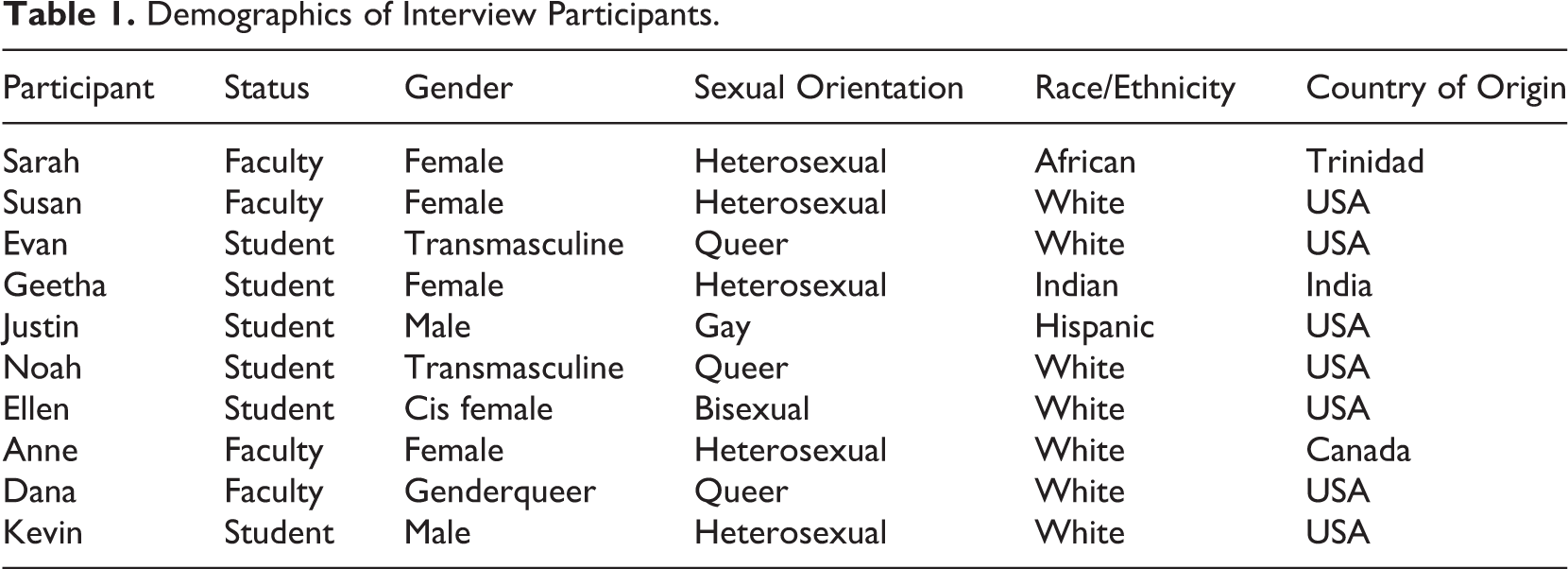
All participants were assigned pseudonyms. The demographics of the interview participants are presented in Table 1, and those for workshop participants can be found in Table 2. Participants came from institutions located across the United States, including the Northeast, West, Midwest, and South. Two participants came from institutions located outside of the United States. This information is suppressed on the demographic table to protect participant identity. Information on institutional control and location was not collected from workshop participants. White early career scholars were overrepresented (only 4 participants of a total of 15 identified as not white). A significant limitation is the lack of inclusion of a more racially and ethnically diverse sample, which was also reflected in the research team.
Demographics of Interview Participants.
Demographics of Workshop Participants.
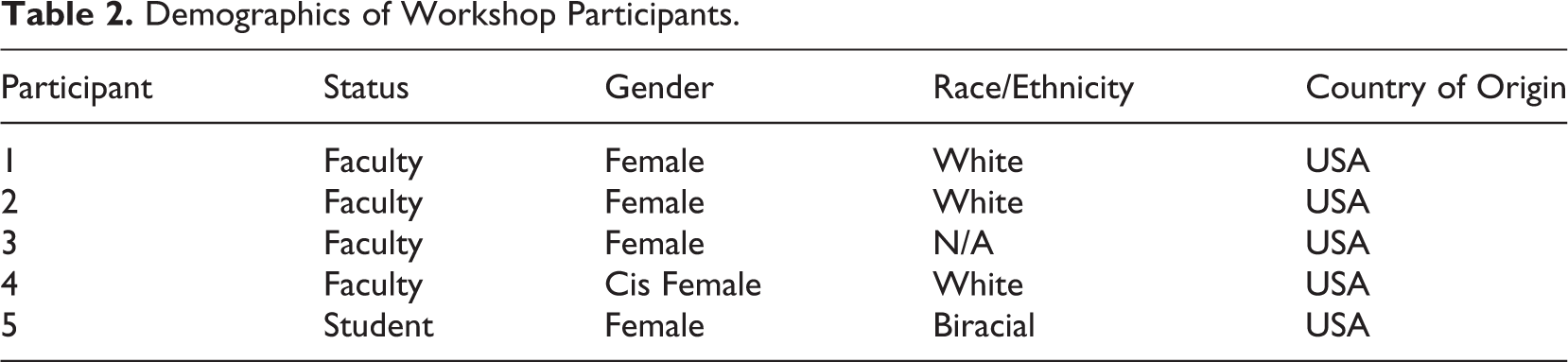
Two of the workshop participants did not meet the criterion of being a doctoral student or faculty in social work. One participant had completed her bachelor of social work (BSW) with a research focus and planned to continue her education with a master of social work (MSW) and PhD. Another was a pre-tenured faculty member but in what the participant identified as a “social work-allied field” as she worked in education with an emphasis on social justice. Both remained in the workshop.
At the workshop and in the interviews, participants described their experiences conducting PAR/CBPR, strategies that supported their work, and their motivations for pursuing PAR/CBPR. Interactive activities were used in the workshop to obtain these data. The workshop facilitators (the first two authors) provided the participants with a series of prompts. Participants reflected on prompts individually and recorded their responses on Post-it Notes. In small teams, participants then discussed the data generated by the collective group, identified themes in the data, and presented the themes that they identified to the larger group. All the interviews and the workshop session were audio-recorded and transcribed verbatim.
Two ethical issues arose related to the workshop. While doctoral students and pre-tenured faculty were both considered “early career scholars,” the potential power differential between students and faculty was of concern because it could constrain students from speaking freely, especially if on the job market. The interview option was offered, in part, to address this. In addition, holding the workshop as a conference session, not usually a site of data collection, created an additional responsibility to clearly communicate to the participants that the session was intended as a research activity.
Data Analysis
The IPA framework of J. A. Smith et al. (2009) shaped the process of the code-based analysis. The analysis process began with each team member reading the same two interview manuscripts (a faculty and student participant) on their own to gain a general sense of the interviews. This was followed by more careful line-by-line reading to gain an in-depth understanding. After team members finished reading, they each took systematic notes with an emphasis on the content and any possible connections. Notes served as potential themes from each participant and across the participants. After working individually, team members came together to discuss our individual thoughts in order to use the notes and emergent codes for interpreting participant experiences. This process of engaging in “dialogue” is consistent with the framework of J. A. Smith and colleagues (2009), and it allowed us to consider areas of convergence and divergence among our individual understandings.
Once a group consensus was reached, two of the team members continued the process described above (e.g., intentional reading, line-by-line reading, note-taking, and theme building) with the remainder of the interview transcripts. All transcripts were stored and analyzed in HyperResearch Version 3.7.5. The software facilitated coding and theme building across all participant transcripts. Eventually, the team considered the themes emerging from all participants and formulated findings across the participants from among these. Once themes were developed from the interview data, we compared these themes to those identified by the participants during the data collection workshop. This provided an opportunity to cross-check our findings with the perspectives of a broader group of participants. We considered the ways in which these themes were different from or similar to our own themes.
To complete the analysis process, team members then organized all themes across the interviews and workshop into larger categories. We ensured that the findings allowed for participant experiences might have differed from each other while also determining how themes were shared across participant experiences. The presentation of findings is accented by quotes from interview participants because this form of data collection allowed for more robust participant contributions.
Findings
Participants described experiencing their identities in the context of conducting PAR/CBPR in two ways. First, they illustrated how their own personal and professional identities served as motivators that fostered their interest in conducting PAR/CBPR upon entering the academy. Second, identity not only motivated participants to conduct PAR/CBPR but also shaped their experience of it (see Figure 1). Given that participants perceived PAR/CBPR as garnering less respect as a research methodology in academia, participants holding traditionally marginalized identities felt less empowered to pursue PAR/CBPR as they had already experienced transphobia, racism, sexism, homophobia, and other forms of discrimination. Some participants also experienced changes in their identity as they entered academia. While they perceived themselves as outsiders within academia, they also found that they became outsiders within the communities they identified with once they had attained academic status. This required navigating perceptions of identities as both insiders and outsiders.
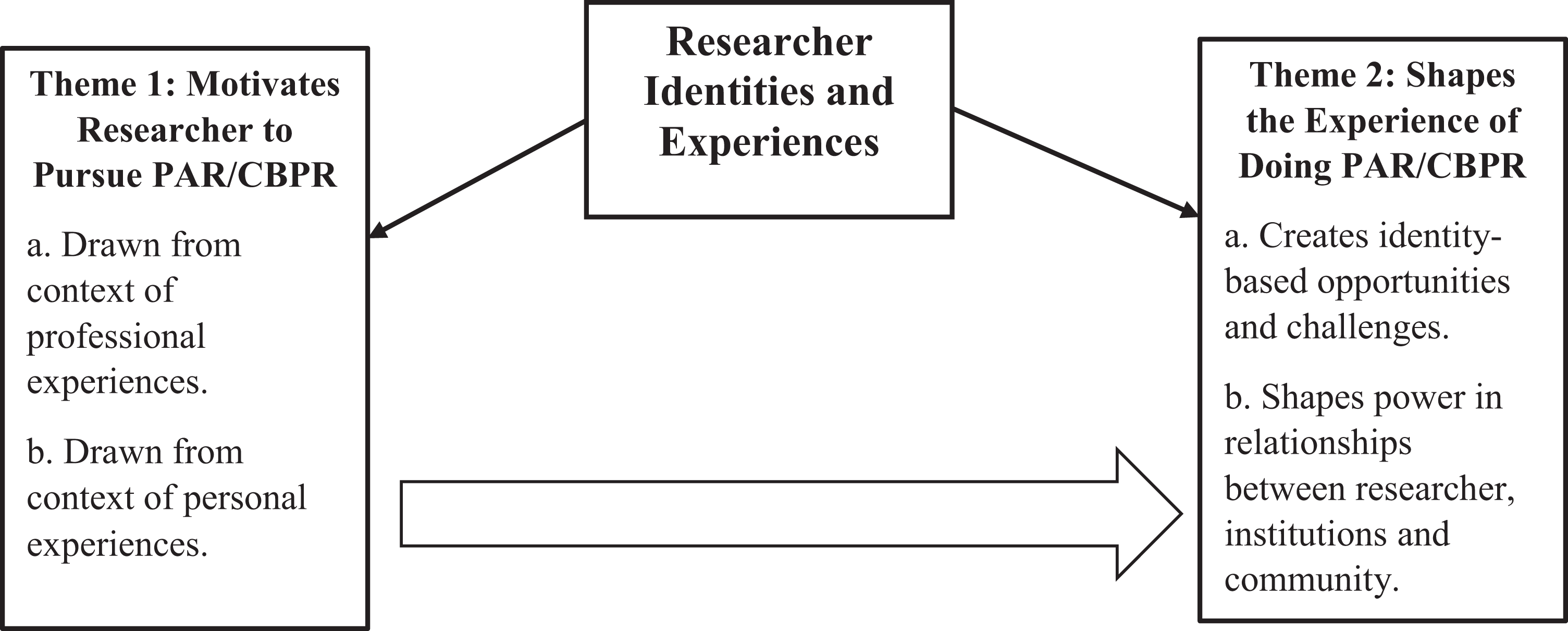
Relationship between findings. Researcher identities and experiences both motivate a researcher to pursue participatory action research and community-based participatory research (PAR/CBPR) and shape the experience of conducting PAR/CBPR.
Participant Context
Participants came from many types of institutions and represented students and faculty from both research and teaching schools. Participants were diverse in how they described their gender, sexuality, and race (although 68.8% identified as white, discussed in Limitations section). Notably, 50% of the interview participants identified as queer, gay, or bisexual, and three participants identified as transgender and/or genderqueer. The role that queer and trans identities played in participants’ interest in PAR/CBPR and experiences as a researcher is further discussed.
Participants’ genders are presented throughout this article as they described them to us. Some participants wished to discuss and identify their experience as transgender or cisgender people, whereas others did not. The reader should not assume a participant to be cisgender in the absence of other descriptors.
Identity as a motivator for researchers to pursue PAR/CBPR
Participants described their identities related to professional and personal experiences as inspiring them to conduct research and motivating them to specifically undertake PAR/CBPR.
Professional experiences
All participants reported some form of practice experience prior to their doctoral studies in social work. Ten participants held MSWs, and each brought diverse backgrounds, ranging from direct clinical practice to policy work. Nearly all the participants linked previous practice experience to a predisposition to pursue PAR/CBPR. For example, Evan (a queer, white, transmasculine doctoral student) described community-based and grassroots organizing around youth rights and anti-racism work. Evan shared the following: A pretty important part of my journey to graduate school is my work in the community. I returned to school after more than a decade in the field. That included traditional, non-profit social service agencies, but also community-based grassroots activism. I have never been a clinical practitioner of social work, but all of my work experiences have been in social work type fields, in youth development and service learning. Before I came back to grad school, I worked in child welfare. I consider myself to be a social worker in spirit. My first job after college was working with an organization training adults who do service-learning projects with young people. The model that we were teaching was basically Youth Participatory Action Research (YPAR). We just weren’t calling it YPAR. I wasn’t even thinking about research at that point. I implemented [the methodology] before I even knew what PAR was. I saw a theater-based presentation, and I said, “Oh my gosh, that’s what I want to do [for my dissertation]!” After completing my dissertation, PAR came up. I was like, “That’s what I was doing!”
While working at a drop-in center that served many LGBTQ youth, Evan and his coworkers received requests from local teachers and health and human service providers for training on sexuality and gender. Recognizing that many of the young people served by the community center felt that such topics were often “swept under the rug” by the adults in their lives, Evan sought ways to center the ideas and leadership of LGBTQ youth. Evan said the following: We started asking youth that were hanging out in the center what they thought about this, how should we do this education? It [was] a process really driven out of those conversations. Young people were interested in co-producing knowledge they wanted adults to know. I became familiar with [PAR] when I was working as an activist and service provider. I practiced what I would call non-research PAR. I experimented with the concept before going back to school, and I actually used it in making an [arts-based advocacy project] for LGBT people. We did participatory focus-group kind of work, and that led to the development of what I think is a project that uses those strategies in its production, process, and outcome.
For participants who described how their work prior to their research training reflected PAR/CBPR, as well as those who first learned about the methodology upon returning to school, such approaches nevertheless appeared to support the mission-driven focus and participatory nature of their work. Furthermore, PAR/CBPR aligned well with their professional social work values of, for example, social justice, self-determination, and empowerment. As explained by faculty member Susan (a white heterosexual woman): [PAR] was a natural fit. I realized that I could be a social worker and a researcher and use research to do social justice work. That was why I got into social work in the first place. That’s what drew me. The fact that it was a way to continue doing social work and also do research.
Personal experiences
While all participants described a belief that PAR/CBPR suited their social work–informed research praxis, some were drawn to it because of their personal experiences. Ellen (a white cisgender, bisexual female, doctoral student) described her own experiences as a young person benefiting from youth leadership programs. Upon the death of her mother as a result of addiction and physical and mental health issues, a school counselor asked Ellen to participate in a positive youth development initiative. Ellen shared the transformative impact of this program and how it informed her commitment to YPAR. She stated, I got a lot of hope and healing from participating and learning that my voice matters. I impacted policies that helped others with mental health issues get access to care and housing. It’s been about living a legacy that my mom didn’t get a chance to live.
Others described how even common experiences, such as family size and sex ratio, can motivate pursuing PAR/CBPR. For example, Anne (a cisgender female, white faculty member) grew up in a large family. She said, The voices of many is a pretty common value for me. From that large family, I am [the] only girl [among] many boys. The experience of having a different voice than everyone else and maybe different roles and expectations [attracts me to PAR/CBPR].
Participants reflected on feeling that those sharing their identities are often misrepresented and left out of research. For some, this sense of exclusion inspired their commitment to PAR/CBPR. Noah (white, queer, and transmasculine) commented on how he had generally positive experiences as a transgender study participant but that he had once overheard two cisgender researchers discussing a plan to study trans people in a way that he felt was objectifying and invasive: That really motivated me to think about research methods that include participant voice much earlier in the process. It was a reminder that folks who have not experienced the phenomenon can make grossly uneducated assumptions about that phenomenon and experience. [The Latinx community] is not represented in the literature, or they are, but it’s not what it should be, and [you realize] that you could sit there and mope about it or try to do something about it. I really think that as a therapist in outpatient care…I remember getting all these evidence-based practices, but these are not appropriate for my community.
Researcher identity shapes the experience of doing PAR/CBPR
Participants were not only motivated by identity-related factors in selecting PAR/CBPR as a methodology but also found that their identities impacted their experience of using such methodologies. Specifically, identities afforded certain opportunities and barriers to conduct PAR/CBPR. Additionally, the intersecting and shifting identities of researchers changed their relationship to power, which complicated their experience of employing PAR/CBPR over time.
Identity-based opportunities and challenges
Participants who were interested in PAR/CBPR experienced living and working outside the expectations of academia. For those whose gender, sexuality, race, and ethnicity positioned them as outsiders, this status was held both personally and through their methodological selections. Participants with marginalized identities spoke about how they had already received messages saying that they did not belong. For some, the presence of implicit bias and microaggressions within academia communicated that their pursuit of unconventional research methods bore an additional degree of risk that others (with more privilege) might not face. Justin described a situation wherein the dean of his school assumed that he was the janitor. Reflecting on this experience, he shared the following: There are these microaggressions that happen almost daily that tell you that you do not belong. You have to work two times as hard as a white student to get the same respect. I’m removing as many barriers as I can. There is not an obvious queer presence in either of [my previous universities]. I felt like I had to repress that part of my identity. Now that I’m getting close to tenure, I’ve decided that I’m going to bring [my LGBTQ identity] forward. As soon as I was on the tenure clock, I thought, “I can’t do PAR anymore.” And so, I spent a number of years doing more traditional research. Then I realized that wasn’t where my heart lies at all. I need to go back to PAR and the arts as well.
Complex identities and multiple relationships with power
Participants described the dynamic nature of identity related to intersectionality and relationships to power. For the participants, PAR/CBPR was a means to combat unequal divisions of social power informed by white, age, class, male, heterosexual, and cisgender privilege. Some came to this research as community outsiders as they did not share identities with the communities with which they sought to work. Some came to this research as community outsiders as they did not share identities with the communities with which they sought to work. Susan (a white, cisgender woman) discussed her research in youth communities of color. While Susan shared that her working-class background provided her with some insight into certain experiences of the youth with which she worked, she was also white. She shared that her faculty mentor, a black man from the community in which she worked, encouraged her to reflect on her own identity and its role in the research. She explained, “We had a lot of honest and open conversations about what it meant for me to be a white woman interpreting the experiences of youth of color.”
For Susan and other white researchers like her, engaging in and with communities of color necessitated a critical awareness of their social positioning and the legacies of harm imposed by outside researchers. Some participants said the selection of PAR/CBPR was intentional because they perceived that collaboration with community “honored” participants more than other forms of research did. Both white and black scholars sought to engage in research that provided opportunities to reflect on racism and privilege and utilized PAR/CBPR to build more egalitarian and transformative research agenda with communities of color.
Participants with marginalized identities experienced shifts in their identities over time that changed their relationship to power and had an impact on their experience of conducting PAR/CBPR. In some instances, these shifts in identity were precipitated by entry into academia. Blurred lines between privileged and subjugated identities arose in Justin’s reflections. As a cisgender man earning his PhD. from a prestigious university, Justin recognized the social capital he carried as a researcher. However, as a Latino gay man, there were many ways in which his identities were not solely defined by experiences of privilege. He experienced both insider and outsider statuses simultaneously. While he felt like an insider doing research with other gay people, he reported pervasive racism in many LGBTQ communities, which left him feeling disconnected and unwelcome. Furthering this sense of outsiderness, Justin shared his experiences of being misperceived as heterosexual, “[My presentation of self] makes others tense and the connections aren’t there since—this sounds horrible—I’m not gay enough.”
Geetha likewise reflected on being an Indian woman studying in the United States and reported similar tensions: I approach research with the perspective that the communities that I do research with have already experienced marginalization and oppression on an extreme level. When I came into the Ph.D. program [in the United States], I was careful that, when I go back [to India], I should not continue the oppression. It’s very hard because I do research in a Western institution and I grew up in India, so of course it’s my culture and my home, but they see me differently. I’m constantly balancing the role of both being an insider and an outsider because yes, they see me because I look like them and I speak like them, but they also know that I’m from the United States.
For those who carried invisible identities, the dilemma of whether to self-disclose in the research setting was a concern. PAR/CBPR’s emphasis on authenticity and shared leadership is a challenge to “spectator research” (Lawson et al., 2015; Pyles, 2015), and disengaged approaches are abandoned for more interactive, flexible, and transparent relationships with those who would otherwise be positioned as study “subjects.” From a feminist perspective, this authenticity is a necessary component of building egalitarian relationships and sharing power. However, blurred roles are challenging in academia. Noah shared the following: I think about what it means to be someone who looks like a cisgender, straight, white man walking into a shelter for young people who are frequently of color…we had a young woman who was also trans…She talked a lot about being trans and the barriers that created for her and her housing situation and her life more broadly. I was in the participant facilitator, observer role. I was new to grad school, and I was still very much in this, “Oh, I can’t participate, I will influence the research” mindset. I didn’t share my trans identity [with her] until the very end.
Limitations
A significant limitation was the underrepresentation of scholars of color among participants. These findings indicate that scholars of color have unique experiences from white scholars, which warrants further study focused on racial and ethnic identities. Nevertheless, the sample does reflect diversity in gender and sexual identity. Representation of participants from teaching-focused institutions was also limited in the sample. However, given the focus on research as a topic and the inclusion of doctoral students, it is likely that participants with a research agenda were more likely to come from research-focused institutions and study at research institutions conferring doctoral degrees.
Discussion
PAR/CBPR presents opportunities to challenge pervasive neoliberal pressures and research pursuits in accordance with the identities and experiences of the researcher. Cornwall and Jewkes (1995) argue that community-engaged methodologies “…are seen less as a means to an end than as offering ends in themselves: the emphasis is not on outcomes, but on process” (p. 1670). Many of the ECSs were drawn to PAR/CBPR because it was a natural fit given their practice experience, which involved supporting individuals/communities with self-defined issues. These scholars were drawn to the processes involved in these methodologies because social justice and transformation inspired them to select social work as their path. However, the participants also reported navigating significant tensions that arose in the clash between their values, processes of PAR/CBPR, and those of the neoliberal academia (e.g., publication-driven metrics of productivity and positivist orientation).
Scholars who held identities that were frequently marginalized within academia faced challenges when adopting approaches that they feared would further “other” them. Many participants shared that while the identities they held motivated their work, these same identities were subject to suspicion or rejection in their white, male, and often heteronormative environments. This is further exacerbated by the shift from higher education as a purely scholarly endeavor to that of economic driver brought about by neoliberalism (Olssen & Peters, 2005). The neoliberal academy deprioritizes contextually based research with oppressed populations and instead promotes research that commodifies social work services and interventions with an emphasis on generalizability. This agenda demands a disinterested researcher who can act objectively; therefore, neoliberalism forced the disembodiment of participants, as they faced pressure to reject a part of themselves. As such, scholars holding marginalized identities reported needing to routinely assess the risks and benefits of pursuing their preferred research agendas. We argue, based on the finding that participants faced pressure to separate from their identities or face suspicion, that the pursuit of research that integrates a researcher’s self-conception with their work can be viewed as an act of resistance to the neoliberal academy.
Consistent with the work of Collins, participants had simultaneous experiences of insiderness and outsiderness as they moved through academic and community spaces. However, the experience of being “outsider-within” expressed by participants was more nuanced when multiple identities were considered beyond race, ethnicity and gender identity. Some participants described being motivated to pursue work with a community with which they shared common identities; however, some scholars indicated that they held positions of privilege and power when compared to participants. For some, this privilege was present throughout their lives, while, for others, it was acquired later, upon achieving university researcher status. Even individuals who share an identity with a community may hold other non-university-based identities that make them outsiders.
Our lens for identity moves the insider–outsiderness concept forward by considering identity as consisting of more than only observable characteristics. Identity is comprised of both what can be observed and what cannot be observed. Identity is an internal experience. How individuals understand their own identities might differ from the ways in which others categorize and label them externally. What individuals consider relevant and meaningful in shaping who they are and how they understand and interpret their social world may differ from how others in their social world view and understand them. Fully unpacking identity leads to recognition of the fact that it has both internal and external components. For example, participants described how they benefited from development projects as youth. This was a positive and formative experience for them that become part of who they are, and it ultimately influenced how they approached others in scholarly inquiry.
Not only did participants find themselves as outsiders within academia but their new education and status placed them at odds with communities they once considered their own or wished to access in order to conduct PAR/CPBR. In part, this stems from the fact that participants (as former insiders) had now acquired education or were pursuing an education at levels far exceeding those of the communities they originated from or sought to work with. Additionally, participant experiences are consistent with the general disconnect between academic institutions and the communities that host them. Local residents view institutions with disinterest or mistrust because institutions are often disconnected from their communities and act in a self-interested manner, a phenomenon referred to as the “town-gown divide.” The shift, precipitated by neoliberalism, from a purely scholarly agenda to one driven more by economic considerations (Olssen & Peters, 2005), results in competition for limited resources in the form of grants and funding, which may further the divide between institutions and communities (Hanesworth, 2017). For example, such a “town-gown” divide is exemplified by institutions chasing federal and foundation grants for issues identified as socially relevant by policy elites rather than members of their local communities (Hanesworth, 2017).
The commodification of higher education presents barriers to conducting PAR/CBPR projects even among academic insiders, as this research requires time to be devoted to a process not conducive to quick publication generation, as well as a general environment that devalues research that is not viewed as generalizable. The pressure on academic insiders further distances them from their communities, which breeds mistrust and disconnection as insiders fail to understand their respective communities’ actual needs. Those perceived as outsiders within academia face the pressure imposed by neoliberalism with the added challenge of feeling as though they must methodologically assimilate because their identities already put them at odds. Therefore, neoliberalism may in many ways exacerbate town-gown relations, although an institutional commitment to PAR/CBPR could be an act of resistance that is a step toward mending the relationship.
Neoliberalism is reordering institutional values and processes in academia in accordance with the free market, where competition and outcome-based accountability mechanisms drive research and education agendas (Olssen & Peters, 2005). This has privileged positivist-centric approaches that, while fitting for many scholarly pursuits, curtail the ability of scholars to pursue PAR/CBPR. At the same time, academic cultural norms that devalue the subjective, personal, and lived forms of “knowing” leave little room for the development of scholarly agendas grounded in researchers’ lived experiences and commitments to communities.
Many scholars with marginalized identities enter academia to pursue projects that enrich social work literature by contributing work from a broader range of perspectives. The absence of such voices risks literature continuing to privilege white heterosexual male and middle-class experience by default (e.g., Iverson, 2007). If certain scholars with marginalized identities are more reluctant to pursue PAR/CBPR for the reasons discussed, this potentially biases the type of literature available, the communities represented, and the possibility of engaging in more egalitarian and participatory research relationships with historically marginalized communities. Furthermore, the authors acknowledge their own privilege in pursuing PAR/CBPR. Given that most of the research team identified as white, this whiteness bestows perceived legitimacy that some participants in our study did not enjoy. Even our decision to pursue this study was made possible in part by the racial privilege we enjoy.
Infusing PAR/CBPR into social work education and promoting it in social work research is a formidable challenge. We suggest the first steps involve building community among PAR/CBPR scholars across the United States (and internationally) such as via social work research conferences (e.g., through the development of special interest groups) as well as virtually through online communities. Additionally, at social work conferences and in publications, generating conversations about how productivity is assessed in social work academia could open up new pathways if consideration is given to holistic evaluation that ties more closely with the values of the profession. Finally, opportunities to infuse PAR/CBPR within the curriculum for social work students exist at all levels (BSW, MSW, and PhD). Ideally, school-level curriculum reflecting PAR/CBPR would be adopted, but individual instructors can use PAR/CBPR as tools to engage students in the community and teach both micro- and macrogeneralist concepts or specialized topic-specific courses (i.e., conducting organization-/population-/community-needs assessments, organizing and conducting group work for therapeutic/nontherapeutic services)
Conclusion
Social work faces increasingly complex social challenges. PAR/CBPR offers unique opportunities for inquiry and action in response. Participants viewed PAR/CBPR as aligning with social work values and therefore a natural extension of their work in the field as practitioners. Indeed, use of PAR/CBPR may represent a return to the historical roots of social work, with an emphasis on community-engaged practice and advocacy in the tradition of settlement houses. The scholars in this study were also motivated to pursue PAR/CBPR because of their own identities and personal experiences with marginalization. Issues related to identity also presented many challenges, as participants faced pressure to conform to norms predominantly built on assumptions of white heterosexual males with economic privilege. As such, there are tensions between prioritizing career success and maintaining commitment to communities. Limited use of PAR/CBPR methodologies risks underrepresenting diverse voices in social work literature.
Footnotes
Acknowledgments
The authors thank Dr. Loretta Pyles for her insights. Her support of this manuscript and study have been invaluable. Additionally, the authors appreciate all the participants who gave their time to share their stories. This work is dedicated to them.
Declaration of Conflicting Interests
The author(s) declared no potential conflicts of interest with respect to the research, authorship, and/or publication of this article.
Funding
The author(s) received no financial support for the research, authorship, and/or publication of this article.
