




Abstract
The apparatus of social reproduction describes the process by which knowledge production contributes to oppressive conditions. This article explains and defines this process through the application of a critical theoretical lens informed the Foucauldian concept of apparatus or dispositif and social reproduction as developed by feminist activists and intellectuals. This process has a notable influence on the political economic conditions of transgender women, conditions that include disproportionate reliance on the use of criminalized economies such as sex work. Social workers inadvertently influence this process through an overreliance on broad categorizations for lesbian, gay, bisexual, transgender, and queer populations, which impede our ability to adequately assess such complex oppressive social relationships. Increasing the profession’s familiarity and competence with critical theory is necessary to reduce our participation in such processes and identify effective interventions for this population. Presenting a review of social work literature and a discussion of the proposed lens, the following seeks to illuminate the apparatus of social reproduction and explain how broad social categorization of transgender women is problematic. The authors recommend the adoption of the proposed lens as a tool social workers can use to better assess their research and practice and better understand the complexities of power and exploitation.
Writing in 2004, McPhail, a social worker and advocate for lesbian, gay, bisexual, transgender, and queer (LGBTQ) communities, challenged social workers to integrate queer theoretical frameworks 1 into social work education and practice. She recommended that social workers problematize and denaturalize identity categories to challenge hegemonic discourses that reinforce fixed, binary categorizations of gender and sexuality. Heeding this challenge, we argue that the identity categories we address or neglect in our research and the ways in which we analyze social problems can potentially reinforce hegemonic discourses that maintain exploitative, oppressive social relationships. To better illustrate this, we will explore how transgender women 2 are represented in social work literature and argue that there is too great a reliance on the use of “umbrella” categories when investigating heteronormative and gender-normative oppression. Transgender women are particularly affected by this process and are often subsumed into larger categorizations such as LGBTQ or men who have sex with men. This practice assumes far too much about sexuality and gender identity and contributes to the misgendering of transgender women. Further, overreliance on general categorizations impedes the critical analysis required to fully understand the power dynamics, which influence high degrees of social exclusion commonly experienced by transgender women. Because of exclusion, this population uses underground economies, such as sex work, to a notable degree (James et al., 2016).
In this article, we hope to disentangle the complex relationship between knowledge production, professional discourse, and the social conditions that influence the use of sex work as a means of survival for transgender women. We aim to do so by applying a theoretical lens that brings these social dynamics into sharper focus. This article names these dynamics as the apparatus of social reproduction. The lens applied is a synthesis of the Foucauldian concept of apparatus or dispositif (Foucault, 1980) and the concept of social reproduction as developed by Fortunati (1996), Dalla Costa and James (1975), and Federici (2004, 2012). Although the following concepts may be unfamiliar to social workers, we feel they have great utility in providing fresh perspective. These concepts aid us in understanding the ways in which institutional discourses create the conditions for the capitalist exploitation of surplus value. 3 We do not propose this analysis as a panacea. However, we hope that, through the application of this theory to our survey of the literature and an analysis of search criteria, the following will offer a new perspective from which social workers can assess their methods and practice.
The following will review the literature to analyze the ways in which transgender women are discussed. This will include an analysis of search criteria in the database Social Work Abstracts (see Table 1). The authors will then introduce the conceptual sources of the apparatus of social reproduction by discussing the work of Foucault as well as feminist activists and intellectuals. The article will then summarize the applied theoretical lens. Finally, implications for social work will be discussed.
Social Work Abstracts Searched Related to Transgender Women.
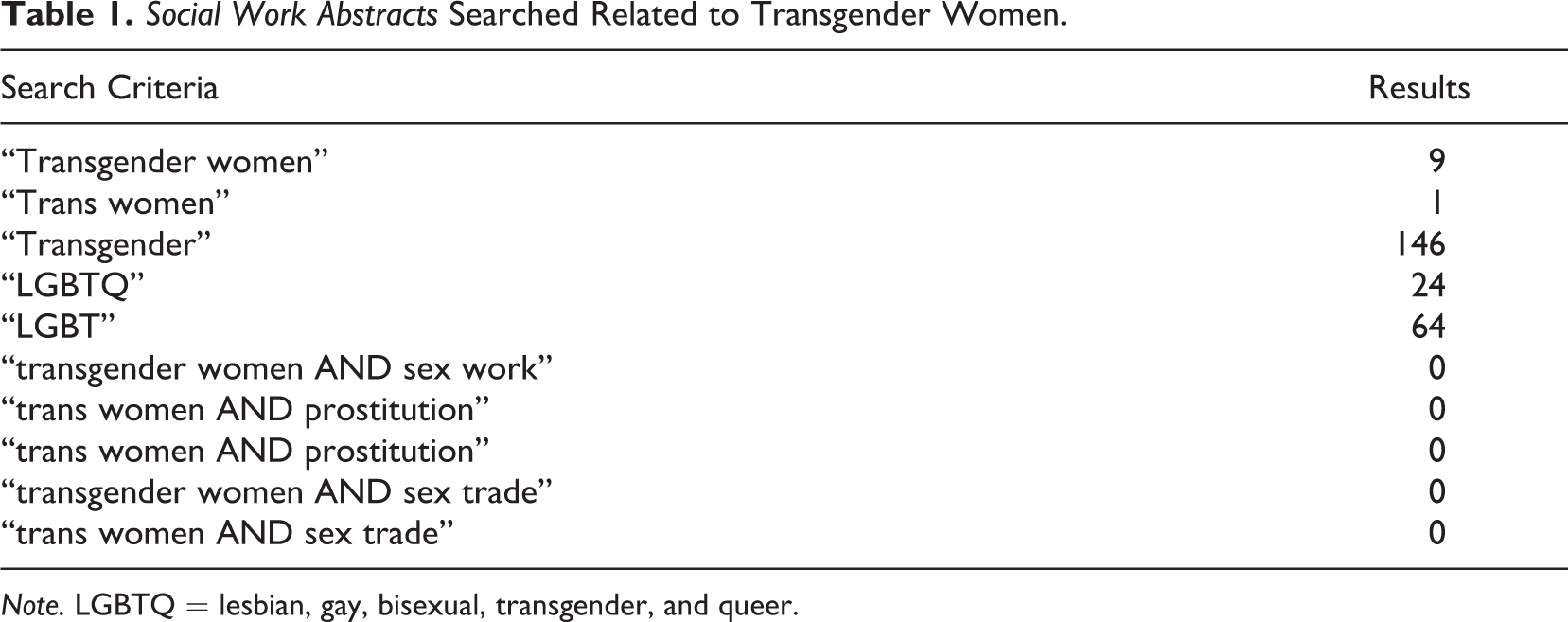
Note. LGBTQ = lesbian, gay, bisexual, transgender, and queer.
Before continuing, it is important to discuss the positionality of the authors. The first author is a white cisgender 4 heterosexual male of class privilege and recent master of social work graduate who took the lead in conceptualizing this article as part of an independent study. The second author is a white cisgender queer female of middle-class background and the faculty member supervising the independent study. Much of the second author’s research focuses on how to improve the social and policy environment to promote equality and social justice in relation to transgender and gender nonconforming people. We are not writing with the intention of making any recommendation to transgender women. We do not believe we should do so from our positions (and, certainly, history is replete of too many examples of cisgender people telling trans people how to act or what is “wrong” with gender expansive identities). However, that does not absolve us from working to improve the lives of transgender women through a rigorous analysis of the ways we maintain our privilege and power through our professional actions. This article is an effort to uncover the ways in which our profession’s lack of theoretical rigor inadvertently contributes to the misunderstanding of trans issues and the negative consequences of those misunderstandings.
Literature Review
Transgender Women in Social Work Literature
A review of the literature relevant to transgender women reveals some of the negative impacts that result from broad categorization. Nagoshi and Brzuzy (2010) discuss the categorical complexity within the term transgender. The category encompasses a wide diversity of gendered experiences. Further, the emphasis on the social construction of gender can have negative impacts on the needs of transsexuals for whom changing the sexed body is of importance. This example reveals the dual character of the term “transgender”—that of both umbrella and eraser. Likewise, Siverskog’s (2014) work on the impacts of aging on transgender people discusses the same process when considering the category LGBTQ. She argues that this category is largely associated with nonheterosexuality, whereas the “T” reflects a gendered experience. Failure to adequately differentiate the letters of LGBTQ when performing research makes invisible gendered experiences.
This is not to say that social work research is ignoring the needs of transgender women, though most research has tended to focus on transgender individuals more broadly rather than specifically speaking about transgender women. In addition to works previously mentioned, contributions include explorations of transgender and queer theory in connection to practice (Burdge, 2014; Hicks, 2014), increasing journal content on transgender issues (Scherrer & Woodford, 2013), assessing and improving the competency of social work curricula on transgender populations (Austin, Craig, & McInroy, 2016; Levy, Leedy, & Miller, 2013; McPhail, 2008), guidelines for clinical practice with transgender clients (Davis, 2008; Lev, 2004), discussions of ethical implications of transgender oppression (Markman, 2011), and recommendations for policy advocacy (Lerner & Robles, 2016). These are key areas to address, but it is also important to understand what our profession is not addressing in our research, the ways in which it influences practice, and the impact our professional voice has on the societal perception of groups. What is not written or discussed also impacts this perception.
Reliance on broad categories is of concern when we consider the metasynthesis of qualitative studies on the lived experiences of people who identify as transgender performed by Moolchaem, Liamputtong, O’Halloran, and Muhamad (2015). The authors analyzed 31 qualitative studies, encompassing 1,005 transgender-identified research participants (though they do not differentiate gender identity within this category). The results indicate a variety of experiences ranging from complications related to transitioning, psychological distress, discrimination/social exclusion, the importance of relationships, and coping skills. Of these themes, the authors focus much of their discussion on social exclusion. The experience of social exclusion occurs on nearly every level of society: personal relationships, work, job markets, education, health care, government institutions, bathrooms, religious communities, and even within communities considered lesbian, gay, bisexual, and transgender affirming (Moolchaem, Liamputtong, O’Halloran, & Muhamad, 2015).
Extreme social exclusion contributes toward a reliance on criminalized economies. In 2015, the National Center for Transgender Equality (NCTE; James et al., 2016) examined the experiences of 27,715 transgender people across the United States. It is currently the largest survey of transgender people available in the United States. The findings of this survey support the dominant theme of social exclusion found in Moolchaem et al. (2015). The NCTE report indicates that the degree of social exclusion creates the conditions that cause transgender people to rely on sex work for income or for alternative access to resources such as housing and food (James et al., 2016). This experience disproportionately 5 affects transgender women, especially transgender women of color. Of the respondents in the NCTE survey, 12% reported participation in sex work. Of those reporting participation in sex work, 50% were transgender women and 42% were black transgender women (James et al., 2016).
Participation in sex work intensifies the experience of social exclusion through criminalization. Criminalization increases one’s risk for HIV/STD transmission, police brutality, homelessness, suicidal ideations, and suicide attempts (James et al., 2016; Open Society Foundations, 2015). However, much of the literature on transgender women focuses on individual behaviors, such as safe sex practices and HIV/AIDS treatment adherence (Nadal, Davidoff, & Fuji-Doe, 2013), rather than systemic forces that contribute to transgender employment barriers, exposure to violence, and social exclusion. Naming the individual as the locus of both cause and intervention creates a blame pattern (Phillips, 1984) that obscures the problem. Although not using this term, Hicks (2014) notes that gender is influenced by a moral order whereby any behavior or expression that questions the gender hierarchy is met with an accounting of the individual or group not the hierarchy itself. Transgender women thus become the cause of the problem, and solutions are achieved through behavioral discipline (Hicks, 2014). This obscures the political economy transgender women find themselves within.
Preoccupation with individual behavior has its historical precedents in social work. Analyzing the evolution of social work practice and prostitution, Wahab (2002) explains that problem definitions have always focused on women’s bodies and behaviors. These definitions range from accusations of weak character, low morals, and psychological deviancy. Wahab’s history is limited to cisgender women. However, the commodification of feminine sexuality has historically been in process alongside the disciplining of trans bodies (Federici, 2004; Feinberg, 1996).
We further illustrate these trends with an assessment of a search of the academic database, Social Work Abstracts. Published by the National Association of Social Workers (NASW), this database indexes social work research from 500 journals. It covers the years 1977 to the present, with records totaling over 74,000 publications. Table 1 includes a list of the searches we conducted in this database.
Searching the database Social Work Abstracts with the criterion “transgender woman” yielded nine results. Only four of the nine were viable citations, that is, directly addressed transgender women. Three focused on transgender women and HIV/AIDS prevention (Collier, Colarossi, Hazel, Watson, & Wyatt, 2015; Cotten & Garofalo, 2016) and one discussed substance abuse and transgender women (Hotton, Garofalo, Kuhns, & Johnson, 2013). The larger number of results for transgender is notable, yet more specific search categories produce zero hits. This assessment is limited, though it does reflect a reliance on broad categorization and individual behavior as discussed above.
Returning to McPhail (2004), we can see how social work is lacking in its efforts toward problematizing and denaturalizing gender in its research with transgender women and sex trade participation. The trend toward oversimplification of categories and limiting analysis to individual behaviors overlooks areas of investigation that can better assess the reasons for such intense social exclusion. Patterns such as this both erase the experiences of transgender women and locate problems within individual behaviors, thereby redirecting responsibility from society onto transgender women.
Foundations of the Apparatus of Social Reproduction
Awareness of these patterns is important, but we must also analyze them with greater complexity. In doing so, it is possible to better understand the social relationships behind them and areas where our profession inadvertently contributes to them. To accomplish this, we need to turn to the work of psychologist, philosopher, and social activist, Foucault (1980), and that of feminist activists and intellectuals on social reproduction.
Foucault’s (1980) concept of apparatus cannot be understood without understanding discourse and power. In The History of Sexuality, Volume 1: An Introduction, Foucault names discursive facts, the fact that something of social significance is discussed, as his focus. Discourse is the discussion itself. These facts are comprised of what is and is not said and who it is that says or does not say. It is discursive facts that produce and channel power. Later in the volume, he defines power as a “multiplicity of force relations” (p. 92). It is through the confrontation and struggle among these relations that systems either develop and evolve into institutions or fail to form links, keeping the relations isolated from each other. If force relations develop into an institution, we can see their expression in the state, law, and/or other social hegemonies. It is through these end points that what is said or not said produces discourse. Thus, as Pollis (1987) explains, discourse is understood as knowledge and practice organized in a way that is conducive to the production and transference of power.
This process, from relational force to discourse to power, does not form a singular source of discourse but many sources. These are expressed through academia, the law, medicine, psychology, social work, the state, and so on. Taken together, Foucault (1980) describes them as an apparatus (dispositif). He explains in “The Confession of the Flesh” that the apparatus is a “heterogeneous ensemble” (of discourse producers systematized according to particular relationships (Foucault, 1980, p.194).
Thus, we can see that what social workers say or do not say or how we categorize produces discourse and, therefore, power. We operate within an apparatus. The impact of our profession may be small relative to other components, but we are participants nonetheless. But does this explain the oppressive conditions of transgender women and our role in producing those conditions, adequately? Foucault found Marxist frameworks lacking in their ability to analyze power and knowledge successfully (Pollis, 1987). Such limitations are acknowledged, but an abandonment of Marxist thought is not sensible. To understand the apparatus of social reproduction, one needs to account for value production as well as discourse and power.
To do this, we turn to the concept of social reproduction. Federici (2012) describes social reproduction as the self-sustaining maintenance of daily life on the material, political, emotional, sexual, and spiritual levels. Under capitalism, social reproduction is crucial to the process of the accumulation of surplus value (see Note 3). Labor power is depleted every day and needs to be reproduced. It is in the interest of capital to devalorize social reproduction as much as possible to ensure the highest possible rate of surplus accumulation. This is achieved through the devaluation and simplification of certain identities to avoid investing in reproductive labor through the wage (Federici, 2012). Considering Federici’s (2012) definition, sex work is a form of reproductive labor, which indirectly contributes to the accumulation of surplus value in that it sexually reproduces the consumers of sexual services for the labor power of said consumers to be redirected back into the capitalist social relation, that is, work.
Social reproduction as a concept was developed through social movement organizing, such as the Wages for Housework movement, and the work of Dalla Costa and James (1975), Fortunati (1996), and Federici (2004, 2012). These authors challenged the traditional Marxist idea that women’s exclusion from waged production also excluded them from social productivity or the process in which value for surplus accumulation is produced. They argued that the unwaged labor of housewives, reproductive labor, contributes to surplus accumulation via mediation through the male wage. Reproductive labor not only physically produces new bodies for capital in childbirth, but it also reproduces the male worker through cooking, cleaning, and sex, enabling him to return to waged labor each day (Dalla Costa & James, 1975; Fortunati, 1996).
Despite its gender-normative and heteronormative organization, this theoretical lens is applicable to the experiences of transgender women. Federici (2012; Vishmidt, 2013) makes clear that the attributes of femininity are work functions—disciplinary forces that shape work relations. Assessing the work function problematizes and denaturalizes (McPhail, 2004, p. 17) the identity category. Capital has always taken advantage of the social construction of gender and used it as a divisive tool alongside the wage. Federici (2012) explains that what defines womanhood has never been static. Feminine attributes and the wage have always been used to facilitate labor divisions strategic for capitalist accumulation. Considering this, we must not abandon gender or theorize it away. Gender operates on multiple planes and is both expressive of our desires and manipulated by capitalist work discipline. Gender is a human attribute socially constructed with real material realities; it is both self-affirmed and imposed, both empowering and oppressive. McPhail (2004) supports this when she explains that group identity can be both the source of oppression and the site for liberation. It is resistance to the work function of an identity that tips the scales toward liberation.
Work functions of transgender women maintained by social exclusion and criminality are parallel to the work functions of women’s labor. The argument that women’s labor is a natural, essential component of their existence creates the discursive conditions that treat the lack of a wage as common sense (Dalla Costa & James, 1975; Federici, 2012; Fortunati, 1996). In the case of transgender women using sex work, processes of invisibility and criminality manufacture common sense notions that their labor is illegitimate and in no way a contribution to society.
But transgender women’s labor is a contribution to society, and capitalist accumulation increases through its exploitation. Fortunati (1996) explains that what is deemed natural and therefore undeserving of a wage in the nuclear bedroom is recoded as criminal and unnatural on the street (or other invalidated arena) and equally undeserving of the wage. This discursive strategy allows for capital to accumulate surplus value without the need to reinvest in labor power. Federici (2012) explains that economic dependence is the ultimate form of control over sexuality. Discriminated and excluded at nearly every societal level (Lerner & Robles, 2016; Moolchaem et al., 2015; NCTE, 2015), transgender women are too often dependent on the work of sexuality. The provision of physical release and accumulation of power for the worker consuming the service allows the worker to endure another shift, the sex worker to survive another day, and profit 6 to rise from the labor of both.
Discussion and Implications for Social Work
We can now speak with greater clarity of the apparatus of social reproduction. It is the ensemble of discourse producers who systematize the disciplining of reproductive work functions. In our case, social workers, by oversimplifying transgender women’s oppression in our discourse through the overreliance on umbrella categories or locating problems/solutions within individuals, contribute to the isolation and mystification required for the devaluation of transgender women’s labor. Social work is neither the only element of the apparatus nor the only profession involved. We do not argue that social work alone is responsible or that the profession has a larger impact than other components of the apparatus. However, we most assuredly argue that without a sophisticated understanding of identity and work, we will continue to contribute to the exploitation of our clients and overlook practice areas in need of intervention.
First and foremost, this article recommends a greater engagement with critical theory in social work practice, research, and education. As has been shown above, the application of critical lenses gives social workers new vantage points from which exploitation comes into greater relief. Greater competency in critical theory will benefit the profession in two ways: (1) it will assist social workers in identifying areas of intervention we have previously overlooked and (2) it will assist social workers’ self-reflection by providing new vocabulary with which to analyze our professional positions.
Second, identifying the blame patterns such as those produced by the criminalization of transgender women is important in our advocacy, research, and classrooms but also in our engagement with individual clients. This can be an empowering process for clients, as it can help identify internalized oppression and articulate personal strengths. As Federici has explained, “Naming your oppression is the first step in transcending it” (Vishmidt, 2013, para. 5).
Finally, social workers need to increase our use of inclusive, horizontal approaches to our research. The people we study must be able to critique our methods. This is not to say that we dismiss our responsibility in the struggle to achieve social justice and hoist it onto the shoulders of transgender women, but it recognizes that knowledge production is not a neutral process and often excludes those we seek to help from gaining voice. Without supporting the possibility of community critique, we run the risk of colonizing discursive strategies for professional betterment alone. Social workers have a history of working with research orientations like participatory action research (PAR), and this article encourages improving and increasing social worker’s use of PAR orientations. As Grant, Nelson, and Mitchell (2008) explain PAR, research becomes a negotiation among researcher subjects and includes common practices that include the sharing of power over the process with subjects, efforts to expand authorship, and budgeting funds to directly benefit the population or community in question regardless of results.
The social reproductive apparatus does not contain a single component. The social work profession is one among many. However, analysis of exploitation and identity construction with the proposed theoretical lenses helps us assess our profession in a way that problematizes and denaturalizes how we speak or do not speak about our clients. Furthermore, recognition of our impact on the social body, and thus on the lives of transgender women, highlights our responsibility to negotiate our research objectives with those directly affected. The power of our profession to speak or remain silent is a power that must be shared with transgender women.
Limitations and Conclusion
Our analysis of the apparatus of social reproduction has its limitations. A thorough study (such as a systematic analysis) of social work literature related to transgender women could better verify these patterns. Further, while this article is a theoretical analysis, PAR guided studies with transgender women would be necessary to confirm whether the apparatus of social reproduction is relevant to the population’s lived experiences.
In closing, we argue that the apparatus of social reproduction is a disciplining body that maintains the social conditions that reproduce gendered work functions and the exploitation they facilitate. Our professional voice has an influence on this process. As we hope to have made clear, this process has a particularly strong impact on transgender women. Given the slow pace with which the social work profession has problematized and denaturalized (McPhail, 2004, p. 17) our research categorizations, we find ourselves in need of developing new critical analyses that better account for such complex processes.
Footnotes
Acknowledgment
We would like to thank Elizabeth Beck, PhD, for her comments and suggestions regarding this article.
Declaration of Conflicting Interests
The author(s) declared no potential conflicts of interest with respect to the research, authorship, and/or publication of this article.
Funding
The author(s) received no financial support for the research, authorship, and/or publication of this article.