




Abstract
Our ability to provide affirming care to individuals who engage in sex work is limited by punitive foundations of social work. This study originates from within the sex worker rights movement. I utilize qualitative dialogues aligned with participatory principles to consider how a Black feminist disability framework can be employed to explore how intersectionality weaves itself into the lives and networks of 13 sex workers in Los Angeles, CA. Specifically, this study engaged in Participatory Action Research (PAR) and collective knowledge production to examine how criminalization operates within larger intersecting systems of oppression and complicates workers’ relationships with each other. The results of this study put forth the conceptualization of the sex worker-informed stratified social hierarchy – described as the “whorearchy” – and the ways that collective care is used to combat it. I conclude with a discussion on centering restorative sex worker narratives in order to examine how criminalization hinders sex worker solidarity and how, similarly, the state's role limits the ways social workers can support sex worker liberation.
Keywords
Introduction
The STAR network, founded by Sylvia Rivera and Marsha P. Johnson in 1970, paved the path for queer liberation of street-connected communities and those left behind by formal systemic supports. These systems of collective care occurred at the intersection of multiple systems of oppression and resisted marginalization by creating systems of mutual aid completely independent of the state. However, the criminal status of sex work, and for many, the compounded criminalization of their social identities (Lutnick & Cohan, 2009; Panichelli et al., 2015) threatens to further exacerbate revictimization perpetrated by the state against marginalized identities. This research examines the differential impact of criminalization on the lives and networks of sex workers at diverse social locations. In doing so, I introduce a sex worker-defined model of social organization that illustrates tensions in the industry. Sex workers have titled this model as the “whorearchy,” expanding on other scholarship using this term (G., 2020; Hutton, 2020; Knox, 2014; McNeill, 2013).
Drawing from an ongoing participatory action research (PAR) initiative and collective organizing with the Sex Worker Outreach Project of Los Angeles, this project aimed to examine sex worker support networks and the effects of criminalization on sex worker solidarity. This study utilized semi-structured dialogues to uplift the narratives of affected communities while avoiding essentializing the sex worker experience. A Black feminist disability theory instructs us to take heed from the collective 2 to support their resistance against the harms of criminalization. In doing so, this study explores the tension that criminalization creates for sex workers who face a dual reliance on and distancing from other sex workers. The discussion pulls from research actor narratives to argue for the legitimization of their struggles against criminalization: not from a quantifiable approach, but on the unconditional value of their lives. I highlight collective sex worker efforts that uplift intersectional care in their work outside the confines of the state. Lastly, the study concludes with a discussion on our duty as social welfare practitioners and scholars to identify our role in this fight.
Framing the Criminalization of Sex Work
I utilize a Black feminist disability framework to guide the exploratory dissection of sex worker experiences. This framing allows us to analyze how a sex worker's position along the different axis of oppression reacts to criminalization and shifts their position within the sex worker hierarchy. Taking this intersectional approach that combines Black feminism and Critical Disability studies is vital because previous approaches to understanding sex worker experiences have primarily focused on the perspectives of cis-gender able-bodied white women. A common critique within sex work communities is that workers with historically marginalized identities such as trans/queer, Black, and brown workers’ concerns are inherently different than their white cishet counterparts (Wahab, 2002). Sex workers, like many marginalized groups, are not a monolith.
Scholars and activists immersed in the sex worker community define sex work (initially coined by Carol Leigh, the Scarlot Harlot) as a consensual exchange of sexual services for money or other non-monetary goods such as housing, transportation, food, medicine, or other survival needs (Baldwin et al., 2021; Sex Worker Outreach Project - Los Angeles, 2021; Sawicki et al., 2019). The language of “sex work” is intended to reject previous labels used to infer immorality such as “prostitute” and create a term that unites all workers in the industry who are “enjoined by both legal and social needs” under one labor force (Leigh, 1997, p.229). The broad umbrella of sex work covers full-service sex workers, BDSM providers, fetish models, sugar babies, escorts, strippers, porn actors, sex phone operators, and webcam models. Sex work can span a varying level of physical contact with clients, with some workers producing entirely online content and never meeting clients in person. Sex workers may choose to identify as their specific facet of work (i.e., stripper), under the umbrella term of “sex worker”, or a multitude of other labels such as, “prostitute”, among other terms. Many of the research participants in this study engaged in more than one form of sex work and thus used a multitude of terms to describe their work.
Previous research has explored risk factors and rates of violence towards sex workers but has neglected to use an intersectional lens in understanding varying experiences of oppression (Quinet, 2011). Intersectionality, a principle of disability justice and main tenet of Black feminist theory, pushes us to distinguish the variable forces that underscore our lived experiences. This is so that we do not fall victim to further essentializing the sex worker organizing agenda as a “single-issue” fight (Crenshaw, 1991; Sins Invalid, 2015). Crenshaw's analysis of intersectionality highlights how mainstream feminism has put hyper-marginalized groups’ concerns on the back burner (mainly, a critique of criminalization) to push an agenda that is antithetical to the interests of the communities they represent (Kim, 2018). This dissonance is mirrored by the sex worker rights movement's political push for the decriminalization of sex work, while Black sex workers urge that decriminalization alone is not a sufficient response to the surveillance, profiling, and mass incarceration that Black bodies face. Organizers have called in sex workers to build greater movement solidarity and not forget the systemic and historical institutional oppressions that decriminalization does not eliminate such as “racism, transphobia or homophobia, sexism, and of course – ableism” (Lemoon, 2021). To address all aspects of sex worker's multidimensional pursuit of justice, it is necessary to frame this study within a comprehensive framework that can allow an analysis of identity within the context of the carceral system.
To this end, I utilize a Black feminist disability framework (Bailey & Mobley, 2018; Collins, 2008; Crenshaw, 1991) to examine how oppression and criminalization are defined by differing social classifications and to understand unique experiences within the sex worker collective. Black feminist scholars, such as Patricia Hill Collins, argue that while there is value in unity for shared organizing, it is necessary to understand how race, gender, and class issues intertwine to form a matrix of oppression (Collins, 2008, p. 227). However, the framing I use for this paper drifts from Collins’ positioning of sex work as violence against women. Instead, I defer to understanding violence in the trade being due to the relegation of sex workers to the margins of oppressive systems, which then results in stigma and violence against them (Sloan & Wahab, 2000; Zangger, 2010). Disability justice, an activist-oriented field, provides us with the tools to expand our understanding of how criminalization (acting as state violence) furthers oppression (Robinson, 2017). A key tenet of this theory is the dual acknowledgement of oppressive structures and recognizing the intersectionality and agency that acts alongside and within these systems: a necessary outlook to honor the autonomy of sex workers (Robinson, 2017; Sins Invalid, 2015).
While some research has investigated the risk factors associated with sex work, it has primarily been through the lens of hyper-visible forms of sex work (street-based sex work) and white cisgender women (Erickson et al., 2000). Bailey and Mobley (2018) build upon Crenshaw's (1991) model of intersectionality with disability justice theory to reconceptualize the normative belief of what constitutes “good” labor. Their approach is helpful in our conceptualization of sex workers as criminalized laborers who experience compounded marginalization. They suggest that we challenge the white cisgender body as normative to examine how our society stigmatizes social identities while simultaneously refusing them access to spaces and services. The intersection of Black feminist thought and critical disability studies demands agency for bodies at the intersection of oppression in how they choose to engage with or resist systems of oppression. Ultimately, a Black feminist disability framework proposes that the labor of ensuring needs are met does not fall on the backs of marginalized people (Miles et al., 2017).
The present research situates itself in Los Angeles, California, where sex work (acknowledged in law and policy as “prostitution”) is criminalized, and mainstream society banishes sex workers into an underground economy. The two most prominent laws that criminalize sex work in California are Penal Code 647(b), which make it illegal to engage in or solicit prostitution and Penal Code 653.23(a)(1) PC, which criminalizes supervising or aiding a prostitute as well as receiving money earned through a prostitution transaction (California Penal Code Section 647(b) PC: Prostitution & Solicitation; California Penal Code Section 653.23(a)(1) PC: Supervising or Aiding a Prostitute). Penal Code 653.23(a)(1) punishes sex workers who act out of concern for each other and share client vetting information by imprisonment, a $1000 fine, or both. As I argue elsewhere, this current carceral framework has led to the criminalization of sex workers, which actively exacerbates victimization (Author).
Even before entering the sex work profession, sex workers are disproportionately marginalized (Clarke et al., 2012). Many sex workers are people of color, trans/queer-identified, and/or undocumented, and sex workers make up a significant percentage of our unhoused population (Vanwesenbeeck, 2001; Weinberg et al., 1999). In addition to experiencing disproportionate rates of violence, sex workers lack access to a wide range of social services (Cohan, 2006) and experience stigma from service providers (Thukral & Ditmore, 2003; Valera et al., 2001). Compared to other low wage service sector jobs, sex work can consist of more flexible schedules and provide more time off, which provides a reprieve from the economic stress individuals experience (Weitzer, 2009). In some cases, sex work may be the only option for work due to discriminatory hiring practices (Cobbina & Oselin, 2011). Criminalizing sex work thus interrupts a critical means of survival and compounds risk for this hyper-marginalized group (Lutnick & Cohan, 2009; Meulen, 2011).
Researchers have previously attempted to classify the social location of sex workers through a hierarchical system identifying vulnerabilities and points of intervention. These studies classified workers through their work environments and where they found their clients (Exner et al., 1977) or through a worker's proximity to “elevated levels of violence, including rape and assault” in which street-based sex workers constitute the bottom rung of this hierarchy (Surratt et al., 2005, p. 25). These forms of classification closely align safety with indoor work (work not performed on the streets) and deem regulated work through organizational management or with access to elite high-paying clientele as the safest. However, by only framing hierarchies to capture proximity to physical acts of violence, researchers can miss critical implications of a hierarchy on important aspects of a sex worker's experiences dictated by other identity factors (Sanchez, 2004).
The term “whorearchy” had its earliest mention in academic literature (to the author's knowledge) in McClintock's essay, where the whorearchy is mentioned in reference to how sex workers are traditionally associated as being difficult to govern (1992). Sawicki (2019) develops a more applicable conceptualization of the whorearchy as arranged “according to intimacy of contact with clients as well as intersections of other marginalized identities,” noting that sex workers are not equally affected by stigma (p.363). In 2021, Bowen analyzed how the whorearchy responded to the social stratification that emerged during the 2016 Brexit referendum. Bowen's analysis showed how the themes of colonialism, capitalism, and patriarchy impacted differential valuation while highlighting a need to explore how police involvement and ability impacts stratification. Most recently, Toubiana and Ruebottom (2022) expanded on the internal dynamics of stigmatization within the whorearchy (also referred to as the stigma hierarchy in the paper) and its applications to occupational science. They identified that the whorearchy creates conditions where workers engage in stealth organizing to find each other while avoiding stigma and that sex workers experience a “bounded entitativity” or being able to build a sense of community within smaller groups that is encased within a fragmented workforce (Toubiana & Ruebottom, 2022). Their main explanation for ordering within the whorearchy was based on corporeality, or the physical aspect of the work, as mentioned by Sawicki et al. (2019). But it does not account for socioeconomic status, race, or reasons for engaging in the work. Indeed, up to this point, the whorearchy's conceptualizations have not accounted for situations where a sex worker engages in multiple forms of sex work or addressed how criminalization compounds vulnerabilities for sex workers.
Within this article, I address the ways that criminalization gives rise to mutual aid systems to temper sex worker exclusion from formal services and how carceral policies threaten to disrupt sex worker solidarity by promoting intergroup policing. Furthermore, I present the concept of the “whorearchy” as an extension of how criminalization is disproportionally stratified amongst sex workers and hinders collective care. I explore how other intersectional factors can impact an individual's fluid position in the whorearchy, including factors such as age, race, class, gender, disability, type of sex work, and visibility through having a public presence as a sex worker. I also analyze how sex workers employ their agency to resist these forces of division.
Methods
To better understand criminalization's differential impact on sex workers, it is essential to utilize methodology that intentionally inquires how these intersecting identities shape sex workers’ experiences. Only by grasping the experiences of the collective across various axis of oppression can sex work organizers and researchers better serve the community and dismantle unproductive hierarchies.
To answer the question, what is the differential impact of criminalization on the lives and networks of sex workers at diverse social locations, the study utilized semi-structured dialogues from October to November 2020 in Los Angeles, CA. I conducted 13 semi-structured dialogues with current sex workers that revolved around themes of identity, effects of criminalization, community, and contributors to feelings of safety. “Dialogue” is used instead of “interview” to reflect the two-way questioning, mutual interest, and commitment to hierarchy destabilization that is integral to the PAR process. At the beginning of the dialogues, the research actor and university-based researcher engaged in a positionality setting exercise to acknowledge the power dynamics in the virtual space (Kvale, 2002). The philosophy of PAR shows us how movement building is a daily occurrence and constitutes a praxis-inspired commitment that never ends (Glassman & Erdem, 2014). In this project, these principles of relationship building by producing community-driven scholarship with a justice-seeking organization is a lifelong commitment that endures beyond academic contributions 3 (Cahill, 2007). Specifically, movement building as method and a Black feminist disability framework inform the design of the study by prioritizing the restorative narratives of those most impacted by criminalization to capture the complexities of being a sex worker from those who may not be formally involved in organizing spaces.
This study is a component of a larger PAR objective of organizing with SWOP LA to build sex worker solidarity and interdependence separate from the state (Glassman & Erdem, 2014). My longstanding involvement with SWOP LA and my positionality as a research actor with lived experience in the sex trade predates this research study and was key to engaging a PAR praxis of relationship building in collectively inquiry with sex worker organizers 4 (Ritterbusch, 2019). In line with a PAR framework, this study resists the power dynamics that are typically held in traditional research methodologies. This was achieved through the integration of sex workers as research actors in the creation of the research question and research instrument, encouraging the research actors to dissect their experiences for critical consciousness building, and ultimately deferring to the sex worker collective to guide the dissemination of knowledge for the social justice objective of building worker solidarity. 5
The primary instrument for data collection was a semi-structured interview guide. The main guiding themes of the research instrument asked individuals to reflect on how their intersectional identities shaped their sex worker experience, overcoming barriers related to or mitigated by their work, and supports that have contributed to their wellbeing in a criminalized profession. This qualitative approach allowed the research actors to identify the protective factors that they leverage based on the intersecting structural factors that shape their experiences.
Using criterion and snowball sampling, the call for participants was shared by SWOP LA's social media channels and listserv directly, then shared from individual accounts. Thirteen sex workers of varying identities and experiences in the sex trade joined the study to share their knowledge, see Table 1. I conducted snowball sampling by utilizing a community-driven recruitment strategy and worked with the leadership team of the Sex Worker Outreach Project - Los Angeles (SWOP LA) to outreach to workers. The community-based research team of SWOP LA members informed the creation of the research instrument.
Sex Worker Research Actor Demographics (n = 13).
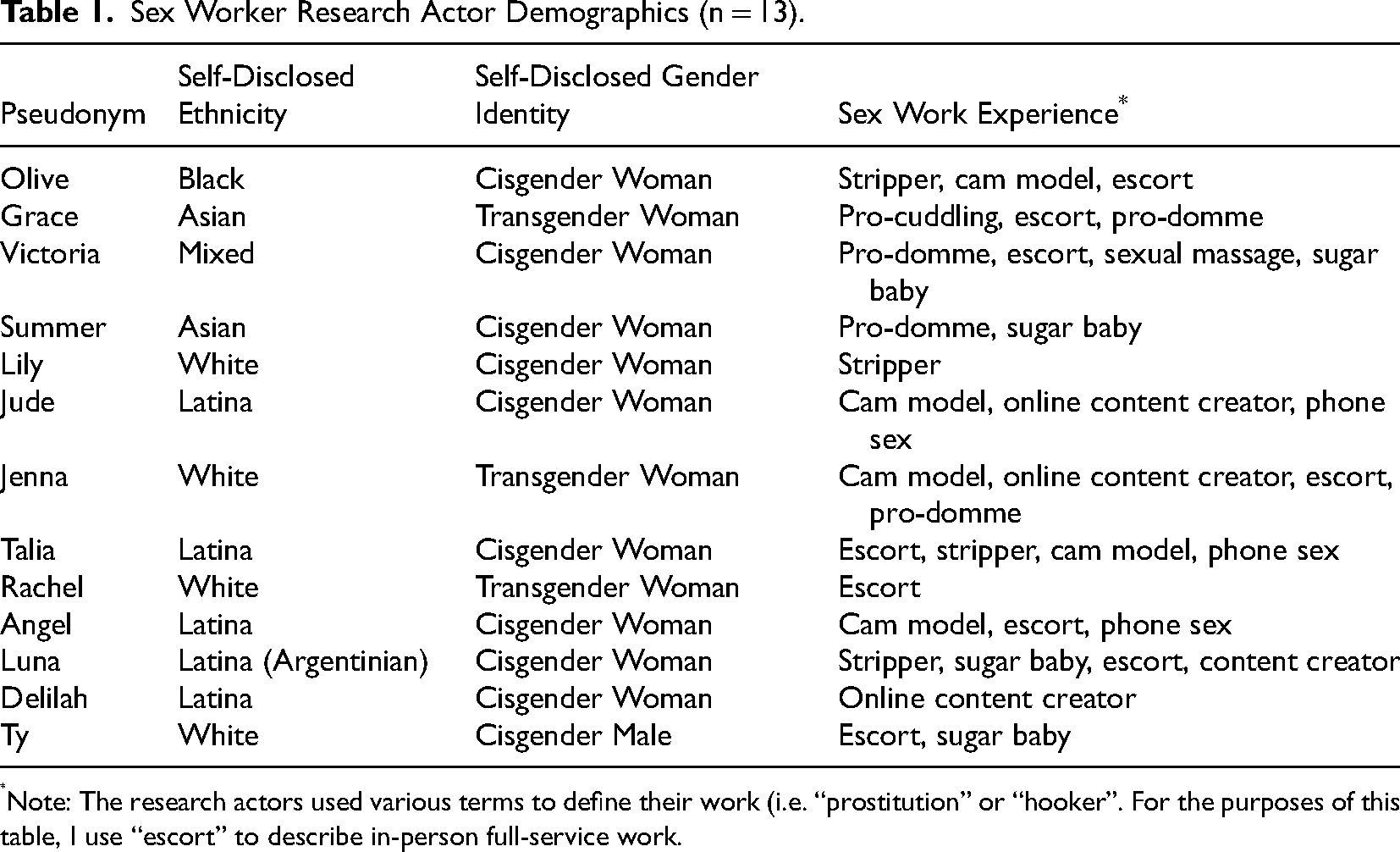
Note: The research actors used various terms to define their work (i.e. “prostitution” or “hooker”. For the purposes of this table, I use “escort” to describe in-person full-service work.
To ensure a descriptive breadth of sex worker perspectives under the consultation of SWOP LA members, I conducted intentional criterion sampling of diverse work field, race, gender, and class attributes, specifically reaching out to transwoman and people of color who did a variety of sex work types (e.g., camming, pro-domming, escorting). Eligibility criteria asked that they be current or former sex workers aged 18 years or older who provide services in Los Angeles County. Exclusion criteria included being a sex worker outside of Los Angeles County or not having consented to the work. The advertising of the study utilized criterion sampling by emphasizing a focus on marginalized identities to avoid oversampling workers that overlap in social circles and to ensure occupational and demographic representation. As a part of the intersectional PAR framework, the study sought to center voices that have historically been silenced and in doing so, elevate the voices of these specific research actors.
Due to the sensitive nature of the interview content, I transcribed the qualitative data using Temi, an encrypted transcription software and Dedoose to code and analyze the data. I compiled an initial list of codes that emerged from the dialogues through coding larger segments of text and double- or triple- coding using in-vivo, descriptive, and concept coding (Saldana, 2015). During this time, the researcher engaged in the method of “member checking,” consulting with the research actors during the analysis to clarify emergent ideas, validate findings and support the quality of the research (Saldana, 2015, p. 35). After reviewing overall trends from the dialogues with the research actors, I conducted axial coding until two major categories emerged around how sex workers were impacted by the whorearchy and collective care.
Results
The Whorearchy as an Extension of Criminalization
The whorearchy bases itself on “whorephobia”, the fear and hate of sex workers. As such, it is similarly arranged to the hierarchy described earlier, with sex workers who have more proximity to full-service contact near the bottom. The sex worker-defined concept of the “whorearchy” emerged in the dialogues when workers described the intricacies of their criminalized experiences. Their dialogues revealed the intersectional impact of their positionality on access to support networks. A quality of the whorearchy is its intersectional format and inclination towards rewarding cisgender women and proximity to other institutions of whiteness. This was seen in higher pay rates and more job opportunities.
Moreover, the whorearchy is whorephobic due to its classist system that stratifies workers by privilege and compounds the internal and external stigma that they face. The implications of this system play out amongst sex workers and are reinforced economically by their clientele, as Luna explains: I have a friend who is half Black and often chooses to hide her Blackness, to make more money, which is really sad that that is a thing that she has seen results from. But because she is privileged enough to have ambiguity of her appearance when she is able to, she presents as not Black and she makes more money than when she does not present as Black. And then I have sex worker friends who do not have the luxury of presenting as non-Black. How we present literally determines what we charge and what we're offered and what guys say to us. (Luna, 5 November, 2020)
Within the whorearchy, systems of oppression that are present throughout everyday life are magnified and ageism, racism, ableism, classism, and the type of work that a research actor engages in define their sex worker experience. Where the umbrella of sex work may serve to unify some workers, it is also prone to its own forms of stratification that one research actor describes below: Even in work, it was a really interesting experience to see people come in to start working [at a BDSM dungeon], who were, bi, gay, trans, white, non-white, racially ambiguous, middle-class, low income, wealthy, sober, addicted, recovering. It's like all these different things that would play into a part. And there was this algorithm where someone could come in and you could be like, “I know how they're going to do”. They could be a really amazing person who gives an awesome session, but they are not going to advertise well. (Victoria, 27 October, 2020)
In the following sections, I dissect the impact of the whorearchy and how the social positioning of sex workers based on the intersection of their type of sex work, race, class, gender, age, and ability impacts their relationships with clients and each other.
The girls who were Black just had such a harder time because their ads didn't do well. And like, I'd have doubles with them. They were fricking amazing, like just slamming bodies, gorgeous. But they're across the board just treated differently by clients. (Victoria, 27 October, 2020)
Furthermore, the whorearchy also impacts the ways that clients treat sex workers. As a transgender provider, Rachel reflects on her experience feeling the impacts of criminalization through being visibly transgender and how this has defined her experience as a hooker: Similar to my law resume being received differently because I'm trans, I do feel like being a trans woman without major porn exposure I don't really have the market power to advertise as an escort or to screen clients thoroughly… I don't really have access to that kind of clientele, and I think the clients that don't want to screen are the same clients that want to know exactly what they're getting beforehand, so you've got these picky clients. I end up doing work that is legally considered prostitution and really having to say I'm a whore if I'm trying to have an honest discussion. (Rachel,15 November, 2020)
The troubling biases that clientele have against workers who are not cisgender white able-bodied women go unchecked in the sex work field and serve to further disparities for already marginalized workers. Similar to how race is a social construct with real-life implications, the whorearchy is a societally constructed paradigm that, when reinforced by clients, has an impact on research actors’ working conditions.
In the following section, we see the impacts of when sex workers themselves reinforce the whorearchy.
It is good for your money to appear less whore-y than the other girls. So, whatever the other girls are doing, you want to be slutty, but not whore-y because you want [the clients] to feel like they're buying something exclusive. You want to be Nordstrom’s not Forever 21. Cause that's why Nordstrom's charges what they charge and Forever 21 is like, ‘We have deals!’ That's why some people offer street services with street prices (Luna, 5 November, 2020)
Within sex worker spaces, there were common feelings of mistrust and “compare and despair” due to the fear of being caught for doing criminalized forms of sex work in a legalized environment (strip club) or being outed by other workers to their communities. Grace describes how holding multiple criminalized identities creates barriers to trust: Doxing isn’t limited from client to provider. It's also provider to provider as well. So, I think me telling people I'm trans [is] a liability. If someone wanted to do me harm, they can use that knowledge to do harm to me. I've had clients do that and I could piss off some other provider, we can get into a fight or whatever and they can go do that to me if they wanted to. You know? So it's hard to trust people and just hard to trust other workers. (Grace, 20 October, 2020) I pick and choose because I work in the club and somebody having that information could get me in trouble. Also, even though they're my close friends [club coworkers], I don't want to burden them with that information. I just think it's a conflict of interest in that world. Now my friends who don't dance, I'll talk about it with them. I'm not planning on telling my parents but that's just cause that's what we gotta deal with. It's still such a stigma and it's illegal. So as much as I’d like to be open, I have to be careful, not cause of shame, it's just cause those are the situations. (Talia, 27 October 2020)
Talia's hesitation in disclosing that she is a full-service provider to her coworkers in a club that is strictly a bikini bar is central to understanding the way that sex workers navigate engaging in multiple forms of sex work in varying settings of criminalization.
The articulation of Talia's reasons impacting her selective disclosure demonstrates the tension that lies within sex worker spaces. It is a deeply complex reality that sex workers navigate to keep themselves safe and well in a criminalized profession. Many of the workers identified situations where they experienced intergroup hostility from other workers.
Lily shared how her attempts to connect with other workers was frequently misinterpreted due to the prevailing hostile environment she faced in her club, “Some girls are just cut throat. If you give, they’ll take advantage of your kindness, and be so ugly to me and I don’t understand because we’re doing the same thing. Like we can help each other out, you don’t have to be nasty.” (Lily, 13 October 2020) Similarly, Luna shared an experience about a fellow worker who attempted to get her in trouble at work: She [told the boss], “This girl was an escort.” Which was just funny because, and not to whore shame, but she literally kissed like every single person that came into the club and this is before [COVID-19], but I'm like, girl, I don't know if they're selling you Coke or what? Cause she made enough money, you know? And I'm like, good for you. Sell the drugs by all means, do your thing. But like you don't need to kiss them all. I got called to the boss’s office and the boss was like, “I heard you're escorting,” I'm like, “Actually it's called sugar baby. It's legal. But where did you find this information?” And she was like, “I see it from this [Instagram post captioned, ‘sex work is work’]” and I'm like “Stripping is sex work.” And she's like, “This is not a strip club.” I asked, “is that not a pole I dance on?” And she's like, “It's a bar.” I'm like, okay. Wow. (Luna, 5 November, 2020)
This quote's significance is layered. Luna was stigmatized for engaging in sugar arrangements, which based on previous literature generally sits higher on the whorearchy. But she still faced hostility in the club environment suggesting that access to “higher levels” of sex work does not preclude stigmatization from other sex workers who may sit at “lower ranks”.
Luna was one of the research actors who was particularly vocal about her awareness of the whorearchy and yet in her description of the worker who tattled on her, her verbiage of judgement towards this worker plays into the dividing forces of the whorearchy. Finally, the club manager's jump from an acknowledgement of sex work as being equivocal to engaging in escorting serves as an example of why sex workers may feel the need to distance themselves from sex work of any kind.
This fear of being outed as a sex worker often disrupted networks of information sharing. This was because of the way that trafficking policy has further criminalized any form of information sharing as possible trafficking efforts. One research actor expanded on how she navigated giving advice to other sex workers while avoiding further criminalization by keeping her exchanges within the veil of legality as much as possible: “When I give advice, I try to just make it like the gray area of you wanna date rich dudes cause there's nothing illegal about that” (Luna, 5 November 2020). Luna's reflection on the tension that comes with associating with, and distancing from, sex work illustrates the larger consequences that workers face. Even if an individual may not identify as a sex worker or they engage in legal types of work within the sex trade, blanket criminality will impact the way sex workers are treated by their clients and each other.
Sex Worker Spaces as Nodes of Collective Care
Some of the research actors worked independently rather than at a formal sex work venue where they had typical coworkers (such as a strip club or BDSM dungeon). Regardless, all of the 13 research actors identified spaces where sex workers congregated (both in-person and online) and how their engagement with other workers served as a main space of education for harm reduction and a refuge for collective care against forces of the whorearchy. These spaces varied from online social media forums, sex worker's rights organizing groups, formal workspaces, and online platforms they used to solicit clients and perform their services. These spaces provided safety, harm reduction, and mutual aid by facilitating informal information sharing that helped sex workers implement safer and more effective working practices. In doing so, it created a network of protection by sex workers against flawed systems that denied them access to aid and services.
The research actors described the ways that the sex worker spaces they have inhabited has contributed to building vital networks of mutual aid and harm reduction. When she was out of work due to the pandemic, Olive recalled how her coworkers at her club took her under their wing: I wasn't working at all. When I first got removed from [club name], [my coworker] was another one that was like helping me to look for work, you know, taking [pole dance classes] from me. And I had a slew of other people just personally come to my aid. I had some people like just giving me donations for [pole dance classes]. And they’ll just say, “I'm not taking the privates, just take the money”. I tend to not ask for anything, just people kind of give. (Olive, 26 October 2020)
A core understanding shared amongst the research actors was the stronghold that the sex worker collective provided for them in their hour of need. All the research actors could describe instances when they helped other sex workers and vice versa. Rachel describes the crucial contributions she received: Once I was homeless, the friends I've made through SWOP were people that I felt comfortable talking to about it or asking them for help and talking through things in my life. I got a safe place to stay a few nights and showers and meals and things from [other workers] who are caring. Shelter, showers, electricity, food, all that was a really big deal to get from my social network. (Rachel, 15 November, 2020)
Similarly, Ty describes how having a shared ingroup proved necessary for his wellbeing: Some of my friends I lived with off and on for example, I was okay with them working because they were okay with me working. So that was part of why we could live together. You know, we needed each other to split the rent. They still found themselves in dangerous situations, just like I would sometimes, but at least we knew that we weren't going to get kicked out by our roommate, which is such a big problem, so at least we had that and we could talk about [sex work] openly, just cause like we're just friends and like you're talking about everything in the world openly, you know? So it's not an issue where we need to like process stuff. It's just very commonplace. So in a way that helps to process. In the civilian world, I've experienced a sense of derealization …that's why it helps to have people that it was normalized to talk to about it. We weren't processing feelings just having that mutuality. (Ty, 16 October, 2020)
There was a unified understanding that formal systems of support have never been accessible to them, but by banding together they could keep each other afloat and succeed in this informal economy.
Jenna described how her disability requires her to take several medications and inject herself with low-grade chemotherapy treatment to survive, but it was her sex worker community that proved to be lifesaving: I would not have been able to get my medications for about nine months before I got Medi-Cal, because I didn't know how any of that worked. I didn't know how to get state insurance. I had nobody guiding me, nobody helping me. I then had a couple of friends who one was a social worker who has a history in sex work. And another friend who was a porn star who guided me and helped push me to get proper doctor treatment, proper care, all the different things, but even so, I didn't have Medi-Cal for like nine months and had to pay for medications out of pocket. Without them, I would be dead right now. I don't even have to think about it. (Jenna, 9 October, 2020)
A concept that many research actors resonated with was the limitations of collective care. As seen in Jenna’s story, these systems of collective care are essential. But they do not solve the inequities within healthcare, housing, and government support that actively threaten their existence. Even though having stability and networks of emotional support does not equate to safety within client sessions, Grace illustrates how her preventative safety measures rely on her community: I was dating a sex worker and we were looking out for each other as we're working. She got me to come [to New York] and then the housing she sent me fell through, but she was able to connect me with another girl, which made me stay longer. So that was really great. In terms of helping another sex worker, even if they're strangers, I’ll share Mr. Number
6
with the rest of the cuddle pros who do the same thing as me. We do look out for each other in that way cause we know what we're doing is inherently dangerous. (Grace, 20 October, 2020)
Like in all work environments, supports are not constantly available, which makes formal safe working conditions all the more necessary. However, when criminalization prevents the creation of formal protections, the support networks that sex workers highlighted hold greater value.
In a world where this hyper-marginalized population faces extreme need and criminalization that makes them wary and sometimes unable to navigate the welfare system, community poses a life-saving connection to resources through mutual aid. In Bateman's comparison of care workers and sex workers, they highlight how in a siloed field where abuse and exploitation are commonplace, domestic workers have banded together to combat their work-related hazards (2021). Similarly, the mutual aid that was described in this study works to foster wellbeing and even counteract forces like the whorearchy. Grace describes how her collective helped her to find clients without outing herself as a transwoman which carries significant risk: I can't be out there on Eros or even my website being the trans provider, you know? I wouldn't have been as successful doing what I do today as a trans provider on my network. So if I want to work as a trans provider, I can connect with other sex workers who can put out the word for me and get me work in that way. I worked with [Summer] and she had a guy that specifically wanted a trans provider. So I can work through the grapevine, but I can't put myself out there as a trans person anywhere, even on dating sites just because I can't jeopardize [being outed as trans]. (Grace, 20 October, 2020)
Organizing efforts to redistribute wealth and offer peer support had substantially increased in moments of high need during the pandemic when many sex workers already did not have access to traditional relief funds or government assistance. Olive shared how she received mutual aid from sex worker organizations who distributed emergency relief to sex workers during the pandemic and how likewise, “I work with those organizations [when] they want me to volunteer or do a show, I do it without them even asking me.” (Olive, 26 October, 2020) The shows she referenced, “Jolene” and “Dirty Dayshift Revival”, raised funds during the pandemic that prioritized queer and transgender sex workers of color, especially Black and/or Indigenous transgender sex workers, with a portion of direct cash relief being distributed to street-based full-service sex workers who experience hyper-criminalization.
For sex workers, these safety nets are crucial both before and after their shifts, whether they text their sex worker friends their location in case they need help or if they need to vent after a stressful client.
A key aspect of sex work that arose in the dialogues was the way that sex workers could support each other like no other civilian could. By acknowledging their interdependencies, they can defy the systems surrounding them that are uncaring by design.
While there is power in this collective, like in all work environments, support is not constantly available which makes formal reliable safety even more necessary. In the following section, I discuss the unique ways that criminalization limits the support available within these networks.
Discussion
The contributions of the research actors in this paper furthers our understanding of how criminalization magnifies the inequalities that sex workers face. The whorearchy, operating from this criminalization, perpetuates a social hierarchy that relies on the oppression of already marginalized workers and interrupts networks of collective care. The research actors in this study revealed that there is a system of communal care and mutual aid that operates exclusively by and for sex workers that reject societal surveillance and oppression. Despite the constant threats they face, there is documentation of sex workers nationwide banding together to create unions and sustain mutual aid funds as they have historically through more formal networks (Braslow, 2019; Nothing, 2013; Rhee & Saunders, 2020). Concurrently, the very thing that makes sex work appealing, its lack of barriers to entry, is the very thing that sabotages sex workers’ safety, as seen through the barriers towards success and access to these supports based on their position in the whorearchy. The criminalization that the whorearchy is reinforced by is defined by intersectional forces rooted in structural racism that prioritize proximity to whiteness. This structural violence that workers face due to white supremacy and criminalization is especially felt by historically excluded groups such as Black and transgender women, disabled, and poor workers.
The discourse of these 13 research actors (Table 1) has opened a window onto the value of engaging in interconnectedness that collective care and mutual aid provides as well as the collective harm that can follow through pressure to view ourselves as separate from the whole. A main intersection of Black feminist thought and critical disability studies is its critique of achieving personal independence as the benchmark for wellbeing by citing the many communities that successfully operate on systems of communal care (Bailey & Mobley, 2018; Schalk & Kim, 2020). The whorearchy is a testament to how systems of white supremacy harm all sex workers (not only those who claim proximity to whiteness and privilege) because it denies workers access to a protective environment where they must constantly compete rather than care for each other. Racism, transphobia, and other isms only compound the heightened vulnerabilities that workers face. While the pressures of criminalization via the whorearchy silos individuals and pit workers against each other for fear of being outed, this framework acknowledges the necessity of systems like mutual aid for the benefit of the individual and the collective.
Unfortunately, this paper reaffirms previous work that identified criminalization as a major disrupter of peer networks and harm reduction for sex workers (Baratosy & Wendt, 2017; O’Doherty, 2011; Platt et al., 2018). Previous literature expresses a vague understanding of who sex workers are (often conflating them with survivors of sex trafficking) and calls for a contextualized understanding of the different marginalization impacting sex workers (Sawicki et al., 2019).
The sex worker-defined concept of the whorearchy is further complicated rather than simplified to include the internal and external pressures of stratification on sex workers and the complexities of their experiences. The whorearchy itself has been acknowledged in previous research and grey literature (Knox, 2014; Witt, 2020) but the literature has yet to analyze the whorearchy's impact on accessing collective care (Aylsworth, 2020; Hester & Stardust, 2020; Sawicki et al., 2019).
This research has conceptualized the whorearchy from the narratives of these research actors and furthers the collective analysis of this social hierarchy. While it is debatable who ultimately sits at each rung of the whorearchy and how permeable these layers are, its identification introduces a vessel for understanding the structural oppressions that ultimately hurt the entire collective's potential for coalition building. In a criminalized profession where workers are constantly evading the punishing arm of the state, the internal policing within this labor force furthers the uncertainty amongst sex workers regarding who they can trust, contributing to the marginalized nature of their work. Criminalization acts as the propelling force that reinforces the implementation of the whorearchy on the individual and systemic levels.
The implications of whorearchy create a culture of silence rather than a culture of care. Research actors feared the criminal and personal consequences of outing if they shared the extent of their work with other sex workers. Moreover, the whorearchy is not an isolated system that is upheld by sex workers. Clients, local communities, and policymakers sustain whorephobia by reinforcing the idea that sex workers require rescue rather than rights. These systems reinforce a white supremacist heteropatriarchy that does the work of oppression.
To fight this oppressive system, there must be a wide level recognition from service providers of how we have denied our interconnectedness with sex workers and banished them from our communities by accepting their criminalization (Kim, 2018). As seen within the context of the Black Lives Matter movement, which was called to acknowledge their intersectional differences and explicitly include all Black lives in their organizing (Clark et al., 2018), there must be a collective investment from sex workers to acknowledge intersectional differences in their organizing for sex workers’ rights that includes all of their marginalized members to combat the whorearchy.
Many of the research actors expressed familiarity or direct organizing with Sex Worker Outreach Project – Los Angeles (SWOP LA), a sex worker run group that provides direct services, community events, and organizes to protect sex workers who face the most surveillance and policing (SWOP LA, 2021). These efforts to combat the repelling forces of the whorearchy are happening nationally. Organizations such as Red Canary Song, a grassroots sex worker organization of self-identified Asian American sex workers in New York organizes in parallel with prison abolitionist groups and transnational efforts to uplift issues of importance for Asian sex workers across the globe (Red Canary Song, n.d.). As a community-enforced dynamic, critical disability studies push us to do more than acknowledge oppressions but to imagine futures where the community practices radical dissent and rejects these oppressions to lean into a coalitional future (Heisinger-Nixon, 2017). Current organizing efforts show us that coalitional futures may be closer than they seem.
If the goal is to improve the structural conditions to make sex work safe, it is critical to address criminalization, racism, ableism, and the other structural systems that oppress workers (Vanwesenbeeck, 2017). Specifically, sex work deserves the same protection as any other workforce “not based on the dignity of work, but on the unconditional value of [their] lives” (O’Brien, 2019). By providing this labor force with legitimacy we can begin to distinguish the ways that sex work and trafficking vary and how criminalization exacerbates baseline conditions for both groups (Huang, 2015; Kim, 2018). Furthermore, the way that criminalization furthered stratification amongst workers due to the whorearchy highlights the state's role in upholding white supremacy. Critical disability scholar, Dean Spade, cautions communities who pursue rights-based platforms to avoid positioning the state as a provider of protections. This is essential in order to avoid subsequently erasing their more marginalized members who are more likely to experience state violence (Spade, 2015).
Even though the study revealed the tensions within sex worker circles, it also highlights the potential of movement building for collective care to disentangle community care from the state. This begs the question, what role can social workers play in this? The National Association of Social Workers (NASW) Code of Ethics details the standards and practices that social workers, in theory, uphold to further the general welfare of society (NASW, 2021). The 2020-2021 revised code of ethics acknowledges that “instances may arise when social workers’ ethical obligations conflict with agency policies or relevant laws or regulations.” But how do social workers grapple with supporting sex workers when our relationship with the police runs counter to the safety and liberation of sex workers? Based on past and present actions from the social work profession regarding sex workers, there is a strong dissonance between ethics and practice. Educator and philosopher, Paulo Freire, urges that to become agents of social change instead of agents of social control, social workers must actively lessen the distance between discourse and action (Freire as quoted in Moch, 2009).
We cannot place an emphasis on promoting a client's self-determination, yet at the same time take a paternalistic approach towards rescuing sex workers while disregarding the systems that sex workers have developed to care for themselves. By understanding the state as the enactor of violence, implications for sex work organizing and social work scholarship include integrating disability justice's anti-capitalist concepts of non-conformity and creating a culture of access to shift the responsibility of change onto the state (Miles et al., 2017). It is our duty to engage in our potential for social justice implications while identifying social work's own complicity as servants of the same state that has enforced violent policies on the populations it claims to serve.
As such, this researcher urges scholars to question the underlying assumptions that criminalize sex work in the first place and our profession's role in practicing based on moral prejudice. If social workers are currently only able to programmatically assist sex workers who have the capacity to comply with the demands of the state, we must dismantle police collaborations and shift to an anti-carceral social work model to provide life-affirming services to sex workers (Jacobs et al., 2021). However, the current knowledge we receive about sex workers primes us to assume that all sex workers need to be rescued with the help of carceral interventions (Panichelli, 2018). This study contributes to other studies that worked collaboratively with sex workers to co-produce knowledge that is affirming of their experiences to inform policy and practice (Desyllas, 2013; Grittner & Sitter, 2020; Wahab, 2004). Until social welfare actively rejects the carceral and moral practices that fuse it to the carceral state, the field will continue to reaffirm the whorephobia that underpins the whorearchy and distance sex workers from us out of fear of facing repercussions for what they do to survive (Mattsson, 2014).
An anti-carceral social work practice that works to defund the police, decriminalize poverty, and end the surveillance of community members is necessary to set the foundation for placing the interests of marginalized communities at the center of our practice (Desyllas et al., 2021). Despite the profession's shortcomings, this study views a potential for the profession to transform by separating itself from the source of its tension: its loyalty to the state.
While social welfare may not be directly responsible for the laws that criminalize sex work, the silence and inaction in speaking out against these injustices or even worse, speaking for sex workers without their consideration and assuming victimhood furthers the state violence that they face. By only providing services on the condition that they exit the trade, furthering practices of surveillance, and furthering a victim narrative when the reality is complex, even a well-meaning social worker can uphold and reproduce social structures and oppressions (Mattsson, 2014). Research that acknowledges harm and uplifts the knowledge that lies within communities is key towards countering this historical oppression to meet people where they are. Through a care-based approach to dialoguing with sex workers, researchers would be better positioned to identify structural interventions that support sex worker resistance to oppressive systems that marginalize them. So long as sex work remains criminalized, the oppression and silencing of this population will continue to happen, and the criminal (in)justice system will continue to revictimize communities. We must continue to deepen our understanding of the power structures that underpin the experiences of workers in the sex trade that surpasses gender and sexuality. A social work approach should do everything possible to minimize the oppressive systems we see in the whorearchy and increase worker agency so that sex workers can lean into the social and political mobilization they are primed to do (Zangger, 2010).
Conclusion
This research shows how criminalization hurts all members of the whorearchy, regardless of legality, while further harming workers whose identities carry inherent criminality such as Black, transgender, and undocumented workers. As evident from Los Angeles’ sex worker communities, the collective care that sex workers engage in is necessary to mitigate harm within this criminalized profession. As it currently stands, clients, sex workers, and the social work profession's discriminate care infrastructure furthers the whorephobia that upkeeps a toxic whorearchy. To end larger structural violence and protect sex workers, the responsibility falls on those inside and outside the whorearchy to combat it. The social work profession cannot provide affirming services when the larger system is dangerous to sex workers because of our alignment with carceral systems. In the fight for justice-seeking, sex workers, practitioners, and researchers alike need to dismantle the power relations that fortify the whorearchy, starting with criminalization. By fully understanding sex workers at all their intersections we can continue the fight for collective liberation.
Footnotes
Acknowledgments
Dedicated to the comrades and sex workers who refuse to let the police state dictate their lives. Your spirit of resistance and love light a fire that will always keep us warm. I want to express gratitude for the funding provided by the UCLA Lewis Center for Policy Research, Center for the Study of Women, and the UCLA Luskin School of Public Affairs.
Declaration of Conflicting Interests
The author(s) declared no potential conflicts of interest with respect to the research, authorship, and/or publication of this article.
Funding
The author(s) disclosed receipt of the following financial support for the research, authorship, and/or publication of this article: This work was supported by the UCLA Luskin School of Public Affairs, UCLA Lewis Center for Policy Research, Center for the Study of Women, University of California, Los Angeles, (grant number Franklin D. Gilliam, Jr. Social Justice Award, Fellowship for Regional Policy Studies, Mariame Kaba Black Feminist Initiative Graduate Fe).
