




Abstract
We diagnosed epitheliotropic T-cell lymphoma of the forestomachs in 2 aged, half-sibling, zoo-managed bontebok (Damaliscus pygargus pygargus). One bontebok also had mesenteric lymph node and cutaneous involvement. Both animals had a history of chronic abdominal distension and diminished body condition that resulted in euthanasia. At autopsy, both animals had marked ruminal distension with diffusely blunted ruminal papillae and reticular crests. In case 1, there was an increased amount and particle length of the ruminoreticular fibrous material with scant fluid, and a 2-cm diameter focus of cutaneous crusting adjacent to a mammary teat. In case 2, the rumen and reticulum were fluid-distended with decreased fibrous material. Histologically in case 1, the rumen, reticulum, omasum, and skin had intraepithelial nests and sheets of neoplastic small lymphocytes; in case 2, the rumen and reticulum had a similar neoplastic cell population. Immunohistochemically, neoplastic lymphocytes were immunoreactive for CD3 and negative for CD20, confirming the diagnosis of epitheliotropic T-cell lymphoma.
The bontebok (Damaliscus pygargus pygargus) is a grazing antelope endemic to South Africa. Brought back from the brink of extinction in the 1830s, when the population reached a nadir of 61 animals, this subspecies has a genetic bottleneck and resulting low genetic diversity. 22 Epitheliotropic T-cell lymphoma has been reported previously in the alimentary tract (esophagus, rumen, colon), mesenteric lymph nodes, reproductive tract, and liver of a 16-y-old female zoo-managed bontebok. 2 Here, we report 2 additional cases of epitheliotropic T-cell lymphoma of the forestomachs in bontebok who shared the same dam, were housed at the same zoologic facility, and had similar clinical presentations; one case also had cutaneous epitheliotropic T-cell lymphoma. Clinical signs for case 1 were observed 28 mo prior to case 2, and case 1 was euthanized 15 mo prior to the diagnosis of lymphoma in case 2.
Case 1 was a 15-y-old female bontebok with a 2-y history of ruminal distension and decreasing body condition. The bontebok was euthanized after becoming acutely lethargic and having difficulty standing. On postmortem examination, the bontebok was in poor body condition with marked dental attrition. The rumen was distended and contained an increased proportion of long plant fibers and decreased fluid content. The ruminal papillae were markedly and diffusely blunted, and the reticular crests were similarly blunted and thickened. A 2-cm diameter area of skin overlying the mammary chain was crusted, and there was asymmetry in teat size. All other organs were grossly unremarkable. Liver trace mineral analysis was consistent with copper deficiency (8.5 µg/g dry weight; normal reference for adult cattle is ≥30 µg/g dry weight). 13
Sections of heart, spleen, trachea, kidneys, adrenal glands, lung, peripheral nerve, lymph nodes, thyroid gland, parathyroid gland, mammary gland, skin, tongue, liver, omasum, abomasum, reticulum, rumen, duodenum, small intestine, colon, pancreas, skeletal muscle, cartilage, and eyes were preserved in 10% neutral-buffered formalin, processed routinely, and stained with hematoxylin and eosin. Sections with lymphoma were also immunolabeled using a polyclonal rabbit anti-human CD3 antibody (1:200; Dako) and a polyclonal rabbit anti-human CD20 antibody (1:200; Bioz Thermo Fisher Neomarkers) according to the manufacturers’ recommendations.
On histologic examination, the epidermis in the mammary gland region was markedly hyperplastic regionally, with compact orthokeratosis. The epidermis was obscured by neoplastic lymphocytes arranged in numerous, discrete intraepidermal nests and sheets (Fig. 1). Similar neoplastic cells extended into the follicular infundibular epithelium, and rare neoplastic cells were present in perivascular areas of the dermis. Neoplastic lymphocytes contained scant pale eosinophilic cytoplasm and small (<1.5 times the diameter of an erythrocyte), finely stippled nuclei with one-to-multiple nucleoli. Anisocytosis and anisokaryosis were mild. Mitoses ranged from 1–3 per 400× microscopic field. In all sections of the rumen, reticulum, and omasum, the mucosa was diffusely obscured by intraepithelial sheets and nests of similar neoplastic lymphocytes. The number of mitoses in these tissues was up to 8 per 400× microscopic field. One section of the mesenteric lymph node had diffuse loss of corticomedullary architecture with marked expansion of the paracortex, compression of subcapsular sinuses, and effacement of cortical follicles by sheets of similar neoplastic lymphocytes. No peripheral lymph node involvement was noted.
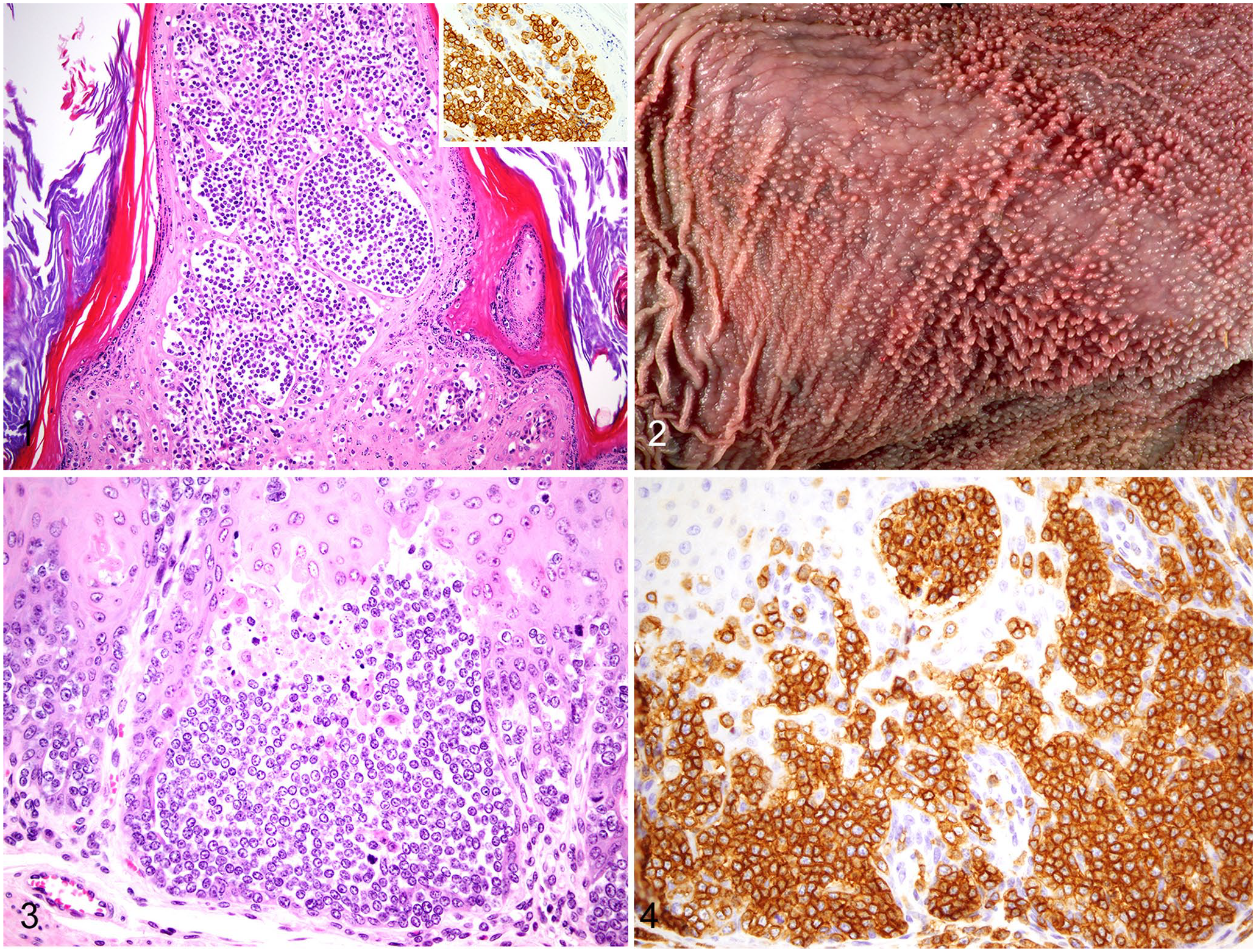
Epitheliotropic T-cell lymphoma in 2 half-sibling bontebok.
Sections of haired skin and reticulum were immunohistochemically labeled for CD3 and CD20. Neoplastic lymphocytes in both the haired skin and reticulum had diffuse perimembranous immunoreactivity for CD3, and were not immunoreactive for CD20, confirming the diagnosis of epitheliotropic T-cell lymphoma (Fig. 1, inset). Other noted histologic lesions included marked serous atrophy of fat; focal aspiration pneumonia; and mild renal interstitial fibrosis.
Case 2 was a 12-y-old castrated male bontebok with a history of a few weeks of intermittent abdominal distension and decreasing body condition, despite normal appetite. On physical examination under anesthesia, the body condition score was 4 of 9, the rumen was distended with increased fluid content, and there was a grade III of VI heart murmur. Complete blood count, serum chemistry, trace mineral panel, and ionized calcium were unremarkable except for hypocalcemia (iCa = 0.92 mmol/L, RI: 1.17–1.3 mmol/L; 11 total Ca = 1.68 mmol/L, RI: 2.13–3.27 mmol/L) and low serum zinc (Zn = 4.6 µmol/L, RI for cattle: 13.8–26.0 µmol/L). 18 A rumen content sample had a pH of 8 with normal flora present on cytologic examination. Radiographs and ultrasound were unremarkable except for an enlarged rumen.
The bontebok was re-anesthetized 2 mo later for left flank exploratory laparotomy, rumenotomy, and rumen biopsies because of worsening ruminal distension, decreasing body condition, and intermittently clumped stool consistency. During surgery, the rumen was severely distended and flaccid with markedly increased fluid content and scant fiber. Ruminal papillae were severely, diffusely blunted. Rumen fluid pH was reduced to 7, and cytologic examination showed markedly decreased flora. Given the poor prognosis, the bontebok was euthanized. On postmortem examination, the bontebok’s ruminal content and mucosal abnormalities observed antemortem during surgery were confirmed (Fig. 2), along with poor body condition. No other gross abnormalities were noted. Liver zinc and copper levels (103 µg/g and 302 µg/g, respectively) were within normal limits (RI for white-tailed deer: 75–210 µg/g [zinc], 180–500 µg/g [copper]). Tissues (cerebrum, cerebellum, brainstem, heart, lung, liver, kidneys, spleen, forestomachs, small and large intestine, trachea, thyroid gland, adrenal gland, bone marrow, lymph node, tongue, urinary bladder) were processed routinely for histologic examination as described above.
On histologic examination, the epithelium of the rumen and reticulum was multifocally infiltrated and effaced by a population of small neoplastic lymphocytes (Fig. 3). Neoplastic cells were arranged in variably sized, discrete intraepithelial nests, or dense sheets. Adjacent epithelial cells were degenerate with marked cytoplasmic swelling or necrotic with hypereosinophilia, fragmentation, and pyknosis. Mucosal erosion or ulceration was not observed. Neoplastic cells extended minimally and multifocally into the underlying submucosa. Neoplastic lymphocytes had scant cytoplasm and small, euchromatic nuclei. Anisokaryosis and anisocytosis were mild. The number of mitoses was 0–1 per 400× microscopic field. A few neutrophils were scattered among the neoplastic population. Sections of the rumen and reticulum were immunohistochemically labeled for CD3 and CD20. Neoplastic lymphocytes within the ruminal epithelium and the lamina propria exhibited diffuse perimembranous immunoreactivity for CD3, and were not immunoreactive for CD20, confirming the diagnosis of epitheliotropic T-cell lymphoma (Fig. 4). Other histologic lesions included moderate lymphoplasmacytic abomasitis and enteritis, and multifocal right atrial epicardial myofiber degeneration and fibrosis.
Our report includes 2 cases of epitheliotropic T-cell lymphoma in aged, half-sibling, zoo-managed bontebok with similar clinical presentations. The neoplasm involved the skin, forestomachs, and mesenteric lymph node in case 1 and was localized to the forestomachs in case 2. In the previously published case of epitheliotropic T-cell lymphoma in a bontebok, neoplasia involved the alimentary tract (esophagus, rumen, colon), reproductive tract, liver, and mesenteric lymph nodes, but not the skin. 2
Epitheliotropic T-cell lymphoma is characterized by progressive infiltration of neoplastic T lymphocytes into the cutaneous, mucosal, and/or adnexal epithelium.1,4,5,8,14,15 The skin is the primary site in most domestic animals.1,4-6 Among veterinary species, epitheliotropic T-cell lymphoma is most commonly reported in dogs, but also occurs in horses, cats, cattle, and alpaca, and is less frequently reported in nondomestic species.2,9,10,12,20,21 Epitheliotropic T-cell lymphoma occurs most often in older animals, with the exception of sporadic cutaneous bovine lymphoma (SBL), which typically occurs in cattle <3 y old. 17 Although some studies implicate chronic inflammatory conditions or allergy as risk factors for disease, the pathogenesis of epitheliotropic T-cell lymphoma remains poorly understood.3-5,8 In cattle, cutaneous lymphoma and other forms of SBL occur independently of infection with bovine leukemia virus, the causative agent of enzootic bovine leukosis.19,21 SBL can be of either T- or B-cell origin, whereas enzootic bovine leukosis is of B-cell origin.19,21
Following a scheme derived from human medicine, there are 3 subtypes of cutaneous epitheliotropic lymphoma: Sézary syndrome, mycosis fungoides, and pagetoid reticulosis.5,6,8,21 These subtypes are applied generally to domestic species, although clinical presentation may be highly variable in small animals.4,5 Sézary syndrome is characterized by peripheral lymphadenomegaly and the presence of neoplastic T lymphocytes within the skin, lymph nodes, and peripheral circulation.1,5,20 Mycosis fungoides is the most common subtype of cutaneous epitheliotropic lymphoma in humans and domestic animals, and is characterized by progressive infiltration of the skin with patches, plaques, and eventually nodules composed of neoplastic T lymphocytes.5,16 Neoplastic lymphocytes can extend as a lichenoid band into the dermis and subcutis.14,23 Pagetoid reticulosis is characterized by exfoliative erythroderma, scale formation, alopecia, and erosions or ulcerations without the presence of distinct masses. 1 Histologically, lymphocyte infiltration is confined exclusively to the epithelium without dermal or submucosal involvement.8,15
In case 1, cutaneous lesions most resembled pagetoid reticulosis, given that neoplastic cells were located predominantly in the epidermis and follicular infundibular epithelium with minimal dermal involvement. Cutaneous lymphoma with epitheliotropism has also been reported in a 13-y-old, zoo-managed addax (Addax nasomaculatus). 9 In the addax, the neoplasm occurred on a hindlimb as a regionally extensive area of alopecia, slight erythema, and skin thickening. Metastasis to a regional (peripheral) lymph node was noted. Histologically, the cutaneous lymphoma in the addax most closely resembled mycosis fungoides with neoplastic lymphocytes extending to the dermis and subcutis. 9 In cattle, cutaneous lymphoma typically occurs as multiple, firm, alopecic nodules prone to ulceration and crusting, and approximately half of affected cases develop generalized superficial lymphadenopathy and/or visceral involvement. 17 Epitheliotropism is uncommon in cutaneous lymphoma of cattle, and is usually found while the disease is still confined to the skin. 19 Given its rarity, the clinical presentation of epitheliotropic cutaneous lymphoma has been poorly described in cattle. 12
In all 4 reported cases of epitheliotropic T-cell lymphoma in antelope, including the 2 bontebok in our report, the disease affected older animals and occurred chronically over the course of months to years.2,9 In the report of cutaneous epitheliotropic T-cell lymphoma in an addax, disease was identified antemortem via biopsy. 9 In bontebok, diagnosis of epitheliotropic T-cell lymphoma has only been made postmortem on histologic examination. 2 Skin biopsies in bontebok with new skin lesions, or biopsies of the gastrointestinal tract of bontebok with recurrent or progressive ruminal distension, would be necessary to diagnose the disease in earlier stages. Rumenotomy in domestic cattle is considered a routine, safe, and effective procedure for diagnosis and treatment of forestomach abnormalities. 7 Given the clinical similarities with case 1, knowledge of previously reported ruminal lymphoma in bontebok, and the clinical signs of rumen dysfunction in case 2, exploratory laparotomy with rumenotomy was performed to identify potential neoplastic disease antemortem. However, given the severity and diffuse presentation of ruminal disease at the time of surgical examination, euthanasia was elected.
To our knowledge, there are no reports of the median survival time of bovids with cutaneous epitheliotropic T-cell lymphoma. In the case of cutaneous epitheliotropic T-cell lymphoma in an addax, the animal survived for 3 y after its original diagnosis, and disease was limited to the skin and regional lymph nodes at the time of euthanasia. 8 In dogs, the prognosis is generally considered to be poor, but varies depending on the stage of the disease at the time of diagnosis, the choice of treatment, and the response to treatment. However, dogs that are diagnosed early and treated with systemic chemotherapeutics have had median survival times >12 mo. 3
The sires and shared dam of cases 1 and 2 were housed at the same zoologic facility as our cases. The dam was euthanized when 12 y old, and diagnosed with an ovarian adenocarcinoma and chronic, non-neoplastic renal disease. The sire of case 1 was euthanized when 14 y old because of arthritis and chronic bronchopneumonia; the sire of case 2 died when 13 y old from non-neoplastic renal disease. We found no known published reports of other types of neoplasia in bontebok, highlighting the occurrence of epitheliotropic T-cell lymphoma in aged, zoo-managed bontebok. 2 Other known cases of neoplasia in this subspecies include the ovarian adenocarcinoma in the dam of cases 1 and 2, as well as a bontebok with multiple neoplasms (ruminal leiomyosarcoma, uterine leiomyoma, metastatic endocrine carcinoma of undetermined origin) mentioned as a personal communication in a previous report. 2
Additional information is required to understand the true prevalence of the disease in captive and wild populations of bontebok. The low genetic diversity in this subspecies and the occurrence of disease in 2 closely related individuals is suggestive of a genetic component to the pathogenesis of epitheliotropic T-cell lymphoma in bontebok; however, their shared environment was a confounding factor. Archived serum samples from both bontebok showed no detectable antibodies to BLV via ELISA performed at the submitting institution (Bovine Leukemia Virus antibody test kit; VMRD); however, antibody cross-reactivity in this species is unknown and this test has not been validated for use in non-domestic bovids. A genetic component has been proposed for epitheliotropic T-cell lymphoma in dogs, with overrepresentation of certain breeds including the English Cocker Spaniel and Boxer. 4
Footnotes
Acknowledgements
We thank Dr. Kurt Williams for his assistance with the autopsy and histologic interpretation of case 1. We thank the MSU Veterinary Diagnostic Laboratory Histology Laboratory for slide and IHC processing, as well as the Binder Park Zoo zookeepers for providing animal care.
Declaration of conflicting interests
The authors declared no potential conflicts of interest with respect to the research, authorship, and/or publication of this article.
Funding
The authors received no financial support for the research, authorship, and/or publication of this article.
