




Abstract
C-reactive protein (CRP) is a major acute-phase protein, and it is produced by the liver in response to a pro-inflammatory stimulus. Given that human and canine CRP have a similar molecular structure, the assays used for human CRP detection have been used to measure CRP concentrations in dogs. We evaluated the use of a human CRP assay (Biotecnica CRP assay) and validated its application in dogs. We analyzed 91 canine serum samples with a fully automated analyzer. Our validation was based on the evaluation of imprecision, limits of linearity, limits of quantification, and an evaluation of interferences. The new assay was also compared with the Randox CRP assay, a validated assay for the measurement of CRP. Intra- and inter-assay repeatability were <8% and <11%, respectively. The tested assay proportionally measured canine CRP in an analytical range up to 60 mg/L; however, hemoglobin, triglycerides, and bilirubin interfered with the determination. Good agreement, with the presence of proportional systematic bias, was observed between Biotecnica and Randox assays. The Biotecnica CRP assay provides reliable measurement of CRP in canine serum, provided that samples are free of interferents.
C-reactive protein (CRP) is one of the most studied acute-phase proteins; increased serum concentrations have been found in several conditions associated with an inflammatory and/or septic process. 18 In humans and dogs, CRP is produced by hepatocytes in response to pro-inflammatory stimuli and is composed of 5 subunits, with a total molecular weight of 100 kDa. 3 Differing from human CRP, 2 subunits of the canine CRP are glycosylated.2,4
Since ~1990, several tests have been validated for CRP determination in dogs, from the first ELISA 4 to those based on an immunoturbidimetric method. A canine-specific method of CRP analysis has been developed and is available commercially. 7 The use of canine-specific antibodies, reagents, and standards reduces the risk of insufficient cross-reactivity between anti-human CRP antibodies and canine CRP. 17 Even though the cross-reactivity between canine CRP and anti-human CRP antibodies is not complete, it is considered sufficient to guarantee meaningful results.7,11,13,15 After appropriate validation, assays used for human CRP detection are used for the measurement of canine CRP concentrations. We validated a new heterologous immunoturbidimetric assay for the determination of canine CRP serum concentration and compared the assay to a validated standard assay.
Blood samples were prospectively obtained from dogs that were presented to the Veterinary Teaching Hospital of the University of Padua (VTH-UP; Italy) from November 2016 to July 2017. The serum samples that we used were residual aliquots of samples collected for diagnostic purposes or for annual health checks. Thus, no ethical committee approval was needed. All procedures were performed in accordance with the relevant Italian and EU legislation concerning Animal Protection and Welfare. Written informed consent regarding personal data processing and the use of biological samples collected for testing and research purposes was obtained from the owners. In the first part of the study, we validated the Biotecnica assay (BA). In the second part, we compared the BA and the Randox assay (RA).
After clot formation, sera were obtained from blood samples collected in plain tubes by centrifugation at 1,750 × g for 10 min. Serum aliquots were stored at −80°C for a maximum of 8 mo until analysis. Hemolytic, lipemic, and/or hyperbilirubinemic samples were discarded. Serum pools were made by mixing samples from 3–5 dogs. Samples were stored in aliquots of 300 µL to avoid freeze–thaw cycles.
Analyses were performed at the Clinical Diagnostic Laboratory of the VTH-UP, using a BT1500 biochemical analyzer (Biotecnica) and 2 different immunoassays. The first assay was the Biotecnica CRP turbidimetric assay (BA), which uses a polyclonal goat anti-human CRP antibody as reagent, and it was standardized with “CRP Calibrator High”. The calibrator was derived from human plasma and was used for calibration at 5 levels of serial dilutions of the calibrator. CRP values were measured turbidimetrically at 340 nm. The assay range reported by the manufacturer for the BA method was 6–220 mg/L. The second assay, used as the reference method, was the Randox canine CRP assay (RA), validated previously in dogs. 13 This assay had polyclonal goat anti-human CRP antibody as reagent and was standardized with a canine CRP calibrator at 6 levels of serial dilution and measured turbidimetrically at 340 nm. The assay range reported by the manufacturer for the RA method was 5–200 mg/L. Both assays were standardized as recommended by the manufacturers.
The precision study included intra-assay and inter-assay repeatability of BA. The intra-assay evaluation was expressed as the coefficient of variation [CV (%) = SD/mean × 100%] and was calculated by measuring 5 serum pools of different CRP concentrations (4.0, 8.2, 15.2, 26.2, 60.1 mg/L) 20 times in the same analytical run. The inter-assay CV was assessed by measuring 3 pools of serum (10.2, 18.1, 28.7 mg CRP/L) on 5 consecutive days. Accuracy was assessed by evaluation of linearity under dilution and a recovery rate test. The linearity study was carried out with serial dilutions of a serum sample pool with physiologic saline (0.154 M NaCl), with CRP concentrations of 4–60 mg/L. The calculation of the coefficient of correlation allowed classification of the results according to a 4° scale as outstanding (1.0), elevated (0.82–0.99), moderate (0.62–0.81), or low (0.51–0.61). The limit of blank (LOB) was calculated using the equations reported previously. 1 The LOB and limit of detection (LOD) were determined using the method of a recent study, 17 by measuring a blank sample, composed of 0.154 M NaCl and 50 g/L BSA, 30 times in one analytic run, and 2 serum samples with canine CRP concentration of 1.5 mg/L and 6 mg/L, respectively, 40 times in 5 analytic runs. The limit of quantification (LOQ) was evaluated according to a 2018 study, 17 using serial dilutions of a canine serum sample pool with physiologic saline (0.154 M NaCl), with concentrations of 1.5–11.9 mg/L. Each dilution was analyzed 8 times in 5 analytic runs (a total of 40 replicates). Following the ASVCP guidelines, 6 the bias (%), CV (%), and total error (TE) were calculated. The desirable TE was set at 29.6%. 7 Interference from hemoglobin, bilirubin, and triglycerides was evaluated as described previously. 17
All serum samples were measured in the same analytic run. The BA and RA results were compared. Method comparison followed published guidelines, 10 and was first performed through a simple linear regression procedure, then with the Passing–Bablok method, and finally by employing the analysis of differences with the Bland–Altman method. All data were evaluated for distribution using the Shapiro–Wilk test. Descriptive statistics were reported as mean ± SD for normally distributed data and median (range) for non-normally distributed data. A p ≤ 0.05 was considered statistically significant.
We included 91 samples. Exclusion was based on lack of storage of sera, insufficient amount of serum after performing routine analyses required for individual cases, and presence of hemolysis, lipemia, and/or hyperbilirubinemia.
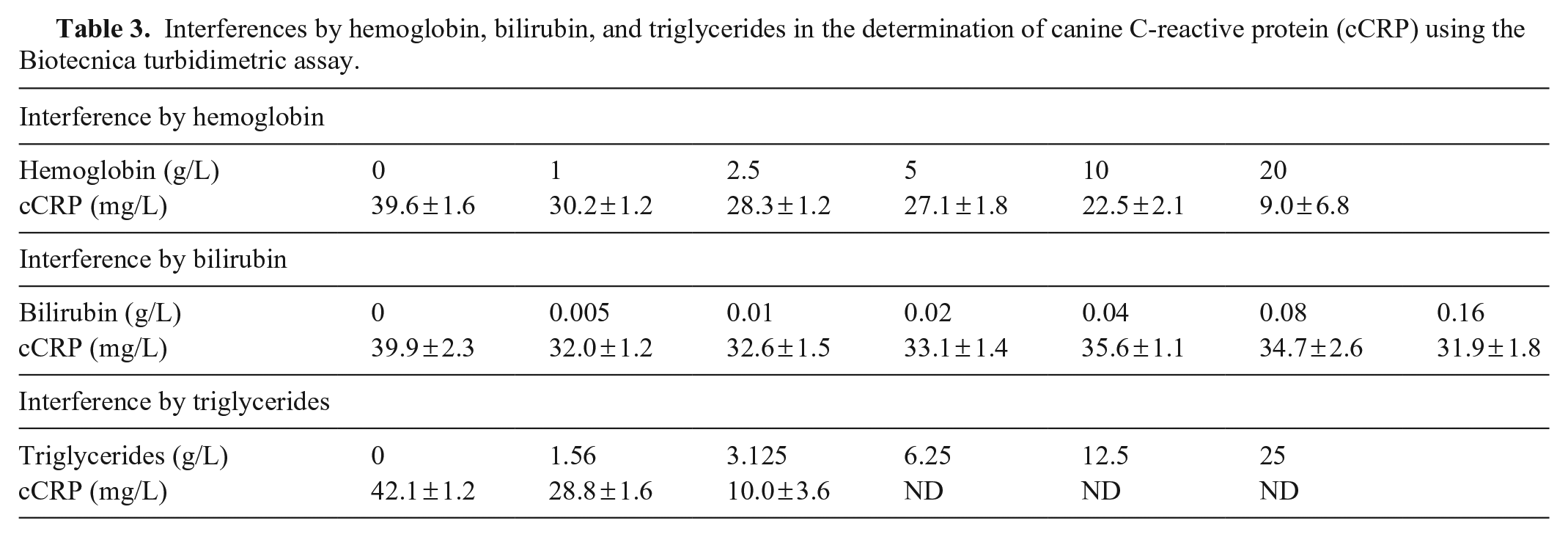
The observed intra- and inter-assay CVs for the BA were 3.3–7.6% and 7.4–10.3%, respectively (Table 1). The BA proportionally measured in the analytic range up to 60 mg/L with a coefficient of correlation of 0.994 (Fig. 1). Recovery rate and CVs were 87.1–109.2% and 3.3–7.6%, respectively. Bias ranged from −12.9 to 9.2%. The LOB and LOD were 1.2 mg/L and 2.4 mg/L, respectively. The LOQ for the BA was 6.7 with a TE of 32% (Table 2). Interferences (bias >10%) as a result of the presence of bilirubin, hemoglobin, and lipids were present at all of the doses of interferents tested (Table 3).
Intra- and inter-assay imprecision of the Biotecnica turbidimetric C-reactive protein assay.
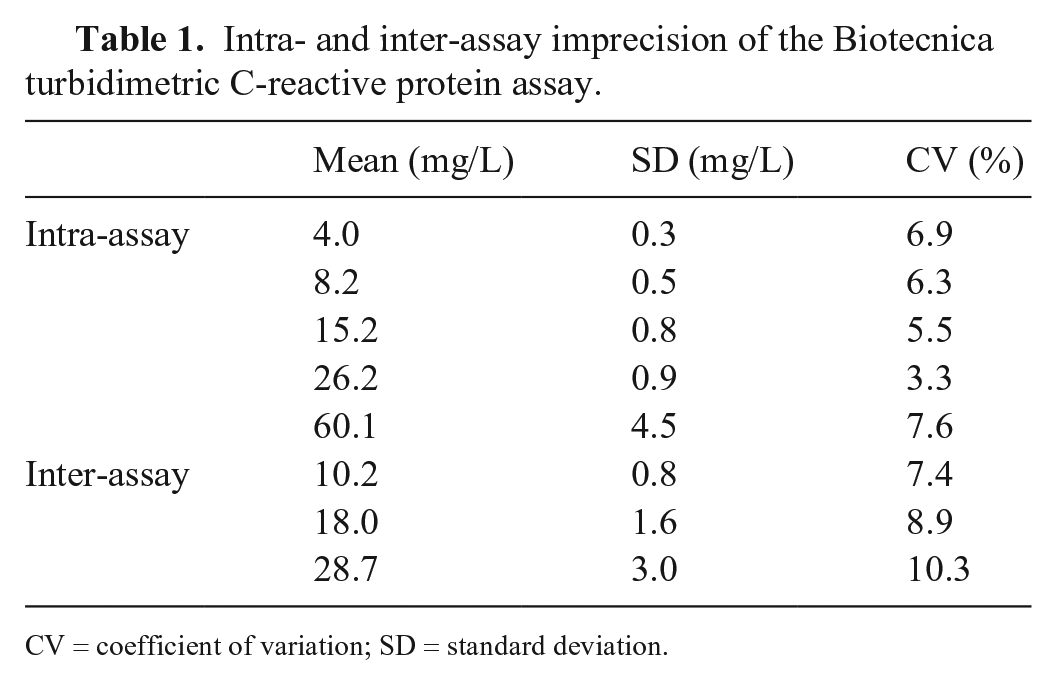
CV = coefficient of variation; SD = standard deviation.
Results of the limit of quantification study of canine C-reactive protein (cCRP).
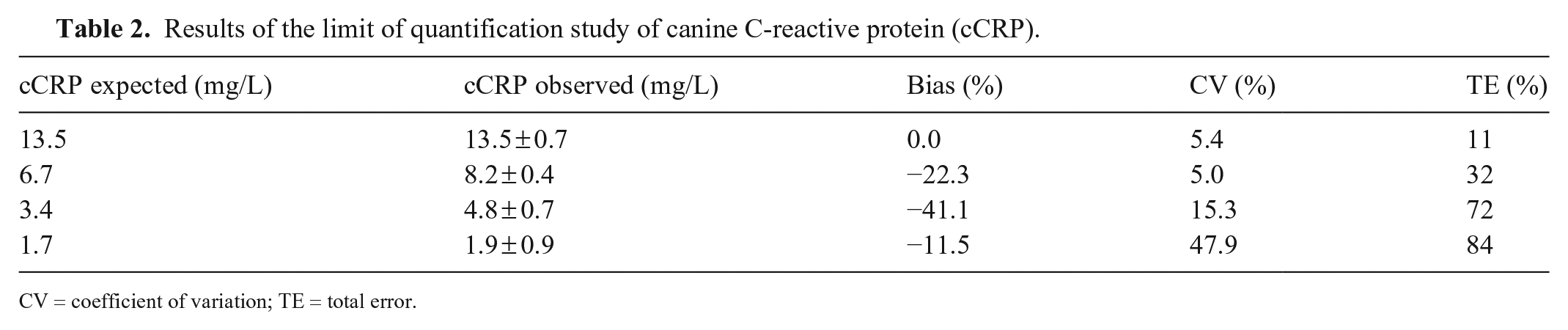
CV = coefficient of variation; TE = total error.
Interferences by hemoglobin, bilirubin, and triglycerides in the determination of canine C-reactive protein (cCRP) using the Biotecnica turbidimetric assay.
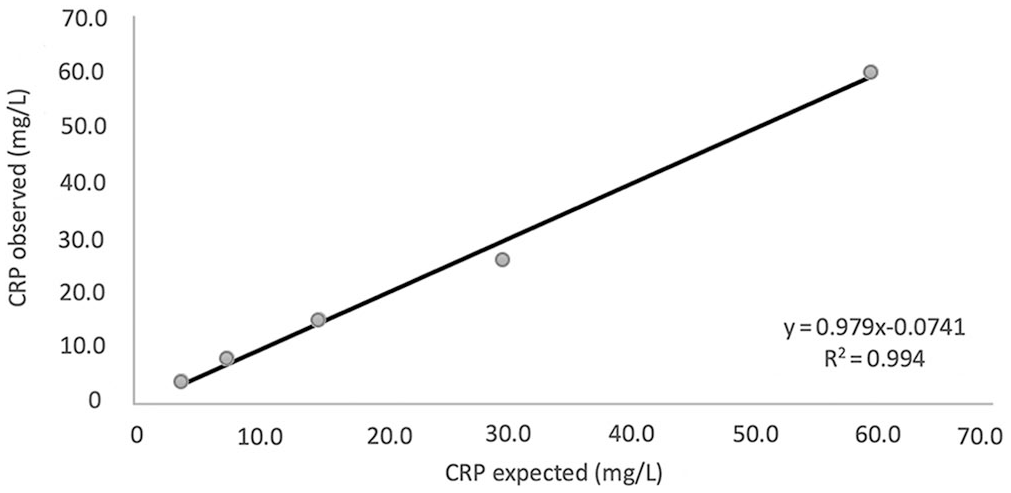
Linearity under dilution of a canine serum pool with saline solution (0.154 M NaCl), at 5 points of concentration from 4 to 60 mg/L measured with a Biotecnica C-reactive protein (CRP) assay. The solid line is the regression line.
The intercept, slope, and r correlation coefficient of the linear regression analysis were −0.052, 1.52, and 0.966 (95% CI = 0.95–0.98), respectively. In the Passing–Bablok regression analysis (Fig. 2), the intercept was 0 (95% CI = 0.0–0.22) and the slope was 0.74 (95% CI = 0.66–0.82). The concordance correlation coefficient was 0.867 (p < 0.0001). The Bland–Altman plot, illustrating the difference between BA and RA against the mean of the methods [(BA + RA)/2], showed 95% limits of agreement of −25.1 to 37.4%. The mean of the differences was −6.2% with a 95% CI of −9.5 to −2.9% (Fig. 3). The tested CRP turbidimetric immunoassay showed good general performance, and accurately and precisely detected canine CRP concentration in canine serum samples.
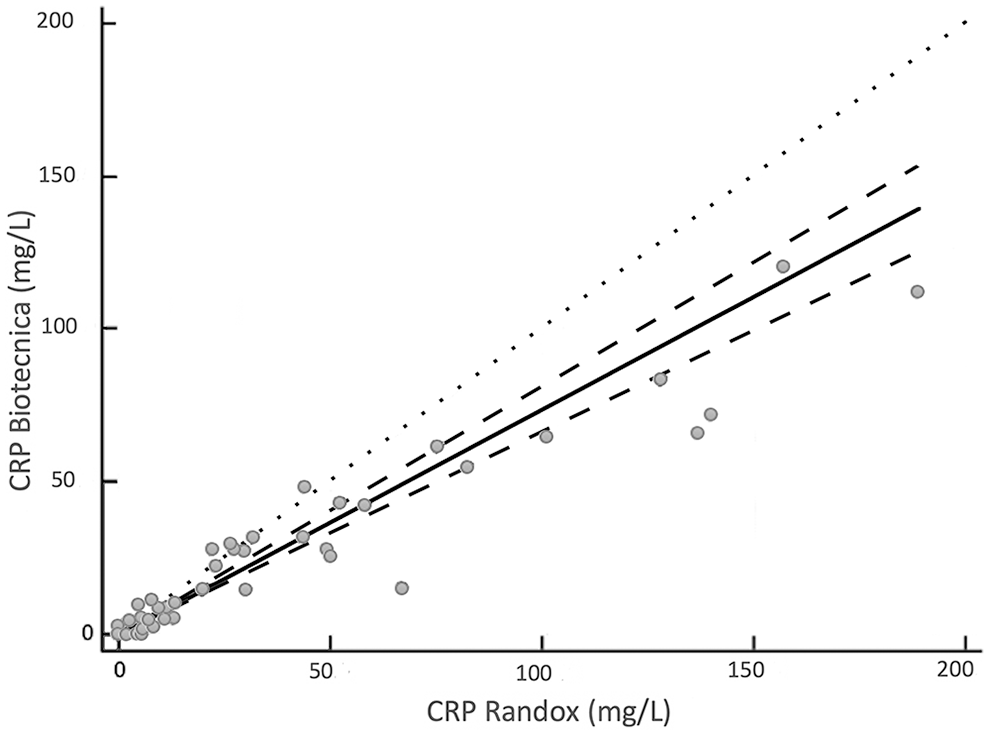
Passing–Bablok regression analysis for canine C-reactive protein (CRP) concentrations in 91 samples measured with a Biotecnica assay and a Randox canine CRP assay. The solid line is the regression line, the dotted line is the line of identity (y = x), and the 2 dashed lines are the 95% limits of agreement.
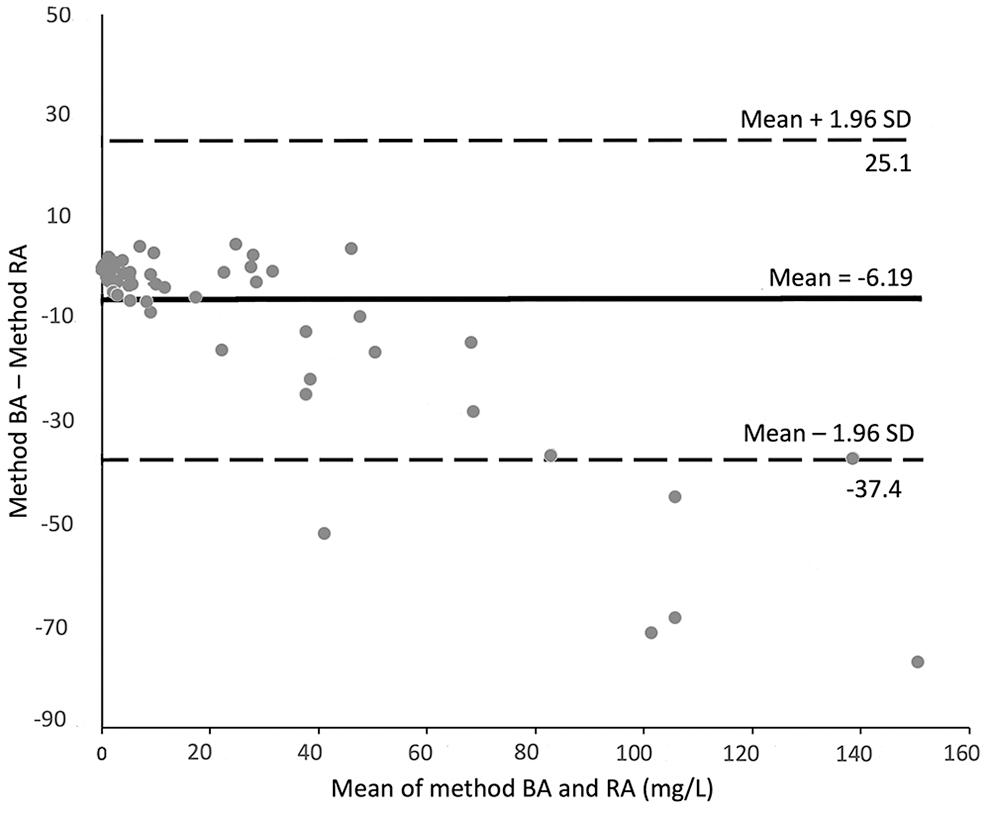
Bland–Altman difference plot for C-reactive protein (CRP) measured in 91 canine serum samples with a Biotecnica assay (BA) compared to a Randox canine CRP assay (RA). The solid line is the mean difference, and the dashed lines are the limits of agreement (mean difference ± 1.96 SD of differences).
It is interesting to compare data of the present and some previous studies regarding intra- and inter-assay (Table 4). Considering an optimal analytical CV of 6% and a desirable CV of 12%, 6 the BA showed a low level of imprecision, similar to other methods. 11
Comparison of imprecision data of different commercial assays for determination of canine C-reactive protein.
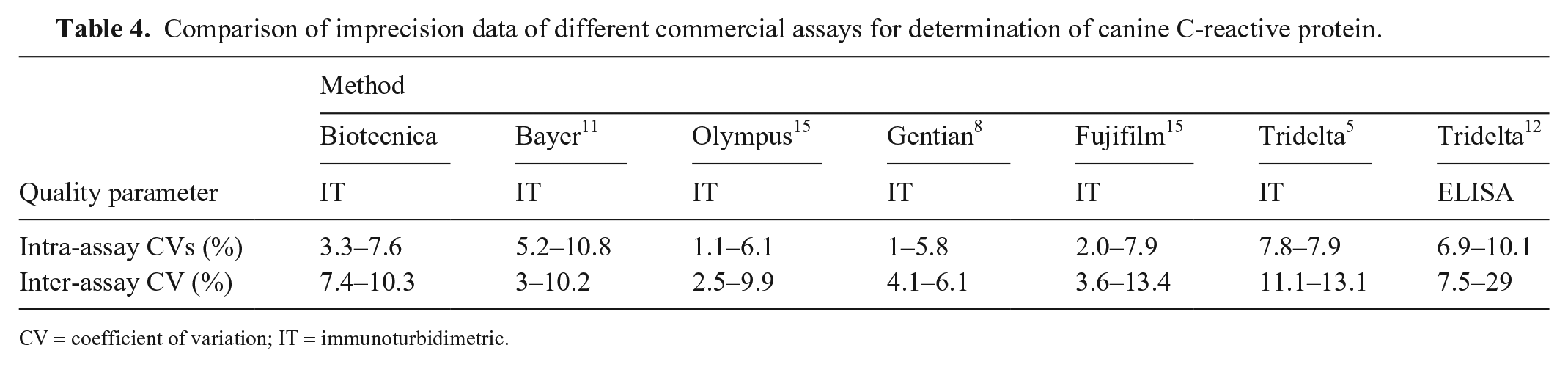
CV = coefficient of variation; IT = immunoturbidimetric.
Accuracy was investigated through linearity under dilution. Canine serum CRP was measured in an excellent linear manner from 4 to 60 mg/L. The maximum linearity point was identified based on the range observed in our laboratory using RA. This was comparable to results of a previous study, in which the authors used the same RA and generally detected values <50 mg/L, 13 and differed from results obtained by other researchers with other assays and other analyzers.1,5,12,13 To perform successful clinical monitoring, it is important to use the same method throughout the course of the study.
The LOQ that we found was 6.7 mg/L, similar to other assays such as the Gentian CRP assay (7 mg/L) and the Life assay (7 mg/L).7,9 Even though the TE was slightly higher than the desired value, the detected concentration of 6.7 mg/L is lower than that declared by the manufacturer and clearly lower than the upper limit of the reference intervals (RIs) for CRP in our laboratory (11.8 mg/L). Based on the LOQ obtained in our study, BA was able to discriminate between healthy and diseased dogs. However, the accuracy in the identification of minimal changes in canine CRP concentration in dogs with a low level of inflammation, or in healthy subjects, could be affected.
We found that interferences (bias >10%) as a result of the presence of bilirubin, hemoglobin, and lipids were also present at the lower tested doses (hemoglobin = 1 g/L; bilirubin = 0.005 g/L; triglycerides = 1.56 g/L). A study using an immunoturbidimetric latex assay reported no interferences for concentrations up to 20 g/L, 0.150 g/L, and 10 g/L for hemoglobin, bilirubin, and triglycerides, respectively. 17 On the contrary, another study, 14 using a solid-phase sandwich immunoassay, reported interferences caused by hemoglobin, bilirubin, and triglycerides at concentrations even lower than those tested in our study. Further studies should be performed to determine the best CRP assay to overcome the problem of interferents.
The correlation coefficient (r = 0.966) of simple regression analysis was below the value recommended by guidelines (0.975 for data encompassing a small range, and 0.99 for data encompassing a wide range). 10 Thus, the Passing–Bablok regression and Bland–Altman plot became essential to better understand the observed data. Based on the Passing–Bablok regression analysis, a statistically significant proportional systematic bias was likely present, whereas a constant systematic bias was considered unlikely, as confirmed by the Bland–Altman test. The exclusion of a constant systematic error is important because it might affect the data significantly, particularly at low concentrations of CRP.
At CRP concentration >40 mg/L, there was a significant proportional discrepancy between assays. This difference has little impact in a clinical setting because the upper normal limit for CRP in dogs in our laboratory is ~12 mg/L. Conversely, the 2 methods are not interchangeable for repeated measurements during follow-up, and it is mandatory to calculate specific RIs for each assay.
Our study had some limitations. The first was the choice of an assay with anti-human antibodies as the reference method for comparison instead of a homologous assay (e.g., the Gentian). However, the Gentian method has been validated and compared with the RA method, with results overlapping in the 2 assays. 7 Furthermore, in our laboratory we have used the heterologous RA of this study for years, reaching a high level of confidence with the method. Finally, the calibration of RA with purified canine CRP provides added value. 15 For these reasons, we believe that the results of our study are not affected by the choice of the RA as a reference method.
A second limitation was the maximum linearity point of concentration of 60 mg/L. Solutions with higher concentrations could have been obtained by using purified canine CRP. However, considering the CRP concentration generally detected with the RA method and also with the BA method in our laboratory and also reported previously, 13 it can be considered a limitation that does not affect the results of our study.
Finally, the samples of our study were stored at −80°C for up to 8 mo. However, studies performed in human patients showed that CRP is stable for a period of years. 16 Additionally, a comparative study of 3 automated assays for CRP determinations in dogs utilized samples that were stored for 4 y. 5 For this reason, it seems unlikely that our results were influenced by storage at −80°C for up to 8 mo.
Footnotes
Authors’ note
Preliminary results were presented as an Abstract at the 73rd Congress of the Italian Society of Veterinary Sciences, Olbia, Italy, June 19–22, 2019.
Declaration of conflicting interests
The authors declared no potential conflicts of interest with respect to the research, authorship, and/or publication of this article.
Funding
The authors declared that they received no financial support for their research and/or authorship of this article.
