




Abstract
Clostridium (Clostridioides) difficile is a gram-positive, spore-forming bacterium that is an important cause of disease in people, a variably important cause of disease in some animal species, and an apparently harmless commensal in others. Regardless of whether it is a known pathogen in a particular species, it can also be found in healthy individuals, sometimes at high prevalences and typically with higher rates of carriage in young individuals. As it is investigated in more animal species, it is apparent that this bacterium is widely disseminated in a diverse range of domestic and wild animal species. Although it can be found in most species in which investigations have been performed, there are pronounced intra- and inter-species differences in prevalence and clinical relevance. A wide range of strains can be identified, some that appear to be animal associated and others that are found in humans and animals. A large percentage of strains that cause disease in people can at least sporadically be found in animals. It is a potentially important zoonotic pathogen, but there is limited direct evidence of animal–human transmission. Although C. difficile has been studied extensively over the past few decades, it remains an enigmatic organism in many ways.
Introduction
Clostridium (Clostridioides) 80 difficile is a gram-positive, anaerobic, spore-forming bacterium that can be found in humans, a wide range of animal species, and the environment. It is the cause of C. difficile infection (CDI), a critically important disease in humans. Its role as an animal pathogen ranges from important to unclear to apparently irrelevant, depending on the animal species.
As a spore-former, the bacterium can be found in 2 states, the fastidious vegetative form that reproduces in the gastrointestinal tract, and as a hardy spore that is passed in feces and can survive for prolonged periods outside the host. The spore is the infectious form, whereas vegetative cells are the metabolically active form that can produce toxins, cause disease, and produce more spores. Virulence is classically attributed to 2 main toxins, toxin A (TcdA) and toxin B (TcdB), with some strains producing a binary toxin (CDT). Most strains produce TcdA and TcdB, or TcdA, TcdB, and CDT, but toxin-variant strains that produce some but not all of these toxins (e.g., TcdA–/TcdB+) can cause disease. Strains that lack genes encoding TcdA, TcdB, and CDT are considered nontoxigenic and clinically irrelevant.
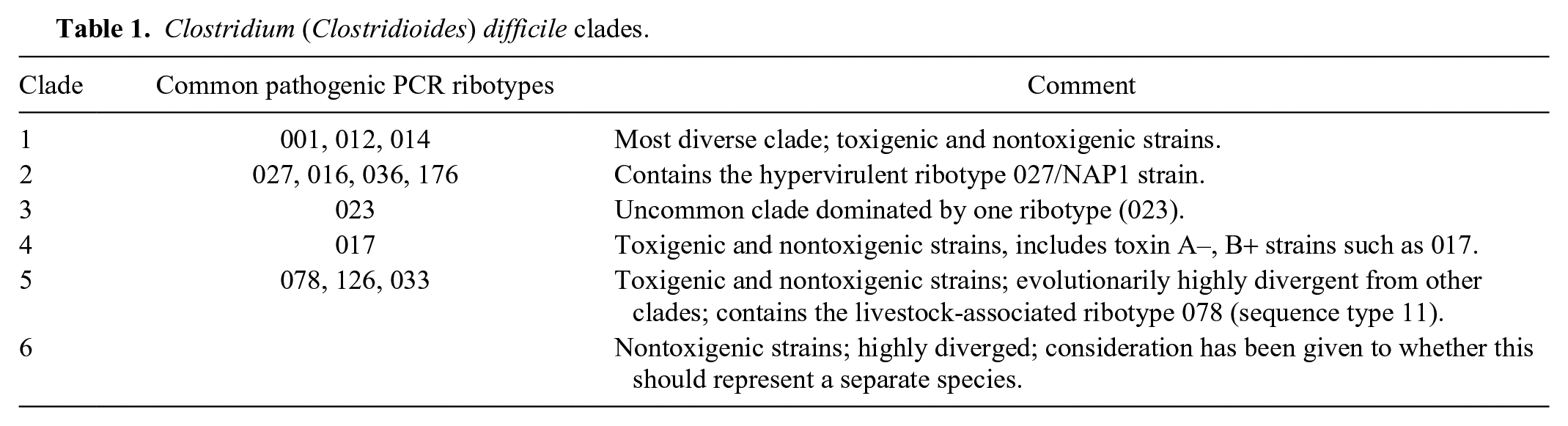
C. difficile is a genetically diverse bacterial species that is estimated to have diverged 1.1–85 million years ago. 53 Most isolates are able to be assigned to 1 of 6 main phylogenetic clades (Table 1), 5 of which (clades 1–5) contain toxigenic strains, 127 although classification has been evolving. Nontoxigenic strains are intermixed with toxigenic strains in 3 clades (clades 1, 4, and 5). PCR ribotyping, a typing method that involves PCR amplification of the spacer region between the 16S and 23S rRNA genes, and subsequent analysis of gel banding pattern or capillary PCR product,26,61 is the most widely used typing method. Although > 300 ribotypes are formally classified and many others have been identified, a relatively small number of strains are of greatest concern. Clade 1 contains the most common human pathogens in most regions (ribotypes 001, 012, and 014). Clade 2 contains ribotype 027 (NAP1), a hypervirulent strain associated with widespread disease in humans internationally. Clade 4 contains the toxin variant (TcdA–, TcdB+) ribotype 017 and related strains, which are important causes of disease in humans in some regions. Most of these ribotypes can also be found in animals; however, the main animal concerns are livestock-associated strains in clade 5, particularly ribotype 078. This clade is highly divergent from other clades, and ribotype 078 has emerged as an important cause of community-associated CDI in humans, raising concerns about zoonotic or food origins.63,73,113 C. difficile is an important cause of disease in some domestic animal species, a potential but unclear cause of disease, or apparently clinically relevant in others.
Clostridium (Clostridioides) difficile clades.
Horses
Some of the earliest evidence of clinical relevance of C. difficile in domestic animals involved horses, and CDI is an important cause of disease in both adult horses and foals.25,138 Initial study of C. difficile in horses involved foals, in which the presence of the bacterium was associated with diarrhea. 64 Subsequent studies demonstrated associations between the presence of TcdA and/or TcdB and diarrhea in adult horses and foals.42,138 Enterocolitis was later reproduced experimentally through administration of C. difficile spores or vegetative cells to foals. 12 CDI is strongly associated with antimicrobial exposure in humans 91 and, although such an association has been suggested in horses, 25 antimicrobial exposure is an inconsistent risk factor and has not always been identified as a risk factor for CDI in horses. 140 Of particular interest have been older reports of severe CDI in mares whose foals were treated with erythromycin and rifampin,23,48 with subsequent reproduction of CDI in mares given low oral doses of those drugs meant to mimic the concentrations they might be exposed to when their foals were treated. 48 Interestingly, this phenomenon has not been reported elsewhere, suggesting regional differences in susceptibility, perhaps because of differences in the gut microbiota. In contrast to human medicine, in which CDI is an important hospital-associated infection, hospital-associated CDI appears to be uncommon in horses, with only one report implicating it in a cluster of hospital-associated infections. 87 Anecdotally, outbreaks are not uncommon in foals on large breeding farms; however, objective data are lacking.
The clinical spectrum of CDI has not been well described in horses, but it can range from mild, self-limiting diarrhea to rapidly fatal, peracute hemorrhagic enterocolitis. It is most often manifest as diarrhea with various degrees of dehydration, toxemia, and abdominal pain.
The bacterium has also been implicated as a cause of duodenitis/proximal jejunitis. 14 Clinical and histologic changes consistent with that disease were reproduced experimentally by administration of a C. difficile toxin suspension. 13
Although C. difficile has been clearly established as an equine pathogen, toxigenic strains can also be found commonly in healthy foals and adult horses. Shedding rates have been reported of 0–29% in healthy foals,24,118,138 44% of antibiotic-treated foals, 24 4.9–8.4% in hospitalized horses,65,93 and 0–7.6% of healthy adult horses.24,93,132,138 Risk factors for C. difficile shedding have been explored in adult horses and have focused on young age and antibiotic exposure.24,47 Reasons why CDI develops in some individuals but not others are unknown, but the intestinal microbiota probably plays an important role.
Various strains have been found in horses. In some studies, the livestock-associated ribotype 078 has been present or predominant.93,96,117,119 Other clade 5 strains found predominantly in livestock such as TcdA–, TcdB–, CDT+ ribotype 033 65 have also been found as common strains in some populations. More common human strains such as ribotypes 001, 012, 014, 017, and 027 have been identified in some regions.93,119,132 Overall, most strains found in horses are also found in humans; however, the zoonotic disease risk is unclear.
Pigs
As in horses, C. difficile is clearly a pathogen in pigs. However, in contrast, disease seems to predominantly, if not exclusively, affect piglets 10 d of age or younger.15,33,134,146,147 Clinical manifestations are variable. Sudden death can occur, with or without evident diarrhea. In less severely affected animals, diarrhea, abdominal distension, decreased appetite, and poor growth may be evident. Pathologically, it is manifest predominantly as typhlocolitis and mesocolonic edema. 147
Similar to clinical observations, disease has been reproduced experimentally in young piglets but not in older piglets. 15 Antimicrobial exposure is not required for development of CDI.
Although disease in piglets is the animal health concern, most studies of C. difficile in pigs has involved surveillance aimed at estimating prevalence and characteristics of C. difficile from pigs of various ages, with a focus on potential zoonotic risks. Shedding of C. difficile is common in many pig populations, with a clear impact of age. Shedding rates are high in young pigs and typically decline to lower levels by the time of slaughter. Rates in 1- to 14-d-old piglets of 27–100% have been reported,4,6,17,19,46,52,57,71,75,78,97,98,115,126,128,137 with rates declining rapidly to 0–4% in finisher pigs.4,16,34,52,55,69,98,108 However, isolation rates from sows of 4–50% have been reported,46,57,69,78,97,98,128 perhaps related to the stress of pregnancy and parturition. Reasons for the marked effect of age have not been investigated, but this pattern is consistent with various other species and is likely related to the protective gut microbiota, which becomes established in the first weeks to months of life. 125 Beyond age, no factors have been clearly associated with C. difficile shedding, including conventional versus organic production. 67
A variety of strains can be found; however, a few livestock-associated strains predominate. At the forefront is ribotype 078, a toxinotype V, clade 5 strain that is strongly associated with pigs, and to a lesser degree the closely related ribotypes 126 and 066. These 3 ribotypes have been the sole or predominant strains identified in studies of livestock in North America, Europe, and Asia.4,6,9,17,56,66,67,69,78,98,115,128,137,141,148 Yet, although ribotype 078 predominates, a wide range of strains can be identified, including other strains found in humans with CDI.6,8,97 As in some other animal species, the ribotype distribution is different in Australia, where ribotype 078 is rare to nonexistent and various strains can be found, including some unusual strains such as ribotype 237.95,126
Further characterization of ribotype 078 isolates by multilocus variable number tandem repeat analysis (MLVA) or whole genome sequencing has shown that human and porcine isolates are indistinguishable,40,68,70 furthering concerns about zoonotic and foodborne exposure.
Cattle
Increasing attention has been paid to C. difficile in cattle, but mainly because of zoonotic disease concerns rather than animal health concerns. The role of C. difficile in cattle health is unclear and probably minimal. In calves, an association between the presence of C. difficile or its toxins in feces and diarrhea has been reported.49,88,106 However, disease could not be reproduced experimentally in neonatal calves. 107 There is no evidence of a role in disease in adult cattle.
As with other species, C. difficile can be found in a variable percentage of healthy individuals. There is a strong influence of age, with young calves having the highest shedding rates.20,21,37,58,72,88,109 Shedding rates for adult dairy cattle (10%), 20 adult beef cattle (3.3–18%),38,50,109,110 adult cattle of unknown type (1.5%), 111 and calves (2–60%)20,37,43,72,74,88,101 have been reported. Farm management and health status factors, such as diet change, mastitis, number of calves, and antimicrobial exposure, have been associated with increased risk of C. difficile shedding.20,21,88
Strain data have been variable, and there may be pronounced regional differences in ribotype distribution. Some authors, mainly from North America and Europe, have reported a predominance or exclusive isolation of livestock-associated ribotype 078.37,38,49,88,110,114 The closely related ribotype 126 has also been found in Australian cattle.72,74 Other studies have reported more diversity, including various common human strains such as ribotypes 033, 001, 014/020, and 027 as well as strains rarely or never recognized in humans.20,21,50,72,74,88
Small ruminants
There has been very little study of sheep and goats, although C. difficile has been identified in a small (2–9.5%) percentage of healthy individuals.18,44,71,111 As with other species, the prevalence may be higher in young individuals. 71 Strain data are very limited, but a variety of strains have been reported, including strains that have been found in humans and other animal species (e.g., ribotypes 014, 010, 045).18,71,111 There is no evidence that CDI is a relevant disease in these species.
Dogs
The role of C. difficile in enteric disease in dogs remains enigmatic. An association between the presence of C. difficile toxins in feces and diarrhea has been reported in some studies, 139 but not others.32,35 Additionally, disease could not be reproduced experimentally. 36 Accurate diagnosis of CDI is a challenge in dogs because of limited information about optimal methods, interpretation of results, and the potentially high background colonization rate in some dog populations. Whether C. difficile is a common cause of disease, a rare cause of disease, a relevant coinfection, or a harmless commensal remains to be determined.
Regardless of its role (or lack thereof) in disease in dogs, C. difficile can be found in a small percentage of healthy individuals. Prevalences of 0–6% tend to be reported in healthy adult dogs,82,83,102,116,130,139,144 but higher rates have also been identified (e.g., 17%). 129 Specific groups from which higher rates of shedding have been identified include hospitalized dogs (19–22%),35,130 veterinary hospital outpatients (14–33%),60,130,133 dogs that visit human healthcare facilities (41–58%),83,84 and racing sled dogs (58%). 92 Colonization rates can be high in young puppies, as highlighted by a 62% prevalence in neonates 30 and a small longitudinal study that reported a cumulative prevalence of 100% in 2 litters. 3 Shedding rates of 6.7–12% have been reported in dogs with gastrointestinal disease,10,41,100,139 similar to the range seen in healthy dog populations. Reported risk factors for C. difficile shedding include contact with human healthcare facilities, 83 exposure to groups of children, 83 antimicrobial treatment,35,60,82,83 and administration of immunosuppressive drugs during hospitalization.35,60,82,83 There may be a major human influence on C. difficile shedding in dogs, given that living with an owner that has been treated with antibiotics 83 and living with an immunocompromised owner 136 have been associated with increased risk of C. difficile shedding. These presumably are related to an increased risk of the owner shedding C. difficile, with subsequent direct or indirect transmission to their dogs. A study that combined dog and cat data identified proton pump inhibitor (PPI) administration as a risk factor, 102 an interesting finding given increasing recognition of the association of PPI administration with C. difficile shedding in humans.11,89 That study also reported antimicrobial exposure, and contact with a person with diarrhea as risk factors.
Strains identified in dogs tend to mimic those found in people, including some of the most common strains found in human CDI, such as ribotypes 001, 014, and 106.5,10,100,102,116,136 The livestock-associated ribotype 078 has been reported less commonly,100,102 and, although rare, the hypervirulent human pathogen ribotype 027 has also been found.81,102 Whether colonization with the same strains represents human–dog transmission or common source exposure is unclear. Likely intra-house transmission of C. difficile from infected owners to their dogs was identified in 2 of 5 of dogs in a small study of households of people with CDI. 85 In that study, dogs were negative on baseline testing then acquired C. difficile that had an indistinguishable pulsed-field gel electrophoresis (PFGE) type compared to the infected person. However, in a study of households with healthy people and pets, the same strain of C. difficile was not identified in people and pets in any of 415 households. 102
Cats
C. difficile has been isolated from healthy and diarrheic cats.2,29,35,86,90,104,116,143 Prevalence data are limited and sometimes hard to discern because some studies do not differentiate diarrheic versus healthy cats. Overall rates of 2.5–38.1% have been reported,35,86,102,116,135 with the low end of that range (i.e., < 5%) likely representing the shedding rate for the general, healthy, homed cat population. Typing data are limited, but as for dogs, common human strains are often found, such as ribotypes 010, 106, and 014/020.102,116,122 In a small study of people with CDI, likely human–animal transmission (based on the cat being negative on an initial sample then later harboring C. difficile with an indistinguishable PFGE type compared to the person) was identified in 1 of 8 cats. 85
The clinical relevance of C. difficile in cats is unclear. Diagnosis of CDI has been made in diarrheic cats, 143 but the true role in disease is unclear because of the presence of the bacterium in healthy animals. Evidence of an association between C. difficile and diarrhea in cats is currently lacking.
Poultry
There is no evidence that C. difficile is a relevant pathogen in poultry. Surveillance studies have investigated shedding of the bacterium in healthy birds, where, as in other species, it can be found in an age-dependent manner59,124 and perhaps of greatest relevance from a potential zoonotic disease standpoint. Prevalences of 0–62% have been reported in healthy chickens.1,51,59,76,103,105,149 High strain diversity has been identified, with perhaps a higher proportion of nontoxigenic strains compared to other species. Strains that have been identified include common human strains (e.g., ribotypes 001, 014, 039), livestock-associated ribotype 078 or related strains, and various nontoxigenic strains.1,51,59,76,105 As with some other livestock species, there appear to be regional differences in strain distribution.
Wildlife
Given the estimate that C. difficile evolved well before humans (and perhaps before mammals), 53 it should be unsurprising that the bacterium can be found in wildlife. It has been isolated from an impressive array of wildlife species, including wild carnivores, omnivores, herbivores, and insectivores, including skunks, opossums, raccoons, coatis, bats, bears, rats, and other rodents, feral swine, various bird species, and wild canids.22,27,45,54,62,77,94,112,121,123,131,142 It is likely that it has been isolated from most species for which a concerted effort has been made to identify it. Whether C. difficile is a pathogen in wildlife species is difficult to discern. Most of the available information is from surveillance of healthy animals or animals with unknown health status, something that precludes assessment of its role as a potential opportunistic (as opposed to obligate) pathogen. Sporadic case reports have implicated C. difficile in disease of individual animals (e.g., ocelot, captive Kodiak bear, harbor seal)7,99,120; however, it can be difficult to put results of detection of the organism or even its toxins into context without understanding the prevalence of the bacterium in healthy cohorts.
Strains found in wildlife often reflect their degree of exposure to human habitats. Three different types of wildlife can be considered, with potential differences in the epidemiology and ecology of the bacterium. These consist of urban wildlife, wildlife associated with farms, and wildlife more removed from humans and domestic animals.
Urban wildlife can have close contact with humans, human environments, human waste, and discarded food products, creating the potential for exposure to a variety of C. difficile strains. Most study of urban wildlife has involved rodents. Over 13% of rats from a low socioeconomic status area of Vancouver, Canada, were shedding C. difficile in one study, with a combination of known human strains (including ribotypes 001 and 014), livestock- (and food)-associated ribotype 078, and previously unknown strains, 54 suggesting exposure through contact with human environments or feces and food waste, as well as endemic rat- or wildlife-associated strains. A lower prevalence (1%), with no isolate characterization, was identified in rats from New York City. 45 However, a study of house mice in New York and mice caught in the Dutch city of Utrecht yielded prevalences of 4% and 35%, respectively, consisting predominantly of ribotypes that have been found in people.31,145
Animals living on or near farms can be exposed to pathogens from livestock, direct contact with farming areas, or indirectly through manure spread on fields or via runoff. Unsurprisingly, C. difficile can be isolated from species such as raccoons and rats that live on or near farms, sometimes at high prevalences (up to 32%).9,39,62,77 The livestock-associated ribotype 078 predominates in wildlife from farms; however, isolates more often associated with humans can also be found.9,28,39,62,77 Birds also have contact with farm environments, as potentially highlighted by detection of C. difficile, including ribotype 078, in 4% of migrating European barn swallows. 22
Although human or domestic animal contact is common for many wildlife populations, C. difficile has been identified in animals well removed from human influences. For example, it was isolated from 15% of polar bears in the Canadian Arctic, with isolates being strains that had not been previously identified in humans. 142 More study of remote wildlife is needed to help understand the natural (non-human–associated) ecology of this organism.
The role of wildlife in the epidemiology of human or domestic animal CDI is unclear. However, there is some potential for wildlife to be a reservoir of novel strains, to bridge agricultural and urban habitats, and to transmit C. difficile over long distances.
Conclusion
Clostridium difficile is a genetically, evolutionarily, and ecologically diverse organism that can be found in a multitude of animal hosts. Why it can cause devastating disease in some species and be an innocuous commensal in others remains unclear and could offer insight into the pathophysiology of CDI.
Although there are marked differences in reported prevalences and strain distributions between studies, species, and regions, a few common themes emerge. The bacterium can be found in a variable and sometimes high prevalence, even in species in which it is a clear pathogen. Shedding is much more common in young animals, particularly neonates, likely as a result of a less well-developed protective gut microbiota, with rapid decreases in shedding with increasing age.
Strain distributions are variable between and within species. Of significant concern is the predominance of the livestock-associated ribotype 078 and related clade 5 strains because of increasing recognition of community-associated disease in people caused by this lineage.68,76,79 However, a diverse range of other types can be found, including some of the most common human strains. The natural ecology of C. difficile and its movement between different species remains unclear. Similarity in strains found in some species (including humans and animals) supports some degree of interspecies movement or common source of exposure; however, the dynamics of interspecies (including zoonotic) transmission of this important and enigmatic bacterium remain to be clarified.
Footnotes
Declaration of conflicting interests
The author declared no potential conflicts of interest with respect to the research, authorship, and/or publication of this article.
Funding
The author received no financial support for the research, authorship, and/or publication of this article.
