




Abstract
We report the importation of a clinical case of canine leishmaniasis (CanL) in Romania, a country where several types of sandflies are present with the potential to develop a new focus of CanL. The Staffordshire Bull Terrier dog was imported into Romania from Spain 1.5 y before he developed clinical symptomatology that included proliferative dermatitis, lymphadenomegaly, and bilateral uveitis. Hematologic analyses showed regenerative anemia and subacute inflammation. Cytologic examination of lymph node fine-needle aspirates revealed Leishmania spp. amastigotes that were confirmed as L. infantum by PCR. The importation of canine leishmania cases into nonendemic areas in which the vector exists could potentially lead to the silent spread of a disease posing a significant public health threat.
Leishmaniasis is a widespread, vector-borne, zoonotic disease known to be emerging or re-emerging in several parts of the world. The causative agents are parasitic protozoans that include several Leishmania species (L. infantum, L. chagasi, L. major, L. tropica) of which L. infantum is responsible for human and canine leishmaniasis (CanL) in Europe. 7 The domestic dog acts as the main reservoir from which the primary vector, the phlebotomine sandfly species, can transmit the disease to several vertebrates including humans. 8
According to the World Health Organization (WHO), an estimated 1.3 million new cases and ~20–30,000 deaths occur annually as a result of leishmaniasis (https://goo.gl/ujdFxC). In Europe, the Department of Control of Neglected Tropical Diseases of the WHO estimated the incidence of visceral leishmaniasis to be 410–620 human cases per year between 2003–2008 in 9 endemic EU countries. 6 Since 1990, Romania’s borders have opened, providing opportunities for travel and the migration of people and pets including to and from endemic Leishmania areas such as Spain and Italy, thus increasing the risk of disease importation. In addition, since the mid-1990s, the average annual temperature in Romania has risen by 1°C, which has potentially created favorable conditions for the main vectors, Phlebotomus spp. Furthermore, data from the VectorNet website of the European Centre for Disease Control (ECDC) shows that several types of sandflies are now present in different parts of Romania (https://goo.gl/GqeHsr). The coexistence of the natural vector, asymptomatic carriers, and the concurrent movement of human and animal clinical cases is therefore concerning as it could increase the risk for a new reservoir of the disease emerging in nonendemic areas.
Herein we describe the importation of a Leishmania-infected 5-y-old male Staffordshire Bull Terrier dog, which was born and lived in Spain for 3 y and was then transported to northeastern Romania in May 2014. The owners traveled with the dog by car, entered the country through the west border, and traveled directly to the northeast region of the country near the city of Iasi. After its arrival in Romania, the dog lived on just one property, near Iasi, and neither traveled to the south of Romania nor to other regions in Romania or abroad. The first signs observed by the owner ~6 mo after their arrival in Romania were capricious appetite and small gum lesions; the owner replaced the dry food with canned cat food.
The first visit to a veterinarian was in April 2015 because of weight loss and gum and nose bleeding; on the next visit, in October 2015, the dog had severe weight loss (from 26 to 11 kg), keratoconjunctivitis, alopecia on 80% of the body surface, erosions and crusts in the nose and ears, severe stomatitis with lingual ulcers, inguinal wounds, and interdigital lesions. Demodicosis was suspected first, but not confirmed, and the dog remained hospitalized for 3 wk (anti-inflammatory, anti-hemorrhagics, and special diet with vitamin and mineral supplements).
Although the dog gained weight, reaching 14 kg, the dog’s condition worsened and, in November 2015, the dog was transferred to another veterinary clinic for investigation. Observations included oscillating temperature 39–40°C, pale mucous membranes, absence of urination, generalized lymphadenomegaly, proliferative dermatitis, epistaxis, uveitis, and head edema (Fig. 1). Abdominal ultrasonography did not reveal any notable changes. The complete blood cell count revealed a regenerative microcytic, normochromic anemia [red blood cell count 3.61 × 10¹²/L (reference interval [RI]: 4.95–7.87 × 10¹²/L), hemoglobin 7.4 × 10 g/L (RI: 11.9–18.9 g/L), packed cell volume 0.30 L/L (RI: 0.35–0.57 L/L), mean corpuscular volume 60.9 fL (RI: 66–77 fL), mean corpuscular hemoglobin concentration 336 g/L (RI: 320–363), reticulocytes 296 × 109/L (RI: <80 × 109/L)], mild neutrophilic leukocytosis [white blood cell count 18.2 × 10⁹/L (RI: 5.0–14.1 × 10⁹/L), segmented neutrophils 12.9 × 10⁹L (RI: 2.9–12 × 109/L ], a regenerative left shift [band neutrophils 4.11 × 10⁹/L (RI: 0–0.45 ×10⁹/L)], and an increased erythrocyte sedimentation rate [26 mm/2h (RI: <20 mm/2h)] suggesting a subacute inflammatory condition. Serum biochemistry data was not remarkable. Fine-needle aspirates (FNA) were obtained from 2 lymph nodes (prescapular and popliteal), stained by May-Grünwald/Giemsa, and showed numerous Leishmania spp. amastigotes, free or within macrophages, a predominance of mature lymphocytes, lymphoblasts, nuclear shadows, lymphocytic free cytoplasmic bodies, and plasma cells, suggesting lymphoplasmacytic inflammation (Fig. 2).
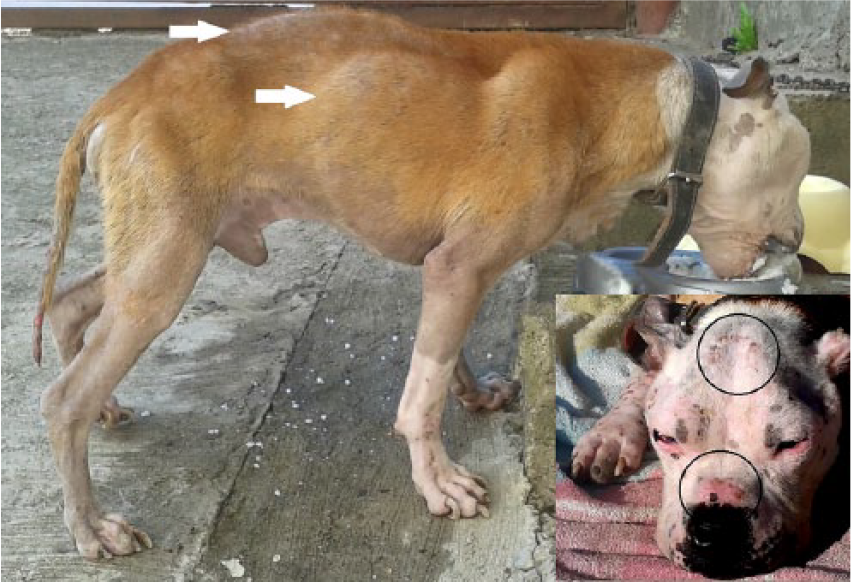
Clinical findings in a 5-y-old male Staffordshire Bull Terrier with leishmaniasis: marked weight loss, alopecia (arrow), swelling of the head, and proliferative dermatitis (circled).
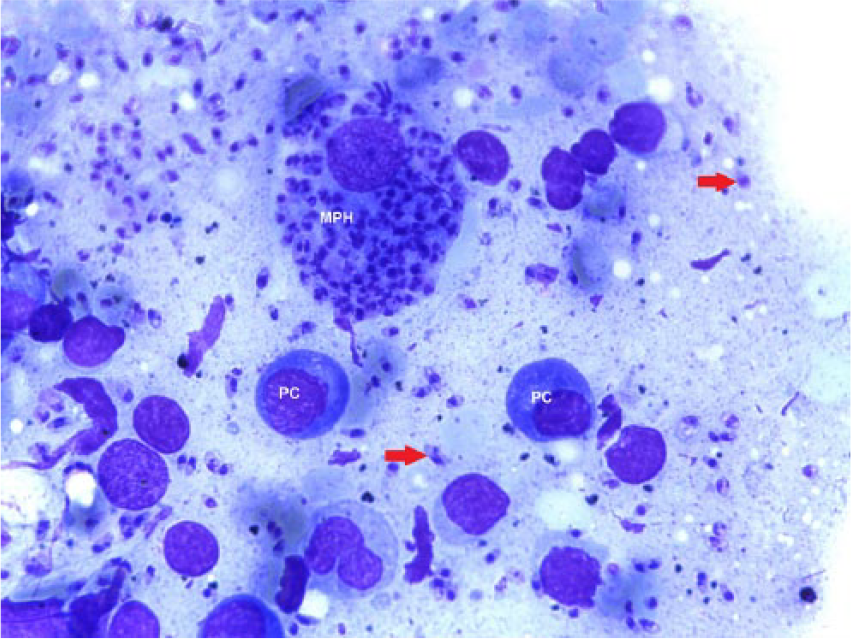
Fine-needle aspiration cytology of popliteal lymph node from a 5-y-old male Staffordshire Bull Terrier: extracellular amastigotes (arrows), a macrophage (MPH) filled with amastigotes, lymphocytes, and plasma cells (PC). May-Grünwald/Giemsa stain. 1000×.
Once the diagnosis was established, the owner decided to euthanize the dog. At the owner’s request, neither autopsy nor histologic sampling was performed. FNA samples were used for DNA extraction, and a nested polymerase chain reaction (PCR) targeting the SSUrRNA (small subunit ribosomal RNA) region was performed as described previously. 2 Positive and negative controls were included in the PCR assay. PCR amplicons from the first and second PCR rounds were subjected to DNA sequencing on both strands using Leishmania-specific primers R223 (TCCCATCGCAACCTCGGTT) and R333 (AAAGCGGGCGCGGTGCTG; Sequencing services, University of Oxford, United Kingdom). The resulting DNA sequences from the isolates were compared (BLAST) against those in GenBank and confirmed as L. infantum with 100% identity based on the SSUrRNA sequence (GenBank accessions XR_001203206.1 and KF302752.1).
Hence, we report a case of imported CanL in northeastern Romania, where according to VectorNet and to a recent mapping of sandfly distribution in Romania based on locality name, vector sandflies are present in the Iasi area, possibly leading to favorable conditions for the development of a second focus of CanL in Romania, the first focus being recently detected in Ramnicu Valcea (southern Romania). 3 , 9
Nineteen cases of imported human visceral leishmaniasis have been reported in Romania since 1999, through travel from Mediterranean areas (i.e., Greece and Spain). 4 , 5 , 10 The last human case was reported in 2014, also in northeastern Romania, in a patient originally infected in Italy. 1 In dogs, a 2012 study investigating the epidemiology of vector-borne infections in stray and pet dogs from Romania and Hungary identified 4 asymptomatic cases out of 138 serum samples investigated. 7 In addition, a case of clinical CanL was histologically and serologically diagnosed in a dog in Ramnicu Valcea (southern Romania). 9 This was a clinical case of autochthonous disease in a dog that had not traveled abroad, highlighting the possibility of a local reservoir of Leishmania in the south of Romania; 8 of 80 dogs tested in the Ramnicu Valcea area were positive for CanL by serology or PCR. 3
According to the ECDC, several types of sandflies are present in various parts of Romania, mainly in the warmer southern part of the country. Phlebotomus perfiliewi have been identified in the Moldova Republic (borders with northeastern Romania). Eighty-four geo-referenced records were extracted to assess sandfly distribution in Romania, 3 providing a complete database on geographic coordinates and maps of distribution for each reported sandfly species. Of these, Phlebotomus papatasi and P. longiductus have been reported in the Iasi area. The concurrent presence of infected dogs and the vector could allow for a new reservoir of disease to arise in this area.
Footnotes
Acknowledgements
We thank Dr. Ioan Arteni for the support in investigating the history of this case, including liaising with the owner and providing detailed information about the clinical details while the dog was in the care of his veterinary practice.
Declaration of conflicting interests
The authors declared no potential conflicts of interest with respect to the research, authorship, and/or publication of this article.
Funding
The authors received no financial support for the research, authorship, and/or publication of this article.