




Abstract
A latex agglutination test (LAT) based on sensitized polystyrene beads with inactivated Bovine herpesvirus 1 (BHV-1) particles was developed to detect serum antibodies against BHV-1 and Bovine herpesvirus 5 (BHV-5). Compared with a virus neutralization test using 252 serum samples, the sensitivity and specificity were 94.7% and 97.5%, respectively. Finally, 512 clinical serum samples from 3 major cattle-breeding provinces were monitored, and the overall positive rate was 34.57% (95% confidence interval: 30.45–38.69%). The results suggest that LAT has the potential to be a rapid method for the diagnosis of BHV-1 and BHV-5 infection in cattle herds.
Keywords
Bovine herpesvirus 1 (BHV-1; order Herpesvirales, family Herpesviridae, subfamily Alphaherpesvirinae, genus Varicellovirus) is the causative agent for upper respiratory tract disorder (known as infectious bovine rhinotracheitis [IBR], and one of the viral pathogens involved in bovine respiratory disease complex), conjunctivitis, genital disorder, abortion, and immune suppression in cattle. 5 In developed countries, such as those in North America and Western Europe, IBR is declared free or controlled by inactivated and/or live attenuated vaccines. 8 While in developing countries in Central and South America, IBR is prevalent and causes huge economic losses in the beef industry.1,4 Bovine herpesvirus 5 (BHV-5), which shares approximately 85% nucleotide sequence and 82% amino acid sequence identities with BHV-1, causes fetal meningoencephalitis in calves less than 18 months old mainly in South America and rarely in Australia. 2 Both BHV-1 and BHV-5 are able to establish life-long latency in sensory ganglia and reactivate occasionally, which make timely eradication very difficult. 9 Due to the highly genetic and antigenic relationship between BHV-1 and BHV-5, inactive BHV-1 vaccine is able to induce cross-protection against experimental BHV-5 in challenge trials. 3
Currently, several methods are utilized to diagnose BHV-1 infection, including virus isolation, polymerase chain reaction (PCR), enzyme-linked immunosorbent assay (ELISA), passive hemagglutination, and virus neutralization. 7 However, all these methods require trained personnel and special instruments. A simple and rapid test is needed in routine field practice to monitor BHV-1 infection status in cattle, especially in those regions where vaccines are not applied. The current study describes the development and validation of a latex agglutination test (LAT) based on sensitized polystyrene beads with inactivated BHV-1 particles.
Bovine herpesvirus 1 field strain HB06 a isolated from cattle was propagated in Madin–Darby bovine kidney (MDBK) cell line as described. 12 Confluent MDBK cells were infected at the multiplicity of infection (MOI) of 0.01 PFU per cell, and the supernatant was collected after full cytopathic effect appeared. Harvested virus was clarified by centrifugation at 8,000 × g for 30 min. The supernatant was then pooled and dialyzed with polyethylene glycol (20,000 kDa), and ultracentrifuged at 34,000 × g for 2 hr in sucrose gradient (60%, 45%, 35%, and 25% sucrose in phosphate buffered saline [PBS], respectively). The 3 layers in sucrose gradient were picked out, re-suspended in 10 mM PBS (pH 7.4), and each layer was subjected to ultracentrifugation at 34,000 × g for 2 hr to remove sucrose. A pellet from each layer was re-suspended with Tris–ethylenediamine tetra-acetic acid–NaCl. The concentrations of antigen (BHV-1) were 20 mg/ml, 30 mg/ml, and 200 mg/ml for the upper layer, middle layer, and bottom layer, respectively, which were determined by a microvolume spectrophotometer. b Viral particles from the bottom layer were inactivated by 0.5% formaldehyde for 72 hr.
The optimal antigen concentration for sensitizing latex beads and concentration of the blocking agent were determined as described previously. 10 Briefly, inactivated virus was diluted serially with borate saline buffer (pH 9.0) from 1:10 to 1,280 and used to sensitize 2% latex beads (0.8 μm polystyrene beads) c by passive absorption. Sensitized beads were blocked with bovine serum albumin d (BSA), and incubated with either PBS or standard anti-BHV-1–positive serum (obtained from China Institute of Veterinary Drugs Control). Results of agglutination were read after 30 sec to 5 min incubation at room temperature. When antigen dilution was 1:160–1:320 and the BSA blocking buffer concentration was 0–0.04%, sensitized beads could not agglutinate spontaneously with PBS or negative serum, but displayed intense agglutination with standard positive serum against BHV-1. Different agglutination densities are denoted by –, +, ++, +++, and ++++, respectively (Fig. 1). The reactions scored with “–” or “+” are regarded as negative reactions, whereas reactions scored with “++”, “+++”, or “++++” are regarded as positive reactions. The optimal sensitization concentration of antigen was 0.10 mg/ml, and blocking condition was with 0.02% BSA at 37°C for 30 min.
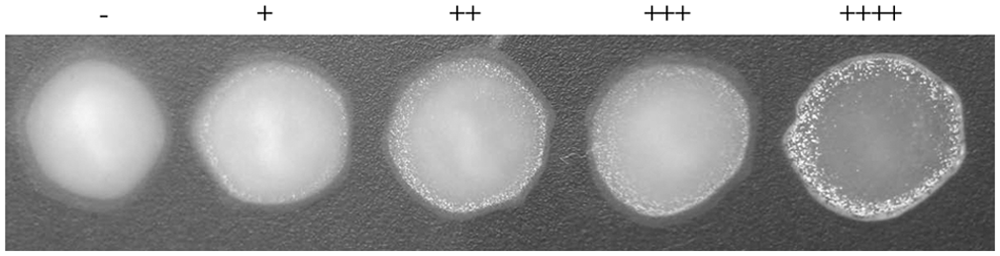
Latex agglutination test for detection of antibody against Bovine herpesvirus 1 (BHV-1). Ten µl of sensitized latex beads with purified BHV-1 virions was pippeted onto a glass slide, added with 10 µl of standard negative bovine serum or positive serum, rocked gently, and incubated at room temperature for 30 sec to 5 min. Agglutination density is determined by different scores: –, no agglutination, latex beads retain their original form, fluid displays muddy; +, mild agglutination, tiny clumps appear at fringe after 5 min; ++, moderate agglutination in 1–3 min, small and homogeneous clumps are visible; +++, heavy agglutination with big clumps appearing within 30–60 sec; ++++, very heavy agglutination within 30 sec, big clumps aggregate to fringe, and liquid droplet center becomes transparent.
The specificity of the LAT was evaluated with standard positive serum sample for Porcine circovirus-2 (PCV-2), Japanese encephalitis virus (JEV), Porcine reproductive and respiratory syndrome virus (PRRSV), Foot-and-mouth disease virus (FMDV), Pseudorabies virus (PRV), BHV-5, and Mycobacterium bovis. Standard negative bovine serum sample and positive serum sample for PCV-2, JEV, PRRSV, FMDV, PRV, and M. bovis were not able to agglutinate with the BHV-1–sensitized latex beads. However, standard BHV-5–positive sera showed positive reaction, indicating that this method is relatively specific for BHV-1 and BHV-5.
To evaluate the sensitivity and specificity, LAT was compared with VNT to detect 252 bovine serum samples in parallel. Clinical bovine serum samples were pretreated at 56°C for 30 min in a water bath, and diluted twofold serially with plain Dulbecco modified Eagle medium (DMEM) from 1:2 to 1:512 before neutralization with BHV-1. By the LAT, 93 samples were positive, of which 89 were from the 94 VNT-positive samples and 4 were from the 158 VNT-negative samples. By calculating the 95% confidence interval (CI) with the following formula:

where

represents the standard deviation, the estimate percentages are very close to the true parameters. Compared with VNT, the sensitivity of the LAT was 94.68% (95% CI: 90.17–99.22%), the specificity was 97.47% (95% CI: 95.02–99.92%), and the correlation between the LAT and VNT was 96.43% (Table 1). The correlation of antibody titers by LAT and VNT was further analyzed for 20 anti-BHV-1–positive samples diluted serially with PBS or DMEM from 1:2 to 1:512. Compared with VNT, 15 samples showed the same antibody titers, while 4 samples (serum no. 7, 10, 16, and 20) showed onefold higher, and 1 sample (sample no. 9) showed onefold lower antibody titer by LAT (Fig. 2). Because LAT mainly detects immunoglobulin M (IgM), 6 while VNT mainly detects IgG, the results indicated that IgM and IgG might exist simultaneously in the same serum from BHV-1– or BHV-5– infected cattle. To assess the repeatability of the LAT, 3 lots of purified antigens were used to sensitize latex beads and test 80 serum samples, and the positive serum amount was 25, 24, and 25, respectively, indicating a high level of repeatability.
Correlation between latex agglutination test (LAT) and virus neutralization test (VNT) in detecting antibody against Bovine herpesvirus 1.*
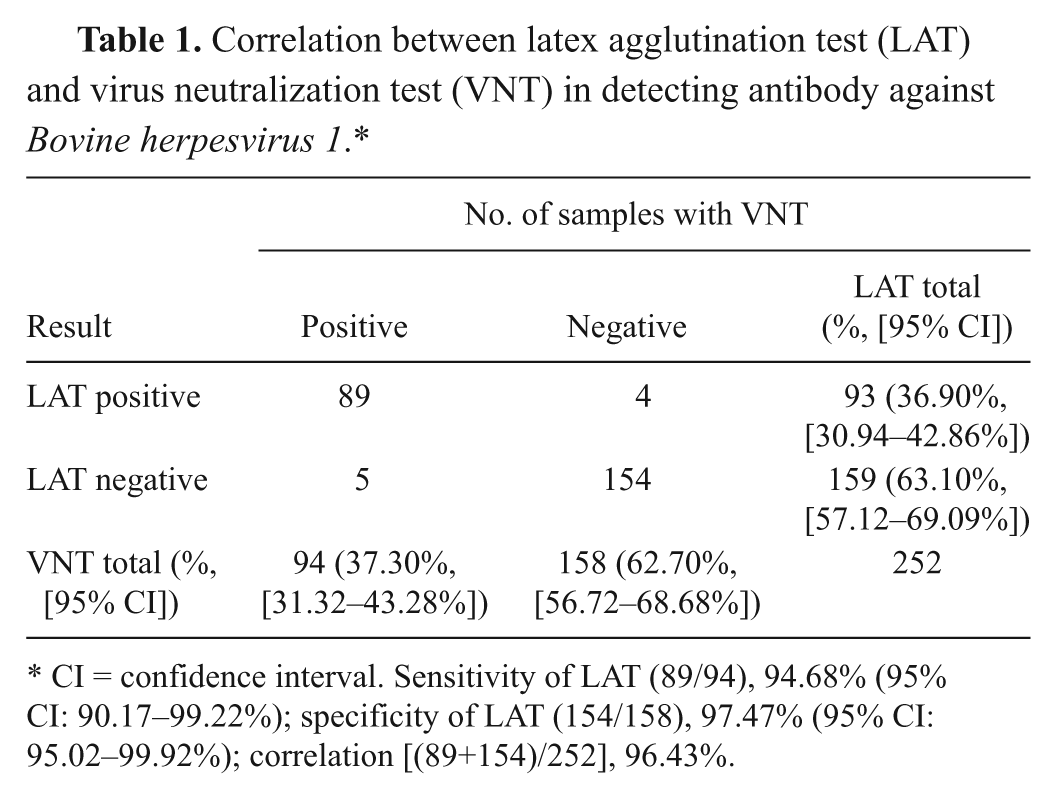
CI = confidence interval. Sensitivity of LAT (89/94), 94.68% (95% CI: 90.17–99.22%); specificity of LAT (154/158), 97.47% (95% CI: 95.02–99.92%); correlation [(89+154)/252], 96.43%.
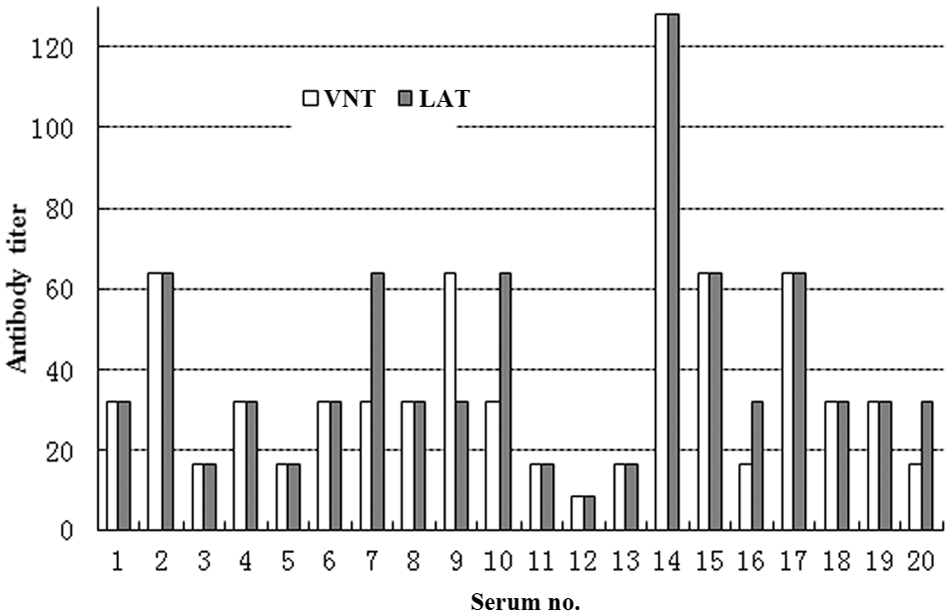
Titration of serum samples for antibody against Bovine herpesvirus 1 (BHV-1) by latex agglutination test (LAT) and virus neutralization test (VNT). Twenty anti-BHV-1–positive serum samples were serially twofold diluted with phosphate buffered saline from 1:2 to 1:512, and detected by LAT. The same serum samples were inactivated at 56°C for 30 min, diluted in Dulbecco modified Eagle medium twofold serially, as described for LAT, before incubation with BHV-1, and VNT was performed in 96-well cell culture plate. Antibody titer for each serum sample was determined by LAT and VNT in parallel for comparison.
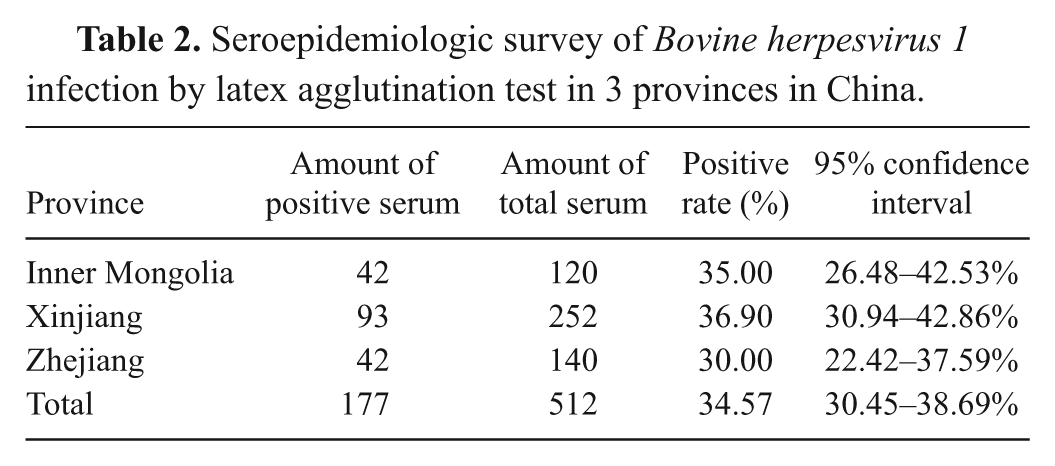
This method was applied for 512 clinical samples randomly collected from 3 major cattle-breeding provinces in China, including Xinjiang autonomous region (XJ), Inner Mongolia autonomous region (IM), and Jiangsu province (JS). The BHV-1 serum positive rate in XJ, IM, and JS was 35.00%, 36.90%, and 30.00%, respectively (Table 2). The overall serum positive rate in those regions was approximately 34.57%, with 95% CI of 30.45–38.69%. Because commercial vaccines are not currently available in China, results of the current study indicate that a high prevalence of BHV-1 infection exists in Chinese cattle herds.
Seroepidemiologic survey of Bovine herpesvirus 1 infection by latex agglutination test in 3 provinces in China.
Latex agglutination test has been widely used for detection of pathogens or antibodies.10,11 In the current study, inactivated BHV-1 field strain virions were used to sensitize latex beads for detection of anti–BHV-1 antibodies. This method shows high specificity, comparable or equal sensitivity with VNT, and good repeatability, as well.
The last 3 decades (1980–2010) saw very fast growth in the total production of beef cattle and milk cows according to the Annual Review from the Chinese Society of Husbandry. However, infectious diseases including IBR cause huge economic losses in the cattle industry. Bovine herpesvirus 1 was first isolated from an imported milk cow in Guangdong province, 13 and has since become one of the most important pathogens in cattle. Considering the huge amount of cattle, the relative time-consuming nature of performing VNT, and the special instruments and trained personnel for performing ELISA, LAT is inexpensive, rapid, and easy to perform. Furthermore, LAT is able to react with IgM, which is the main subtype of early antibodies, thus making early diagnosis of BHV-1 possible.
Due to the high nucleotide and amino acid sequence identities, LAT is able to detect antibodies against BHV-1 and BHV-5 simultaneously. Thus, LAT might be a promising method in developing countries, such as China, for primary screening of BHV-1 and/or BHV-5 infection, with ELISA or VNT used as a confirmation method.
Footnotes
Acknowledgements
The authors thank Dr. Shafiqul Chowdhury for the generous gift of the BHV-5 strain, which was used for making standard serum in cattle as one of the positive controls in this study. The authors also thank Ke-Mei Peng, Meng-Jin Zhu, and Dong-Sheng Chen for technical assistance.
a.
CCTCC V201024, Collection Center of Tissue Culture of China at Wuhan University, Wuhan, China.
b.
NanoDrop 2000, Thermo Fisher Scientific Inc., Waltham, MA.
c.
Medical Examination Institute of Shanghai, Shanghai, China.
d.
Difco Laboratories Inc., Sparks, MD.
Declaration of conflicting interests
The author(s) declared no potential conflicts of interest with respect to the research, authorship, and/or publication of this article.
Funding
The author(s) disclosed receipt of the following financial support for the research, authorship, and/or publication of this article: This work was support by Natural Science Foundation of China (31070133), 863 research grant (2011AA10A212) and 973 research grant (2010CB530203) to ZF Liu.