




Abstract
Recently a commercial antigen-capture enzyme-linked immunosorbent assay kit in the form of a dipstick (Bovine Enterichek®, Biovet Inc.) was made available to bovine practitioners and producers for the rapid detection of Betacoronavirus 1 (BCV-1), Rotavirus A (RV-A), Escherichia coli K99+, and Cryptosporidium parvum in feces from diarrheic calves. The diagnostic performance of Bovine Enterichek was evaluated in comparison with a multiplex real-time polymerase chain reaction assay (mrtPCR). One hundred fecal samples were procured from diagnostic submissions to Iowa State University Veterinary Diagnostic Laboratory and were used for the assessment. The agreement quotient (kappa) in results for each pathogen between Bovine Enterichek and mrtPCR were 0.095 (BCV-1), 0.521 (RV-A), 0.823 (E. coli K99 + ), and 0.840 (C. parvum). In comparison to mrtPCR, the diagnostic sensitivity of Bovine Enterichek was 60.0%, 42.3%, 71.4%, and 81.5%, and the diagnostic specificity was 51.4%, 100%, 100%, and 98.6% for BCV-1, RV-A, E. coli K99 + , and C. parvum, respectively. The current study suggested that Bovine Enterichek can be a rapid test tool in the field for detection of RV-A, C. parvum, or E. coli K99+ in feces from calves at acute stage of clinical disease. However, test results for BCV-1 by the kit should be interpreted with caution due to low specificity and sensitivity of the kit.
Keywords
Calf diarrhea is a worldwide issue in cattle industry and causes a high rate of mortality and morbidity. 4 Numerous pathogens (e.g., Betacoronavirus 1 [BCV-1], Rotavirus A [RV-A], Bovine viral diarrhea virus, Bovine norovirus, Bovine torovirus, Escherichia coli K99 + , Salmonella spp., Cryptosporidium parvum, and coccidia) have been reported to be associated with diarrhea in calves. Timely prevention and control of calf diarrhea is important to reduce economic losses to producers and improve animal welfare. 7 Dealing with such a large number of potential etiological agents as well as various management factors (e.g., housing, colostrum uptake, herd size, and environmental temperature) is an ongoing challenge for effective control of enteric disease in newborn calves.2,5,9,12 Accurate and rapid detection of etiology early in the disease outbreak can aid in quick implementation of appropriate interventions to decrease losses. 7 An animal-side or pen-side rapid test kit designed to simultaneously detect multiple pathogens is useful in the field.
Recently, a commercial “dipstick” antigen-capture enzyme-linked immunosorbent assay (ELISA; Bovine Enterichek® a ; hereafter, Enterichek) has been marketed for rapid detection of 4 major bovine enteric pathogens (BCV-1, RV-A, E. coli K99 + , and C. parvum) in feces from diarrheic calves. The principle of the kit is based on a lateral flow immunochromatography assay 1 that captures target antigen(s) within a fecal sample. The kit is designed to be a rapid test and can be used as an animal-side or pen-side test in the field. Diagnostic sensitivity of the kit stated by the manufacturer is 63.6%, 96.0%, 82.6%, and 78.3% for BCV-1, RV-A, E. coli K99+, and C. parvum, respectively, while the stated diagnostic specificity of the kit is 97.4%, 100.0%, 94.4%, and 93.3% for the same agents. However, no independent evaluation of the kit has been reported. Internal evaluation of kit performance by the manufacturer was conducted by comparing various tests for each of the different agents. Different laboratory methods have varying sensitivity and specificity for the specific targets for which they are designed. Use of different laboratory methods to validate test performance for different agents can yield biased results due to varying degree of sensitivity and/or specificity among assays and unintended diagnostic error during testing.
The present study was conducted to assess the diagnostic performance of Enterichek in comparison with a multiplex real-time polymerase chain reaction (mrtPCR), which was designed to detect the same pathogens 3 and is currently offered by the Iowa State University Veterinary Diagnostic Laboratory (ISUVDL; Ames, Iowa) for detecting major bovine enteric pathogens in bovine feces.
One hundred fecal samples were procured from submissions to ISUVDL during 2010. All samples were collected from diarrheic calves. No more than 3 fecal samples were collected from the same herd. All samples were tested concurrently by both mrtPCR and the Enterichek kit. The diagnostic performance of the Enterichek kit was evaluated by comparison of results to those of mrtPCR. The discrepant test results between the 2 tests were resolved by performing gel-based PCR or reverse transcription (RT)-PCR for each agent and then sequencing the PCR products as previously described. 3
The kit includes strips and dilution tubes. Each dilution tube has a lid with measuring spoon attached and contains 2 ml of a proprietary diluent. The kit was used to test samples as directed by the manufacturer with a modification. In brief, a spoonful amount (approximately 0.25 g) of sample was taken from each feces, transferred to a dilution tube, and mixed well with the diluent by shaking the tube. The diluted and homogenized feces in the dilution tube were then transferred to a container with a larger opening instead of keeping them in the dilution tube so that all 4 strips could be dipped in the sample together at the same time without touching each other. The strips were hung together by a paper clip and were kept immersed in the liquid phase of the sample for approximately 10 min or until the liquid reached the top of each strip as recommended by the manufacturer. The strips were then removed from the sample and kept for 5 min at room temperature for drying before reading. The sample was considered negative or positive for each target agent if the corresponding strip had 1 or 2 lines, respectively. Testing was considered invalid if no line was observed on the strip.
The mrtPCR was performed as previously described. 3 All fecal samples were prepared with 0.01 M phosphate buffered saline (pH 7.4) to generate 30% fecal homogenates. After centrifuging the fecal homogenates for 1 min at 100 × g, 175 µl of the supernatant was used to extract genomic material of target agents using a commercial nucleic acid isolation kit b according to the manufacturer’s instruction. A multiplex quantitative PCR kit c was used for the one-step RT-PCR. For PCR, 8 µl of nucleic acid template was mixed with 17 µl of reaction mixture containing primers and probes (200 nM each), multiplex RT-PCR buffer, multiplex enzyme mix, and nuclease-free water. Amplification of the template was performed using an automated real-time PCR system. d The cycling conditions were as follows: reverse transcription reaction for 10 min at 45°C (skipped for DNA pathogens) and 10 min activation for the DNA polymerase, followed by 40 cycles of denaturation at 94°C for 10 sec and annealing/extension at 60°C for 60 sec. Samples with threshold cycle (Ct) ≤ 35 were considered positive for the corresponding target agent(s).
For each pathogen (i.e., BCV-1, RV-A, E. coli K99 + , and C. parvum), 4 positive fecal samples as determined by mrtPCR were prepared from clinical cases. Each was assessed for level of target pathogen by mrtPCR using standard curves generated based on known copy numbers of plasmid standards constructed to contain the target gene of each pathogen. The fecal samples were then diluted by serial 2-fold dilution technique in the diluent provided with the Enterichek kit. Each of the diluted fecal samples was tested by both Enterichek and mrtPCR to determine the detection limit of Enterichek for each pathogen. The level (genomic copy number per ml) of the target pathogen in each diluted feces was determined based on Ct value using a standard curve generated from a set of varying copy numbers of plasmid constructed to contain the target gene of the pathogen.
The performance of Enterichek was compared with that of mrtPCR by using chi-square analysis and kappa (κ) calculation. The diagnostic sensitivity and specificity of the kit was then calculated. The κ value was interpreted as one of the following: poor (κ = 0), slight (0.01 < κ < 0.20), fair (0.21 < κ < 0.40), moderate (0.41 < κ < 0.60), substantial (0.61 < κ < 0.80), and excellent (0.81 < κ < 1.00). 6
Of the 100 samples tested by mrtPCR, 34% were positive for 1 of the 4 target pathogens, 45% were positive for more than 1 target pathogen, and the remaining (21%) were negative for all of the 4 target pathogens. The results and comparative performance of Enterichek on the same 100 fecal samples in comparison to mrtPCR are summarized in Table 1. The agreement between Enterichek and mrtPCR was good (98% and 94%, respectively) in detecting E. coli K99+ and C. parvum, acceptable (85%) in detecting RV-A, and relatively poor (54%) in detecting BCV-1. Accordingly, κ values were in a similar pattern: poor for BCV-1, moderate for RV-A, and excellent for E. coli K99+ and C. parvum. Samples with discrepant results between Enterichek and mrtPCR were retested by conventional gel-based PCR for each agent and sequencing PCR product. In all discrepant samples, the results of gel-based PCR and sequencing confirmed the results of mrtPCR.
Comparative performance of the Bovine Enterichek® kit and bovine enteric multiplex polymerase chain reaction (PCR) panel in detecting Betacoronavirus 1 (BCV-1), Rotavirus A (RV-A), Escherichia coli K99+, or Cryptosporidium parvum from fecal samples.
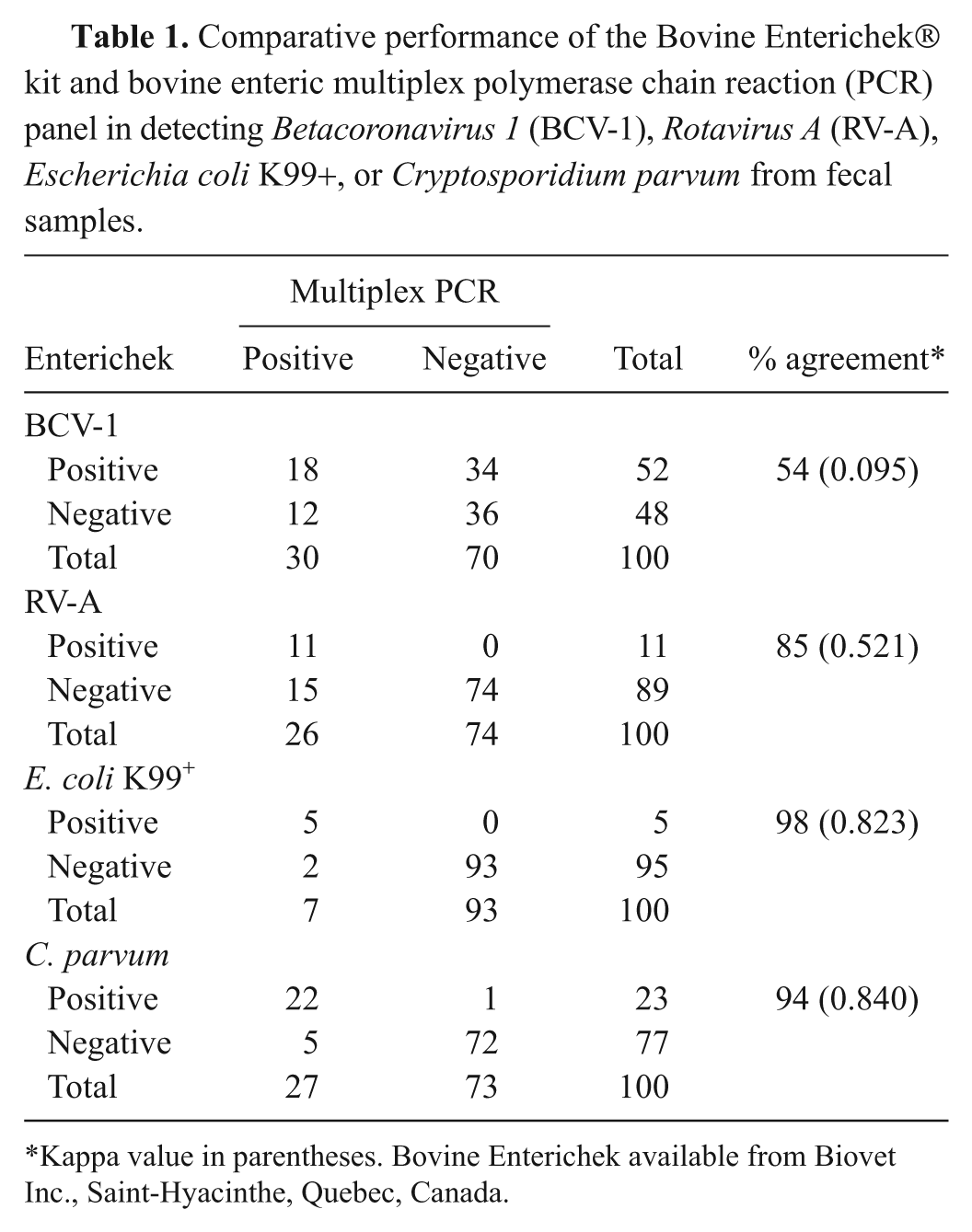
Kappa value in parentheses. Bovine Enterichek available from Biovet Inc., Saint-Hyacinthe, Quebec, Canada.
The estimated detection limit of Enterichek for all agents was approximately 300 copies/ml. When mrtPCR was used as the reference test, the diagnostic sensitivity of Enterichek was 60.0%, 42.3%, 71.4%, and 81.5% for detection of BCV-1, RV-A, E. coli K99 + , and C. parvum, respectively. The diagnostic specificity of Enterichek was 51.4%, 100%, 100%, and 98.6% for detection of BCV-1, RV-A, E. coli K99+, and C. parvum, respectively.
Multiple factors, both infectious and noninfectious, are involved in calf diarrhea outbreaks, which makes disease control on farms difficult.10,11 Rapid and accurate diagnosis of various pathogens is essential for timely implementation of appropriate intervention or preventive measures in the herd to reduce economic losses. 8 In this regard, an animal-side or pen-side rapid test kit is highly desirable as long as the kit has an appropriate and predictable level of sensitivity and specificity.
The current study was to evaluate diagnostic performance of a commercially available lateral flow chromatography-based rapid antigen detection kit (Enterichek). When compared to mrtPCR, the performance of Enterichek on fecal samples from clinical cases was comparable in the detection of E. coli K99+ and C. parvum (κ value >0.8), suggesting that the kit can be a rapid test for these 2 agents in the field. The kit was, however, less than optimal in detecting RV-A and BCV-1 in feces from clinical cases.
The low agreement (κ = 0.521) between mrtPCR and Enterichek for RV-A was due to lower sensitivity (42.3%) of Enterichek than that of mrtPCR. The poor agreement (κ = 0.095) between mrtPCR and Enterichek for BCV-1 was due to both low sensitivity (60%) and low specificity (51.4%). Since nucleic acid–based assays are generally much more sensitive than ELISA-based assays for antigens, the observed sensitivity of Enterichek for the detection of RV-A or BCV-1 in feces may be acceptable as an animal-side test if the test is performed on samples collected from calves at acute stage when a large number (i.e., ≥103 virus particles) of rotaviruses and/or coronaviruses are expected to shed. However, such poor specificity of Enterichek for BCV-1 was unexpected. The specificity of the antibodies used in the test for capturing and/or detecting BCV-1 may need to be reevaluated or modified. Until such time, positive results of the kit for BCV-1 should be interpreted with caution, and the sample may need to be submitted to a diagnostic laboratory for confirmation.
Several technical concerns with the kit were identified while testing the fecal samples in the present study. First, the dilution tube provided with the kit has a narrow opening; therefore, the tube can hold only 1 strip at a time if one follows the manufacturer’s recommendation to keep strips separated while in the dilution tube. This means it would take at least 40 min to complete the testing for 4 pathogens (i.e., 10 min with each strip). In the current study, a modification had to be made to accommodate all 4 strips in a fecal suspension at the same time to save testing time. Second, the strips for different targets varied in absorption/migration rate even though testing was done on the same sample. Hence, running time could vary between strips. Third and importantly, clogging occurred in strips when semi-solid samples were tested so that testing could not be done within the timeframe (approximately 10 min) as directed by the manufacturer or even with extended time (i.e., >20 min). Solving this problem requires further dilution (e.g., 2× or 4×) of samples, but such a protocol modification would lower the sensitivity of the kit. These technical drawbacks should be taken into consideration when using the kit in the field.
Footnotes
Acknowledgements
The authors would like to thank Jessica Boor and Jacqueline Thomas for their excellent assistance in sample collection from the veterinary diagnostic laboratory submissions as well as Dr. Rodger Main, Director of Iowa State University Veterinary Diagnostic Laboratory, for his support of research.
a.
Bovine Enterichek®, Biovet Inc., Saint-Hyacinthe, Quebec, Canada.
b.
MagMax™ Total Nucleic Acid Isolation Kit, Applied Biosystems, Austin, TX.
c.
AgPath-ID™ Multiplex RT-PCR kit, Applied Biosystems, Austin, TX.
d.
ABI 7500 Fast Real-Time PCR System, Applied Biosystems, Austin, TX.
The author(s) declared no potential conflicts of interest with respect to the research, authorship, and/or publication of this article.
The study was supported in part by funding from Iowa State University Veterinary Diagnostic Laboratory Research and Development Fund, Iowa Beef Center, and USDA CSREES (award 2007-35102-18115).