




Abstract
Virus isolation rates for influenza A virus (FLUAV) and Avian paramyxovirus serotype 1 (APMV-1) from wild bird surveillance samples are lower than molecular detection rates for the specific viral genomes. The current study was conducted to examine the possibility of increased virus isolation rates from real-time reverse transcription polymerase chain reaction (real-time RT-PCR) using alternative virus isolation substrates such as embryonating duck eggs (EDEs), embryonating turkey eggs (ETEs), Madin–Darby canine kidney (MDCK) cell cultures, and African green monkey kidney (Vero) cell cultures. Rectal swabs of birds in the orders Anseriformes and Charadriiformes were tested by real-time RT-PCR for the presence of FLUAV and APMV-1 genomes, and virus isolation (VI) was attempted on all real-time RT-PCR–positive samples. Samples with threshold cycle (Ct) ≤37 had VI rates for FLUAV of 62.5%, 50%, 43.8%, 31.5%, and 31.5% in embryonating chicken eggs (ECEs), ETEs, EDEs, MDCK cells, and Vero cells, respectively. A higher isolation rate was seen with ECEs compared to either cell culture method, but similar isolation rates were identified between the different embryonating avian eggs. Virus isolation rates for APMV-1 on samples with real-time RT-PCR Ct ≤37 were 75%, 100%, 100%, 0%, and 37.5% in ECEs, ETEs, EDEs, MDCK cells, and Vero cells, respectively. Significantly higher VI rates were seen with ECEs as compared to either cell culture method for all real-time RT-PCR–positive samples. Because of the limited availability and high cost of ETEs and EDEs, the data support the continuing usage of ECEs for primary isolation of both FLUAV and APMV-1 from real-time RT-PCR–positive wild bird surveillance samples.
Wild birds are the reservoir for influenza A virus (FLUAV; family Orthomyxoviridae, genus Influenzavirus A) and Avian paramyxoviruses (APMV; family Paramyxoviridae, subfamily Paramyxovirinae, genus Avulavirus). Influenza A virus can be categorized as 1 of 16 different hemagglutination subtypes (H1–H16) in combination with 1 of 9 different neuraminidase subtypes (N1–N9). 14 Avian paramyxovirus can be categorized as 1 of 9 serotypes, of which serotype 1 is the most common (APMV-1), with Newcastle disease virus strains being the virulent form of this serotype (i.e., intracerebral pathogenicity index of ≥0.7).1–3 At least 2 primary wild aquatic bird reservoirs for low pathogenicity avian influenza (LPAI) viruses exist in nature: birds in the order Anseriformes, which are composed of ducks, geese, and swans, and birds in the order Charadriiformes, which are composed of gulls, terns, and waders.4,12 Virus isolates of APMV-1 have frequently been obtained from migratory waterfowl and aquatic birds, but infections have been identified in at least 241 species of birds. 3 influenza A virus and APMV-1 have been transmitted from wild birds to domestic poultry, causing various outcomes ranging from asymptomatic infections to mild or even severe disease. The most frequently infected poultry species with LPAI viruses from wild birds are domestic ducks. Turkeys are the most frequently infected poultry species in the order Galliformes, and chickens have a lower frequency, based on population numbers, of infection with wild bird LPAI viruses. This information raises the question of whether embryonating duck or turkey eggs might be more efficient at isolating LPAI viruses from wild bird samples.
The standard method for virus isolation (VI) of FLUAV and APMV-1 is inoculation of sample material into the chorioallantoic sac (CAS) of embryonating chicken eggs (ECEs), but these viruses have been isolated using multiple types of cell cultures including the commonly used Madin–Darby canine kidney (MDCK) and African green monkey kidney (Vero) cell cultures. Influenza A virus and APMV-1 both replicate in ECEs and hemagglutinate avian and mammalian erythrocytes.2,13,14 Identification of both viruses can be accomplished with standard hemagglutination inhibition (HI) assays (Carbrey EA, Beard CW, Cooper RJ, et al.: 1974, Hemagglutination and hemagglutination-inhibition tests with Newcastle disease virus: microtiter technique. In: Proceedings of the 17th annual meeting of the American Association of Veterinary Laboratory Diagnosticians, pp. 1–6, Roanoke, Virginia), antigen detection, or molecular-based assays such as real-time reverse transcription polymerase chain reaction (real-time RT-PCR).5,9,10,15 Real-time RT-PCR is commonly used to screen wild and domestic bird samples to reduce the number of samples entered into the more labor- and resource-intensive VI methods. However, the most efficient method for VI is unknown. The purpose of the current study was to determine if 4 additional VI methods were more efficient than standard ECEs for isolating FLUAV and APMV-1 from real-time RT-PCR–positive (real-time RT-PCR+) wild bird surveillance samples. Virus isolation was performed on all real-time RT-PCR+ samples using ECEs, embryonating duck eggs (EDEs), embryonating turkey eggs (ETEs), and MDCK and Vero cell cultures.
Cloacal swabs were collected from 197 wild aquatic birds in Minnesota, North Dakota, New Jersey, and Delaware from 2003 to 2008; 50.8% (n = 100) were obtained from the order Charadriiformes (ruddy turnstone, Arenaria interpres) and 49.2% (n = 97) from Anseriformes consisting of the mallard (Anas platyrhynchos, n = 58), blue-winged teal (Anas discors, n = 28), green-winged teal (Anas carolinensis, n = 1), wood duck (Aix sponsa, n = 4), gadwall (Anas strepera, n = 1), ring-necked duck (Aythya collaris, n = 1), and ruddy duck (Oxyura jamaicensis, n = 1). Samples were stored in 2.0 ml of brain heart infusion media and frozen at −80°C until processed.
Wild bird samples were tested using real-time RT-PCR directed to the FLUAV matrix gene and a duplex real-time RT-PCR directed to APMV-1 matrix and polymerase genes. Real-time RT-PCR was performed as previously described5,9,10,15 using 100 µl of original sample material. Real-time RT-PCR+ samples for FLUAV, APMV-1, and mixed infections were inoculated into 10-day-old specific pathogen–free (SPF) ECEs, 12-day-old SPF ETEs, and 12-day-old FLUAV antibody–negative EDEs. One hundred microliters of sample material was injected into the CAS of 3 eggs using standard methods, and the embryos were incubated for 4 days at 37°C. 14 Amnioallantoic fluid (AAF) from all embryos was harvested for hemagglutination (HA) testing using 0.5% chicken erythrocytes (Carbrey EA, et al.: 1974, Hemagglutination and hemagglutination-inhibition tests with Newcastle disease virus). Amnioallantoic fluid from dead embryos was harvested separately; AAF from live embryos was harvested and pooled. If HA negative, 200 µl of AAF was reinoculated into CAS for a second isolation attempt by the previously described method. 14 For the third VI attempt, 200 µl of AAF was inoculated into the yolk sac of 6-day-old ECEs and 8-day-old ETEs and EDEs and allowed to incubate for 4 days at 37°C. The yolk sac membrane and embryo were collected and forcefully passed through a syringe. Contents were centrifuged at 200 × g for 10 min; supernatant was collected and tested for HA activity.6,16
Real-time RT-PCR+ samples for FLUAV and APMV-1 were inoculated into MDCK and Vero cell cultures for 3 isolation attempts. Cells were seeded into 96-well cell culture plates with 1× Dulbecco modified Eagle medium (DMEM), 5% fetal bovine serum, and antibiotic and antimycotic solution (10,000 U/ml of penicillin G, 10,000 µg/ml of streptomycin, 25 µg/ml of amphotericin B) and allowed to monolayer overnight at 37°C and 5% CO2. The monolayers were washed twice with sterile phosphate buffered saline and inoculated with 20 µl of original sample into each of 3 wells and allowed to incubate for 45 min at 37°C. After incubation, 150 µl of 1× DMEM supplemented with antibiotic/antimycotic solution was added. Infected cells were allowed to incubate for 4 days. Cells were frozen at −80°C and thawed. Fifty microliters of supernatant was harvested for HA testing (Carbrey EA, et al.: 1974, Hemagglutination and hemagglutination-inhibition tests with Newcastle disease virus), and an additional 20 µl of supernatant was used as inoculum for the second VI attempt. This method was repeated for a total of 3 VI attempts. Any sample with positive HA results was grown to a volume sufficient for differential diagnostic testing.
Samples with positive HA results were identified as FLUAV using a commercial antigen-capture enzyme-linked immunosorbent assay a or APMV by standard HI assay (Carbrey EA, et al.: 1974, Hemagglutination and hemagglutination-inhibition tests with Newcastle disease virus). The APMV serotype was determined using reference antigen/antiserum combinations for APMV serotypes 1–4, 6, and 7. Statistical comparisons were made using statistical software. b Data were organized into 2 × 2 contingency tables and analyzed for significant differences in VI using the Fisher exact test; statistical significance was set to P < 0.05. The results for different VI methods were compared to each other for all real-time RT-PCR+ samples and real-time RT-PCR+ samples with threshold cycle (Ct) ≤37.
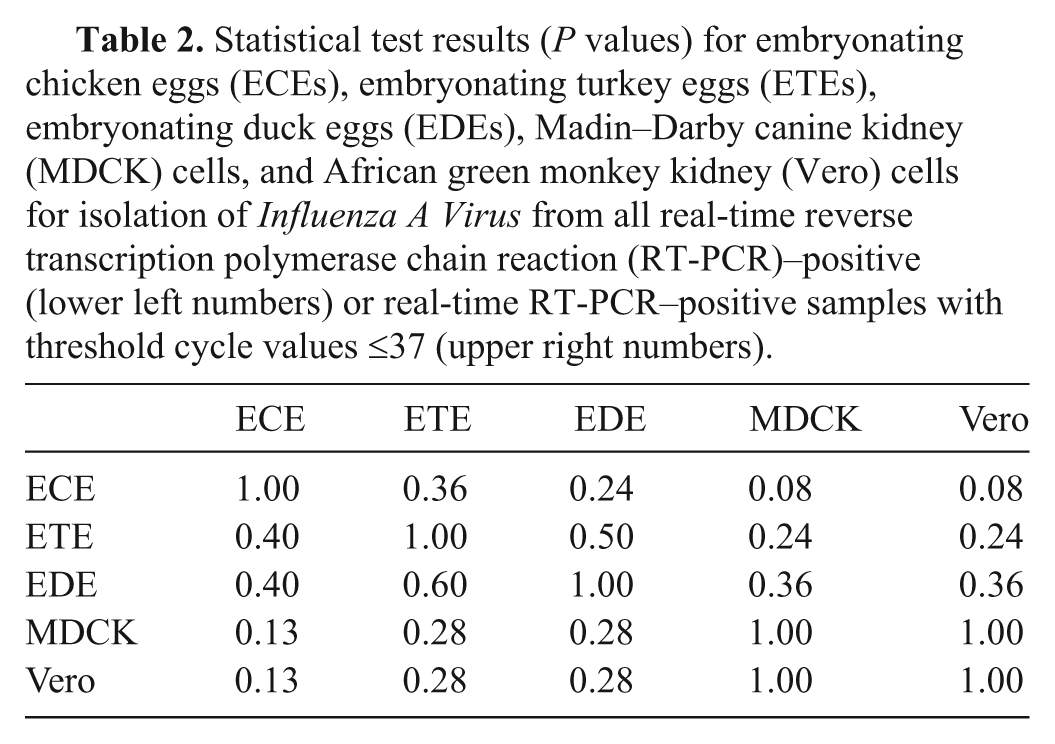
There were 23.4% (n = 46) of samples that were real-time RT-PCR+ for the FLUAV matrix gene; 54.3% (n = 25) were obtained from Anseriformes and 45.6% (n = 21) obtained from Charadriiformes. The Ct values ranged from 29.39 to 43.32. The FLUAV VI results for ECEs, ETEs, EDEs, and MDCK and Vero cell cultures are reported in Table 1. The majority of the VI occurred in the real-time RT-PCR samples with Ct ≤37 (n = 16). With real-time RT-PCR samples with Ct ≤37, ECEs, ETEs, EDEs, and MDCK and Vero cells had VI rates of 62.5% (n = 10), 50% (n = 8), 43.8% (n = 7), 31.5% (n = 5), and 31.5% (n = 5), respectively. For Ct >37 (n = 30), ECEs, ETEs, and MDCK and Vero cells had a VI rate of 0.0% (n = 0), and EDEs had a VI rate of 3% (n = 1). The ECEs supported the growth of 3 FLUAV isolates not recovered using ETEs and EDEs. The ETEs supported the growth of 1 FLUAV isolate not recovered using ECEs or EDEs, and EDEs supported the growth of 1 FLUAV isolate not recovered using ECEs and ETEs. Overall, for the 5 VI methods, there was no Ct value below which there was 100% predictable isolation of FLUAV (i.e., low Ct value always correlating with positive VI). The ECEs had higher VI rates than the MDCK and Vero cell cultures for all real-time RT-PCR+ samples as well as those samples with Ct values ≤37 (Table 2) that were close to statistical significance, possibly due to small virus-positive rates. No significant differences in isolation rates were detected in the pairwise comparisons between the other VI methods.
Virus isolation results for Influenza A virus (FLUAV) and Avian paramyxovirus serotype 1 (APMV-1) in embryonating chicken eggs (ECEs), embryonating turkey eggs (ETEs), embryonating duck eggs (EDEs), Madin–Darby canine kidney (MDCK) cells, and African green monkey kidney (Vero) cells.*
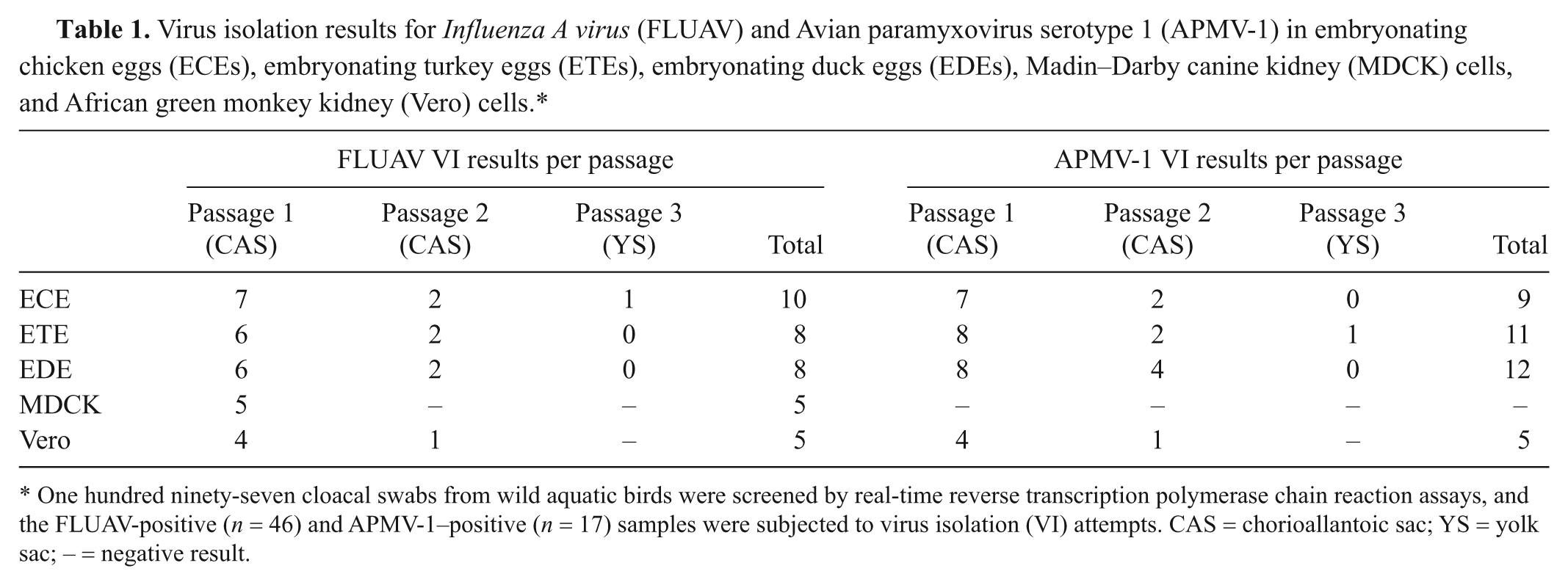
One hundred ninety-seven cloacal swabs from wild aquatic birds were screened by real-time reverse transcription polymerase chain reaction assays, and the FLUAV-positive (n = 46) and APMV-1–positive (n = 17) samples were subjected to virus isolation (VI) attempts. CAS = chorioallantoic sac; YS = yolk sac; – = negative result.
Statistical test results (P values) for embryonating chicken eggs (ECEs), embryonating turkey eggs (ETEs), embryonating duck eggs (EDEs), Madin–Darby canine kidney (MDCK) cells, and African green monkey kidney (Vero) cells for isolation of Influenza A virus from all real-time reverse transcription polymerase chain reaction (RT-PCR)–positive (lower left numbers) or real-time RT-PCR–positive samples with threshold cycle values ≤37 (upper right numbers).
For the duplex APMV-1 real-time RT-PCR, 8.6% (n = 17) were positive for class I and II APMV-1; 47.2% (n = 8) were from Anseriformes, and the remaining 52.9% (n = 9) were from Charadriiformes. The Ct values ranged from 28.19 to 39.85. The APMV VI results for ECEs, ETEs, EDEs, and MDCK and Vero cell cultures are reported in Table 1. The majority of the VIs occurred from real-time RT-PCR samples with Ct values ≤37 (n = 8, 47%). The APMV-1 isolation rates for ECEs, ETEs, EDEs, and MDCK and Vero cells were 75% (n = 6), 100% (n = 8), 100% (n = 8), 0%, and 37.5% (n = 3), respectively. For Ct values >37 (n = 9), ECEs and ETEs both had a VI rate of 33% (n = 3), EDEs had a VI rate of 44% (n = 4), and Vero cells had a VI rate of 22.2% (n = 2). The ECEs supported the growth of 1 APMV-1 isolate not recovered using ETEs or EDEs. The ETEs supported the growth of 3 APMV-1 isolates not recovered using ECEs or EDEs. The EDEs supported the growth of 1 APMV-1 isolate not isolated in ECEs or ETEs. Overall, for the 5 VI methods, there was no Ct value below which there was predictable isolation of an APMV-1 isolate. For all real-time RT-PCR+ samples, significantly higher rates of APMV-1 isolation were seen with ECEs, ETEs, and EDEs as compared to either cell culture method (Table 3), but no significant differences in VI rates were observed in pairwise comparisons between embryonating avian eggs. Vero cell cultures had significantly higher VI rates than MDCK cell cultures, as no APMV-1 was isolated by this latter method for all sample sets that were real-time RT-PCR+. For samples with Ct values ≤37, significantly higher VI rates were seen with ECEs, ETEs, and EDEs compared to MDCK cell cultures and near significant (ECE) or significant (ETE and EDE) against Vero cell cultures.
Statistical test results (P values) for embryonating chicken eggs (ECEs), embryonating turkey eggs (ETEs), embryonating duck eggs (EDEs), Madin–Darby canine kidney (MDCK) cells, and African green monkey kidney (Vero) cells for isolation of Avian paramyxovirus serotype 1 from all real-time reverse transcription polymerase chain reaction (RT-PCR)–positive (lower left numbers) or real-time RT-PCR–positive samples with threshold cycle values ≤37 (upper right numbers).
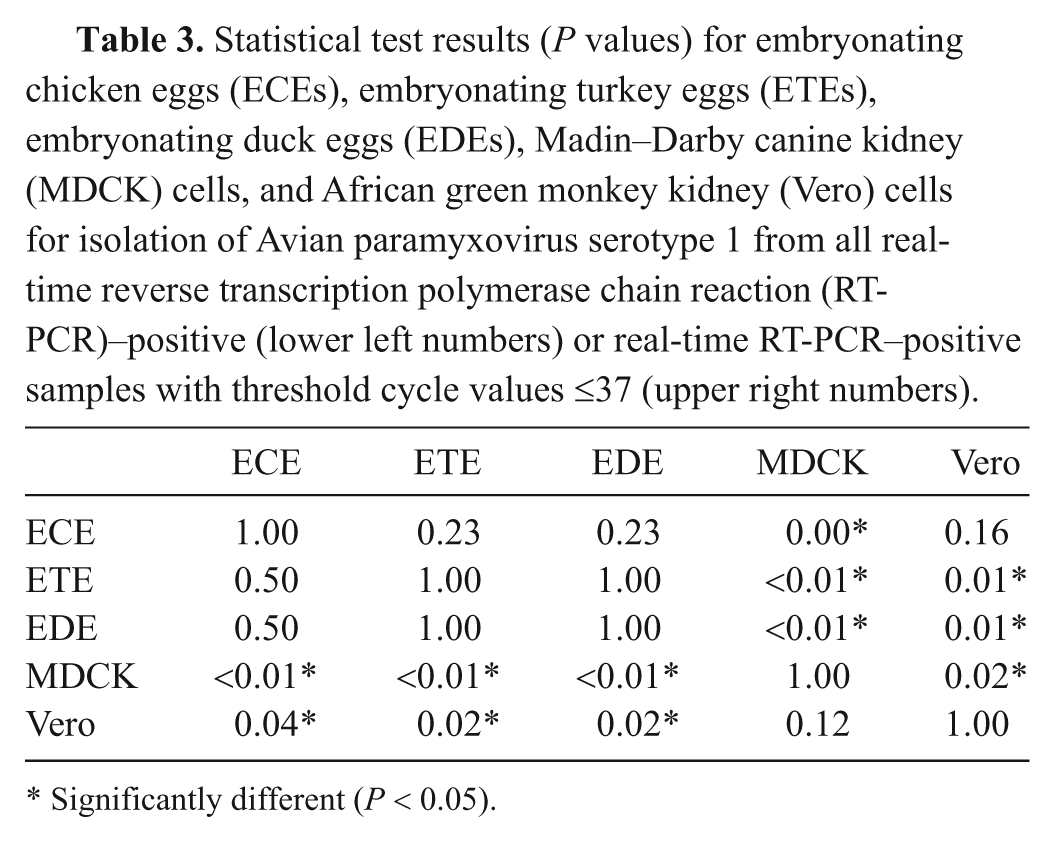
Significantly different (P < 0.05).
In poultry, FLUAV infections are most frequent in domestic ducks, which are the same species as wild mallards (i.e., A. platyrhynchos), followed by domestic turkeys and least frequent in chickens when compared to the relative populations of global production for each species. Because the VI of wild bird surveillance samples in ECEs consistently yields fewer viable virus isolates than are detected by real-time RT-PCR, the possibility of increasing the rate of VI using ETEs and EDEs, and 2 common cell culture methods, was investigated.
The real-time RT-PCR assays directed to the FLUAV matrix gene, and the APMV matrix and polymerase genes, are commonly used as prescreen tools to reduce the number of samples selected to continue into laborious and time-consuming VI methods. 11 Real-time RT-PCR assays detected FLUAV matrix gene in 23.4% (n = 46) of samples, from which ECEs produced viable isolates in 21.7% (n = 10), and ETEs and EDEs produced isolates in 17.4% (n = 8), but samples with high Ct values (>37) rarely yielded virus isolates. When restricting VI attempts to Ct values ≤37, the success rate rose to 62.5%, 50%, and 43.8% for ECEs, ETEs, and EDEs, respectively. Real-time RT-PCR detected APMV-1 matrix and polymerase genes in 8.5% (n = 17) of samples, from which ECEs produced viable isolates in 52.9% (n = 9), ETEs in 58.8% (n = 11), and EDEs in 70.5% (n = 12) of real-time RT-PCR+ samples. When restricting VI attempts to Ct ≤37, the success rate rose to 75% for ECEs and 100% for both ETEs and EDEs, respectively. Other studies report similar findings related to VI rate and Ct values. A 2008 report described that, when Ct values >37 were used as the cutoff for VI attempts, only 3.5% of virus isolates would have been missed. 8 A previous report noted increased VI from samples with Ct values of 33 ± 2 as well as an occasional VI-positive result in samples with Ct values of 36.7,9 Focusing VI attempts to samples with lower Ct values would save time and reduce resources for the isolation of viruses, especially for FLUAV. The low isolation rate for samples with >37 Ct values could be from the presence of nonviable viruses, resulting from the failure to maintain a cold chain from the collection site to the laboratory, improper maintenance of the temperature, or multiple freeze-thaw cycles in processing the material in the laboratory. For APMV-1, the isolation rate was higher than for FLUAV, possibly because of a lower Ct range for APMV-1 compared to FLUAV.
There were no significant differences in the numbers of FLUAV isolated when utilizing ECEs, EDEs, or ETEs on all real-time RT-PCR+ samples or restricting VI attempts to only samples with real-time RT-PCR+ Ct values of ≤37, although ECEs yielded 3 additional isolates not recovered with ETEs or EDEs. Similarly, VI results for APMV-1 show there were no significant differences in isolation frequency when utilizing ECEs, EDEs, and ETEs, irrespective of comparing all real-time RT-PCR+ samples or limiting to just samples with Ct values ≤37. The ETEs yielded 3 isolates not recovered with ECEs or EDEs. In addition, ETEs and EDEs yielded APMV-1 isolates on all samples with Ct values ≤37. The ETEs and EDEs may be reasonable alternatives for VI attempts when ECEs fail to isolate APMV-1 on samples with real-time RT-PCR Ct values ≤37.
Overall, there was reduced VI efficiency for samples with Ct values >37. While there was no definite predictive VI outcome associated with a specific range of Ct values, the range of real-time RT-PCR Ct values should be evaluated for each study before entering into labor- and resource-intensive VI studies. The expectation of increased VI efficiency of FLUAV and APMV-1 from wild bird surveillance samples with use of ETEs and EDEs is generally impractical, except maybe as a second passage for APMV-1 real-time RT-PCR+ samples that were VI negative with ECEs. However, the VI efficiency of ECEs was similar or higher than VI efficiency using ETEs and EDEs for FLUAV in surveillance samples used in the current study.
The ECEs had significantly or near significantly higher rates of VI than either MDCK or Vero cell cultures for FLUAV or APMV-1 real-time RT-PCR+ samples. Similarly, ECEs produced higher FLUAV VI rates from wild bird cloacal swabs than produced by MDCK. 6 While VI using cell culture is a lower cost method, 6 the use of MDCK or Vero cell culture provides fewer FLUAV isolates than ECEs, and such cell culture methods would be disadvantageous unless used in a high throughput system with the goal of maximizing the number of samples for VI attempts. The ECEs remain the preferred method of FLUAV and APMV-1 VI from real-time RT-PCR+ wild bird surveillance samples.
Footnotes
Acknowledgements
This project was completed as partial requirement by the senior author for a Master of Science degree. Maple Leaf Farms is thanked for generously providing the high quality embryonating duck embryos. Dr. Patti Miller is thanked for APMV antigen and antiserum. Joan Beck and Tim Olivier are thanked for providing technical assistance.
a.
BinaxNow®, Binax Inc., Scarborough, ME.
b.
GraphPad Prisma 5.0A, GraphPad Software, La Jolla, CA.
The author(s) declared that they had no conflicts of interest with respect to the research, authorship, and/or publication of this article.
The author(s) disclosed receipt of the following financial support for the research, authorship, and/or publication of this article: Research funding provided by ARS CRIS project no. 6612-32000-048-00D.