




Abstract
Enzootic calcinosis was diagnosed in sheep in Uruguay in pastures containing the plant Nierembergia rivularis. In a flock of 200 sheep, 20 were affected and 12 died. Clinical signs were anorexia, weight loss followed by cachexia, stiffness, and kyphosis. At necropsy and histologic examination, mineral deposits were observed on the medial layer of the arteries, heart, lungs, and kidneys. Similar lesions were also observed in 3 sheep forced to graze in an area containing the plant, while no lesions were observed in a control sheep that grazed in an area free of N. rivularis. It is concluded that N. rivularis is a calcinogenic plant for sheep.
Enzootic calcinosis is a disease of ruminants caused by calcinogenic, poisonous plants. The first calcinogenic plant reported in Uruguay was Solanum glaucophyllum (syn. Solanum malacoxylon), which affects cattle in Argentina, 3 Brazil, 6 and Uruguay; 12 buffalo in Brazil; 15 and sheep in Uruguay (Garcia y Santos MC, Pereira R, Capelli A, et al.: 2007, Intoxicación espontánea en ovinos por ingestión de Solanum glaucophyllum (malacoxylon) en Uruguay [Spontaneous poisoning in sheep from ingestion of Solanum glaucophyllum (malacoxylon) in Uruguay], pp. 284–285. XXV workshop of Uruguayan Buiatrics, Paysandu, Uruguay. In Spanish). Nierembergia veitchii causes the disease in sheep in Brazil, 13 Trisetum flavescens in cattle in Germany 5 and Austria, 10 Solanum torvum in cattle in New Guinea, 4 and Cestrum diurnum in cattle and horses in the United States 8 and cattle in Cuba. 7 In Uruguay, an outbreak of enzootic calcinosis in sheep was associated with the presence of Nierembergia repens in the pastures (Mederos A, Easton C, Paullier C, et al.: 1991, Comprobación de intoxicación por Nierembergia repens en ovinos del Uruguay [Nierembergia repens poisoning in sheep in Uruguay]. Ninth conference on sheep, Tacuarembó, Uruguay. In Spanish). The current report describes enzootic calcinosis in sheep in Uruguay caused by Nierembergia rivularis, a previously unrecognized calcinogenic plant. The experimental reproduction of the disease in sheep is also reported.
The disease occurred between December 2005 and February 2006 (spring and summer) at a farm in Bañado Grande, State of Rivera, in the northern region of Uruguay (S 31º47’12.7” and W 55º10’26.4”). In a flock of 200 Corriedale and crossbred sheep of different ages, 20 were affected and 12 died. The flock was grazing in a native pasture in which forage was scarce due to a serious drought in that area. Solanum glaucophyllum, the only calcinogenic plant known in Uruguay, was not found on the farm. A plant found in high abundance in the paddocks was identified as N. rivularis. The plant was identified by the Chemistry Faculty at the Republic University in Montevideo, Uruguay. A voucher specimen (4228 MVFQ E. Alonso Paz) was deposited in the herbarium of this faculty. Nierembergia rivularis (Fig. 1) is from the Solanaceae family and is commonly known as chuscho, water nierembergia, and whitecup. The plant grows intermingled with native vegetation and has creeping stems, with obovate or spatulate leaves and white or lilac flowers. It is an annual plant and grows during spring and summer (October–March). 1 This species is found in western South America, from Colombia to Chile, and in the region of Rio de la Plata. In Uruguay, it is found in several provinces. 9
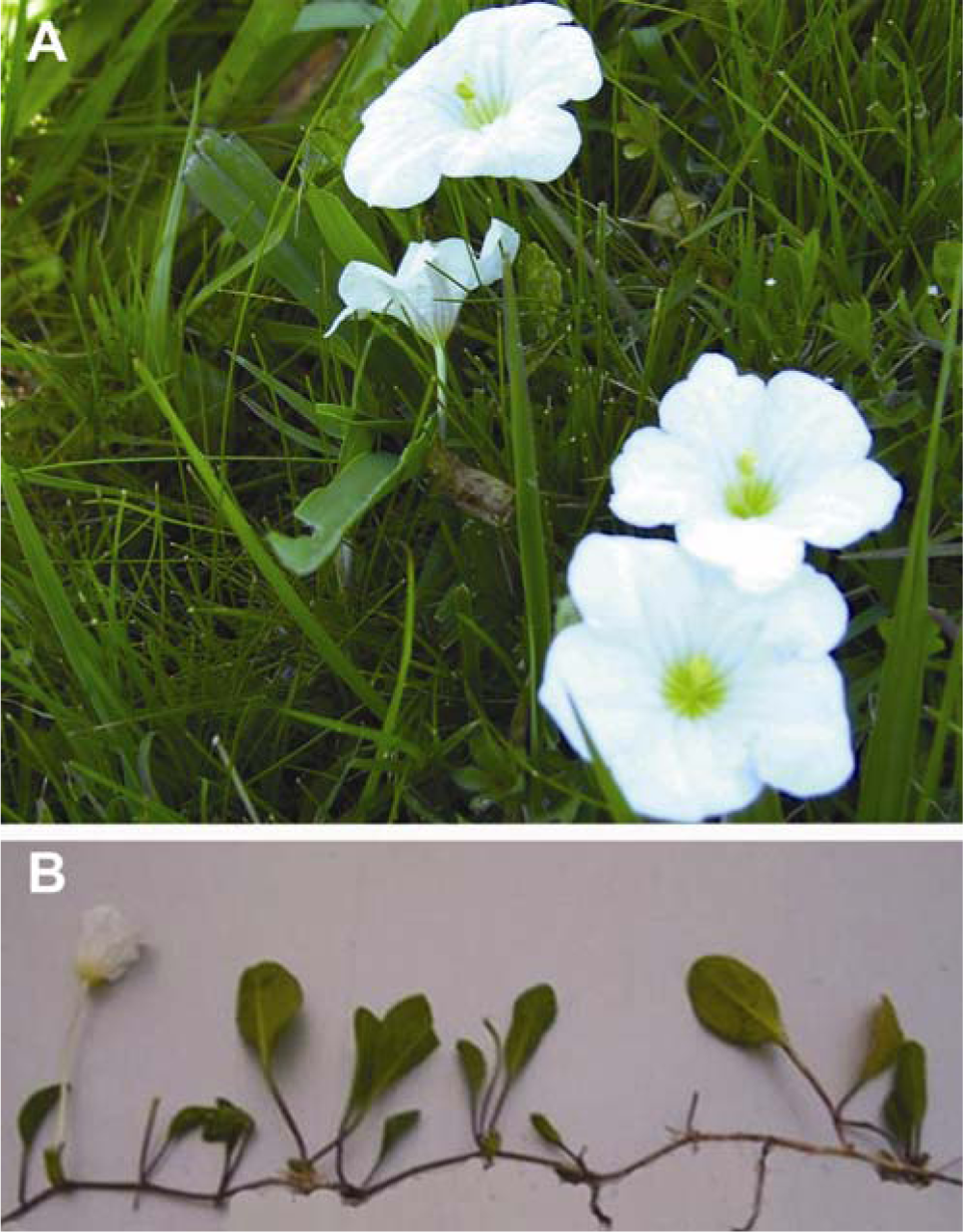
Nierembergia rivularis. Bañado Grande, Rivera, Uruguay.
Clinical signs observed in the affected sheep were anorexia, weight loss followed by cachexia, stiffness, and kyphosis. Death occurred after a chronic clinical course. In 2 sheep that died spontaneously, the arteries, mainly the aorta, had mineralized irregular plates in the endothelial surface that were inelastic, firm, and thickened. Soft tissue calcification was also observed on heart, lungs, and kidneys. A histological examination revealed mineral deposits in variable degrees on the medial layer of the arteries, heart, lungs, and kidneys, which were positively stained for calcium with von Kossa stain.
The experimental reproduction of the disease was performed on the same farm where the outbreak occurred. Four Corriedale sheep, weighing an average of 20 kg and raised on a farm without any known toxic plants, were used. An area of 625 m 2 , where N. rivularis was dominant, was isolated using an electric fence, and 3 experimental sheep were put inside for grazing. The electric fence was rotated every 15 days, over the course of 3 months, from February 15 to May 15, 2008, so that the animals always had access to a pasture containing N. rivularis. The control animal grazed on the same farm in a paddock free of N. rivularis. Ninety days after the beginning of the experiment, the animals were sent to the Veterinary Faculty, where they were euthanized by intravenous injection of sodium thiopental and then exsanguinated. Samples of the lung, trachea, heart, aorta and other arteries, esophagus, small and large intestine, peritoneum, kidney, adrenal gland, liver, spleen, thyroid, and central nervous system were fixed in 10% buffered neutral formalin. All tissues were stained with hematoxylin and eosin. Sections of the arteries were also stained with von Kossa for calcium.
Intolerance to exercise and dyspnea were observed in the experimental sheep that ingested N. rivularis. Trichomes and epidermal fragments of the plant were found in fecal samples from the experimental sheep submitted to microhistological analysis. Feces of the control sheep were negative for N. rivularis epidermis.
At necropsy, the macroscopic alterations observed in the 3 experimental sheep were a slight increase in the amount of pericardial fluid, small whitish areas inside the heart atria, and a very hard and stiff aorta, with a whitish, rough, and striated internal surface. White, elevated areas were observed on the surface of the apical lung lobes and on the surface and borders of the diaphragmatic lobes. The kidneys had congestion and showed a slightly mottled area close to the corticomedullary junction. No lesions were observed in the control sheep. The histological findings showed degeneration and mineralization of the elastic fibers of the intima and the middle layer of the aorta and other medium-sized arteries (Fig. 2). These lesions were often surrounded by connective tissue proliferation, with infiltration by mononuclear cells, macrophages, giant cells, and occasional chondroid and osseous metaplasia (Fig. 2). Intimal proliferation, with the presence of mononuclear cells, giant cells, and macrophages, was also observed. The mineral salt deposits were positive for calcium by von Kossa staining. Mineralization was also observed in the alveolar pulmonary septum, in the renal cortical and medullar tubular walls, and in the renal arteries (Fig. 2).
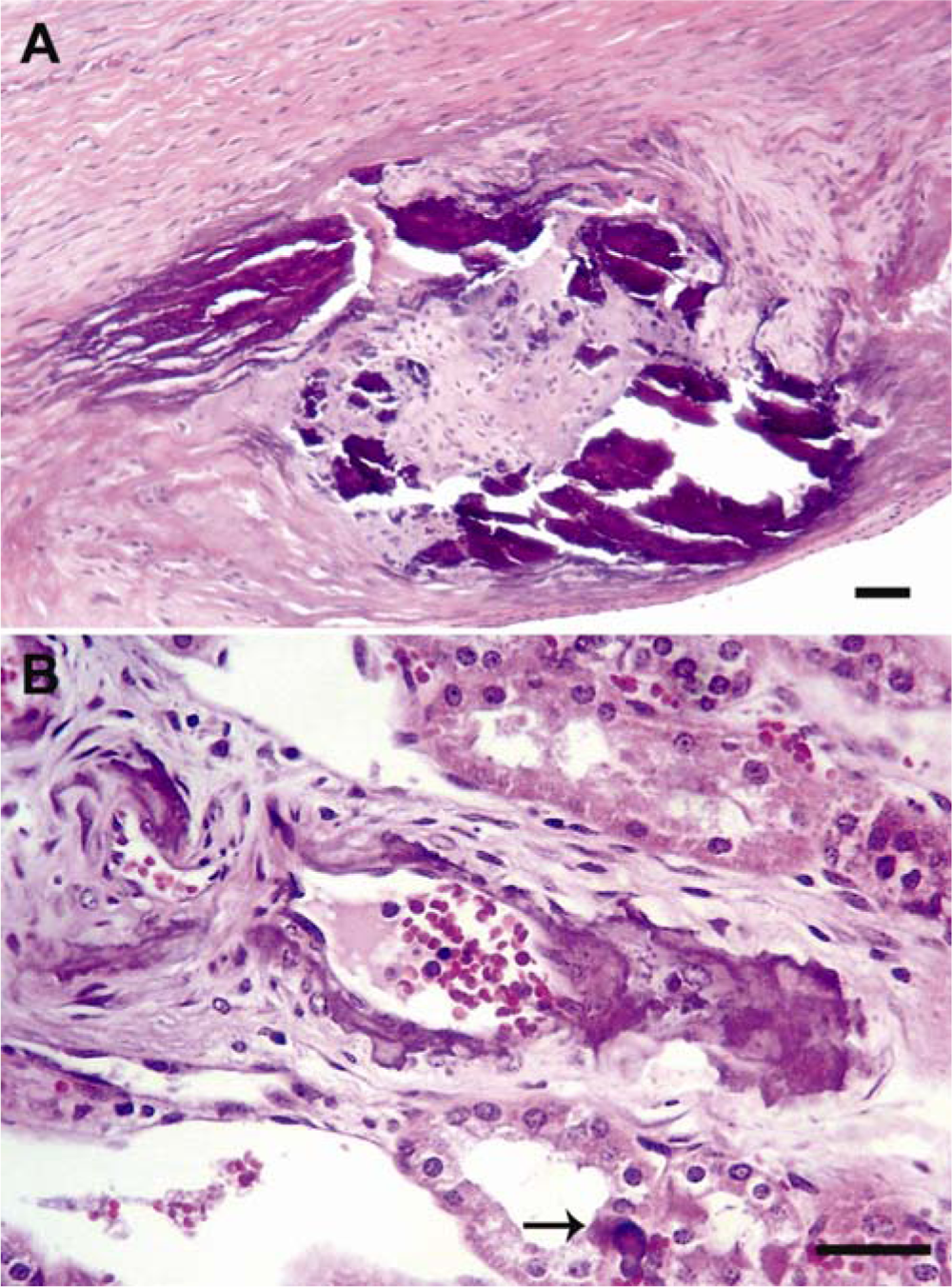
Sheep with enzootic calcinosis.
Macroscopic and histological findings in the spontaneous and experimental sheep were similar to those observed in poisoning by N. veitchii in sheep in southern Brazil13,14 and other cases of enzootic calcinosis in cattle caused by other toxic plants.3,6 The best known of the calcinogenic plants is S. glaucophyllum, which contains derived glycosides of 1,25(OH)2D3 (calcitriol). 17 It has been demonstrated that N. veitchii contains a vitamin D–like activity, probably due to a 1,25(OH)2D3–like compound. 13
The reproduction of the disease in sheep grazing in an area with large amounts of N. rivularis for 90 days showed that the animals must have ingested the plant for long periods to become poisoned. A similar situation was observed with N. veitchii, which induced weight loss or decreased weight gains and arterial calcification but no other clinical signs after the ingestion of the dry plant at concentrations of 50% of food over 21 days or 10% of food over 49 days. 11 It has been estimated that N. veitchii is approximately 78 times less toxic than S. glaucophyllum, 11 which causes calcinosis in sheep with a dose of 5 g/kg of body weight. 2 Trisetum flavescens, which also contains a calcitriol-like substance, 17 caused severe soft tissue calcification in sheep after being ingested when mixed at 50% of food for 154 days. 16 To control the poisoning by N. rivularis, because there is no effective treatment, ingestion of the plant should be avoided during its growing period, from October to March.
Footnotes
Acknowledgements
The authors thank the farmers who gave permission for epidemiological studies and experimental reproductions on their farms and the veterinarians who reported the clinical cases. The authors also thank Dr. Silvia Gallo for providing language help.
The author(s) declared no potential conflicts of interest with respect to the research, authorship, and/or publication of this article.
The author(s) disclosed receipt of the following financial support for the research, authorship, and/or publication of this article: The project was funded by CSIC I+D (Universidad de la República, Montevideo, Uruguay).