




Abstract
The objective of the current study was to isolate and identify phenotypes of Staphylococcus spp. strains derived from buffalo (Bubalus bubalis) milk. A total of 548 milk samples from 137 buffalo were cultured in Columbia agar enriched with 5% defibrinated sheep blood. Determination of the capacity of Staphylococcus aureus to produce enterotoxins A–D and toxic shock syndrome toxin-1 (TSST-1) was achieved by reverse passive latex agglutination (RPLA). Antimicrobial sensitivity of S. aureus strains was evaluated using the disk diffusion technique, and β-lactamase detection was achieved using the chromogenic test with paper discs impregnated with nitrocefin. From all the mammary quarters examined, 36 (10.8%) were positive for Staphylococcus spp., 83.3% were coagulase-negative staphylococcus (CNS), 11.1% were coagulase-positive staphylococcus (CPS), and 5.6% were of CPS+CNS positive. All isolates of S. aureus produced at least 1 toxin and 5 out of 6 isolates (83.0%) produced β-lactamase. One hundred percent of S. aureus isolates were sensitive to methicillin and amoxicillin + clavulanic acid, and resistant to ampicillin, penicillin, and oxacillin. Analysis of the results obtained in the current study highlight the epidemiologic importance of buffalo milk regarding the production of enterotoxins and TSST-1 and the potential risk to public health.
Buffalo present sanitary problems similar to other bovine species, particularly mastitis, 5 which is considered one of the main problems in the dairy industry worldwide and affects all production species. The most important effect is related to economic losses due to decrease in milk yield. 7 Among the microorganisms responsible for mastitis, bacteria are implicated as the principal etiologic agents. 2 Bacteria isolated with greatest frequency are Staphylococcus aureus, Staphylococcus spp., Bacillus spp., Corynebacterium spp., Escherichia coli, Streptococcus spp., Pseudomonas spp., and Klebsiella spp.7,9,13
Besides causing mastitis, the genera Staphylococcus are the etiologic agents responsible for approximately 45% of toxin infections worldwide. Contamination can occur by strains of environmental or human origin during the stages of food production or storage; in favorable temperature conditions, the microorganism grows and may produce toxins. 16 The enterotoxins produced by S. aureus are part of a broad family of pyrogenic toxins produced by bacteria from both the Staphylococcus and Streptococcus genera. These toxins can cause toxic shock syndrome and are commonly associated with food intoxication and many types of allergies and autoimmune diseases. 3 The objectives of the current study were to isolate and characterize the strains of Staphylococcus spp. of buffalo milk, and evaluate the sensitivity profile in vitro and the capacity of S. aureus isolates to produce enterotoxins, toxic shock syndrome toxin-1 (TSST-1), and β-lactamase.
The study involved 137 female buffalo of the Murrah and Mediterranean breeds, totaling 548 mammary quarters. The buffalo cows in various stages of lactation were bred in a semi-intensive management system and originated from different dairy properties located in 3 cities of the State of São Paulo. Six of the farms used mechanical means of milking, and 1 farm milked manually.
After washing the udders with soap and water, drying them with paper towels, and performing antisepsis of the teat ostium with 70% isopropyl alcohol, 10-ml samples of milk were collected from mammary quarters positive and negative for the California Mastitis Test 14 in sterilized flasks and identified with the name or number of the buffalo and the respective room. Following collection, the samples were placed in isothermal boxes containing ice packs and immediately sent to the laboratory to be processed.
For microbiological analysis, aliquots of 0.1-ml milk samples were inoculated on plates containing Columbia agar base enriched with 5% defibrinated sheep blood. The plates were incubated at 37ºC in a bacteriological incubator under aerobiosis conditions and examined for growth at 24, 48, and 72 hr. To identify Staphylococcus spp., the growth characteristics in blood agar colonies, the production of hemolysis, pigment, and the staining characteristics of Gram technique were analyzed. Other biochemical tests performed on bacterial colonies included catalase, thermonuclease, Voges–Proskauer, coagulase, fermentation of mannitol, trehalose, raffinose, xylose, sucrose, arabinose, and lactose under aerobiosis conditions, fermentation of mannitol and of glucose under anaerobiosis conditions, urease, reduction of nitrate to nitrite, acetoin and oxidase production, and novobiocin resistance.
Determination of the capacity of the S. aureus strain to produce enterotoxins A–D and toxic shock syndrome toxin-1 (TSST-1) was conducted by the reverse passive latex agglutination (RPLA) technique using 2 commercial kits.a,b The cellophane-over-agar technique 11 was used to obtain the supernatant from lavage of cultures grown on previously sterilized cellophane. The supernatants were filtered using nitrocellulose membranes with porosity between 0.2 and 0.45 mm. The filtrates were analyzed for enterotoxins A–D (EEA, EEB, EEC, and EED) and TSST-1, following the manufacturer’s recommendations. The result was considered positive if the agglutination reaction occurred. Negative controls were used with all samples tested.
The antimicrobial sensitivity of S. aureus strains was evaluated using the drug diffusion technique in Mueller–Hinton agar 10 and using S. aureus ATCC 25923 c as a reference strain for the test. The following antimicrobial drugs were used: ampicillin (10 mcg), d cephalothin (30 mcg), d erythromycin (15 mcg), d penicillin (10 UI), d oxacillin (1 mcg), d tetracycline (30 mcg), d cefoperazone (75 mcg), d gentamicin (10 mcg), d enrofloxacin (5 mcg), d methicillin (5 mcg), a and amoxicillin associated with clavulanic acid (70 mcg). e The quantity of microorganisms was measured in culture medium after 18 hr of incubation at 37ºC using McFarland standard.
For the S. aureus isolates, evaluation of the capacity of β-lactamase production was determined by the chromogenic test using paper discs impregnated with nitrocefin. e The colonies were cultured on plate surface, and the occurrence of pink and red staining on the surface was considered positive, while the absence of staining was considered negative for β-lactamase. Neisseria gonorrhoeae was used as positive control and Haemophilus influenzae as negative control.
The results of Staphylococcus spp. identified in the current study are presented in Table 1. The most frequently identified Staphylococcus spp. isolated was Staphylococcus epidermidis (30.56%), followed by Staphylococcus simulans (16.67%). Global increase in intramammary infection in ruminants by coagulase-negative staphylococcus (CNS), coliforms, and S. aureus has been reported, while infection by Streptococcus agalactiae has diminished (Costa EO, Garino F Jr, Watanabe ET, et al.: 1997, Evaluation of the CMT positivity and the microbiologic status of the mammary gland over the different lactation phases in buffalo cows (Bubalus bubalis). Proceedings of the fifth World Buffalo Congress, pp. 631–634, Caserta, Italy).
Analysis of Staphylococcus spp. in buffalo milk samples in the State of São Paulo, Brazil.*
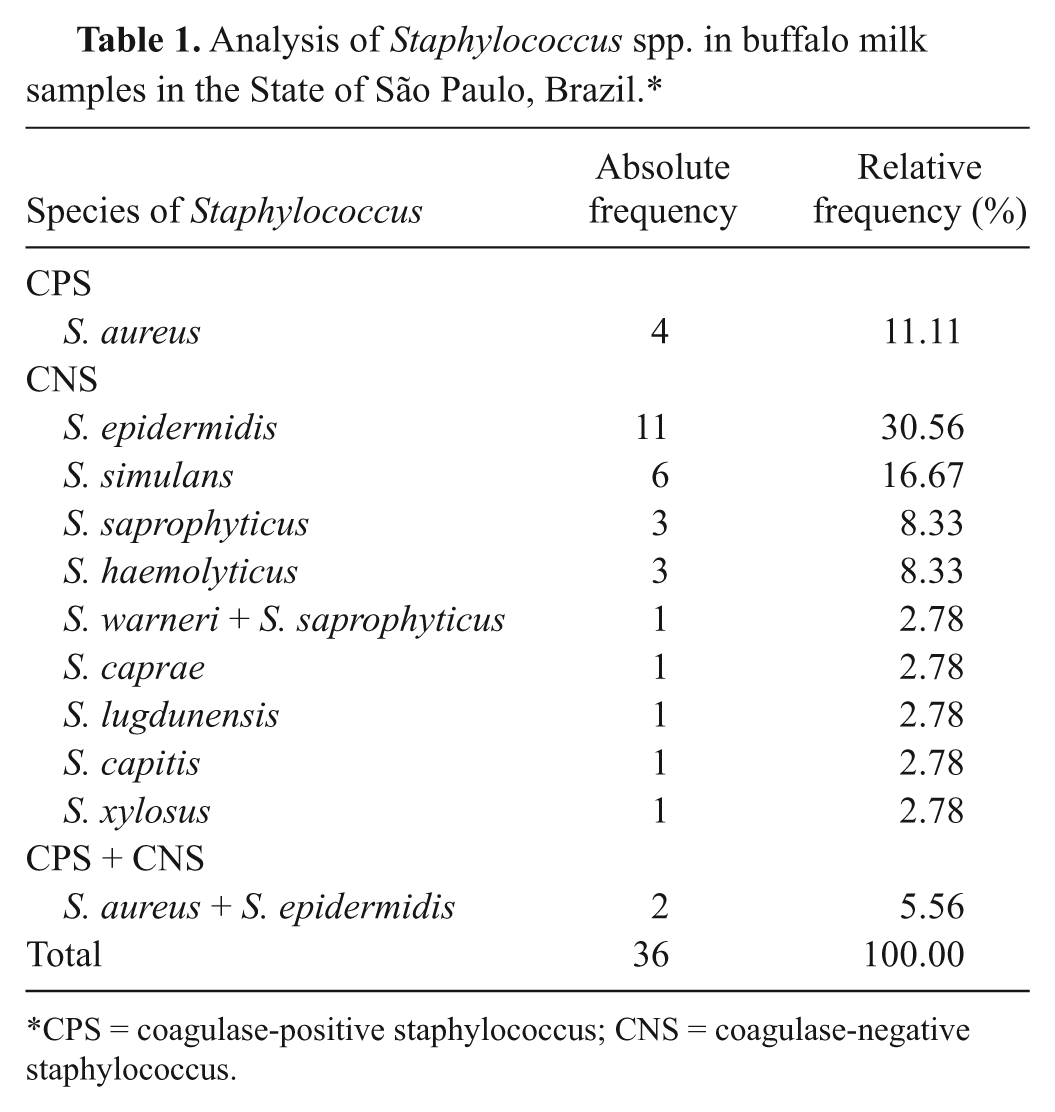
CPS = coagulase-positive staphylococcus; CNS = coagulase-negative staphylococcus.
The importance of CNS as the causal agent of intramammary infections continues to increase. Previously, CNS were considered agents of lesser importance 17 ; however, numerous studies involving different species have demonstrated the association of CNS with several disorders, including mastitis.6,8 Thus, the findings of 2 samples of S. epidermidis in the present study, associated with the California Mastitis Test, suggest that CNS are responsible for buffalo mastitis.
Other species of CNS such as S. simulans, S. saprophyticus, S. haemolyticus, S. hominis, S. caprae, S. lugdunensis, S. xylosus, S. capitis, and S. warneri were isolated (Table 1). The presence of such agents could be related to the fact that all of these species form part of human skin microbiota and despite antiseptic teat care, certain species show a relatively strong degree of adherence to epithelial cells in the dermis, presenting formation of biofilm. 1
The antimicrobial sensitivity profile verified in the present study indicated that S. aureus isolated from buffalo milk presented greater sensitivity to the antibiotics methicillin (100%), amoxicillin associated with clavulanic acid (100%), cephalothin (84.0%), and gentamicin (67.0%), and total resistance (100%) to ampicillin, penicillin, and oxacillin. Regarding CNS, 88.0% presented sensitivity to gentamicin, the most efficient antibiotic in relation to those tested, and greatest resistance to penicillin (100%). The β-lactamase production capacity determined in 6 samples of S. aureus demonstrated that 5 (83.0%) were producers.
While evaluating Staphylococcus spp. strains from buffalo mastitis, a previous study 6 determined that the samples showed greater sensitivity to enrofloxacin (93.0%), followed by gentamicin (92.5%), while ampicillin was the least effective antibiotic. The differences in results between the previous and current studies could be associated with variations in and the differentiated use of the active principals that compose antibiotics between countries and between regions of the same country.
The high resistance of S. aureus strains to penicillin and ampicillin is probably associated with the indiscriminate use of these drugs over the years; moreover, approximately 83.0% of isolated strains of S. aureus are β-lactamase producers, a factor of importance when conducting research concerning the association of amoxicillin with clavulanic acid (inhibitor of β-lactamase) in that 100% sensitivity to this combination of drugs was obtained. In the toxigenic analysis from 6 isolated samples of S. aureus, 5 (83.3%) were positive for TSST-1 and 1 (16.6%) for EEA.
All of the samples of S. aureus analyzed produced toxins, 5 produced TSST-1, and 1 produced EEA. Several studies have been conducted involving enterotoxin research and TSST-1 in bovids4,9,12 and caprids15,18; however, for buffalo, very few studies exist.
The detection of enterotoxins and TSST-1 is decisive in determining the toxigenicity of strains. Such findings are of fundamental importance from an epidemiological point of view because references regarding the presence of staphylococcus toxins obtained from buffalo milk were not available in the veterinary literature. This finding is of importance to public health because 100% of the samples agglutinated, with scores of up to +++; moreover, considering that the strains are thermoresistant, they would not be inactivated by the temperature of boiling milk commonly used in domestic environments. Further studies with different strains of S. aureus and CNS are required to determine the real importance of these toxins for public and animal health.
Analysis of the results obtained in the current study show the necessity of more in-depth epidemiological studies to determine the importance and dynamics of CNA as emergent pathogens in cases of buffalo mastitis in Brazil. Another point that should be highlighted is related to the production of enterotoxins and TSST-1 by S. aureus strains because this is a potential risk to public health. The increased resistance to antibiotics and the production of β-lactamase should alert diagnosticians to the possible indiscriminate use of antibiotics without proper management by producers and veterinarians working in the countryside.