




Abstract
The current study investigated an outbreak of mixed infection with Goatpox virus (GTPV), Orf virus (ORFV), and Mycoplasma capricolum subsp. capripneumoniae (MCCP) that occurred on a Chinese goat farm, with a case fatality rate of 60.2%. The observed clinical signs were ecthyma and accelerated respiration with frequent coughing. Specific fragments of the p32 gene of GTPV, B2L gene of ORFV, and 16S ribosomal RNA gene of MCCP were synchronously amplified by polymerase chain reaction (PCR) from the tissues of 12 dead goats. The PCR products were cloned, sequenced, and aligned with related reference sequences in GenBank for further identification of the pathogens. The present study reports a mixed infection with GTPV, ORFV, and MCCP in goats.
Goatpox virus (GTPV) belongs to the Capripoxvirus genus in the family Poxviridae. The Capripoxvirus genus consists of GTPV, Sheeppox virus (SPPV), and Lumpy skin disease virus (LSDV), whose natural hosts are goats, sheep, and cattle, respectively. Capripoxvirus diseases are of a transboundary nature, and they are on the World Organization for Animal Health Organization (OIE) list of notifiable animal diseases to the OIE. 15 Clinical signs of goat pox (caused by GTPV) may be variable, depending on individual host susceptibility or on the virus strain. Skin lesions are most commonly seen, and are characterized by maculae, papules, nodules, pustules, and scabs. The lesions may cover the whole body or may be restricted to hairless or wool-less areas such as the face, groin, axilla, and perineum. The lesions can also be seen in the nose, eye, mammary glands, vulva, prepuce, and mouth, making feeding painful with the latter. In some cases, nodules can also be found in internal organs, particularly the lungs. The majority of fatalities occur during the acute phase of the disease at the time of bronchopneumonia following secondary bacterial infection. 4 Young animals are mostly affected, with a mortality rate varying between 50% and 70%. Most adults, however survive with a mortality rate of approximately 1%. 6
In endemic areas, the diagnosis of goat pox is easily based on clinical signs. But such clinical diagnoses should be differentiated from contagious pustular dermatitis (caused by Orf virus) because of the presence of labial crusts. Orf virus (ORFV), one member of the Parapoxvirus genus within the family Poxviridae, mainly affects goats and sheep. Human beings, camels, and some wild ruminants such as reindeer and Japanese deer can also be infected with ORFV. 5 Lesions of parapoxviruses evolve through the stages of maculae, papule, vesicle, pustule, scab, and resolution. In ORFV-infected goats, the lesions most often form around the muzzle and buccal cavity. There is little evidence that ORFV can spread systemically. 10 Orf virus infections often cause a debilitating disease in young kids affecting the animals’ ability to feed. The incidence rate is high, but mortality is usually low. 9
Both GTPV and ORFV infections seem to be common diseases among goats in China. Many reports of single virus infection of goats have been published, 13,17 but disease syndromes of multifactorial etiology have not been published, to the authors’ knowledge. The present report describes an outbreak of mixed infection of GTPV, ORFV, and Mycoplasma capricolum subsp. capripneumoniae (MCCP) in goats that occurred on a Chinese goat farm.
In September 2009, an outbreak of goat pox was diagnosed based on clinical signs from a farm that housed 338 local goats in Chongqing municipality of China. Fever (rectal temperature >40.5°C), accelerated respiration with frequent coughing, nodules around the mouth, and papules on the tongue and inguinal region were visible in most goats. Pustules and scabs formed around the muzzle in some goats. The morbidity was 29.0% (98/338), but 19 of 30 adults and 40 of 68 kids died, thus yielding a case fatality rate of 60.2% (59/98). Postmortem examination of dead and euthanized animals revealed fibrinous pleuropneumonia with massive lung hepatization and pleurisy resulting in accumulation of pleural effusion. Nodules could be seen in the lungs of some goats.
Further investigation on the etiologic agents of the disease in this outbreak was necessary because of the occurrence of fibrinous pleuropneumonia and the high case fatality rate in adults and kids. The tongue, lung, and liver tissues of 12 goats collected under aseptic condition were submitted to the authors’ laboratory. The tissues were repeatedly milled with the quartz (silica) sand powders in 0.1 M phosphate buffered saline, after they were shredded with sterile scissors. The tissue homogenate was collected, followed by repeated freeze–thawing cycles (2–3 times). The homogenate was then centrifuged at 1,500 × g for 10 min at 4°C. Genomic DNA was extracted from the supernatant using a DNA extraction kit, a as directed by manufacturer’s instructions. Three pairs of primers were synthesized for independently amplifying the specific gene fragments of GTPV (P1: 5’-CTCATTGGTGTTCGGATT-3’, P2: 5’-ATGGCAGATATCCCATTA-3’), 16 ORFV (O1: 5’-CGAACTTCCACCTCAACCACTCC-3’, O2: 5’-CCTTGACGATGTCGCCCTT CT-3’), 16 and MCCP (M1: 5’-CGAAAGCGGCTTACTGGCTTGT-3’, M2: 5’-CGAAAGCGGCTTACTGG CTTGT-3’). 3 The reaction mixture was 50 µl containing 5 µl of template DNA, 25 µl of Premix Ex Taq version 2.0, a 1 µl of each primer (approximately 0.1 mM), and 18 µl of distilled water. The target fragments of GTPV and ORFV were amplified following the same conditions: an initial denaturation at 94°C for 5 min, followed by 35 cycles of 94°C for 50 sec, 56°C for 50 sec, and 72°C for 1 min, with a final extension at 72°C for 10 min. The PCR conditions for MCCP were as follows: pre-denaturation at 94°C for 5 min; 30 cycles of 95°C for 1 min, 62°C for 40 sec, 72°C for 1 min, followed by a final extension at 72°C for 10 min. After that, 20 µl of PCR products of MCCP were digested with PstI a as previously described. 3
A specific GTPV p32 gene fragment of 969 bp was amplified from the tongue, lung, and liver tissues of the 12 goats, but the specific ORFV B2L gene fragment of 507 bp was obtained only from the tongue tissues of the 12 goats. A fragment of 548 bp, which is from the 16S ribosomal DNA of MCCP, was amplified from the lung tissues of the 12 goats. After the fragment was digested using the enzyme PstI, an uncut fragment of 548 bp, and 2 digested bands of 420 bp and 128 bp, which are specific for MCCP, were observed.
To confirm the identity of the pathogens, the PCR products from 1 goat were cloned into the pMD18-T vector a and sequenced. The obtained gene sequences were labeled as Gpv_Chq09, Orfv_Chq09, and Mccp_Chq09, respectively. They were submitted to GenBank (accession nos. HM572329, HM572328, and HM572330, respectively). Alignment with related reference sequences in GenBank was performed by using the online BLAST program (http://www.ncbi.nlm.nih.gov/blast/Blast.cgi). Sequence identities of nucleotides were analyzed by the ClustalW method. 12 It was found that Gpv_Chq09 had 99.0–99.9% homology compared to other GTPV isolates, 97.7–98.6% homology compared to LSDV isolates, and 98.1% homology compared to SPPV isolates. Orfv_Chq09 had 97.2–99.4% homology against other ORFV strains. Mccp_Chq09 had 99.8% homology against MCCP reference strain F38 and field strain 4/2LC, but only 98.8–99.1% homology against other members within the Mycoplasma mycoides cluster.
Phylogenetic trees were constructed based on the related sequences with the neighbor-joining method with 1,000 bootstrap replicates using MEGA version 4.0. 11 The results showed that Gpv_Chq09 clustered in the sub-branch, which consists of strains from Vietnam (EU625263), and 2 Chinese provinces of Guangxi (EF522180, AY773088) and Guizhou (EF514890; Fig. 1A). This is consistent with the fact that Chongqing, Guizhou, and Guangxi are geographically adjacent to each other in the southwest region of China, and Guangxi shares a border with Vietnam. Orfv_chq09 was genetically closer to the 2 ORFV stains from Taiwan (EU935106, DQ904351) compared to other strains from the mainland of China (GU903501, GU320351; Fig. 1B). Mccp_chq09, MCCP reference strain F38, and another MCCP isolate 4/2LC, clustered in the same branch of the phylogenetic tree (Fig. 1C).
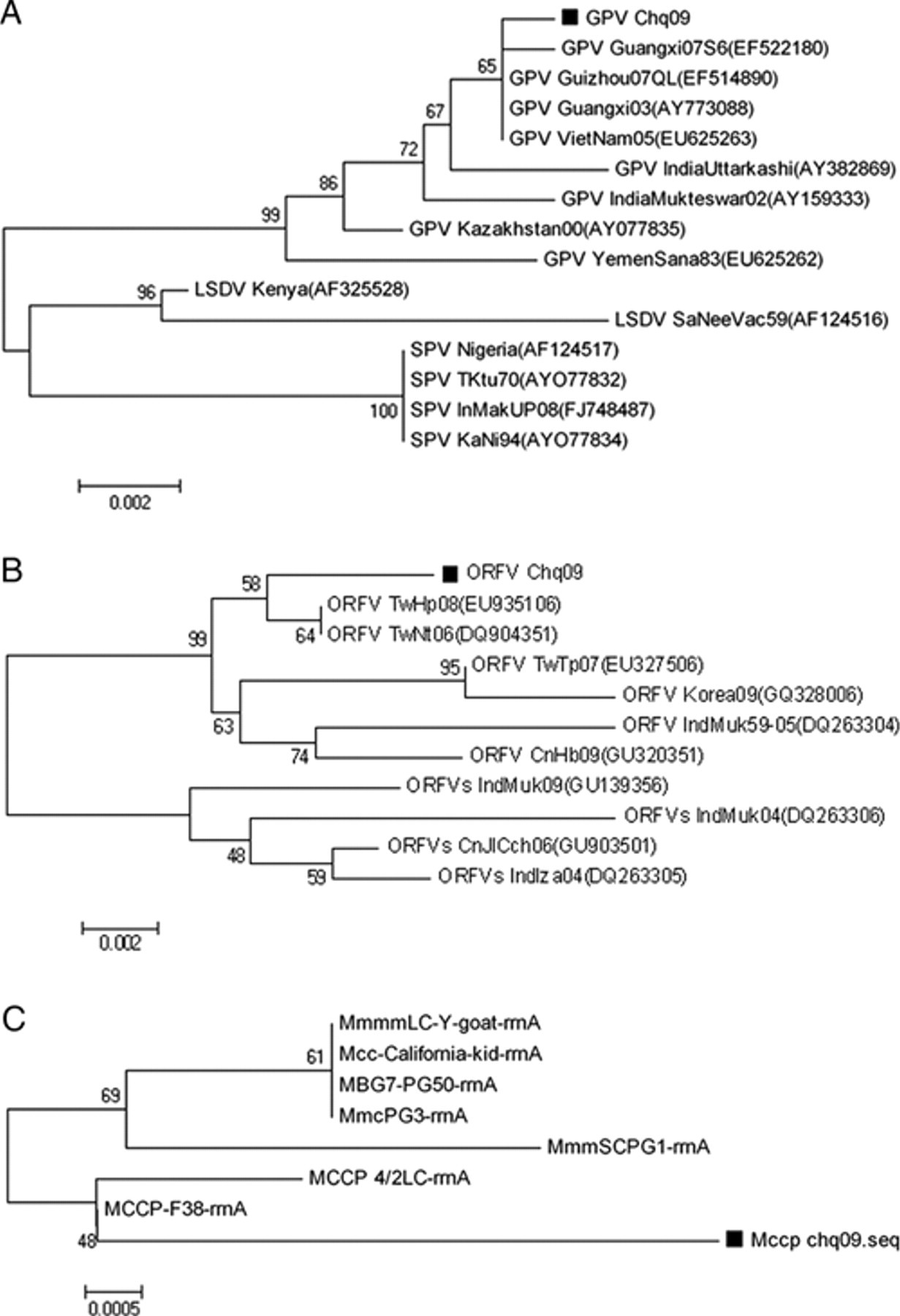
Phylogenetic tree of Goatpox virus (GTPV) based on p32 gene sequences (
In recent years, disease syndromes of multifactorial etiology have been increasingly recognized with GTPV. Capripoxvirus can induce immune suppression in infected hosts, thereby favoring secondary infections with increase in the mortality rate. In 2009, a mixed infection of GTPV, Bluetongue virus, and Peste-des-petits-ruminants virus was reported in Turkey, which caused a huge economic loss to the local goat husbandry. 8 In the present study, a higher case fatality rate and fibrinous pleuropneumonia indicated that there should be a secondary or mixed infection. The pathological changes in the thoracic cavity of the goats in the present study were strongly suggestive of infection with MCCP, the causative agent of contagious caprine pleuropneumonia (CCPP), a severe disease of goats. It is also an OIE listed disease, 14 and has been shown to affect sheep 2 and some wild ruminants. 1 While CCPP has been reported in nearly 40 countries in Africa and Asia, MCCP has only been isolated in 13 countries because of its fastidious growth conditions and the difficulty in isolating it from clinical samples. 7 This is also the possible reason that there is no official report on the isolation of this pathogen and no detailed information on the disease in China. Fortunately, recent PCR-based diagnostic methods, which can be applied directly to various clinical samples, have increased the ability to detect MCCP rapidly and effectively. 3 In the present study, specific fragments of the p32 gene of GTPV, B2L gene of ORFV, and 16S ribosomal RNA gene of MCCP were synchronously amplified by PCR from the tissues of 12 dead goats. Sequence alignment of PCR products and phylogenetic analysis further confirmed these pathogens because of their close association with reference sequences in GenBank. As a result, an outbreak of GTPV in China, in which co-infection with ORFV and MCCP occurred, was recorded.
The finding of the mixed infection in this outbreak is epidemiologically significant and challenges the existing plans for the prevention and control of goat diseases. Moreover, other ruminants such as sheep, camels, and some wild ruminants can also be infected with GTPV, ORFV, and MCCP. The role of these animals in introducing and spreading these causative agents should be considered.
Footnotes
Acknowledgements
The authors thank Dr. Chenghao Chu at Johns Hopkins University for his assistance with the English. Dr. Yuefeng Chu and Dr. Xinmin Yan contributed equally to this work.
a.
Takara Biotech (Dalian) Co. Ltd., Dalian, China.
The author(s) declared no potential conflicts of interest with respect to the research, authorship, and/or publication of this article.
The author(s) disclosed receipt of the following financial support for the research, authorship, and/or publication of this article: This work was supported by the Gansu Province Agricultural Biotechnology Research and Application Development Project (GNSW-2010-09), the National Scientific-Basic Special Fund (2008FY210200), the Key Program of Science and Technology of Gansu Province (0902NKDA032, 0702NKDA040).