



Abstract
Serology is the method of choice for country-scale Salmonella control programs in pigs and can be carried out both on blood serum or meat juice. However, the diagnostic performance of enzyme-linked immunosorbent assays (ELISAs) on these sample matrices has not been sufficiently compared. The agreement between the serum ELISA and meat juice ELISA on samples taken from commercial farms was assessed in 2 pig populations (adult sows and finishers). Results of optical density percentage (OD%) from the serum ELISA were consistently higher than those from the meat juice ELISA (38.5 vs. 27.9; P < 0.001), and the mean difference between them was significantly different from zero (P < 0.0001). The overall correlation coefficient between serum ELISA and meat juice ELISA results was low (r = 0.53). These results indicated an important disagreement between ELISA performed on serum and meat juice matrices and suggested that before implementing a control program to reduce the prevalence of Salmonella in swine the choice of matrix on which to perform the ELISA should be carefully considered.
The difficulties for the detection of Salmonella-infected animals through bacteriology have made serology the method of choice for country-scale Salmonella control programs. It has been well documented that serology is not useful in determining the infection status of an individual, but it is generally accepted that it is suitable for determining the level of infection in the herd. 2–4,6 However, after observing large differences in test results among different enzyme-linked immunosorbent assay (ELISA) kits supposedly designed to detect the same Salmonella serogroups, the latter has been questioned as well. 7,12 This is thus one important caveat that should be taken into account before initiating a large-scale control program against pig salmonellosis.
Another aspect of serology less reviewed in the scientific literature is the type of matrix used for detection of Salmonella-specific antibodies in pigs. After being shown that meat juice was as suitable as blood serum for serological diagnosis of pig salmonellosis, 5 most of the available ELISAs have been manufactured to be carried out either on blood serum or meat juice. The only aspect that differs when performing the ELISAs on serum or meat juice is the dilution factor of the sample (around 10 times higher for the serum sample). 8 The threshold (cut-off value) used to discriminate seropositive from seronegative animals is however the same regardless of the type of sample used. a Although there are studies that did not find significant differences in test results between both sample matrices, they are generally based on experimental studies where a low number of animals are infected with a high dose of Salmonella. 5,9
In the context of a large study to estimate the seroprevalence of pig salmonellosis in northern Spain, some conflicting results were observed when using serum or meat juice samples from pigs from commercial farms. Thus, the agreement between the serum ELISA and meat juice ELISA tests on samples taken from commercial farms under typical field conditions in Spain was assessed.
Paired blood and diaphragmatic muscle samples were collected as described 6 from 2 pig populations: 41 finishing pigs approximately 6 months old (population A) and 51 adult sows (different ages) culled from a commercial farm (population B). A commercial ELISA kit a that showed an overall better diagnostic accuracy in a previous study under typical field conditions in Spain 11 was the test of choice. The test was carried out following the manufacturer’s instructions. All samples were analyzed by duplicate, and the mean optical density percentage (OD%) calculated for each sample.
The logarithm of the mean OD% value was used to perform a paired t-test to detect significant differences of OD% between the serum ELISA and the meat juice ELISA. This analysis was done for each population separately as well.
Following the approach used previously, 5 the agreement between serum ELISA and meat juice ELISA was calculated and expressed as limits of agreement. Briefly, the difference (serum OD% – meat juice OD%) was calculated for all pigs in each population and then the mean difference (meand) and the standard deviation of the differences (SDd) were estimated. Limits of agreement were calculated as meand ± 2SDd. An F-test was performed to compare the limits of agreement from population A and population B. 1 One sample t-test was also used to determine if meand in each population was significantly different from zero. Linear correlation coefficients between serum ELISA and meat juice ELISA results were estimated for both populations after data were log transformed.
Relative sensitivity (Se) and specificity (Sp) of the meat juice ELISA with respect to the serum ELISA as the “gold standard” were also estimated at 3 different cut-off values (OD ≥ 10%, OD ≥ 20%, and OD ≥ 40%). The software Intercooler Stata 8.2 b was used for statistical analyses.
Seroprevalence was significantly higher in sows (population B) than in finishing pigs (population A) for both sample matrices at the highest cut-off values (OD ≥ 20% and OD ≥ 40%; Table 1). Samples coming from the adult population showed significantly higher OD% values regardless of the type of sample used (Table 2). Both findings were expected because sows have greater possibilities of infection and re-infection as they are exposed longer to Salmonella-contaminated environments (i.e., boar houses, etc.), 10 and therefore elevated antibody titers from anamnestic responses are more likely.
Seroprevalence (%) at different cutoff values and for serum and meat juice samples for populations A (finishers) and B (adult sows).*
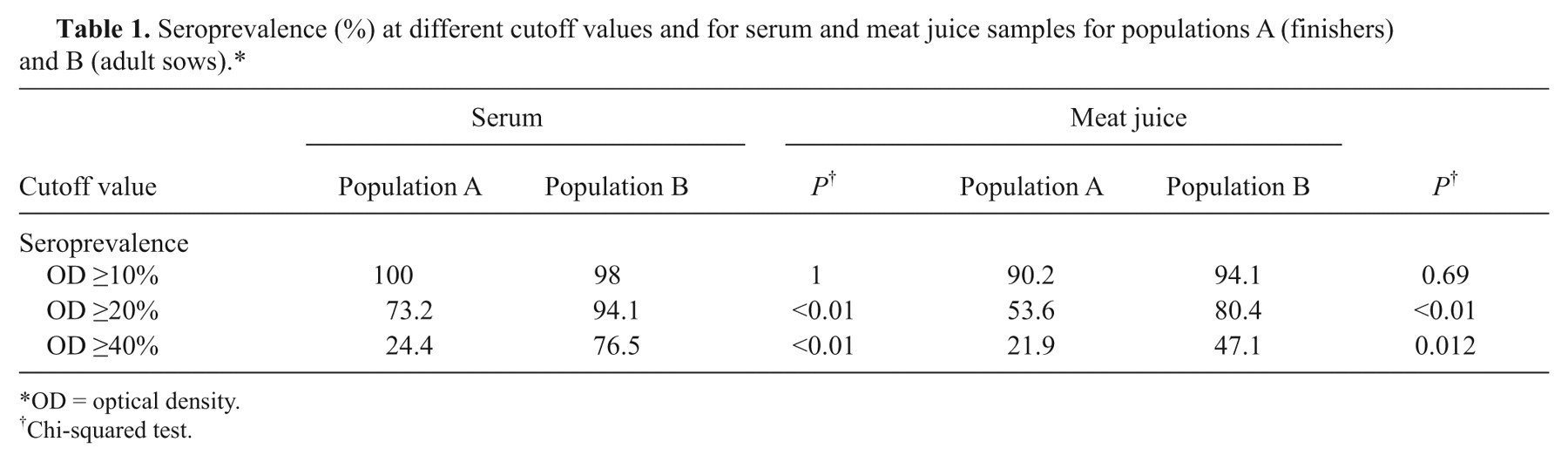
OD = optical density.
Chi-squared test.
Comparison of the test mean results from the serum enzyme-linked immunosorbent assay (ELISA) and the meat juice ELISA on populations A (finishers) and B (adult sows) and on both populations combined.
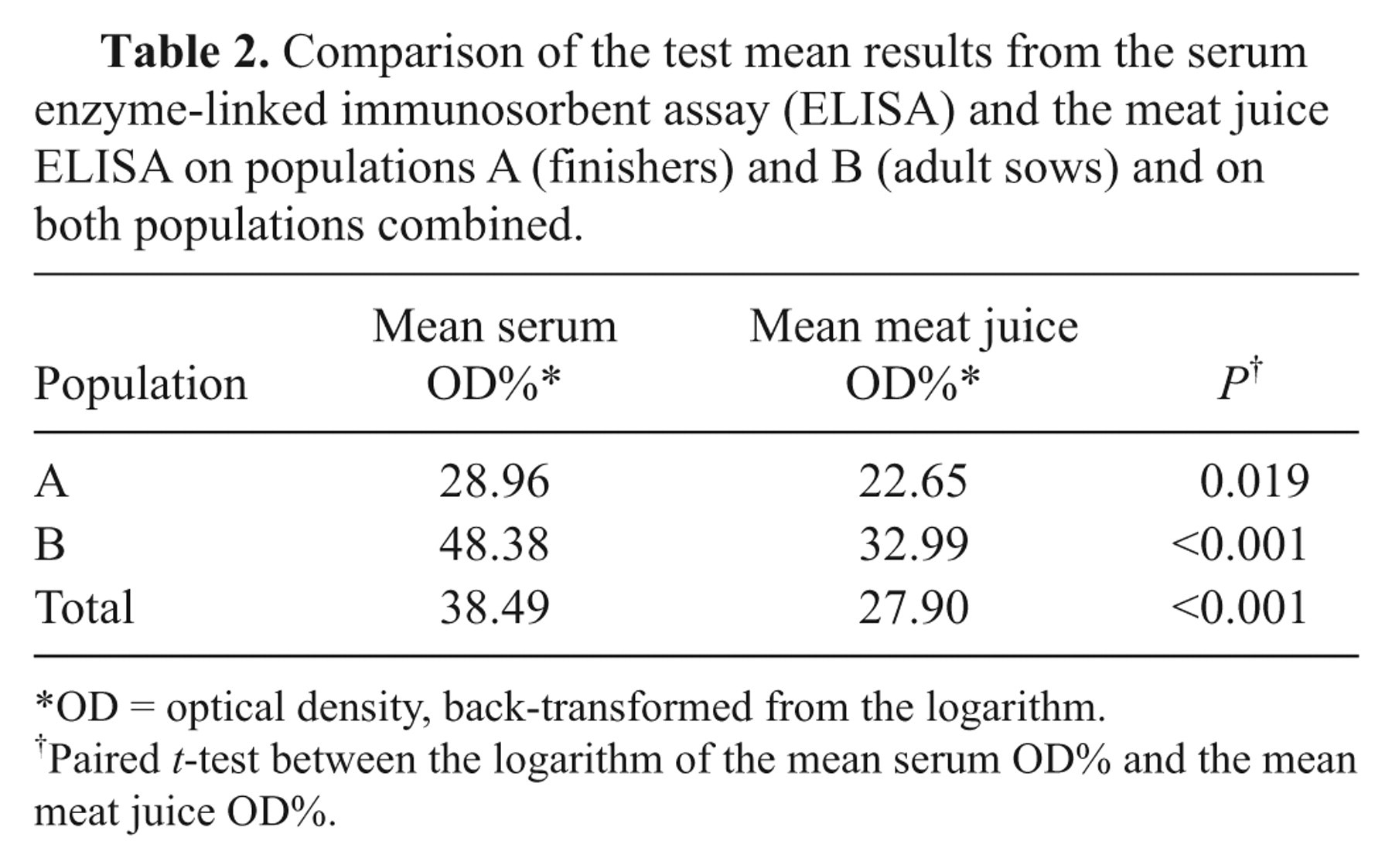
OD = optical density, back-transformed from the logarithm.
Paired t-test between the logarithm of the mean serum OD% and the mean meat juice OD%.
The OD% values from the serum ELISA were consistently higher than those from the meat juice ELISA in both populations (Table 2). Similar results have been described, 9 and are probably related to a higher level of immunoglobulins in serum than in meat juice, 8 suggesting a lower chance for detection of the infection (i.e., lower sensitivity) and a likely underestimation of the actual seroprevalence when the ELISA is performed on meat juice compared to serum.
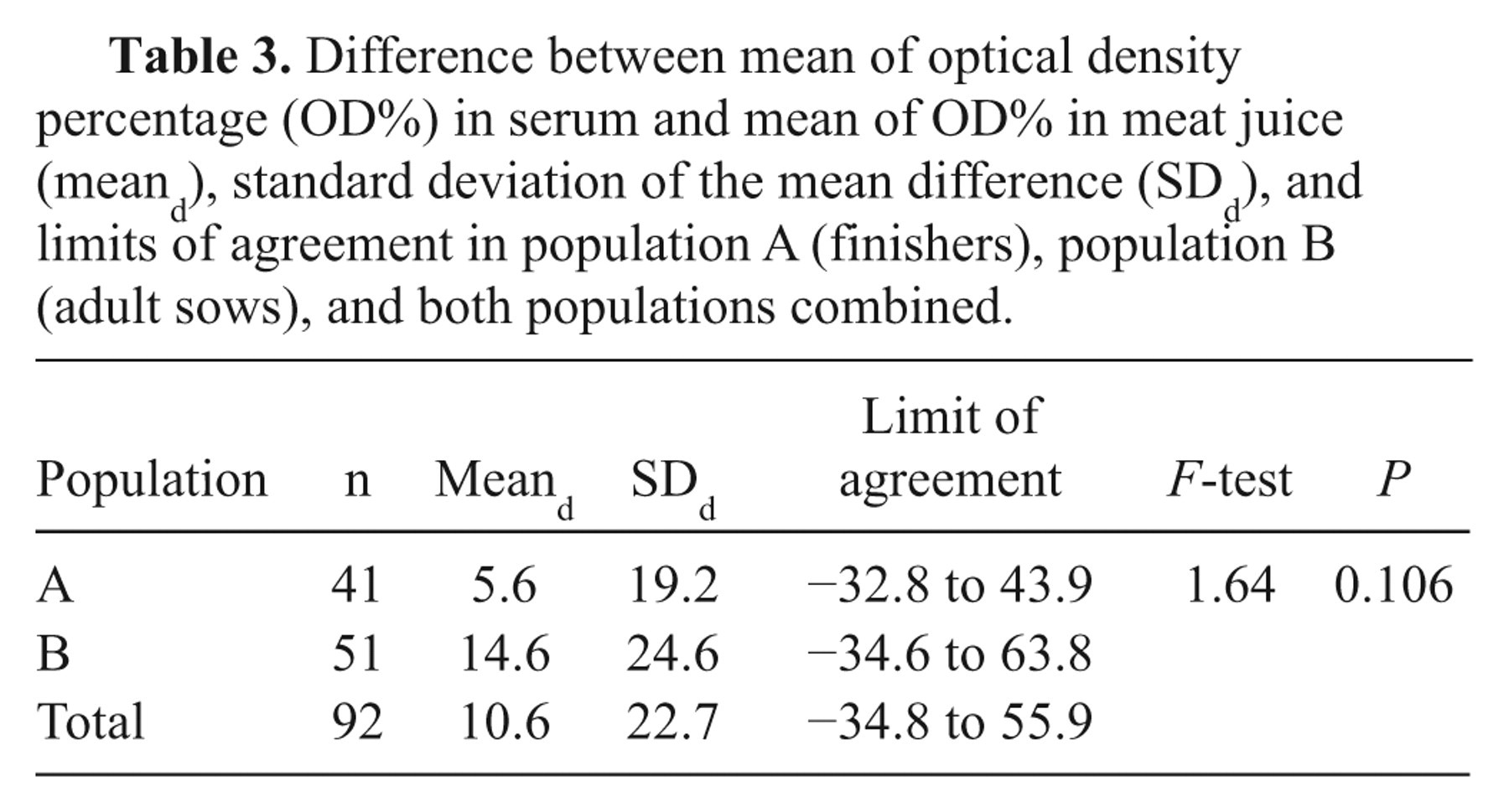
Table 3 shows the estimated values of meand and limits of agreement. Agreement between results from serum ELISA and meat juice ELISA was somewhat lower in population B (larger limit of agreement), with the F-test finding borderline differences between the variances of both populations (F = 1.64; P = 0.106). The one sample t-test indicated that the meand was clearly different from zero for population B (t = 4.25; P = 0.0001) but not so obvious for population A (t = 1.87; P = 0.07). Overall, results from both populations combined indicated that the meand was significantly different from zero (t = 4.48; P < 0.0001) suggesting an important disagreement between the results from the serum and the meat juice ELISA.
Difference between mean of optical density percentage (OD%) in serum and mean of OD% in meat juice (meand), standard deviation of the mean difference (SDd), and limits of agreement in population A (finishers), population B (adult sows), and both populations combined.
The correlation coefficients (r) between serum ELISA and meat juice ELISA results, although highly significant, were low in both populations (r < 0.5; Fig. 1) and for both populations combined (r = 0.53). Previous studies have shown that the relationship between serum and meat juice ELISA results does not fit a linear equation but would follow a nonlinear one, suggesting that meat juice results should be recalculated to make them comparable to serum results if both matrices are being used within the same control program. 12
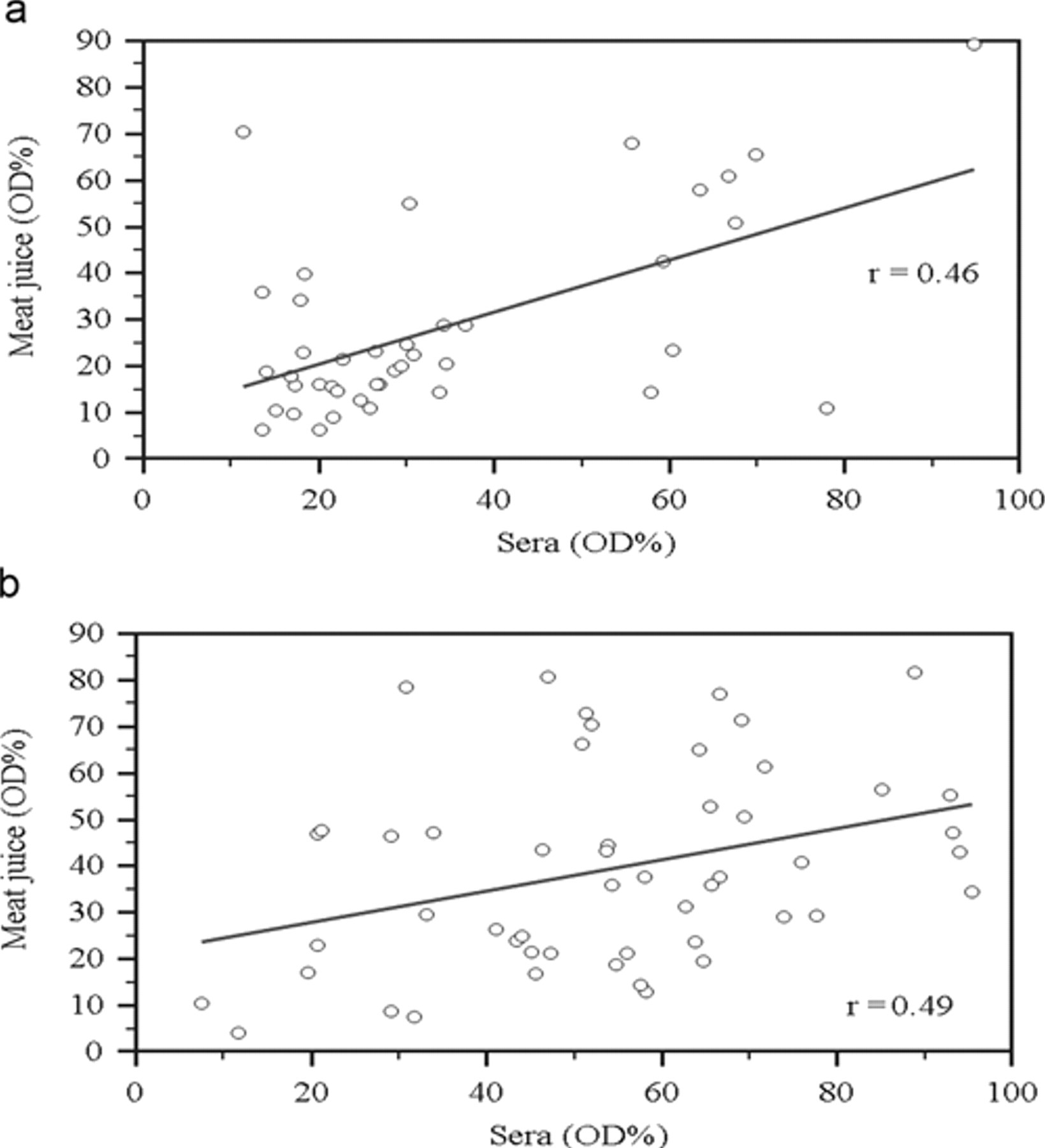
Regression line and correlation coefficient between individual optical density percentage (OD%) results in serum and meat juice for a population of finishing pigs (a) and of adult sows (b).
Serum to meat juice ratios may diverge due to several factors such as stress and the state of hydration of the pigs. 2 Also, population prevalence may play a role in the relationship between results from these 2 sample matrices. 12 While the level of stress or hydration of the sampled animals could not be determined, the seroprevalence was significantly higher in population B, which may help to explain the larger limit of agreement in the sow population. It may also explain the larger divergence observed between the serum ELISA and the meat juice ELISA and the lower relative sensitivities and specificities found (Table 4) compared to that observed in preceding studies. 5 Another likely factor that may be associated with the large variability observed was the lack of homogeneity of the animals included in the present study as the population analyzed was composed of adult sows of different ages and fattening pigs from multiple herds. These populations, however, would better reflect what may be found in the field than any experimental study. Several studies have shown large discrepancies among different ELISA kits results, 7,11 which could be another reason why the variability observed in the current study was larger than that found previously.5
Results of relative sensitivity and relative specificity and their respective 95% confidence intervals (95% CI) at 3 different cutoff values when results from serum enzyme-linked immunosorbent assay (ELISA) were used as gold standard (%).*
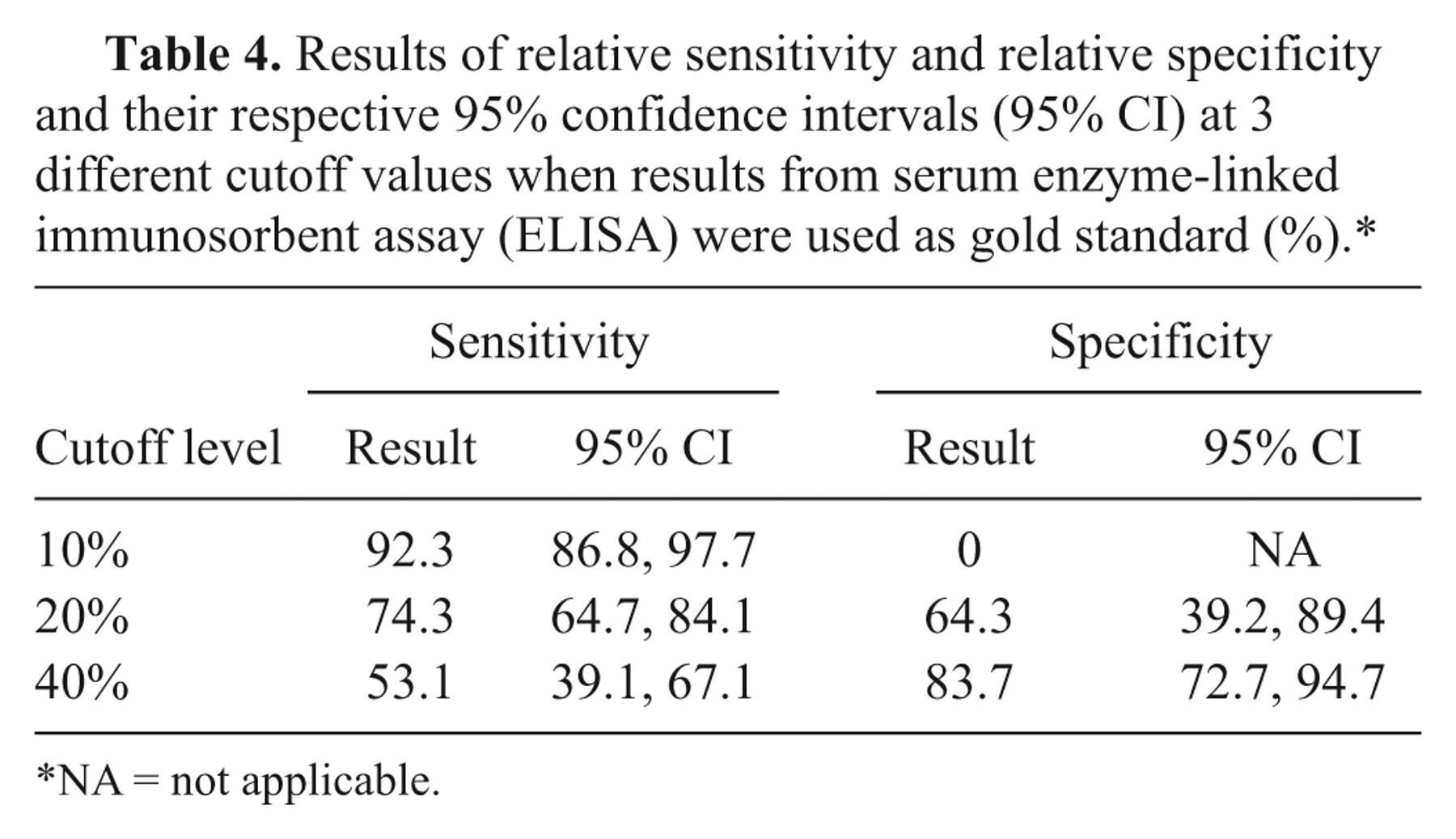
NA = not applicable.
The results obtained from the present study under the conditions described suggest that the choice of the matrix on which to perform the ELISA should be carefully discussed before implementing a control program to reduce the prevalence of Salmonella in swine. It seems preferable to use one type of matrix unless an adjustment of results from both matrices is calculated for the target population (i.e., performing pilot studies on a representative number of animals from the population). In countries where Salmonella prevalence is high, the divergence between both types of samples may be even more important.
Footnotes
a.
HerdChek Swine Salmonella Antibody, IDEXX Laboratories, Westbrook, ME.
b.
StataCorp LP, College Station, TX.
The authors declared that they had no conflicts of interest with respect to their authorship or the publication of this article.
This study has been fully funded by the Instituto Nacional de Investigación y Tecnología Agraria y Alimentaria–INIA of Spain (research grant no. RTA2007-65).