



Abstract
The objective of the current study was to compare the sensitivity of 2 Mycoplasma hyopneumoniae enzyme-linked immunosorbent assays (ELISAs) in experimentally challenged and contact-exposed pigs in a long-term longitudinal assessment. On day 0 of the assessment, twelve 2-month-old M. hyopneumoniae–negative pigs were inoculated with M. hyopneumoniae strain 232 (group A). Twelve negative pigs were placed alongside the inoculated pigs, allowing direct contact exposure (group B). A third group of 12 pigs was allocated into 2 independent pens; no direct contact was allowed (group C). A longitudinal serologic profile was performed; samples were collected on days 0, 28, 35, 42, 49, 63, 91, 119, 154, and 170 of the study. Serum samples were tested using a blocking ELISA and an indirect ELISA. Results of the study demonstrated higher sensitivity of the blocking ELISA during early infection (clinical signs). Both ELISAs were 100% sensitive in challenged and naturally infected groups at several testing points during late infection (63, 91, 119, 154, and 170 days of the study) and showed a long antibody detection period. Both tests worked equally well during the chronic phase of infection but the blocking ELISA was more sensitive during acute stages of infection.
Mycoplasma hyopneumoniae remains one of the most important pathogens involved in respiratory disorders in the swine industry worldwide. 7 Although molecular techniques have emerged to enhance the detection of M. hyopneumoniae, finding specific antibodies by serological testing remains the most common method used to detect exposure to the agent. 12 In addition, serologic profiles are still critical to determine infection patterns within swineherds2,9,10; however, caution regarding specificity and sensitivity of the test used should be considered when serological results are interpreted.9,12 Two of the most extensively used ELISAs for diagnostic surveillance are the Tween-20 test, a which is an indirect enzyme-linked immunosorbent assay (ELISA), and the Dako test, b which is a blocking ELISA.4,6 In a comparative study of M. hyopneumoniae ELISAs, a previous study documented that both assays had high specificity (100%) in recognizing samples negative for antibodies, but the Dako ELISA was more sensitive (detecting more positive samples) than the Tween-20 ELISA. 5 In another independent study, the Dako ELISA assay was also compared to another M. hyopneumoniae indirect ELISA b showing that the Dako ELISA was more successful in identifying positive samples. 1 It has been shown that sensitivity of these serological tests is influenced by the infection stage of the host, suggesting that these assays are less sensitive early in infection. 5 However, information on the performance of these serological tests in repeatedly measured challenged pigs has not been extensively reported in the literature. Therefore, long-term longitudinal assessments are necessary to determine the ability of antibody detection for both assays throughout the different stages of infection in pigs.
Additionally, it has been shown that seroconversion patterns in contact-exposed pigs (naturally infected) is different than described for experimentally infected pigs, presenting a more delayed onset of seroconversion and more variable rate of seroconversion.3,6,8,10,11 In order to obtain valid and more applicable information, it is important to generate and determine the performance of serologic assays from controlled studies that evaluate not only experimentally challenged pigs but also naturally infected pigs (contact-exposed animals). Thus, the objective of the present study was to compare the sensitivity of 2 ELISAs in detecting M. hyopneumoniae–specific antibodies from challenged and contact-exposed pigs (naturally infected pigs) in a long-term longitudinal assessment.
On day 0 of the study, twelve 3-month-old M. hyopneumoniae–negative pigs were inoculated intratracheally with 10 ml of M. hyopneumoniae strain 232 (105 color-changing units [CCU] per ml).c,12 The animals were assigned to group A. On the same day, 12 age-matched, negative pigs were placed together with the inoculated pigs, allowing direct contact exposure (group B). A third group of 12 pigs was allocated to 2 independent pens 3 meters away from the challenged pigs. This last group was considered as the indirect contact–exposed pigs (group C). Three 2-month-old M. hyopneumoniae–negative pigs were housed in another facility on the same site, to serve as negative controls. Animals included in the study were housed in a conventional, mechanically ventilated barn located on the research farm of the Swine Disease Eradication Center (St. Paul, Minnesota). Animals were cared for under the guidelines of the University of Minnesota Institutional Animal Care and Use Committee.
In order to assess the performance of the 2 ELISAs, a longitudinal serologic profile was performed for the 3 groups (A–C). Blood samples were taken from all pigs on days 0, 28, 35, 42, 49, 63, 91, 119, and 154 of the study. Blood samples were also collected 1 day before sending the animals to be euthanized (day 170 of the study). Serum samples were tested for M. hyopneumoniae antibodies using a blocking ELISA 6 and the indirect ELISA. 4 The blocking and indirect ELISAs were performed as described by the manufacturers.a,b For the blocking ELISA, the inhibition percentage (IP) was calculated considering the optical density (OD) of each sample as well as the negative control. Classification of individual animals on the basis of IP values was as follows: IP < 30%, negative; IP > 50%, positive; IP > 30% and < 50%, suspicious. The percentage was obtained from the following formula: % IP = (mean negative value OD − sample OD)/(mean negative value OD). The indirect ELISA was performed as previously described. 4 Results from this assay were also computed from the OD values: an OD value of ≥0.24 being positive, 0.20–0.23 suspect, and ≤0.20 negative. 6 To facilitate data analysis, results in the suspect range were interpreted as antibody negative.
Analysis of the data was performed in 2 steps. In step 1, assay sensitivity was calculated for each testing day, including all groups. In step 2, the relationship and agreement between the 2 assays were analyzed using the chi-square test d and kappa test, respectively. Previously published benchmarks were used for kappa analysis. 5 To increase the sample size, analysis was performed by sectioning the longitudinal assessment into 2 parts, early (acute) and late (chronic) stages of infection. For the challenged pigs (group A), the acute stage of the infection was considered from day 28 to day 42 post-inoculation, for group B the acute stage was from day 35 to day 63, and for group C day 49 to day 91 of the study. The acute stage of infection was assigned according to onset of clinical signs (coughing) throughout the study. Specificity could not be assessed due to the small number of negative controls included in the current study.
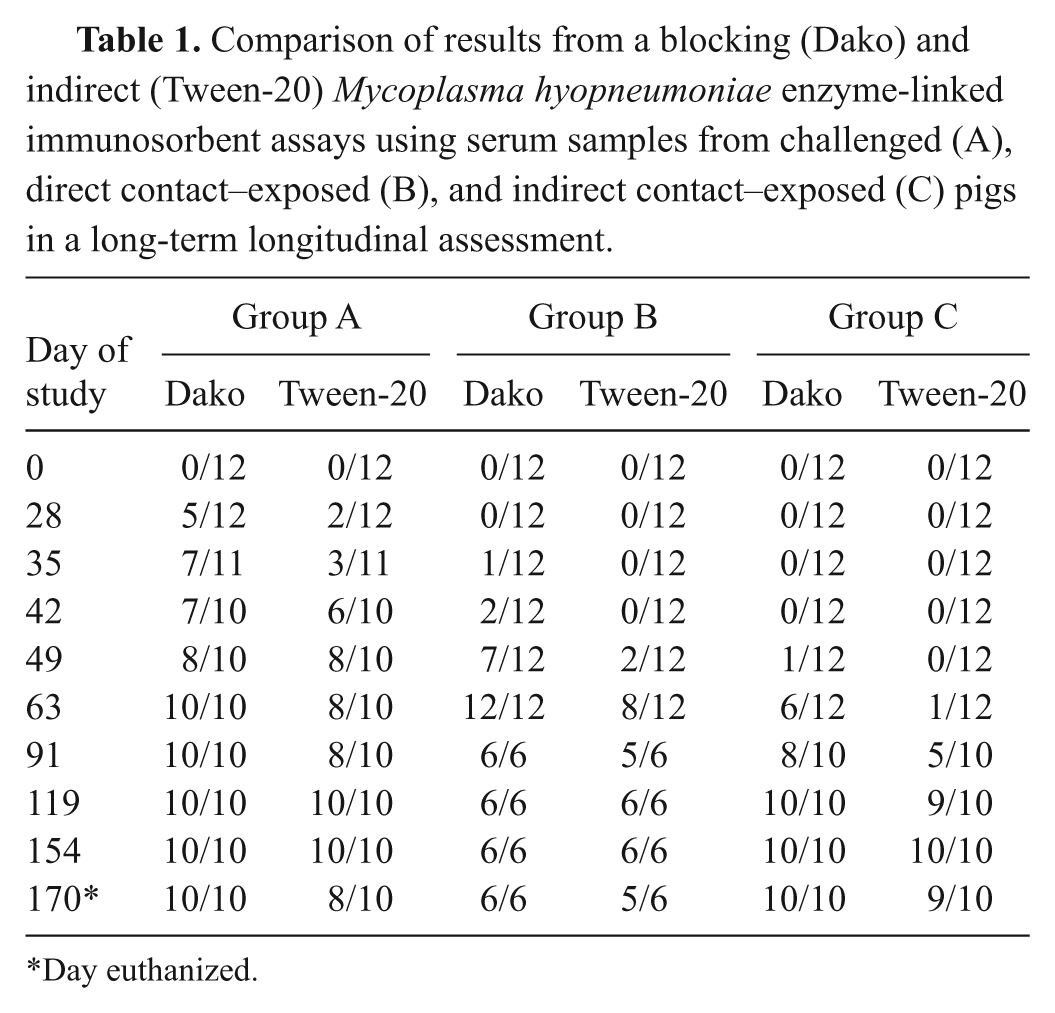
Results of the 2 ELISAs generated from the longitudinal assessment for groups A–C are shown in Table 1. In the current study, all pigs tested positive on at least 1 testing day by both tests throughout the longitudinal assessment. All 3 negative control pigs remained negative on all testing days with both assays.
Comparison of results from a blocking (Dako) and indirect (Tween-20) Mycoplasma hyopneumoniae enzyme-linked immunosorbent assays using serum samples from challenged (A), direct contact–exposed (B), and indirect contact–exposed (C) pigs in a long-term longitudinal assessment.
Day euthanized.
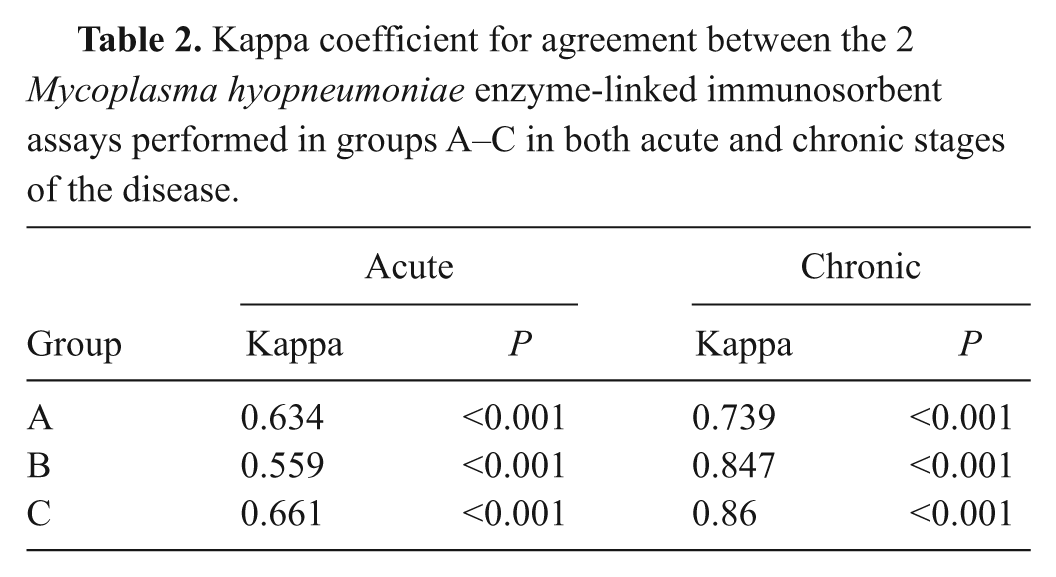
Table 2 shows the agreement and association between the 2 ELISAs throughout both infection stages for groups A–C. During the acute stage of infection, a substantial agreement was observed between the 2 ELISAs in groups A and C, and moderate agreement in group B. In contrast, during the chronic stage of infection, a substantial agreement between tests for group A and a perfect agreement for groups B and C were observed.
Kappa coefficient for agreement between the 2 Mycoplasma hyopneumoniae enzyme-linked immunosorbent assays performed in groups A–C in both acute and chronic stages of the disease.
Average OD values from the indirect ELISA throughout the longitudinal assessment are shown in Figure 1. No descriptive statistics of the values from the blocking ELISA are shown because results were obtained categorically (positive, suspect, or negative). Group A showed a gradual increase of OD values, reaching the highest average values on weeks 9, 13, and 17 after challenge (0.539 ± 0.30, 0.537 ± 0.33, and 0.611 ± 0.34, respectively). Group B showed a similar pattern to that of group A, reaching the peak of OD average value on week 17 (0.546 ± 0.24); however, a more delayed onset of detectable antibodies was observed. Although inoculation and placement of the contact pigs was done on the same day, it is probable that the contact pigs were not exposed to the agent until the onset of shedding (1 week later). This delay was more noticeable in the indirect contact–exposed group; however, a gradual increase was also observed, reaching the highest average OD value on week 22 (0.648 ± 0.30) at the end of the assessment.
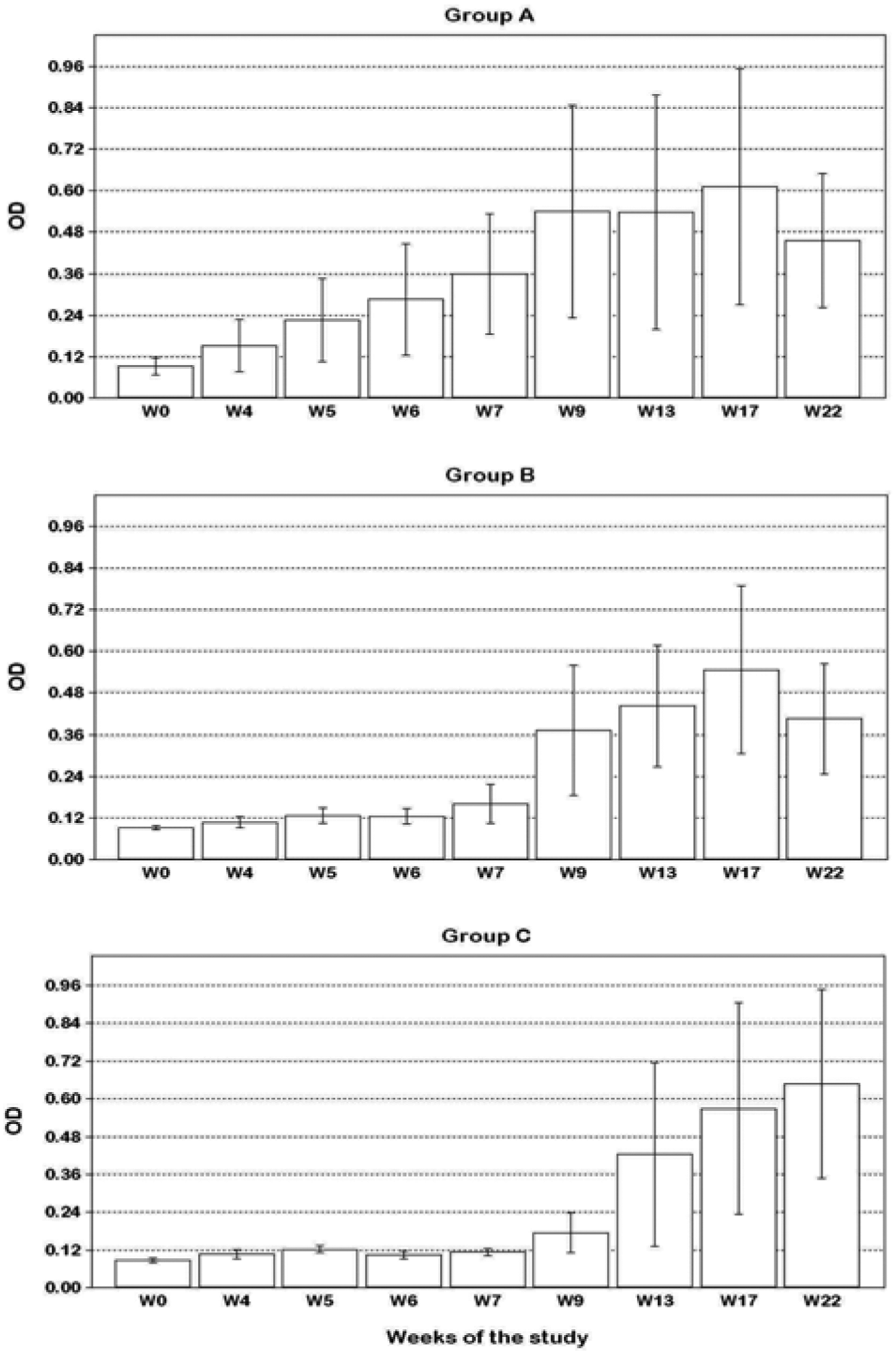
Average optical density (OD) values of the indirect enzyme-linked immunosorbent assay (Tween-20 test) for the 3 assessed groups (
The objective of the present study was to assess the sensitivity of both assays throughout the different infection stages of experimentally and naturally infected pigs. In agreement with previous findings, 5 results from the present study showed that the blocking ELISA was more sensitive than the indirect ELISA. However, this was observed only in the acute stage (clinical signs) of the infection in all groups and more noticeable in the contact-exposed pigs. In groups B and C, the onset of antibodies detected by the blocking ELISA was observed at least 1 week before the onset observed with the indirect ELISA. Despite the differences in sensitivity, antibody detection was low for both tests on day 28 post-infection in the experimentally infected animals.
On the other hand, a minimal difference in sensitivity was observed during chronic stages of the infection, after clinical signs had disappeared. Similar to previous studies,4,11 both ELISAs showed 100% sensitivity for several weeks and a long antibody detection period in challenged as well as naturally infected groups. The sensitivities of the tests determined in the current study were higher than those described in a recent publication, 5 but were similar to those reported in the original publications first describing these assays.4,11 Sensitivity rates detected in the present study during early infection were higher than those described previously 5 ; this difference is most likely due to the short post-infection period (21 days) utilized in the previous study. In contrast, the present study allowed for the evaluation of the detection rate dynamics over time, including the complete acute stage as well as the chronic phase of the disease.
Agreement between tests was better during the chronic stage of infection compared to the acute phase of infection. This reflects the differences in sensitivity observed between tests during the acute stage of the infection. Kappa coefficients for agreement obtained in the current study were higher than those described in previous studies 5 ; however, the kappa coefficients were similar to those described in previous studies comparing the blocking ELISA with another indirect ELISA. 1 This information is important with regards to interpretation of results in field cases. Knowledge of the optimal time for testing, according to the test being used, helps the practitioner to determine the best test according to the stage of infection.
In conclusion, low sensitivity of diagnostic testing during early infection should be considered when time of infection is uncertain under field conditions. 5 Under the controlled conditions of the current study, the blocking ELISA was more sensitive during the early stages of infection; therefore, it can be suggested that this assay can be a reliable diagnostic tool when a susceptible population is at risk of M. hyopneumoniae infection and early detection is critical. On the other hand, the indirect ELISA performed well during the chronic stage of infection, showing a perfect agreement with the blocking ELISA. No major differences in performance between these 2 ELISAs were observed between challenged and contact-exposed pigs (naturally infected animals). In general, both tests work equally well during the chronic phase of infection but the blocking ELISA was more sensitive during acute stages of infection.
Footnotes
a.
IDEXX Laboratories, Westbrook, ME.
b.
Dako Denmark A/S, Glostrup, Denmark.
c.
Veterinary Diagnostic Laboratory, Iowa State University, Ames, IA.
d.
Statistix, version 8.0, Analytical Software, Tallahassee, FL.
The author(s) declared no potential conflicts of interest with respect to the research, authorship, and/or publication of this article.
The author(s) received no financial support for the research, authorship, and/or publication of this article.