




Abstract
Canine parvovirus 2 (CPV-2) emerged in 1978 as one of the most pathogenic etiologic agents in dogs. Under the influence of evolution, the original CPV-2 was replaced, a few years later, by 2 variants, CPV-2a and CPV-2b. In 2000, a new variant, CPV-2c, was detected first in Italy and later in other countries. The current study was conducted to provide data about the CPV types circulating in Bulgaria. Forty-two fecal samples from dogs with clinical signs of parvovirosis, collected between June 2009 and February 2010, were tested for CPV using a rapid test based on detection of CPV antigens and a real-time polymerase chain reaction (PCR) for detection of viral DNA. Positive samples were characterized by means of minor groove binder probe PCR assays. Forty samples were positive, of which 30 were identified as CPV-2a, 9 as CPV-2b, and 1 as CPV-2c. The results from this molecular investigation of CPV show the prevalence of type 2a and occurrence of type 2c for the first time in Bulgaria.
Canine parvovirus 2 (CPV-2), the causative agent of one of the most severe diseases in dogs, was first identified in 1978 after an epizootic of gastroenteritis and myocarditis, and is now occurring worldwide. 17 The investigation of the evolutionary changes suggested that CPV-2 has originated from a feline panleukopenia-like virus infecting wild carnivores. A few years after its emergence, 2 new antigenic variants, designated type 2a and type 2b, were detected consecutively. Both variants completely replaced the original type 2 and are currently distributed worldwide in the canine population. Subsequently, several CPV mutants were described in different countries. 17 A new CPV mutant with an amino acid change (Asp-426 to Glu) occurring in a strategic residue for the antigenicity of CPV-2 was detected in Italy. 1 This variant was found to be widespread in all continents 2,4,7,13,16 and was associated with outbreaks of hemorrhagic gastroenteritis, even in adult dogs, that had completed the vaccination protocol using type 2-based formulations. 3,6 The aim of the present study is to report the CPV distribution in Bulgaria, together with the first identification of the new variant, CPV-2c, in this country.
A total of 42 fecal samples from dogs with clinical signs of parvovirosis were obtained from Sofia, Bulgaria, and several provincial towns between June 2009 and February 2010. The data for each sample are presented in Table 1. Data were provided by the contributing small animal practitioners: vaccinated (n = 24, 21 with identified vaccine producers and 3 with unidentified vaccines); unvaccinated (n = 8); and unknown vaccination status (n = 10). The ages are shown for most dogs (n = 35) and varied from 40 days to 8 months, but there was also an 11-year-old vaccinated dog. No data for the remaining dogs (n = 7) were available. The breed was known for 25 dogs, including 18 purebred and 17 mixed-bred animals, whereas this information was not available for 17 dogs. Sex was known only for 3 dogs (Table 1).
As reported in Table 1, 24 of 42 fecal samples had been already tested by practitioners using a rapid test for simultaneous detection of CPV and Canine coronavirus (CCoV) antigens. a Fecal samples were homogenized (10%, wt/vol) in phosphate buffered saline (pH 7.2) and subsequently clarified by centrifuging at 1,500 × g for 15 min. The DNA from each sample was extracted from fecal homogenates by boiling 200 μl of the supernatant for 10 min and chilling on ice. To reduce residual inhibitors of DNA polymerase activity to ineffective concentrations, the DNA extracts were diluted 1:10 in distilled water. 8,9 The extracted DNA were tested by a TaqMan assay, which is able to recognize all CPV strains. 8 Real-time PCR was performed using a commercial real-time detection system, b and the data were analyzed with the appropriate sequence detector software c (version 3.0). Duplicates of the CPV standard dilutions and DNA templates were simultaneously subjected to real-time analysis. The 25-μl PCR mixture for one reaction contained 12.5 μl of Supermix, d 600 nM of primer CPV-For (5′-AAACAGGAATTAACTATACTAATATA TTTA-3′) and CPV-Rev (5′-AAATTTGACCATTTGGAT AAACT-3′), 200 nM of probe CPV-Pb (5′-FAM-T GGTCCTTTAACTGCATTAAATAATGTACC-TAMPRA-3′), and 10 μl of DNA. The following thermal cycling protocol was used: activation of DNA polymerase at 95°C for 10 min, and 40 cycles consisting of denaturation at 95°C for 15 sec, primer annealing at 52°C for 30 sec, and extension at 60°C for 1 min. The internal control consisted of exogenous DNA, extracted from Ovine herpesvirus 2. 10
For CPV type prediction, minor groove binder (MGB) probe assays specific for types 2a and/or 2b and 2b and/or 2c 9 were performed using the same instrument and software as described above. The reactions were carried out in a total volume of 25 μl containing 10 μl of template or standard DNA, 12.5 μl of Supermix, d 900 nM of primers CPVa/b-For (5′-AGGAAGATATCCAGAAGGAGATTGGA-3′) and CPVa/b-Rev (5′-CCAATTGGATCTGTTGGTAG CAATACA-3′; type 2a/2b assay) or CPVb/c-For (5′-GAAGATATCCAGAAGGAGATTGGATTCA-3′) and CPVb/c-Rev (5′-ATGCAGTTAAAGGACCATAAG TATTAAATATATTAGTATAGTTAATTC-3′; type 2b/ 2c assay), 200 nM of probes CPVa-Pb (5′-VIC-CTTCCTGTAACAAATGATA-MGB-3′) and CPVb1-Pb (5′-FAM-CTTCCTGTAACAGATGATA-MGB-3′; type 2a/2b assay), or CPVb2-Pb (5′-FAM-CCTGTAACAGAT GATAAT-MGB-3′) and CPVc-Pb (5′-VIC-CCTGTAA CAGAAGATAAT-MGB-3′; type 2b/2c assay). Standard DNA for types 2a–c were obtained from field fecal samples containing high CPV DNA concentrations based on the TaqMan assay, as previously described. 8 The following thermal cycle protocol was used: activation of DNA polymerase at 95°C for 10 min and 45 cycles consisting of denaturation at 95°C for 30 sec and primer annealing-extension at 60°C for 1 min.
Results of the investigations for detection of Canine parvovirus in Bulgarian samples. *
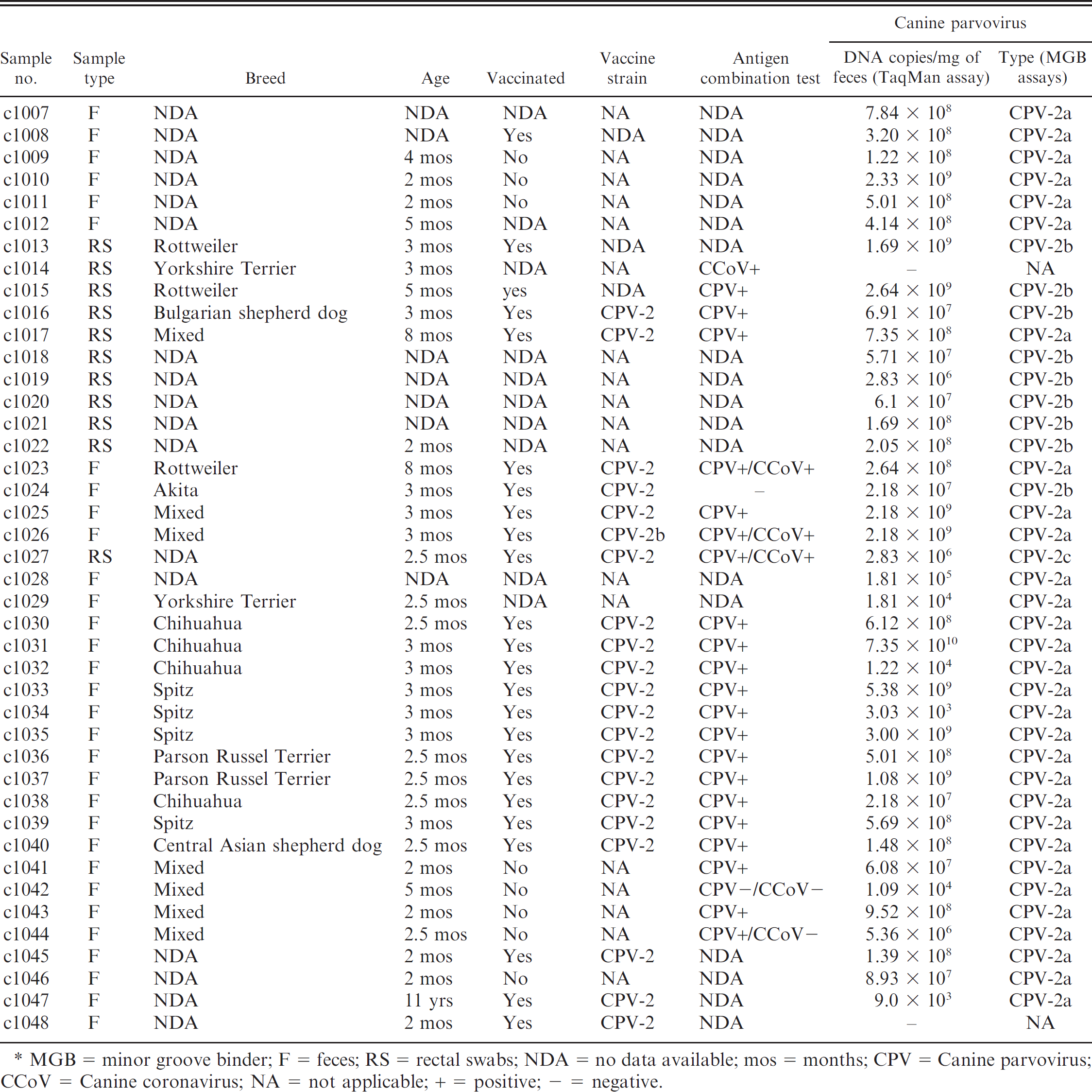
MGB = minor groove binder; F = feces; RS = rectal swabs; NDA = no data available; mos = months; CPV = Canine parvovirus; CCoV = Canine coronavirus; NA = not applicable; + = positive; − = negative.
If the dogs had been vaccinated shortly before the onset of clinical signs, additional MGB probe assays were used that are able to discriminate between field and vaccine viruses. 5 Specificity and sensitivity of all molecular assays used in the current study were previously calculated. 5,8,9
Real-time PCR and MGB probe analysis of the 42 samples detected 40 positive specimens, including 30 (71.43%) CPV-2a (18 vaccinated and 12 unvaccinated), 9 (21.43%) CPV-2b (4 vaccinated and 5 unvaccinated), and 1 (2.38%) CPV-2c (vaccinated). Two dogs (1 vaccinated and 1 unvaccinated; 4.76%) tested negative for CPV-2.
There was a good agreement between the real-time PCR assay and the rapid test as all 21 fecal specimens that tested positive by the rapid antigen-detection kit were confirmed by the TaqMan assay. b In contrast, 2 samples that tested negative by the rapid test were found to contain CPV DNA by real-time PCR. The antigen combination test a detected 4 CCoV-positive samples, 1 as a single infection and 3 as CPV/CCoV-mixed infections (Table 1).
The current investigation is the first showing the distribution of different CPV types in Bulgaria. In the past, the diagnosis of parvovirosis in dogs was based only on clinical signs and rapid (enzyme-linked immunosorbent assay based) tests, which are often used in small animal practices without interpretation of possible false-negative results and without comparison with other methods. The characterization of field samples through MGB probe realtime PCR seemed to be a rapid and helpful method to solve the diagnostic dilemmas frequently occurring in veterinary practice. In contrast with previous reports, 12 there was a good correlation between the antigen-detection test and molecular methods, with only 2 samples being recognized as false negatives.
The current study showed that the most prevalent type of CPV in Bulgaria is type 2a, with only 1 sample positive for type 2c despite the increased international commerce of dogs. The findings are in agreement with previous results indicating a prevalence of CPV-2a and the absence of the new variant CPV-2c in Eastern Europe. 4,11
Whether the CPV epidemiology in Bulgaria and in other Eastern European countries is related to different canine vaccination protocols or trade practices should be evaluated carefully in the future. As previously noted, 3,6 the occurrence of CPV-induced gastroenteritis in regularly vaccinated dogs poses intriguing questions about the real efficacy of currently available (type 2 based) vaccines against the infection and diseases caused by the antigenic variants.
Acknowledgements. The authors acknowledge the Federation of European Microbiological Societies (FEMS), the University of Bari, Italy, and the University of Forestry, Sofia, Bulgaria, for financial and logistic support.
Footnotes
a.
Canine Parvovirus, Corona Virus Antigen Combo Test; Anigen, Korea.
b.
iCycler iQ™ Real Time Detection System, Bio-Rad Laboratories Srl, Milan, Italy.
c.
I-Cycler sequence detection software version 3.0, Bio-Rad Laboratories Srl, Milan, Italy,
d.
IQ™ Supermix, Bio-Rad Laboratories Srl, Milan, Italy.