




Abstract
The aim of the present study was to characterize Canine parvovirus 2 (CPV-2) variants currently circulating in Greece. Between March 2008 and March 2009, 167 fecal samples were collected from diarrheic dogs from different regions of Greece. Canine parvovirus 2 was detected by standard polymerase chain reaction, whereas minor groove binder probe assays were used to distinguish genetic variants and discriminate between vaccine and field strains. Of 84 CPV-2–positive samples, 81 CPV-2a, 1 CPV-2b, and 2 CPV-2c were detected. Vaccine strains were not detected in any sample. Sequence analysis of the VP2 gene of the 2 CPV-2c viruses revealed up to 100% amino acid identity with the CPV-2c strains previously detected in Europe. The results indicated that, unlike other European countries, CPV-2a remains the most common variant in Greece, and that the CPV-2c variant found in Europe is also present in Greece.
Canine parvovirus 2 (CPV-2) is the causative agent of hemorrhagic enteritis in dogs, characterized by vomiting, hemorrhagic diarrhea, and lymphopenia. Canine parvovirus 2, so named to differentiate it from CPV-1, the genetically and antigenically distinct minute virus of canines, is a small, nonenveloped, single-stranded DNA virus. 1 Canine parvovirus 2, along with Feline panleukopenia virus (FPV), Raccoon parvovirus (RPV), and Blue fox parvovirus (BFPV), comprise the Feline parvovirus (FPV) subgroup of the genus Parvovirus. 2
Canine parvovirus 2 emerged in the late 1970s, but, after a few years, it was completely replaced by 2 new antigenic variants, CPV type 2a (CPV-2a) and CPV type 2b (CPV-2b), distinguishable by means of monoclonal antibodies and characterized by amino acid substitutions in the capsid protein gene. 20 These 2 new antigenic variants have a worldwide distribution. 5,8,17,18,23 In 2001, a new antigenic variant, CPV type 2c, with a mutation in an antigenically important residue (Asp-426 to Glu), was detected in Italy 3 and found to have a wide distribution, replacing CPV-2a and CPV-2b. 14 The CPV-2c has also been detected in Vietnam, 19 the United States, 17 South America, 5 and in other European countries. 8,15 Canine parvovirus 2 remains an important cause of mortality in puppies in Greece (Kalli I: 2009, Prevalence of acute pancreatitis in young dogs with parvoviral (CPV-2) enteritis. PhD Dissertation, Aristotle University of Thessaloniki, Thessaloniki, Greece). The current study aimed to determine the presence and distribution of the CPV-2 variants in Greece.
Between March 2008 and March 2009, 167 fecal samples were collected from dogs with diarrhea, from northern, central, and southern Greece, including the cities of Athens and Thessaloniki. Signalment (including age, sex, breed, vaccination history, and clinical signs) was noted. The age of the dogs ranged from 45 days to 8 months. Ninety-eight of 167 dogs (58.68%) were vaccinated at least once against CPV-2 with a modified live virus vaccine.
Fecal samples were homogenized (10%, w/v) in phosphate buffered saline solution and were clarified by centrifugation at 8,000 × g for 5 min. DNA was extracted by boiling the supernatants (200 μl) for 10 min and chilling them on ice. 21 DNA extracts were diluted 1:10 in distilled water to minimize residual inhibitors to an ineffective concentration. 13
To detect CPV-2 DNA, a conventional polymerase chain reaction (PCR) assay with primers Hfor and Hrev a was performed by using DNA polymerase. b , 3,13 The PCR-positive samples were tested by using real-time PCR assays with minor groove binder (MGB) probes, to characterize the variants and discriminate between vaccine and field strains. 12,14 The MGB probe assays for vaccine and/or field strain discrimination were applied to the PCR-positive samples collected from dogs displaying gastroenteritis within 10 days after vaccination with CPV-2. 9
Eighty-four of 167 samples (50.3%) were positive for CPV-2 by conventional PCR. Thirty-six of 84 positives samples came from dogs that had received 1–3 doses of various commercial modified live virus CPV vaccines. Seventeen of these dogs were sampled when presenting clinical signs within 10 days of vaccination.
By real-time PCR with MGB probes, 81 samples were characterized as CPV-2a, 1 as CPV-2b, and 2 as CPV-2c, the recently detected variant. Both CPV-2c–positive samples were from Thessaloniki (a city in northern Greece) and came from 6- and 11-month-old dogs. The older dog (GR51/08) had never been vaccinated, whereas the younger one (GR09/09) had been fully vaccinated by using a classic CPV-2 vaccine. Analysis by MGB-PCR determined that all viruses detected were field rather than vaccine strains.
To confirm the MGB probe assay results and to compare the genetic relatedness between the Greek CPV-2c genomes with other sequences described so far, the full-length VP2 gene (1755 nucleotides [nt]) sequence was determined. The Asn/Asp to Glu mutation (amino acid [aa] residue 426) characteristic for CPV-2c is included within that sequence. Conventional PCR assays were performed by using 3 different pairs of primers a that amplify overlapping fragments encompassing the entire VP2 gene sequence. 11 The products were purified c and subjected to sequencing. d The presence of the codon GAA at position 4062 to 4064 verified that both strains were CPV-2c variants, and the complete sequences of the capsid protein VP2 of strains GR51/08 and GR09/09 were submitted in GenBank (accession nos. GQ865518 and GQ865519, respectively).
The GenBank database was used for retrieving full-length VP2 sequences and partial VP2 sequences of CPV-2c strains. The strains and accession numbers used for sequence analysis are shown in Tables 1 and 2. Sequence assembling and analyzing were carried out by using the BioEdit software package 16 and National Center for Biotechnology Information (http://www.ncbi.nlm.nih.gov) and European Molecular Biology Laboratory (http://www.ebi.ac.uk) analysis tools.
Sequence comparisons of the VP2 gene of Canine parvovirus 2c strains. *
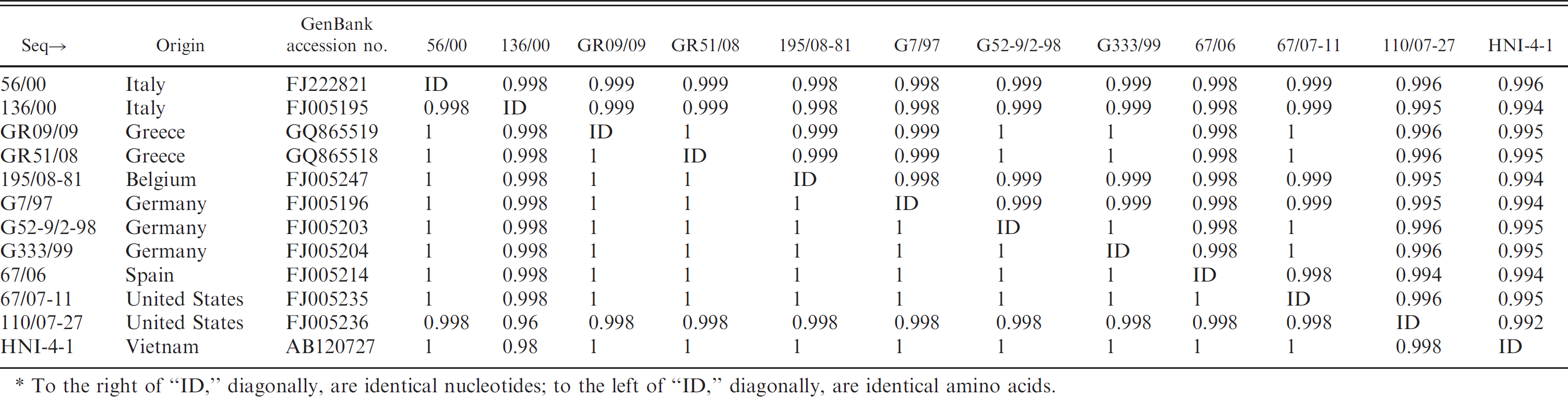
To the right of “ID,” diagonally, are identical nucleotides; to the left of “ID,” diagonally, are identical amino acids.
Sequence comparisons of the 3prime; end of the VP2 gene (495 nucleotides, 165 amino acids) of Canine parvovirus 2c strains. *
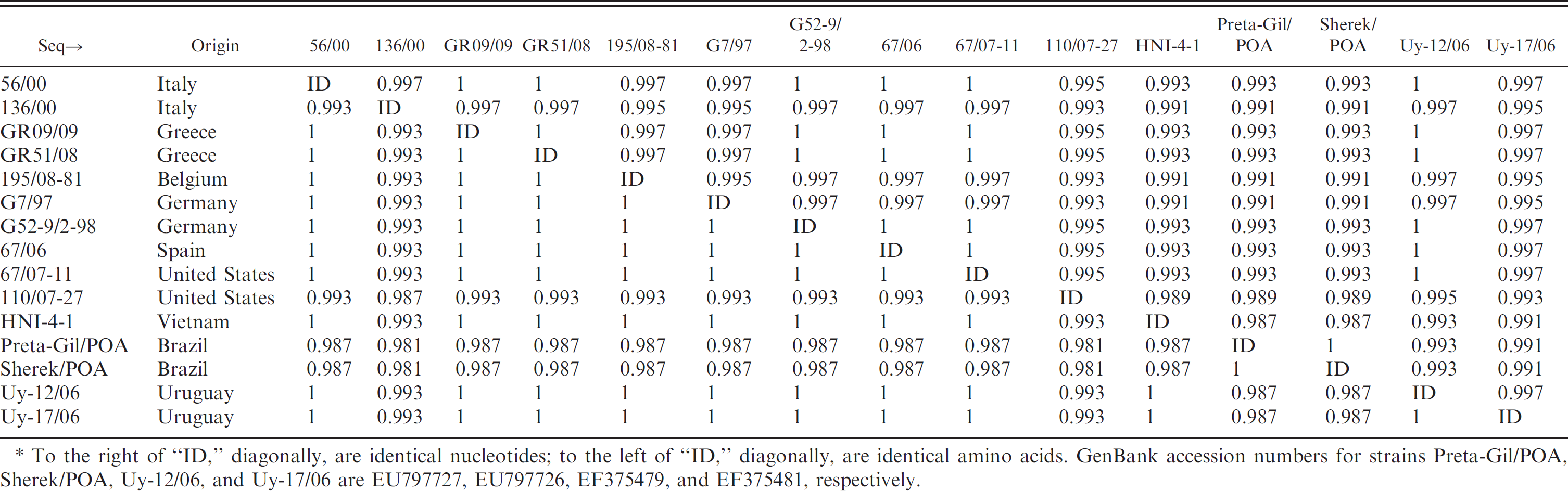
To the right of “ID,” diagonally, are identical nucleotides; to the left of “ID,” diagonally, are identical amino acids. GenBank accession numbers for strains Preta-Gil/POA, Sherek/POA, Uy-12/06, and Uy-17/06 are EU797727, EU797726, EF375479, and EF375481, respectively.
Sequence analysis of the 2 Greek CPV-2c viruses showed a 100% nt and aa identity to each other. Both viruses displayed 100% aa identity with the Italian prototype CPV-2c isolate 56/00 (GenBank accession no. FJ222821). In position 2846, the 2 CPV-2c Greek strains shared the common synonymous substitution TA (GCT→GCA), compared with 56/00, that involved the third nucleotide of codon 20 (Ala). The positions refer to the nt and aa sequences of the strain CPV-2b (M38245).
Compared with other CPV-2c strains, the Greek viruses showed the lowest nt identity with the HNI-4-1 Vietnam strain (GenBank accession no. AB120727) and the 110/07-27 U.S. strain (FJ005236), 99.5% and 99.6%, respectively. The Greek strains shared the lowest aa identity (99.8%) again with the U.S. strain 110/07-27. Compared with other European strains, the nt identity was ≥99.8% (Table 1). By comparison of the 3′ end of VP2 (165 aa) of CPV-2c strains, the Greek strains showed the lowest aa identity (98.7%) with the Brazilian strains Preta-Gil/POA and Sherek/POA (Table 2). Overall, the results of the sequence analysis suggest a European origin for the 2 Greek viruses.
The present study represents the first survey of CPV-2 variants in Greece by means of molecular techniques. Previously, the diagnosis of CPV-2 infections in the field was based on enzyme-linked immunosorbent assay and immunochromatographic commercial tests (Vasileios Ntafis, unpublished observations). In Greece, CPV-2 is a common pathogen in dogs with diarrhea as evidenced by the detection of viral DNA in 50.3% of diarrheic fecal samples tested by PCR.
All 3 antigenic variants of CPV-2 were detected by real-time PCR with MGB probes among PCR-positive samples, including the recently described type 2c. The CPV-2a was the most-common variant in Greece, whereas the other 2 variants were detected sporadically. The proportion of CPV-2a in Greece most resembles that of Belgium, where CPV-2a was found to be the only variant present, albeit in a smaller number (13) of samples. The data from Greece contrasts with that of other European countries, such as Italy, Germany, and Portugal, where CPV-2c is wide-spread. 8 In Italy, it appears that the new variant is progressively replacing types 2a and 2b. 14 The variable prevalence in the 3 variants among countries could be because of the trends in commercial trade practices, because countries import dogs from various origins all over Europe. 8
According to the clinical histories, 36 of the 84 positive dogs in the current study were vaccinated against CPV-2 at least once, whereas 17 were vaccinated during the last 10 days before clinical signs and sampling took place. There are several possible explanations for CPV-2 infection in vaccinated dogs. It is well known that a puppy's response to vaccination varies primarily because of interference of maternally derived antibodies and is 1 reason for vaccine failure. 4,24 Dogs may not have been fully vaccinated against CPV-2 or were infected before vaccine administration (especially in the group of 17 “recently” vaccinated dogs). In addition, mishandling of vaccines or failure of individual dogs to respond to vaccination with protective immunity cannot be excluded.
It is believed that classic CPV-2 vaccines may offer protection against CPV-2c. However, reports in the scientific literature do not completely agree: some reports suggest that CPV-2–based vaccines are protective against CPV-2c, 22 whereas other reports indicate that vaccine breaks are possible, with CPV-2c infection occurring in CPV-2–vaccinated dogs. 5,7,10 In the present study, 1 of the 2 dogs with CPV-2c (a 6-month-old puppy) was fully vaccinated (3 inoculations) with a modified live vaccine that contained the original CPV-2. When taking into consideration the antigenic differences between CPV-2 (the variant currently used in most CPV vaccines) and the 3 variants CPV-2a, −2b, and −2c, 6 it is reasonable to consider including currently circulating strains in the formulation of new vaccines.
Footnotes
a.
Primers, Eurofins MWG GmbH, Ebersberg, Germany.
b.
AmpliTaq Gold® Master Mix, Applied Biosystems, Branch-burg, NJ.
c.
Ultrafree®-DA columns, Millipore Corp., Billerica, MA.
d.
BigDye® 3.1 ready reaction mix, Applied Biosystems, Branchburg, NJ.