



Abstract
The objective of the current study was to investigate characteristics of Erysipelothrix spp. from slaughter condemnations. Specimens from 70 carcasses with lesions suspect for swine erysipelas were collected at an abattoir in Iowa from October 2007 to February 2009. Erysipelothrix spp. were isolated from 59 of 70 carcasses (84.3%). Abattoir inspectors classified lesions as acute, subacute, or chronic; 8 of 8 (100%) were acute cases, 31 of 32 (96.9%) were subacute cases, and 20 of 30 (66.6%) were chronic cases that were isolation positive. The following serotypes were identified: 1a (40.7%; 24/59), 2 (49.2%; 29/59), 7 (1/59), 10 (1/59), 11 (1/59), and untypeable (5.1%; 3/59). Serotypes 1a and 2 were identified in pigs with acute, subacute, or chronic clinical manifestations, whereas serotypes 7, 10, and 11 were only present in chronic cases. Fifty-seven of the 59 isolates were determined to belong to E. rhusiopathiae, and 2 of 59 of the isolates were determined to be E. tonsillarum by multiplex real-time polymerase chain reaction. Surface protective antigen (spa) A was detected in all E. rhusiopathiae isolates but not in E. tonsillarum serotypes 7 and 10. The results of the present study indicate that E. rhusiopathiae serotypes 1a and 2 continue to be commonly isolated from condemned pig carcasses and that spaA is the exclusive spa type in U.S. abattoir isolates. Interestingly, E. tonsillarum, thought to be avirulent for swine, was isolated from systemic sites from 3.4% of the carcasses that were negative for E. rhusiopathiae, indicating the potential importance of this genotype in erysipelas pathogenesis.
Members of the genus Erysipelothrix are facultative anaerobic, slender, Gram-positive, rod-shaped bacteria that cause swine erysipelas. The clinical disease associated with Erysipelothrix spp. is called erysipelas in birds and mammals or erysipeloid in humans. 24 Current taxonomy recognizes the genus Erysipelothrix with 2 species, each with differentiable serotypes: Erysipelothrix rhusiopathiae (serotypes 1a, 1b, 2, 4, 5, 6, 8, 9, 11, 12, 15, 16, 17, 19, 21, N) and Erysipelothrix tonsillarum (serotypes 3, 7, 10, 14, 20, 22, 23). 15,17,19 Two proposed Erysipelothrix spp. consisting of serotypes 13 (E. sp. strain 1) and 18 (E. sp. strain 2) have been described. 13,15,19 In addition, another proposed species, Erysipelothrix inopinata, has also recently been described. 21 Acute septicemia in U.S. swine is typically associated with serotype 1a. 24 Subacute and chronic cases are typically associated with serotype 2; however, all clinical forms of erysipelas can be induced experimentally in susceptible pigs with serotypes 1a or 2. Other serotypes have less clinical significance in pigs. 23,24 Recent investigations have focused on the surface protective antigen (spa) of Erysipelothrix spp. as a highly immunogenic and protective antigen. 8,20 To date, 4 different spa types have been described and identified in Erysipelothrix spp. references strains banked several decades ago, which include spaA, spaB1, spaB2, and spaC. 8,14,20 A cross protection study reported complete protection with homologous spa but only partial protection was observed with heterologous spa strains. 20 Recently, it was determined that a certain spa type is not confined to a specific serotype. 5
Economic losses associated with swine erysipelas are from increased numbers of deaths, treatment costs, vaccination costs, and slower growth of diseased pigs. 23 In addition, financial loss associated with abattoir condemnations or lesion trimming is of economic significance. The U.S. Department of Agriculture (USDA) and USDA Food Safety Inspection Service (FSIS) collect data related to swine abattoir condemnations on an annual basis. Swine erysipelas continues to be ranked as one of the top 10 causes for swine carcass condemnations (Courtesy of Jackie Lenzy, USDS FSIS, FOIA-2008-000440). Few studies have investigated isolates obtained from condemned car-casses. 6,18 The objective of the current study was to confirm the presence of Erysipelothrix spp. in condemned carcasses and to characterize the isolates obtained from a regional abattoir in the Midwestern United States.
Tissue specimens (tonsil, skin, kidney, liver, and spleen) from a total of 70 individual cases representing 70 different farm sites were collected from October 2007 to February 2009 by the veterinary inspector-in-charge at a single regional abattoir in Iowa. Utilizing previously described criteria, cases suggestive of swine erysipelas were visually identified and classified as acute, subacute, or chronic. 24 Tissue specimens were collected, labeled, and frozen at −20°C in individual specimen bags. Frozen samples were transported to the Iowa State University Veterinary Diagnostic Laboratory (Ames, Iowa) and tested.
Bacterial isolation was accomplished by utilizing a previously described selective broth enrichment and media technique. 1,12,22 Standard laboratory methods (Gram staining, hydrogen sulfide production) were used to confirm Erysipelothrix spp. All isolates were serotyped by using an agar gel precipitation test as previously described. 9,11,25 One isolate from all culture-positive carcasses was additionally characterized by using a multiplex realtime polymerase chain reaction (PCR) assay to determine the Erysipelothrix spp. genotype as previously described 13 with the following modification: the addition of primer (5′-CCTTATATCTTTAGCAGGTGATCTAG-3′) for Erysipelothrix spp. strain 2 was incorporated to increase the sensitivity of the assay. 14 All isolates were also evaluated by using a multiplex real-time PCR assay to identify the spa types (spaA, spaB1, spaB2, and spaC). 14
Number of Erysipelothrix spp. isolation–positive cases by lesion stage with associated serotypes.
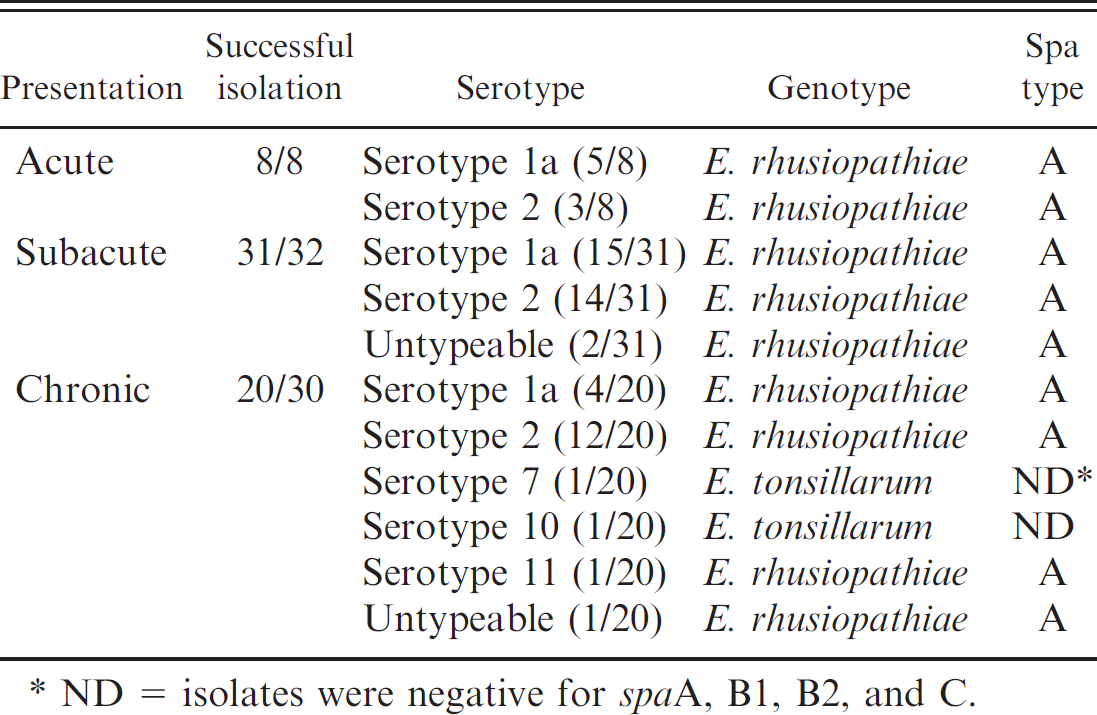
ND = isolates were negative for spa A, B1, B2, and C.
The isolation results of 70 condemned cases collected at the regional abattoir are summarized in Table 1. Of 70 cases examined, 84.3% (59/70) were found to be culture positive for Erysipelothrix spp. Moreover, of 350 tissue specimens cultured, which included tonsil, skin, kidney, liver, and spleen, 58.9% (206/350) were positive. In 11.9% (7/59) of the carcasses, all 5 tissues collected from the same carcass were culture positive; in 39.0% (23/59), 4 of 5 tissues from the same carcass were culture positive; in 37.3% (22/59), 3 of 5 tissues from the same carcass were culture positive; and in 8.5% (5/59) and 5.1% (3/59), 2 or 1 of the 5 tissues collected from the same carcass were culture positive, respectively. Overall, the highest isolation success was observed with tonsils for which 75.7% (53/70) of the samples were positive for Erysipelothrix spp.
All isolates recovered from different tissues of the same carcass were found to belong to the same serotype. The most common serotype was serotype 2 identified in 49.2% (29/59) of the carcasses, followed by serotype 1a identified in 40.7% (24/59) of the carcasses. Other serotypes detected were serotype 7 (1 isolate), serotype 10 (1 isolate), serotype 11 (1 isolate), and untypeable (3 isolates). Serotypes 1a and 2 were generally identified in tissues from pigs with acute, subacute, or chronic clinical manifestations, whereas serotypes 7, 10, and 11 were only identified in cases with a chronic presentation (Table 1). Previous investigations reported an association of serotype 1a with acute disease manifestation and an association of serotype 2 with subacute or chronic disease manifestation. In the current study, both serotypes 1a and 2 were found to be present in all 3 clinical presentations of erysipelas. Consistent with previous reports is the finding that serotypes 1a and 2 are the most common serotypes associated with disease. 4,11,16
Fifty-seven of 59 isolates belonged to E. rhusiopathiae (including the untypeable isolates), and 2 of 59 isolates were found to be E. tonsillarum, which was isolated from the spleen (serotype 7) or from spleen, liver, and kidney (serotype 10). Spa typing revealed that 97% (57/59) of the isolates were positive for the spaA type, which also includes all 3 untypeable isolates. Two isolates of E. tonsillarum (serotypes 7 and 10) were found to be negative for the spaA type as well as for other spa types. To the authors' knowledge, the present study is the first to determine the spa type in recent Erysipelothrix spp. isolates recovered from field cases of swine erysipelas. On the basis of reference strain analysis, it is speculated that spa types associated with swineherds are likely highly conserved; however, additional field isolates need to be screened to prove the speculation. Results of the present study are consistent with previous observations associating serotypes 1a and 2 with spaA. 3
The culture results from the current study confirm that 84.3% (59/70) of the carcasses were appropriately condemned as swine erysipelas at a regional abattoir. On the basis of USDA and/or FSIS data collected from 2003 to 2008, the predominant cause for postmortem swine condemnation in the United States was septicemia (15.5%) followed by arthritis (4.1%). However, the number of swine condemnations classified as septicemia or arthritis that may actually be caused by Erysipelothrix spp. is unknown, because the criteria of gross lesions are not etiologic specific and because a previous work demonstrated difficulties differentiating the acute stage of swine erysipelas from other causes of septicemia. 10 Bacterial causes of arthritis in Canadian slaughter hogs were investigated in 1992, and E. rhusiopathiae was identified as the most common bacterial pathogen (45%) isolated from arthritic joints. 2 For these reasons, the full economic and public health impact of swine erysipelas may be greatly underestimated. Because of constraints at the abattoir, condemnations as a result of septicemia or arthritis not highly suspected of swine erysipelas were not included in the present study. With the development and validation of improved diagnostics assays, additional investigation into cases of septicemia or arthritis condemned without classic diamond-skin lesions is warranted.
The 3 E. rhusiopathiae isolates found positive for spaA type were untypeable by utilizing serotyping techniques. Earlier studies have indicated that serotype N strains lack a type-specific antigen; as a result, they fail to induce antibody production in rabbits, which were used for producing typing antisera. 7,25 This could be the probable reason for lack of visible precipitation lines while performing the agar diffusion test in the current study. Therefore, it can be concluded that the isolates that were untypeable in the present study may likely belong to serotype N.
An unexpected finding was the presence of E. tonsillarum (serotypes 7 and 10) in 2 cases condemned for chronic erysipelas. Interpretation of the importance of E. tonsillarum is difficult as it can be frequently isolated from tonsils of normal swine, 24 and it is reported to be of little pathologic significance. 17 A 1987 study demonstrated that strains belonging to E. tonsillarum serotype 10 induced generalized urticarial skin lesions after intradermal inoculation; however, E. tonsillarum serotype 7 induced no clinical signs or macroscopic lesions. 17 In the current study, E. tonsillarum was the only pathogen (E. rhusiopathiae was not detected) isolated from internal organs (spleen, liver, and kidney) of the 2 condemned cases, suggesting that E. tonsillarum may be more important in pigs than previously speculated. The spa PCR was negative for spaA, spaB1, spaB2, and spaC on the E. tonsillarum isolates recovered from the carcasses, which is consistent with previous studies. 20 Additional investigations to determine the full impact of E. tonsillarum strains is warranted. Recent evidence of the immunogenic properties of the spa protein suggests this virulence factor may better predict pathogenicity than the serotype of the isolate.
Constraints at the abattoir prevented trace-back of condemned cases to the farm of origin; therefore, it remains unknown if the condemned carcasses had been vaccinated against erysipelas. Commercial killed and attenuated-live vaccines are derived from serotype 1a. 11 It can be speculated that a pig vaccinated with a product containing serotype 1a should be protected against serotypes 1a and 2 on the basis of previous studies using homologous spa types. 20 The E. tonsillarum isolates were found to contain no spa types, suggesting a mechanism for a lack of protection from currently available vaccines. Future investigations of swine erysipelas should include spa typing of vaccines if utilized on site, recognizing that immunization failures also occur for other reasons.
Results of the current study indicate that cases of suspected swine erysipelas condemned at an abattoir were appropriately classified. In addition, the majority of isolates recovered indeed belong to E. rhusiopathiae serotypes 1a and 2. In contrast to previous studies, however, the presence of these serotypes was demonstrated in carcasses with lesions at all stages (acute, subacute, and chronic). Furthermore, an important novel finding in this study is the association of E. tonsillarum strains with condemned tissue specimens. On the basis of the findings, E. tonsillarum may play a more significant role than previously suspected. Alternatively, the findings could be due to carcass contamination. Investigations at additional abattoirs in the United States are necessary, as results of the present study are based on condemnations at a single abattoir by utilizing a single inspector.
Acknowledgements. The authors thank Dr. Howard Lindaman for assistance procuring samples. This study was supported by the Pork CheckOff Dollars from the National Pork Board, the Iowa Livestock Health Advisory Council, and Schering-Plough Animal Health.