




Abstract
The most widely used method for bilirubin concentration determination is the diazo method, which measures the color of azobilirubin. The vanadate oxidase method is based on oxidation of bilirubin to biliverdin by vanadate. The objective of this study was to compare total and direct bilirubin concentration ([Bt] and [Bd], respectively) determined by the diazo and vanadate oxidase methods in pooled serum samples from dogs, monkeys, and rats spiked with panels of different concentrations of bilirubin standards. Pooled serum samples from 40 dogs, 40 monkeys, and 60 rats were spiked with either ditaurine conjugates of bilirubin or a standard reference material. The results obtained from both assays were compared using Deming regression analysis. The intra- and interassay precision, expressed as a percentage of the coefficient of variation (%CV), was determined for [Bt] and [Bd], and the mean percentage of recovery was calculated. The vanadate oxidase method displayed an excellent correlation (r = 0.99–1.00) with the diazo method. Using Deming regression, there were minimal negative or positive constant and proportional biases for [Bt] and [Bd]. The precision studies revealed that the vanadate oxidase method has comparable between-run and within-run CVs to those of the diazo method. The recovery study demonstrated that the diazo method more closely approximates the expected values of [Bt]. In conclusion, the vanadate oxidase method is a simple and rapid method that can be employed as an alternative to the diazo method when interfering substances are present in the serum samples of dog, monkey, and rat.
Keywords
Bilirubin is the major metabolite of heme, which is found in hemoglobin, myoglobin, and cytochromes. Bilirubin is mostly formed in liver, spleen, and bone marrow. Total bilirubin (Bt) in plasma consists of conjugated bilirubin (Bc), unconjugated bilirubin (Bu), and delta bilirubin (Bδ), which is covalently bound to serum albumin. Conjugated bilirubin and Bu are removed from plasma mainly by the liver. Hyperbilirubinemia is the result of an imbalance between the production and excretion of bilirubin by the liver and may be found in hepatocellular disorders, hemolytic diseases, and cholestasis. The accurate determination of the types and amounts of bilirubin fractions in body fluids, especially serum, is important for diagnostic purposes and for therapeutic monitoring.
Bilirubin and related compounds are measured in body fluids by various spectrophotometric, chromatographic, and electrophoretic methods. Currently most clinical laboratories rely on automated analyzers for rapid bilirubin determinations in multiple samples. 7 The most widely used chemical method for determination of Bt and Bc concentration ([Bt] and [Bc], respectively) in serum is the diazo method, in which the color of azobilirubin formed by the reaction of the porphyrin rings of bilirubin with a diazo compound is spectrophotometrically measured. Because Bu reacts slowly, accelerators such as caffeine, methanol, or ethanol are used to release Bu from albumin binding sites so that [Bt] can be measured. Deletion of these accelerants allows determination of [Bc]. The terms direct and indirect refer to the way bilirubin reacts to diazo compounds. Conjugated bilirubin and Bδ react directly with the diazo agent and are reported as direct bilirubin (Bd), whereas Bu reacts with the diazo agent only in the presence of an accelerant. Indirect bilirubin concentration [Bi] is derived from the [Bt] minus the [Bd]. Direct bilirubin and Bi have been used interchangeably with Bc and Bu, respectively, but this use of the terms is not quantitatively correct, because a small portion of Bu is also detected by the diazo method as Bd. 4,16,17 Moreover, only 76–89% of Bδ was reported1 3 to be detected as Bd. Spurious results in the determination of serum bilirubin concentrations using the diazo method due to interference by coexistent serum substances such as hemoglobin, 5,6,20–22 immunoglobulins (paraproteins), 3,19,22,24 and ascorbic acid 6,15 have also been reported.
Efforts to develop alternative assays for determination of bilirubin have led to different enzymatic methods utilizing bilirubin oxidase for measuring [Bt] and [Bc]. 1,9,11,12,16,17 In these methods, bilirubin oxidase catalyzes the oxidation of bilirubin to biliverdin, which causes the characteristic yellow absorption band for bilirubin to disappear. It has been suggested 9,11,12,16,17 that Bc can be exclusively detected by bilirubin oxidase methods. The vanadate oxidase method is based on oxidation of bilirubin to biliverdin, accomplished by utilization of vanadate as an oxidizing agent. 23 Using the vanadate oxidase method, Bt is oxidized by vanadate in the presence of detergent to produce biliverdin, which is further oxidized to colorless products. Deletion of the detergent allows determination of [Bd]. The oxidation reaction causes a decrease in the optical density, which is proportional to the [Bt] or [Bd]. It has been reported 23 that the vanadate oxidase method is relatively free of interference from coexisting serum substances.
Constant and proportional biases between the vanadate oxidase and the diazo methods for measuring serum total and direct bilirubin concentration in dog, monkey, and rat. *

Results were expressed as the mean of biases (95% confidence interval).
Although the vanadate oxidase method has been in use in human medicine for a considerable length of time, it has been rarely employed in animals, 2,10 and to the authors' knowledge, comparison between the diazo and vanadate oxidase methods in dogs, monkeys, and rats has never been reported. The objective of the current study was to compare [Bt] and [Bd], as determined by the diazo and vanadate oxidase methods, in serum pool samples from clinically healthy dogs, monkeys, and rats spiked with panels of different concentrations of commercially available bilirubin standards.
The animals included in the present study comprised 40 Beagle dogs, 40 cynomolgus monkeys, and 60 Sprague–Dawley rats. The animals were of both sexes and healthy and were housed under an Institutional Animal Care and Use Committee–approved protocol. The animals had not been included in any previous toxicology study. Blood was collected into tubes without anticoagulant and centrifuged within 1 hr of collection at 1,850 × g for 10 min at 4°C. A pooled serum sample for each species was prepared by mixing equal volumes of serum sample from each animal. The serum samples were stored at −80°C until analysis.
Because the glucuronide bilirubin conjugates oxidize quickly, ditaurine conjugates of bilirubin or ditaurobilirubin (DTB), a which is a mixture of taurine conjugated (76%) and Bu (24%), was used to make a standard bilirubin solution. Ditaurobilirubin, while not produced in vivo, is stable and reacts similarly to glucuronide conjugate when it is measured using the Bd assays. 1,8,9,16,17 To prepare the DTB stock solution, 30 mg of DTB was dissolved in 3 ml of 0.01 M phosphate buffered saline (pH 7.4) b under reduced light. Next, each species' pooled serum sample was spiked using this stock solution to create a set of species-specific serum samples with [Bt] ranging from 0.8 mg/dl to 50.0 mg/dl. These concentrations were selected based on the values used by the manufacturer c to establish test performance characteristics for the vanadate oxidase method. Pooled serum samples spiked with DTB were used for the correlation, regression, and precision studies.
Intra-assay (within-run) precision of serum total (Bt) and direct bilirubin (Bd) concentration in dog, monkey, and rat determined by the diazo (D) and vanadate oxidase (V) methods.
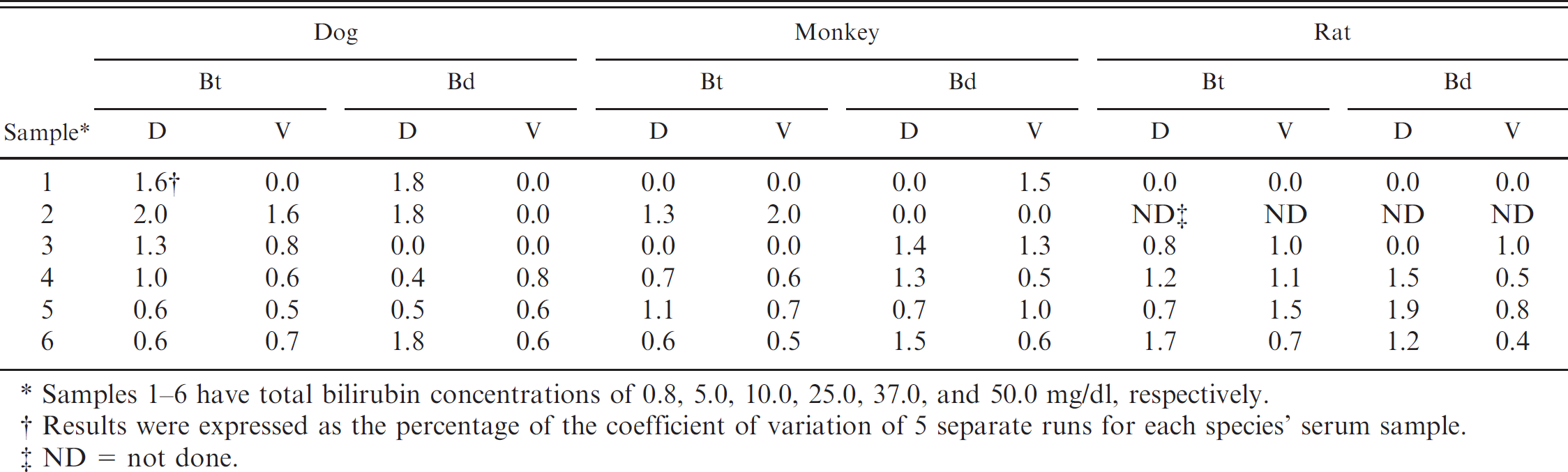
Samples 1–6 have total bilirubin concentrations of 0.8, 5.0, 10.0, 25.0, 37.0, and 50.0 mg/dl, respectively.
Results were expressed as the percentage of the coefficient of variation of 5 separate runs for each species' serum sample.
ND = not done.
For the recovery study, a standard reference material (SRM 916a), d which contains a mixture of Bu isomers (IIIα, IXα, XIIIα) with a purity of 98.3%, was used. The spiking of animal serum with known gravimetric quantities of this material fulfills the need to provide elevated [Bt] with minimal Bc content. To prepare a stock solution, 30.0 mg of SRM 916a was dissolved in 1.0 ml of dimethyl sulfoxide b under reduced light. Then, 2.0 ml of 0.1 M sodium carbonate (NaHCO3, pH 8.5) b was added to make a 10 mg/ml Bu standard. Finally, each species-specific pooled serum sample was spiked with the SRM 916a stock solution to create a set of serum samples with known [Bt] ranging from 1.4 mg/dl to 52.5 mg/dl.
Species-specific pooled serum samples spiked with DTB or SRM 916a were prepared in advance and stored in the dark at −80°C prior to testing. Samples were thawed at room temperature in the dark and placed on the analyzer immediately prior to analysis to avoid light exposure. The diazo method e and vanadate oxidase method c were performed according to the manufacturers' instructions using a clinical chemistry analyzer. e
Interassay (between-run) precision of serum total (Bt) and direct bilirubin (Bd) concentration in dog, monkey, and rat determined by the diazo (D) and vanadate oxidase (V) methods.
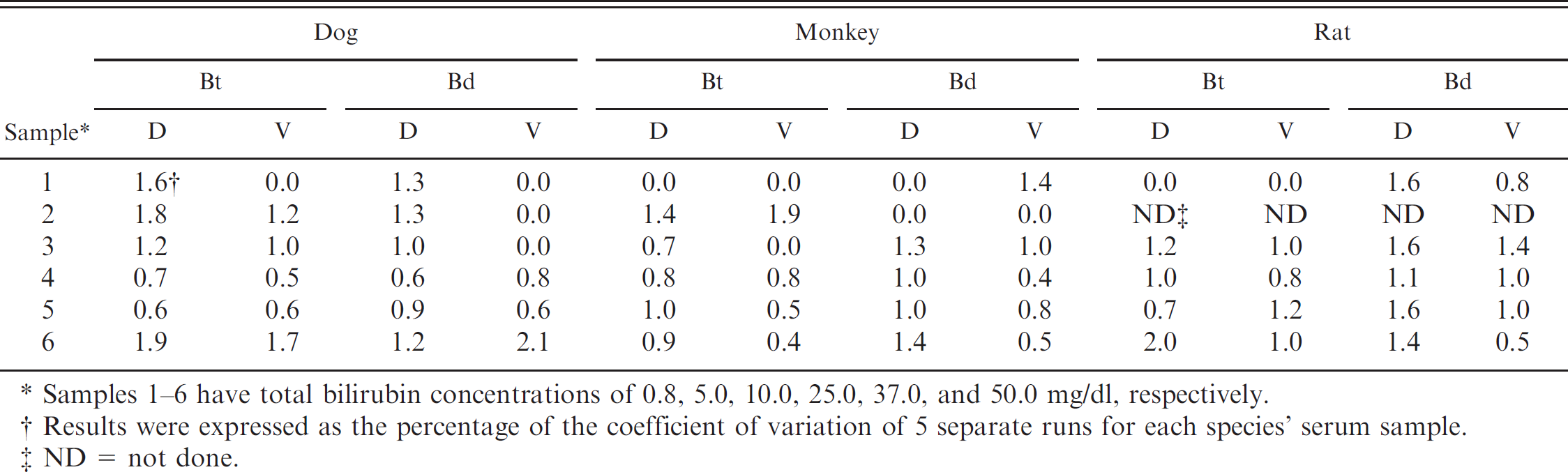
Samples 1–6 have total bilirubin concentrations of 0.8, 5.0, 10.0, 25.0, 37.0, and 50.0 mg/dl, respectively.
Results were expressed as the percentage of the coefficient of variation of 5 separate runs for each species' serum sample.
ND = not done.
All statistical analyses were performed using Analyse-it software for Excel (version 2.20). f The Pearson correlation coefficient test was used to measure the correlation (r) between 2 assays. The assays were compared using Deming regression analyses, and the results were expressed as the 95% confidence interval (CI). The intra-assay (within-run) and interassay (between-run) precision, expressed as a percentage of the coefficient of variation (%CV), was determined from the mean of the [Bt] and [Bd] of 5 separate runs for each species. The mean of percentage of recovery of [Bt] in each species' pooled serum sample was calculated from 5 separate runs. The differences were considered significant at values of P ≤ 0.05.
Using the Pearson correlation coefficient, the vanadate oxidase method displayed an excellent correlation (r = 0.99–1.0) with the diazo method for both [Bt] and [Bd] in all 3 species. When the vanadate oxidase method was compared to the diazo method using Deming regression, there were minimal negative or positive constant and proportional biases for [Bt] and [Bd] in all 3 species (Table 1). The intra-assay and interassay precision variability for both assays were quite low. The intra-assay precision ranged from 0.0% to 2.0% for the diazo method and from 0.0% to 2.0% for the vanadate oxidase method (Table 2). The interassay precision ranged from 0.0% to 2.0% for the diazo method and from 0.0% to 2.1% for the vanadate oxidase method (Table 3). The recovery study demonstrated that the diazo method more closely approximates the expected values of [Bt] in all 3 species (Table 4). The results obtained by the vanadate oxidase method were significantly (P ≤ 0.05) different from those obtained by the diazo method.
Knowledge of serum bilirubin level is useful for the diagnosis and prognosis of hepatobiliary diseases and hemolytic anemias. Currently most clinical laboratories employ the diazo methods to measure [Bt] in serum; these methods are based on a coupling reaction with various diazo dyes in the presence of an accelerating agent. Bilirubin determination by the diazo method, however, is subject to a number of exogenous or endogenous interferences that affect analytical accuracy. A spurious result due to technical interferences in laboratory determination of serum bilirubin concentrations may result in an incorrect diagnosis and may consequently involve inappropriate treatment. Therefore, another method for determination of serum bilirubin concentration should be available when interfering exogenous or endogenous substances are present in serum samples. As an alternative, a chemically oxidative method using vanadate for bilirubin determination has been developed. It has been shown 23 that this method is relatively free of interferences from coexisting serum substances.
In the present study, the vanadate oxidase and diazo methods displayed a perfect correlation for both [Bt] and [Bd] in all 3 species. A similar result has also been reported1 2,23 on human blood specimens using these methods. The inter- and intra-assay precision studies revealed that the vanadate oxidase method has comparable between-run and within-run CVs to those of the diazo method for both [Bt] and [Bd].
Recovery study using a commercial standard reference material (SRM 916a) for determination of total bilirubin concentration by the diazo and vanadate oxidase methods. *
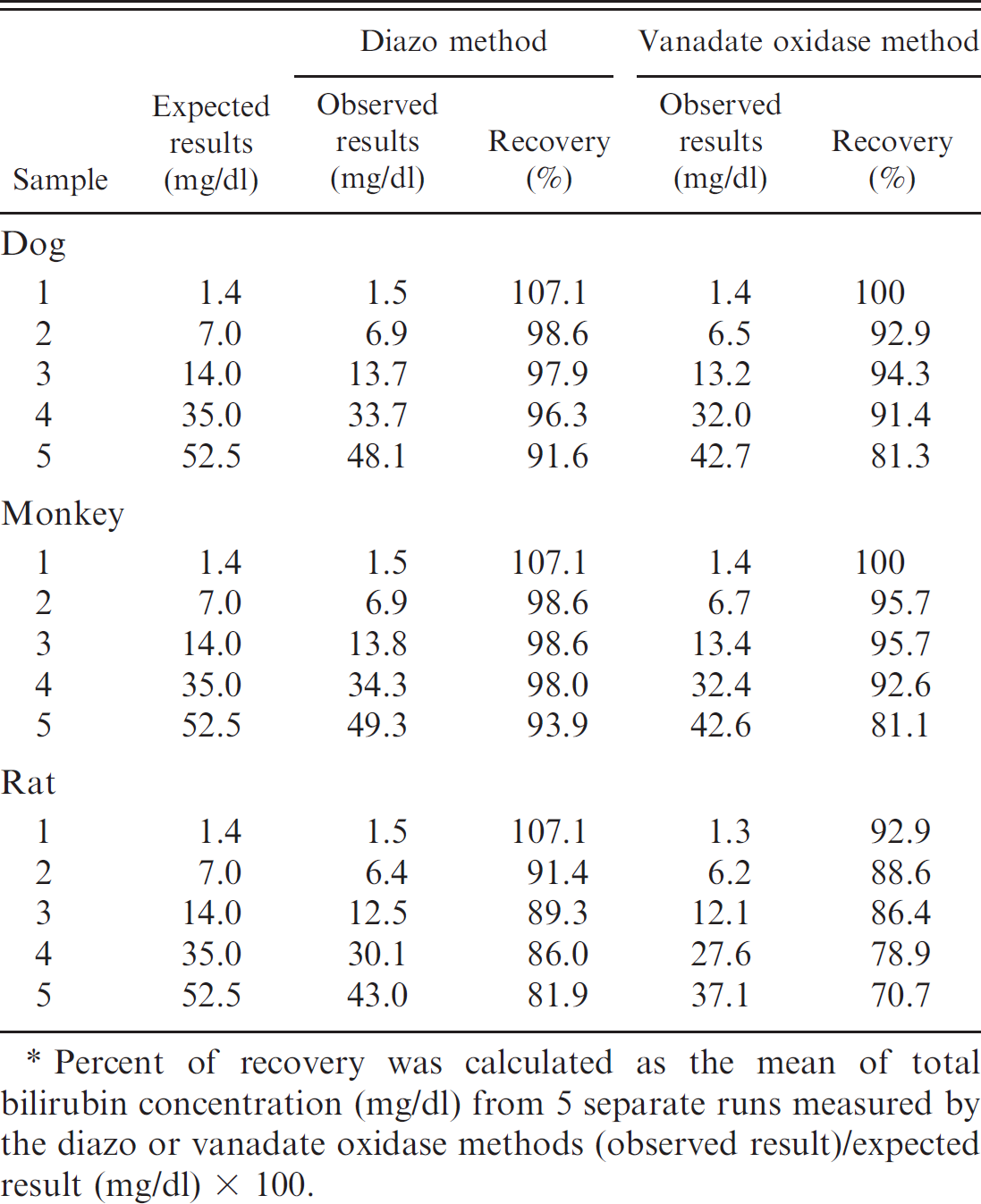
Percent of recovery was calculated as the mean of total bilirubin concentration (mg/dl) from 5 separate runs measured by the diazo or vanadate oxidase methods (observed result)/expected result (mg/dl) × 100.
Deming regression analysis revealed minimal negative or positive constant and proportional biases between the 2 assays for [Bt] and [Bd] determination in the serum samples spiked with DTB in all 3 species. Although the cause for these biases remains unclear, the bias may partially be related to the method of calibration for these assays. It has been shown 14 that the use of different calibrators containing a protein base and DTB accounted for the discrepant results between different bilirubin assays. Compared to the diazo method, the vanadate oxidase method showed proportionally lower [Bt] in the pooled serum samples spiked with DTB or SRM 916a in all 3 species. Although the differences between the [Bt] results obtained by these 2 methods were statistically significant, the authors believe that in the measurement of bilirubin in animals with high [Bt], such small differences may be tolerable because they have no relevance to the diagnosis or monitoring of the disease. It has been shown 18 that the difference between the diazo and oxidase methods is at least partially due to incomplete oxidation of Bc by the oxidase methods.
In conclusion, although the vanadate oxidase method offers no advantage over the diazo method for determination of bilirubin concentration, the vanadate oxidase method is a simple and rapid method that can be employed as an alternative to the diazo method when interfering substances are present or suspected in the serum samples of dog, monkey, and rat. Further studies are required to investigate the effects of interference on bilirubin determination by the vanadate oxidase method in serum samples from animals.
Footnotes
a.
Frontier Scientific Inc., Logan, UT.
b.
Sigma-Aldrich, St. Louis, MO.
c.
Wako Chemicals USA Inc., Richmond, VA.
d.
National Bureau of Standards, Washington, DC.
e.
Olympus AU2700, Olympus Diagnostics, Melville, NY.
f.
Analyse-it Software Ltd., Leeds, United Kingdom.