




Abstract
Coagulase-positive staphylococci (CoPS) are potential causative agents of equine infections, but they are rarely responsible for the death of the animal. In the current study, staphylococci implicated in the death or euthanasia of horses were retrospectively studied in 3,457 necropsies performed over a decade (1995-2006). Morbidity associated with CoPS was 1.7%, representing 60 isolates of CoPS, which were identified as Staphylococcus aureus (59) and Staphylococcus pseudintermedius (1). Coagulase-positive staphylococci (alone or in association with another bacterial species) were associated with the death or euthanasia of 90% of the cases (54/60). Proportions of antibiotic resistance to penicillin G and tetracycline reached 62.7% and 23.7%, respectively. Virulence genes were detected in 91.7% of the strains, with a majority of seh or sei enterotoxin genes. Finally, 3 methicillin-resistant Staphylococcus aureus (MRSA) isolates belonging to the t064 spa-type were identified. One strain was isolated in 2003 and might thus be one of the first cases of equine MRSA in France.
Staphylococcus aureus (order Barillales, family Staphylococcaceae) is a member of the commensal flora of mammals but is also a traditional opportunistic pathogen in human and veterinary medicine. In horses, it is a common nasal colonizer in healthy animals, 4 but staphylococcal-related diseases are also largely described in the veterinary literature. The main clinical outcomes are skin lesions and wounds, 7 sepsis, 13 respiratory tract infections, 8 and genital tract infections, 15 which do not usually lead to the death or euthanasia of the animal. Therefore, data on the link between staphylococcal infections and death is rarely emphasized.
The importance of S. aureus as a pathogen has increased with the emergence of methicillin-resistant S. aureus (MRSA) strains, which are resistant to all β-lactam antibiotics. Consequently, most of the research has focused on the emergence of MRSA in both healthy and diseased horses, 1,5,19 especially because it has been shown that MRSA-carrying horses are at a higher risk of developing infections and that they can transmit MRSA to other horses or to human beings in contact. 17,18 Since 2005, special attention was paid to the emergence of the ST398 clone, which broadly disseminated in pigs, companion animals, horses, and human beings. 6 In contrast, colonization of healthy horses by methicillin-sensitive S. aureus is still poorly documented. The objective of the current study was to determine the prevalence of death-related infections caused by coagulase-positive staphylococci (CoPS) in the horse population of Normandy, France, as well as to characterize the resistance and virulence patterns of staphylococci isolated at necropsy.
Between 1995 and 2006, 3,457 necropsies were performed on horses at the Anses Laboratory (Goustranville, France). Carcasses were necropsied within 24 hr of death according to a complete and standardized procedure adapted from a previous study. 12 Bacteria were immediately isolated from specific swabs or organ samples taken depending on the epidemiological context, the clinical signs, and the macroscopic lesions observed. A staphylococcal infection was diagnosed when macroscopic or histologic lesions coincided with the isolation of a pure or predominant culture of Staphylococcus spp. Staphylococci were identified by standard methods (catalase, coagulase, commercial gallery test a ). Staphylococcus aureus were identified by polymerase chain reaction (PCR) amplification of the nuc gene, whereas Staphylococcus pseudintermedius, Staphylococcus delphini, and Staphylococcus intermedius, which are members of the S. intermedius group (SIG), were differentiated by PCR-restriction fragment length polymorphism on the kat gene. 3 Susceptibility tests were performed by disk diffusion on Mueller-Hinton agar b using antibiotics presenting a veterinary or a human interest. c Staphylococcus aureus ATCC 25923 was used as the quality-control strain, and results were interpreted according to the clinical breakpoints recommended by the French Society of Microbiology (Recommandations 2008 du Comité de l'antibiogramme de la Société Française de Microbiologie [2008 recommendations of the Antibiogram Committee of the French Society of Microbiology]. Available at http://www.sfm.asso.fr/publi/general.php?pa=5. Accessed on July 7, 2010. In French). The mecA gene was systematically screened by PCR, and MRSA were spa-typed by sequence analysis using a commercial software program. d Enterotoxin genes (sea, seb, sec, sed, seg, seh, sei, and sej), exfoliating toxins (eta and etb), and hemolysins (hla and Mb) were detected by multiplex PCR. 11 All statistical tests were performed using chi-square tests with the level of significance set at 0.05.
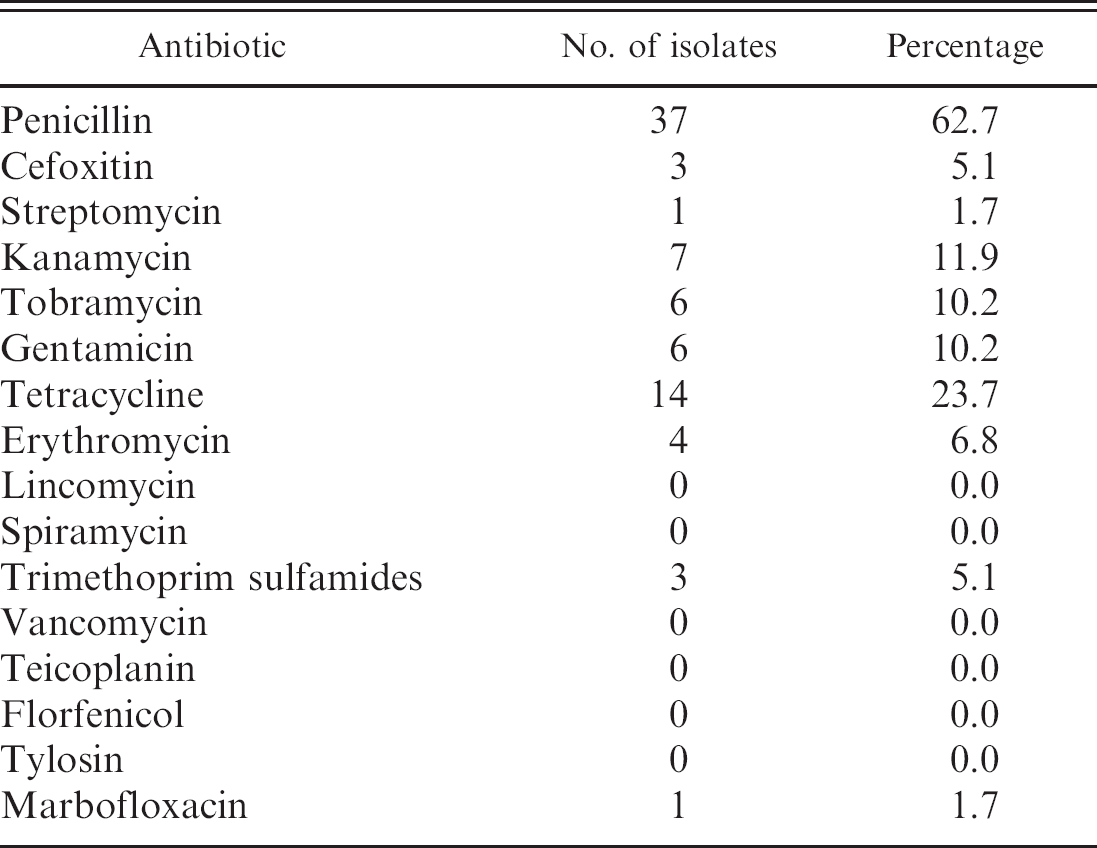
Antibiotic resistance patterns of the 59 Staphylococcus aureus isolates.
Among the 3,457 necropsies performed between 1995 and 2006, CoPS were recovered from 60 horses (1.7%), and identified as S. aureus (59) and S. pseudintermedius (1). No other species of the SIG bacteria (i.e., S. delphini, S. intermedius) were identified. Because other studies showed a nearly equal distribution between S. aureus and the SIG members in horses, 2,14 this discrepancy might indicate that S. aureus might be more prone than SIG bacteria to generate severe infections. Further, 19 isolates (19/60, 31.7%) were found in coculture, namely with Streptococcus zooepidemicus (7), Escherichia coli (4), Pasteurella multocida (3), Rhodococcus equi (3), Actinobacillus equuli (1), and Pseudomonas aeruginosa (1). Of these 60 isolates, 54 (90%) were considered as strongly associated to death (19 septicemia; 18 in utero infections associated with 14 abortions and 4 stillbirths; 11 pneumonia; 3 pyemia; 2 arthritis; and 1 osteomyelitis). The remaining 6 out of 60 isolates were considered as a comorbidity factor (2 skin lesions, 1 phlebitis, 1 ocular lesion, 1 suppurative lymphadenitis, and 1 suppurative myositis). Breed had no influence on the frequency of staphylococcal infection cases (P > 0.05). On the contrary, the frequency of staphylococcal cases significantly depended on the age of the animal (P < 0.05), with 55% (33/60) of the positive samples coming from foals whose age ranged between 0 and 6 months. Despite an overrepresentation of Thoroughbred foals (P > 0.05), this prevalence is representative of the horse population of this region in France.
Resistance of S. aureus to 16 antibiotics of medical and/or veterinary interest was tested (Table 1). The highest proportions of resistance were observed for penicillin (62.7%), tetracycline (23.7%), and the aminosides (approximately 10%). This might be a consequence of the use of this antimicrobial in equine veterinary practice in France, with the exception of tetracycline resistance, which was surprisingly elevated as this antibiotic is often contraindicated for horses. Four isolates (6.7%) presented an inducible MLSb phenotype (resistance to macrolide—lincosamide—streptogramin B), as proved by erythromycin resistance and the D-shaped zone around the lincomycin antibiotic disk. Special attention should be paid to this inducible resistance because phenotypic analyses might lead to false-negative results if lincosamides or other macrolides are tested without erythromycin as an inducer. No resistance was observed to glycopeptides (vancomycin and teicoplanin) and florfenicol. A proportion of 5.1% of the isolates were resistant to cefoxitin, and all 3 isolates displayed the mecA gene.
Virulence genes identified in the 59 Staphylococcus aureus isolates.
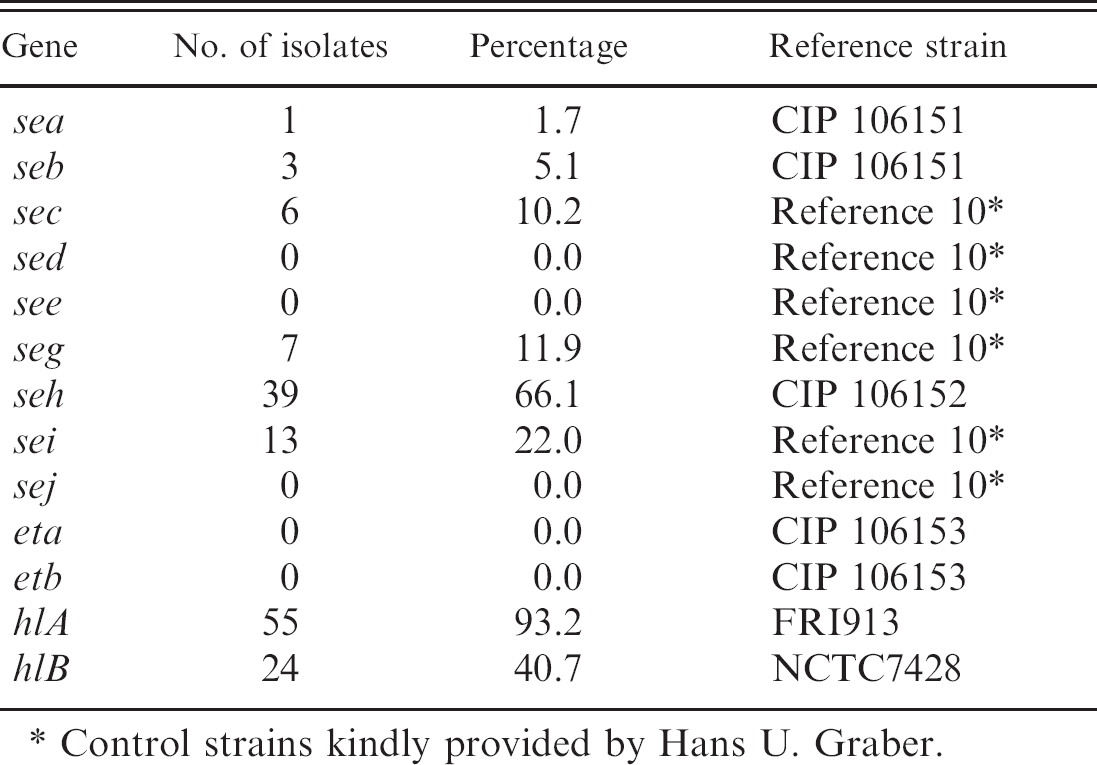
Control strains kindly provided by Hans U. Graber.
The 3 MRSA isolates, identified as spa-type t064, were isolated from foals that were 10-12 days of age in 2003, 2004, and 2006, respectively. Spa-type t064 usually belongs to clonal complex (CC)8, which was described first in human beings and then in animals, and more specifically in horses. 6,10,16 Thus, the 2003 isolate might well be one of the earliest cases of MRSA in France in horses, since the first outbreaks of methicillin resistance in horses were reported at the end of the 1990s in the United States and Japan, in 2000 in Canada, and in the early 2000s in Europe. 6 In the present study, the absence of ST398, which were reported recently as highly prevalent in northern Europe, might result from the fact that this clone only recently disseminated into the equine population. 17 Methicillin resistance was always coupled with tetracycline resistance, and with the MLSb and KTG phenotypes, in the current study. Two out of the 3 strains were additionally resistant to trimethoprim sulfamides. Finally, the S. pseudintermedius isolate presented resistance to penicillin, streptomycin, and kanamycin and was devoid of the mecA gene.
A set of toxin genes was also investigated to assess whether these isolates might be especially virulent because all 60 strains were associated, directly or not, in the death of the animal. Enterotoxins were included in line with their superantigenic activity, causing fever, hypotension, and shock. Overall, no isolate exhibited exfoliating toxins, but 91.7% (55/60) presented at least 1 enterotoxin, and another 55 isolates displayed either the hlA or the hlB hemolysin. However, specific virulence genes could not be assigned to a specific symptom. Among the enterotoxins, the most widely distributed gene was seh (66.1%, 39/59), whereas sei and seg were found in 22.0% (13/60) and 11.9% (7/60) of the isolates, respectively (Table 2). The seb gene was only detected in the 3 MRSA (once in association with sea), where it was associated twice with symptoms of severe pneumonia and once with septicemia. Interestingly, seh and seb have been rarely reported in animals. Enterotoxin genes were mostly found alone (76.2%, 45/59), but 10 isolates (16.8%) presented an association of 2–3 genes. Finally, the hlA hemolysin was detected in 55 isolates (93.2%) and was present either alone (56.4%, 31/55) or associated with hlB (43.6%, 24/55). Only the S. pseudintermedius displayed none of these 3 categories of virulence genes.
In conclusion, lethal infections implicating CoPS were rare in the Normandy region of France, and mortality was most probably not related to a treatment failure resulting from multiple antibiotic resistance. A MRSA isolate was retrospectively identified as early as 2003 and might be one of the first equine MRSA isolates in this region of France. Consequently, the current study emphasizes the need of a survey of Staphylococcus spp. carried by healthy horses to estimate the prevalence of such bacteria in the equine population but also highlights the need of a global approach to infer the pathogenicity of such staphylococci.
Acknowledgements. The authors thank Damien Gaillard and Pierre Chatre for technical assistance, and Hans U. Graber for kindly providing the control strains.
Footnotes
a.
bioMérieux SA, Marcy l'Etoile, France.
b.
Bio-Rad Laboratories, Marnes-la-Coquette, France.
c.
Mast Diagnostic, Amiens, France.
d.
Ridom StaphType, Ridom GmbH, Wurzburg, Germany.