



Abstract
The aim of the current study was to determine the antimicrobial resistance of streptococci isolated from mastitic bovine milk samples. A total of 178 isolates belonging to 6 different Streptococcus species were examined: S. uberis (n = 99), S. bovis (n = 30), S. oralis (n = 24), S. salivarius (n = 13), S. intermedius (n = 7), and S. agalactiae (n = 5). Only 8.9% (16/178) of the isolates were susceptible to all antimicrobial agents tested in this study, and S. agalactiae and S. intermedius isolates were all resistant to at least 1 antimicrobial agent tested. Overall, the most frequently observed resistance was to tetracycline (61.2%), followed by lincomycin (43.2%), gentamycin (35.3%), oxacillin (34.3%), and erythromycin (28.6%). Cephalothin and penicillin were the only antimicrobial agents to which most of the streptococci (92%) were susceptible. Wide differences in the prevalence of resistance are apparent among the individual species: S. salivarius displayed exceptionally high resistance to cephalothin (23.0%) and oxacillin (76.9%) and S. agalactiae (20%) and S. intermedius (14.2%) to penicillin. Streptococcus salivarius and S. agalactiae were all susceptible to erythromycin, but others showed various rates of resistance ranging from 12.5% to 42.8%. Resistance to 3 or more of 7 antimicrobial agents was observed in all species (37.6%, 67/178).
Streptococcal species are known to be significant causative pathogens of bovine intramammary infections. For years, Streptococcus agalactiae was one of the main pathogens causing mastitis and a source of economic loss for the industry. 10 However, epidemiology of bovine mastitis has been changed because current control measures against contagious pathogens are considerably less effective than in controlling environmental pathogens. 16
Environmental streptococci have consistently been reported as a leading cause of both subclinical and clinical mastitis throughout the world. 9 In addition to the predominant species such as Streptococcus uberis, various other streptococcal species have been isolated from milk samples: Streptococcus bovis, Streptococcus equinus, Streptococcus mitis, Streptococcus salivarius, Streptococcus equi subsp. zooepidemicus, or Streptococcus canins. 5,8,13,20,21 Some of them are viridans group streptococci, which are becoming increasingly resistant to many antimicrobial agents and are known to be reservoirs of resistance genes, transferring different resistance traits to more pathogenic organisms. 1,2,19 In spite of that, information on antimicrobial activities to unusual streptococci such as viridans group streptococci is scarce. The objective of this study was, therefore, to determine the patterns of antimicrobial resistance among different species of streptococci other than major pathogens isolated from mastitic bovine milk samples taken from dairy cattle in Korea.
A total of 12,508 quarter milk samples from lactating cows on 435 dairy herds nationwide were examined in the Mastitis Diagnostic Laboratory of National Veterinary Research and Quarantine Service (NVRQS) in Korea from January 2004 to June 2008. Cows that were being treated with antimicrobials were excluded, and milk samples were aseptically collected from individual mammary quarters by the herd owner or personnel from NVRQS. Bacterial examination of the samples with SCC of greater than 200,000 cells/ml was conducted according to standard laboratory techniques 15 : 10 μl of milk was streaked onto a portion of 5% blood agar plates a and incubated at 35–37°C for 18–24 hr. Plates were observed for growth up to 48 hr, and bacterial growth of 5 or more identical colonies were chosen for identification. All organisms presumptively identified as streptococci by colony morphology and Gram stain were identified to the species level with the VITEK system b as described by the manufacturer. Among a total of 212 streptococcal isolates, 178 strains belonging to 6 different species were selected for examination of resistance to 7 antimicrobial agents: S. uberis (n = 99), S. bovis (n = 24), S. oralis (n = 30), S. salivarius (n = 13), S. intermedius (n = 7), and S. agalactiae (n = 5).
According to the recommendations of the National Committee for Clinical Laboratory Standards, 14 the disc diffusion method was performed with the use of commercially prepared antimicrobial sensitivity discs c : gentamicin (10 μg/disk), lincomycin (2 μg/disk), oxacillin (1 μg/disk), penicillin (10 μg/disk), cephalothin (30 μg/disk), erythromycin (15 μg/disk), and tetracycline (30 μg/disk). Strains of
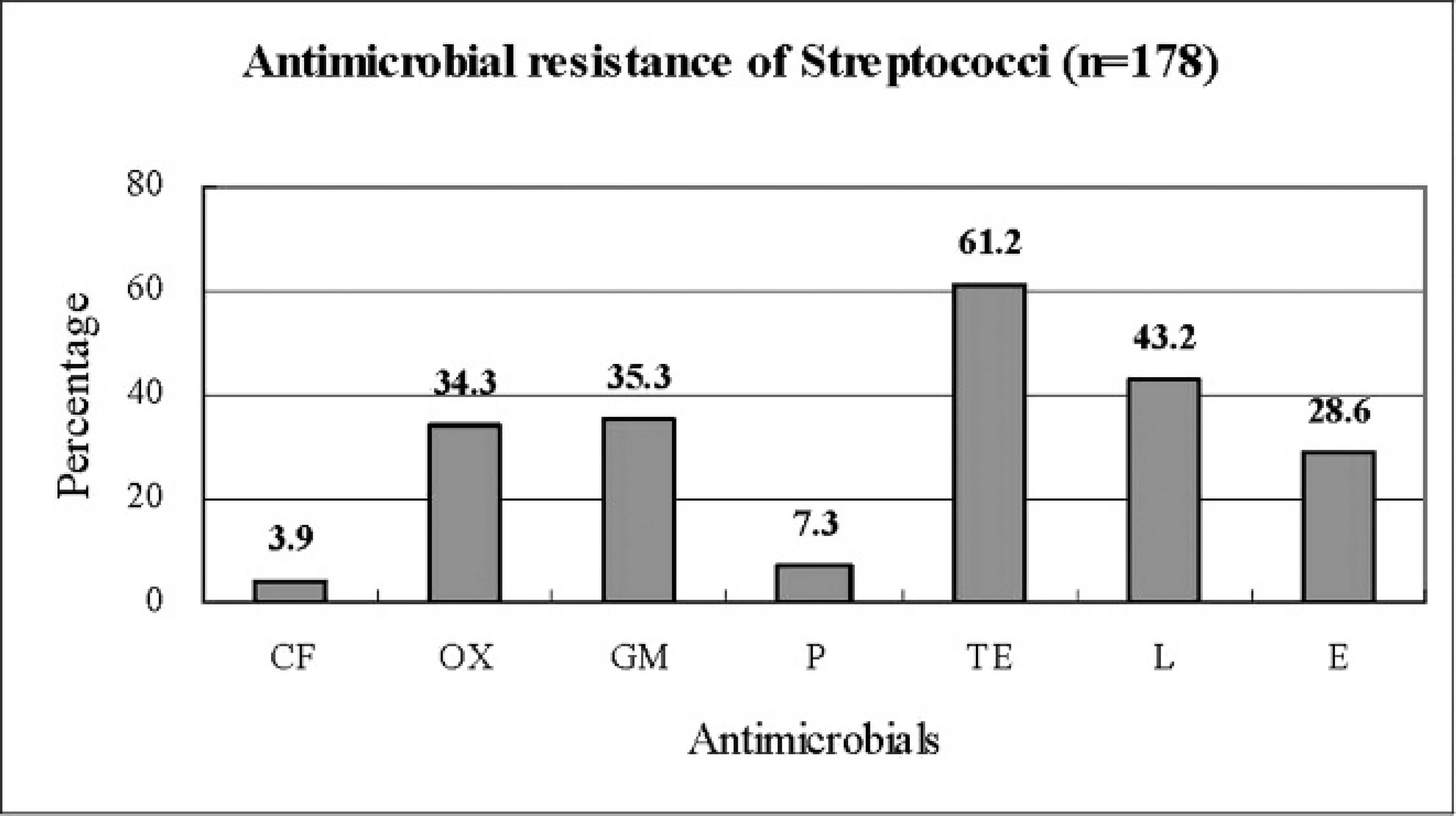
Percentage of antimicrobial resistance observed in 178 isolates of Streptococcus spp. originated from mastitic bovine milk samples.
Escherichia coli ATCC 25922 and Staphylococcus aureus ATCC 29213 were used as the quality control organisms. Isolates were categorized as susceptible, intermediate, and resistant on the basis of interpretive criteria developed by the National Committee for Clinical Laboratory Standards. 14 Test results were accepted only when the zone of inhibition for the control strain fell within the acceptable ranges.
Only 8.9% (16/178) of the isolates were susceptible to all antimicrobial agents tested in this study: S. oralis (16.6%, 5/30), S. bovis (8.3%, 2/24), S. uberis (8.0%, 8/99), and S. salivarius (7.6%, 1/13). In particular, all the isolates of S. agalactiae and S. intermedius were resistant to at least 1 of 7 antimicrobial agents tested in this study. About 65% (115/178) of the isolates were resistant to 2 or more antimicrobial agents tested. The in vitro antimicrobial resistance profiles of all streptococcal isolates tested and by each species are summarized in Figure 1 and Table 1, respectively.
Tetracycline resistance was most commonly observed in all species tested, and the prevalence of resistance observed in this study is comparable to those previously reported for streptococci isolates from mastitis. 4,18 However, data from the present study is quite high compared with a report from Sweden, which showed 0% resistance to oxytetracycline in S. uberis and S. agalactiae. 6 The high level of tetracycline resistance could be associated with tetracycline usage in Korea, in which the proportion of tetracyclines accounted for more than 50% of the sales of antimicrobial agents for animals. 11,12 β-Lactams are known as the first-line antimicrobial agents when treating streptococcal udder infections. 3 As several studies have demonstrated, 4,6 cephalothin and penicillin were found to be uniformly effective against streptococcus isolates in the current study: more than 96% and 92% of isolates showed susceptibilities to these 2 β-lactams, respectively. Oxacillin showed relatively low activity compared with other β-lactams tested in this study, and the prevalence of resistance to oxacillin is lower than those of previous studies. 4,18 Besides β-lactams, erythromycin seemed to be the most active antimicrobial agent, and 28.6% of streptococcal isolates showed resistance to this drug. This finding is similar to those of previous reports from France (21%) 7 and Argentina (27.6%), 3 but much higher than that of a study on dairy herds in Uruguay (0–3%). 6 Percentage of erythromycin-resistant S. uberis (34.3%) observed in the present study was similar to the finding in a report from the United States (31.9%) 4 but was much higher than that of a report from Finland, 17 in which no S. uberis isolates were resistant to this drug.
Previous studies described the need for identification of environmental streptococci to the species level and an antimicrobial susceptibility test for them, especially when they failed to respond to therapy. 6,18 Similar to the findings of previous studies, 3,6 differences in the prevalence of resistance are apparent among the individual species in this study: although all species showed less than 10% resistance to cephalothin and penicillin and relatively higher prevalence of resistance to oxacillin (40%), S. salivarius displayed exceptionally high rates of resistance to cephalothin (23.0%) and oxacillin (76.9%). Streptococcus agalactiae (20%) and S. intermedius (14.2%) also showed relatively high resistance to penicillin. The prevalence of resistance to gentamycin and erythromycin was the most variable among the species: all species showed lower portions of resistance to gentamycin (range, 20–42.4%) but more than 92% of S. salivarius were susceptible to this agent. Although all strains of S. salivarius and S. agalactiae were susceptible to erythromycin, others showed various rates of resistance to this drug, ranging from 12.5% to 42.8%. (Table 1).
Prevalence of antimicrobial resistance by species of streptococcal isolates from milk samples (SCC > 200,000/ml) submitted to the Mastitis Diagnostic Laboratory of National Veterinary Research and Quarantine Service in Korea (n = 178). *
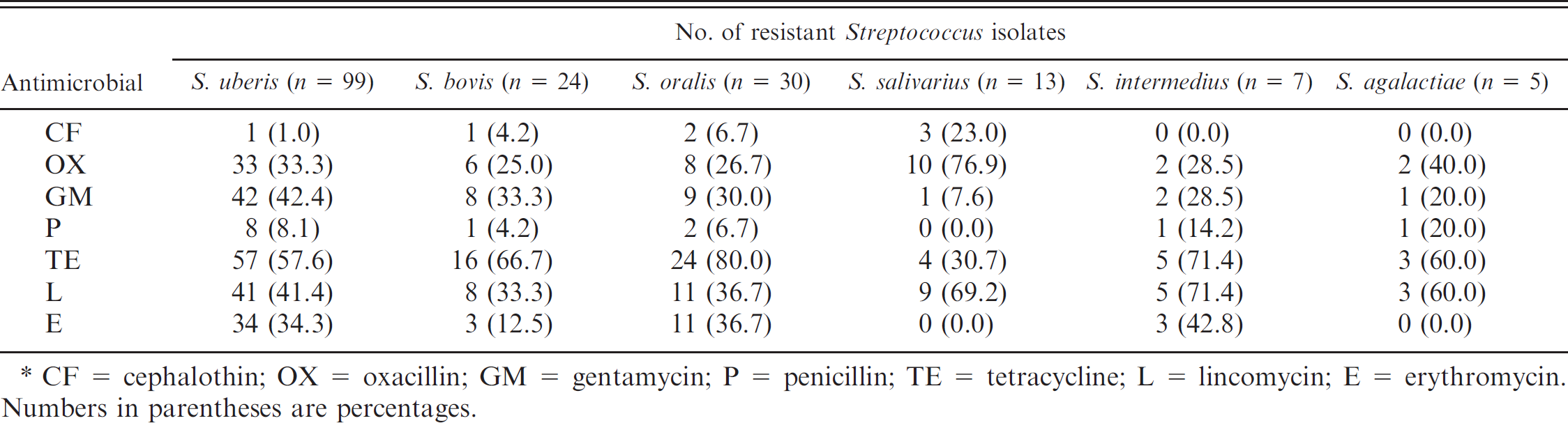
CF = cephalothin; OX = oxacillin; GM = gentamycin; P = penicillin; TE = tetracycline; L = lincomycin; E = erythromycin. Numbers in parentheses are percentages.
Number of isolates resistant to 3 or more antimicrobials and the resistance patterns most frequently observed among the streptococcal isolates by species. *
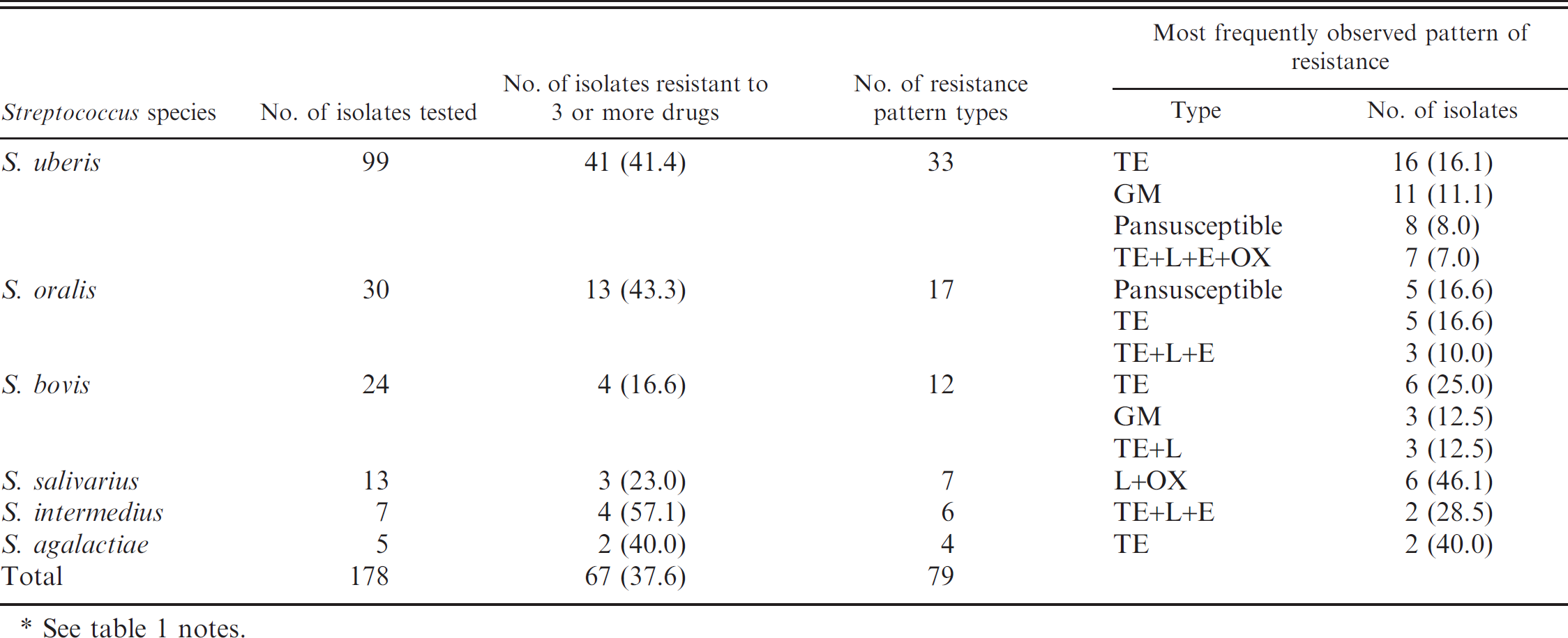
See Table 1 notes.
Table 2 summarizes the number of isolates resistant to more than 3 antimicrobial agents tested and the resistance patterns most frequently observed in each species of Streptococcus. Of the 178 Streptococcus isolates, 37.6% (67/178) were resistant to 3 or more of 7 antimicrobial agents tested in this study. Although a considerable rate of S. intermedius (57.1%) strains showed resistance to 3 or more antimicrobial agents, only 16.6% of S. bovis were resistant to multiple drugs. Meanwhile, S. uberis had a higher proportion of strains exhibiting resistance to 5 or more antimicrobial agents simultaneously than any other species tested in the current study.
The present study shows that more than 90% of Streptococcus species isolated from mastitic bovine milk samples showed resistance to at least 1 of 7 antimicrobial agents tested. All the isolates of S. agalactiae, one of the main pathogens causing mastitis, were resistant to at least 1 of 7 antimicrobial agents tested in this study. Multiple resistances to 3 or more of 7 antimicrobial agents tested were observed in all species. Patterns of antimicrobial resistance differed widely among the individual species, indicating the need for identification of environmental streptococci to the species level for examination of antimicrobial resistance.
Footnotes
a.
KOMED, Seoul, Korea.
b.
bioMérieux, Hazelwood, MO.
c.
BBL, Becton-Dickinson, Cockeysville, MD.