




Abstract
The aims of the current study were to monitor the presence of ochratoxin A (OTA) in the serum of slaughtered swine and to investigate its distribution in 4 major geographical regions of Brazil. A total of 400 samples of serum were collected from 4 major states of Brazil (100 samples each). Ochratoxin A concentrations were determined by high-performance liquid chromatography. In Santa Catarina State, 60% of the samples had OTA concentrations ranging from 4.01 to 75.4 mg/l. In Mato Grosso State, 75% of the samples had OTA concentrations ranging from 0.17 to 46.79 mg/l. Bahia State samples had OTA concentrations ranging from 2.72 to 4.13 mg/l in 36% of the samples, whereas 68% of the samples from Rio de Janeiro State had OTA concentrations ranging from 0.16 to 115 mg/l. Only Santa Catarina State and Rio de Janeiro State had serum samples that exceeded 75 mg/l OTA in 20% and 2% of the samples, respectively. A direct relationship between the higher concentrations of OTA in serum from the States of Santa Catarina and Rio de Janeiro and the highest concentrations of OTA in food intended for animal consumption in the same 2 Brazilian states was found in the present study. Ochratoxin A distribution in foodstuffs is very heterogeneous, and an alternative method by which to monitor the presence of OTA in feed includes analyzing swine serum samples, which reflect the toxin content of the ingested feed. This strategy could prevent the occurrence of ochratoxicosis in animal production, reduce economic losses, and minimize hazards to human health.
Keywords
Mycotoxin contamination of animal feed represents a serious hazard to human and animal health due to the potential transmission of the toxins to meat, milk, and other animal by-products. Ochratoxin A (OTA) is one of the most common and dangerous mycotoxins in foods and feeds. This toxin is naturally produced by the Aspergillus ochraceus, Aspergillus carbonarius, and Aspergillus niger aggregate, mainly in tropical regions, and by Penicillium verrucosum in temperate areas. 16 These fungal species occur worldwide as contaminants of agricultural commodities, especially cereals, but they also may be found in a variety of other food commodities as a result of poor storage or poor agricultural practices during drying procedures. 1,10 Interest in OTA increased when OTA group 2B was classified by the International Agency for Research on Cancer as a possible human carcinogen, based on evidence of carcinogenicity in experimental animal studies. 17 Ochratoxin A has a potent toxicity, and its nephrotoxic, hepatotoxic, teratogenic, carcinogenic, and immunosuppressive effects have been demonstrated in many mammalian species. The use of OTA-contaminated feed during a long rearing period involves serious risk as a result of reduced feed efficiency, with decreased growth and weakening of the immune system. Ochratoxin A has been implicated in several mycotoxicoses in farm livestock in Italy, Israel, 15 Denmark, and Brazil. 2 Under certain circumstances, the concentrations of OTA in porcine blood are of great concern. A previous study 6 demonstrated that the concentration of OTA in blood indicates exposure to this mycotoxin; thus, it might be a useful indicator of ochratoxicosis. It has also been demonstrated that OTA accumulates in blood and edible organs, especially the kidneys. 11,12 Therefore, pork products, especially those that include blood and kidney, are considered to be important sources of OTA in humans. Surveys of swine for OTA in blood and/or edible tissues have been done in several countries, including Denmark, 7 Germany, 9 Hungary (Sandor G, Glavits R, Vajda L, et al.: 1982, Epidemiological study of ochratoxin A associated porcine nephropathy in Hungary. In: Proceedings of the 5th International Union of Pure and Applied Chemistry Symposium, pp. 349–352. Technical University, Vienna, Austria), and Norway. 8
Previous studies in Brazil have determined the mycobiota and OTA contamination from poultry, cow, and pig feeds. 13,14 However, no data are available with regard to monitoring the presence of OTA in the serum of swine in Brazil. The aims of the current study were to monitor the presence of OTA in the serum of slaughtered swine and to investigate its distribution in 4 major geographic regions of Brazil.
Serum samples were collected in collaboration with key members of the veterinary inspection services of the Ministry of Agriculture, Livestock, and Supply (Brasília, Federal District, Brazil). A total of 400 serum samples were collected from 4 states in Brazil (100 samples each) representing 4 major regions, including Santa Catarina (south), Mato Grosso (midwest), Rio de Janeiro (southeast), and Bahia (northeast).
Study animals were obtained from commercial pig farms integrated with large companies and slaughtered in slaughterhouses under the supervision of the Federal Inspection Service. Blood samples from each animal were individually collected. Serum samples were sent by mail to the laboratory and were received at adequate temperature and with no perceived shipping problems.
The analytical procedure used for the detection of OTA was performed following the methods described in a previous study. 3 Briefly, 50 ml of blood was collected by jugular puncture, stored for 12 hr at room temperature, and centrifuged at 3,000 × g for 15 min. Serum (0.8 ml), 0.2 ml 15% trichloroacetic acid, and 1 ml dichloromethane were placed into a 2-ml microtube. The filled microtubes were vortex stirred for 30 sec, left to stand at room temperature for 4–48 hr, and centrifuged at 16,060 × g for 5 min. As a result, 3 layers were formed. The lowest layer (dichloromethane) was carefully removed, placed into a 1.5-ml tube, and reserved (this process was repeated twice). The extracts were allowed to dry under flowing nitrogen. a Chromatography subsequently was performed with a mobile phase of acetonitrile, water, and acetic acid (57:41:2, v/v) and a flow rate of 1 ml/min.
Ochratoxin A concentrations were determined as follows:

where h1 indicates the height (mm) of the OTA peak in the sample; Vf indicates the final volume of the solvent extract (μl); M indicates the mass of OTA contained in the volume of standard injected; Vi indicates the volume of injected sample (μl); Va indicates the initial volume of the sample (ml); and h2 indicates the height (mm) of the standard injected peak. The value of the standard mass (0.0737 mg/ml) was calculated using a spectrophotometer.
The mobile phase was prepared immediately before analysis. Acetonitrile, water, and acetic acid (57:41:2, v/v) were mixed in a laminar flow and homogenized via ultrasound. The flow rate used was 0.5 ml/min. The fluorescence detection was at excitation and fluorescence wavelengths of 330 and 460 nm, respectively. The retention time was about 5 min.
Table 1 presents the concentrations of OTA in porcine serum samples from the 4 major Brazilian states. For Santa Catarina State, 60% of the samples had OTA concentrations ranging from 4.01 to 75.4 mg/l. For Mato Grosso State, 75% of the samples had OTA concentrations ranging from 0.17 to 46.79% mg/l. Serum samples from the State of Bahia had OTA concentrations ranging from 2.72 to 4.13 mg/l in 36% of the samples. Finally, serum samples from Rio de Janeiro State had OTA concentrations ranging from 0.16 to 115 mg/l in 68% of the samples. Only serum samples from Santa Catarina State and Rio de Janeiro State exceeded concentrations of 75 mg/l OTA in 20% and 2% of the samples, respectively.
Among all analyzed serum samples, 165 had OTA concentrations below the detection limit (DL; 41.25%) of the assay; 5 serum samples were between the DL and quantification limit (QL; 1.25%); 33 serum samples were between the QL and 1 mg/l (8.25%); 51 serum samples ranged from 1 to 5 mg/l (12.75%); 98 serum samples ranged from 5 to 25 mg/l (24.5%); 33 serum samples ranged from 25 to 75 mg/l (8.25%); and 15 serum samples (3.75%) had OTA concentrations greater than 75 mg/l.
The State of Santa Catarina is cooler in temperature (mean: 20°C) than the other states studied, which greatly favors the presence of fungi in feed and thus provides the greatest opportunity for mycotoxin production. The greatest number of OTA-positive serum samples was obtained from Santa Catarina. Mato Grosso State had the second highest number of OTA-positive serum samples, but is one of the hottest states of Brazil (mean: ≥26°C). Animal production is high in this state, but the state has inadequate storage infrastructure and an insufficient number of warehouses for proper grain storage. The appearance of fungi and mycotoxins in postharvest grain is an important risk factor for pig feed production. The climate in the State of Bahia is hot (mean: ≥30°C) and humid. However, at the time of sample collection, the weather did not influence the results obtained herein. This could be due to the fact that the grains used as feed were obtained from other states and were adequately stored. The animals slaughtered and sampled from Bahia had the highest number of OTA-negative serum samples, compared with serum samples studied from the other Brazilian states. Thus, there was no indication of risk to humans following the consumption of these animals.
Concentrations of ochratoxin A in pig serum samples obtained from 4 major Brazilian states. *
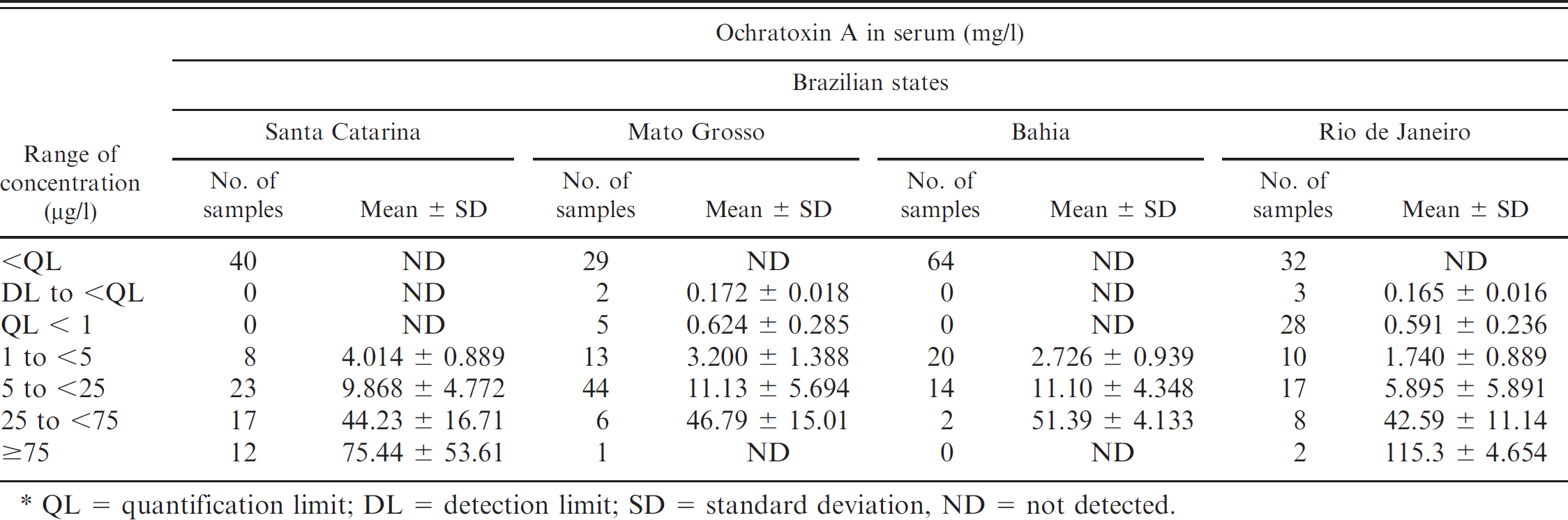
QL = quantification limit; DL = detection limit; SD = standard deviation, ND = not detected.
The State of Rio de Janeiro is a large center for food consumption and is characterized by a very low concentration of livestock. Factors such as lack of financial incentives, lack of official slaughterhouses, small areas for planting grain for animal feed, and the higher costs of production (compared with neighboring states) do not promote major swine production. However, Rio de Janeiro was the state with the highest percentage of OTA-positive serum samples.
The results obtained in the present study reflect the data reported previously by studies of OTA concentrations found in food intended for animal feed in different Brazilian states. According to these studies, samples from Santa Catarina had OTA concentrations ranging from 2 to 101 mg/kg in feed such as rations for pigs, corn flour, and wheat and rice by-products (Santurio JM, Baldissera MA, Almeida CAA, et al.: 1992, Aflatoxinas, ocratoxina A e zearalenona em grãos e rações destinadas ao consumo animal no sul do Brasil. [Aflatoxins, ochratoxin A and zearalenone in grains and feeds for animal consumption in southern Brazil]. In: Encontro Nacional de Micotoxinas [Mycotoxin National Meeting] Proceedings, p. 14. São Paulo, Brazil). 4 A previous study 13 reported OTA concentrations from pig feed in Rio de Janeiro State that varied from 36 to 120 μg/kg. On the other hand, reported 5 concentrations of OTA in maize in the State of Mato Grosso did not exceed 36 μg/kg, whereas in Bahia State there are neither reports of OTA contamination in feed intended for pigs nor related signs in these animals to predict the presence of OTA in feed.
One early work (in collaboration with Brazilian researchers) determined the presence of OTA in pig serum. Of 444 serum samples studied, 32.21% had OTA concentrations above 0.6 μg/l. 11 In a study from Serbia, the rate of contamination by OTA in pig serum was 31% (28/90). In the Serbian study, OTA concentrations ranged from 0.22 to 220.8 ng/ml in positive serum samples, with an average OTA concentration of 3.70 ± 23.59 μg/l. These blood samples were collected from pigs in 3 different regions of the country and showed great variation among them. These studies reported lower concentrations of OTA in serum samples compared to the present study. In the current study, a direct relationship existed between the highest concentrations of OTA in serum from the States of Santa Catarina and Rio de Janeiro, with the highest concentrations of OTA in food intended for animal consumption in the same Brazilian states.
The current study represents the first scientific report on OTA contamination of porcine serum from different Brazilian states. The OTA distribution in foodstuffs is very heterogeneous, and an alternative method to monitor its presence in feed is to analyze swine serum samples, which reflects the toxin content of the ingested feed. This strategy could possibly prevent the occurrence of mycotoxicosis in animal production, reduce economic losses, and minimize hazards to human health.
Acknowledgements
This work was carried out with grants from CAPES-DS and ANPCyT (PICT-CNPq).
Footnotes
a.
White Martins Praxair Technology Inc., Brazil.