



Abstract
A mortality event caused by exposure to the carbamate insecticide methomyl was diagnosed in several hundred pigeons fed treated corn kernels in a city park. A cholinesterase inhibitor insecticide was initially suspected based on clinical signs and a significant inhibition (P < 0.05) of brain cholinesterase (ChE) activity compared with normal values for the species. However, brain ChE activity was within the normal range in birds subsequently submitted in an advanced stage of autolysis. Two groups of 10 healthy pigeons were allocated into a control group and an experimental group, which was offered corn samples retrieved from the incident site. Within minutes of ingesting the contaminated corn, the birds became immobile, had transient wing fluttering, and developed profuse salivation immediately followed by death. Plasma ChE activity at death had declined by more than 95% of preexposure levels (0.04 ± 0.02 vs. 1.56 ± 0.23 μmol/min per milliliter). Brain activity in the sagittal brain sections that were immediately frozen after death was inhibited by ≥50% of control birds (13.5 ± 2.2 vs. 27.5 ± 1.8 μmol/min per gram). However, the sagittal sections left for 1.5 days at ambient temperature of 25°C had normal or higher activity, an effect that was attributed to a combination of spontaneous reactivation and dehydration. After incubation of both plasma and brain homogenates for 1 hr at 37°C, ChE activity recovered by 2- and 1.46-fold, respectively. An organophosphorus and carbamate screen conducted by 2 independent laboratories identified and quantified methomyl in treated kernels at 400 ppm. These results indicate that spontaneous reactivation and dehydration can mask previous reductions in ChE activity.
In October 2008, a mortality incident involving several hundred pigeons (Columba livia f. domestica) occurred in one of the city parks in Medellin, Colombia. The initial submission included 4 fresh pigeons and approximately 1 kg of suspected corn kernels that had been retrieved from the park and that exhibited some green discoloration, particularly around the tip cap area. Upon request, more birds were submitted later in an advanced stage of autolysis. Necropsies did not reveal any gross lesions, but all crops (n = 17 pigeons) were filled with between 2.5 and 18 g of intact tainted corn kernels. Preliminary results of the cholinesterase (ChE) assay showed that brains frozen within 3-4 hr of death had variable but significant (P < 0.05) degrees of inhibition compared with reference values generated in the same laboratory with different Columba spp. (Table 1). Cholinesterase activity in birds with obvious signs of autolysis was within the normal range.
A feeding study was conducted with kernels retrieved from the park. Ten healthy pigeons (C. livia f. domestica) were allocated to one of two groups: 5 pigeons were fasted overnight and then offered corn kernels ad libitum, whereas the other 5 pigeons were euthanized with a combination of ketamine and xylazine and served as concurrent controls. Blood samples (approximately 200 μl) were taken from the cephalic vein before the feeding trial and immediately after death; the samples were drawn into ethylenediamine tetra-acetic acid tubes and centrifuged (10 min at 1,600 × g), and the plasma was then frozen until analyzed. Whole brains were divided into 2 sagittal sections: one half was immediately frozen, and the other half was left at ambient temperature (approximately 25°C) for 1.5 days before freezing. Intact brain and plasma samples were kept frozen at −20°C for 2 weeks before the analysis. Total ChE activity was determined using an adaptation of a method previously described. 1,2 Values were expressed as micro-moles acetylthiocholine iodide hydrolyzed per minute per gram wet weight for brain, and micromoles per minute per milliliter for plasma. To provide information comparable to that reported by other laboratories using the same methodology, brain activity was also determined in Japanese quail (Coturnix japonica), a species with approximately half the normal activity of brain ChE compared with pigeons. Brain levels in 5 decapitated adult male Japanese quail were 14.0 ± 0.9 μmol/min per gram, which is similar to reference values of 15.6 ± 1.1 μmol/min per gram reported by the U.S. Fish and Wildlife Service. 3 The ChE activity of each bird was considered inhibited (diagnostic threshold) if it was more than 2 standard deviations below the arithmetic mean for the control group, 4 and it was considered reactivatable when an activity obtained at 37°C was significantly greater than the value obtained initially, 5 as determined by a one-tailed Student's t-test.
. Mean (standard deviation) brain cholinesterase activity (μmol/min per gram) in unexposed pigeons (control) and pigeons collected from a methomyl-exposure incident, either freshly examined or with signs of autolysis.
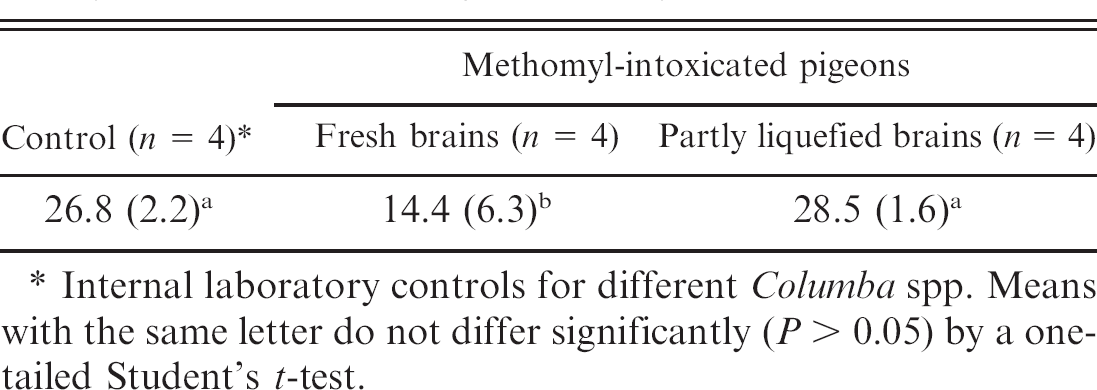
Internal laboratory controls for different Columba spp. Means with the same letter do not differ significantly (P > 0.05) by a one-tailed Student's t-test.
Within minutes of ingesting the contaminated kernels, all 5 pigeons started exhibiting signs of toxicosis that progressed rapidly to death in the next 5–10 min. Signs commenced with eye blinking and were rapidly followed by a motionless recumbent position with outstretched wings, extended necks, and final profuse salivation before death. Occasional transient wing fluttering was also seen in 3 pigeons.
Brain ChE activities of the sagittal sections that were immediately frozen were depressed to 41.1–56.7% of control birds, whereas the sections left at ambient temperature (approximately 25°C) for 1.5 days either were within the normal range or elevated above control levels (Table 2). When brain homogenates were incubated 1 hr at 37°C and retested for ChE activity, a statistically significant (P < 0.05) increase of activity from 13.1 to 19.3 μmol/min per gram was observed; however, the activity regained at 1 hr after incubation remained constant despite further incubation for 2, 18, 25, and 44 hr at 37°C (data not shown).
Typically, a brain ChE depression of >50% has been generally believed to be indicative of death from acute exposure to a ChE inhibitor. 4,6,10 Although such a degree of inhibition may be considered suitable for diagnostic purposes, in the current case, the interpretation of ChE values from specimens collected during the initial outbreak was confounded by a wide variation in the degree of depression between birds, as well as the fact that decomposing birds had normal ChE activity. Among various confounding factors, postmortem reactivation of ChE activity is known to occur with exposure to carbamate insecticides, and it has been described for birds exposed to carbofuran and aldicarb. 5,6,9,11 The results of the current investigation (Table 2) showed that the ChE activity in the sagittal brain sections that were left at ambient temperature for 1.5 days exhibited a normal activity compared with their freshly sampled counterparts. This observation substantiates the fact that spontaneous reactivation of ChE had occurred in the initial outbreak. Nonetheless, the sagittal sections left at room temperature for 1.5 days had lost approximately 50–70% of their initial water content and were not liquefied, as would be expected under field situations. The dehydration process probably accounted for the abnormally high ChE activity, above normal controls, that was observed in some brains, particularly in light of the fact that their activity still rose by approximately 30% after 1 hr of incubation at 37°C.
. Brain and plasma cholinesterase activities in pigeons fed with methomyl-contaminated corn kernels. *
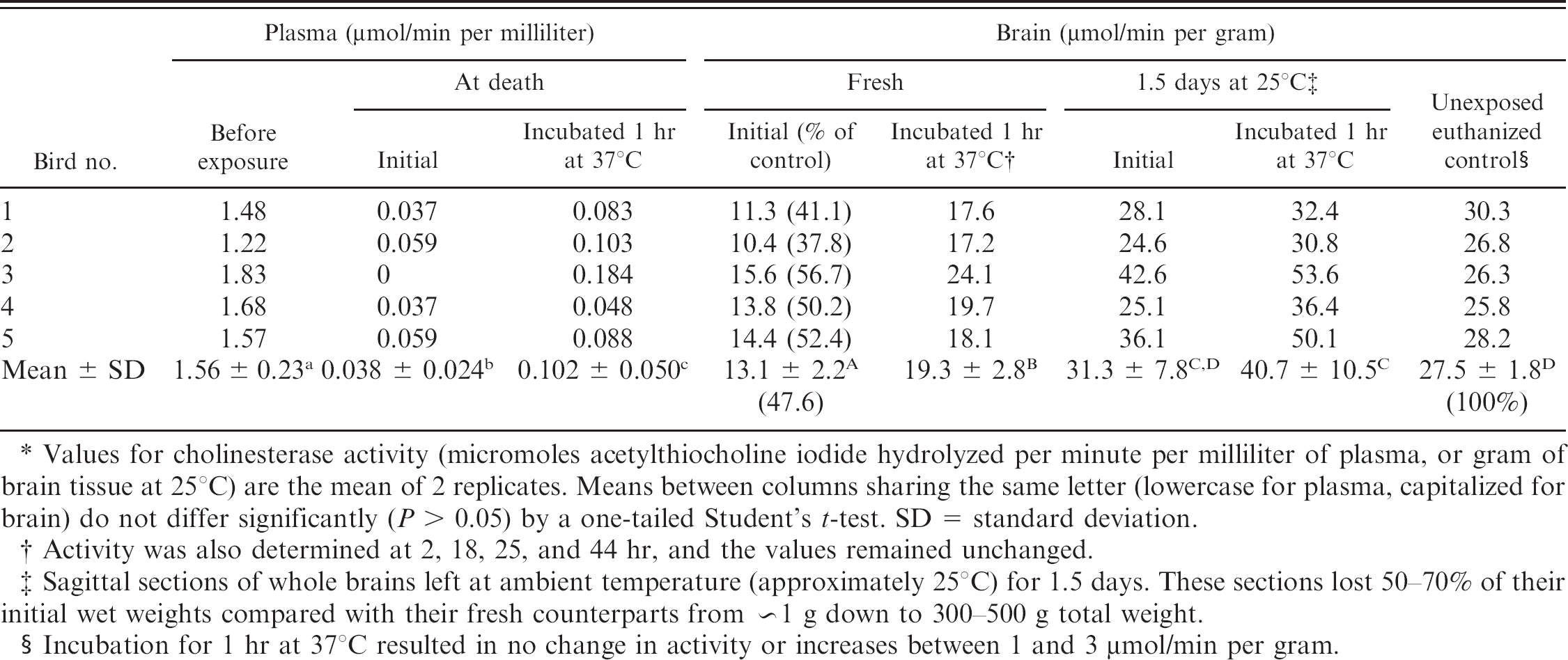
Values for cholinesterase activity (micromoles acetylthiocholine iodide hydrolyzed per minute per milliliter of plasma, or gram of brain tissue at 25°C) are the mean of 2 replicates. Means between columns sharing the same letter (lowercase for plasma, capitalized for brain) do not differ significantly (P > 0.05) by a one-tailed Student's t-test. SD = standard deviation.
Activity was also determined at 2, 18, 25, and 44 hr, and the values remained unchanged.
Sagittal sections of whole brains left at ambient temperature (approximately 25°C) for 1.5 days. These sections lost 50–70% of their initial wet weights compared with their fresh counterparts from ∼1 g down to 300–500 g total weight.
Incubation for 1 hr at 37°C resulted in no change in activity or increases between 1 and 3 μmol/min per gram.
Because ChE inhibition followed by thermal reactivation has also been used to discriminate between reversible carbamate and nonreversible organophosphorus insecti-cides, 9 the initial ChE activity was compared to that following incubation at 37°C. Furthermore, because different induced reactivation patterns have also been documented to occur depending on the type of carbamate and bird species involved, 5 the ChE activity was assessed throughout a 48-hr incubation period to characterize the progression of reactivation. The results of the feeding trial (Table 2) showed an approximately 1.5-fold increase in brain ChE activity from 13.1 to 19.3 μmol/min per gram, reaching 70% of normal control levels. This reactivation is much lower than that observed for carbofuran-exposed free-ranging birds, in which the activity of an initially inhibited sample was shown to rise to normal levels or at least levels equal to the diagnostic threshold after incubation. 9 The 1-hr incubation was sufficient time to ensure adequate reactivation, because no further increase in activity was observed beyond that time for 48 hr. Again, this contrasts with reports of carbofuran exposures, in which a 16–18-hr incubation period was chosen to ensure full expression of the reactivation process. 9
Several studies have also measured brain and plasma ChE activities simultaneously in birds exposed to ChE inhibitors. 3,6,7 Although a weak relationship prevents making predictions of brain ChE from plasma activities and vice-versa, it appears that plasma ChE is much more sensitive and may decrease by as much as 75% before brain activity declines by 10–20%. 3,6 This was supported by the present investigation, in which plasma ChE was almost absent at the time of death when brain activities were depressed by about 50% of controls (Table 2). However, other studies have shown that when birds are challenged to sublethal dosages for prolonged exposures, brain depression can be greater than that observed for plasma. In a study that exposed white-winged doves (Zenaida asiatica) to nonlethal concentrations of methyl parathion for 5 days, it was demonstrated that prolonged exposures may cause a depression of brain ChE greater than 60% of normal controls in apparently healthy birds, with plasma ChE activity being much less inhibited in comparison with normal controls. 7 As previously observed with brain homogenates, thermal reactivation of plasma supported a carbamate exposure. When whole plasma was incubated, a 2.5-fold increase in activity occurred.
An organophosphorus and carbamate screen of the corn kernels retrieved from the incident site was carried out by 2 independent laboratories. The Toxicology Laboratory Unit at the University of Murcia (Murcia, Spain) initially identified methomyl by gas chromatography–mass spec-trometry. The Iowa State University Veterinary Diagnostic Laboratory (Ames, IA) identified and quantified methomyl and malathion at 400 ppm and 1 ppm, respectively. Because the detection and confirmation of methomyl approached, and in some pigeons exceeded, the median lethal dose (10–20 mg/kg) for the compound in other bird species, 8 it provides further evidence of a lethal exposure to methomyl. Although methomyl is one of the favored insecticides used to prevent fall armyworm infestations in sweet corn, it is not registered for use directly on corn seeds; unfortunately, the origin of the compound in this incident was never found.
In conclusion, the current study may assist the interpretation of ChE activities from a carbamate insecticide exposure in various ways. Dehydration of brain tissue can falsely elevate ChE activity and potentially mask an inhibited ChE activity; this effect was substantiated by reactivation of an otherwise apparently normal activity. From a practical standpoint, it suggests that incubation of brain homogenates may be warranted, even when the initial ChE values are within the normal range for the species. The total absence of plasma ChE activity to a lethal acute exposure by methomyl makes it a more sensitive parameter than brain ChE, which showed a greater variation between individuals in both the initial and reactivated samples. In addition, birds with advanced postmortem autolysis did not show declines in brain ChE activities, supporting previous reports on the stability of the enzyme after death.
Acknowledgements. Thanks to Dr. Stewart Rhind, Dr. Gary Osweiler, and two anonymous reviewers for their helpful insights while working on this case and writing the manuscript.