




Abstract
A latex agglutination test (LAT) for detecting antibody against Bluetongue virus (BTV) in ruminants was developed using latex beads coupled with recombinant VP7 protein. Compared with competitive enzyme-linked immunosorbent assay (ELISA), the specificity and sensitivity of the LAT were 99.0% and 93.0%, respectively. There was excellent agreement between the results obtained by competitive ELISA and the LAT (kappa = 0.930). Because it is rapid and easy to use, the LAT could be used for BTV antibody detection, especially for screening many serum samples.
Bluetongue virus (BTV), the prototype virus of the genus Orbivirus in the family Reoviridae, 12 is an arthropod-borne virus that infects both domestic and wild ruminants, causing a noncontagious infectious disease or bluetongue (BLU), which has been reported in every continent except Antarctica. 5,14 At present, 24 serotypes of BTV have been characterized. 12
All ruminant species can be infected with BTV, but improved breeds of sheep and some species of deer tend to develop particularly severe clinical signs of disease with mortality about 50%–70% in infected sheep flocks. 6,8 In addition to morbidity and mortality, BLU disrupts the international trade in animals and animal products because countries free of BTV infection frequently restrict the importation of ruminants and their genetic products from BTV-endemic areas. 12
Bluetongue virus is a double-stranded RNA (dsRNA) virus and its genome consists of 10 dsRNA segments that encode 4 nonstructural proteins (NS1–NS3, and NS3a) and 7 structural proteins (VP1–VP7). 4 Among the 7 structural proteins, VP7 has been identified as the group-specific antigen of BTVs by different immunoassays. 2,13 The VP7 protein was the antigen used for developing group-specific immunoassays, such as competitive enzyme-linked immunosorbent assay (ELISA), which is more specific and sensitive than the agar gel immunodiffusion (AGID) test based on whole virus antigen. 1,7,10,11
In the current study, a latex agglutination test (LAT), based on latex beads coupled with recombinant VP7 protein, was established for BTV antibody detection in serum samples. The LAT yielded higher sensitivity than that of AGID based on whole BTV antigen, and the specificity and sensitivity of the LAT were comparable with that of a commercial competitive ELISA. Because it is rapid and easy to use, the LAT is suitable for detecting anti-BTV antibody at the farm.
The VP7 gene fragment, amplified by reverse transcription polymerase chain reaction (RT-PCR) from total RNA of BTV serotype 1, was cloned into pBAD/Thio plasmid
a
to form the recombinant expression vector pBAD/Thio BTV VP7. The VP7 protein was expressed in Escherichia coli LMG194 cells induced by
Purified recombinant VP7 protein was coupled to carboxylated latex particles (polystyrene microspheres) d of 0.8 μm in diameter according to the manufacturer's instruction. Briefly, 0.5 ml of a 2.5% (wt/vol) suspension of the particles was washed 3 times in 50 mM borate buffer (pH 8.5). After the final wash, the microspheres were resuspended in 0.5 ml of 50 mM borate buffer (pH 8.5). Three hundred micrograms of purified recombinant VP7 protein was added and the mixture was incubated overnight at room temperature (20–25°C) with gentle end-to-end mixing. The mixture was centrifuged for 10 min at 10,000 × g and the supernatant was removed. The pellet was resuspended in 50 mM phosphate buffered saline (PBS; pH 7.2) containing 1% bovine serum albumin (BSA) fraction V e and incubated for 30 min at room temperature (20–25°C) with gentle mixing. After washing 3 times in 50 mM PBS (pH 7.4), the sensitized latex particles (SLPs) were resuspended in 1 ml of storage buffer (50 mM PBS, pH 7.4, containing 1% BSA, 0.1% NaN3, and 5% glycerol) and stored at 4°C until required. Latex agglutination tests were performed by mixing 20 μl of SLPs with 10 μl of serum sample on a black-coated glass slide. The slide was then rotated manually for 30 sec. The results can be scored as ++++ (rapid agglutination of 100% SLPs), +++ (agglutination of 75% of SLPs), ++ (agglutination of approximately 50% of SLPs), + (agglutination of 25% of SLPs), and – (no visible agglutination). The sample is considered positive if agglutination of 25% SLPs occurred within 5 min. A sample should be retested by standard immunoassay recommend by The World Organization for Animal Health, such as competitive ELISA, if agglutination is less than 25% SLPs.
Results of positive sera against Bluetongue virus (BTV) and against related virus tested by latex agglutination test (LAT) and competitive enzyme-linked immunosorbent assay (cELISA). *
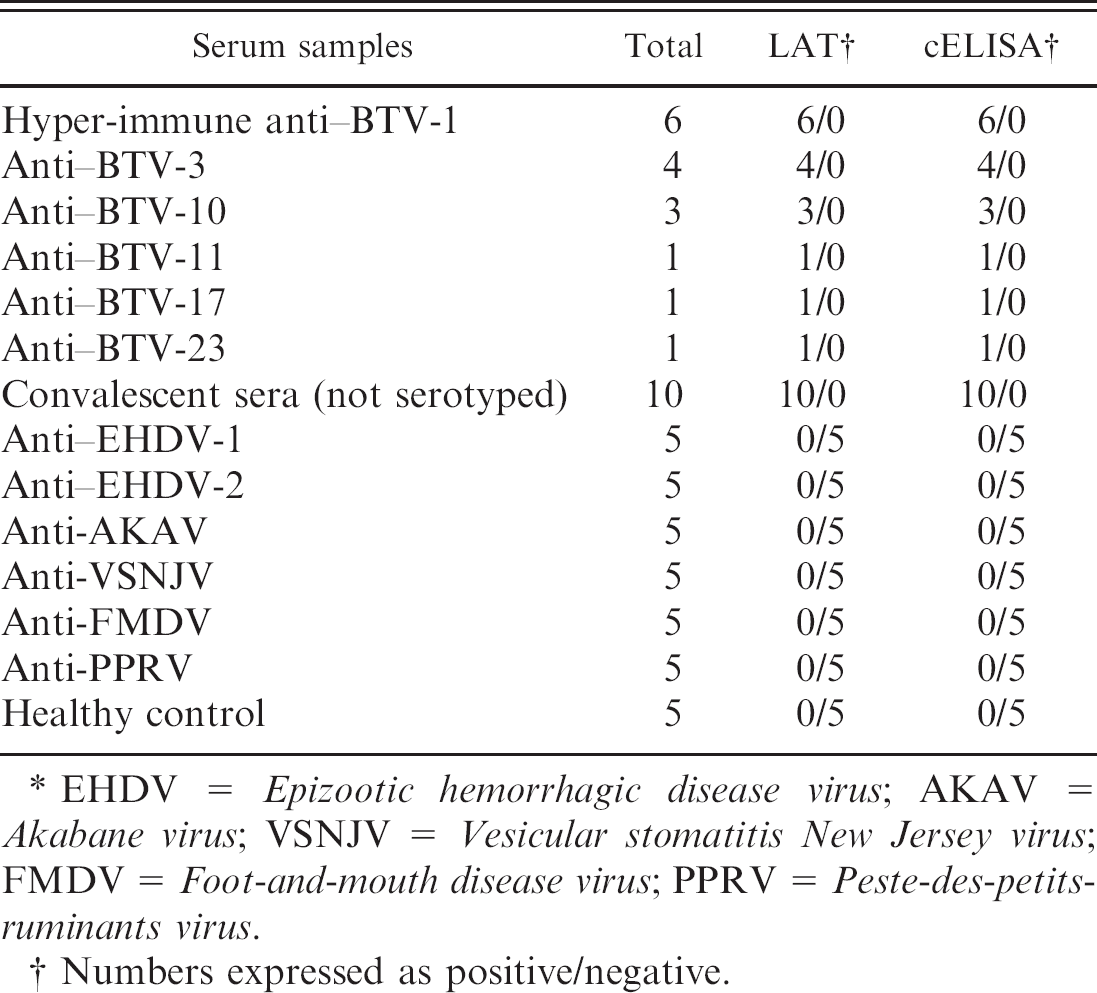
EHDV = Epizootic hemorrhagic disease virus; AKAV = Akabane virus; VSNJV = Vesicular stomatitis New Jersey virus; FMDV = Foot-and-mouth disease virus; PPRV = Peste-des-petits-ruminants virus.
Numbers expressed as positive/negative.
To evaluate the specificity of the LAT, the LAT was used to test 30 serum samples against other viruses (Epizootic hemorrhagic disease virus, Akabane virus, Vesicular stomatitis New Jersey virus, Foot-and-mouth disease virus, and Peste-des-petits-ruminants virus) in addition to BTV and 5 serum samples taken from healthy sheep, a commercial competitive ELISA f was used as a reference method, and the results showed that LAT and competitive ELISA had no cross-reaction with these sera (Table 1). These data indicated that the LAT had good specificity. The LAT was also used to analyze 10 convalescent sera collected from sheep recovered from BTV infection (not serotyped), 6 hyperimmune anti–BTV-1 sera, and 10 positive sera against other serotypes of BTV including serotype 3, 10, 11, 17, and 23; a commercial competitive ELISA f was used as a reference method. All samples tested were positive by both LAT and competitive ELISA (Table 1), suggesting that there was a perfect agreement between the two assays (kappa = 1; data not shown). In the current study, only positive sera against BTV serotype 1, 3, 10, 11, 17, and 23 were tested by LAT and all gave sera-positive results. Because VP7 protein is the group-specific antigen of BTV, theoretically this LAT can be used for detection of sera against all 24 serotypes of BTV.
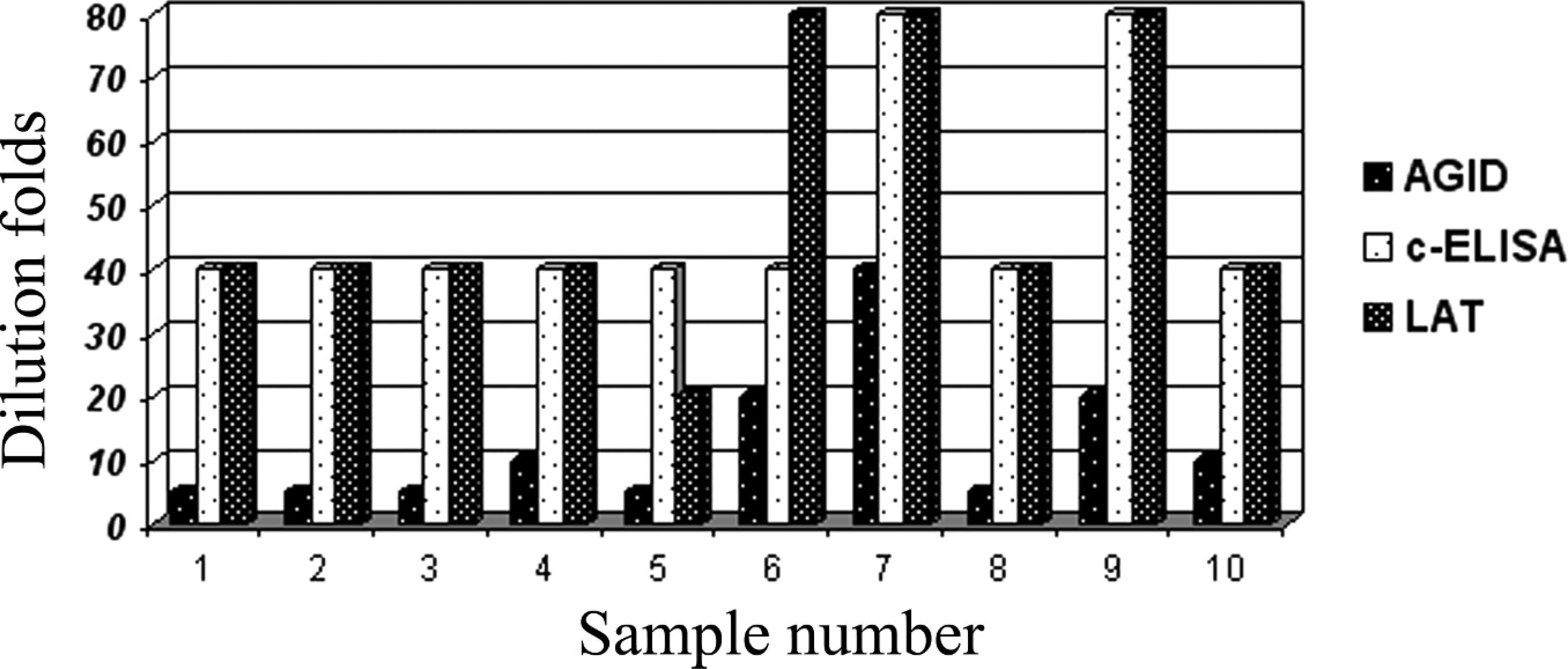
Comparison of detection limit of latex agglutination test (LAT), competitive enzyme-linked immunosorbent assay (cELISA), and agar gel immunodiffusion (AGID). Sera were 2-fold diluted from 1:5 to 1:80.
To evaluate the analytical sensitivity compared with the reference methods including AGID and competitive ELISA, 10 hyperimmune anti–BTV-1 sera were serially 2fold diluted in PBS (1:5–1:80) and tested by LAT, AGID, and competitive ELISA in triplicate. The results showed that antibody titers tested by LAT were 1–3-folds higher than those obtained by AGID (Fig. 1), suggesting that the sensitivity of the LAT is higher than that of AGID. Compared with competitive ELISA, the LAT gave 8 sera the same antibody titers, but gave one serum 1-fold higher (sample no. 6) and one serum 1-fold lower antibody titer (sample no. 5; Fig. 1). These data suggested that the analytical sensitivity of the LAT was comparable with that of competitive ELISA.
Results of antibody detection in clinical samples using latex agglutination test (LAT) and competitive enzyme-linked immunosorbent assay (cELISA). *
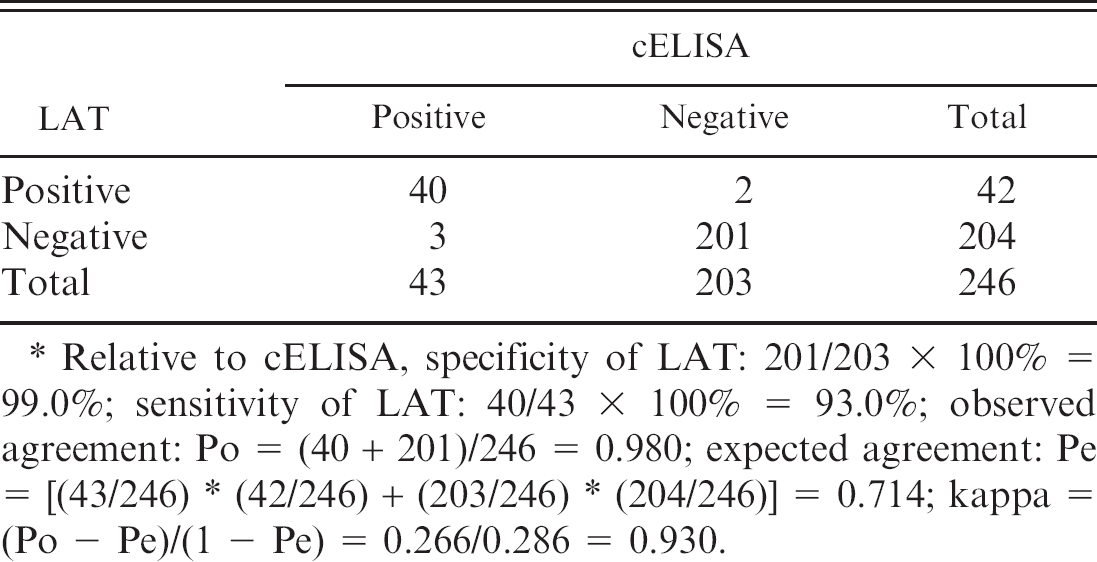
Relative to cELISA, specificity of LAT: 201/203 × 100% = 99.0%; sensitivity of LAT: 40/43 × 100% = 93.0%; observed agreement: Po = (40 + 201)/246 = 0.980; expected agreement: Pe = [(43/246) * (42/246) + (203/246) (204/246)] = 0.714; kappa = (Po — Pe)/(1 — Pe) = 0.266/0.286 = 0.930.
To evaluate the relative sensitivity and specificity of LAT, and the agreement ratio between LAT and the reference method, a total of 246 clinical sera samples taken from sheep were tested simultaneously using LAT and competitive ELISA. The sensitivity and specificity of LAT was calculated as described previously. 16 Of these samples, 42 were antibody positive and 204 were negative by LAT, whereas 43 were positive and 203 were negative by competitive ELISA. In addition, 40 were positive in both assays and 201 were negative in both tests. Thus, the specificity and sensitivity of LAT, compared with competitive ELISA, was 99.0% and 93.0%, respectively. There was an excellent agreement (kappa = 0.930) between the LAT and competitive ELISA (Table 2).
Although some immunoassays, such as competitive ELISA and AGID, have been developed for detecting anti-BTV antibody, these methods are not suitable for rapid detection of antibody against BTV in the field because AGID is time and labor consuming (24–48 hr) to give a result and competitive ELISA needs equipment such as a microplate reader and a refrigerator. In contrast, the LAT, which has been proved to be a very useful test for detection of antibodies or antigens of various patho-gens, 3,15 is simple to use and does not require special equipment. Furthermore, the LAT is suitable for rapid antibody detection as it can give a result within 10 min. The LAT developed in this study had good specificity and sensitivity and the kappa statistics showed excellent agreement between the results tested by LAT and competitive ELISA. In this context, the LAT can be used as a tool for seroepidemiological survey of sheep, goat, cattle, and other susceptible animals from different areas in China, especially for screening many sera samples.
Acknowledgements. This study is supported by National 863 Program (2006AA10Z445) and China Postdoctoral Science Foundation (20080430855).
Footnotes
a.
Invitrogen Corp., Carlsbad, CA.
b.
Pierce Inc., Rockford, IL.
c.
Beckman Coulter Inc., Fullerton, CA.
d.
Polysciences Inc., Warrington, PA.
e.
Shanghai Sangon Biological Engineering Technology & Services Co. Ltd., Shanghai, China.
f.
VMRD Inc., Pullman, WA.