




Abstract
Esophageal squamous cell carcinoma is a commonly malignant tumor of digestive tract with poor prognosis. Previous studies suggested that forkhead box F2 (FOXF2) could be a candidate gene for assessing and predicting the prognosis of human cancers. However, the relationship between FOXF2 promoter methylation and the prognosis of esophageal squamous cell carcinoma remained unclear. Formalin-fixed, paraffin-embedded esophageal squamous cell carcinoma tissues of 135 esophageal squamous cell carcinoma patients were detected for FOXF2 promoter methylation status by methylation-specific polymerase chain reaction approach. DNA methylation results were evaluated with regard to clinicopathological features and overall survival. Our study confirmed that FOXF2 promoter hypermethylation could independently predict a poorer overall survival of esophageal squamous cell carcinoma patients (p = 0.002), which was consistent with the data mining results of the data from 82 esophageal squamous cell carcinoma patients in The Cancer Genome Atlas datasets (p = 0.036). In addition, no correlation was found between FOXF2 promoter methylation and other clinic pathological parameters (age, gender, differentiation, lymph node metastasis, stage, cutting edge, vascular invasion, smoking behavior, and drinking history). In conclusion, FOXF2 methylation might be a useful prognostic biomarker for esophageal squamous cell carcinoma patients.
Keywords
Introduction
Esophageal cancer ranks the third lethal cancer among males and the fifth deadly malignance among females in China. 1 Esophageal squamous cell carcinoma (ESCC) is the main histological subtype of esophageal cancer. 2 Epidemiologic data from American Cancer Society have revealed that the most influential factors contributing to ESCC are poor nutritional status, fallacious dietary habit, and human papillomavirus (HPV) infection. 3 In spite of many advanced diagnosis and treatments, the overall 5-year survival rate is generally low. 4 Therefore, precise prediction on molecular level is needed for individual diagnosis and therapy.
Accumulating studies have revealed that epigenetic regulations of important biological processes are related to esophagus tumorigenesis.5–7 Aberrant methylation in the promoter cytosine-phosphate-guanine (CpG) island may lead to the loss of gene expression and further functional dysregulation. 8 DNA methylation biomarkers provide a range of applications in early detection, diagnosis, and prognosis of cancers. 9 Two aberrant methylated genes (DAPK and APE) in peripheral blood were found to be associated with the prognosis of esophageal carcinoma. 10 Moreover, RASSF5A 11 and RASSF2 12 hypermethylation along with low protein expression were found to predict poor outcomes of ESCC patients.
As a member of Fox family of transcription factors, forkhead box F2 (FOXF2) plays an important role in the regulation of cell growth and differentiation as well as tissue development. 13 Decreased FOXF2 expression could be observed in prostate cancer 14 and hepatocellular carcinoma. 15 In addition, the loss of FOXF2 transcription indicated poor prognosis for breast cancer 16 and ESCC. 17 FOXF2 promoter methylation was involved in the regulatory mechanism of the subtype-specific expression of FOXF2 in breast cancer cells. 18 However, little is known about the correlation between FOXF2 methylation and prognosis in esophageal cancer. In this study, we investigated the FOXF2 promoter methylation in ESCC patients, and then we assessed the association between FOXF2 promoter methylation and ESCC outcome after resection.
Materials and methods
Samples
Formalin-fixed, paraffin-embedded (FFPE) tissues were collected from 135 ESCC patients in Shaoxing People’s Hospital, China. All the patients were diagnosed according to the tumor-node-metastasis (TNM) staging system of the Union for International Cancer Control (UICC)/American Joint Committee on Cancer (AJCC), seventh edition. 19 Hematoxylin and eosin–stained pathological sections were used to categorize differentiation levels in the ESCC samples (Supplemental Figure 1). There were 39 well-differentiated cases, 53 moderately differentiated cases, and 43 poorly differentiated cases. Other clinical characteristics (age, gender, lymph node metastasis, cutting edge, vascular invasion, smoking behavior, and drinking history) were also provided by Shaoxing People’s Hospital. Considering the effects of preoperative chemoradiotherapy on DNA methylation level, 20 patients without preoperative chemoradiotherapy were recruited in our study. All the patients underwent radical resection of esophageal cancer during surgery. Overall survival (OS) refers to the data from the date of primary surgery to the date of death or the date of last follow-up. The study was approved by the bioethics committee in Shaoxing People’s Hospital. All the participants signed the informed consent forms.
The Cancer Genome Atlas dataset
DNA methylation profiles (Illumina Human Methylation 450K) and individual OS data of 82 ESCC patients were downloaded from The Cancer Genome Atlas (TCGA) website (https://cancergenome.nih.gov/) to validate the prognostic role of FOXF2 promoter methylation in ESCC. The details of clinical information, including age, gender, differentiation, and stage, were extracted for Cox analysis in TCGA cohort (Supplemental Table 1).
DNA extraction, bisulfite conversion, and methylation-specific polymerase chain reaction
E.Z.N.A.™ FFPE Tissue Kit (Omega Bio-Tek, Norcross, GA, USA) was used to isolate DNA according to the manufacturer’s instruction. DNA concentrations were measured by Nanodrop2000 spectrophotometer (Thermal Scientific Co. Ltd, Wilmington, DE, USA). EZ DNA Methylation-Gold Kit™ (Zymo Research, Orange, CA, USA) was used to convert unmethylated cytosines into uracils correspondingly, while the methylated cytosines remain in the reaction. The details of methylation-specific polymerase chain reaction (MSP) were described previously. 21 The primer sequences of the reaction were 5′-TTTATAGAATATTAATTGGGGTGCG-3′ for the methylated forward primer, 5′-ATTACAAACCGCTAACGATCGTA-3′ for the methylated reverse primer, 5′-ATAGAATATTAATTGGGGTGTGG-3′ for the un-methylated forward primer, and 5′-AAAATTACAAACCACTAACAATCATA-3′ for the unmethylated reverse primer. Cycling conditions comprised initial denaturation at 95°C for 10 min, followed by 35 cycles of 30 s denaturation at 95°C, 45 s annealing at 50°C/55°C for methylated/unmethylated primers, and 60 s extension at 72°C. PCR products were subjected to the Qsep100 DNA fragment analyzer (Bioptic, Taiwan, China). The pen-shaped gel-electrophoresis cartridge could perform 200 tests at 4 min per sample run. Multiple objective straps were visualized in Gel-view format. Subsequently, some MSP products’ sequences were verified by Applied Biosystems® 3730 DNA Analyzer (Applied Biosystems, Warrington, UK).
Statistical analysis
Chi-square test or Fisher’s exact test was used to evaluate the correlation between FOXF2 methylation status and clinical characteristics. For 2 × 2 table, if the expected frequency of each cell is more than 5, and total number n ⩾40, Pearson’s chi-square test should be chosen; otherwise, Fisher’s exact test should be used. Kaplan–Meier curves were used to assess the median OS of FOXF2 methylation in our cohort. Log-rank test was performed to compare the survival curves in univariate analysis. Potentially important factors (univariate p < 0.05) were included in multivariate analyses, including age, differentiation, lymph node metastasis, TNM stage, drinking history, vascular invasion, and FOXF2 methylation. Cox proportional hazard models were fitted to calculate the hazard ratios (HRs) and the corresponding 95% confidence intervals (CIs). All the data were analyzed with SPSS 18.0 software (SPSS Inc., Chicago, IL, USA). A two-tailed p <0.05 was defined as significant.
Results
In this study, we recruited 135 Chinese ESCC patients to investigate the role of FOXF2 promoter methylation in ESCC. The genomic region and sequences of primers and two mapped CpG probes (cg03848675 and cg06005891) in Illumina Human Methylation 450K were shown using the UCSC Genome Browser (http://genome.ucsc.edu/cgi-bin/hgGateway; Figure 1(a)). Using the MSP method, both methylated and unmethylated MSP primers could yield 174-bp fragments. Meanwhile, Sanger sequencing showed that the amplified fragments matched the target sequences (Figure 1(b)). As a result, there were 42 patients with FOXF2 methylation and 93 patients with FOXF2 unmethylation. Subsequently, we examined the correlation between FOXF2 methylation status and the clinicopathological features of ESCC. However, no statistically significant correlation was found with age, gender, differentiation, lymph node metastasis, stage, cutting edge, vascular invasion, smoking behavior, and drinking history (Table 1).

Target sequences on FOXF2 promoter region. (a) Genomic positions of MSP primers and two available CpG probes (cg03848675 and cg06005891) in Illumina Human Methylation 450K. Transcription track shows RNA-seq data for nine cell lines (GM12878, H1-hESC, HeLa-S3, HepG2, HSMM, HUVEC, K562, NHEK, and NHLF). Layered H3K4Me1, H3K4Me3, and H3K27Ac tracks show ENCODE ChIP-seq data for seven cell lines (GM12878, H1-hESC, HSMM, HUVEC, K562, NHEK, and NHLF). F represents forward primer. R represents reverse primer. (b) Representative sequences and electrophoresis of two MSP products. Left panel (M, U) represents the methylated product (174 bp) and the unmethylated product (174 bp). The top row of the sequence represents the original sequence of the gene, and the second row shows the converted sequences. Right panels (Sample 1 and Sample 2) are two representative results for the methylated FOXF2 and the unmethylated FOXF2.
Association of FOXF2 promoter methylation with clinical characteristics in ESCC patients.

p-Value was calculated by Fisher’s exact test; otherwise it was calculated by chi-square test.
Kaplan–Meier analysis and log-rank test confirmed that ESCC patients with methylated FOXF2 promoter had a poorer OS than those with unmethylated FOXF2 promoter (p = 0.005, Figure 2(a)). In univariate analysis, the statistically significant OS predictors for ESCC patients were age (p = 0.013), differentiation (p = 0.006), lymph node metastasis (p = 0.030), disease stage (p = 0.019), vascular invasion (p = 0.002), and patients with drinking history (p = 0.036). Therefore, potentially important factors in univariate analyses were included in multivariate analyses. Cox proportional hazard model analysis showed that FOXF2 promoter methylation was an independent predictive biomarker of the OS of ESCC patients (HR = 2.385, 95% CI = 1.360–4.182, p = 0.002, Table 2 and Figure 2(b)).
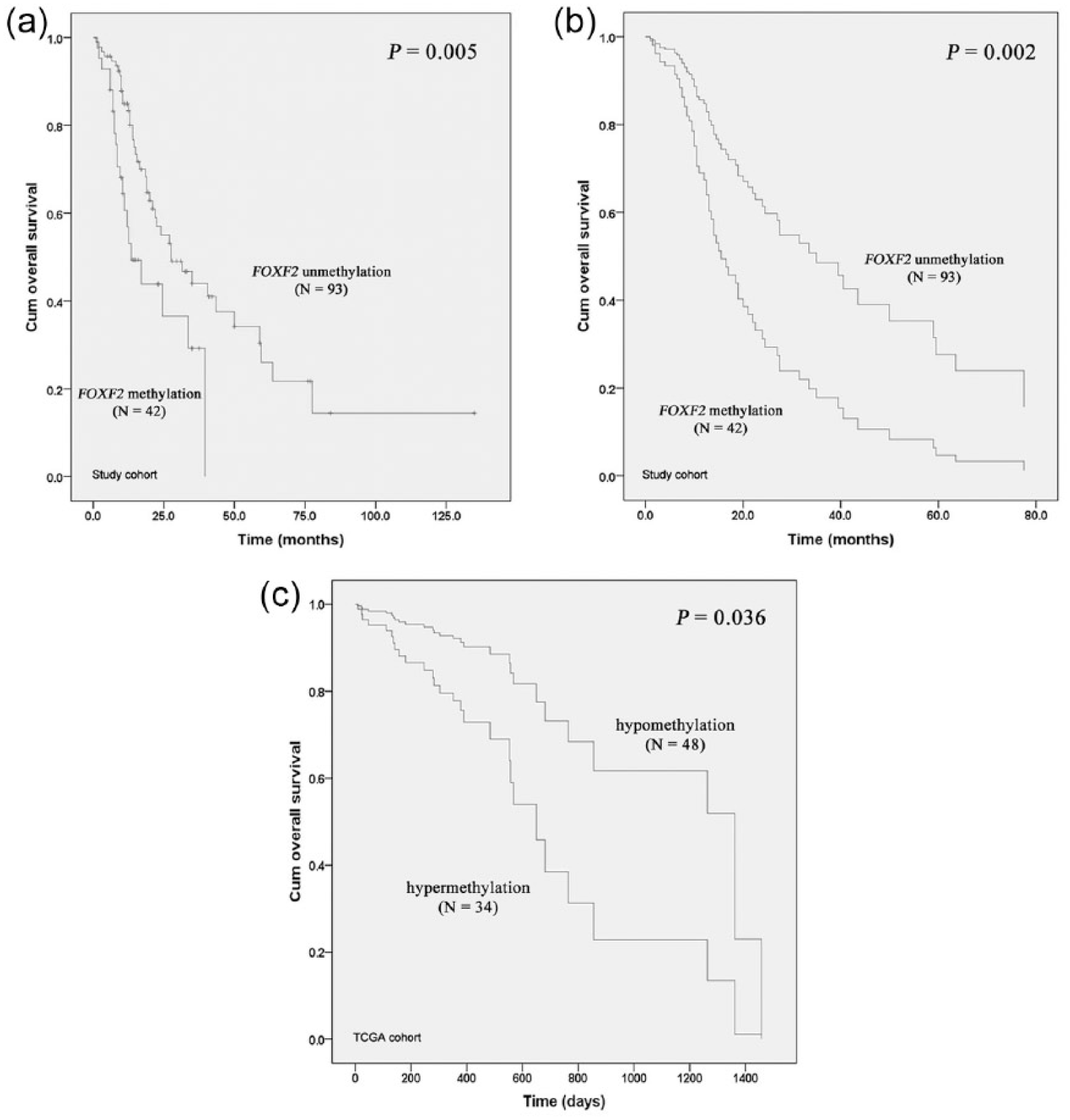
The relationship between FOXF2 promoter methylation and OS in ESCC patients: (a) prognostic role of FOXF2 promoter methylation from study cohort is shown in a Kaplan–Meier survival curve, (b) prognostic role of FOXF2 promoter methylation from study cohort is shown in a Cox proportional hazard model, and (c) prognostic role of two CpG sites’ (cg03848675 and cg06005891) methylation levels from TCGA dataset is shown in a Cox proportional hazard model. The cut-off value is the mean methylation level.
Survival analysis of 135 ESCC patients with different FOXF2 promoter methylation.

OS: overall survival; HR: hazard ratio; CI: confidence interval; NA: not applicable; FOXF2: forkhead box F2.
Potentially important factors in univariate analyses (p < 0.05) were included in multivariate analyses.
To investigate whether FOXF2 promoter methylation could be a prognostic biomarker in other populations, we collected 82 ESCC patients from the TCGA data portal for validation. There were 15.9% Brazilians, 6.1% Canadians, 13.4% Russians, 6.1% Ukrainians, 15.6% Americans, and 42.7% Vietnamese among 82 ESCC patients. There two available Illumina Human Methylation 450K CpG probes (cg03848675 and cg06005891) were located in the current amplification fragment (chr6:1,388,999–1,389,172) to represent the methylation level of FOXF2. High correlation was observed between methylation levels of these two CpG sites (r = 0.729, p < 0.001, data not shown), thus we used average methylation of these two CpG sites for the further analysis. Since age, gender, cancer differentiation, and stage were important in human cancers including ESCC,1,22,23 we extracted the corresponding information from TCGA datasets and performed subsequent Cox regression analysis in TCGA cohort. Our analyses of TCGA data confirmed that hypermethylated FOXF2 promoter could independently predict poorer OS of ESCC patients (p = 0.036, HR = 3.061, 95% CI = 1.075–8.720; Figure 2(c) and Supplemental Table 1).
Discussion
In this study, our results showed that FOXF2 promoter methylation was significantly associated with poorer OS, and it could be a potential clinical marker to predict the OS of ESCC patients.
Prognosis in esophageal cancer greatly depends on local invasion as well as spreads to regional and distant structures within the body. 24 The 5′-aza-deoxycytidine (5′-AZA) demethylation treatment was shown to inhibit the proliferation, 25 invasiveness, and migration 26 and induce the cell apoptosis 27 in esophageal cancer cells. Illumina HumanHT-12 V4.0 expression beadchip (accession number GSE57130) showed an increased expression level of FOXF2 in esophageal squamous cancer cell OE21 after 5′-AZA treatment; however, no significant difference was found in non-neoplastic cell Het-1A and esophageal adenocarcinoma cell OE33 (Supplemental Figure 2(a)). Likewise, head and neck squamous cell carcinoma (HNSCC) cell HN17 from GSE33493 and human oral squamous cell carcinoma cell UM1 from GSE3168 both showed increased mRNA levels after demethylation (Supplemental Figure 2(b) and (c)). It suggested that the association of FOXF2 promoter methylation with ESCC might be specific in the squamous cancer.
In this study, FOXF2 was reported as a tumor suppressor gene in ESCC. Decreased FOXF2 transcription was associated with poor prognosis in ESCC patients. 17 Decreased FOXF2 expression was involved in the early-onset metastasis and poor prognosis for triple-negative breast cancer patients. 16 However, FOXF2 expression in lung cancer cells accelerated invasion and metastasis, acting as an oncogenic role. 28 Future exploration on the contribution of FOXF2 gene in other cancers is needed.
FOXF2 gene actively participates in many important biological pathways, such as Wnt signaling 29 and FOXF2/FOXC2 pathways. 30 Reduced FOXF2 expression contributed to increased proliferation and increased Wnt signaling. 29 ESCC recurrence was reported to be associated with aberrant methylation of Wnt antagonist genes, including SFRP1, DKK3, RUNX3, 31 FHIT, 32 CDH1, WIF1, and ITGA4. 33 FOXF2 deficiency might enhance the epithelial–mesenchymal transition (EMT) program by positively regulating FOXC2 expression, which was shown to be able to cause an aggressive phenotype of cancer. 30 However, the exact mechanism of FOXF2 methylation on ESCC prognosis is needed to be explored in the future study.
In this study, FOXF2 promoter methylation was shown to be an independent and significant predictive factor of OS in ESCC patients. Multivariate analysis showed that FOXF2 methylation was an unfavorable factor for ESCC outcomes (HR = 2.385, 95% CI = 1.360–4.182). Interestingly, the prognostic role was found in both Chinese cohort and TCGA samples from Europe, America, and Asia, suggesting FOXF2 promoter methylation as a common candidate biomarker in the prediction of the prognosis in ESCC patients. However, we only had the OS information of the patients, thus we were unable to evaluate the association of FOXF2 methylation with the therapeutic response among the ESCC patients.
Surgery age and cancerous tissues with vascular invasion were also shown to be markedly associated with poorer survival. Age was known as an independent predictor on prognosis of cancers.34,35 Vascular invasion was shown to be associated with worse prognosis in early hepatocellular carcinoma 36 and early-stage lung adenocarcinoma patients after surgery. 37 However, the significant levels of these two prognostic factors were weaker than FOXF2 methylation, suggesting that FOXF2 promoter methylation was a better indicator of ESCC prognosis.
In conclusion, FOXF2 promoter methylation was shown as a useful prognostic biomarker for ESCC patients. Our findings provided a new insight into the biological mechanism of ESCC progression. Future work with a larger number and in various ethnic groups is warranted to confirm that FOXF2 promoter methylation is a reliable diagnostic biomarker for ESCC patients.
Footnotes
Acknowledgements
X.C. and H.H. are co-first authors of this work.
Declaration of conflicting interest
The author(s) declared no potential conflicts of interest with respect to the research, authorship, and/or publication of this article.
Funding
The research was supported by grants from National Natural Science Foundation of China (81371469), Clinical Research Foundation of Zhejiang Province Medical Association (2015ZYC-A77), and K. C. Wong Magna Fund in Ningbo University.
References
Supplementary Material
Please find the following supplemental material available below.
For Open Access articles published under a Creative Commons License, all supplemental material carries the same license as the article it is associated with.
For non-Open Access articles published, all supplemental material carries a non-exclusive license, and permission requests for re-use of supplemental material or any part of supplemental material shall be sent directly to the copyright owner as specified in the copyright notice associated with the article.
