






Abstract
Aims and Background
YKL-40 is a glycoprotein secreted by macrophages, neutrophils and malignant tumor cells. YKL-40 is expressed and secreted by several types of tumors. The aim of this study examined the clinical usefulness of YKL-40 for detection in esophageal squamous cell carcinoma (ESCC).
Methods
Using ELISA kits, we measured the concentration of YKL-40 in serum from 100 patients with ESCC and compared this concentration with healthy population.
Results
We found significantly higher serum levels of YKL-40 in patients with ESCC compared to the healthy population (
Conclusions
These results suggested that regarding serum YKL-40 as a tumor marker could be benefical in the early clinical diagnosis.
Introduction
Esophageal squamous cell carcinoma (ESCC) is one of the most aggressive malignant tumors associated with poor prognosis, rapid clinical progression, and a high rate of metastases.1,2 Degradation or breakdown of the extracellular matrix is the main structural change during the invasion and metastases of esophageal squamous cell carcinoma. 3
YKL-40 is a heparin- and chitin-binding lectin4–6 secreted by activated neutrophils, 7 macrophages during later stages of differentiation,8,9 arthritic chondrocytes, 1 differentiated vascular smooth cells, 6 and fibroblast-like synovial cells.10,11
YKL-40 is a mammalian member of the chitinase protein family which has no chitinase activity.4,11 Although the physiological function of YKL-40 is unknown, the pattern of its expression in normal and disease stage suggests a function in remodeling or the degradation of extracellular matrix.
YKL-40 is a new biomarker with an important value in cancers. 13 A number of studies in patients with solid tumors and hematological malignancies14–21 have shown that an elevated serum YKL-40 is an independent biomarker of many malignant cells. 22
In vivo, YKL-40 mRNA has been demonstrated in tumor-associated macrophages 23 and in normal and malignant epithelial cells of the breast.20,24 The human YKL-40 gene (CHI3LI)8,25 and the crystal structure of the protein26,27 have been characterized.
The serum levels of YKL-40 are unknown in the esophageal squamous cell carcinoma. We hypothesized that YKL-40 serum levels in patients with ESCC might be associated with prognosis. Thus, in our study we investigated the value of serum YKL-40 in ESCC.
Patients and Methods
The study included 100 patients with ESCC (53 women and 47 men, aged 40–60 years) diagnosed by gastroenterologists and operated at the Department of General Surgery at the Yüzüncü Yıl University Medical Faculty, Van. The control group comprised 40 healthy volunteer subjects (10 women and 30 men, aged 39–58 years). The absence of disease such as infection and asymptomatic early adenocarcinoma and adenoma was assessed by clinical history, physical examination, routine laboratory tests, including liver and renal function tests, and colonoscopy.
The study was approved by the locals Ethics Committee. All patients gave their informed consent. From every patient, 5 ml of blood were withdrawn from cubital vein in the operating-room before the start of the operation. Blood samples were processed into serum aliquots within 3 hr, stored at –70 °C and analyzed blinded to clinical parameters and study endpoints at the end of the study. Serum levels of YKL-40 were determined in duplicates by ELISA (Quidel Corporation, San Diego, CA). 26
Using streptavidin-coated microplate wells, a biotinylated-Fab monoclonal mouse antibody against human YKL-40 (capture antibody), and an alkaline phosphatase-labeled polyclonal rabbit antibody against human YKL-40 (detection antibody) serum samples were evaluated.
Bound enzyme activity is detected with
Statistical Analysis
Comparisons between two groups were performed by the Mann-Whitney U-test. The differences were considered statistically significant at
Results
There was an amnestically no other tumor disease, or any acute or chronic inflammation (including autoimmune diseases). Average values of serum levels of YKL-40 are shown in Table 1. The scatters of age and serum YKL-40 levels are given in Figures 1 and 2.
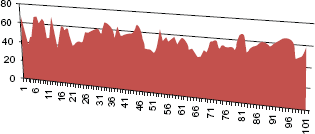
The age scatter of patients with esophageal squamous cell carcinoma.
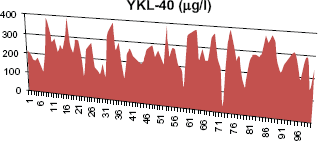
The scatter of the serum concentrations of YKL-40 levels of patients with esophageal squamous cell carcinoma.
Mean values of YKL-40 levels in patients ESCC and in healthy subjects (Data are means ± SD).
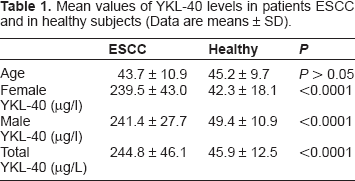
We found significantly higher in the concentration of YKL-40 in patients with ESCC compared to the healthy population (
Discussion
Various factors influence the biology of esophageal squamous cell carcinoma. 2 This is to our knowledge the first report on the novel serum biomarker YKL-40 in patients with ESCC. In all patients had elevated serum concentration of YKL-40, which were significantly higher than healthy population.
The YKL-40 ELISA is useful for the measurement of serum (or EDTA plasma) concentrations of YKL-40 in humans, 29 but not in other species like bovine, swine, rabbit, mouse, and rabbit. The detection limit of the ELISA is 20 ng/ml. 22
The median serum concentration of YKL-40 in healthy adults is 43 μg/l (90% percentile = 95 μg/l; 95 percentile = 124 μg/l).22,28
In 1995, we reported increased serum levels of YKL-40 in some patients with metastatic breast cancer. 29 Recent studies have found elevated serum levels of YKL-40 in patients with several types of localized or advanced solid cancer.14–20 These cancer patients were scored as having elevated serum YKL-40 if it was higher than the upper 95th percentile confidence limit of serum YKL-40 in healthy subjects adjusted for age.28–30 Preoperative serum levels of YKL-40 were elevated in 19% of patients with primary breast cancer, and patients with metastases to axillary lymph nodes had higher serum YKL-40 compared with lymph node-negative patients. 31 Preoperative serum levels of YKL-40 from patients with colorectal cancer were elevated in 26%, and there was an association between serum YKL-40 and Dukes stage: 16% of the patients with Dukes’ A, 265 with Dukes’ B, 19% with Dukes’ C, and 39% with Dukes’ D had elevated preoperative serum YKL-40.31,32 Serum YKL-40 decreased significantly after curative operation for colorectal cancer in patients with high preoperative YKL-40 17 indicating that serum YKL-40 reflects tumor burden. In patients with small cell lung cancer, 22% with local disease and 40% of the patients with extended disease had elevated serum YKL-40. 15 Forty-three percent of patients with metastatic prostate cancer, 14 83% of patients with metastatic renal cell cancer33–35 and 45% of patients with metastatic malignant melanoma 12 had elevated serum YKL-40. In patients with glioblastoma, the serum YKL-40 level was related to tumor grade and burden: 72% of patients with glioblastoma multiforme and 57% of patients with lower grade gliomas had high serum YKL-40. 21 Also, we found higher serum levels of YKL-40 in all patients with ESCC.
The biological function of YKL-40 in cancer is not yet known. It has been suggested that YKL-40 may play a role in the proliferation and differentiation of malignant cells, protects the cancer cells form undergoing apoptosis, stimulates angiogenesis, has an effect on extracellular tissue remodeling, and stimulates fibroblasts surrounding the tumor, although in vivo proof of these hypotheses are yet to be obtained. 35 YKL-40 is not produced by fibroblasts, but it is a growth factor for fibroblasts, synovial cells, and chondrcytes. 9 Some studies demonstrated that increased serum YKL-40 levels found in various cancer patients reflect YKL-40 secretion from a subset of tumors with a more aggressive phenotype, especially esophageal squamous cell carcinoma.
Recently, an in vitro study has shown that ectopic expression of YKL-40 in breast and colon cancer cells respectively led to tumor formation with an extensive angiogenic phenotype and that recombination YKL-40 protein promoted vascular endothelial cell angiogenesis both in vitro and in vivo. 36 Furthermore, immunohistochemical analysis of human cancer showed a correlation between YKL-40 expression and blood vessel density. 36 Therefore, the occurrence of high YKL-40 levels in highly differentiated and advanced cancers and recurrent cancer states could be explained by the role of YKL-40 in both angiogenesis and fibrogenesis, since highly differentiated tumors are characterized by high vascularization and a high turnover of extracellular matrix.
YKL-40, initiates mitogen-activated protein kinase (MAP) and PI-3K signaling cascades in fibroblasts leading to phosphorylation of both the extracellular signal-regulated kinase (ERK)-1/2 MAP kinase and protein kinase B (AKT)-mediated signaling cascades, 36 which are associated with the control of mitogenesis. This suggests a role of YKL-40 as an anti-apoptotic protein.
Not all patients with cancer had elevated serum YKL-40 levels compared with healthy age-matched controls, suggesting that not all tumors secrete YKL-40 or that the protein is secreted at a low level. Cancer cells that secrete YKL-40 may have a different phenotype than cancer cells that do not express and secrete YKL-40, and the protein may therefore reflect differences in the biology of various cancer types. Serum concentrations of YKL-40 were independent of serum carcinoembryonic antigen in patients with colorectal cancer, 20 of serum CA-125 and CA15-3 in patients with ovarian cancer, 19 of serum HER2 in patients with metastatic breast cancer, 14 of serum prostate-specific antigen in patients with metastatic prostate cancer, 17 and of serum lactate dehydrogenase in patients with small cell lung cancer, 18 indicating that serum YKL-40 reflects other aspects of tumor growth and metastasis than these tumor markers. 22
This study shows that serum concentrations of YKL-40 have a high sensitivity for esophageal squamous cancer, and that determination of serum YKL-40 can be used as a test. First of all, in this study, we investigated the effect of YKL-40 that we have obtained interesting results.
In conclusion, this study has shown that YKL-40 is expressed in esophageal squamous cell carcinoma. This may be due to contribution to the serum YKL-40 level from esophageal squamous cells, which also produce the protein. Also, serum concentrations of YKL-40 could be useful in the early diagnosis of esophageal squamous cell carcinoma.
Disclosure
This manuscript has been read and approved by all authors. This paper is unique and is not under consideration by any other publication and has not been published elsewhere. The authors and peer reviewers of this paper report no conflicts of interest. The authors confirm that they have permission to reproduce any copyrighted material.