




Abstract
Background
Coronary artery disease is a common cardiac ailment prevalent worldwide.
Objectives
To explore the therapeutic impacts and related mechanisms of Yangxinxue (YXX) granules on myocardial injury.
Materials and Methods
A mouse model of myocardial injury was induced, and different doses of YXX were used for intervention. The protective effects of YXX on mouse myocardium and related mechanisms were observed through pathological examination and Western blot. Network pharmacology methods were used to analyze the relevant mechanisms of YXX in treating unstable angina.
Results
Animal experiments showed that YXX significantly enhanced the serum superoxide dismutase (SOD) and glutathione peroxidase (GSH-Px) levels in isoproterenol (ISO)-treated mice, while reducing serum malondialdehyde (MDA), and alleviating the levels of cardiac troponin T in myocardial tissue after ISO treatment. YXX inhibited the elevation of vascular endothelial growth factor (VEGF) and hypoxia-inducible factor-1α (HIF-1α). The decrease of endothelial nitric oxide synthase (eNOS) in mouse myocardial tissue was caused by ISO but had no significant effect on the elevation of endothelin-1 (ET-1) and the decrease of phosphorylated Ser/Thr protein kinase B (p-AKT). YXX also inhibited the elevation of caspase-3 and caspase-9, as well as BAX expression, and the decrease of BCL-2 expression in mouse myocardial tissue after ISO intervention. Network pharmacology analysis identified 239 targets associated with the treatment of myocardial injury by YXX.
Conclusion
YXX can protect the myocardium, and its treatment of myocardial injury involves a complex mechanism with multiple targets and pathways, providing a new approach to the clinical treatment of unstable angina.
Introduction
Coronary artery disease (CAD), a common cardiac ailment, is common worldwide (Iliadou et al., 2024). According to the Report regarding Cardiovascular Health and Diseases in China 2022, there are approximately 11.39 million CAD patients in China (Ma et al., 2023). Acute coronary syndrome (ACS) is one of the primary types of CAD and is prone to severe complications such as malignant arrhythmias, heart failure, and even sudden death (Bergmark et al., 2022). The primary mechanism of ACS is coronary artery stenosis caused by atherosclerosis. When plaques become unstable, rupture, and form thrombi, they can lead to complete or incomplete occlusion of coronary arteries, resulting in acute and severe ischemic injury to myocardial tissue (Libby et al., 2019). The treatment of ACS includes opening occluded vessels, preventing recurrent thrombosis, reducing myocardial oxygen consumption, and stabilizing cardiac electrical activity (Atwood, 2022). Reducing myocardial injury can significantly decrease abnormal cardiac electrical activity and preserve myocardial contractile function (Wu et al., 2020). Yangxinxue (YXX) is a formula based on the classic Chinese medicine formula Siwu Tang, supplemented with qi-invigorating and blood-activating herbs. Its composition includes Baishao, Chenpi, Chishao, Danshen, Danggui, Dangshen, Huangqi, Jixueteng, Shengdi, Shoudi, and Yujin (Xu et al., 2023). The formula has the functions of nourishing blood and promoting blood circulation, regulating qi and invigorating qi, and promoting collateral circulation and relieving pain (Luo et al., 2023).
Network pharmacology can integrate many disciplines, such as pharmacology, computational biology, and network analysis. It possesses systematic and holistic characteristics and can assist in exploring the potential mechanisms of herbal medicine in treating diseases (Jiashuo et al., 2022; Li & Zhang, 2013). We aimed to demonstrate the therapeutic effects of YXX on myocardial injury through animal experiments and to preliminarily observe its impact on the expression levels of myocardial injury-related molecules. We also aim to explore the mechanism of YXX in the treatment of myocardial injury using network pharmacology and to conduct preliminary validation through molecular docking technology.
Materials and Methods
Animal Grouping and Experimental Design
Forty male C57BL/6 mice, about 6 weeks old with a body weight of around 20 g, were placed at a temperature of 20°C–22°C and humidity of 50%–60%. After two adaptation weeks, animals were randomly allocated to four groups with respective treatment and regular food for 4 weeks, each consisting of 10 mice: the control group, ISO group (isoproterenol 20 mg/kg, intraperitoneal injection of saline, SIGMA), YXX-20 mg group (ISO 20 mg/kg intraperitoneal injection, YXX-20 mg/kg gavage), and YXX-40 mg group (ISO 20 mg/kg intraperitoneal injection, YXX-40 mg/kg gavage) (Zhang et al., 2020). YXX-20 and 40 mg were used according to the corresponding dosage in patients at a ratio of 1:7.
Biochemical Analysis
After four treatment weeks, animals were euthanized, and heart specimens were collected. Two mice from each group were anesthetized with pentobarbital sodium solution (1%, 50 mg/kg), and their hearts were perfused with 4% paraformaldehyde for pathological examination. The remaining mice were anesthetized with isoflurane inhalation, and their chests were quickly opened with surgical scissors. A fine blood collection needle was inserted into the apex of the heart, and the collected mouse blood (approximately 2 mL) was centrifuged at high speed in a low-temperature centrifuge to collect the supernatant for subsequent serum testing. Then, the hearts were collected for subsequent experiments, such as Western blot. Malondialdehyde (MDA), superoxide dismutase (SOD), and glutathione peroxidase (GSH-Px) were identified through enzyme-linked immunosorbent assay (ELISA) kits purchased from Beijing Dongge Biotechnology Co., Ltd. (China) (Dong et al., 2018; Zhou et al., 2022).
Western Blot Assay
Ischemia-related factors in myocardium, phosphorylated AKT (p-AKT), such as endothelin-1 (ET-1), endothelial nitric oxide synthase (eNOS), vascular endothelial growth factor (VEGF), hypoxia-inducible factor-1α (HIF-1α), Ser/Thr protein kinase B (AKT), and apoptotic proteins in mouse myocardium, were detected using Western blot. Antibodies were obtained from Santa Cruz Inc. (California, USA). The Ethics Committee of Liaoning University of Traditional Chinese Medicine (TCM) approved the research (Siti et al., 2022).
Network Pharmacology Analysis
Selection of Effective Components and YXX Decoction Targets
The active YXX ingredients, including Baishao, Chenpi, Chishao, Danshen, Danggui, Dangshen, Huangqi, Jixueteng, Shengdi, Shoudi, and Yujin, were sourced from the Traditional Chinese Medicine Systems Pharmacology Database and Analysis Platform (
Building a Unified Drug–Component–Target Network
The information on drugs, compounds, and corresponding targets of YXX was used to construct “Network” and “Type” files. Cytoscape 3.8.2 was employed to import the relevant files and conduct a network topology assessment to build the drug–component–target network. Target node opacity, shapes, sizes, and colors were adjusted considering the degree value (number of gene connections) (Du et al., 2019).
Acquisition of Unstable Angina-related Targets
By searching the keywords “Unstable angina” in OMIM (
Acquisition of Key Therapeutic Targets
The drug targets obtained from Section 1.1 were intersected with the disease targets obtained from Section 1.3 using Venny (
Constructing and Screening of Protein–Protein Interaction (PPI) Network
The STRING platform (
Gene Ontology (GO) Enrichment and Kyoto Encyclopedia of Genes and Genomes (KEGG) Pathway Assessment
KEGG pathway enrichment and GO function assessments were done using Metascape (
Molecular Docking
AutoDock Vina (1.1.2) performed molecular docking of the active ingredients (AIs) in YXX with the main targets to confirm their interaction. The specific procedures were as follows: (a) Compounds in mol2 format were downloaded from the TCMSP website and underwent energy minimization in Chembio3D, followed by processing in AutoDockTools-1.5.6 for charge calculation, hydrogenation, identification of rotatable bonds, and charge distribution, with the final output saved in “pdbqt” format. (b) Key target proteins were sourced from the PDB (
Statistical Analysis
Statistical Package for the Social Sciences (SPSS) 24 performed statistical analysis at a significance level of p < .05. Continuous parameters were presented as mean and standard deviation, and comparisons among the groups were performed using analysis of variance (ANOVA).
Results
Animal Experiment Results
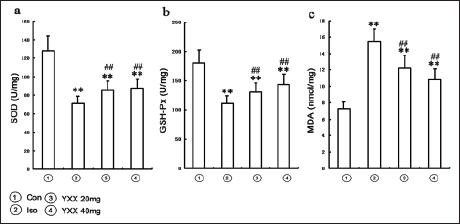
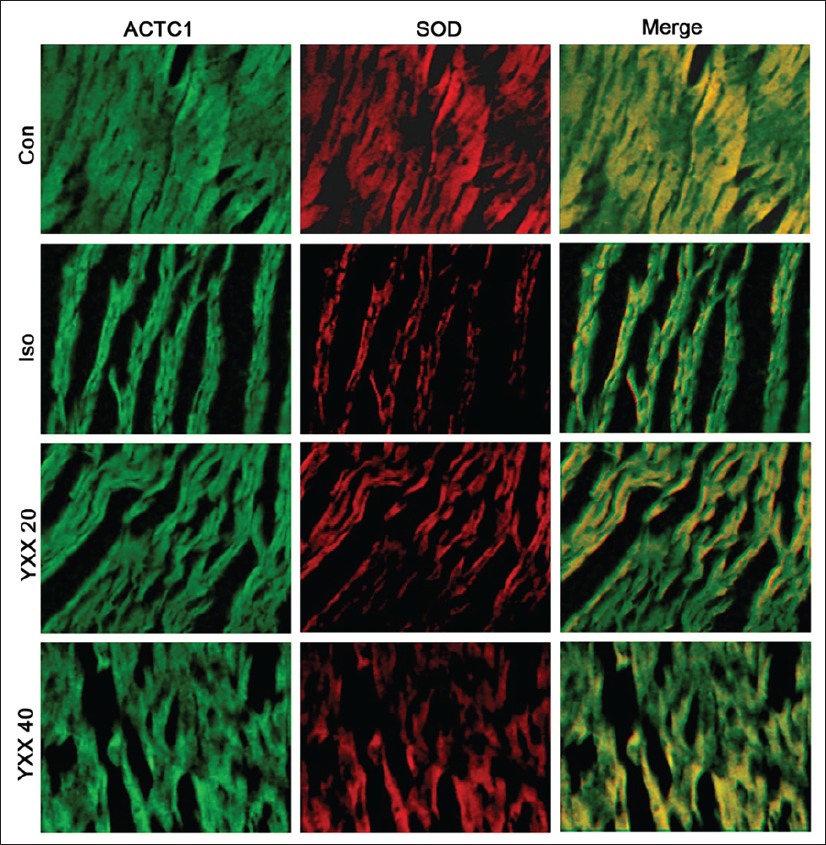
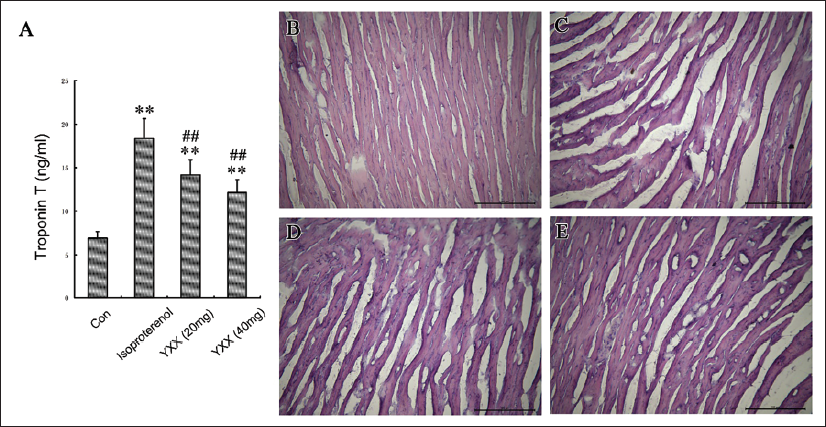
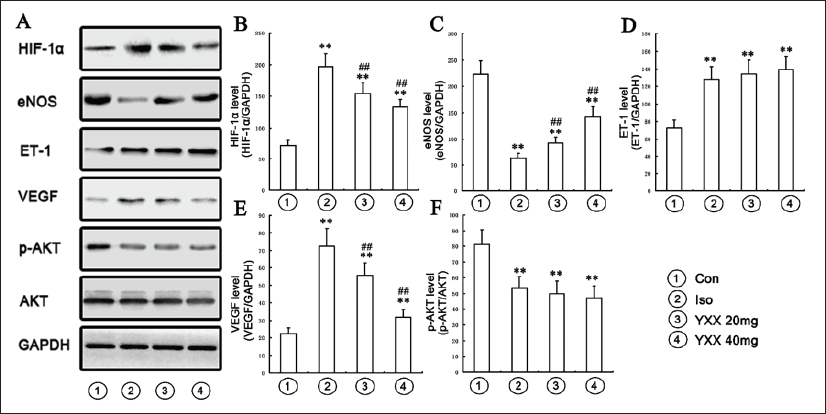
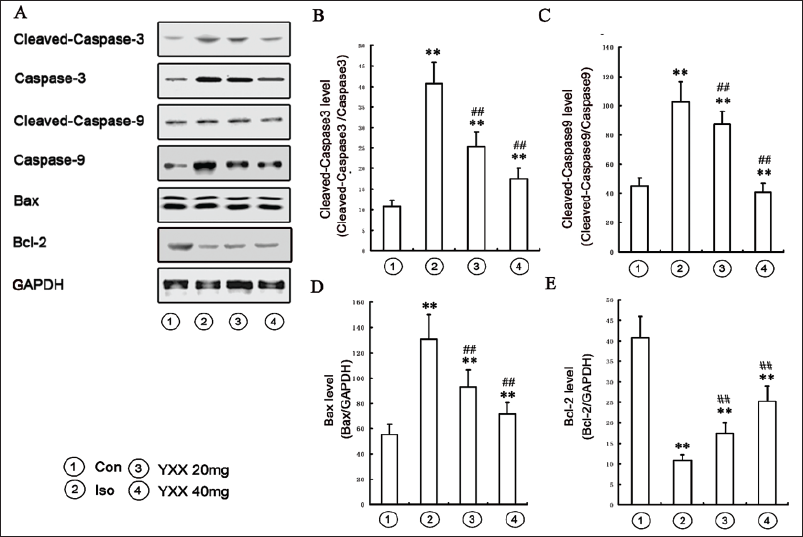
The SOD and GSH-Px expression in myocardial tissue of model mice intervened by ISO was significantly reduced (p < .05, Figures 1 and 2), while MDA exhibited a significant elevation (p < .05). Moreover, the GSH-Px and SOD expression in mice of the YXX-20 mg group and YXX-40 mg group was significantly higher in comparison to the ISO group, while MDA was lower in comparison to the ISO group (p < .05, Figures 1 and 2). Additionally, we observed that myocardial damage caused by ISO was significantly alleviated after YXX intervention (p < .05, Figure 3). YXX could inhibit the elevation of HIF-1α and VEGF and the decrease of eNOS after ISO intervention (p < .05, Figure 4). YXX also inhibited the increased expression of pro-apoptotic factors like caspase-9, BAX, and caspase-3, and the reduced BCL-2 expression after ISO intervention (p < .05, Figure 5).
Compared with the Control Group, the Expression of Superoxide Dismutase (SOD) and Glutathione Peroxidase (GSH-Px) in Model Mice was Significantly Decreased (p < .05), While Malondialdehyde (MDA) was Significantly Increased (p < .05). Moreover, the Expression of SOD and GSH-Px in Mice of the Yangxinxue (YXX)-20 mg Group and YXX-40 mg Group was Significantly Higher than that in the ISO Group, While MDA was Lower than that in the Isoproterenol (ISO) Group.
Compared to the Control Group, the Fluorescence Intensity of Superoxide Dismutase (SOD) in Mouse Myocardial Tissue After Isoproterenol (ISO) Intervention was Significantly Weakened. However, the Fluorescence Intensity of SOD After Yangxinxue (YXX) Intervention was Higher than that in the ISO Model Group.
(A) The Content of Cardiac Troponin T was Detected by Enzyme-linked Immunosorbent Assay (ELISA). (B–E) The Results of Hematoxylin and Eosin (HE) Staining of Mouse Myocardium are Shown. (B) Represents the Blank Control, (C) Represents the Model Group, (D) Represents the Yangxinxue (YXX) Low-dose Group, and (E) Represents the YXX High-dose Group. Scale Bar = 100 µm. (A) Compared to the Control Group, the Expression of Cardiac Troponin T in Mouse Myocardial Tissue Significantly Increased After Isoproterenol (ISO) Intervention, and YXX Could Inhibit the Expression of Cardiac Troponin T after ISO Intervention. (B) Normal Myocardial Fibers (Cells) were Neatly Arranged. (C) ISO Caused Myocardial Fiber Swelling and Rupture. (D and E) YXX Intervention Could Alleviate Myocardial Lesions Caused by ISO.
After Isoproterenol (ISO) Intervention, the Expression of Hypoxia-inducible Factor-1α (HIF-1α), Endothelin-1 (ET-1), and Vascular Endothelial Growth Factor (VEGF) Increased in Mouse Myocardial Tissue, While the Expression of Endothelial Nitric Oxide Synthase (eNOS) and Phosphorylated Ser/Thr Protein Kinase B (p-AKT) Decreased. Administration of Yangxinxue (YXX) Could Inhibit the Increase in HIF-1α and VEGF Expression and the Decrease in Endothelial Nitric Oxide Synthase (eNOS) Expression. There was No Significant Effect on the Expression Changes of ET-1 and p-AKT.
After Isoproterenol (ISO) Intervention, the Expression Levels of Caspase-3, Caspase-9, and BAX in Mouse Myocardium were Significantly Increased, While the Expression Level of BCL-2 was Significantly Decreased. Yangxinxue (YXX) Could Significantly Inhibit These Effects of ISO.
Network Pharmacology Analysis Results
Selection of AIs and Prediction of Targets in YXX
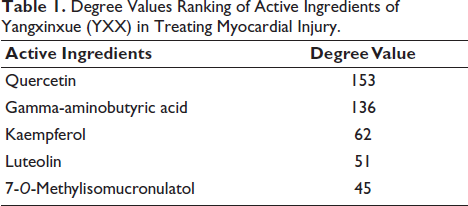
Through TCMSP retrieval, 85 AI of Baishao, 63 AI of Chenpi, 119 AI of Chishao, 202 AI of Danshen, 125 AI of Danggui, 134 AI of Dangshen, 87 AI of Huangqi, 68 AI of Jixueteng, 8 AI of Shengdi, 76 AI of Shoudi, and 222 AI of Yujin were collected. After screening with criteria of OB ≥30% and DL ≥0.18, there were 7 AI of Baishao, 5 AI of Chenpi, 15 AI of Chishao, 65 AI of Danshen, 2 AI of Danggui, 18 AIs of Dangshen, 14 AI of Huangqi, 13 AI of Jixueteng, 8 AI of Shengdi, 2 AI of Shoudi, and 2 AI of Yujin. Specific AI of each herb in YXX is detailed in Table 1.
Degree Values Ranking of Active Ingredients of Yangxinxue (YXX) in Treating Myocardial Injury.
Constructing Drug–Ingredient–Target Network
The “Drug–Ingredient–Target” network diagram was generated with Cytoscape 3.8.2, as illustrated in Supplementary Figure 1. This network comprises 645 nodes and 2,282 edges. Triangular nodes signify the herbs in YXX, hexagonal nodes denote the AIs from each herb in YXX, blue diamond nodes indicate the targets associated with the herbs, and black lines represent the edges connecting them. The top five key compounds selected based on degree values are quercetin, kaempferol, 7-O-methylisomucronulatol, luteolin, and gamma-aminobutyric acid (see Table 1 for details).
Myocardial Injury-related Targets
A total of 1,952 disease targets were sourced from the GeneCards database (
Intersection Gene Results
Using Venny (
Building PPI Network and Core Target Selection
The drug component targets derived from the Venn diagram, along with the 239 common targets associated with unstable angina, were entered into the String database (
Biological Function Enrichment Analysis
GO Enrichment Assessment
The overlapping genes between drug and disease were chosen, and GO function enrichment assessment was done using the DAVID database. In total, 5,944 GO entries were analyzed, comprising 4,890 entries associated with BP, 396 entries linked to CC, and 658 entries related to MF. Using a criterion of p < .05, 30 significantly enriched biological function main entries for drug treatment of myocardial injury were selected (Supplementary Figure 4). The main BP entries mainly involve responses to drugs, oxidative stress responses, cellular responses to chemical stimuli, responses to nutrient levels, and reactive oxygen species metabolic processes. The main CC entries mainly involve membrane rafts, postsynaptic membranes, receptor complexes, cytoplasmic nuclear periphery, and transcription factor complexes. The primary MF entries primarily include ribonucleic acid (RNA) polymerase II-specific deoxyribonucleic acid (DNA)-binding transcription factor binding, ligand-activated transcription factor activity, nuclear receptor activity, receptor-ligand activity, and DNA-binding transcription factor binding.
KEGG Pathway Enrichment Analysis
By employing the DAVID database for pathway enrichment assessment, 1,986 pathways associated with treating myocardial injury by the drug were identified. The top 20 KEGG metabolic pathways were chosen considering their p values, and a bar chart was generated (Supplementary Figure 5). The length of each bar indicates the number of enriched genes in the respective pathway, while the color gradient from blue to red shows decreasing p values, facilitating a clear visualization of significant enrichment data.
Molecular Docking Findings
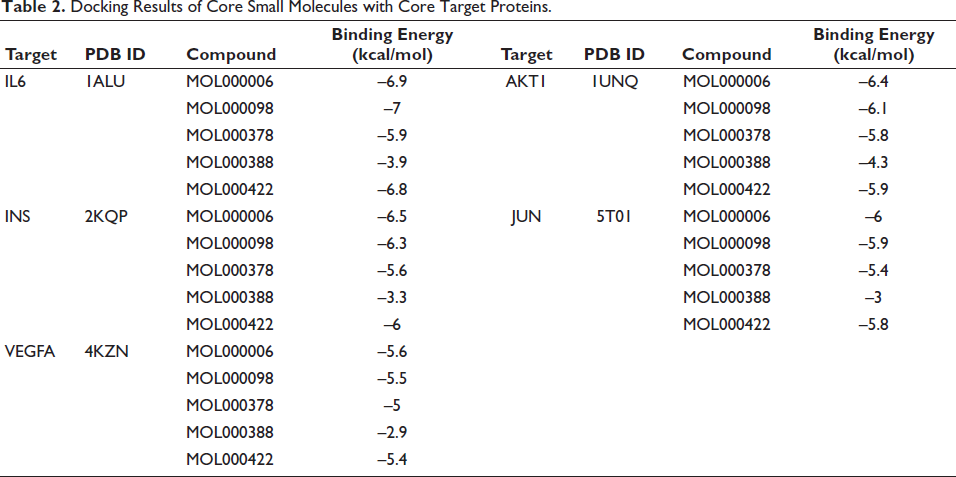
The top five important targets with high degree values were selected based on the previous analysis to perform semi-flexible docking with compounds. Binding affinity was used to assess the binding quality between target proteins and small molecules. A binding affinity of <0 indicates that the small molecule is able to easily attach to the target protein, and lower values suggest a higher binding chance.
The small molecules can access the active sites of the target proteins. The most effectively docked small molecules for each protein were chosen for visualization (Supplementary Figure 6). Luteolin establishes hydrogen bonds with Gln59 and Trp80 of AKT1, with bond lengths measuring 3.23 and 2.87 Å, respectively (Supplementary Figure 6). Quercetin can form hydrogen bonds with Arg182 and Arg30 of IL6, with bond lengths of 3.78 and 3.19 Å, respectively. Additionally, luteolin forms hydrogen bonds with Gly66, Arg65, and Arg272 of INS and JUN, with bond lengths of 3.13, 2.80, and 3.23 Å, respectively. These small molecules also demonstrate significant hydrophobic interactions with nearby amino acid residues. For more detailed docking results, see Table 2.
Docking Results of Core Small Molecules with Core Target Proteins.
Discussion
The study demonstrated through animal experiments that YXX successfully alleviates ISO-related myocardial injury in mice. Using ELISA and histopathological examination, it was found that YXX can alter the expression levels of certain factors in ISO-induced mouse myocardial tissue, including suppressing the expression of SOD, GSH-Px, eNOS, and BCL-2 induced by ISO, and increasing the levels of MDA, HIF-1α, VEGF, caspase-3, caspase-9, BAX, and troponin T. Subsequently, through network pharmacology analysis, five main AIs of YXX were identified based on degree values: luteolin, quercetin, kaempferol, 7-O-methylisomucronulatol, and gamma-aminobutyric acid. Then, five core targets of YXX for treating myocardial injury were identified: AKT1, JUN, IL6, VEGFA, and INS. Molecular docking findings indicated that luteolin can form hydrogen bonds with AKT1, INS, and JUN, while quercetin can form hydrogen bonds with IL6 (Du et al., 2020).
Previous studies have indicated that myocardial injury caused by ischemia is a complex process with many signaling pathways and BP (Libby et al., 2019; Zhu et al., 2022), including oxidation-reduction, apoptosis, autophagy, and cell proliferation. Targeting a single signaling pathway or biological response may have limited efficacy. Although TCM was initially based on the principles of TCM, many studies have confirmed that TCM has multitarget and multimechanism synergistic effects in treating diseases (Huo et al., 2022; Miao & St Clair, 2009). This characteristic often makes elucidating specific effector molecules and target sites difficult, hindering further drug development. In this study, we demonstrated through animal experiments that YXX can effectively alleviate ISO-induced myocardial injury and modify multiple BP in the process of myocardial injury intervention after ISO administration.
SOD is a widely distributed antioxidant metal enzyme in the body, which decreases during myocardial ischemic injury (Liu et al., 2021). In our experiments, the addition of YXX significantly alleviated the decrease in SOD induced by ISO. GSH-Px is a crucial peroxidase found throughout the body that facilitates the conversion of GSH to GSSG, helping to safeguard the function and structure of cell membranes from the harmful effects of toxic peroxides (Ceconi et al., 1991). Our experiments demonstrated that ISO-induced myocardial injury results in a reduction of GSH-Px expression in myocardial tissue, an effect that YXX can alleviate. In contrast, MDA is an important product of lipid peroxidation in humans, and its expression level serves as an indicator of oxidative reactions occurring in tissues (Zheng et al., 2021). We found that ISO significantly increased MDA levels in mouse myocardial tissue, which YXX significantly attenuated. These findings suggest that YXX enhances the myocardial tissue’s antioxidant capacity and reduces damage severity.
We found that ISO can significantly increase the expression levels of HIF-1α in mouse myocardial tissue, and HIF-1α can increase the expression of ET-1 and VEGF (Ergorul et al., 2010; Vecoli et al., 2024; Zhang et al., 2018). This study also observed a significant increase in the expression levels of ET-1 and VEGF in mouse myocardial tissue after ISO intervention, but YXX can attenuate the increase in HIF-1α and VEGF expression. Meanwhile, we observed that ISO can decrease the expression of eNOS in mouse myocardial tissue, while YXX can inhibit this effect. eNOS is a nitric oxide synthase mainly produced in vascular endothelial cells, which has a vasodilatory effect (Raphael et al., 2006). When eNOS expression is reduced, vasospasm is prone to occur, leading to or exacerbating myocardial ischemia. These experimental results suggest that YXX can alleviate myocardial cell hypoxia induced by ISO.
Caspase-3 plays an important role in apoptosis, and transfection of the caspase-3 gene into insect SF-9 cells induces apoptosis, which BCL-2 can block (Raphael et al., 2006). BCL-2 is an important anti-apoptotic molecule in humans, playing a significant role in myocardial ischemic injury, especially ischemia–reperfusion injury (Allan & Clarke, 2009). In addition, studies have shown that caspase-9 is an important initiator of apoptosis (Spitz & Gavathiotis, 2022). BAX is a soluble protein homologous to BCL-2 in the BCL-2 gene family and a pro-apoptotic gene. Overexpression of BAX can counteract the protective effect of BCL-2 and lead to death (Ru et al., 2014). Our experiments showed that the expression of caspase-3, caspase-9, and BAX in the ISO-induced myocardial injury model significantly increased. In contrast, the expression level of BCL-2 significantly decreased. YXX can significantly inhibit the above changes, to some extent restore the expression levels of these factors, and the higher the dose of YXX, the more pronounced this effect is. This result suggests that YXX has a significant anti-apoptotic effect.
The above animal experimental results indicate that YXX can alleviate myocardial injury through anti-oxidation, myocardial hypoxia improvement, and apoptosis inhibition. However, YXX may contain numerous components and which components exert the effect of alleviating myocardial injury, through which pathways, needs further exploration. In further network pharmacology analysis, we screened five potential effective ingredients through cross-comparison: luteolin, quercetin, kaempferol, 7-O-methylisomucronulatol, and gamma-aminobutyric acid. Further analysis suggested that luteolin and quercetin may be the main AIs. These two components act on five core targets (AKT1, JUN, IL6, VEGFA, INS) through hydrogen bonding. Luteolin is a well-known flavonoid that exhibits significant cardioprotective effects. For example, luteolin can alleviate myocardial injury induced by sepsis by enhancing autophagy (Wu et al., 2020), and it can also alleviate myocardial ischemia–reperfusion injury by upregulating tissue factor pathway inhibitor 2 and downregulating microRNA-23a (Luo et al., 2023). Quercetin is one of the members of the flavonoid family and has significant cardiac benefits. Studies have shown that it may improve cardiovascular disease by lowering blood pressure, anti-oxidation, interfering with the renin–angiotensin–aldosterone system, improving vascular function in endothelium-dependent patients, alleviating ischemia–reperfusion injury, and reducing arrhythmia (Dong et al., 2018; Zhang et al., 2020). Kaempferol, also a flavonoid, has significant protective effects against myocardial injury. It can alleviate cisplatin-induced myocardial injury by inhibiting STING/NF-κB-mediated inflammation (Qi et al., 2020), reduce Ang II-induced inflammation and oxidative stress, thereby preventing Ang II-induced cardiac remodeling (Du et al., 2019), and alleviate myocardial ischemia–reperfusion injury by regulating endoplasmic reticulum stress (Kim et al., 2008). However, we did not find a good combination between Kaempferol and core targets in the network pharmacology analysis, suggesting that this component may not play a major role in protecting the myocardium in YXX. There is limited research on 7-O-methylisomucronulatol in cardiovascular diseases, and it is currently unknown what potential role it may play in myocardial injury. Additionally, there was no interaction found between GABA and YXX core targets in the network pharmacology analysis in this study.
This study has certain limitations. First, the study used an ISO-induced myocardial injury model, which may differ from actual severe ischemia-induced myocardial injury. However, the experimental results of this study indeed demonstrated a significant impact of YXX on the expression of molecular proteins related to myocardial ischemic injury. Second, the mechanism of action of YXX in this study was mainly explored through network pharmacology, and the results need to be further confirmed by experimental studies. Future research can further observe the effects of early administration of YXX and related changes in molecular protein expression in patients with acute myocardial ischemia. YXX can alleviate ISO-induced myocardial injury, with its main AIs being luteolin and quercetin. The core target molecules include AKT1, JUN, IL6, VEGFA, and INS.
Conclusion
YXX can alleviate ISO-induced myocardial injury, and its main AIs are luteolin and quercetin. Its core targets include AKT1, JUN, IL6, VEGFA, and INS.
Footnotes
Abbreviations
ACS: Acute coronary syndrome; BC: Betweenness centrality; BP: Biological process; CAD: Coronary artery disease; CC: Cellular component; ClC: Closeness centrality; DL: Drug-likeness; eNOS: Endothelial nitric oxide synthase; GSH-Px: Glutathione peroxidase; HIF-1α: Hypoxia-inducible factor-1α; ISO: Isoproterenol; MDA: Malondialdehyde; MF: Molecular function; OB%: Oral bioavailability; p-AKT: Phosphorylated Ser/Thr protein kinase B; PPI: Protein–protein interaction; SOD: Superoxide dismutase; TCMSP: Traditional Chinese Medicine Systems Pharmacology Database and Analysis Platform; VEGF: Vascular endothelial growth factor; YXX: Yangxinxue.
Declaration of Conflict of Interests
The authors declared no potential conflicts of interest with respect to the research, authorship, and/or publication of this article.
Ethical Approval
The experimental protocols of this study were approved by the Experimental Animal Center of Liaoning University of Traditional Chinese Medicine.
Funding
Exploration of the Mechanism of Yangxinxue Tang in Treating Myocardial Injury Based on Network Pharmacology and Molecular Docking (Liaoning Provincial Department of Education, JYTQN2023466).
Informed Consent
Not applicable.
Supplementary Material

References
Supplementary Material
Please find the following supplemental material available below.
For Open Access articles published under a Creative Commons License, all supplemental material carries the same license as the article it is associated with.
For non-Open Access articles published, all supplemental material carries a non-exclusive license, and permission requests for re-use of supplemental material or any part of supplemental material shall be sent directly to the copyright owner as specified in the copyright notice associated with the article.
