




Abstract
Background
Astragalus and Five-Ginseng Decoction is a traditional Chinese medicine formulation designed to address symptoms of chest obstruction, heart failure, and palpitations associated with Qi and Yin deficiency and blood stasis. This formula comprises herbs such as Astragalus (Huangqi), Radix Pseudostellariae (Taizishen), and Salvia miltiorrhiza (Danshen). These herbs are rich in polysaccharides, which are known for their anti-inflammatory, antioxidant, and immunomodulatory properties. Optimizing the extraction process is critical for enhancing the yield and maintaining the biological activity of these polysaccharides.
Objectives
This study aimed to optimize the process of polysaccharide extraction from Astragalus and Five-Ginseng Decoction.
Materials and Methods
The polysaccharide extraction rate, crude polysaccharide content, and extraction yield from Astragalus and Five-Ginseng Decoction were considered as integrated indexes. An orthogonal test was adopted to investigate the effects of dilution ratio, extraction time, and extraction frequency on the extraction rate. Finally, experiments were conducted to validate the optimized process.
Results
The refined extraction method involves the addition of 14 multiples of water, boiling the extract for 1.5 h each time, and conducting four extraction cycles.
Conclusion
The polysaccharide yield from the samples was all influenced by the solid–liquid ratio, extraction time, and extraction frequency. The degree of influence followed this order: extraction time > extraction frequency > solid–liquid ratio.
Introduction
Astragalus and Five-Ginseng Decoction is a formula developed by Chen Yongcan, an instructor of the sixth and seventh batches of the National Academic Experience Inheritance of Elderly Chinese Medicine Specialists. The formula is intended to address a spectrum of ailments, including chest obstruction, heart failure, and palpitation, often associated with Qi and Yin deficiency, along with stagnation and stasis of blood vessels in the heart (Qiu et al., 2022). With numerous successful clinical applications, the formula has garnered recognition for its efficacy and yielded positive outcomes.
The formulation comprises a selection of herbal components, including Huangqi (Hedysarum multijugum Maxim), Taizishen (Radix pseudostellariae), Kushen (Sophorae flavescentis Radix), Xuanshen (figwort root), Gualoupi (Pericarpium Trichosanthes), Zhihuangjing (Mayflower Solomonseal Rhizome), Baiziren (Platycladi Semen), Danshen (Salvia miltiorrhiza Bunge), Sanqishen (Panax notoginseng), Jiangxiang (Dalbergia odorifera), Wuweizi (Schisandra chinensis [Turcz.] Baill.), and Zhigancao (Radix Glycyrrhizae Preparata). Huangqi and Taizishen are considered sovereign drugs known for their ability to reinforce primordial Qi. The minister herbs include Zhihuangjing and Xuanshen, which nourish the Yin and the fluids; Danshen and Sanqishen, which invigorate blood circulation and eliminate blood stasis; Gualoupi and Jiangxiang, which relieve chest pain and promote blood circulation. Kushen, Baiziren, and Wuweizi are assistant drugs that tranquilize the heart and calm the mind. Zhigancao acts as a supplementary herb that harmonizes the body (Wei et al., 2023, 2024; Xia et al., 2024; Yang et al., 2022). The entire formulation benefits Qi, nourishes Yin, resolves blood stasis, promotes circulation, tranquilizes the heart, and calms the mind. In this study, an orthogonal test was designed to optimize the extraction of polysaccharides from Astragalus and Five-Ginseng Decoction, providing a scientific basis for its development, promotion, and application.
Materials and Methods
Instruments: Ultraviolet spectrophotometer, electronic balance, intelligent thermostatic electric heating jacket, centrifuge, and rotary evaporator.
Reagents: Analytically pure anhydrous glucose, phenol, sulfuric acid, and ultra-pure water (prepared in-house).
Medicinal Materials
Huangqi (30 g), Taizishen (30 g), Zhihuangjing (15 g), Xuanshen (15 g), Danshen (15 g), Sanqishen (6 g), Gualoupi (9 g), Jiangxiang (9 g), Kushen (9 g), Baiziren (9 g), Wuweizi (6 g), and Zhigancao (6 g); total 159 g.
Methods
Preparation of Samples
The herbs were weighed precisely and divided equally into three portions. They were transferred into round-bottom flasks and processed in accordance with the experimental parameters listed in the orthogonal design table. They were decocted, maintained at a slight boil for a specified time, cooled completely, centrifuged at 3,000 rpm for 10 min, and filtered. The filtrates were mixed and subjected to further centrifugation. The supernatant obtained was concentrated to 500 mL under reduced pressure for the tests. The extraction rate was calculated as the ratio of the measured polysaccharide content to the weight of the herbs.
Preparation of Controls
The glucose control was dried to a constant weight of 10 mg at 105°C. It was placed in a 50-mL measuring flask, dissolved, and diluted to scale using distilled water to obtain a 0.2 mg/mL glucose solution serving as the control.
Determination of Polysaccharide Content Using the Phenol-sulfuric Acid Method
A specified volume of the sample, which had been diluted 1000-fold, was placed in a test tube with a stopper. Ultra-pure water was added up to the 1-mL mark, followed by the addition of 0.5 mL of 6% phenol solution. After shaking well, 2.5 mL of sulfuric acid was added quickly. The reaction was carried out in a boiling water bath for 15 min and immediately transferred to an ice water bath. Once cooled to room temperature, the absorbance was measured at 490 nm.
Methodological Test
Test of Linear Relationships
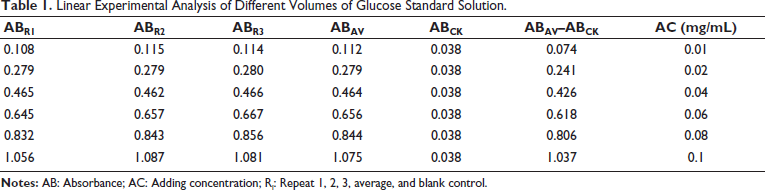
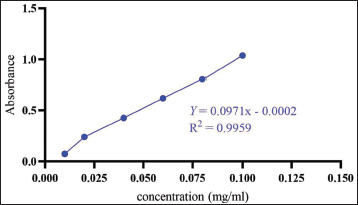
Glucose solutions (0.05, 0.1, 0.2, 0.3, 0.4, and 0.5 mL) were subjected to the method described in Determination of Polysaccharide Content Using the Phenol-sulfuric Acid Method section. The absorbance detected was set as the vertical coordinate, and the concentration of the standard solution was set as the horizontal coordinate. A calibration curve was plotted, and the linear regression equation was obtained as Y = 0.0971X − 0.0002 (R2 = 0.9959), which indicated a good linear relationship for the standard solution (Table 1 and Figure 1).
Linear Experimental Analysis of Different Volumes of Glucose Standard Solution
Total Sugar Content Standard Curve.
Test of Repeatability
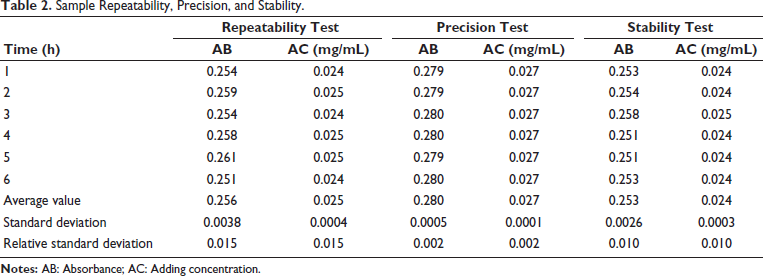
The total polysaccharide content was determined according to the method described in Determination of Polysaccharide Content Using the Phenol-sulfuric Acid Method section. The relative standard deviation (RSD) was 1.74%, indicating the reproducibility of the method.
Test of Precision
The absorbance of the glucose control solution was determined six times consecutively according to the method described in Determination of Polysaccharide Content Using the Phenol-sulfuric Acid Method section. The RSD was 0.20%, indicating good precision of the instrument.
Test of Stability
Sample solutions were prepared from one portion of the herbs, as described in Preparation of Samples section. Their total polysaccharide content was measured at 0, 1, 2, 3, 4, 5, and 6 h, following the procedure outlined in Determination of Polysaccharide Content Using the Phenol-sulfuric Acid Method section. The RSD was calculated to be 1.03%, indicating that the samples remained stable over the 6 h period (Table 2).
Sample Repeatability, Precision, and Stability.
Test of Recovery Efficiency
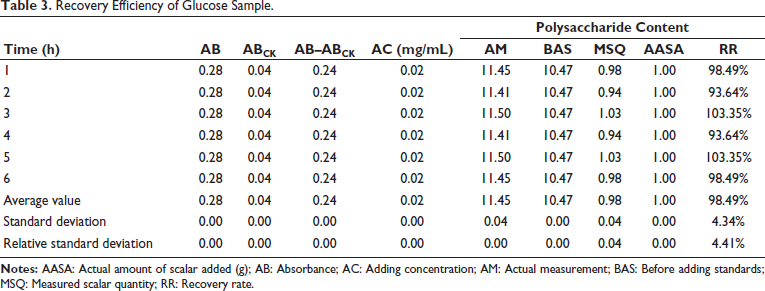
Six copies of all the herbs, with known total polysaccharide contents, were weighed precisely. Additionally, 1.00 g of glucose standard was added. The sample solution was prepared according to the method described in the previous section. The total polysaccharide content was determined using the method described in earlier section, and the recovery rate was calculated. The average recovery rate was 98.5%, with an RSD of 4.41% (Table 3).
Recovery Efficiency of Glucose Sample.
One-factor Test
Effect of Extraction Time on Polysaccharide Extraction Rate
Five copies of all the herbs were weighed precisely, mixed in a solid–liquid ratio of 1:10, and decocted once. The investigated extraction times were 0.5, 1, 1.5, 2, and 2.5 h. The solutions to be tested were prepared according to the method described in the previous section, and their absorbances were determined. The polysaccharide extraction rate was calculated based on the absorbance and calibration curve, and the effect of extraction time on polysaccharide extraction rate was investigated (Table 4 and Figure 2).
Relationship Between Different Extraction Times and Polysaccharide Yields.
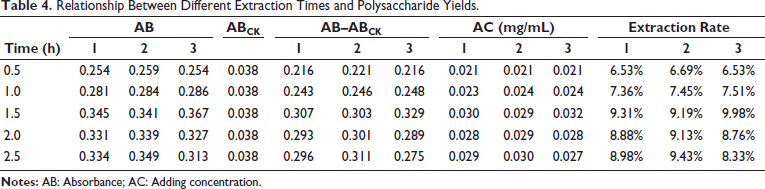
Relationship Between Different Extraction Times and Polysaccharide Yields.
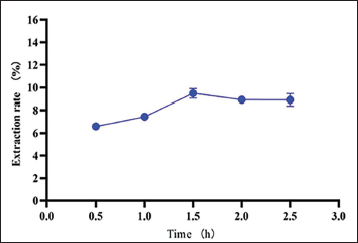
The yield of polysaccharide increased with the duration of extraction time (Figure 2), reaching its peak at 1.5 h. Therefore, extraction times of 1, 1.5, and 2 h were selected for the subsequent orthogonal tests.
Effect of Solid–Liquid Ratio on Polysaccharide Extraction Rate
Five copies of all herbs were weighed precisely, decocted once, and extracted for 0.5 h. Solid–liquid ratios investigated were 1:08, 1:10, 1:12, 1:14, and 1:16, respectively. The resulting filtrates were mixed and prepared into the tested solutions following the method described in Preparation of Samples section, and the absorbance was determined. The polysaccharide extraction rate was calculated based on absorbance and calibration curves. This analysis elucidated the effect of the solid–liquid ratio on the polysaccharide extraction rate (Table 5 and Figure 3).
Relationship Between Different Solid–Liquid Ratios and Polysaccharide Yields.
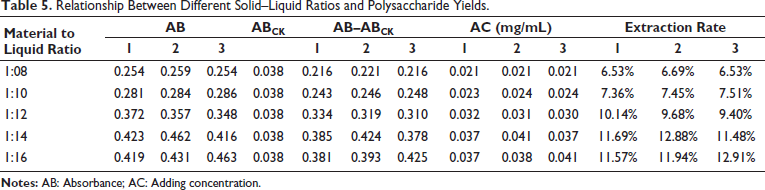
Relationship Between Different Solid–Liquid Ratios and Polysaccharide Yields.
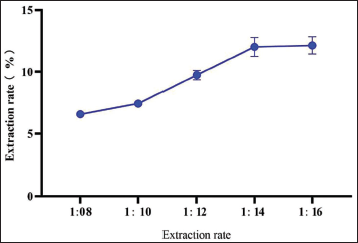
As the solid–liquid ratio increases, the higher the polysaccharide yield also rises (Figure 3). At a solid–liquid ratio of 1:14, the polysaccharide had been extracted completely, and further increases in the ratio did not affect the dissolution rate of polysaccharides. Thus, solid–liquid ratios of 1:12, 1:14, and 1:16 were selected for the subsequent orthogonal tests.
Effect of Extraction Frequency on Polysaccharide Extraction Rate
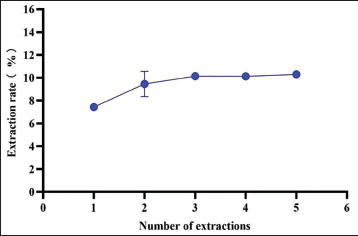
Five copies of all herbs were weighed precisely, and a solid–liquid ratio of 1:10 was maintained. Each extraction was carried out for 0.5 h. The extraction frequencies investigated were 1, 2, 3, 4, and 5, respectively. The resulting filtrates were mixed and prepared into the test solutions according to the method described in the previous section, and the absorbance was determined. The polysaccharide extraction rate was calculated using absorbance and calibration curves. The influence of extraction frequency on polysaccharide extraction rate was then deduced (Supplementary Table 1 and Figure 4).
The higher the extraction frequency, the greater the polysaccharide yield (Figure 4). At an extraction frequency of 3, nearly all polysaccharides were extracted, and a further increase in the extraction frequency had minimal effect on their dissolution rate. In addition, an increase in the extraction frequency led to the successive dissolution of protein and starch in the drug, resulting in an inaccurate determination of polysaccharides. Considering these factors, extraction frequencies of 2, 3, and 4 were chosen for subsequent orthogonal tests, aligning with the practical scenario.
Relationship Between Different Extraction Frequencies and Polysaccharide Yields.
Orthogonal Test
An L9 (34) orthogonal array was applied to optimize the three factors: extraction time, solid–liquid ratio, and extraction frequency. This approach aimed at determining the optimal conditions for extracting drug polysaccharides (Supplementary Tables 2–4).
Statistical Analysis of Data
Data were statistically analyzed using SPSS after three replicate experiments.
Results
The test was carried out according to the conditions of the L9 (34) orthogonal array for water extraction, and the total polysaccharide content was evaluated. Analysis of variance showed that Factor A (extraction time) and Factor C (extraction frequency) were the significant factors (f > 19.00). In contrast, Factor B (solid–liquid ratio) did not have a significant impact on the test results (f < 19.00). Notably, based on the dose-effect curve and visual analysis, the optimal combination for water extraction was A2 + B2 + C3, considering the factors of both extraction efficiency and energy consumption. The optimized extraction process involved adding 14 multiples of water, boiling the extract for 1.5 h each time, and conducting four extractions in total. Three compound herbs were chosen to validate the optimized design of A2 + B2 + C3. Their polysaccharide contents were found to be 28.15%, 27.82%, and 28.06%, with an average of 28.1% and an RSD of 0.62% (n = 3).
Discussion
Polysaccharides, formed by monosaccharides linked via glycosidic bonds, are sensitive to acids and bases, which can lead to partial hydrolysis if the extraction process is not properly designed (Leong et al., 2021; Yu et al., 2018). Therefore, optimizing the extraction technology is crucial for achieving high yields of polysaccharides (Benchamas et al., 2020). Polysaccharides are effective active components in natural plants, serving as water-soluble biological macromolecules. Various extraction methods exist, with selection based on the properties of the specific polysaccharide. Traditional Chinese medicine (TCM) polysaccharides, a class of bioactive substances extracted from TCM, have been traditionally used to maintain or enhance physiological functions (Chen & Huang, 2018; Liu et al., 2018; Yue et al., 2022). Extensive studies have demonstrated their efficacy in improving cardiovascular diseases such as myocardial ischemia (MI), reperfusion injury, myocardial infarction, atherosclerosis, and heart hypertrophy through regulation of signaling pathways including nuclear factor-κB, phosphatidylinositol-3-kinase/protein kinase B, endoplasmic reticulum stress, and nuclear factor-E2-associated factor-2 (Li et al., 2023; Wu et al., 2025; Yuan et al., 2021). Consequently, they exhibit antioxidant, anti-inflammatory, anti-endoplasmic reticulum stress, and anti-apoptotic properties while regulating energy metabolism disorders (Guo et al., 2023).
In recent years, attention to extraction methods has led to the mastery of various polysaccharide extraction techniques. However, different extraction methods or conditions can significantly impact the activity and conformation of polysaccharides (Chen et al., 2016; Xue et al., 2022). The occurrence and development of many diseases are closely related to free radicals, and disturbances in physiological function can cause varying degrees of organ damage, thereby affecting human health. Astragalus and Five-Ginseng Decoction have been applied to treat the insufficiency of Qi and Yin, as well as blood vessel stagnation and stasis in the heart, manifested by symptoms like chest obstruction, palpitation, and heart failure. Studies have shown improvements in Qi and Yin deficiencies, the stagnation and stasis of blood vessels in the heart, and QT dispersion, alongside decreased mortality risk in heart failure patients with non-ST segment elevated myocardial infarction who underwent percutaneous coronary intervention combined with this decoction (Sheng et al., 2020). Moreover, polysaccharides from R. pseudostellariae exerted myocardial protective effects by scavenging oxygen free radicals, attenuating MI, and preventing arrhythmia (Sun et al., 2018). Furthermore, polysaccharides from Astragalus can mitigate MI and inhibit cardiomyocyte apoptosis in MI reperfusion injury rats (Huang & Liu, 2023). Substances like Kushenol and Tanshinone possess a wide range of pharmacological activities, including antioxidant and promotion of blood circulation (Sang et al. 2022).
An orthogonal test was conducted to ascertain the optimized method for extracting polysaccharides from Astragalus and Five-Ginseng Decoction. This process involved the use of 14 multiples of water, boiling the extract for 1.5 h each time, and repeating the extraction four times, yielding a relatively high polysaccharide extraction rate of 27.94%. The extraction time and extraction frequency significantly affected the results, whereas the impact of the solid–liquid ratio was comparatively weaker. In conclusion, Chinese herbal compounds are characterized by their multicomponent nature, targeting multiple pathways and mechanisms. Therefore, the efficacy of polysaccharide extraction was investigated in this study to establish a scientific groundwork for the development, promotion, and application of Astragalus and Five-Ginseng Decoction.
This study investigated the effects of solid–liquid ratio, extraction time, and extraction frequency on polysaccharide extraction from Huangqi Wushen Decoction using single-factor analysis. Results indicated that polysaccharide yield increased with extraction time, peaking at 1.5 h. The solid–liquid ratio also positively influenced yield, reaching maximum extraction efficiency at a ratio of 1:14. Extraction frequency showed a similar trend, with optimal results achieved at three extractions. Orthogonal experiments further confirmed that an extraction time of 1.5 h, a solid–liquid ratio of 1:14, and four extraction cycles yielded the highest polysaccharide extraction efficiency.
The study has several limitations. First, it only optimized extraction conditions without identifying the chemical structure of the extracted polysaccharides or analyzing the elution curve. Future research should focus on these aspects. Second, no in vitro or in vivo studies were conducted on the extracted polysaccharides. Future investigations should evaluate their biological activity through such studies. The findings provide a theoretical foundation for subsequent research on the biological activity of polysaccharides from Huangqi Wushen Decoction and their clinical applications.
Conclusion
The solid–liquid ratio, extraction duration, and extraction frequency influenced the extraction yield of polysaccharides. Through orthogonal experimental design, it was determined that the optimal conditions were an extraction duration of 1.5 h, a solid–liquid ratio of 1:14, and four extraction cycles. The order of influence on polysaccharide extraction efficiency in Huangqi Wushen Decoction was found to be extraction duration > extraction frequency > solid–liquid ratio. This study provides a theoretical foundation for further research on the biological activities of polysaccharides in Huangqi Wushen Decoction and their clinical applications.
Footnotes
Abbreviations
MI: Myocardial ischemia; RSD: Relative standard deviation; TCM: Traditional Chinese medicine.
Declaration of Conflicting Interests
The authors declared no potential conflicts of interest with respect to the research, authorship, and/or publication of this article.
Ethical Approval and Informed Consent
Not applicable.
Funding
The authors disclosed receipt of the following financial support for the research, authorship, and/or publication of this article: This work was supported by the Zhejiang Province Traditional Chinese Medicine Science and Technology Project (2023ZF072); CHEN Yongcan National Famous Traditional Chinese Medicine Experts Inheritance Studio Project of the State Administration of TCM (G.TCM.R.J.H. [2022]75).
Supplementary Material

References
Supplementary Material
Please find the following supplemental material available below.
For Open Access articles published under a Creative Commons License, all supplemental material carries the same license as the article it is associated with.
For non-Open Access articles published, all supplemental material carries a non-exclusive license, and permission requests for re-use of supplemental material or any part of supplemental material shall be sent directly to the copyright owner as specified in the copyright notice associated with the article.
