



Abstract
Buckling and postbuckling behavior of carbon nanotube (CNT) reinforced thick composite plates resting on elastic foundations and subjected to thermomechanical loads are investigated in this paper. The plates are subjected to uniform uniaxial compression in a thermal environment or the combined action of nondestabilizing preexisting uniaxial compression and uniform temperature rise. CNTs are reinforced into matrix through functionally graded distributions. The properties of constitutive materials are assumed to be temperature dependent and effective properties of CNT-reinforced composite are determined according to an extended rule of mixture. Governing equations are based on a higher order shear deformation theory taking von Kárman nonlinearity, initial geometrical imperfection, elasticity of tangential restraints of unloaded edges and plate-foundation interaction into consideration. Analytical solutions are assumed to satisfy simply supported boundary conditions and Galerkin method is applied to obtain nonlinear load-deflection relations. Numerical analyses are carried out to show the effects of CNT distribution patterns, preexisting loads, initial imperfection, degree of in-plane constraint, and elastic foundations on the nonlinear thermomechanical stability of CNT-reinforced composite plates.
Keywords
Introduction
Carbon nanotubes (CNTs) possess unprecedentedly excellent mechanical, thermal and electrical properties and extremely large aspect ratio. Therefore, CNTs are ideally used as advanced fillers into polymer matrix to form carbon nanotube reinforced composite (CNTRC), a new class of nanocomposites.1,2 The concept of functionally graded carbon nanotube reinforced composite (FG-CNTRC) material is proposed in the work of Shen 3 in which volume fraction of CNTs is varied in the thickness direction according to functional rules. Basing on first order shear deformation theory (FSDT), Liew and coworkers4,5 used an element-free Ritz approach to study linear buckling behavior of FG-CNTRC rectangular plates under mechanical compressive loads. Malekzadeh and Shojaee 6 used differential quadrature method (DQM) basing on the FSDT to calculate buckling loads of quadrilateral laminated plates with FG-CNTRC layers under compressive loads. Mechanical and thermal buckling problems of FG-CNTRC rectangular plates with various boundary conditions have been dealt with in the works of Kiani and collaborator7,8 using Chebyshev-Ritz method. Fazzolari 9 utilized Ritz method with trigonometric shape functions to examine the linear vibration and buckling behavior of FG-CNTRC plates. Thermal buckling behavior of FG-CNTRC plates with different shapes has been addressed in works10,11 making use of numerical methods. Basing on shell finite element approaches, buckling analyses of FG-CNTRC plates, curved panels and cylindrical shells under mechanical loads have been carried out in works.12–14 Shen and Zhu 15 analyzed the buckling and postbuckling behavior of FG-CNTRC plates under uniaxial compression in thermal environments.
Postbuckling behavior of FG-CNTRC rectangular plates resting on elastic foundations under compressive loads have been analyzed in works16,17 using element-free and analytical approaches, respectively. Based on different methods, thermal postbuckling behavior of FG-CNTRC plates under various temperature conditions have been analyzed in the works of Shen and Zhang, 18 Kiani 19 and Tung and Trang.20,21 Kiani 22 used Chebyshev-Ritz method to deal with postbuckling problem of sandwich plates with FG-CNTRC face sheets exposed to uniform temperature rise. Based on the FSDT, Long and Tung23,24 presented results of postbuckling analyses for two sandwich plate models constructed from FG-CNTRC layers and subjected to thermal and thermomechanical loadings.
Basing on a higher order shear deformation theory (HSDT) and a semi-analytical approach, Shen and Xiang 25 analyzed the postbuckling behavior of FG-CNTRC cylindrical panels subjected to axial compression in a thermal environment. Using an analytical approach, Tung and Trang26–28 analyzed the effects of tangential constraints of edges on the nonlinear stability of FG-CNTRC cylindrical panels under external pressure, axial compression and combined loads. Postbuckling behavior of axially compressed FG-CNTRC cylindrical panels has been analyzed by Macias et al. 29 using a numerical approach. Recently, Chakraborty et al. 30 used a semi-analytical approach to investigate the buckling and postbuckling of functionally graded CNT-reinforced laminated composite flat and cylindrical panels. Trang and Tung31,32 presented analytical investigations on the thermomechanical nonlinear stability of pressure-loaded FG-CNTRC doubly curved panels.
Postbuckling analyses of FG-CNTRC circular cylindrical shells under mechanical and thermal loads have been carried out in works of Shen33–35 making use of asymptotic solutions and a perturbation technique. Hieu and Tung36–39 made use of an analytical approach to deal with postbuckling problems of FG-CNTRC cylindrical shells and toroidal shell segments subjected to mechanical, thermal and thermomechanical loads. Elasticity of tangential constraints of boundary edges is inherent in practical applications of structural components. For examples, two unloaded edges of pre-compressed rectangular plates are elastically restrained by neighbor members. Previous studies on thin and moderately thick FG-CNTRC plates and shells20,21,23,24,26,37 indicated the dramatic influences of tangential edge constraints on the buckling loads and postbuckling response of nanocomposite structures. Basing on the FSDT and a numerical approach, Zhang et al.40,41 analyzed the static and postbuckling responses of FG-CNTRC plates with edges elastically restrained against translation and rotation. To the best of authors’ knowledge, the effects of elasticity of tangential edge constraints on the thermomechanical postbuckling of thick FG-CNTRC plates should be analyzed.
As an extension of previous works,42–44 the present study aims to analyze the buckling and postbuckling behavior of thick FG-CNTRC rectangular plates subjected to two types of thermomechanical loads. Specifically, plates are mechanically compressed in preexisting thermal environments or pre-compressed plates are exposed to thermal load. Basic equations are established within the framework of a HSDT accounting for geometrical nonlinearity, initial imperfection, plate-foundation interaction and tangential constraints of uncompressed edges. Analytical solutions are assumed and Galerkin method is adopted to obtain buckling loads and postbuckling load-deflection relations. A variety of numerical examples are given to analyze various influences on the thermomechanical buckling and postbuckling behavior of nanocomposite plates.
Nanocomposite plate resting on an elastic foundation
Structural model considered in this paper is a rectangular plate of length a, width b and thickness h. The plate is made of carbon nanotube reinforced composite (CNTRC) and defined in a Cartesian coordinate system

in which
The effective elastic moduli



in which
Effective Poisson ratio

in which
In this study, effective thermal expansion coefficients


where
Evidently, due to temperature dependence of properties of constitutive materials,
Formulations
In this study, basic equations of thick nanocomposite plates are established within the framework of Reddy’s HSDT. Based on the HSDT, in-plane strain components

where


in which
Stress components in CNTRC plates are determined as

where

and
Force and moment resultants in higher order shear deformable nanocomposite plate are defined as


Introduction of equations (5) and (7) into equation (9) gives the following relations


where



Based on the HSDT, system of equilibrium equations of geometrically perfect plate resting on an elastic foundation is expressed as



where qf is interactive pressure from elastic foundation and is represented as

in which k1 and k2 are elastic modulus of Winkler springs and shear layer stiffness of Pasternak model, respectively.
By introducing a stress function


where
Strain compatibility equation of an imperfect plate is expressed as

Solving equation (10) for


in which coefficients
In this work, all boundary edges of the plate are assumed to be simply supported. Two edges


where

in which c2 is average tangential stiffness parameter on opposite edges
Approximate analytical solutions satisfying the boundary conditions (18) have the form



where
Introduction of equation (20) into the compatibility equation (17) gives



Subsequently, placing the constitutive relations (10) and (11) into two equilibrium equations (13d, e) and putting kinematic relations (6) and solutions (20) into the obtained equations lead to a system of two equations in terms of

where



in which
Now, introduction of solutions (20) into equilibrium equation (15) and applying Galerkin method to the obtained equation yield the following expression

where

and coefficients
Next, fictitious compressive force resultant

where


in which


Now, introduction of

where


Equation (29) expresses nonlinear relation between load and deflection of CNTRC plates exposed to a preexisting thermal environment and subjected to uniform uniaxial compressive pressure. The buckling loads of geometrically perfect CNTRC plates are obtained as

Readily, equation (29) is rewritten in the form as

Equation (32) is nonlinear load-deflection relation of CNTRC plates under nondestabilizing preexisting uniaxial compressive load and subjected to uniform temperature rise. Due to temperature dependence of material properties, temperature-deflection paths in the postbuckling analysis can be obtained through an iteration process.
Results and discussion
Comparative studies
There is no model of the present problem in the literature for a direct comparison. Therefore, this subsection presents comparative studies for simply supported CNTRC square plates with all movable edges and without elastic foundations. The plates are made of poly{(m-phenylenevinylene)-co-[(2,5-dioctoxy-p-phenylene) vinylene]}, referred to a
In first comparative example, non-dimensional buckling loads of CNTRC square plates without elastic foundations and with movable edges subjected to uniaxial compressive load are obtained from equation (31) and given in Table 1 in comparison with results of Lei et al. 4 using element-free (EF) Ritz method, Malekzadeh and Shojaee 6 employing differential quadrature method (DQM), Hajlaoui et al. 14 utilizing an efficient solid-shell element and with results reported in the work of Chakraborty et al. 30 making use of a semi-analytical approach. Evidently, an excellent agreement is achieved in this comparison.
Comparisons of critical buckling load coefficients (

As a second example for validation, variation of critical buckling load factor of CNTRC square plates versus side to thickness ratio is displayed in Figure 1 together with results obtained by Hajlaoui et al. 14 The plates are placed at room temperature and subjected to uniform uniaxial compression. As can be seen, the present results agree well with those in the literature.

Comparison of buckling load factor
As ultimate example for verification, the postbuckling response of a CNTRC plate with all movable edges and loaded by uniaxial compression at room temperature is examined. The CNTRC plate is made of Poly (methyl methacrylate) matrix material, referred to as PMMA, with temperature dependent properties are

Comparison of postbuckling paths of FGX CNTRC plates under uniaxial compression with all freely movable edges.
Numerical results are presented in next subsections for CNTRC plates made of PMMA matrix and (10,10) SWCNT reinforcements. The temperature dependent and independent properties will be briefly mentioned as T-D and T-ID properties, respectively, and T-ID properties are those calculated at

It is noted that
Nanocomposite plate under uniaxial compression in a thermal environment
In electronic and aerospace engineering, plates are usually placed in severe situations of loading and boundary constraints. Specifically, the plate is heated by elevated temperature, compressed by mechanical load and restrained at uncompressed edges. This subsection presents numerical results for FG-CNTRC square plates exposed to a preexisting thermal environment and subjected to uniform uniaxial compression. These results of square plates correspond with buckling mode shape
Critical buckling loads
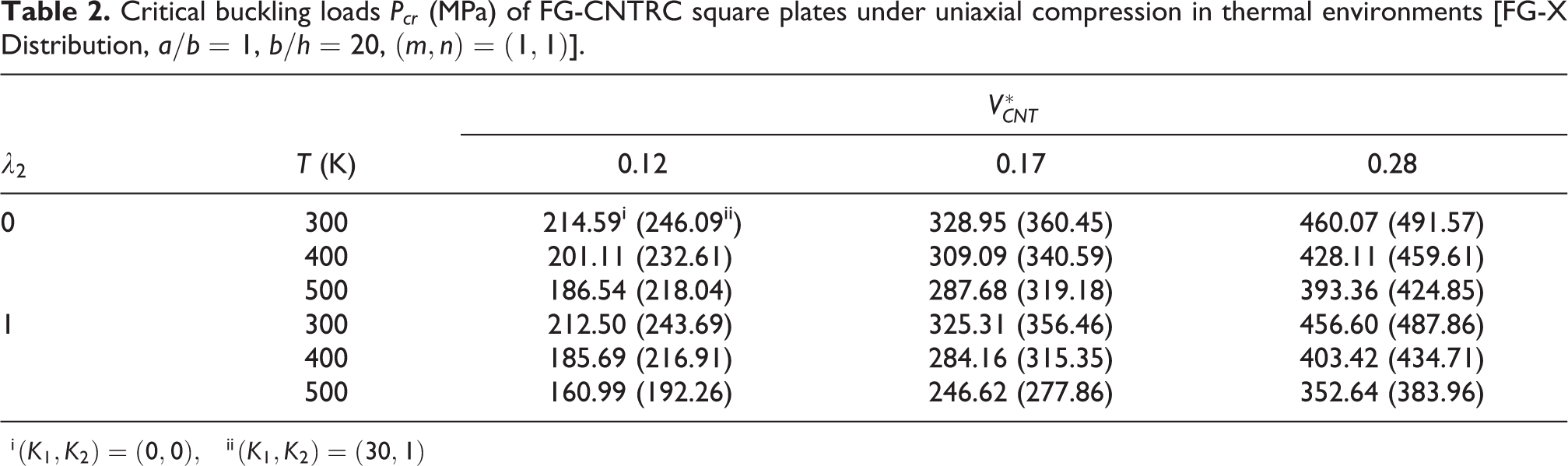
Figure 3 indicates the effects CNT distribution patterns on the postbuckling behavior of perfect and imperfect CNTRC plates with movable unloaded edges. Among four types of CNT distribution, FG-X and FG-O plates have the highest and lowest postbuckling paths, respectively. The deflection of the plate is smaller and larger when CNTs are more concentrated at near two surfaces and the middle of plate, respectively. Next, as indicated in Figure 4, postbuckling paths are higher and more quickly developed when the volume fraction

Effects of CNT distribution patterns on the postbuckling behavior of CNTRC plates under uniaxial compression with movable uncompressed edges.

Effects of CNT volume fraction and thermal environments on postbuckling behavior of FG-CNTRC plates with partially movable unloaded edges.
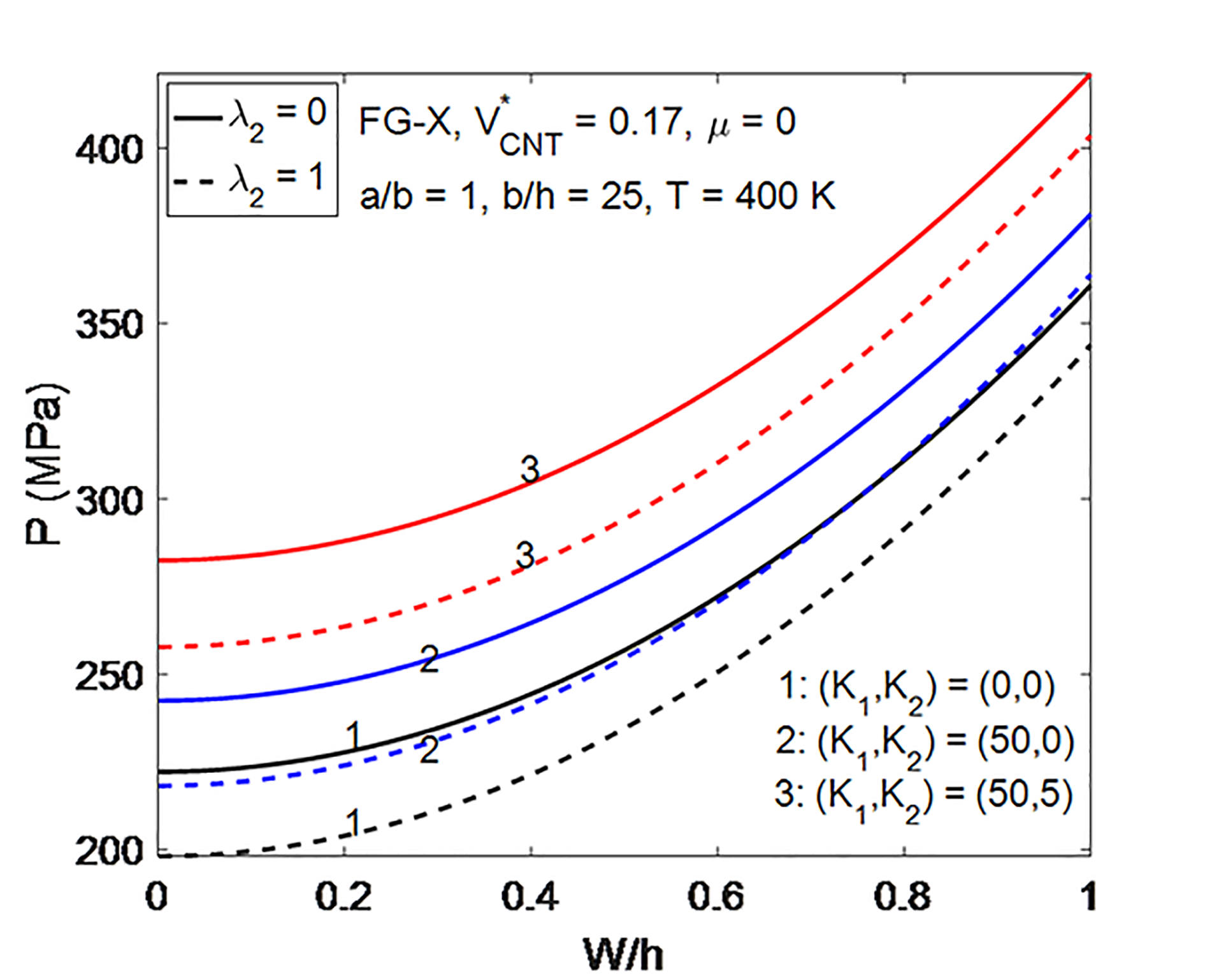
Effects of elastic foundations and constraints of unloaded edges on the postbuckling of FG-CNTRC plates under uniaxial compression in a thermal environment.

Effects of initial imperfection on the thermomechanical postbuckling behavior of FG-CNTRC plates under uniaxial compression in a thermal environment.
Thermally induced postbuckling of pre-compressed nanocomposite plates
Numerical results on thermal postbuckling behavior of nanocomposite plates under nondestabilizing preexisting uniaxial compression with partially movable or immovable unloaded edges are presented in this subsection. Figure 7 analyzes the effects of CNT distribution patterns on the postbuckling behavior of pre-compressed CNTRC plates with immovable uncompressed edges under uniform temperature rise. It is clear that FG-X type of distribution yields the best load carrying capability of nanocomposite plate. Although buckling temperatures of FG-V and
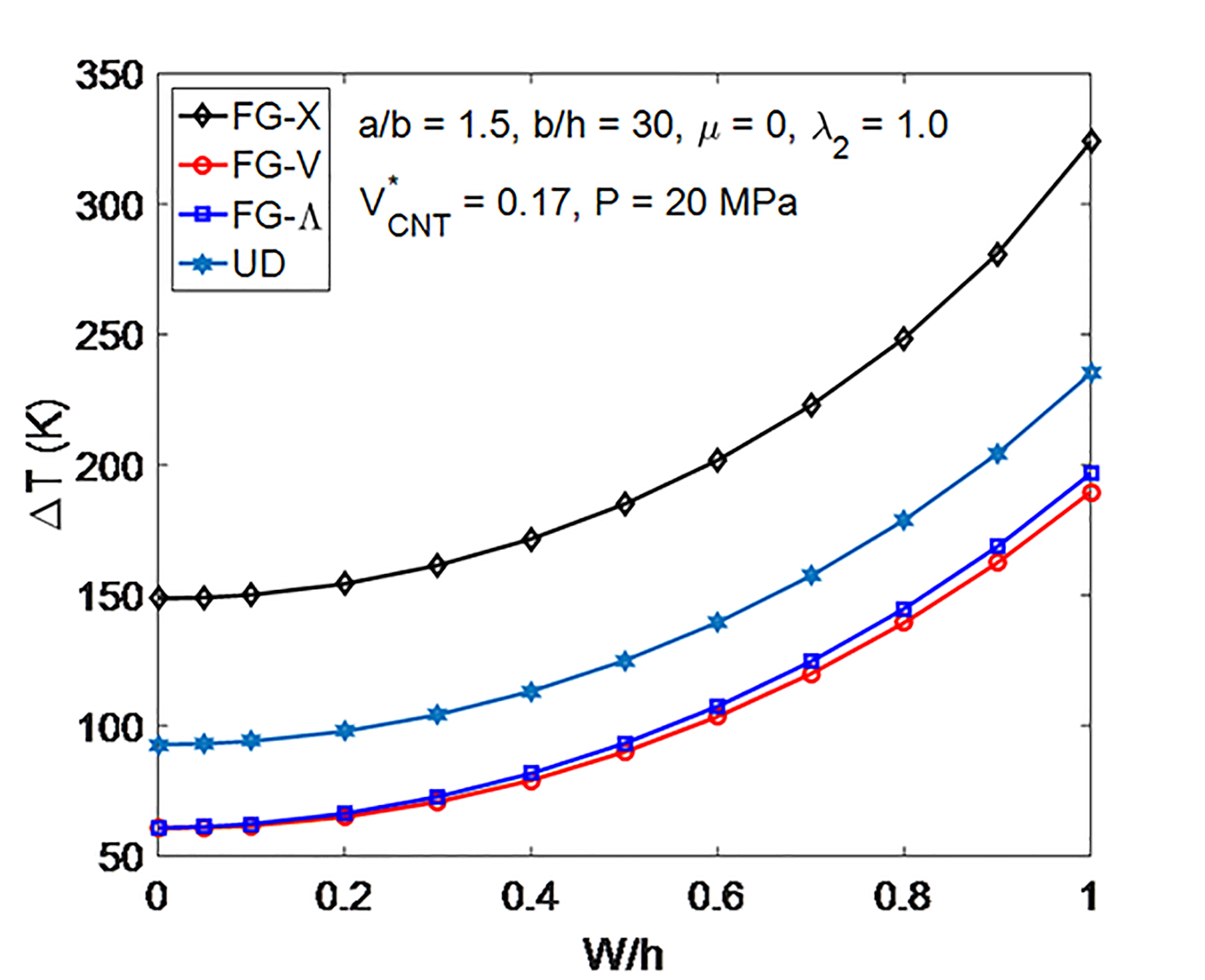
Effects of CNT distribution patterns on thermal postbuckling of CNTRC plates under preexisting uniaxial compression.

Effects of tangential constraints of uncompressed edges on thermal postbuckling of CNTRC plates under preexisting uniaxial compression.
Next example is shown in Figure 9 considering the effects of preexisting uniaxial compressive loads on thermal postbuckling behavior of FG-CNTRC plates with immovable uncompressed edges. Obviously, buckling thermal load and postbuckling strength of the plates are considerably decreased due to increase in preexisting uniaxial compression. In other words, a combination of active loads on movable edges and passive loads on immovable edges makes the plates buckled sooner and postbuckling strength reduced. Finally, effects of elastic foundations and CNT volume fraction on thermomechanical postbuckling of pre-compressed nanocomposite plates are examined in Figure 10. Both elastic foundation and high percentage of CNT reinforcement have beneficial influences on the buckling loads and postbuckling paths. Furthermore, positive effects of higher percentage of CNTs become more significant for the case of plate without elastic foundation. This result reflects a fact that the deflection of the plate is decreased due to the support of elastic foundation and, consequently, the efficiency of CNT richness is lowered.
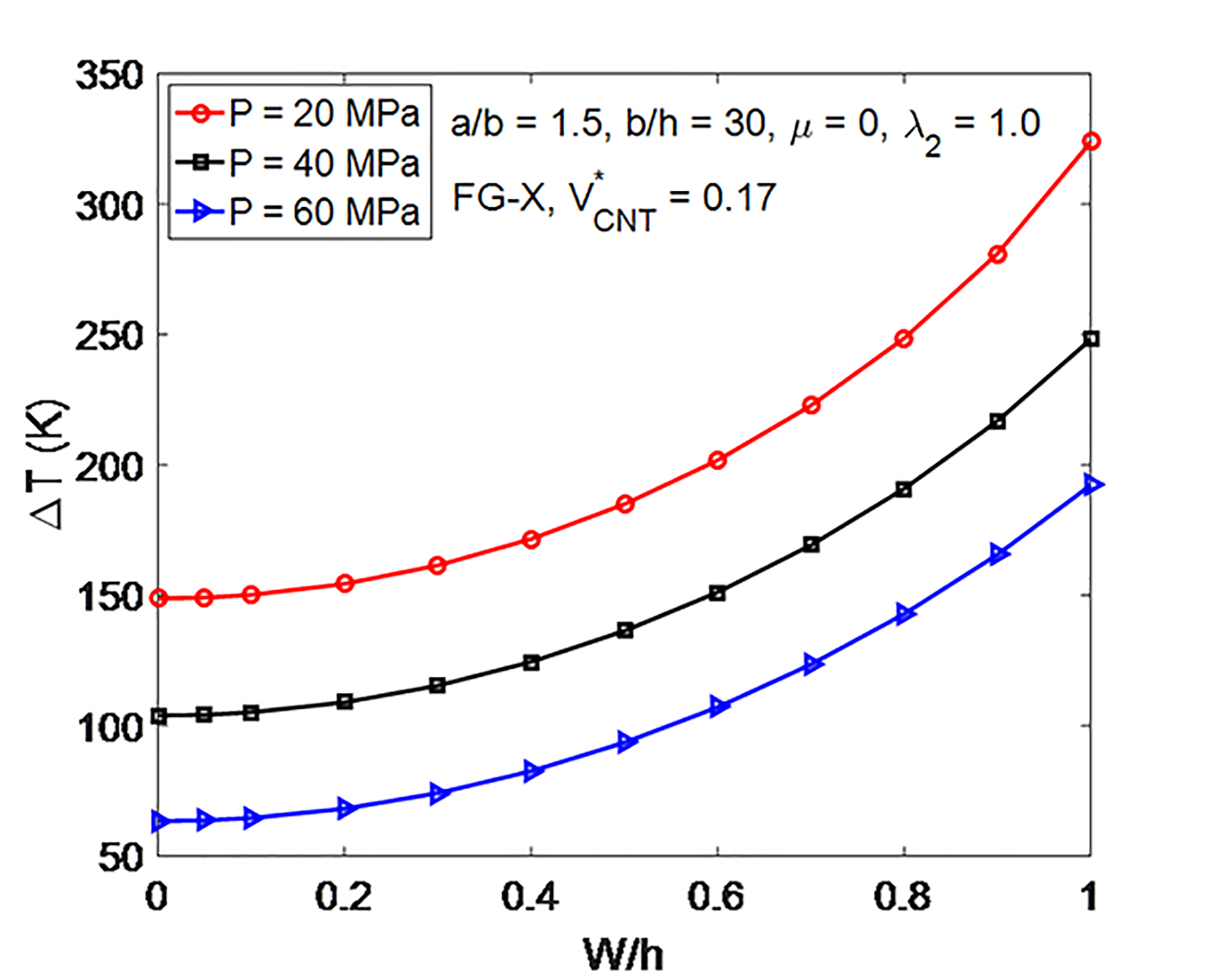
Effects of preexisting uniaxial compressive load on thermal postbuckling of FG-CNTRC plates under uniform temperature rise.

Effects of elastic foundation and CNT volume fraction on thermal postbuckling of pre-compressed FG-CNTRC plates under uniform temperature rise.
Concluding remarks
Basing on an analytical approach and higher order shear deformation theory, the buckling and postbuckling behavior of thick FG-CNTRC plates resting on elastic foundations under two types of thermomechanical load have been presented. To reflect more exactly practical situations, the elasticity of tangential constraints of unloaded edges and temperature dependence of material properties are taken into consideration. The study reveals that tangential condition of unloaded edges has significant effects on the buckling loads and postbuckling load carrying capability, especially at elevated temperatures. Specifically, the postbuckling paths of mechanically loaded plates in thermal environments and thermally loaded plates under preexisting compression are considerably decreased as unloaded edges are partially movable or immovable. The results also indicate that an intermediate percentage of CNT reinforcement and support of an elastic foundation can yield a positive improvement in buckling resistance and load carrying capabilities of thermomechanically loaded nanocomposite plates.
Footnotes
Declaration of conflicting interests
The author(s) declared no potential conflicts of interest with respect to the research, authorship, and/or publication of this article.
Funding
The author(s) received no financial support for the research, authorship, and/or publication of this article.
