



Abstract
Buckling and postbuckling behaviors of sandwich plates reinforced by single-walled carbon nanotube (CNT), rested on elastic foundations and subjected to uniform temperature rise, are investigated in this article. CNT is embedded into matrix phase through uniform or functionally graded distributions. The properties of constituent materials are assumed to be temperature-dependent, and effective properties of nanocomposite are determined by extended rule of mixture. Two models of sandwich plates with face sheets and core layer reinforced by CNTs are presented. Formulations are based on the first-order shear deformation theory taking geometrical nonlinearity, initial geometrical imperfection, plate-foundation interaction, and elasticity of tangential edge constraints into consideration. Analytical solutions of deflection and stress function are assumed, and Galerkin method is applied to derive nonlinear temperature–deflection relation from which buckling temperatures and thermal postbuckling paths are obtained through an iteration algorithm. Numerical examples show the effects of CNT volume fraction, distribution patterns, in-plane edge constraint, elastic foundations, geometrical ratios, initial imperfection, and temperature dependence of properties on thermal postbuckling behavior of nanocomposite sandwich plates. The most important finding is that sandwich plate constructed from CNT-poor nanocomposite core layer and thin homogeneous face sheets with partially movable edges bring the best capacities of thermal buckling resistance and postbuckling load carrying.
Keywords
Introduction
Due to unprecedentedly excellent mechanical, thermal, and electrical properties, and extremely large aspect ratio, carbon nanotube (CNT) is ideal filler into polymer matrix to form carbon nanotube–reinforced composite (CNTRC) known as an advanced nanocomposite. 1 –3 Idea of optimal distribution of CNTs motivated the concept of functionally graded CNTRC (FG-CNTRC) 4 in which CNTs are reinforced into isotropic polymer matrix such that their volume fraction is varied along the plate thickness through functional rules in order to obtain desired responses of nanocomposite structures. This propositional work of Shen 4 stimulated subsequent investigations on static and dynamic responses of FG-CNTRC structures. Tornabene et al. 5 studied the linear static response of CNTRC plates and shells accounting for agglomeration of CNTs. Free vibration of FG-CNTRC plates with arbitrary shapes has been analyzed by Fantuzzi et al. 6 using the generalized differential quadrature method. Based on a numerical approach, Mehar et al. 7 examined the free vibration behavior of FG-CNTRC plates under elevated thermal environment. Fazzolari 8 employed Ritz method to investigate the thermoelastic vibration and stability characteristics of FG-CNTRC plates. Bakhadda et al. 9 analyzed the dynamic and bending behavior of CNTRC plates on elastic foundations. Free vibration response of functionally graded nanoscale plates has been considered in works. 10,11
Buckling and postbuckling behaviors of plates and shells made of composite materials have attracted attention of many researchers. 12 –19 Numerous investigations have been conducted on the subject of stability behavior of FG-CNTRC plates and shells under mechanical loads. Based on a numerical approach with element-free methods, Liew and coworkers 20 –23 investigated the linear buckling of FG-CNTRC rectangular and skew plates with transverse shear deformation under compressive loads. Using Ritz method with different shape functions, Kiani and collaborator 24 –26 dealt with linear buckling problem for FG-CNTRC rectangular and skew plates with various boundary conditions subjected to shear, compressive, and parabolic mechanical loadings. Linear buckling behavior of FG-CNTRC cylindrical panels under axial compression and shear loads has been analyzed by Macias et al. 27 utilizing shell finite elements. Zhang and Liew 28 used element-free approach to study postbuckling response of axially compressed FG-CNTRC plates resting on Pasternak foundations. Making use of asymptotic solutions and a perturbation technique, Shen and co-operators 29 –34 presented the results of postbuckling analysis for higher order shear deformable FG-CNTRC cylindrical panels and shells subjected to axial compression, external pressure, and combined loads in thermal environments. Recently, Hieu and Tung 35 employed an analytical approach to examine the nonlinear stability of FG-CNTRC circular cylindrical shells surrounded by elastic media and simultaneously loaded by axial compression and lateral pressure.
Since composite and nanocomposite structures are usually exposed to severe temperature conditions, the stability of nanocomposite beams, plates, and shells under thermal loadings is a problem with considerable importance. Based on some different plate theories and approaches, Tounsi and coworkers 36 –39 dealt with the stability problem of single layer and sandwich plates made of functionally graded materials and subjected to thermal loads. Mirzaei and Kiani 40,41 treated the linear buckling problem of rectangular plates and conical shells reinforced by CNTs and exposed to uniform temperature rise. Based on different plate theories and various approaches, the postbuckling problem of FG-CNTRC rectangular plates subjected to thermal loadings has been dealt with in works of Shen and Zhang, 42 Kiani, 43 and Tung. 44 Postbuckling analyses for FG-CNTRC cylindrical panels and shells under elevated temperatures have been carried out by Shen and Xiang 45 and Shen, 46 respectively, making use of a higher order shear deformation theory and a perturbation technique. Thermal buckling and postbuckling behaviors of functionally graded graphene-reinforced laminated plates have been addressed in works of Mirzaei and Kiani 47,48 using B-spline-based isogeometric finite-element method, Wu et al. 49 employing a differential quadrature-based iteration technique, and Shen et al. 50 utilizing a two-step perturbation technique.
Due to outstanding properties, sandwich-type structures play an important role in engineering applications, and appearance of advanced nanocomposites motivates investigations on behavior of sandwich structures comprising of CNTRCs. Wang and Shen 51 and Shen et al. 52 investigated nonlinear vibration and bending behavior of sandwich plates with CNTRC face sheets on elastic foundations. Free vibration of sandwich plates with CNTRC face sheets has been analyzed by Wang et al. 53 employing multi-term Kantorovich–Galerkin method. The vibration characteristics of CNT-reinforced sandwich plates and curved panels exposed to elevated temperature have been considered in works of Mehar and coworkers 54,55 using the finite element method. Based on some different plate theories and differential cubature method, the bending, vibration, static buckling, and dynamic buckling responses of sandwich nanocomposite plates have been examined by Kolahchi 56 and Kolahchi et al. 57 taking into account piezoelectric layers and viscoelastic effects. Using a numerical approach, Natarajan et al. 58 studied the bending and free vibration of sandwich plates with CNTRC face sheets. Employing the shooting and pseudospectral methods, Jalali and Heshmati 59 analyzed the linear buckling behavior of circular sandwich plates with tapered cores and FG-CNTRC face sheets. Shokravi 60 used Navier’s solution method to calculate buckling load of sandwich plates with FG-CNTRC layers resting on orthotropic elastic foundations subjected to magnetic field. Shen and Zhu 61 investigated the postbuckling behavior of sandwich plates with FG-CNTRC face sheets resting on elastic foundations subjected to compressive load and uniform temperature rise. The thermal postbuckling behavior of sandwich plates with FG-CNTRC face sheets and various boundary conditions has been considered in work of Kiani 62 using Ritz method with Chebyshev polynomials as shape functions.
Due to elasticity of in-plane constraints of boundary edges, the effects of tangential edge restraints on the response of structures should be considered. Previous works of Tung 63 –66 indicated that tangential restraints of boundary edges have dominant influences on buckling load and postbuckling strength of ceramic-metal functionally graded plates and shells. Based on the first-order shear deformation theory (FSDT) and element-free improved moving least-squares Ritz method, Zhang et al. 67 –69 presented results of geometrically nonlinear, free vibration, and compressive postbuckling analyses for FG-CNTRC plates with edges elastically restrained against translation and rotation. Recently, Tung and Trang 44,70 –74 considered the effects of tangential edge constraints on the nonlinear stability of FG-CNTRC plates and cylindrical panels resting on elastic foundations and subjected to thermal, mechanical, and thermomechanical loadings. More recently, Hieu and Tung 75 analyzed the effects of tangential edge constraints on the thermomechanical nonlinear buckling behavior of FG-CNTRC toroidal shell segments.
Investigations on CNTRC sandwich structures in the literature only considered sandwich plates and shells with CNTRC face sheets. To the best of authors’ knowledge, there is no study on thermal postbuckling behavior of CNTRC sandwich plates resting on elastic foundations with elastically restrained edges. This article investigates the buckling and postbuckling behaviors of sandwich plates reinforced by CNTs, rested on elastic foundations and exposed to uniform temperature rise. Besides sandwich plate model with CNTRC face sheets, another sandwich plate model with CNTRC core layer and homogeneous face sheets is suggested in this article. The material properties of CNTs, matrix, and homogeneous layer are assumed to be temperature-dependent, and the effective properties of nanocomposite layer are estimated by extended rule of mixture. Formulations for geometrically imperfect CNTRC sandwich plates are based on the FSDT accounting for Von Karman nonlinearity, plate-foundation interaction, and elasticity of in-plane constraints of edges. Analytical solutions are assumed, and Galerkin method is applied to obtain nonlinear temperature-deflection relation from which buckling temperatures and thermal postbuckling paths are determined through an iteration process. Many various effects including beneficial and detrimental influences on the thermal postbuckling response of CNTRC sandwich plates are analyzed through numerical examples, and concluding remarks are suggested. The most important finding is that sandwich plate model with CNTRC core layer and thin homogenous face sheets can bring the best capabilities of thermal buckling resistance and postbuckling load carrying.
Two models of sandwich plates reinforced by CNTs
Consider a rectangular sandwich plate of length a, width b, and total thickness h reinforced by CNTs and rested on an elastic foundation. The plate is defined in a Cartesian coordinate system xyz origin of which is located at a corner on the middle surface, x and y axes are directed toward length and width edges, respectively, and z-axis is perpendicular to the middle surface of the plate (
Sandwich plate of type A: Homogeneous core layer and CNTRC face sheets
In this type of sandwich plate, the core layer is isotropic homogeneous, and face sheets are reinforced by CNTs as shown in Figure 1. The volume fractions VCNT of CNTs in face sheets corresponding to five different types of distribution, named as uniform distribution (UD), FG-X, FG-Λ, FG-V, and FG-O, are given in Table 1 in which
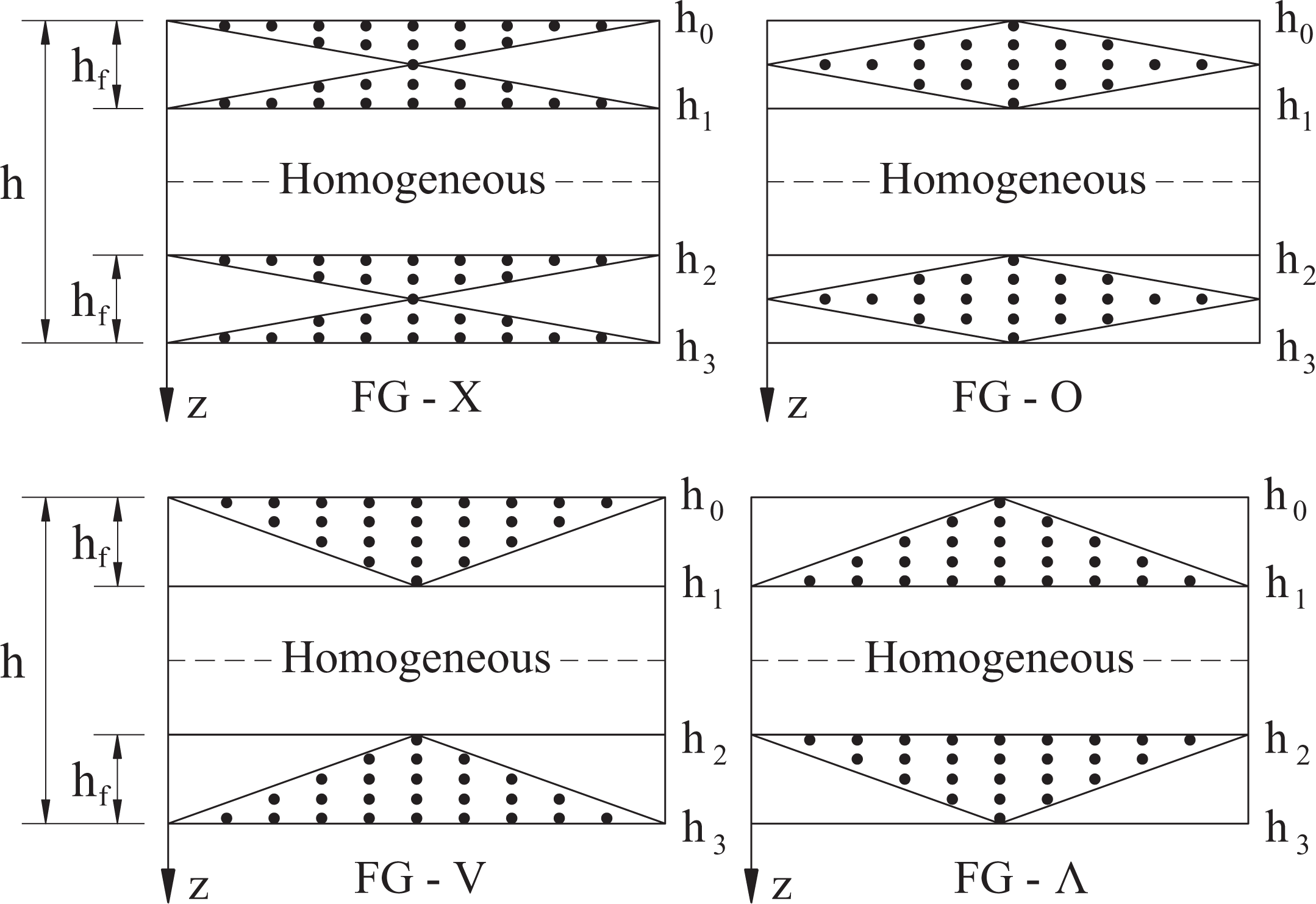
FG types of CNT distribution into CNTRC face sheets of sandwich plate of type A. FG: functionally graded; CNT: carbon nanotube; CNTRC: carbon nanotube–reinforced composite.
Volume fraction VCNT(z) of CNTs in face sheets of sandwich plate of type A.
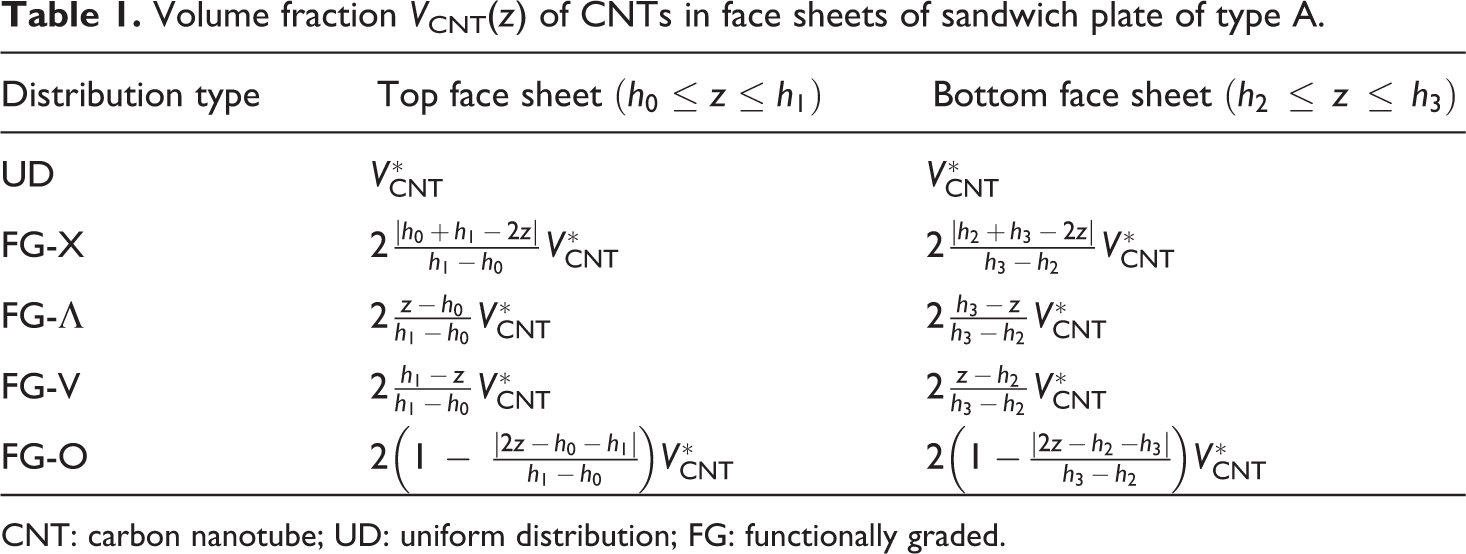
CNT: carbon nanotube; UD: uniform distribution; FG: functionally graded.
Sandwich plate of type B: CNTRC core layer and homogeneous face sheets
For sandwich plate of type B, the core layer is reinforced by CNTs, and face sheets are isotropic homogeneous as illustrated in Figure 2. The volume fractions VCNT of CNTs in core layer (
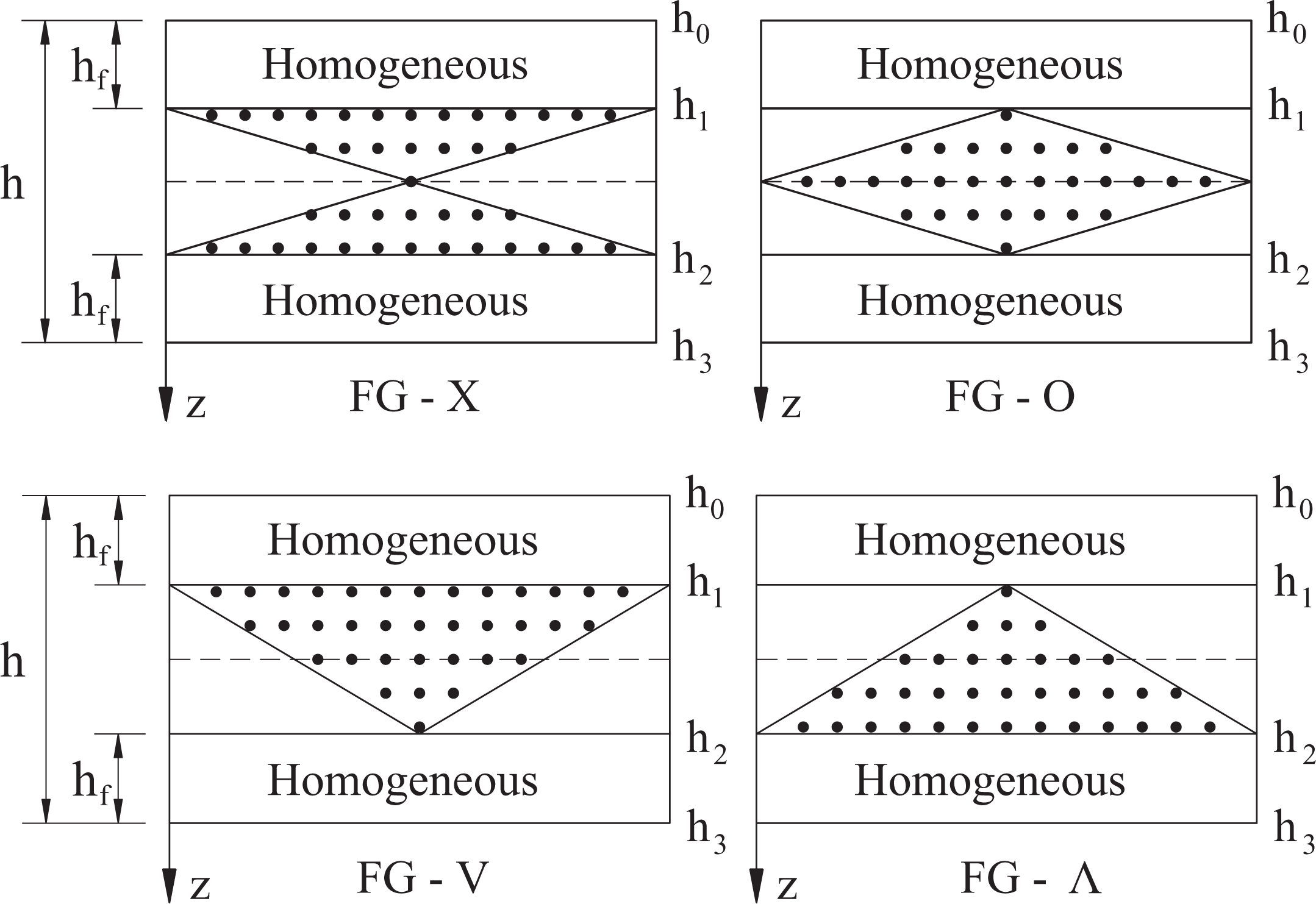
FG types of CNT distribution into CNTRC core layer of sandwich plate of type B. FG: functionally graded; CNT: carbon nanotube; CNTRC: carbon nanotube–reinforced composite.
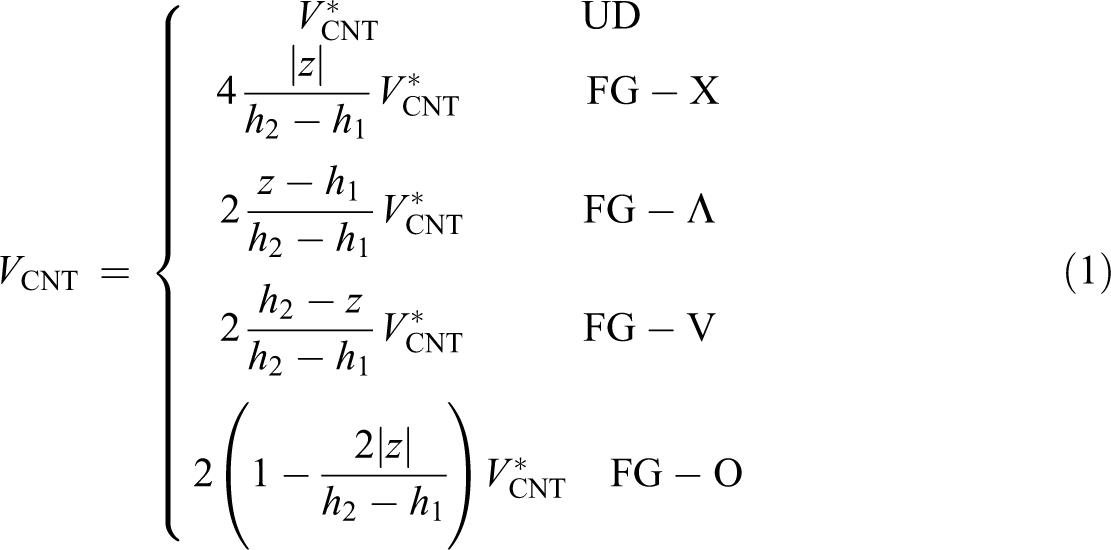
In this study, the properties of constituents are assumed to be temperature-dependent, and effective elastic moduli of CNTRC are determined according to extended rule of mixture as 4,42



where
Effective Poisson ratio of CNTRC is assumed to be position- and temperature-independent and is determined as

where
Subsequently, effective coefficients of thermal expansion of CNTRC layers in the longitudinal and transverse directions have the form as 45,46,62


where
Formulations
The present study uses FSDT to formulate for moderately thick sandwich plates. Based on the FSDT, strain components at a z distance from middle surface are expressed as

where, herein, subscript prime indicates partial derivative with respect to corresponding variable, for example,

in which u, v, and w denote the displacements of a point on the plane
In this study, thermal loading is considered to be uniform temperature rise. Specifically, CNTRC sandwich plate is exposed to a thermal environment temperature of which is uniformly raised from thermal stress free initial state T0 to final value T and temperature change
The stress components in CNTRC sandwich plate are determined as
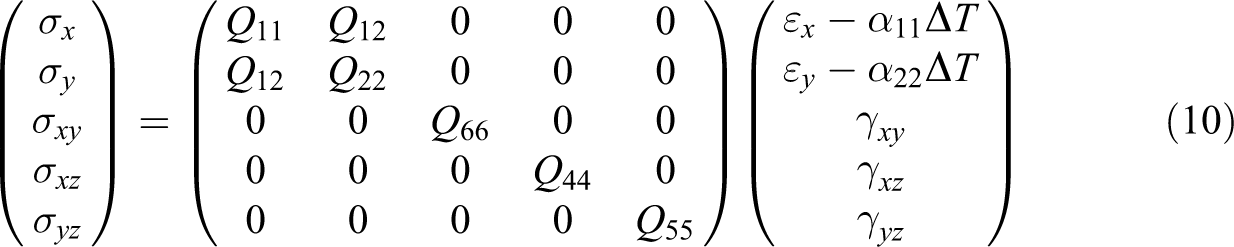
where

in CNTRC layers (i.e.


in isotropic homogeneous layers (i.e.
Force and moment resultants in the CNTRC sandwich plate are determined as


where
From equations (8), (10), and (13), the force and moment resultants are expressed as




where



The sandwich plate is assumed to be rested on an elastic foundation, and plate-foundation interaction is represented according to Pasternak model as

in which k1 is the elastic modulus of Winkler springs, and k2 is the stiffness of shear layer in Pasternak model.
Based on the FSDT, nonlinear equilibrium equation of geometrically imperfect CNTRC sandwich plate resting on an elastic foundation has the form 73


where
Next, strain compatibility equation of moderately thick CNTRC sandwich plate with initial geometrical imperfection has the form 73


where coefficients
In the present study, all edges of the plate are assumed to be simply supported and tangentially restrained. The associated boundary conditions are expressed as

where

in which c1 and c2 are average tangential stiffness parameters in the x and y directions on each opposite edge, respectively, and the average end-shortening displacements are defined as

To satisfy boundary conditions (19) approximately, analytical solutions of the deflection, stress function, and rotations are assumed as



where


where coefficients
Next, solutions (22)–(24) are substituted into the equilibrium equation (17), and applying Galerkin method for the resulting equation yields the following expression


where
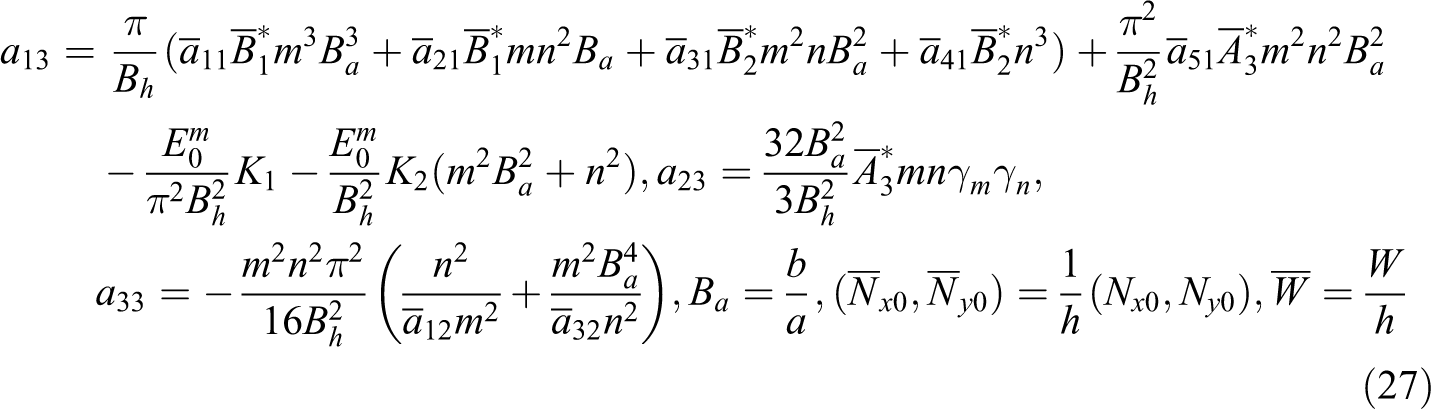
in which

and
From equations (9) and (14),


and a combination of equations (20), (29), and (30) leads to the following expressions of fictitious force resultants


in which coefficients
Now, placing

Evidently, buckling temperature change of geometrically perfect CNTRC sandwich plate is determined as

and critical buckling temperature change
Due to temperature dependence of material properties, critical buckling temperature changes and thermal postbuckling paths are determined through an iteration algorithm. Detailed steps of iteration process have been described in previous works 63,64 and are omitted here for the sake of brevity.
Results and discussion
This section presents numerical results of buckling and postbuckling analyses for CNTRC sandwich plates of types A and B constructed from CNTRC and homogeneous layers and subjected to uniform temperature rise. The CNTRC layers are made of poly_(methyl methacrylate), referred to as PMMA, as matrix material, and are reinforced by (10, 10) single-walled carbon nanotubes (SWCNTs). The isotropic homogeneous layers are made of Ti-6Al-4V temperature-dependent properties of which are 62



The temperature-dependent properties of the PMMA are assumed to be
Verification
To verify the presented approach, the postbuckling behavior of a simply supported sandwich plate of type A with FG-CNTRC face sheets under uniform temperature rise is considered. The sandwich plate is assumed to be geometrically perfect, with immovable boundary edges and without elastic foundations. Postbuckling temperature-deflection curve of a sandwich plate with FG-CNTRC face sheets is given in Figure 3 in comparison with the result of Kiani 62 using Ritz method, the shape functions of which are estimated according to the Chebyshev polynomials. As can be seen, a good agreement is achieved in this comparison.
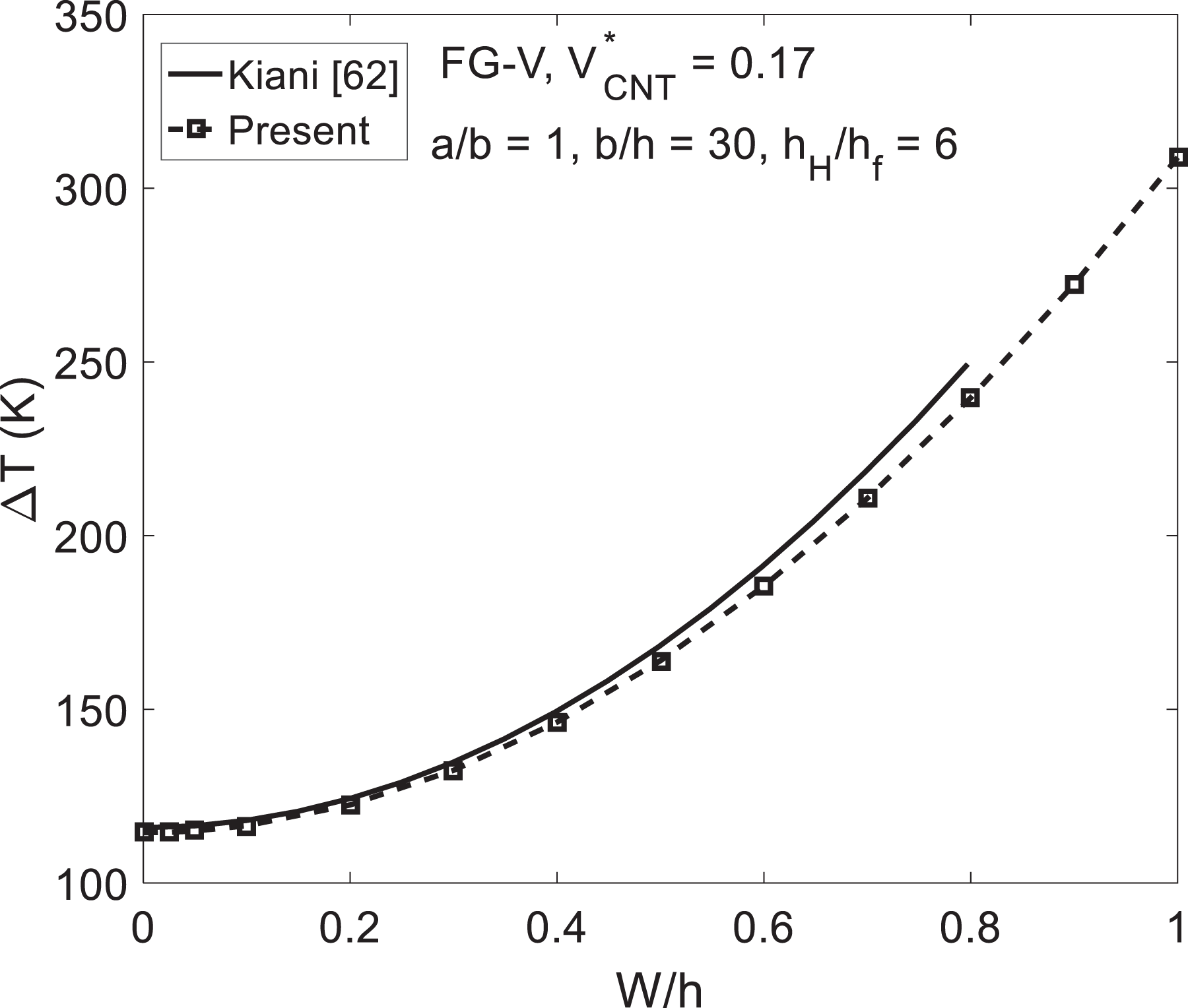
Comparison of postbuckling curves of a sandwich plate with CNTRC face sheets and immovable edges under uniform temperature rise. CNTRC: carbon nanotube–reinforced composite.
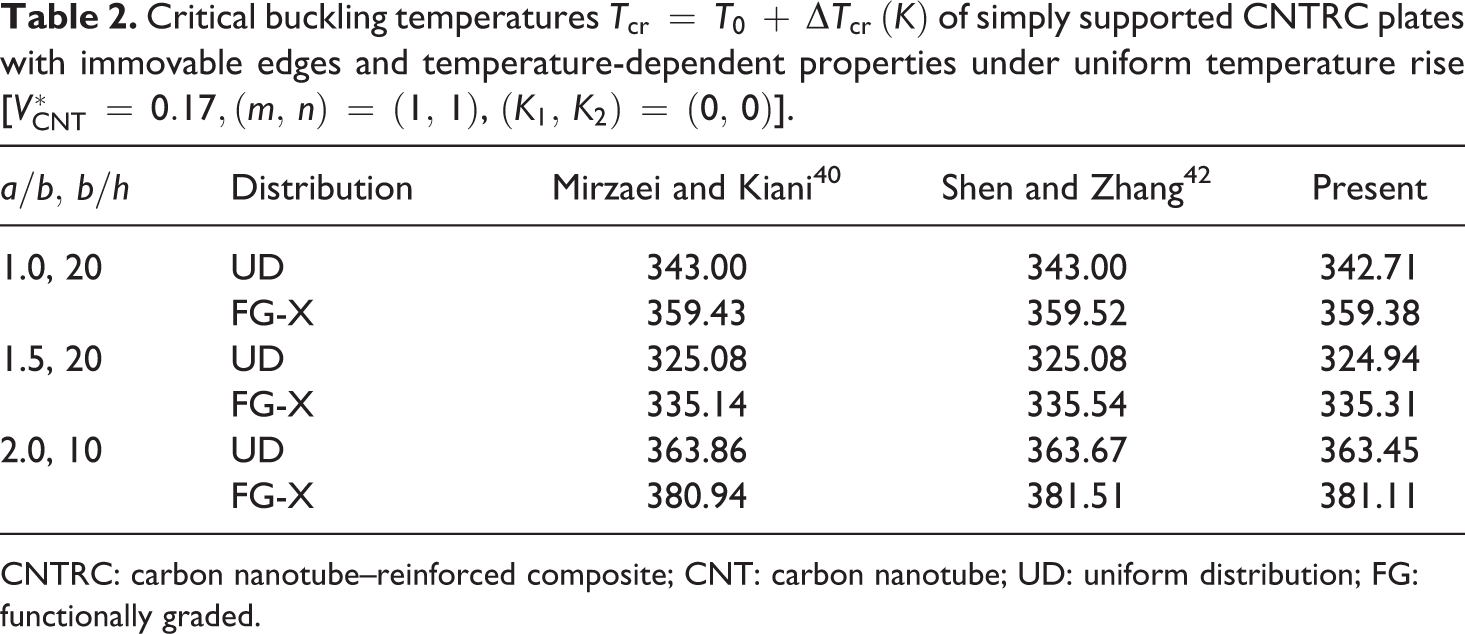
As a second example for validation, thermal buckling behavior of a simply supported CNTRC plate with immovable edges, without elastic foundations and subjected to uniform temperature rise, is considered. Critical buckling temperatures of CNTRC plates obtained by the present work for a special case of CNTRC sandwich plate of type B as

Critical buckling temperatures
CNTRC: carbon nanotube–reinforced composite; CNT: carbon nanotube; UD: uniform distribution; FG: functionally graded.
Again, it is evident from Table 2 that our result excellently agrees with those in the literature.
In what follows, thermal buckling and postbuckling behaviors of CNTRC sandwich plates of types A and B will be analyzed. To measure degree of in-plane constraints of edges in a more convenient way, the following nondimensional tangential stiffness parameters are defined

In such a way, values of
Thermal buckling analysis
Results of thermal buckling analysis for geometrically perfect CNTRC sandwich plates of types A and B are given in this subsection. Table 3 indicates the effects of CNT volume fraction and distribution patterns in nanocomposite layer and ratio of homogeneous core thickness to face sheet thickness
Comparisons of critical buckling temperature change
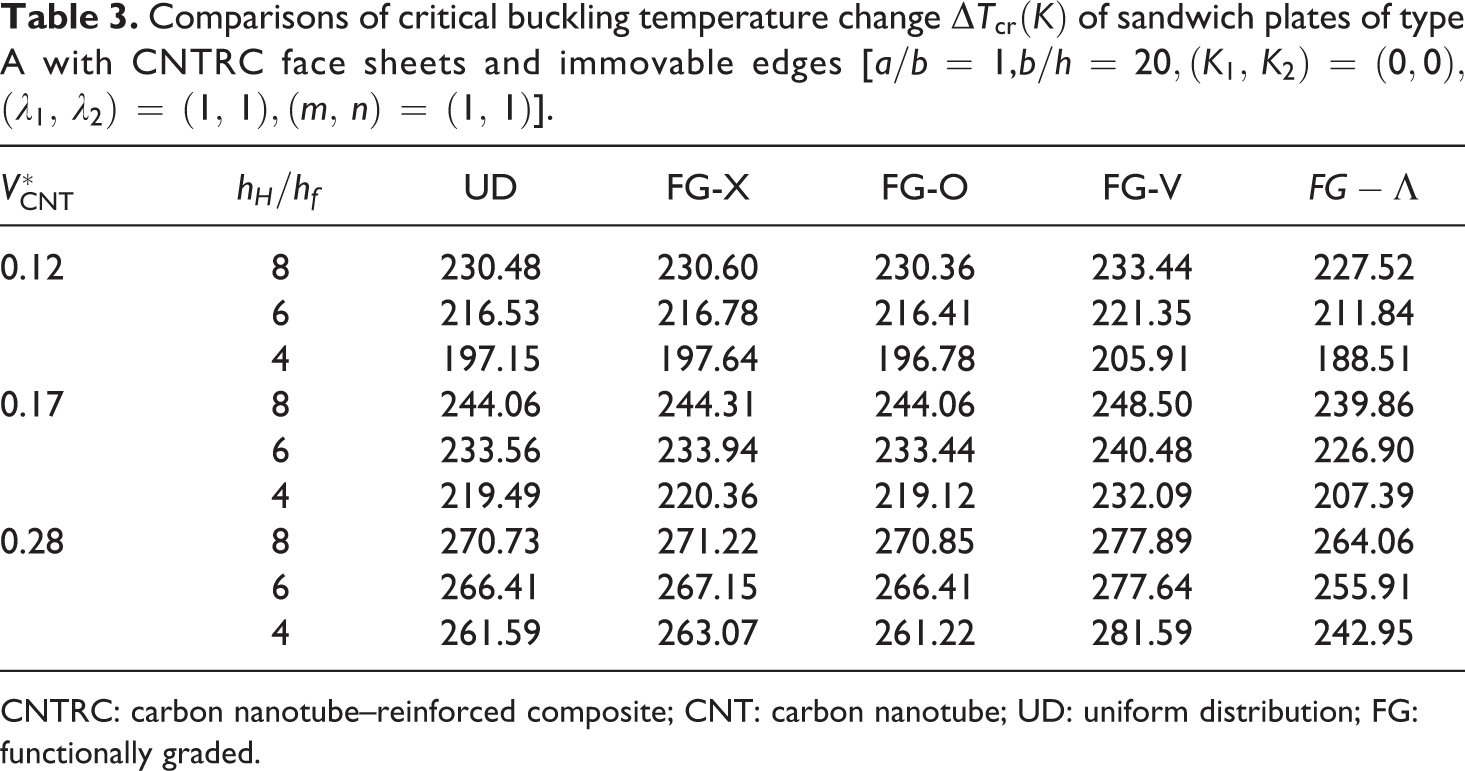
CNTRC: carbon nanotube–reinforced composite; CNT: carbon nanotube; UD: uniform distribution; FG: functionally graded.
Effects of tangential edge constraints, elastic foundations, and aspect ratio on critical buckling temperature change
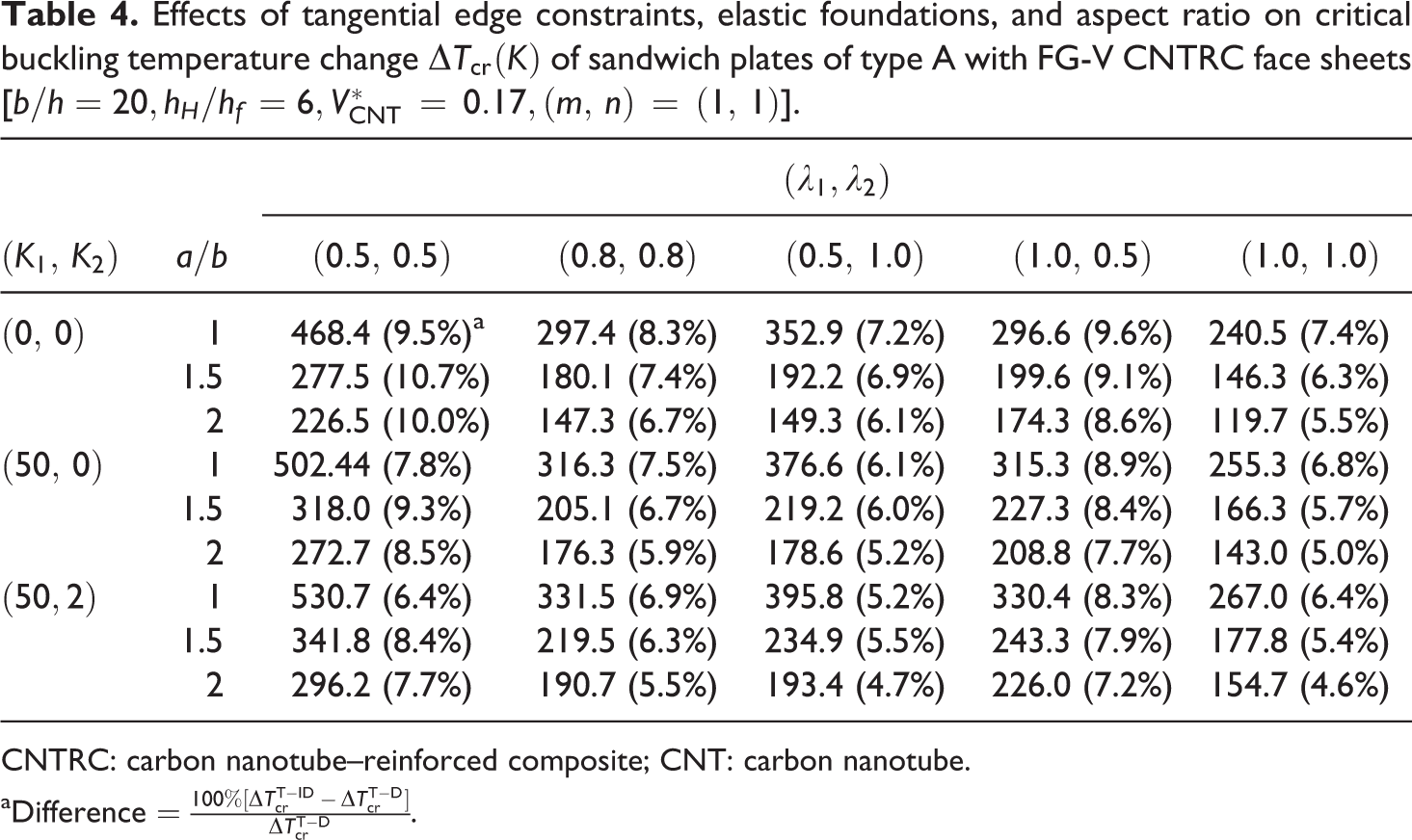
CNTRC: carbon nanotube–reinforced composite; CNT: carbon nanotube.
aDifference =
The effects of CNT volume fraction
Comparisons of critical temperature change
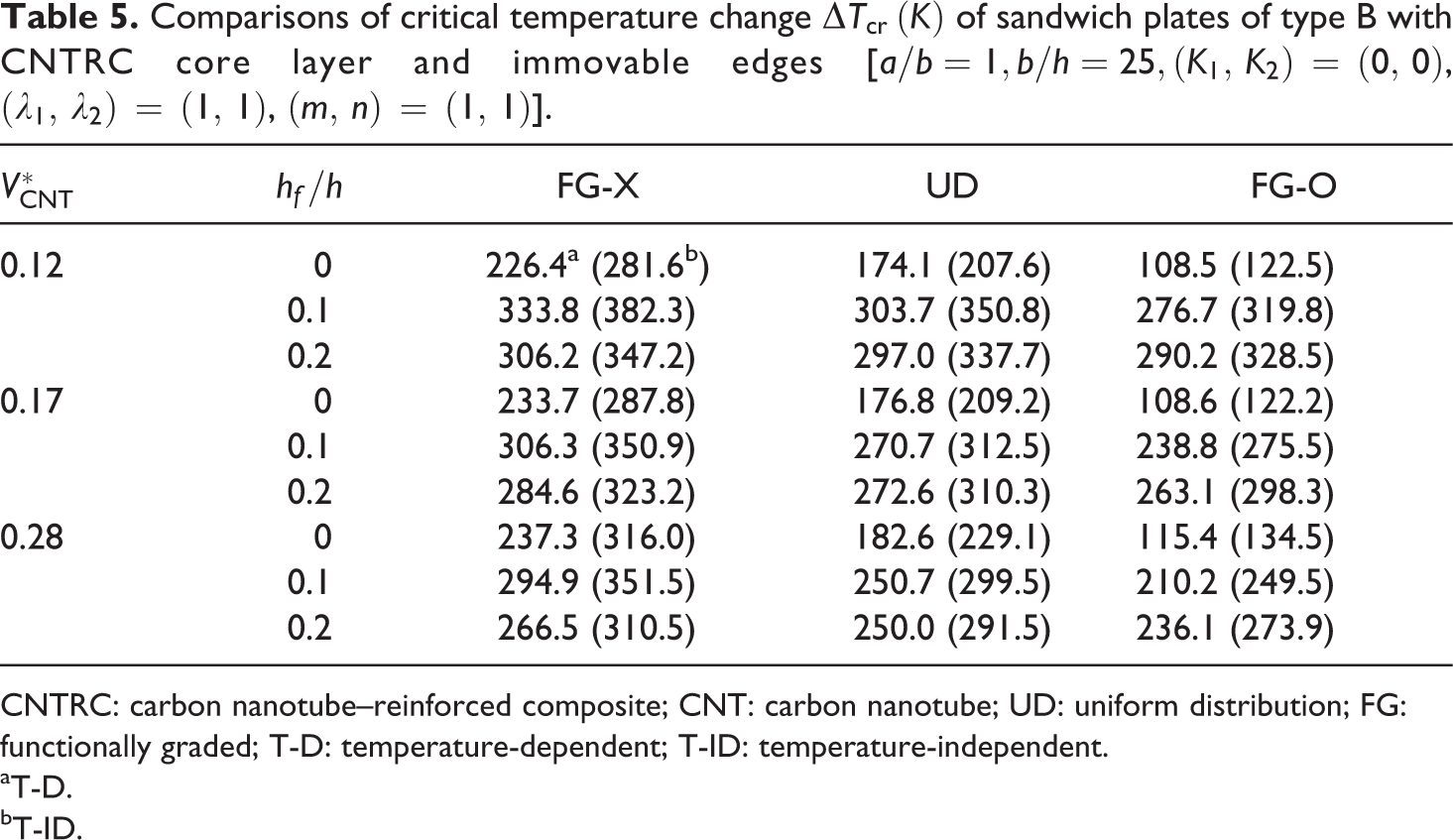
CNTRC: carbon nanotube–reinforced composite; CNT: carbon nanotube; UD: uniform distribution; FG: functionally graded; T-D: temperature-dependent; T-ID: temperature-independent.
aT-D.
bT-ID.
Final example for thermal buckling analysis is shown in Figure 4 considering the effects of
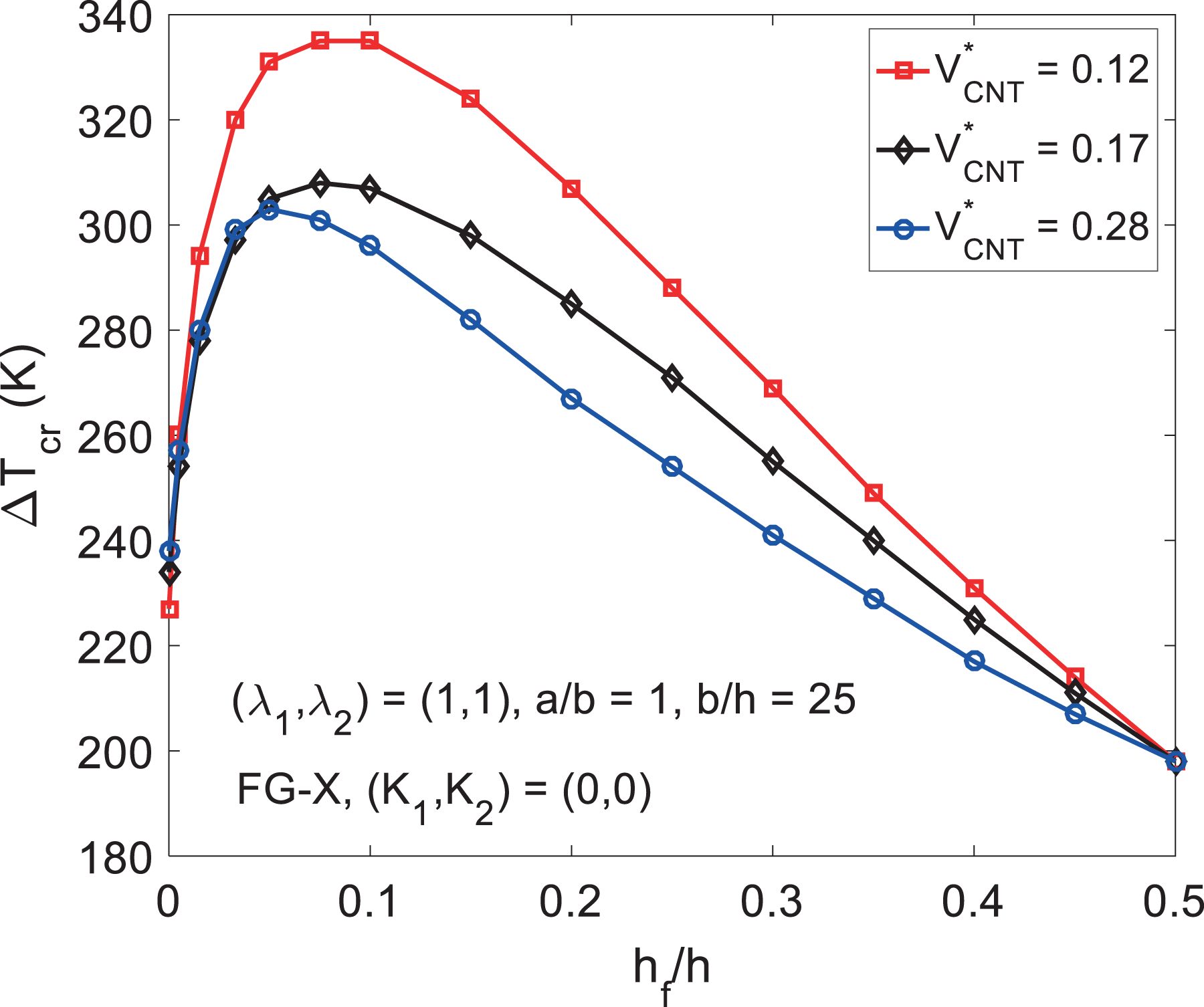
Effects of thickness of face sheets on critical thermal load of geometrically perfect sandwich plates of type B with FG-CNTRC core layer and immovable edges. FG-CNTRC: functionally graded carbon nanotube–reinforced composite.
Thermal postbuckling analysis
This subsection presents numerical illustrations of thermal postbuckling analysis for CNTRC sandwich plates in graphical form. Figure 5 shows the effects of CNT distribution types on the postbuckling behavior of sandwich plates of type A with CNTRC face sheets and immovable edges under uniform temperature rise. It is obvious that postbuckling paths of FG-V and FG-Λ plates are the highest and lowest, respectively, whereas postbuckling paths of FG-X, FG-O, and UD plates are very close to each other. Accordingly, for midplane symmetric model of CNTRC sandwich plate of type A, FG-V type of CNT distribution bring the best postbuckling response under thermal load. Next, the effects of tangential constraints of boundary edges on the thermal postbuckling behavior of CNTRC sandwich plates of type A are examined in Figure 6. This figure indicates that thermal load carrying capability of sandwich plates is significantly lowered as edges are prevented from in-plane displacement. More specifically, equilibrium paths are strongly dropped as
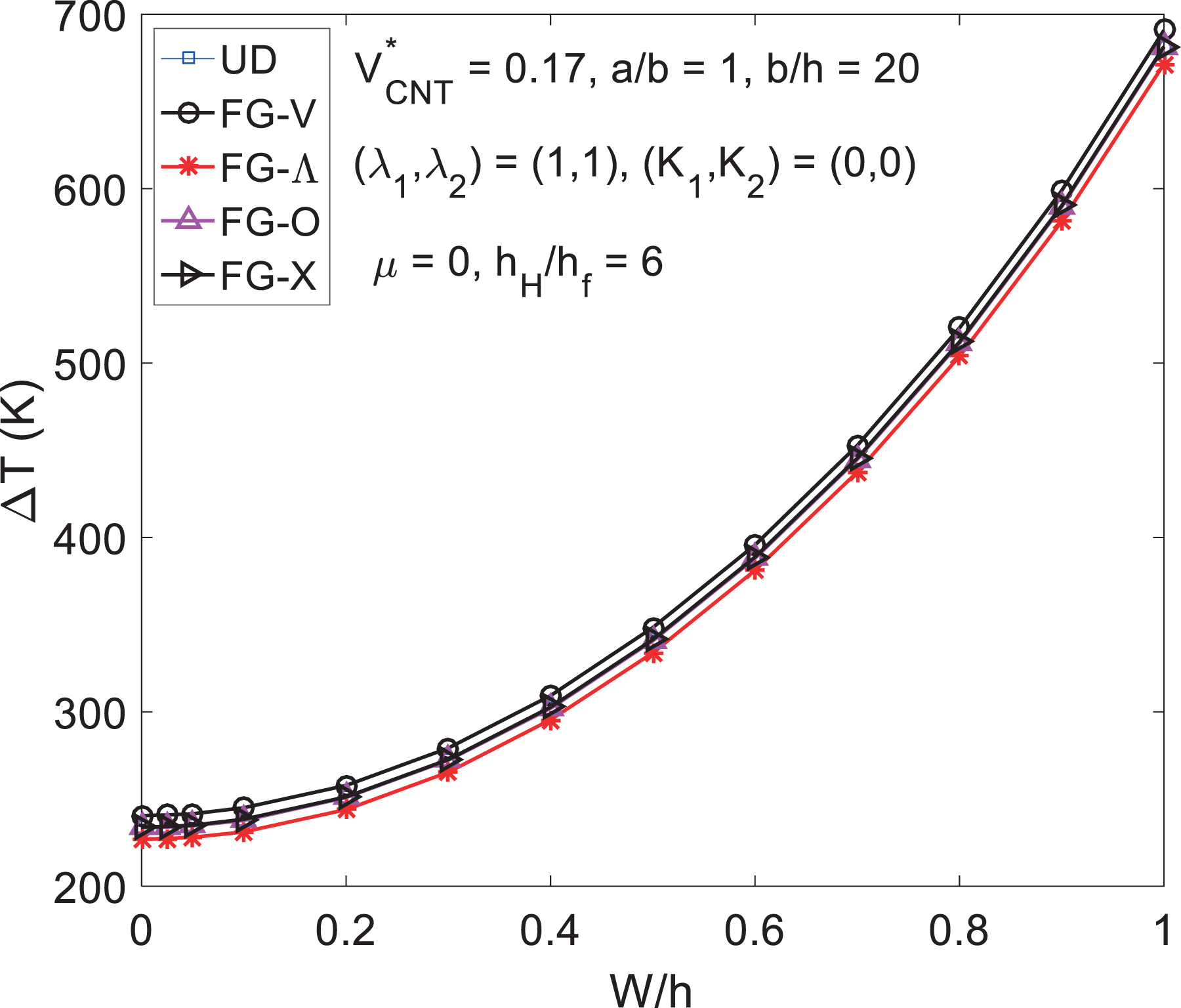
Effects of CNT distribution types on the thermal postbuckling behavior of sandwich plates with CNTRC face sheets and all immovable edges. CNT: carbon nanotube; CNTRC: carbon nanotube–reinforced composite.
Effects of tangential edge constraints on the thermal postbuckling behavior of sandwich plates with FG-CNTRC face sheets. FG-CNTRC: functionally graded carbon nanotube–reinforced composite.
As a sequent example, Figure 7 considers the effects of homogeneous core thickness-to-face sheet thickness ratio
Effects of thickness of face sheets and imperfection on the thermal postbuckling behavior of sandwich plates with FG-CNTRC face sheets and all immovable edges. FG-CNTRC: functionally graded carbon nanotube–reinforced composite.
Effects of geometrical imperfection and degree of in-plane constraints on the thermal postbuckling behavior of sandwich plates with FG-CNTRC face sheets. FG-CNTRC: functionally graded carbon nanotube–reinforced composite.
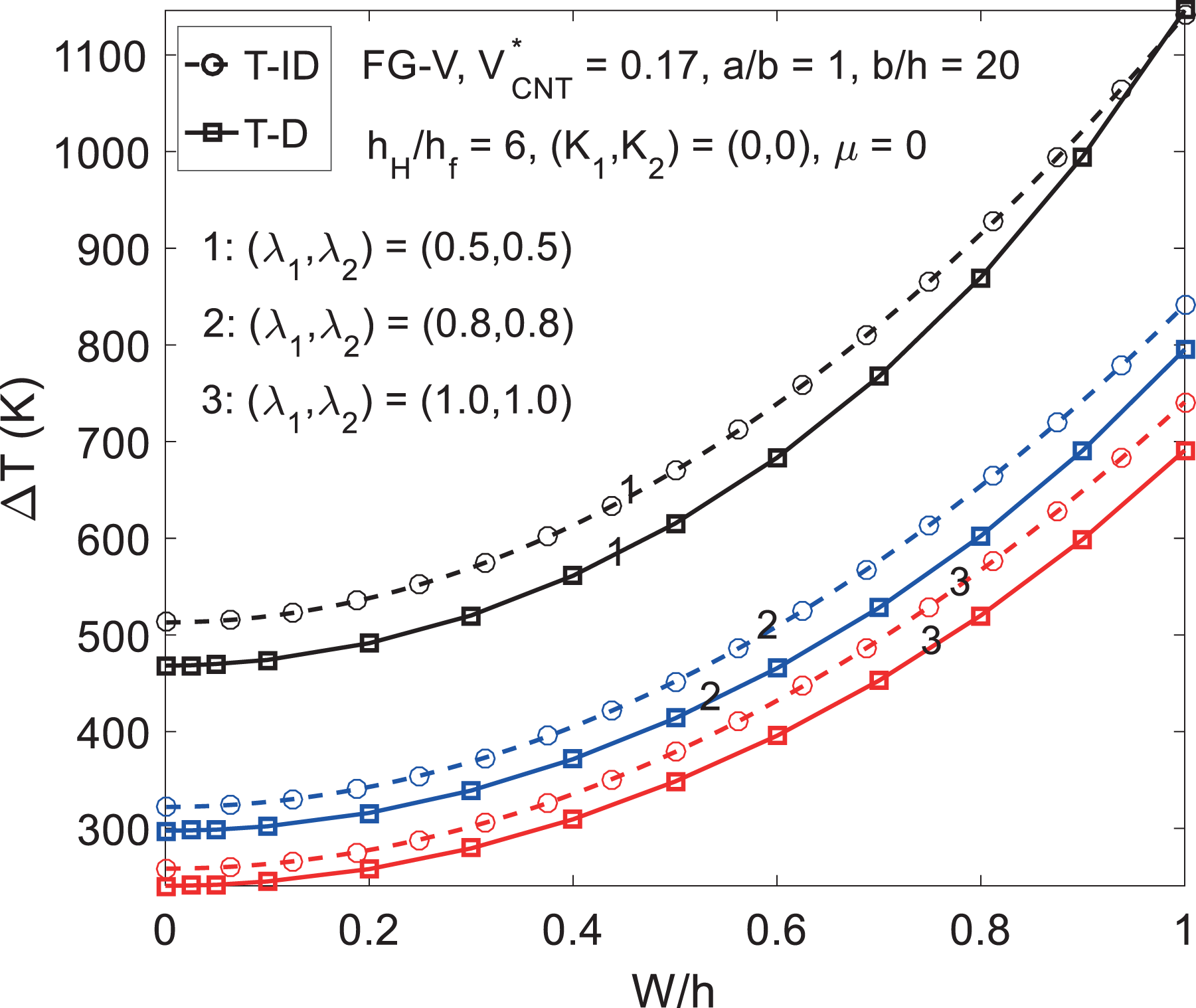
Next, Figure 9 considers the effects of CNT volume fraction on the postbuckling behavior of sandwich plates of type A with FG-CNTRC face sheets and immovable edges. As shown, thermal postbuckling equilibrium paths are enhanced, and difference between these paths corresponding to cases of T-D and T-ID properties is bigger as CNT volume percentage in face sheets is increased. The effects of elastic foundations and side-to-thickness ratio on the thermal postbuckling behavior of sandwich plates with FG-CNTRC face sheets are depicted in Figure 10. Temperature–deflection equilibrium paths are considerably lower and more gradual as the plates become thinner. Furthermore, elastic foundations pronouncedly improve the load carrying capability of sandwich plates, and beneficial influences of elastic foundations are more remarked for thicker plates. Ultimate example for postbuckling analysis of CNTRC sandwich plates of type A is displayed in Figure 11 considering effects of elastic foundations and aspect ratio on the thermal postbuckling behavior of sandwich plates with FG-CNTRC face sheets. It is recognized that both buckling temperature and postbuckling temperature–deflection path are lowered due to increase in
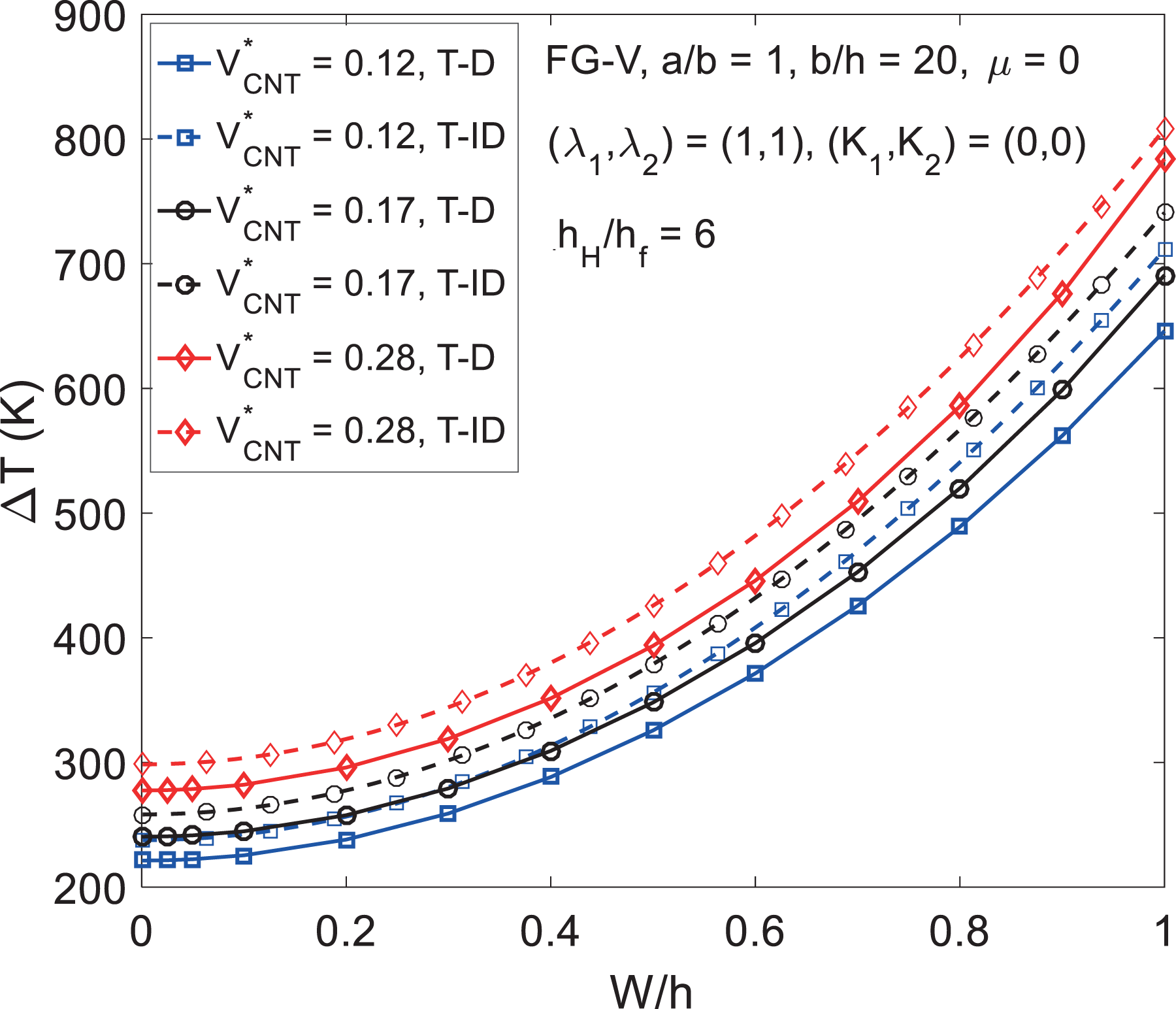
Effects of CNT volume fraction on the thermal postbuckling behavior of sandwich plates with FG-CNTRC face sheets and all immovable edges. CNT: carbon nanotube; FG-CNTRC: functionally graded carbon nanotube–reinforced composite.
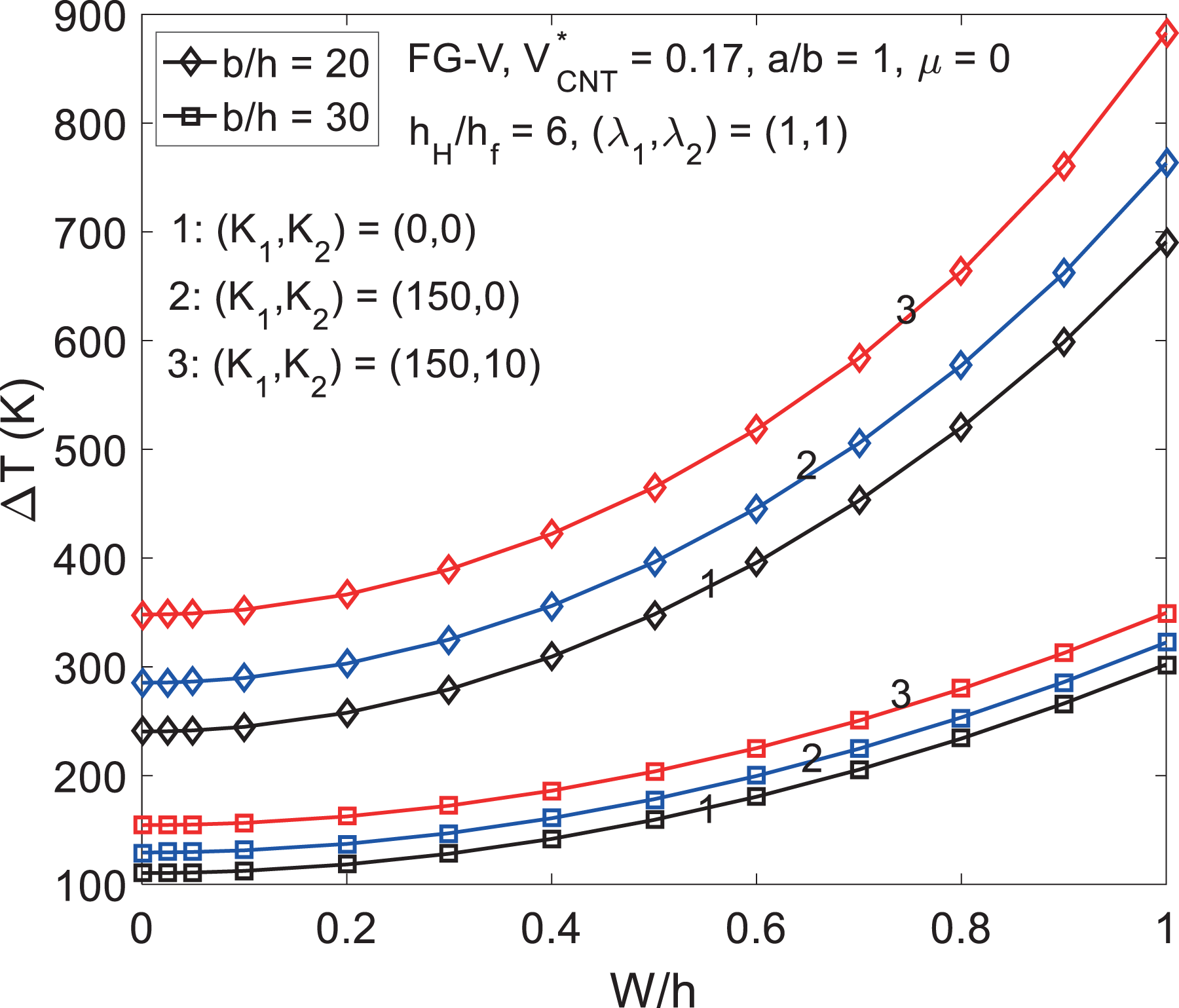
Effects of elastic foundations and side-to-thickness ratio on the thermal postbuckling behavior of sandwich plates with FG-CNTRC face sheets and all immovable edges. FG-CNTRC: functionally graded carbon nanotube–reinforced composite.
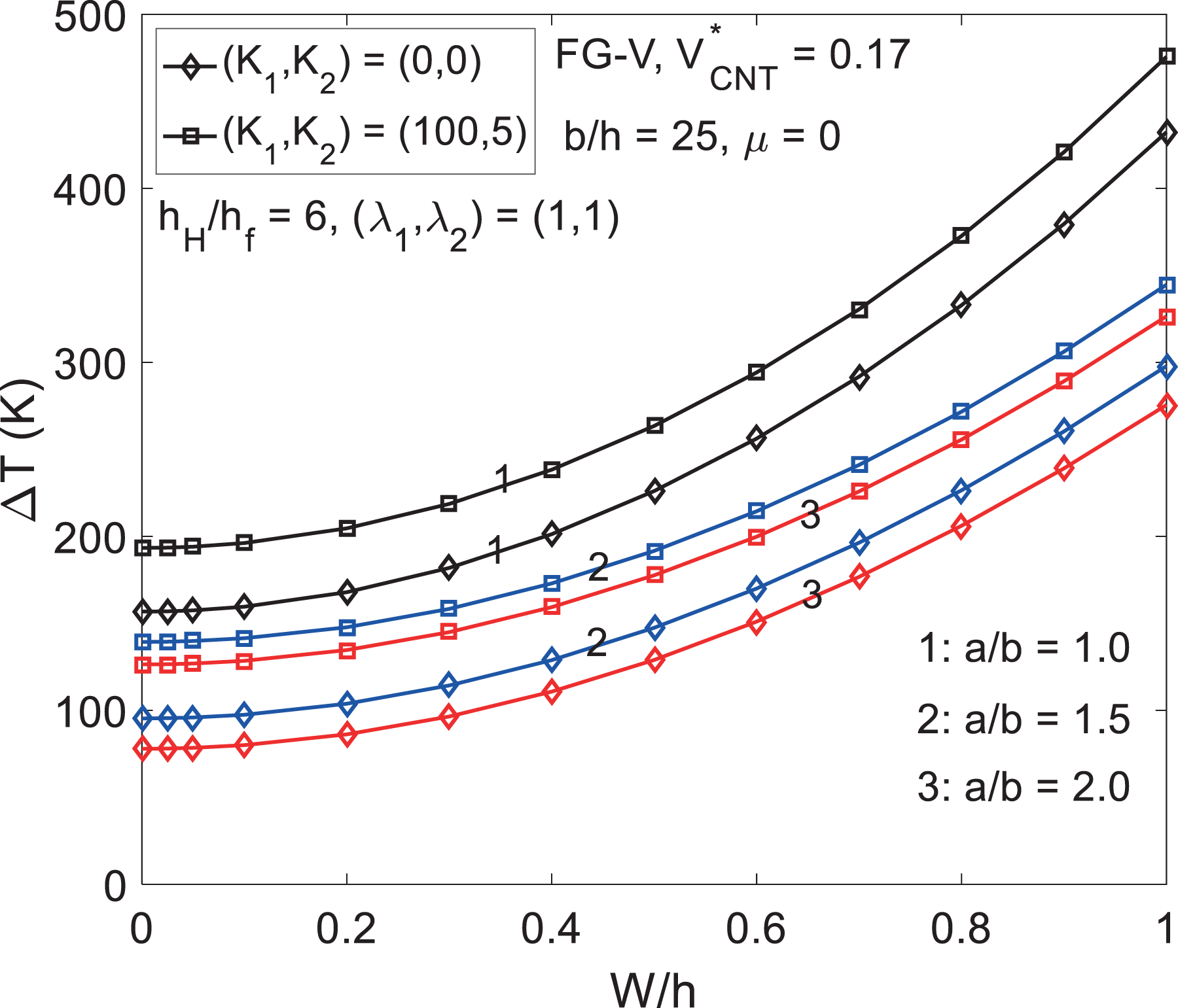
Effects of elastic foundation and aspect ratio on the thermal postbuckling behavior of sandwich plates with FG-CNTRC face sheets and all immovable edges. FG-CNTRC: functionally graded carbon nanotube–reinforced composite.
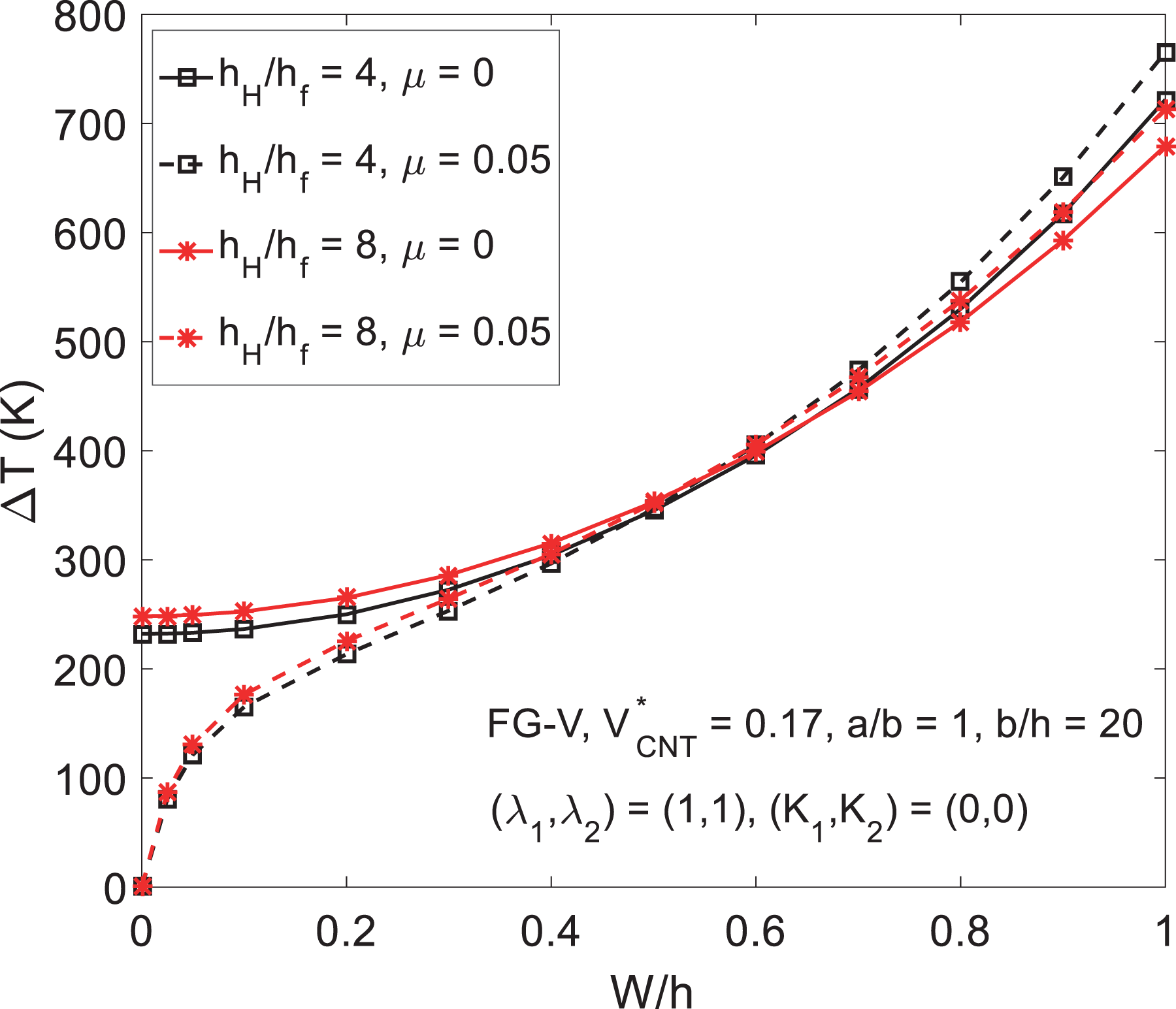
In what follows, thermal postbuckling behavior of sandwich plates of type B with CNTRC core layer will be analyzed. Figure 12 illustrates the effects of CNT distribution types on the postbuckling behavior of sandwich plates of type B with CNTRC core layer and immovable edges under uniform temperature rise. Among three types of CNT distribution, FG-X and FG-O types give the best and worst postbuckling responses, respectively, and UD pattern leads to intermediate postbuckling strength of thermally loaded CNTRC sandwich plates of type B. Accordingly, in most of the following numerical examples relating to CNTRC sandwich plates of type B, FG-X type of CNT distribution in core layer will be considered. Next, the effects of tangential edge constraints and temperature-dependent properties on thermal postbuckling behavior of sandwich plates with FG-CNTRC core layer are analyzed in Figure 13. As can be observed, in small region of deflection, postbuckling temperature–deflection paths are dropped due to rigorous constraints of edges and/or temperature dependence of material properties. It is unexpected that equilibrium paths are higher as T-D properties are accounted for in relatively deep region of postbuckling response.
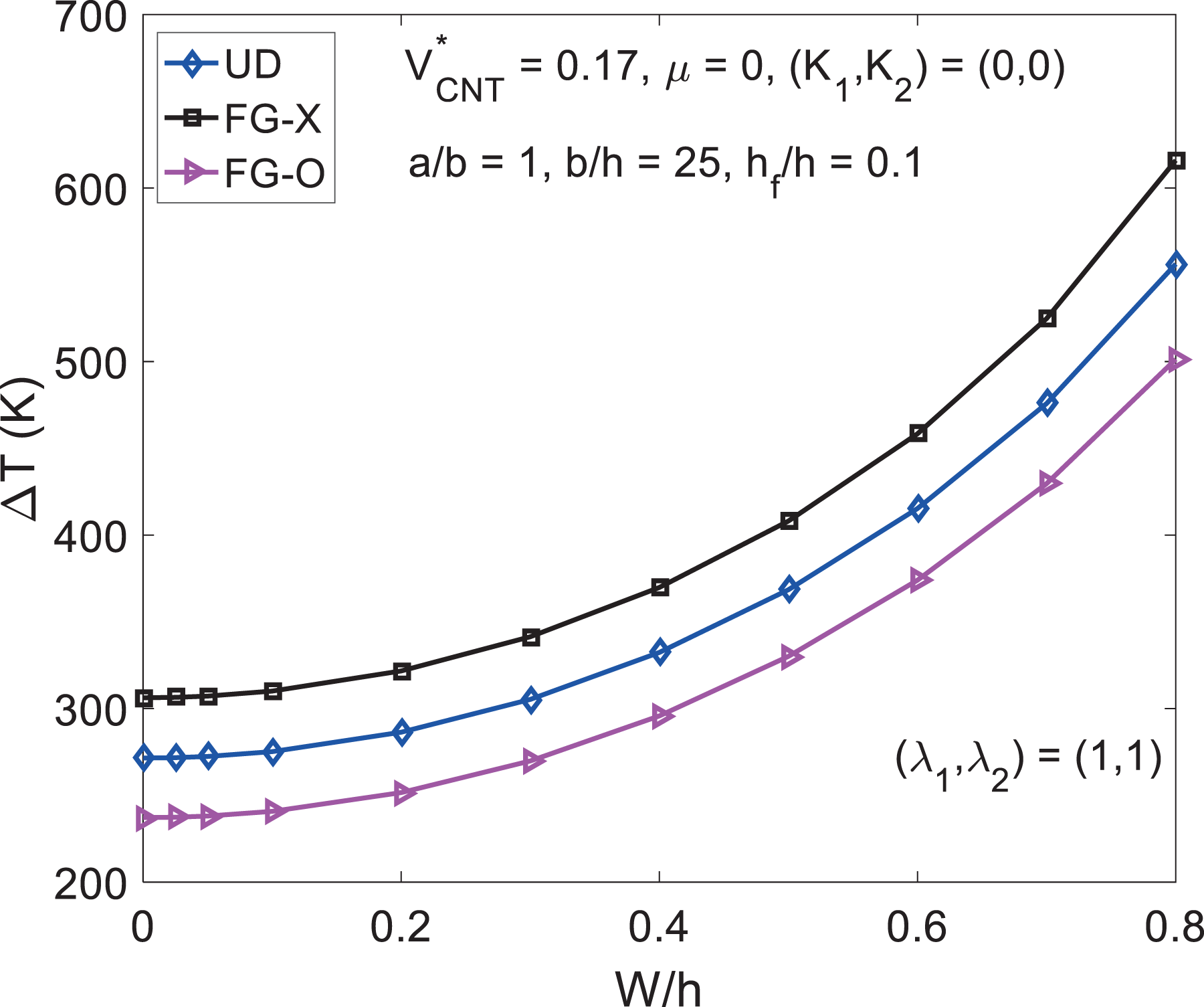
Effects of CNT distribution types on thermal postbuckling behavior of sandwich plates with CNTRC core layer and immovable edges. CNT: carbon nanotube; CNTRC: carbon nanotube–reinforced composite.
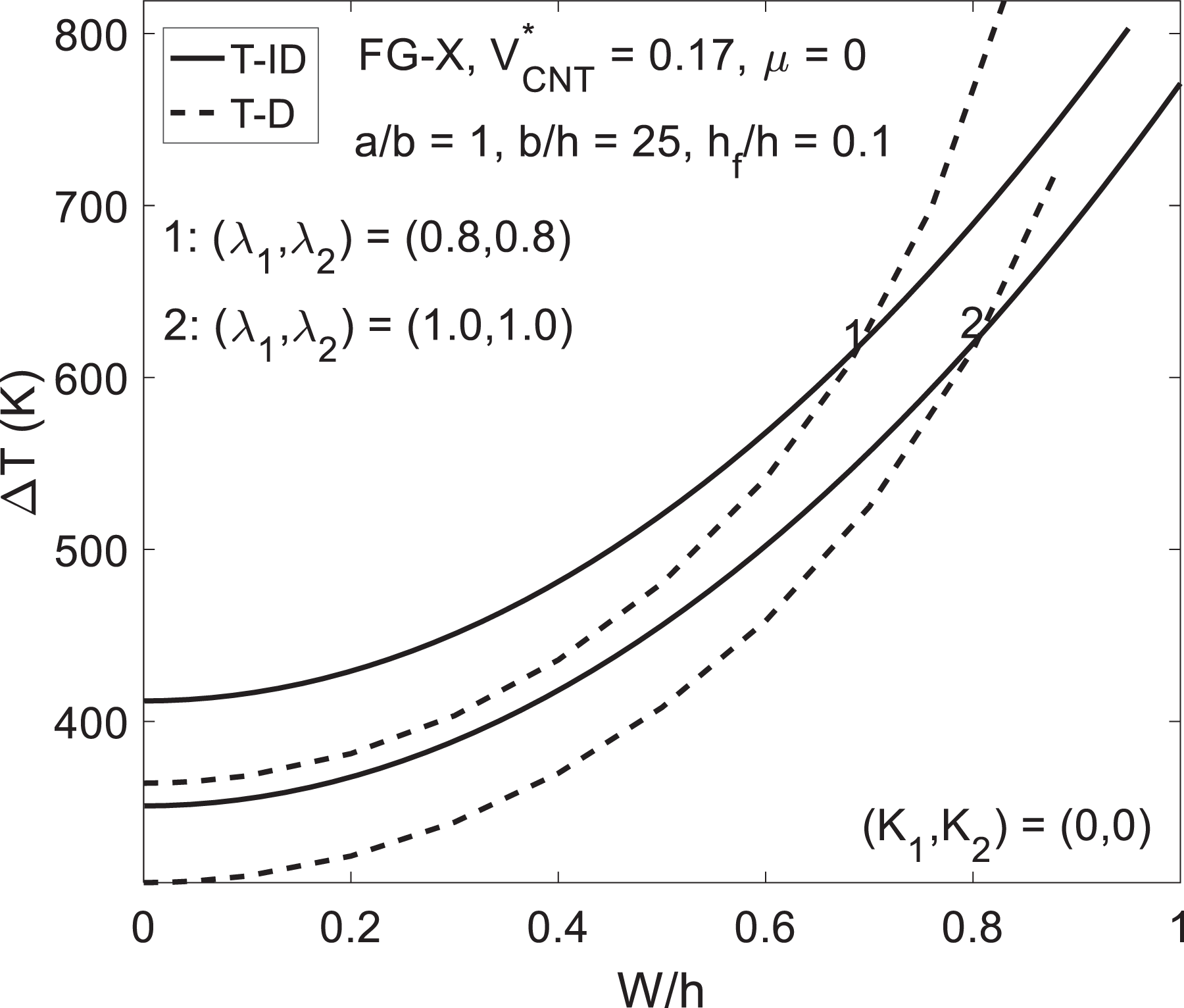
Effects of tangential edge constraints and temperature-dependent properties on thermal postbuckling behavior of sandwich plates with FG-CNTRC core layer. FG-CNTRC: functionally graded carbon nanotube–reinforced composite.
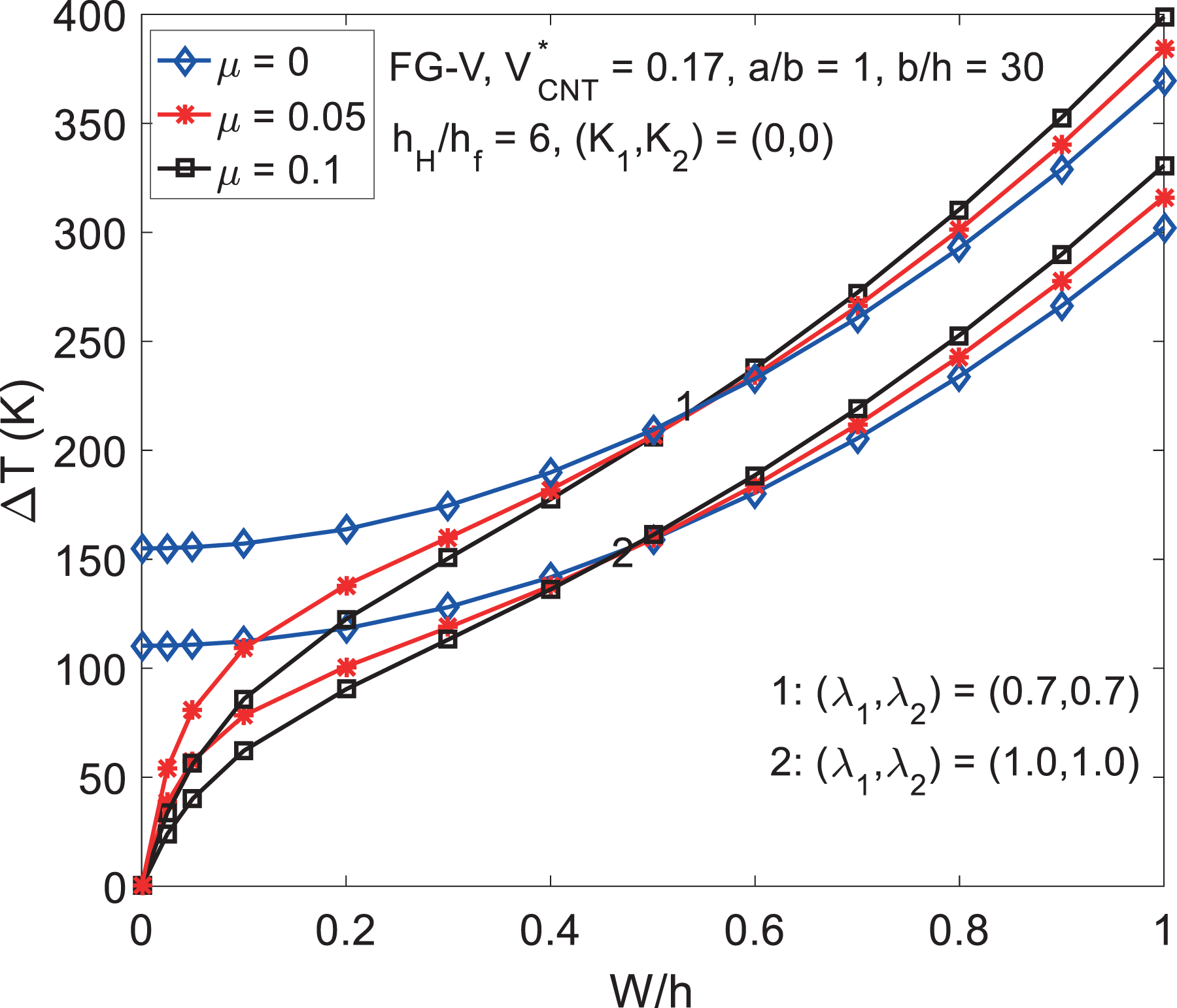
To access the effects of
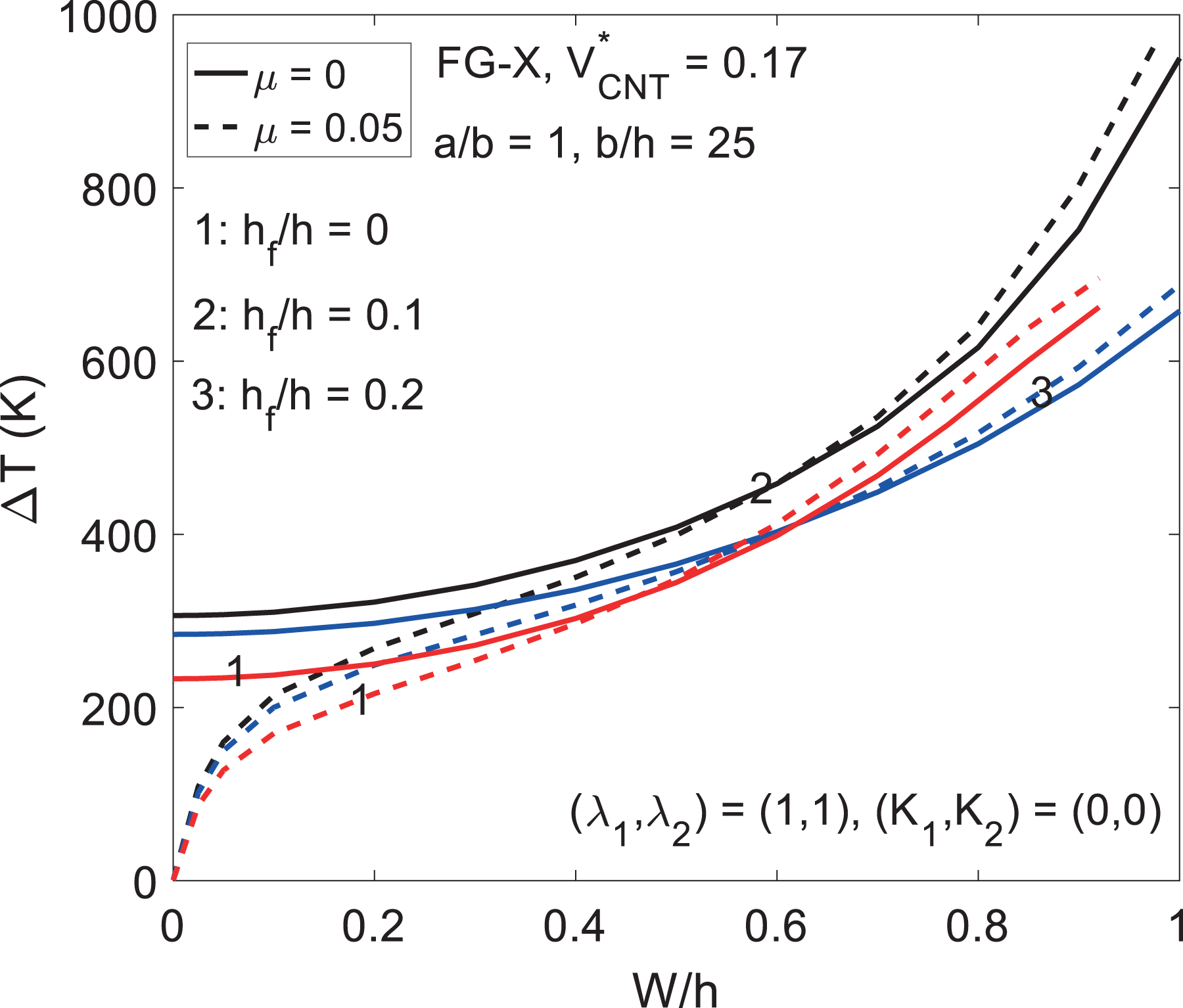
Effects of thickness of face sheets on thermal postbuckling behavior of sandwich plates with FG-CNTRC core layer and immovable edges. FG-CNTRC: functionally graded carbon nanotube–reinforced composite.
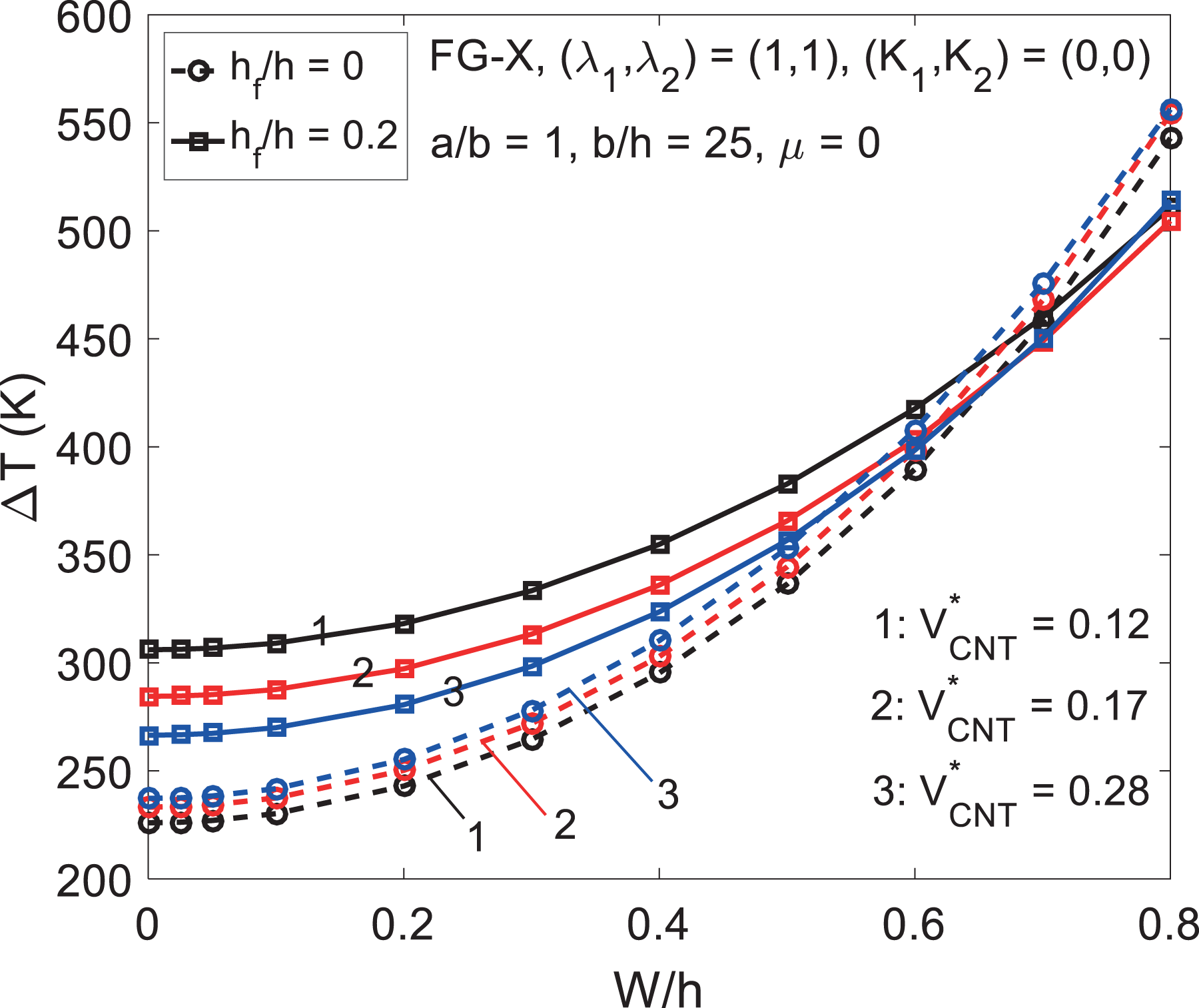
Effects of CNT volume fraction on thermal postbuckling behavior of pure FG-CNTRC plates and sandwich plates with FG-CNTRC core layer. CNT: carbon nanotube; FG-CNTRC: functionally graded carbon nanotube–reinforced composite.
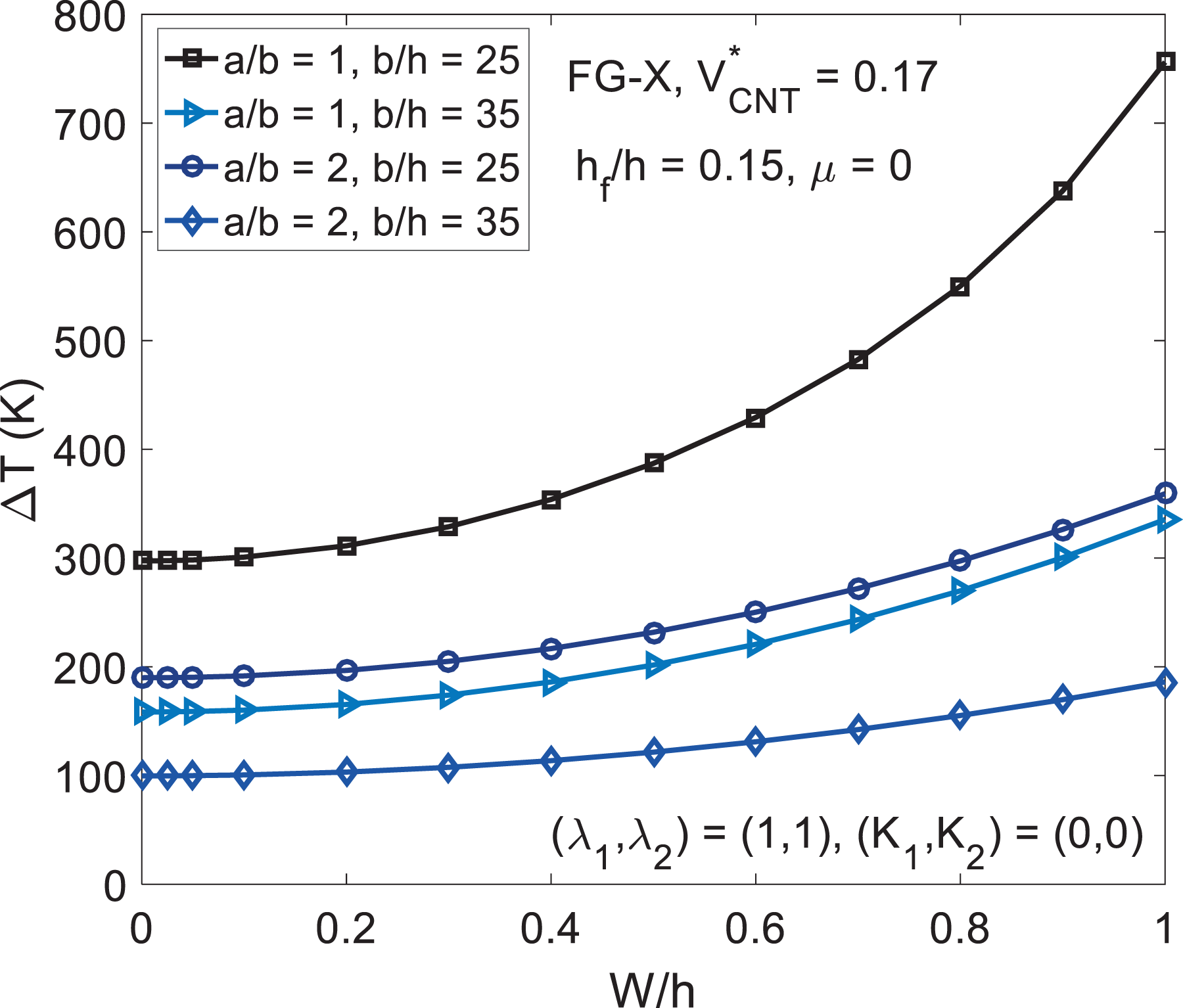
Effects of geometrical parameters on the thermal postbuckling behavior of sandwich plates with FG-CNTRC core layer and immovable edges. FG-CNTRC: functionally graded carbon nanotube–reinforced composite.
Subsequently, Figure 17 demonstrates that thermal buckling resistance and postbuckling load carrying capacities of sandwich plates with CNTRC core layer are fundamentally improved due to support of elastic foundations, especially Pasternak-type foundations. Finally, thermal postbuckling behavior of two sandwich plate models, specifically type A with UD or FG-V CNTRC face sheets and type B with UD or FG-X CNTRC core layer, with
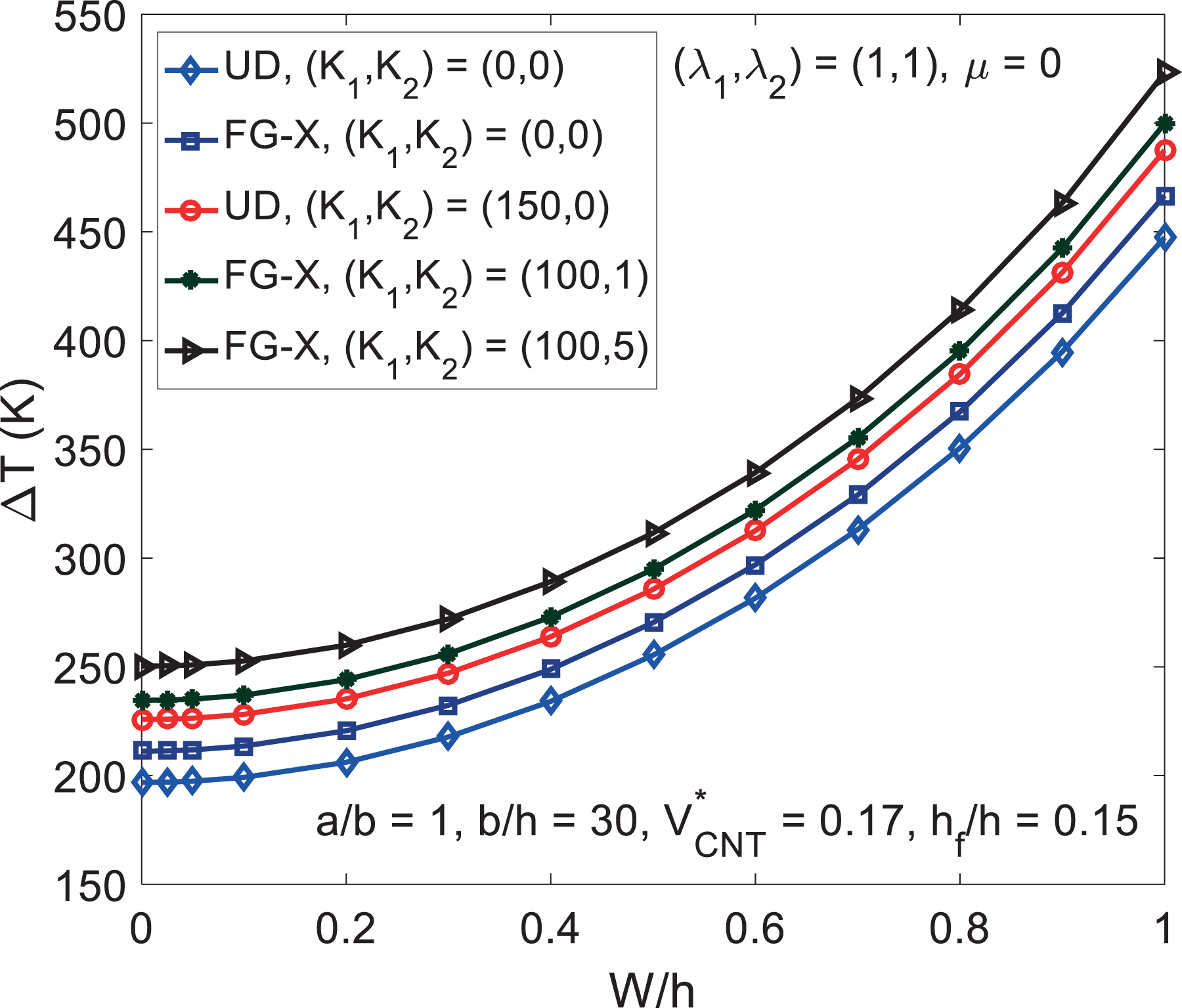
Effects of elastic foundations on the thermal postbuckling behavior of sandwich plates with CNTRC core layer and immovable edges. CNTRC: carbon nanotube–reinforced composite.
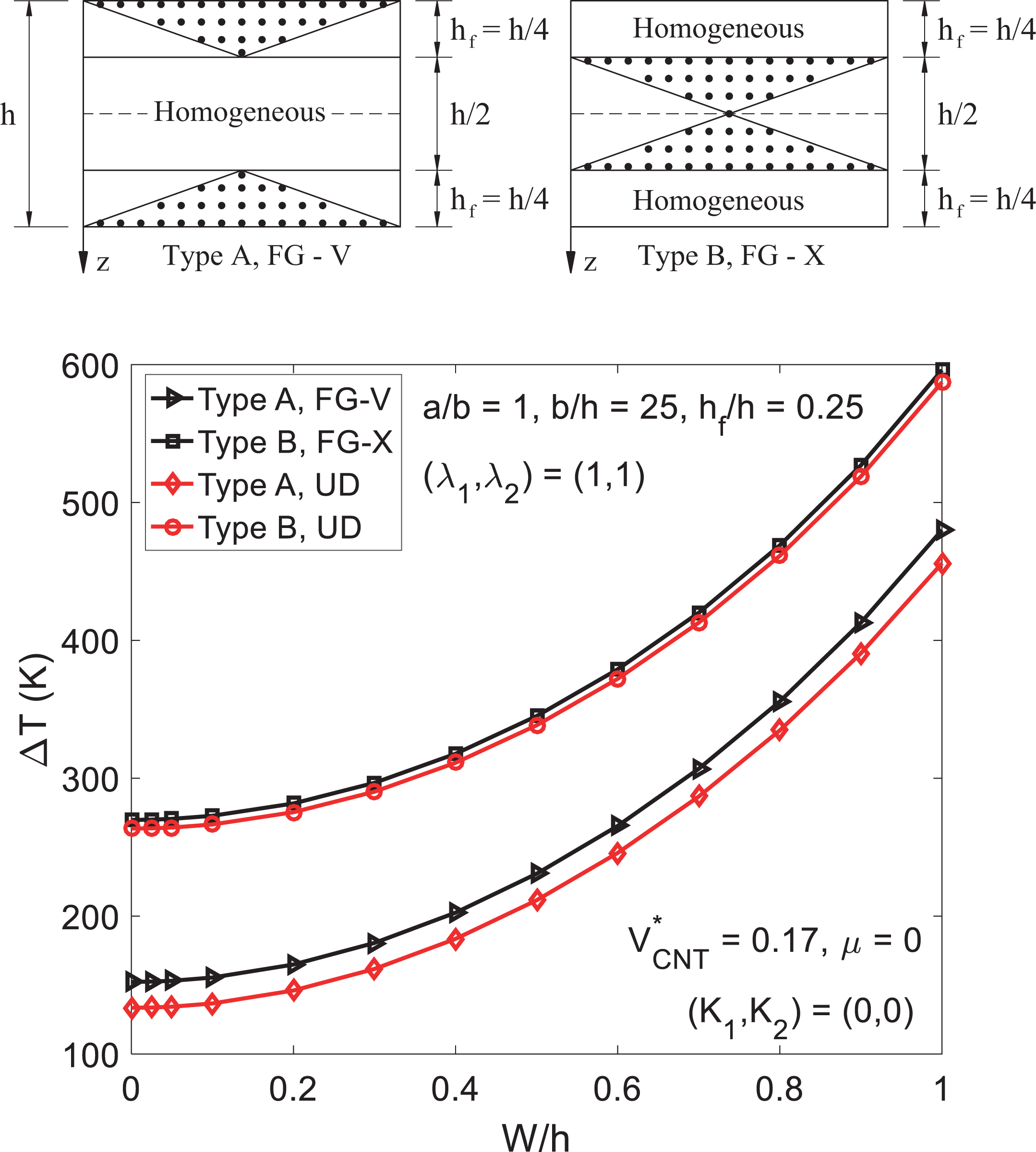
Comparison of thermal postbuckling behavior of sandwich plates with CNTRC face sheets (type A) and CNTRC core layer (type B). CNTRC: carbon nanotube–reinforced composite.
Concluding remarks
Based on an analytical approach and an iteration algorithm, buckling and postbuckling behaviors of moderately thick CNTRC sandwich plates resting on elastic foundations with initial geometrical imperfection, tangentially restrained edges and temperature-dependent properties, and subjected to uniform temperature rise have been analyzed. Abovementioned numerical results suggest the following remarks.
For sandwich plate of type A with CNTRC face sheets and homogeneous core layer: 1. Type of CNT distribution in face sheets has slight effects on buckling temperatures and thermal postbuckling response of sandwich plate. Specifically, critical thermal loads and postbuckling curves of FG-V and FG-Λ plates are slightly higher and lower, respectively, whereas those of UD, FG-X, and FG-O plates are almost the same. 2. Critical buckling temperature and thermal postbuckling path of CNTRC sandwich plates are increased and decreased as CNT volume fraction and thickness of face sheets hf are increased, respectively.
For sandwich plate of type B with homogeneous face sheets and CNTRC core layer: 3. Thermal postbuckling curves of CNTRC sandwich plates ( 4. Unlike pure CNTRC plates, thermal buckling and postbuckling behaviors of CNTRC sandwich plates with homogeneous face sheets become worse as volume fraction of CNT reinforcement in core layer is increased. 5. Type of CNT distribution in core layer has significant effects on critical buckling temperature and postbuckling strength of CNTRC sandwich plates, and FG-X type of CNT distribution gives the best thermal postbuckling response.
For both CNTRC sandwich plates of types A and B:
6. Critical buckling temperature and thermal postbuckling strength of CNTRC sandwich plates are strongly reduced when boundary edges are more rigorously restrained in tangential displacement.
7. Thermal postbuckling strength of CNTRC sandwich plates is evidently enhanced and dropped as stiffness of elastic foundation and
8. Thermally loaded CNTRC sandwich plate is sensitive to initial geometrical imperfection, and equilibrium path of the plate in deep region of deflection is higher due to the presence of initial imperfection.
As a final remark, a sandwich plate with CNTRC core layer and thin homogeneous face sheets resting on a Pasternak elastic foundation and with partially movable edges can bring the best thermal postbuckling response.
Footnotes
Funding
The author(s) received no financial support for the research, authorship, and/or publication of this article.
