This paper presents an analytical investigation on postbuckling behavior of thin plates reinforced by carbon nanotubes (CNTs) and subjected to nonuniform thermal loads. Unlike many previous works considered ideal case of thermal load is that uniform temperature rise, the present study considers more practical situations of thermal load are that sinusoidal and linear in-plane temperature distributions. CNTs are reinforced into matrix through functionally graded distributions and effective properties of nanocomposite are estimated according to extended rule of mixture. Basic equations are based on classical plate theory taking into account Von Karman nonlinearity, initial geometrical imperfection, interactive pressure from elastic foundations and elasticity of tangential constraints of simply supported boundary edges. Basic equations are solved by using analytical solutions and Galerkin method. From the obtained closed-form relations, thermal buckling and postbuckling behavior of nanocomposite plates are analyzed through numerical examples.
Structural components are usually exposed to severe temperature conditions and, thus, the stability of these components under thermal loads has received considerable attention of researchers.1 Linear and nonlinear instabilities of functionally graded material (FGM) plates and cylindrical shells under thermal loads have been addressed in works.2–7 The effects of different types of thermal load on the nonlinear stability and vibration of FGM curved shell panels have been explored in works of Kar and coauthors.8,9 The generation of functionally graded carbon nanotube reinforced composite (FG-CNTRC)10 has motivated investigations on static and dynamic responses of plates and shells made of this new class of nanocomposite. Basing on an element-free approach, buckling analysis of FG-CNTRC plates under compressive load is carried out by Lei et al.11 Kiani12,13 used Chebyshev-Ritz method to deal with linear buckling problem of FG-CNTRC plates under mechanical loads. The effects of elasticity of boundary condition on the nonlinear stability of FG-CNTRC plates under compressive loads have been analyzed by Zhang et al.14 and Trang and Tung15 using numerical and analytical approaches, respectively. Buckling behaviors of FG-CNTRC flat and cylindrical panels under mechanical loads have been examined in works16,17 making use of numerical methods. Shen and Xiang18,19 investigated the postbuckling of FG-CNTRC cylindrical panels under axial load and external pressure in thermal environments. Basing on an analytical approach, the nonlinear stability of FG-CNTRC cylindrical and doubly curved panels under mechanical and thermomechanical loadings has been analyzed by Tung and Trang20–24 taking into account effect of tangential constraints of boundary edges. Employing a semi-analytical method, Chakraborty et al.25 analyzed nonlinear stability and vibration of FG-CNTRC laminated panels under mechanical loads. Shen26,27 made use of asymptotic solutions and a perturbation technique to analyze postbuckling behavior of FG-CNTRC circular cylindrical shells subjected to axial compression and external pressure in thermal environments. Recently, postbuckling analysis of thin FG-CNTRC cylindrical shells surrounded by an elastic medium and subjected to combined mechanical loads has been carried out by Hieu and Tung28 using Galerkin method.
Thermally induced buckling and postbuckling of FG-CNTRC plates and shells are problems of considerable importance. Kiani and coworker29,30 employed Chebyshev-Ritz method to deal with buckling problem of FG-CNTRC rectangular and skew plates under uniform temperature rise and various boundary conditions. Making use of some different plate theories and approaches, thermal postbuckling responses of FG-CNTRC rectangular plates have been investigated in works.31–34 Kiani35 studied the postbuckling of sandwich plates with FG-CNTRC face sheets under uniform temperature rise. Long and Tung36,37 used Galerkin method in conjunction with an iteration procedure to analyze postbuckling behavior of FG-CNTRC sandwich plate models subjected to thermal and thermomechanical loads. Basing on a higher order shear deformation theory and asymptotic solutions, postbuckling responses of FG-CNTRC cylindrical panels and shells under uniform temperature rise have been considered in works of Shen and Xiang.38,39 Recently, Trang and Tung40 investigated the effects of elastic restraints of boundary edges and geometrical imperfection on the thermal postbuckling of FG-CNTRC cylindrical panels under uniform temperature rise. Hieu and Tung41–43 used an analytical approach and classical shell theory to investigate the postbuckling behavior of FG-CNTRC cylindrical shells and toroidal shell segments surrounded by an elastic medium and subjected to thermal and thermomechanical loadings. In these works, three-term solution of shell deflection and the effects of tangential constraints of shell edges have been taken into consideration. Thermal buckling behavior of FG-CNTRC conical shells has been treated by Mirzaei and Kiani44 making use of adjacent equilibrium criterion and a numerical solution. Recently, thermal and thermomechanical buckling responses of shear deformable FG-CNTRC cylindrical shells and toroidal shell segments have been analyzed by Hieu and Tung.45 Beside studies of thermal stability, investigations on the nonlinear vibrations of nanocomposite structures under thermal loads have been performed by Mehar and coworkers46–50 using a numerical approach. Most of aforementioned studies of thermal buckling and postbuckling of FG-CNTRC plates and shells only considered the case of uniform temperature rise. This special case of thermal load yields considerable simplification of mathematical formulations. However, in many practical situations, plate and shell structures may subject to nonuniform thermal loads. As indicated in previous works,51–54 in engineering applications, plates and shells are frequently exposed to in-plane temperature distributions. Accordingly, nonlinear stability of composite structures in general and nanocomposite structures in particular under nonuniform thermal loads should be addressed.
As an extension of previous work,33 the present paper aims to analyze buckling and postbuckling behavior of thin FG-CNTRC rectangular plates resting on elastic foundations and subjected to two types of nonuniform thermal loads are that sinusoidal and linear in-plane temperature distributions. The effective properties of nanocomposite are estimated according to extended rule of mixture. Basic equations are based on the classical plate theory taking into account Von Karman nonlinearity, initial geometrical imperfection and interactive pressure from elastic foundations. Analytical solutions of deflection and stress function are assumed to satisfy simply supported boundary conditions and Galerkin method is used to derive closed-form expressions of nonlinear load-deflection relation. From these expressions, numerical examples are carried out and interesting remarks are given.
Rectangular nanocomposite plate
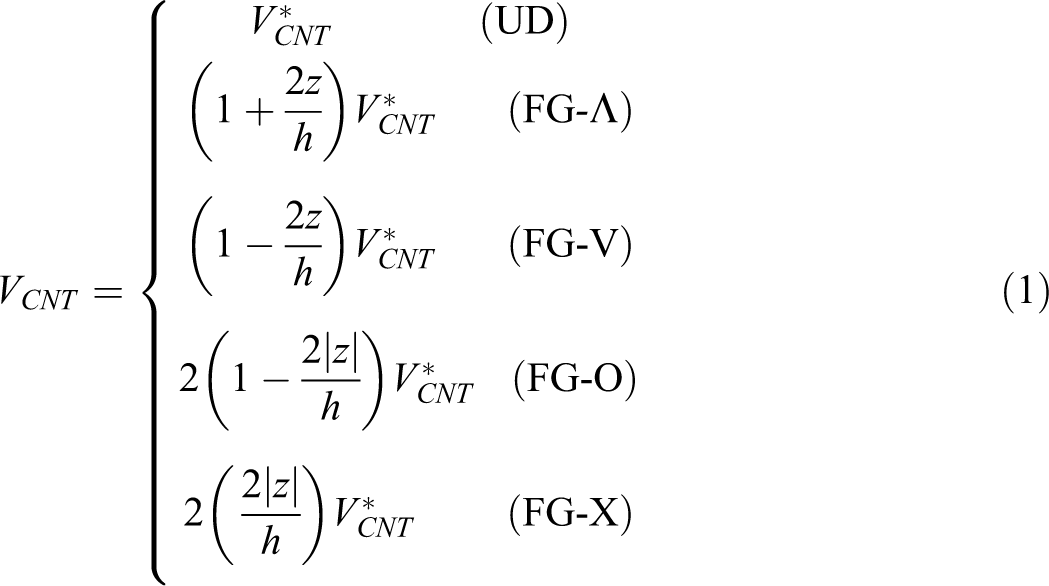
Consider a rectangular plate of length a, width b and thickness h. The plate is made of carbon nanotube reinforced composite (CNTRC) and defined in a Cartesian coordinate system origin of which is located on the middle surface at a corner of the plate, x and y axes are in directions of length and width, respectively, and z axis is perpendicular to the middle surface of the plate. Carbon nanotubes (CNTs) are reinforced into matrix such that x axis is the aligned direction of CNTs and the volume fraction of CNTs is varied in the thickness direction according to functional rules. Specifically, CNTs are embedded into isotropic matrix phase through uniform distribution (UD) or four types of functionally graded (FG) distributions named as , FG-V, FG-O and FG-X, and the volume fraction of CNTs is defined as follows
in which is total volume fraction of CNTs and its expression is defined in many previous works, for examples.10,31
In analysis of nanocomposite structures, the effective properties of CNTRC may be estimated according to Eshelby-Mori-Tanaka scheme55 or extended rule of mixture.10 While the former allows to evaluate the effective properties of a heterogeneous medium with inclusions and is appropriate for nanocomposites with agglomerated CNTs, the latter is simple to estimate overall properties of two-constituent materials. A good agreement between two these approaches has been demonstrated in several works, for examples.16 In the present study, the effective elastic moduli and effective shear modulus of CNTRC are determined according to the extended rule of mixture as10
where is volume fraction of matrix and are CNT efficiency parameters.
The effective Poisson ratio of CNTRC is assumed to be a constant and determined as follows10,11
The effective thermal expansion coefficients and in the longitudinal and transverse directions, respectively, are determined according to Schapery model as follows29,30,38,39
The significances of symbols ,, in the above equations (2) to (4) have been explained in many previous publications, for examples,10–19 and omitted here for the sake of brevity.
Formulations
In the present study, CNTRC plate is assumed to be thin and classical plate theory (CPT) including geometrical nonlinearity in Von Karman sense is used for formulations. Based on the CPT, strain components and at an arbitrary point of the plate are expressed as
where strain components at the middle surface and changes of curvature are defined as follows
in which are displacement components in the coordinate directions, respectively, and herein subscript comma indicates partial derivative with respect to the followed variable, for example .
The present work considers two types of nonuniform thermal load are that sinusoidal and linear in-plane temperature distributions. Specifically, in the case of sinusoidal thermal loading, temperature distribution in the plate is expressed as
in which Tu is initial uniform temperature rise, is temperature difference between central point and edges of the plate, and with are positive integers. When , distribution type (7) coincides with that given in the work of Haydl.52
For linear in-plane temperature distribution, the expression of temperature is assumed as
where is temperature difference between central point and edges of the plate. It is interesting to notice that linear temperature distribution (8) is suggested as a simplification of parabolic in-plane temperature distribution given in the work of Klosner and Forray.51
Next, stress components in the CNTRC plate are determined as follows
where
and is temperature change in comparison with reference value T0 at which the plate is free from thermal stresses.
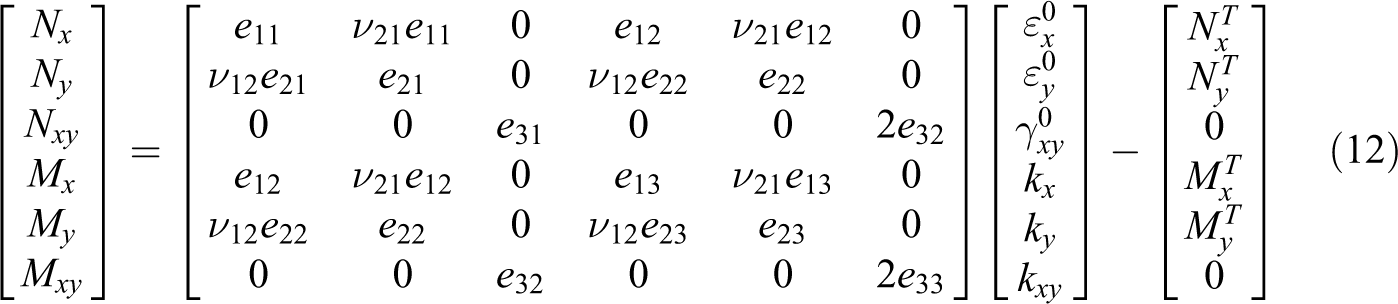
Force and moment resultants in the plate are calculated through stress components as
From equations (5) and (9), these resultants are expressed in the form
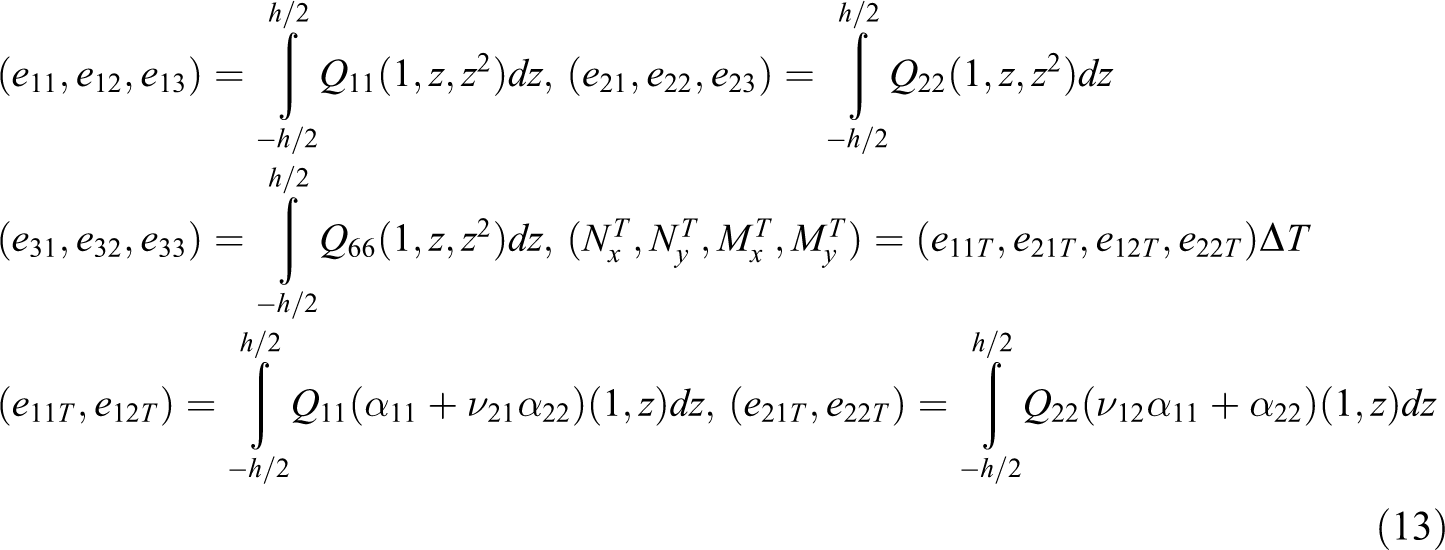
in which
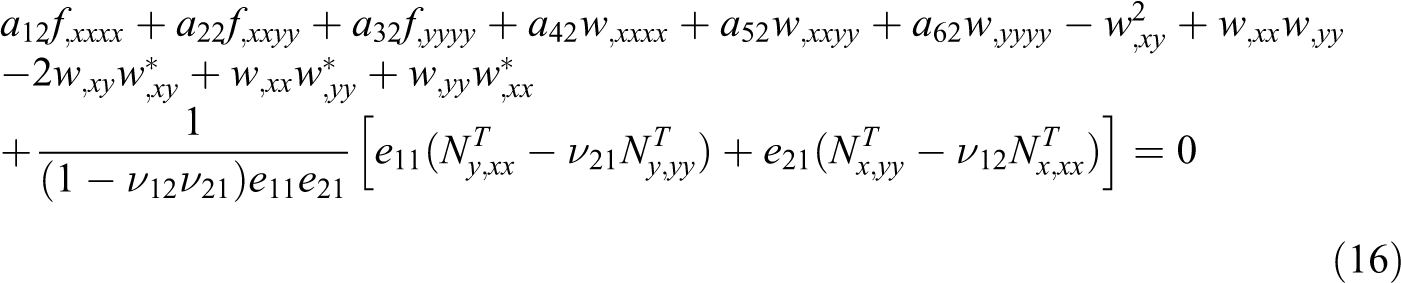
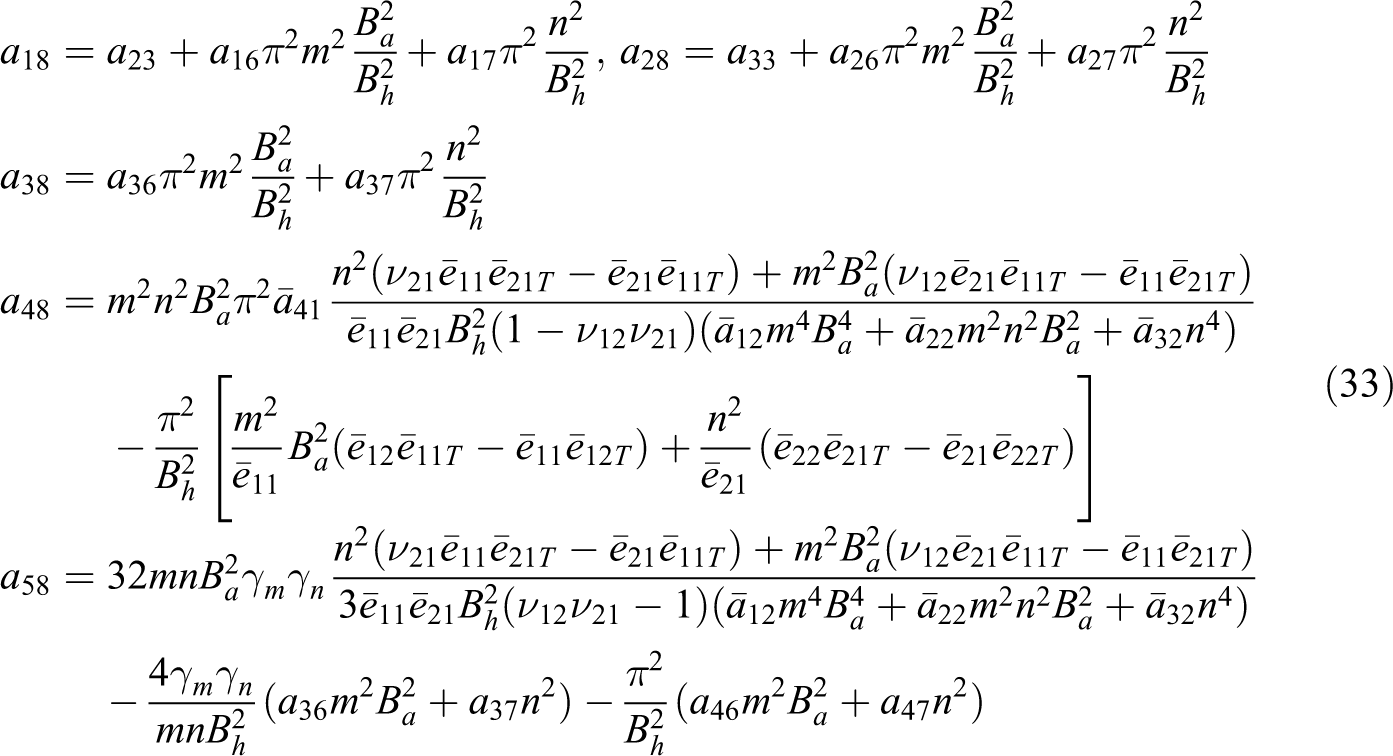
Based on the CPT, system of three nonlinear equilibrium equations of the plate has been introduced in many works, for instances.2,3,33 From constitutive relations (12), taking into account effects of initial geometrical imperfection and interactive pressure from elastic foundations, equilibrium equation of geometrically imperfect CNTRC plates has the form as follows
where is a known function representing initial geometrical imperfection and is a stress function defined as . In addition, in equation (14), k1 and k2 are elastic modulus of Winkler springs and shear layer stiffness of Pasternak foundation model, respectively, and specific definitions of coefficients can be found in the work.33
Next, strain compatibility equation of imperfect plate is expressed as3,33
By solving from equation (12), strain compatibility equation of imperfect CNTRC plates under nonuniform thermal loads has the form
in which coefficients are the same as those given in the work.33
In the present work, all edges of the plate are assumed to be simply supported and tangentially restrained. The associated boundary conditions are expressed as
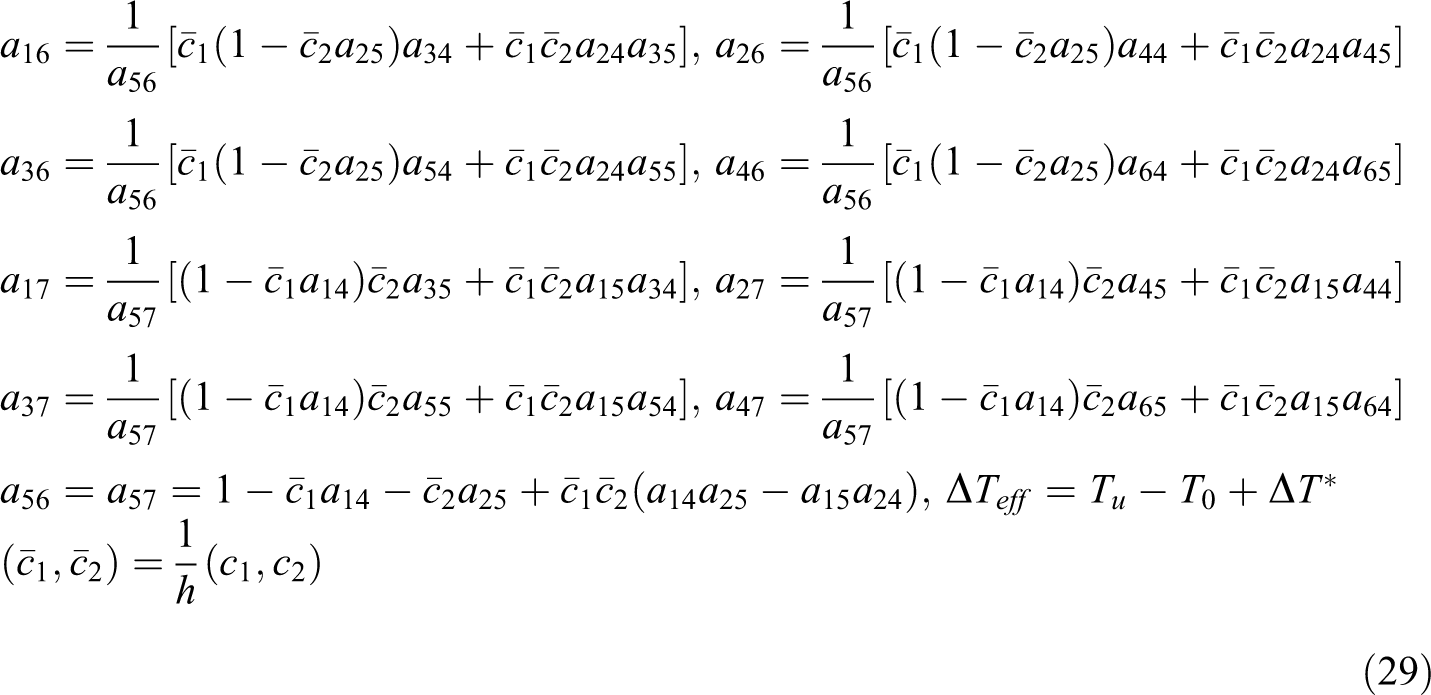
where and are fictitious force resultants at restrained edges and related to average end-shortening displacements of these edges as follows33,34
in which c1 and c2 are tangential stiffness parameters on opposite edges and , respectively. It is noticed that values of , and represent the cases of movable, immovable and partially movable edges, respectively.
To satisfy boundary conditions (17), the following approximate solutions are assumed54
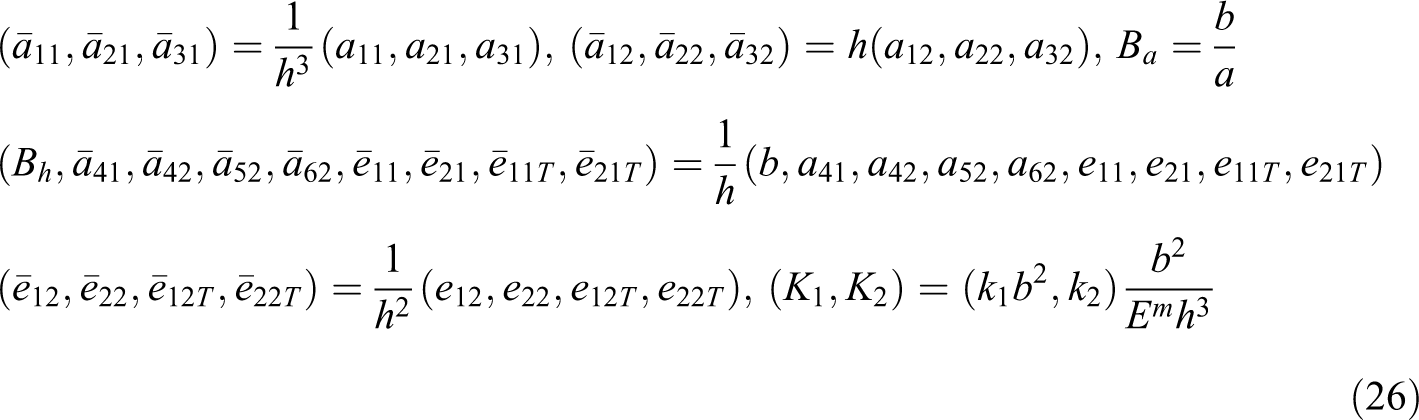
in which W and µ are the amplitude of deflection and size of imperfection, respectively, and are coefficients to be determined. By introducing solutions (19) into the compatibility equation (16), these coefficients are determined as
where
for the case of sinusoidal temperature distribution and for the case of linear temperature distribution.
From equations (19) and (20), thermally induced force resultants at prebuckling membrane state can be evaluated as follows
It is clear from equation (22) that prebuckling thermal force resultants depend on in-plane coordinates according to sinusoidal variations when (i.e. ) corresponding to sinusoidal temperature distribution. Otherwise, if temperature is linearly distributed or uniformly elevated, i.e. , are independent of in-plane coordinates.
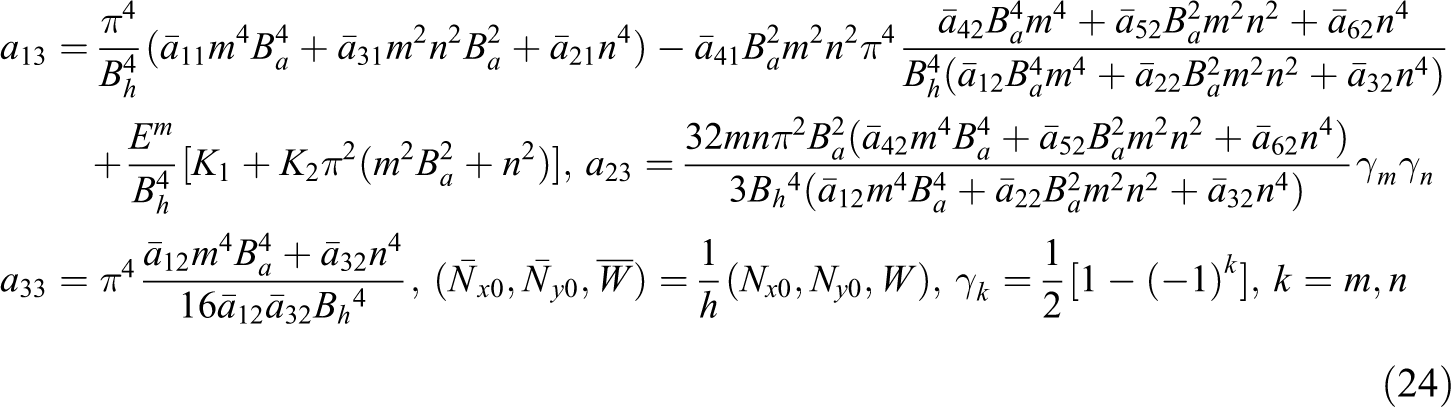
Now, introduction of solutions (19) into the equilibrium equation (14) and applying Galerkin method to the obtained equation yield the following expression
where
and
for the case of sinusoidal temperature distribution, whereas for the case of linear temperature distribution, in which
In what follows, fictitious force resultants will be determined. From equations (6) and (12), taking into account initial imperfection, the following relations are obtained
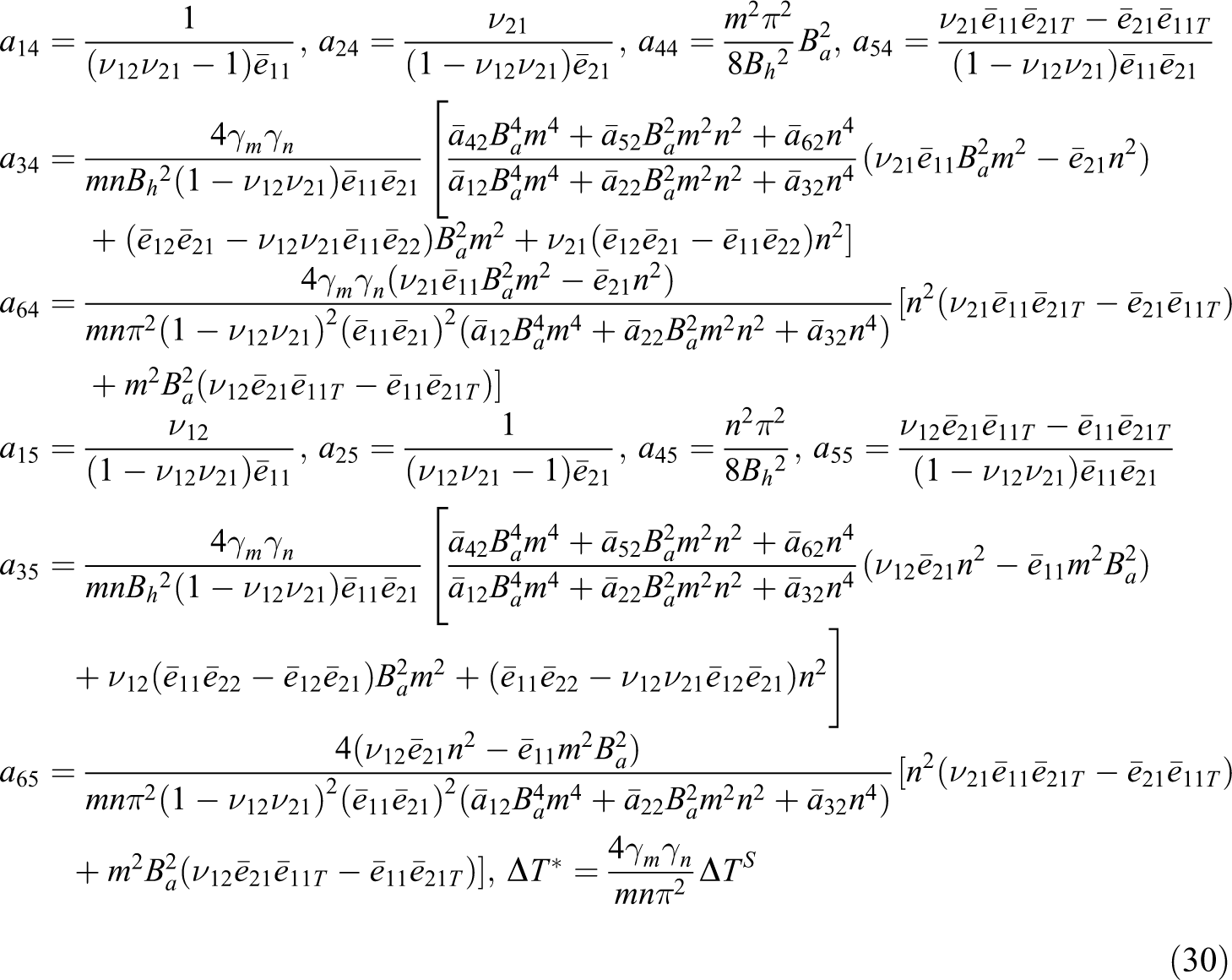
Substituting the solutions (19) into the equation (27) and introducing the obtained expressions into the equation (18) yield the following results of fictitious force resultants
where
in which
for the case of sinusoidal temperature distribution, whereas
and are given as equation (30) for the case of linear temperature distribution.
Now, introduction of from equation (28) into the equation (23) yields nonlinear relation between thermal load and non-dimensional maximum deflection. Specifically, for the case of sinusoidal in-plane temperature distribution, nonlinear relation has the form
where
It is noticed that for mid-plane symmetric patterns of CNT distribution, such as UD, FG-X and FG-O distribution types, one has
This deduces and equation (32) leads to the following relation
Equation (35) indicates that, under sinusoidal temperature distribution, geometrically perfect FG-CNTRC plates with mid-plane symmetric configuration can be buckled in bifurcation type are corresponding buckling thermal loads are predicted as
For the case of linear in-plane temperature distribution, nonlinear load-deflection relation has the form as follows
and buckling thermal loads of perfect plates () can be obtained as .
It is evident from equations (35) and (37) that nonlinear relation between thermal load and deflection of FG-CNTRC plates under uniform temperature rise can be obtained as special cases of nonuniform in-plane temperature distributions in which as follows
Results and discussion
This section presents numerical examples for nanocomposite plates made of Poly (methyl methacrylate) matrix material, referred to as PMMA, and reinforced by (10,10) single-walled carbon nanotubes (SWCNTs). The temperature dependent properties of PMMA and (10,10) SWCNTs have been given in many previous works, for examples,19,29,32,38,39 and are omitted here for the sake of brevity. In addition, CNT efficiency parameters are the same as those given in the works.26,31,39 Specifically, for the case of , for the case of and for the case of .
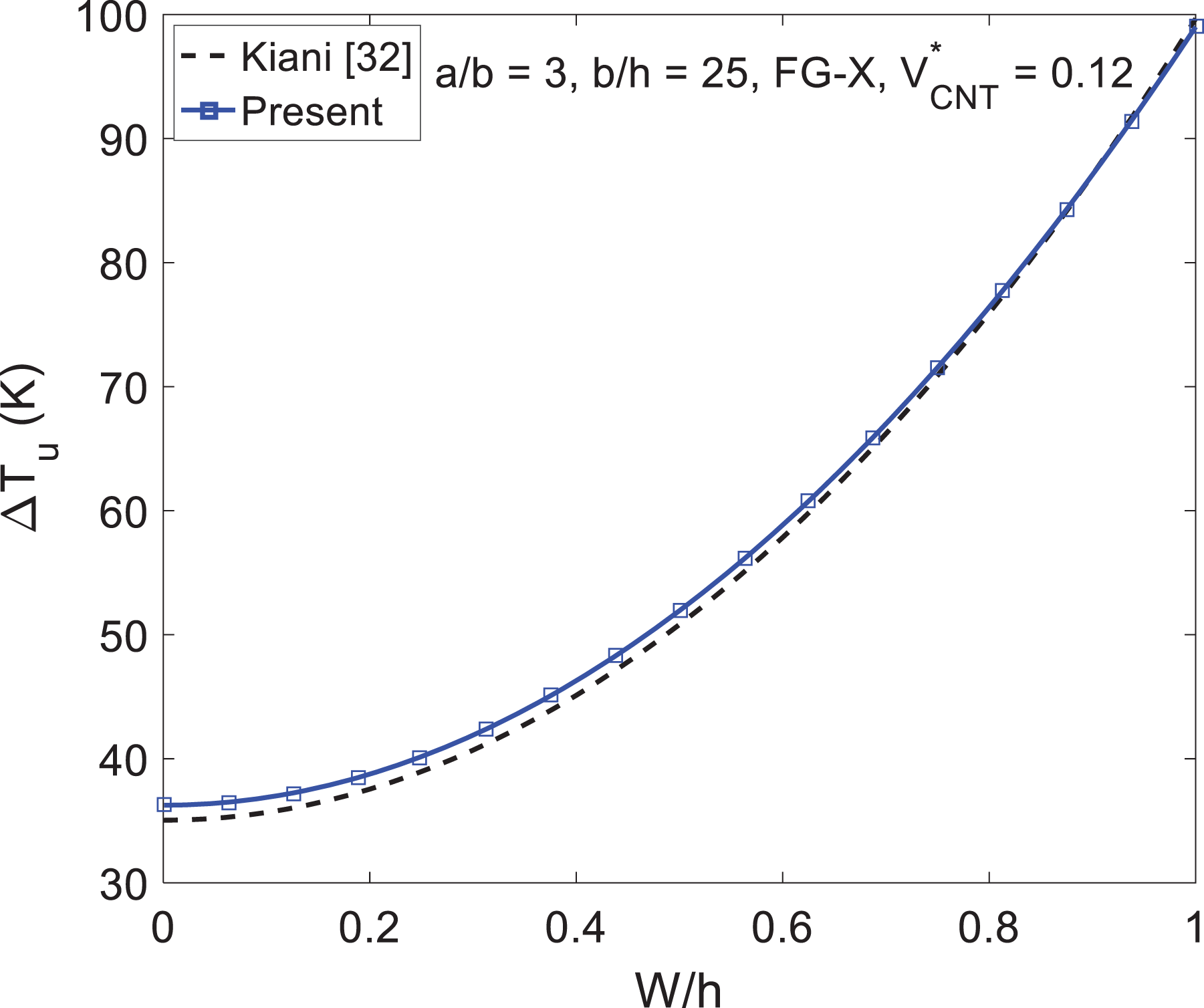
There are no investigations on postbuckling behavior of FG-CNTRC plates with tangentially restrained edges under sinusoidal and linear in-plane temperature distributions in the literature. Therefore, comparative study is performed for special cases of thermal load, plate model and in-plane boundary condition. Specifically, thermal postbuckling behavior of a geometrically perfect FG-CNTRC rectangular plate with simply supported and immovable edges, without foundation interaction (), and subjected to uniform temperature rise is considered. This problem is also solved by Kiani32 using Chebyshev-Ritz method with temperature independent properties. The thermal postbuckling path obtained by the present work is shown in Figure 1 in comparison with results reported by Kiani.32 It is clear that a good agreement is achieved in this comparison.
Comparison of postbuckling paths of FG-CNTRC rectangular plates with immovable edges under uniform temperature rise.
Since there are no propositional formulae of temperature dependent material properties for the case of nonuniform temperature distribution, numerical analyses in the remainder of this section are performed for temperature independent properties calculated at room temperature . In addition, to measure degree of in-plane edge constraints in a more convenient way, the following non-dimensional tangential stiffness parameters are defined
Obviously, according to definitions (39), the cases of movable, immovable and partially movable edges are characterized by , and , respectively. Furthermore, for the sake of brief expression, CNTRC plates are assumed to be square (), geometrically perfect (), with immovable edges (), without foundation interaction () and initially placed in room temperature environment (), unless otherwise specified. As shown in previous works,2–5,31,34,54 the plates are buckled at mode shape under thermal loads. Accordingly, numerical results in this section correspond to buckling mode .
CNTRC plates under sinusoidal in-plane temperature distribution
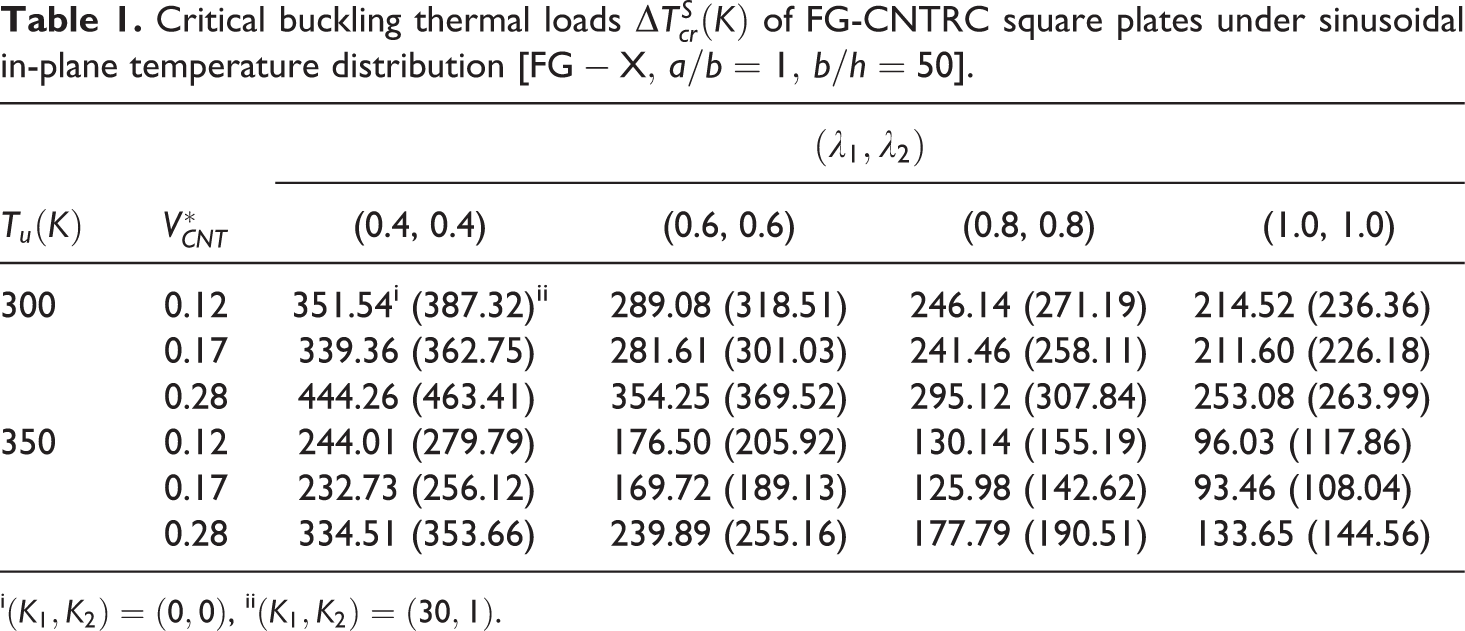
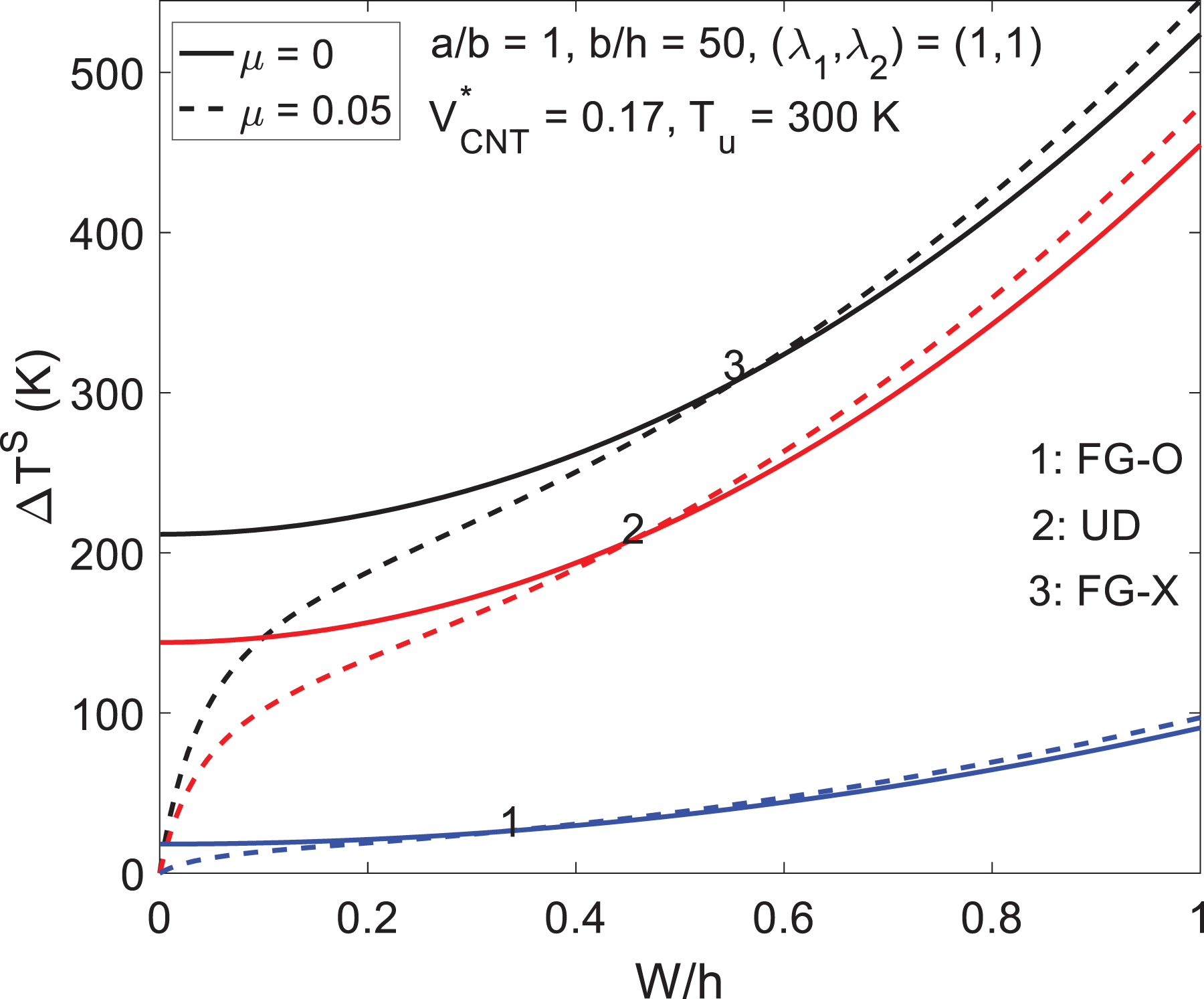
The results of buckling and postbuckling analyses of FG-X CNTRC plates under sinusoidal in-plane temperature distribution are presented in this subsection. Table 1 indicates the effects of tangential edge constraints, CNT volume fraction, initial temperature rise and elastic foundations on the critical buckling thermal loads of CNTRC plates under sinusoidal temperature distribution. It is realized that buckling thermal loads are the smallest and highest for intermediate () and largest () values of volume percentage of CNTs. In addition, it is clear from Table 1 that buckling thermal loads are significantly reduced when tangential stiffness parameters and/or initial temperature rise Tu are increased. In contrast, buckling thermal loads of the plate are enhanced due to the support of an elastic foundation. Next, postbuckling paths of perfect and imperfect nanocomposite plates with different types of CNT distribution are depicted in Figure 2. Evidently, among three distribution patterns, FG-X and FG-O plates have the strongest and weakest capacities of thermal load carrying, respectively.
Critical buckling thermal loads of FG-CNTRC square plates under sinusoidal in-plane temperature distribution [].
(0.4, 0.4)
(0.6, 0.6)
(0.8, 0.8)
(1.0, 1.0)
300
0.12
351.54i (387.32)ii
289.08 (318.51)
246.14 (271.19)
214.52 (236.36)
0.17
339.36 (362.75)
281.61 (301.03)
241.46 (258.11)
211.60 (226.18)
0.28
444.26 (463.41)
354.25 (369.52)
295.12 (307.84)
253.08 (263.99)
350
0.12
244.01 (279.79)
176.50 (205.92)
130.14 (155.19)
96.03 (117.86)
0.17
232.73 (256.12)
169.72 (189.13)
125.98 (142.62)
93.46 (108.04)
0.28
334.51 (353.66)
239.89 (255.16)
177.79 (190.51)
133.65 (144.56)
i, ii.
Effects of CNT distribution patterns on thermal postbuckling of CNTRC plates under sinusoidal in-plane temperature distribution.
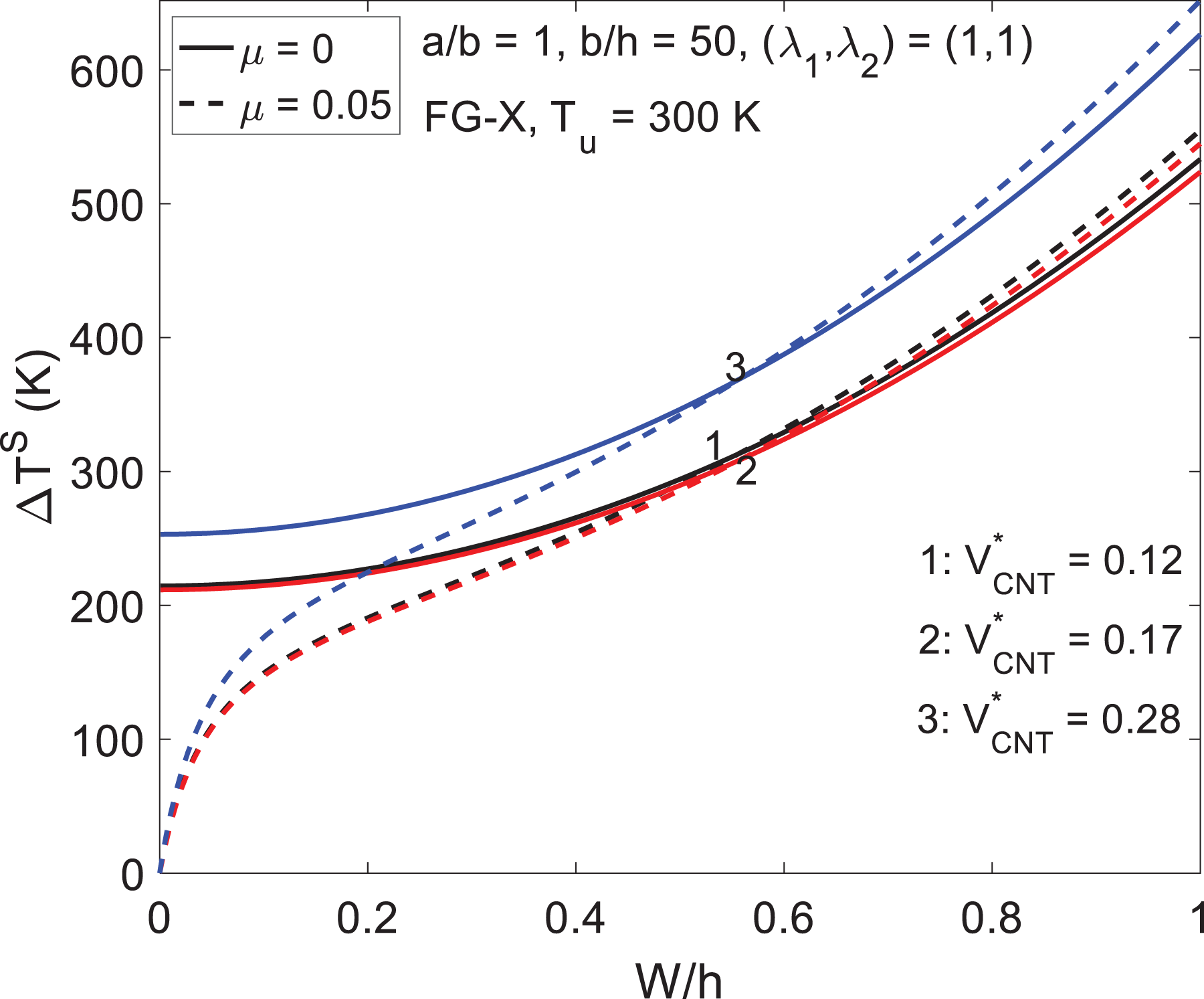
Subsequent example is shown in Figure 3 considering the effects of total volume fraction of CNTs on the postbuckling paths of perfect and imperfect FG-CNTRC plates under sinusoidal temperature distribution. As can be observed, the postbuckling paths are the highest for the largest value of and postbuckling path corresponding to is slightly higher than that corresponding to . The effects of tangential edge constraints on thermal postbuckling response of FG-CNTRC plates placed in an initial thermal environment () and subjected to sinusoidal temperature distribution are analyzed in Figure 4. As can be seen, thermal postbuckling paths are considerably lowered when tangential stiffness parameters are increased. Furthermore, due to high anisotropy of CNTRC material, effect of parameter is more pronounced than parameter .
Effects of CNT volume fraction on thermal postbuckling of FG-CNTRC plates under sinusoidal in-plane temperature distribution.
Effects of tangential edge constraints on thermal postbuckling of FG-CNTRC plates under sinusoidal in-plane temperature distribution.
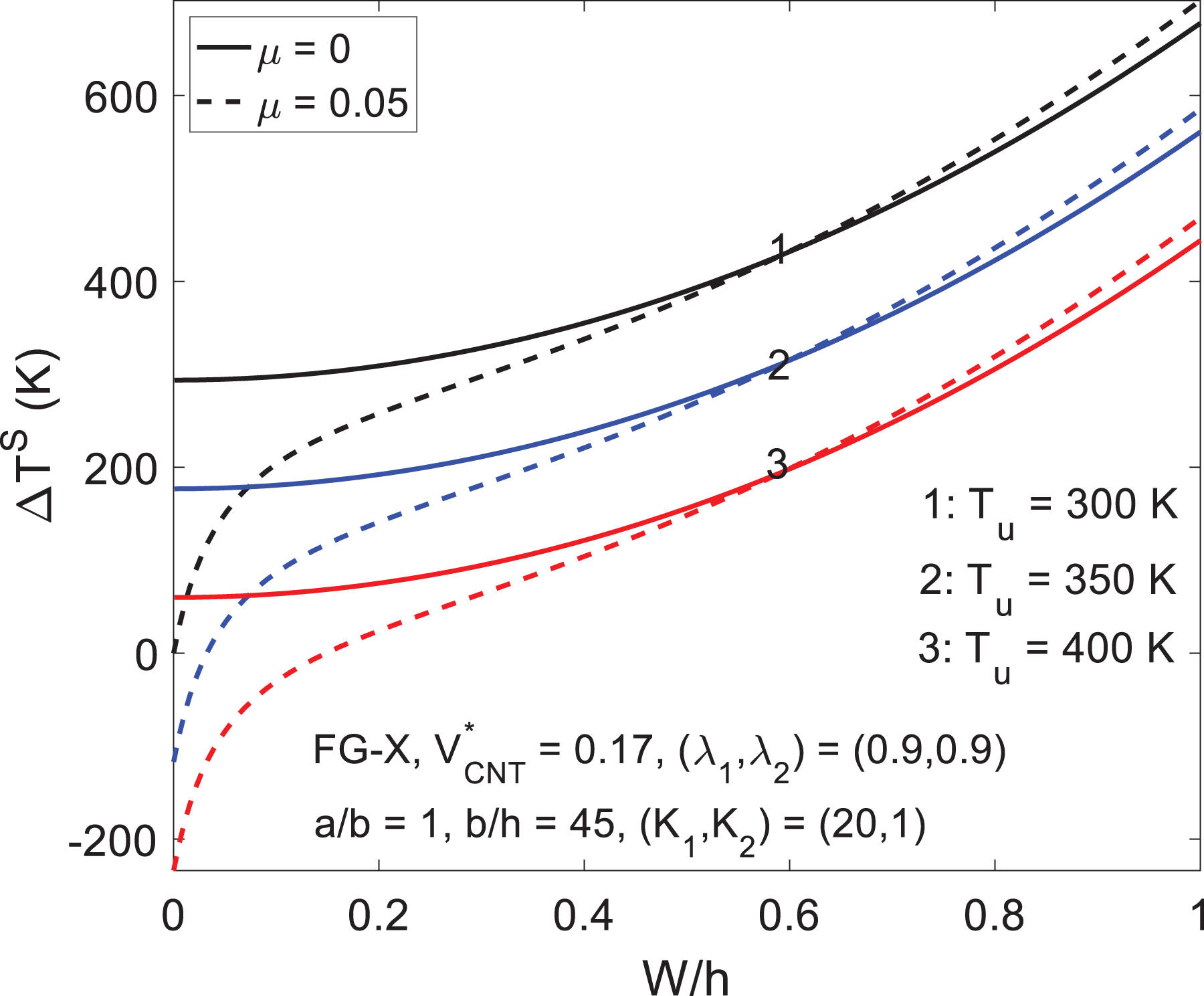
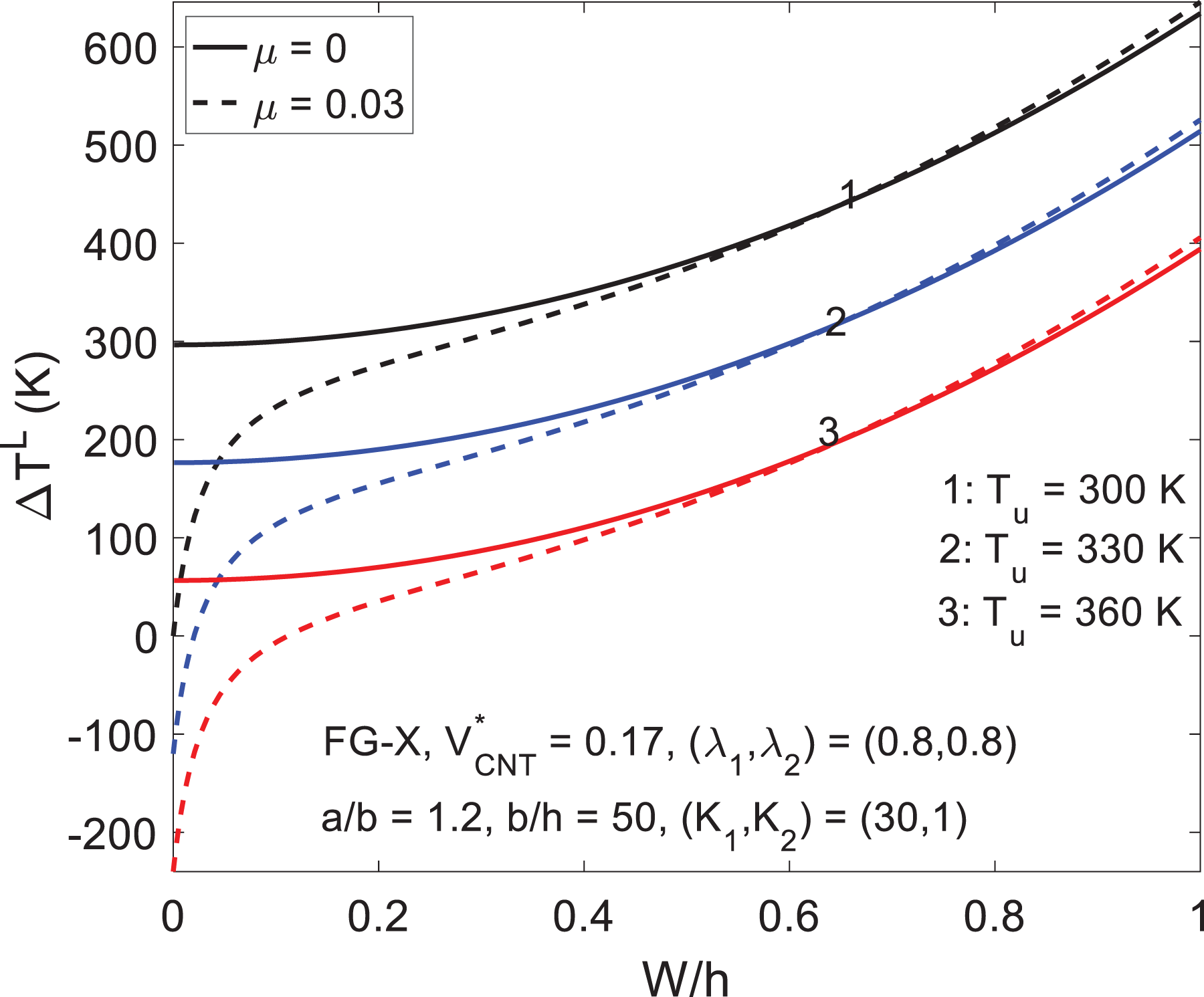
Subsequently, the influences of elastic foundations and aspect ratio on the nonlinear stability of FG-CNTRC plates under sinusoidal temperature distribution are examined in Figure 5. As shown, while elastic foundations evidently improve the load carrying capability, increase in aspect ratio significantly reduces postbuckling strength of thermally loaded nanocomposite plates. Moreover, beneficial influence of elastic foundation is more remarkable for larger value of ratio. Final example in this subsection is displayed in Figure 6 illustrating the effects of preexisting uniform temperature rise Tu on thermal postbuckling behavior of FG-CNTRC plates with almost immovable edges () resting on a Pasternak elastic foundation. It is clear that buckling load and postbuckling path of the plate under sinusoidal temperature distribution are pronouncedly decreased because of the presence of initial uniform temperature rise. Especially, imperfect FG-CNTRC plates are deflected by initial uniform temperature rise () prior to application of sinusoidal temperature.
Effects of elastic foundation and aspect ratio on thermal postbuckling of FG-CNTRC plates under sinusoidal in-plane temperature distribution.
Effects of initial uniform temperature rise on postbuckling of FG-CNTRC plates with partially movable edges under sinusoidal temperature distribution.
CNTRC plates under linear in-plane temperature distribution
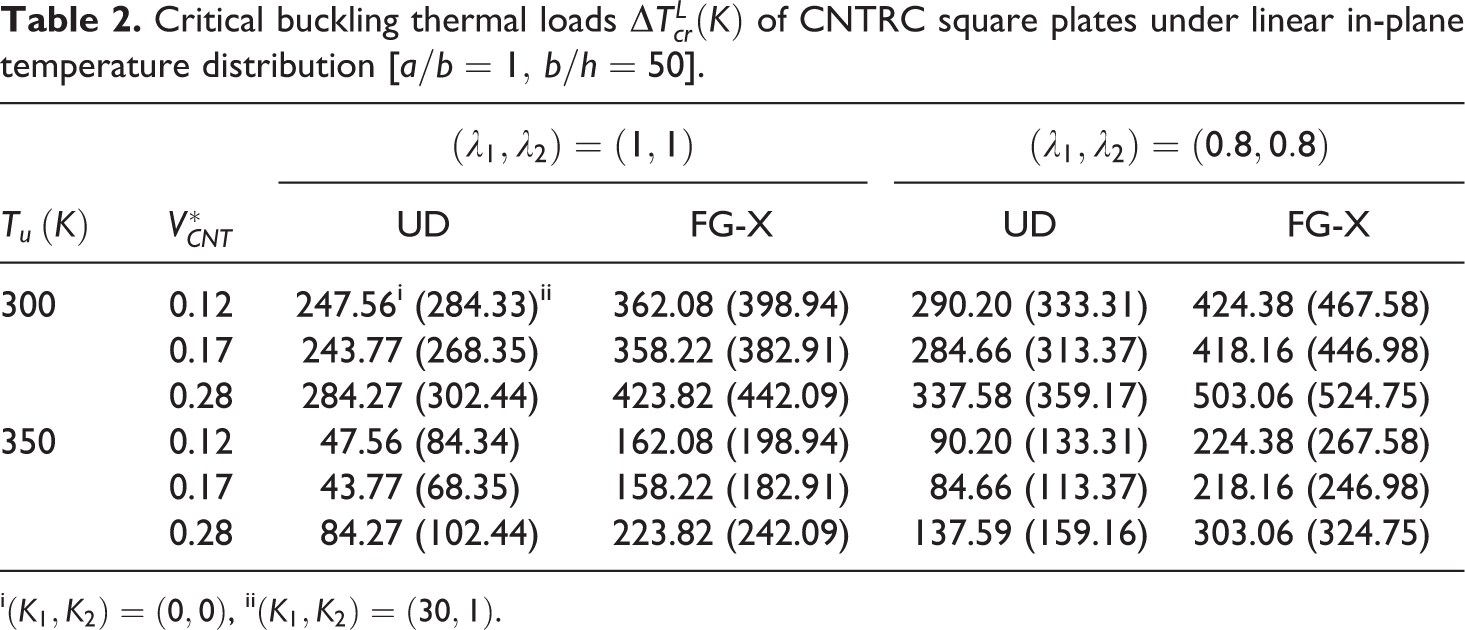
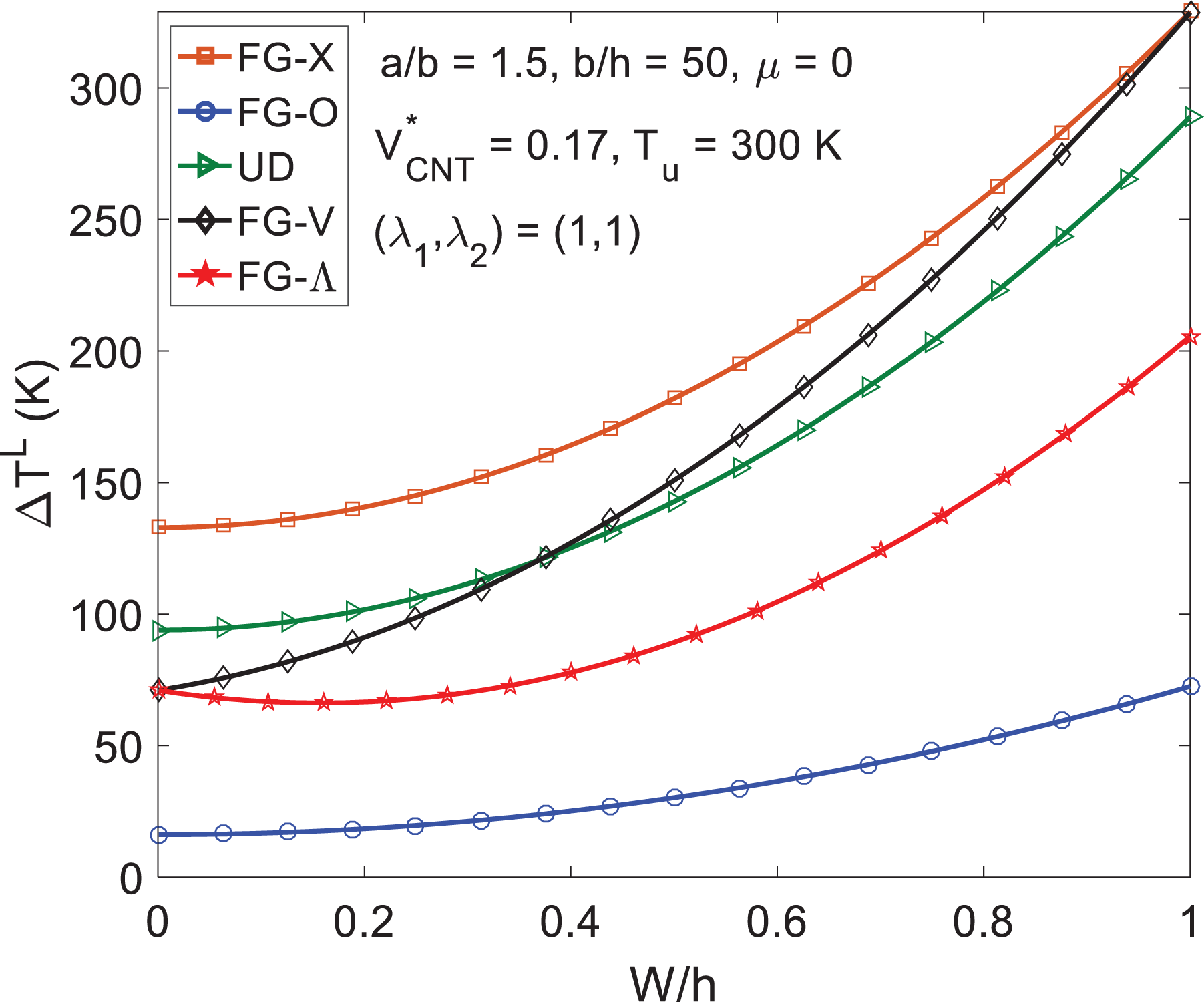
Table 2 shows the results of critical buckling thermal loads of CNTRC square plates under linear in-plane temperature distribution. As can be seen, buckling temperature changes corresponding to values of and are the lowest and highest, respectively. It is recognized from Tables 1 and 2 and Figure 3 that, under nonuniform in-plane temperature distributions, the plates with intermediate volume fraction of CNTs have the smallest buckling thermal loads. Table 2 also indicate that buckling temperature changes are decreased and increased due to the presence of preexisting uniform temperature rise and elastic foundation, respectively. Next, the postbuckling paths of CNTRC rectangular plates with immovable edges and different patterns of CNT distribution are illustrated in Figure 7. This figure demonstrates that FG-X plate has the strongest postbuckling strength. Furthermore, the postbuckling path of FG-V plate is lower and higher than that of UD plate in initial and deep postbuckling regions, respectively.
Critical buckling thermal loads of CNTRC square plates under linear in-plane temperature distribution [].
UD
FG-X
UD
FG-X
300
0.12
247.56i (284.33)ii
362.08 (398.94)
290.20 (333.31)
424.38 (467.58)
0.17
243.77 (268.35)
358.22 (382.91)
284.66 (313.37)
418.16 (446.98)
0.28
284.27 (302.44)
423.82 (442.09)
337.58 (359.17)
503.06 (524.75)
350
0.12
47.56 (84.34)
162.08 (198.94)
90.20 (133.31)
224.38 (267.58)
0.17
43.77 (68.35)
158.22 (182.91)
84.66 (113.37)
218.16 (246.98)
0.28
84.27 (102.44)
223.82 (242.09)
137.59 (159.16)
303.06 (324.75)
i, ii.
Effects of CNT distribution patterns on thermal postbuckling of CNTRC plates under linear in-plane temperature distribution.
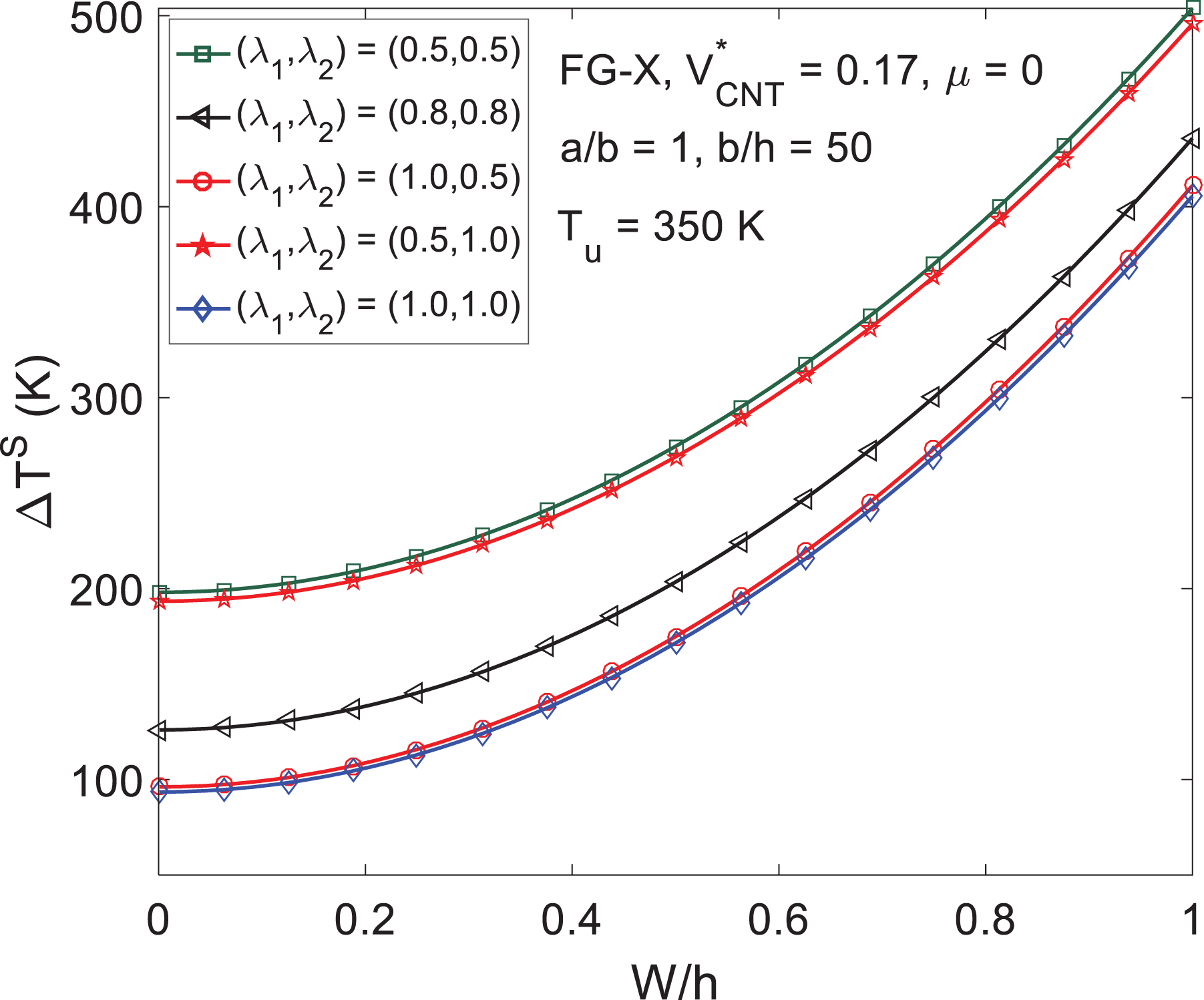
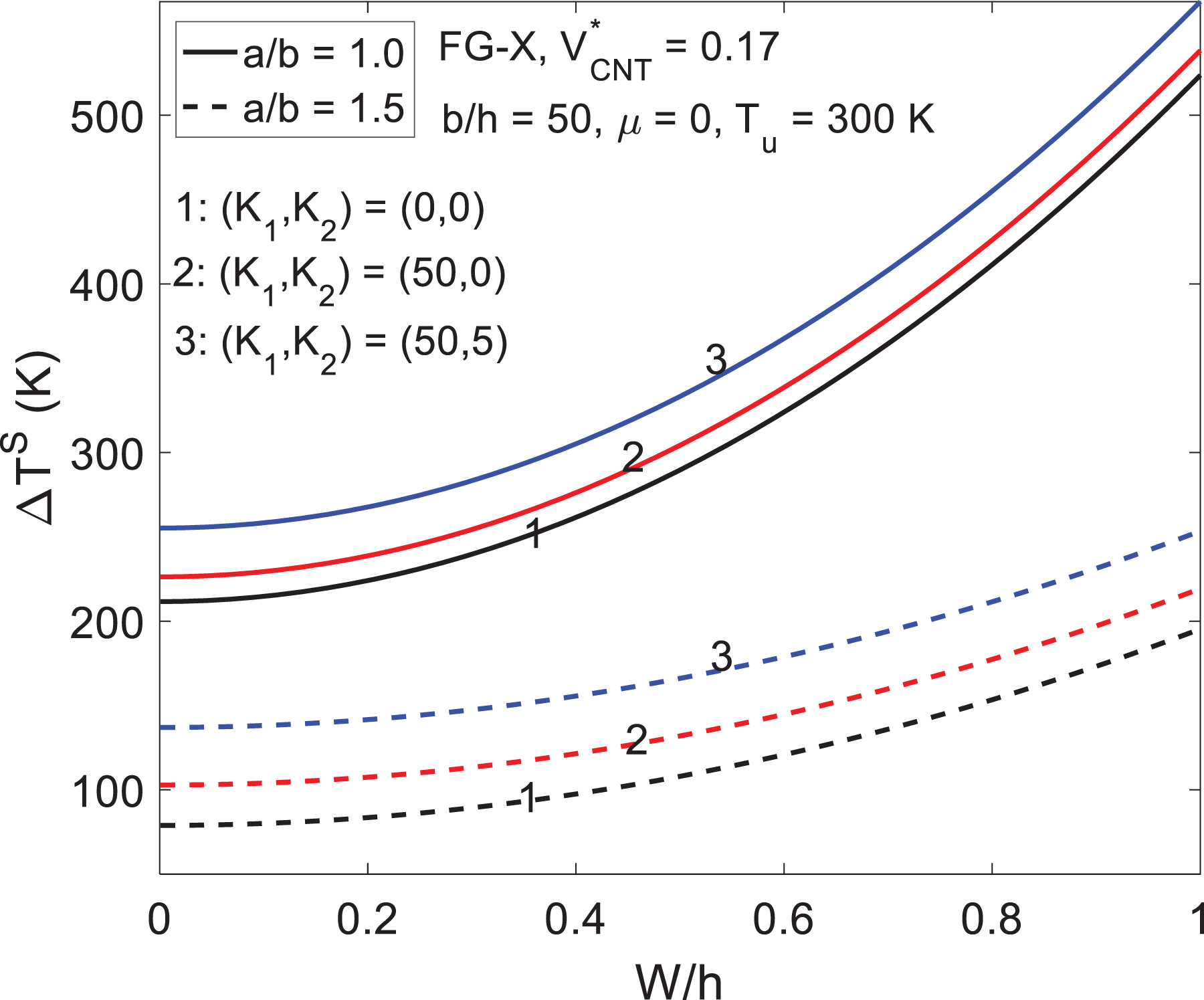
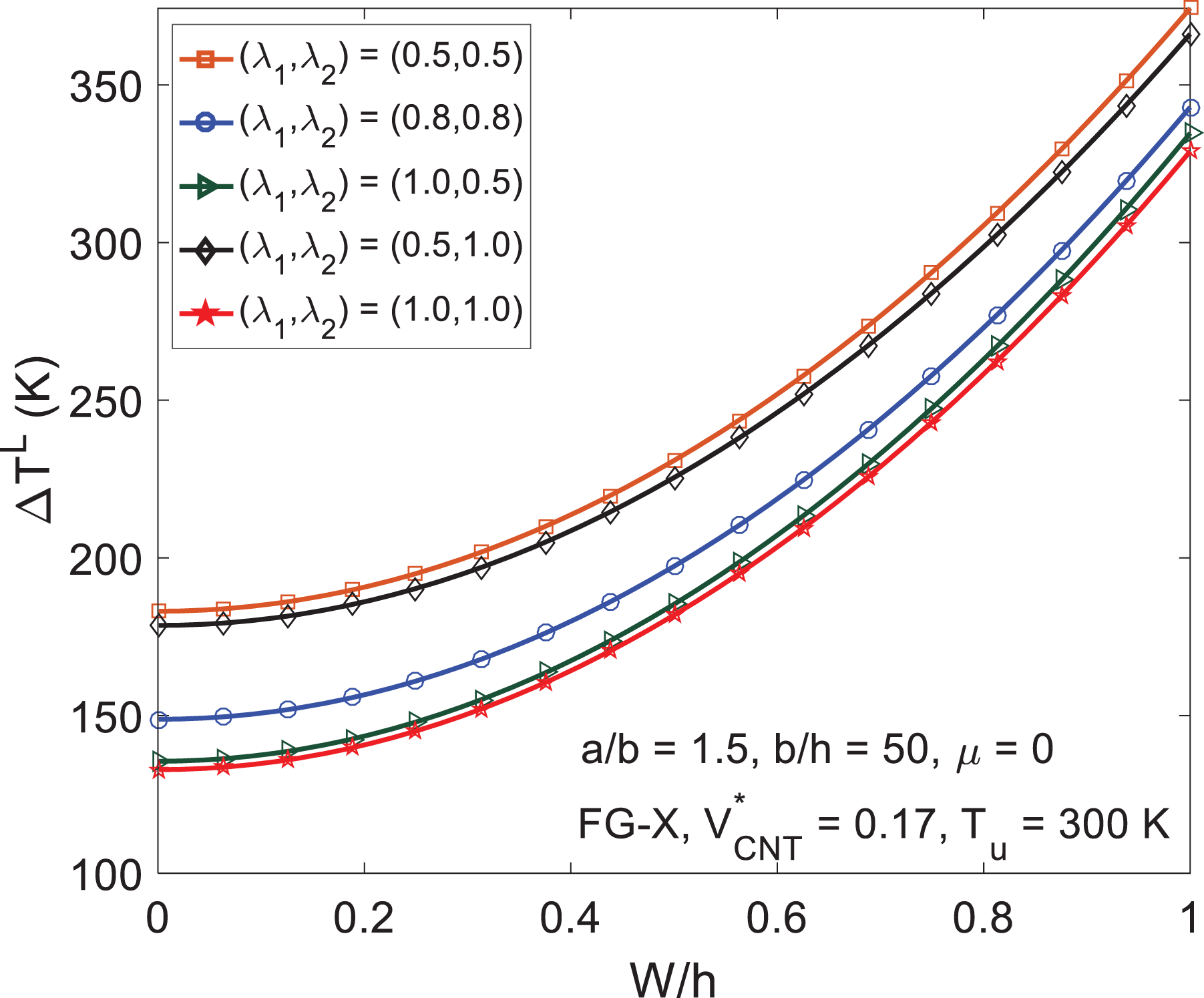
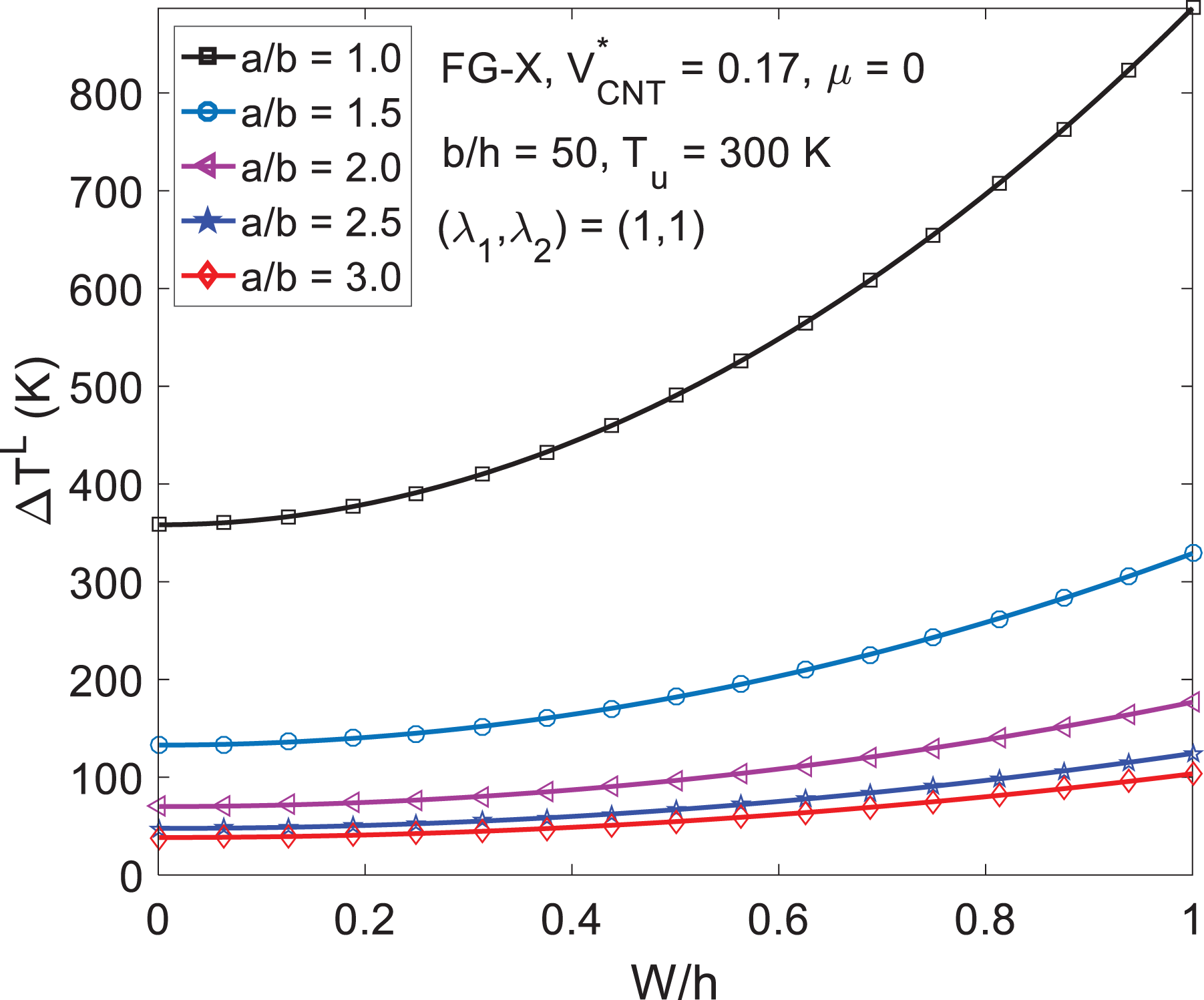
Subsequently, the thermal postbuckling curves of FG-CNTRC plates with various degrees of tangential edge constrain are shown in Figure 8. As expected, the plate with immovable edges has the weakest postbuckling strength and in-plane constraint of edges (parallel to the aligned direction of CNTs) has slight effect on postbuckling curves. Next, Figure 9 examines the effects of aspect ratio on the thermal postbuckling of FG-CNTRC plates under linear in-plane temperature distribution. Obviously, postbuckling path is strongly dropped when ratio is increased from 1 to 1.5, then this path is more slowly reduced as increases from 1.5 to 3. Moreover, postbuckling path is more gradually developed for larger value of ratio. Finally, the effects of preexisting uniform temperature rise on the thermal postbuckling of a FG-CNTRC rectangular plate with partially movable edges () resting on a Pasternak elastic foundation are shown in Figure 10. It is similar to case of sinusoidal temperature distribution, preexisting uniform thermal environment has evidently detrimental effects on the postbuckling load carrying capability of nanocomposite plates, especially imperfect plates, under linear in-plane temperature distribution.
Effects of tangential edge constraints on thermal postbuckling of FG-CNTRC plates under linear in-plane temperature distribution.
Effects of aspect ratio on thermal postbuckling of FG-CNTRC plates under linear in-plane temperature distribution.
Effects of initial uniform temperature rise on thermal postbuckling of FG-CNTRC plates under linear in-plane temperature distribution.
Concluding remarks
Basing on an analytical approach, the buckling and postbuckling behavior of thin CNTRC plates with simply supported and tangentially restrained edges subjected to two types of nonuniform in-plane temperature distribution have been presented. Since engineering structures are usually subjected to nonuniform temperature distribution, this paper aims to predict the nonlinear stability of CNTRC plates under more practical situations of thermal load and in-plane boundary conditions. The results indicate that plate with an intermediate volume fraction of CNTs can have the weakest postbuckling strength under sinusoidal and linear in-plane temperature distributions. The study also shows that tangential edge constraints and aspect ratio have essential effects on buckling loads and postbuckling paths. In addition, initial uniform temperature field and elastic foundation have detrimental and beneficial influences on the nonlinear stability of nanocomposite plates under nonuniform in-plane temperature distributions, respectively.
Footnotes
Funding
The author(s) disclosed receipt of the following financial support for the research, authorship, and/or publication of this article: This research was funded by Vietnam National Foundation for Science and Technology Development (NAFOSTED) under grant number 107.02-2019.318.
ORCID iD
Hoang Van Tung
References
1.
TauchertTR. Thermally induced flexure, buckling and vibration of plates. Appl Mech Rev1991; 44(8): 347–359.
TungHVDucND. Nonlinear analysis of stability for functionally graded plates under mechanical and thermal loads. Compos Struct2010; 92: 1184–1191.
4.
DucNDTungHV. Mechanical and thermal postbuckling of higher order shear deformable functionally graded plates on elastic foundations. Compos Struct2011; 93: 2874–2881.
5.
TungHV. Thermal and thermomechanical postbuckling of FGM sandwich plates resting on elastic foundations with tangential edge constraints and temperature dependent properties. Compos Struct2015; 131: 1028–1039.
6.
TungHV. Postbuckling of functionally graded cylindrical shells with tangential edge restraints and temperature-dependent properties. Acta Mech2014; 225: 1795–1808.
7.
HieuPTTungHV. Nonlinear buckling behavior of functionally graded material sandwich cylindrical shells with tangentially restrained edges subjected to external pressure and thermal loadings. J Sandw Struct Mater2020 (in press). DOI: 10.1177/1099636220908855.
8.
KarVRMahapatraTRPandaSK. Effect of different temperature load on thermal postbuckling behavior of functionally graded shallow curved shell panels. Compos Struct2017; 160: 1236–1247.
9.
KarVRPandaSK. Large amplitude vibration of functionally graded doubly curved panels under heat conduction. AIAA J2017; 55(12): 4376–4386.
10.
ShenHS. Nonlinear bending of functionally graded carbon nanotube-reinforced composite plates in thermal environments. Compos Struct2009; 91: 9–19.
11.
LeiZXLiewKMYuJL. Buckling analysis of functionally graded carbon nanotube-reinforced composite plates using the element-free kp-Ritz method. Compos Struct2013; 98: 160–168.
12.
KianiY. Shear buckling of FG-CNT reinforced composite plates using Chebyshev-Ritz method. Compos B Eng2016; 105: 176–187.
13.
KianiY. Buckling of FG-CNT-reinforced composite plates subjected to parabolic loading. Acta Mech2017; 228(4): 1303–1319.
14.
ZhangLWLiewKMReddyJN. Postbuckling of carbon nanotube reinforced functionally graded plates with edges elastically restrained against translation and rotation under axial compression. Comput Methods Appl Mech Eng2016; 298: 1–28.
15.
TrangLTNTungHV. Tangential edge constraint sensitivity of nonlinear stability of CNT-reinforced composite plates under compressive and thermomechanical loadings. J Eng Mech ASCE2018; 144(7): 04018056.
16.
MaciasEGTemblequeLRTrigueroRC, et al.Buckling analysis of functionally graded carbon nanotube-reinforced curved panels under axial compression and shear. Compos B Eng2017; 108: 243–256.
17.
ZghalSFrikhaADammarkF. Mechanical buckling analysis of functionally graded power-based and carbon nanotubes-reinforced composite plates and curved panels. Compos B Eng2018; 150: 165–183.
18.
ShenHSXiangY. Postbuckling of axially compressed nanotube-reinforced composite cylindrical panels resting on elastic foundations in thermal environments. Compos B Eng2014: 67: 50–61.
19.
ShenHS. Postbuckling of nanotube-reinforced composite cylindrical panels resting on elastic foundations subjected to lateral pressure in thermal environments. Eng Struct2016; 122: 174–183.
20.
TungHVTrangLTN. Imperfection and tangential edge constraint sensitivities of thermomechanical nonlinear response of pressure-loaded carbon nanotube-reinforced composite cylindrical panels. Acta Mech2018; 229(5): 1949–1969.
21.
TrangLTNTungHV. Thermomechanical nonlinear analysis of axially compressed carbon nanotube-reinforced composite cylindrical panels resting on elastic foundations with tangentially restrained edges. J Therm Stresses2018; 41(4): 418–438.
22.
TrangLTNTungHV. Nonlinear stability of CNT-reinforced composite cylindrical panels with elastically restrained straight edges under combined thermomechanical loading conditions. J Thermoplast Compos Mater2020; 33(2): 153–179.
23.
TrangLTNTungHV. Thermomechanical nonlinear stability of pressure-loaded CNT-reinforced composite doubly curved panels resting on elastic foundations. Nonlinear Eng Model Appl2019; 8: 582–596.
24.
TrangLTNTungHV. Thermomechanical nonlinear stability of pressure-loaded functionally graded carbon nanotube-reinforced composite doubly curved panels with tangentially restrained edges. Proc Inst Mech Eng C J Mech Eng Sci2019; 233(16): 5848–5859.
25.
ChakrabortySDeyTKumarR. Stability and vibration analysis of CNT-reinforced functionally graded laminated composite cylindrical shell panels using semi-analytical approach. Compos B Eng2019; 168: 1–14.
26.
ShenHS. Postbuckling of nanotube-reinforced composite cylindrical shells in thermal environments, part I: axially-loaded shells. Compos Struct2011; 93: 2096–2108.
27.
ShenHS. Postbuckling of nanotube-reinforced composite cylindrical shells in thermal environments, part II: pressure-loaded shells. Compos Struct2011; 93: 2496–2503.
28.
HieuPTTungHV. Postbuckling behavior of CNT-reinforced composite cylindrical shell surrounded by an elastic medium and subjected to combined mechanical loads in thermal environments. J Thermoplast Compos Mater2019; 32(10): 1319–1346.
29.
MirzaeiMKianiY. Thermal buckling of temperature dependent FG-CNT reinforced composite plates. Meccanica2016; 51(9): 2185–2201.
TungHV. Thermal buckling and postbuckling behavior of functionally graded carbon nanotube-reinforced composite plates resting on elastic foundations with tangential-edge restraints. J Therm Stresses2017; 40(5): 641–663.
34.
TungHVTrangLTN. Thermal postbuckling of shear deformable CNT-reinforced composite plates with tangentially restrained edges and temperature dependent properties. J Thermoplast Compos Mater2020; 33(1): 97–124.
35.
KianiY. Thermal post-buckling of temperature dependent sandwich plates with FG-CNTRC face sheets. J Therm Stresses2018; 41(7): 866–882.
36.
LongVTTungHV. Thermal postbuckling behavior of CNT-reinforced composite sandwich plate models resting on elastic foundations with tangentially restrained edges and temperature-dependent properties. J Thermoplast Compos Mater2020; 33(10): 1396–1428.
37.
LongVTTungHV. Thermomechanical postbuckling behavior of CNT-reinforced composite sandwich plate models resting on elastic foundations with elastically restrained unloaded edges. J Therm Stresses2019; 42(5): 658–680.
38.
ShenHSXiangY. Thermal postbuckling of nanotube-reinforced composite cylindrical panels resting on elastic foundations. Compos Struct2015; 123: 383–392.
39.
ShenHS. Thermal buckling and postbuckling behavior of functionally graded carbon nanotube-reinforced composite cylindrical shells. Compos B Eng2012; 43: 1030–1038.
40.
TrangLTNTungHV. Thermally induced postbuckling of higher order shear deformable CNT-reinforced composite flat and cylindrical panels resting on elastic foundations with elastically restrained edges. Mech Based Des Struct Mach2020 (in press). DOI: 10.1080/15397734.2020.1785312.
41.
HieuPTTungHV. Thermal buckling and postbuckling of CNT-reinforced composite cylindrical shell surrounded by an elastic medium with tangentially restrained edges. J Thermoplast Compos Mater2019 (in press). DOI: 10.1177/0892705719853611.
42.
HieuPTTungHV. Thermomechanical postbuckling of pressure-loaded CNT-reinforced composite cylindrical shells under tangential edge constraints and various temperature conditions. Polym Compos2020; 41: 244–257.
43.
HieuPTTungHV. Thermomechanical nonlinear buckling of pressure-loaded carbon nanotube reinforced composite toroidal shell segment surrounded by an elastic medium with tangentially restrained edges. Proc Inst Mech Eng C J Mech Eng Sci2019; 233(9): 3193–3207.
44.
MirzaeiMKianiY. Thermal buckling of temperature dependent FG-CNT reinforced composite conical shells. Aerosp Sci Technol2015; 47: 42–53.
45.
HieuPTTungHV. Thermal and thermomechanical buckling of shear deformable FG-CNTRC cylindrical shells and toroidal shell segments with tangentially restrained edges. Arch Appl Mech2020; 90(7): 1529–1546.
46.
MeharKPandaSKSharmaN. Numerical investigation and experimental verification of thermal frequency of carbon nanotube-reinforced sandwich structure. Eng Struct2020; 211: 110444.
47.
MeharKMishraPKPandaSK. Numerical investigation of thermal frequency responses of graded hybrid smart nanocomposite (CNT-SMA-epoxy) structure. Mech Adv Mater Struct2020 (in press). DOI: 10.1080/15376494.2020.1725193.
48.
MeharKPandaSKMahapatraTR. Thermoelastic nonlinear frequency analysis of CNT reinforced functionally graded sandwich structure. Eur J Mech A/Solids2017; 65: 384–396.
49.
MeharKPandaSKBuiTQ, et al.Nonlinear thermoelastic frequency analysis of functionally graded CNT-reinforced single/doubly curved shallow shell panels by FEM. J Therm Stresses2017; 40(7): 899–916.
50.
MeharKPandaSK. Geometrical nonlinear free vibration analysis of FG-CNT reinforced composite flat panel under uniform thermal field. Compos Struct2016; 143: 336–346.
51.
KlosnerJMForrayMJ. Buckling of simply supported plates under arbitrary symmetrical temperature distributions. J Aerosp Sci1958; 25(3): 181–184.
52.
HaydlHM. Elastic buckling of heated doubly curved thin shells. Nucl Eng Des1968; 7: 141–151.
LinWLibrescuL. Thermomechanical postbuckling of geometrically imperfect shear-deformable flat and curved panels on a nonlinear elastic foundation. Int J Eng Sci1998; 36(2): 189–206.
55.
MeharKPandaSKMahapatraTR. Theoretical and experimental investigation of vibration characteristic of carbon nanotube reinforced polymer composite structures. Int J Mech Sci2017; 133: 319–329.