




Abstract
Buckling and postbuckling behaviors of moderately thick composite plates reinforced by single-walled carbon nanotubes (SWCNTs), rested on elastic foundations and subjected to two types of thermal loading are investigated in this article. Carbon nanotubes (CNTs) are reinforced into isotropic polymer matrix according to functional rules in which volume fractions of constituents are graded in the thickness direction. Material properties of constituents are assumed to be temperature-dependent and effective properties of nanocomposite are estimated by extended rule of mixture. Formulations are based on first-order shear deformation theory taking von Karman nonlinearity, initial geometrical imperfection, tangential constraints of edges, and two-parameter elastic foundation into consideration. Approximate solutions are assumed to satisfy simply supported boundary conditions and Galerkin method is applied to derive nonlinear temperature–deflection relations from which buckling temperatures and postbuckling equilibrium paths are determined by an iteration algorithm. Novel findings of the present study are that deteriorative influences of temperature-dependent properties on the postbuckling behavior become more serious as plate edges are partially movable, CNT volume fraction is higher, elastic foundations are stiffer, plates are thicker, and/or temperature linearly changed across the thickness.
Keywords
Introduction
Since their excellent properties, carbon nanotubes (CNTs) have attracted attention of many researchers in many different fields. CNTs are obtained by rolling sheets of graphite and have single-walled (SWCNT) or multi-walled (MWCNT) structures. The reports of material scientists proven that CNTs possess extremely high elastic moduli and very superior electrical and thermal properties with very large aspect ratio. 1 –3 There is no previous material displayed extraordinary characteristics as CNTs. Due to unprecedentedly wonderful mechanical, electrical, and thermal properties, CNTs are used as excellent fillers in polymer matrix to obtain carbon nanotube–reinforced composite (CNTRC) known as advanced nanocomposite. 1,4 Nanocomposites with CNT fillers are widely used in industrial applications 5 and have promising potential for numerous applications in the future. 6,7
The concept of functionally graded carbon nanotube–reinforced composite (FG-CNTRC) is first proposed by Shen 8 in which volume fraction of CNTs is varied in the thickness direction according to functional rules. Shen’s this work on the nonlinear bending of FG-CNTRC plates in thermal environments has motivated subsequent investigations. Zhang et al. 9 conducted the results of nonlinear bending analysis of thick FG-CNTRC plates resting on Pasternak foundations using a numerical method. Hajmohammad et al. 10 used differential quadrature method (DQM) to study dynamic response of CNTRC cylindrical shells submerged in an incompressible fluid subjected to earthquake, thermal, and moisture loads. Hajmohammad et al. 11 analyzed vibration of nanocomposite sandwich conical shells with piezoelectric layers. Kolahchi and coworkers 12,13 employed numerical approaches based on different plate theories to investigate the bending, vibration, and buckling of viscoelastic sandwich nanoplates and wave propagation of FG-CNTRC sandwich plates. Vibration analysis of FG-CNTRC piezoelectric cylindrical shells subjected to temperature distributions has been carried out by Madani et al. 14 utilizing differential cubature method. Buckling behavior of concrete columns armed with CNTs has been analyzed by Arani and Kolahchi. 15 Basing on Reddy plate theory, Shokravi 16 treated linear buckling problem of sandwich plates with FG-CNTRC layers resting on orthotropic elastic foundations. Linear stability of rectangular and skew FG-CNTRC plates in single layer and laminated forms under mechanical loadings has been analyzed in works 17 –20 making use of a numerical approach based on the first-order shear deformation theory (FSDT). Macias et al. 21 used numerical simulations based on shell finite elements to analyze the linear buckling of FG-CNTRC cylindrical panels under axial compression and shear load. Basing on DQM and the FSDT, the results of linear buckling analysis for quadrilateral laminated FG-CNTRC plates under mechanical load have been presented by Malekzadeh and Shojaee. 22 Wattanasakulpong and Chaikittiratana 23 analyzed the bending, mechanical buckling, and vibration of FG-CNTRC plates utilizing Navier series solution. Kiani 24,25 dealt with linear buckling problems of FG-CNTRC rectangular plates under shear and parabolic loadings using Chebyshev–Ritz methods. The shear buckling behavior of FG-CNTRC skew plates has been studied by Kiani and Mirzaei 26 making use of Ritz method whose shape functions are constructed according to the Gram–Schmidt process.
Thermal buckling and postbuckling behaviors of composite and nanocomposite structures are problems of considerable importance in the design of these structures. Rafiee et al. 27 examined thermal bifurcation buckling of piezoelectric FG-CNTRC beams. Mirzaei and Kiani 28,29 made use of Chebyshev–Ritz and discrete singular convolution methods to study the linear buckling of FG-CNTRC rectangular plates and conical shells subjected to uniform temperature rise, respectively. Based on the FSDT and Ritz method with Gram–Schmidt shape functions, thermal buckling behavior of FG-CNTRC skew plates has been addressed in work of Kiani. 30 Shen and Zhang 31 presented the first investigation on the subject of nonlinear stability of FG-CNTRC rectangular plates subjected to uniform temperature rise and in-plane temperature variation. In their work, basic equations are established within the framework of a higher order shear deformation plate theory and thermal postbuckling behavior of simply supported FG-CNTRC plates are determined by means of a two-step perturbation technique. Recently, Kiani 32 dealt with the postbuckling problem of FG-CNTRC plates with arbitrary combination of boundary conditions under uniform temperature rise employing Ritz method whose shape functions are selected as the Chebyshev polynomials. Utilizing a two-step perturbation technique, thermal postbuckling of FG-CNTRC hybrid laminated plates and postbuckling of sandwich plates with FG-CNTRC face sheets resting on elastic foundations subjected to compressive loading and uniform temperature rise have been treated in works, 33,34 respectively. Utilizing Ritz method, Kiani 35 has conducted results of postbuckling analysis for sandwich plates with FG-CNTRC face sheets exposed to uniform temperature rise. Kiani and coworker 36,37 made use of a nonuniform rational B-spline-based isogeometric finite element method to study the thermal buckling and postbuckling responses of graphene-reinforced laminated plates. Basing on numerical methods, dynamic stability of nanocomposite plates has been addressed in works of Kolahchi and collaborators 38 –43 including the effects of viscidity, piezoelectric layers, CNT agglomeration, orthotropic elastomeric medium, and temperature-dependent properties. Making use of asymptotic solutions and a perturbation technique, Shen and Xiang 44 and Shen 45 investigated thermal postbuckling behaviors of FG-CNTRC cylindrical panels and circular cylindrical shells subjected to uniform temperature rise, respectively.
Above mentioned works only considered thermal buckling and postbuckling of FG-CNTRC plates and shells as in-plane condition of boundary edges is immovable. However, in practical situations, boundary edges of plates and shells may be restrained elastically and partially movable only. Accordingly, elastic condition of boundary edges should be considered to account for various degrees of tangential constraints of edges. Previous works of Tung 46,47 relating to thermal postbuckling of ceramic-metal functionally graded (FG) plates and shells indicated that temperature dependence of material properties has more detrimental influences on the thermal postbuckling behavior of plates and shells as their edges are not fully immovable. There is a limited number of investigations on behavior of FG-CNTRC structures taking into account elastic condition of in-plane restraint of edges. Zhang et al. 48,49 employed a numerical approach based on the FSDT and IMLS-Ritz method to analyze geometrically nonlinear response of FG-CNTRC plates with column supports and elastically restrained edges and postbuckling behavior of FG-CNTRC plates with edges elastically restrained against translation and rotation under axial compression, respectively. Recently, Tung 50 investigated the thermal buckling and postbuckling of thin FG-CNTRC plates on elastic foundations with temperature-independent properties and tangentially restrained edges making use of Galerkin method and classical plate theory. More recently, Tung and Trang 51 –53 presented analytical investigations on the nonlinear stability of thin FG-CNTRC rectangular plates and cylindrical panels subjected to mechanical and thermomechanical loadings taking tangential constraints of boundary edges into consideration.
Motivated by previous study 47 and as an extension of work, 50 the present article investigates the buckling and postbuckling of moderately thick FG-CNTRC plates with elastically restrained edges resting on elastic foundations and subjected to uniform temperature rise and linear temperature change across the thickness. CNTs are reinforced into isotropic polymer matrix according to uniform distribution (UD) or FG distribution along the plate thickness. The properties of CNTs and matrix are assumed to be temperature-dependent, and effective properties of CNTRC are determined by extended rule of mixture. Governing equations are based on the FSDT taking von Karman nonlinearity, initial geometrical imperfection, elastic foundations, and tangential constraints of edges into consideration. Approximate solutions are assumed to satisfy simply supported boundary conditions and Galerkin method is applied to obtain nonlinear temperature–deflection relation from which thermal buckling and postbuckling behaviors are determined by means of an iteration algorithm. The study reveals that the deteriorative effects of temperature-dependent material properties on the thermal postbuckling behavior become more pronounced as edges are partially movable, elastic foundation is stiffer, and/or as temperature is linearly changed across the thickness. Separate and combined influences of CNT volume fraction and distribution types, aspect ratios, elastic foundations, and various degrees of tangential edge constraints on the buckling temperatures and postbuckling loading capacity are analyzed through numerical examples.
CNT-reinforced composite plate resting on an elastic foundation
A rectangular nanocomposite plate of length a, width b, and thickness h is considered. The plate is reinforced by SWCNTs, rested on a Pasternak elastic foundation and defined in a Cartesian coordinate system



where

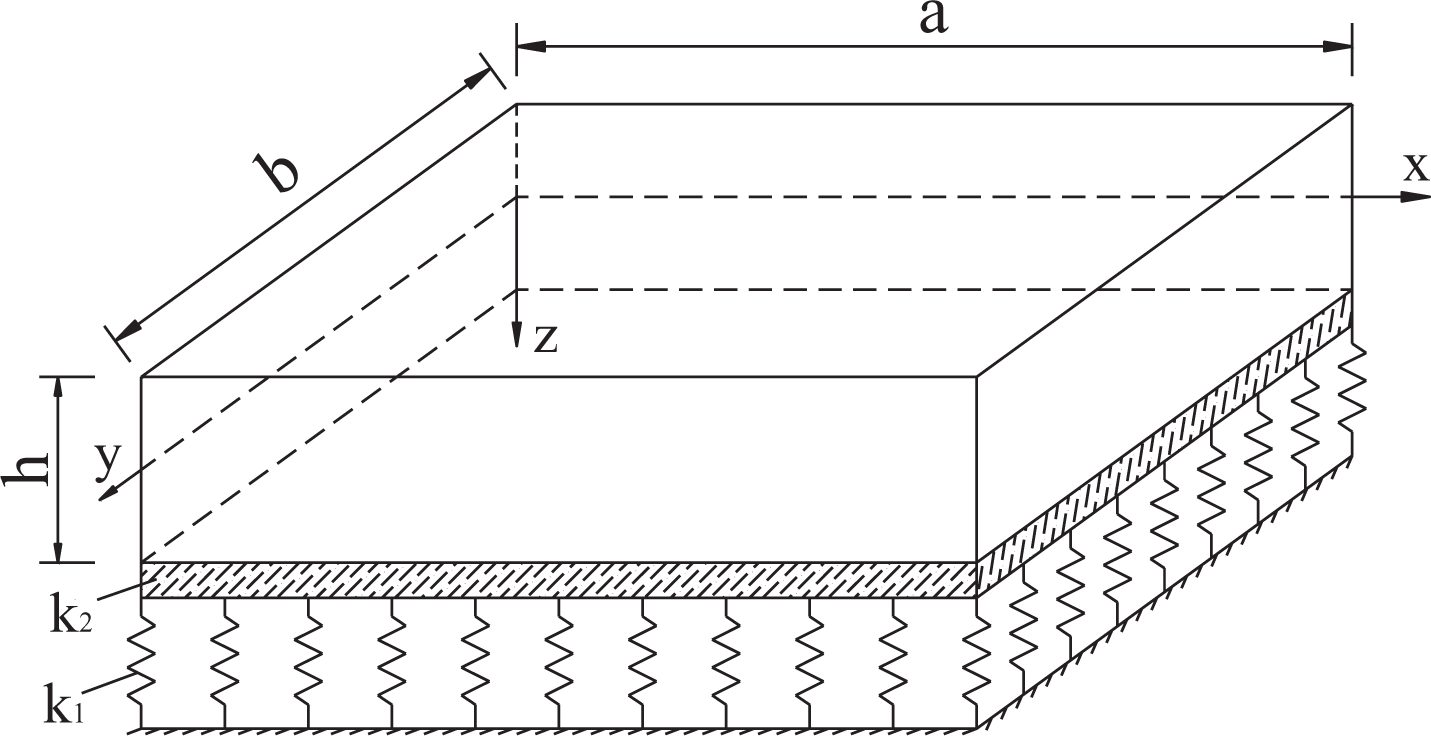
Configuration and coordinate system of a rectangular plate resting on a Pasternak elastic foundation.
The volume fractions
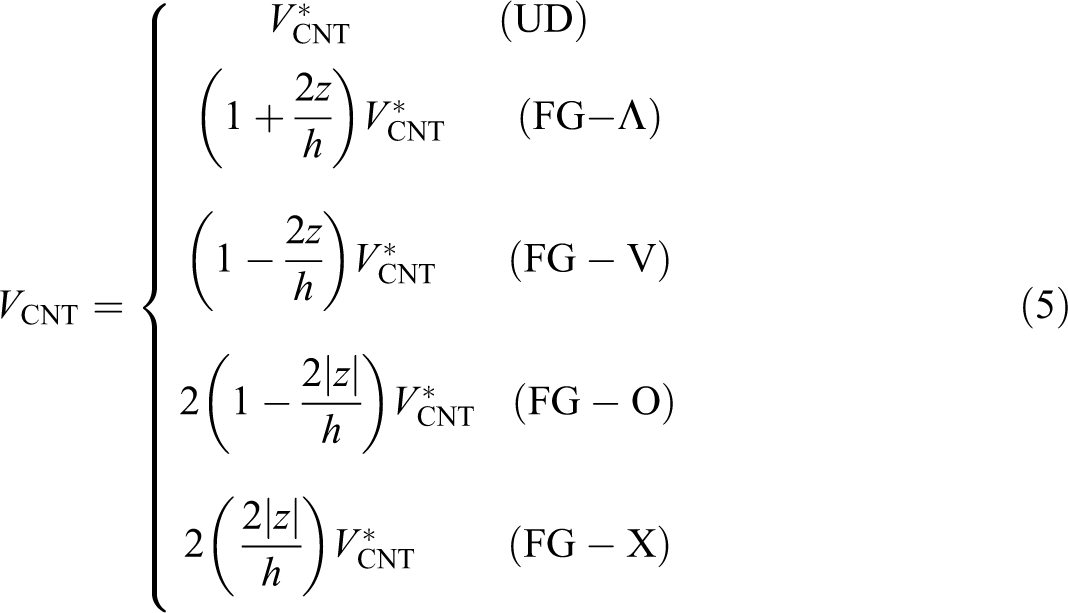
where

in which
Poisson ratio depending weakly on position and temperature can be determined by

where
The coefficients of thermal expansion of the CNTRC plate in the longitudinal and transverse directions have the form as 8,31


where
Formulations
Based on the FSDT, strain components are expressed as

where

in which
In the present study, the CNTRC plate is subjected to two types of thermal loading are that uniform temperature rise and linear temperature change across the thickness. In case of uniform temperature rise, the plate is exposed to an environment temperature of which is uniformly raised from thermal stress free initial state T
0 to final value T and temperature change

where
Next, stress–strain relations of CNTRC plate are expressed as

where

and
Based on the FSDT, force and moment resultants in the CNTRC plate are expressed as
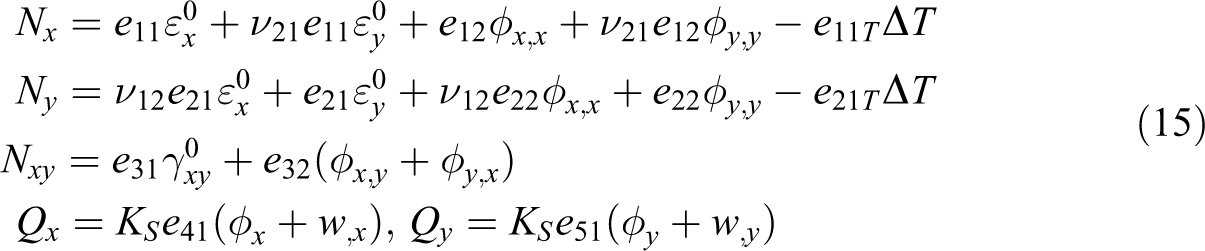

where KS
is shear correction coefficient assumed to be


whereas thermal coefficients are defined as
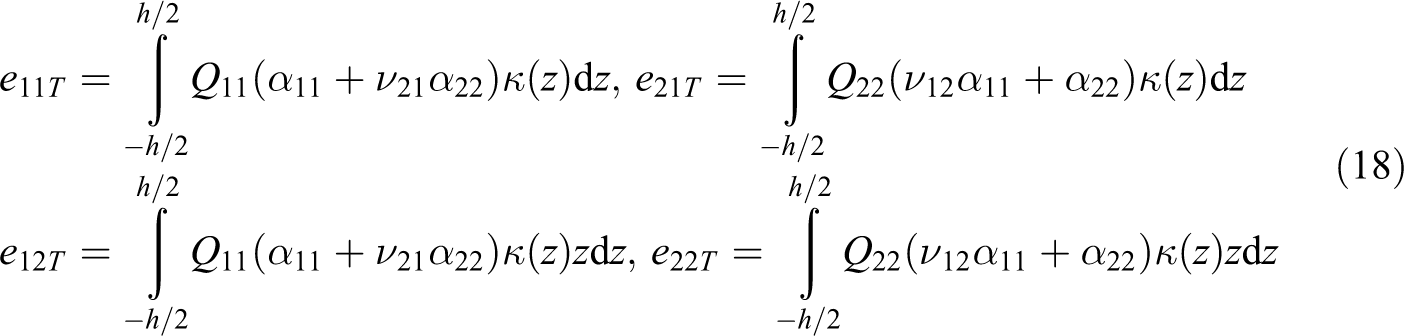
in which
Based on the FSDT, equilibrium equations of a plate resting on an elastic foundation and without transverse pressure are





where qf is interaction pressure due to elastic foundation and represented by Pasternak model as

in which k
1 is Winkler foundation modulus, k
2 is stiffness of shear layer of Pasternak foundation model, and
By virtue of constitutive equations (15, 16) and relations (11), and taking into account effects of initial geometrical imperfection, above equilibrium equations can be rewritten in a more compact form as

where

Next, strain compatibility equation of a geometrically imperfect plate is defined as 47

Expressing

where coefficients
The present study considers simply supported plates and corresponding boundary conditions are expressed as 47

where

in which c 1 and c 2 are average tangential stiffness parameters in the x and y directions on each opposite edge, respectively. The definitions of the average end-shortening displacements are expressed as

It is noted from equation (30) that
The boundary conditions (29) are approximately satisfied by the following solutions



where
Now, substitution of solutions (32–34) into compatibility equation (28) yields the following results

Subsequently, introduction of equations (11) and (15, 16) into the equations (22, 23), then placing solutions (32–34) into the obtained relations give a system of two equations relating to coefficients

where, for sake of brevity, coefficients
Next, the solutions (32–34) are substituted into equilibrium equation (25) and applying Galerkin procedure for the resulting equation yield

where
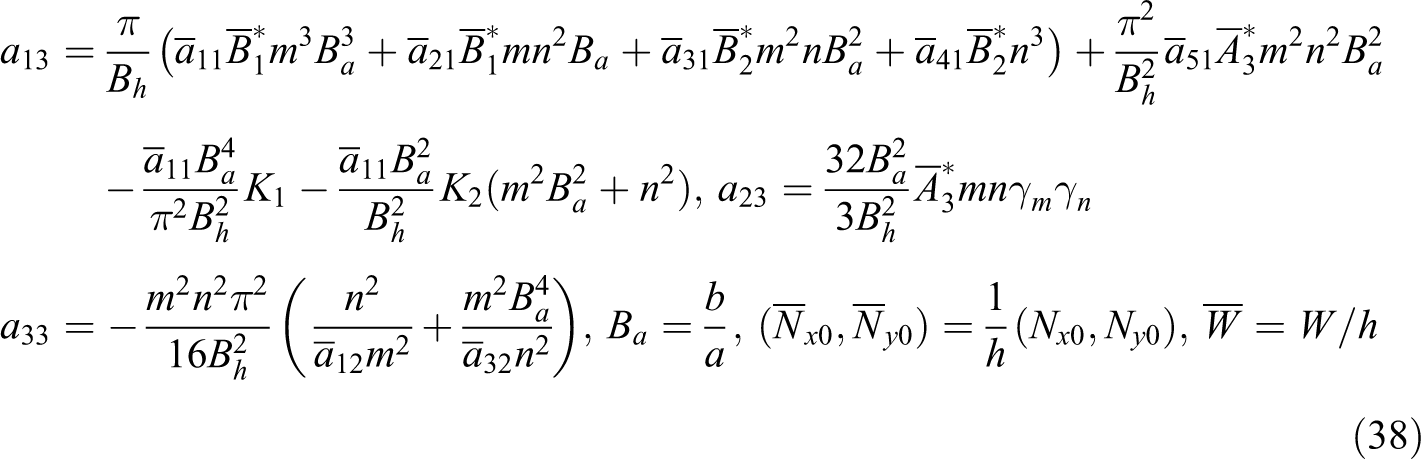
in which

In what follows, fictitious compressive force resultants


where
By placing the solutions (32–34) into the equations (40, 41) and then putting the resulting expressions into equation (31), the average end-shortening displacements are obtained as


where
Subsequently, a combination of equations (42, 43) and (30) leads to the following expressions


where the detail of coefficients
Now, introduction of equations (44, 45) into equation (37) leads to the following expression of nonlinear relation between temperature change and nondimensional maximum deflection

Equation (46) indicates that, for geometrically perfect CNTRC plates, bifurcation type buckling behavior can occur as temperature change reaches buckling point value predicted as

and critical buckling temperature change
Results and discussion
This section presents numerical results of buckling and postbuckling analysis for CNTRC plates subjected to two types of thermal loading. The plates are made of poly(methyl methacrylate), referred to as PMMA, as matrix material and are reinforced by (10,10) SWCNTs. The temperature-dependent properties of the PMMA is assumed to be
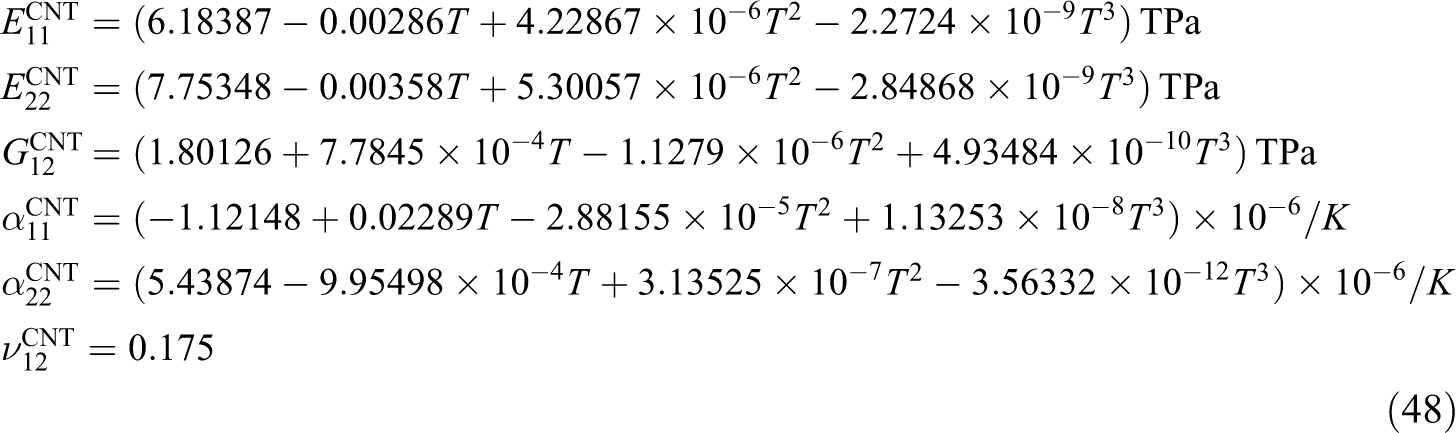
The CNT efficiency parameters
Verification
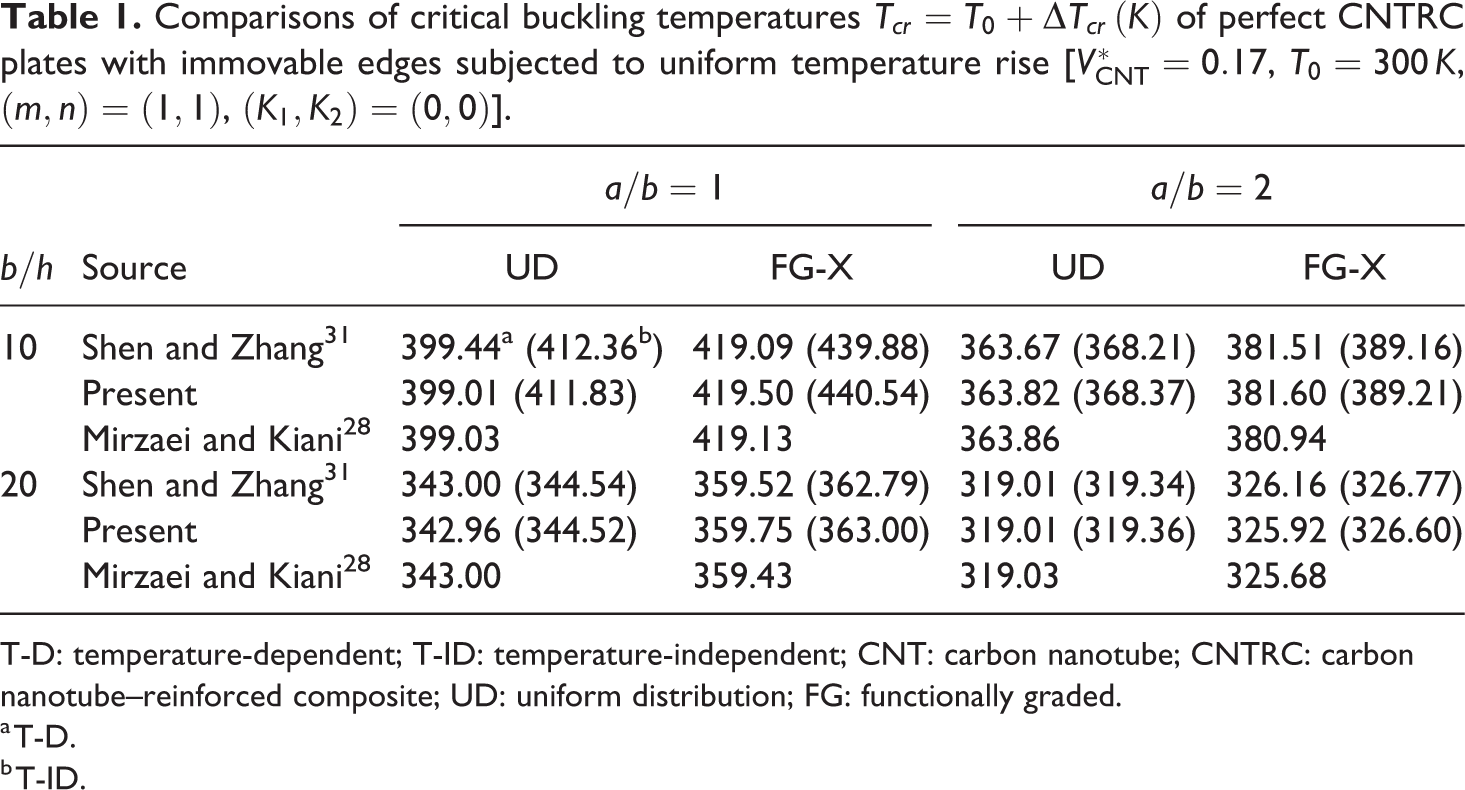
To validate the proposed approach, thermal buckling and postbuckling behaviors of a simply supported CNTRC plate with all immovable edges, without elastic foundation and subjected to uniform temperature rise are considered. The critical buckling temperatures of geometrically perfect CNTRC plates obtained from the present study are shown in Table 1 in comparison with results of Shen and Zhang
31
making use of asymptotic solutions and a two-step perturbation technique and those of Mirzaei and Kiani
28
using Ritz method with Chebyshev polynomials as shape functions. Also, the present analysis of thermal postbuckling behavior of geometrically perfect CNTRC plates without elastic foundations (
Comparisons of critical buckling temperatures
T-D: temperature-dependent; T-ID: temperature-independent; CNT: carbon nanotube; CNTRC: carbon nanotube–reinforced composite; UD: uniform distribution; FG: functionally graded.
a T-D.
b T-ID.
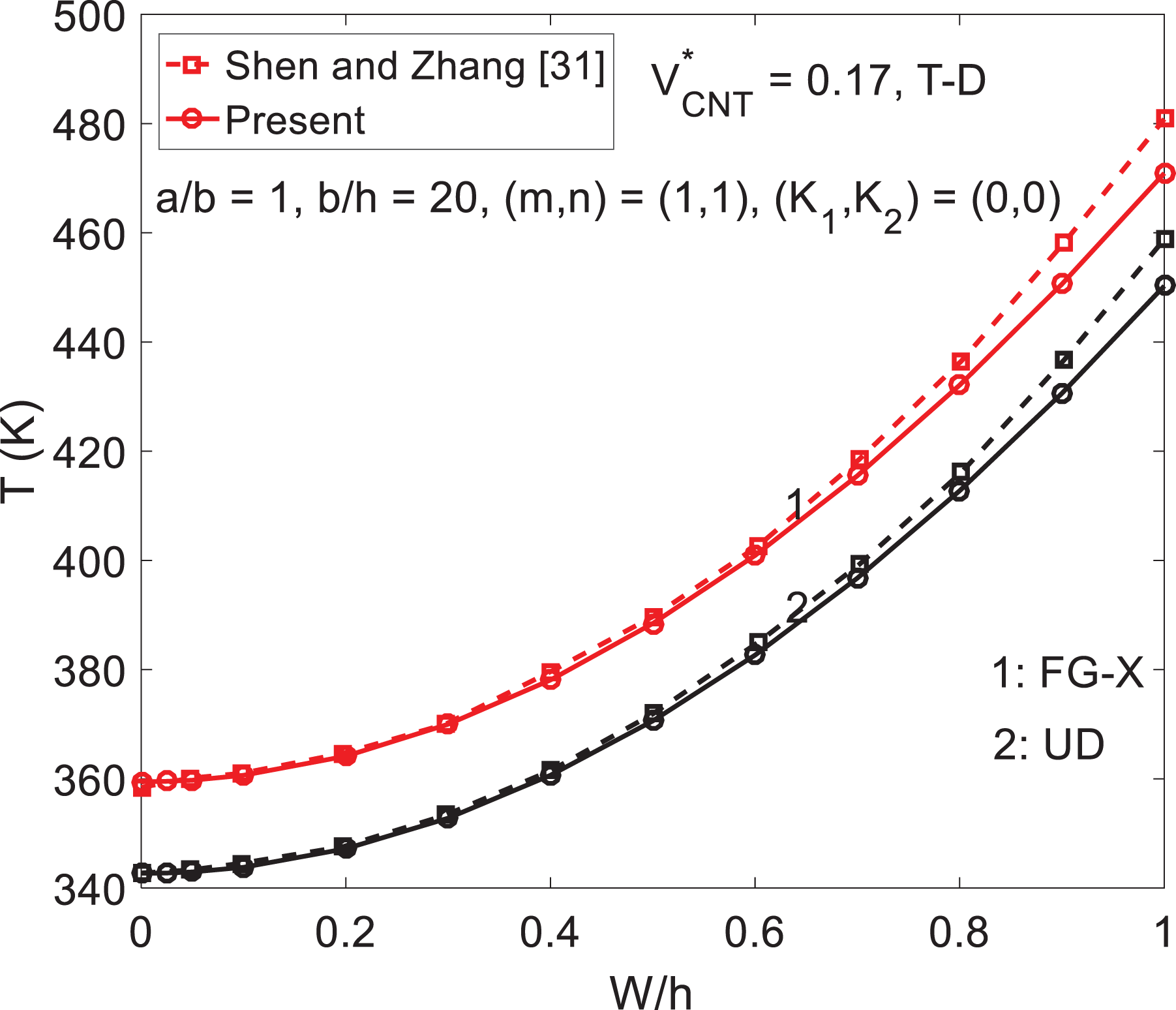
Comparison of the postbuckling behavior of CNTRC plates with all immovable edges under uniform temperature rise. CNTRC: carbon nanotube–reinforced composite.
The remainder of this section presents numerical results for buckling and postbuckling behaviors of the CNTRC plates with tangentially restrained edges subjected to two types of thermal loading. It is examined that the CNTRC plates buckle at fundamental mode

Evidently,
Thermal buckling analysis
The results of buckling analysis for geometrically perfect CNTRC plates under two types of thermal loading are presented in tabular form. Table 2 considers effects of geometrical ratios
Effects of geometrical ratios and tangential edge restraints on the critical buckling temperatures
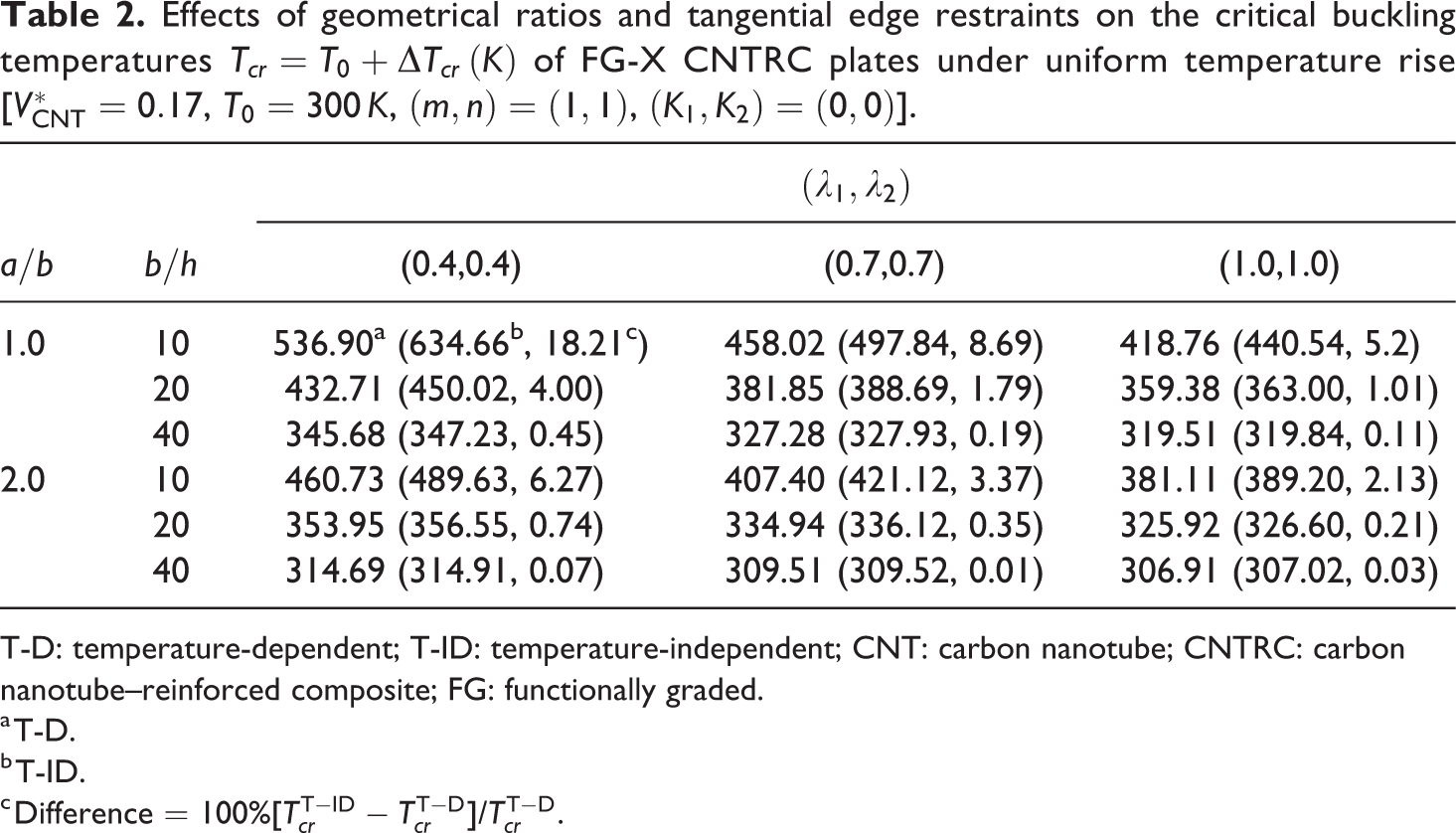
T-D: temperature-dependent; T-ID: temperature-independent; CNT: carbon nanotube; CNTRC: carbon nanotube–reinforced composite; FG: functionally graded.
a T-D.
b T-ID.
c Difference = 100%[
Effects of CNT volume fraction and distribution types on the critical thermal loading
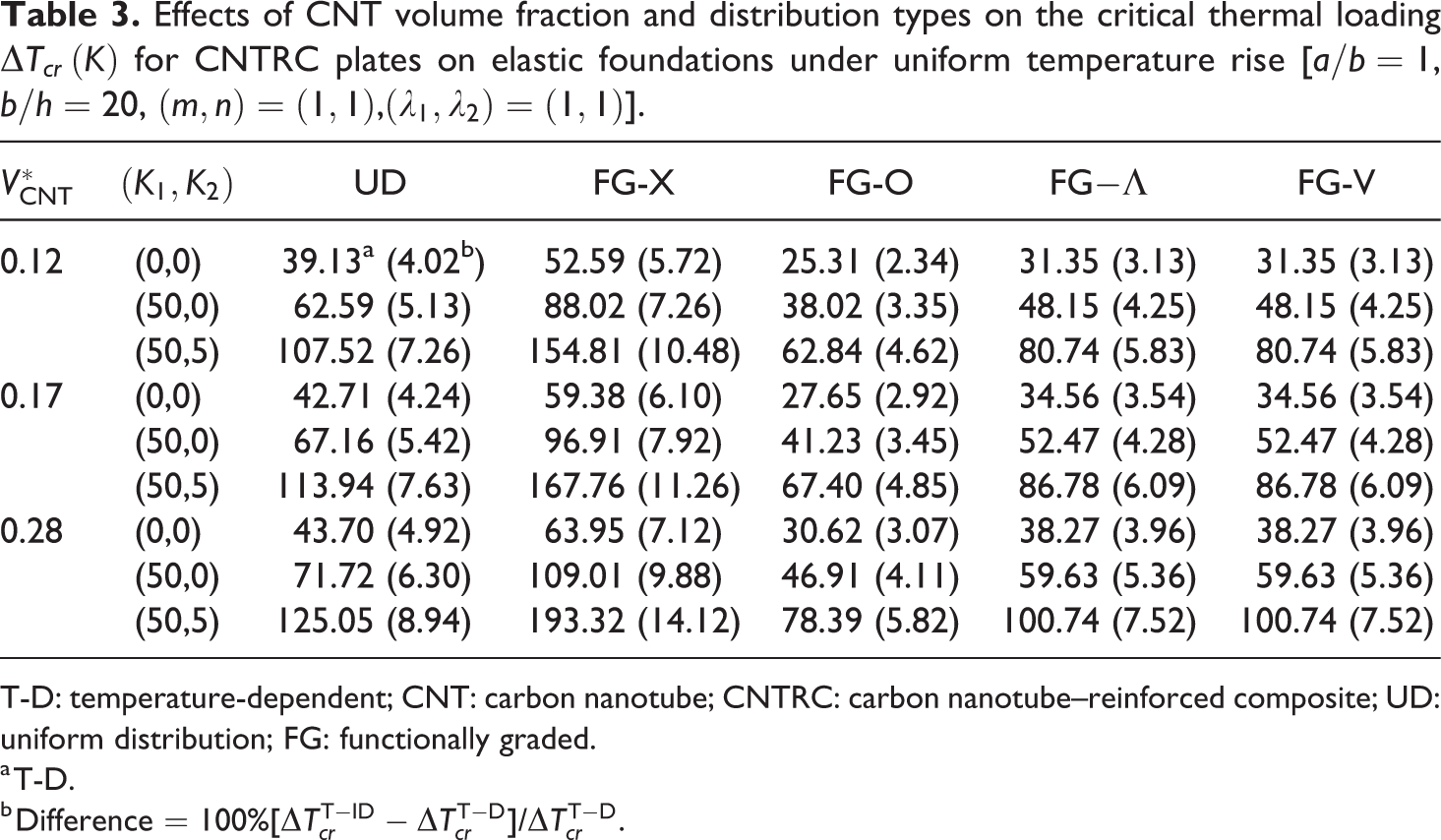
T-D: temperature-dependent; CNT: carbon nanotube; CNTRC: carbon nanotube–reinforced composite; UD: uniform distribution; FG: functionally graded.
a T-D.
b Difference = 100%[
As final example of buckling analysis, Table 4 gives the critical buckling loads of CNTRC plates subjected to the LTC as bottom surface of the plate is maintained at room temperature
Effects of tangential edge constraints and elastic foundations on the critical thermal loading
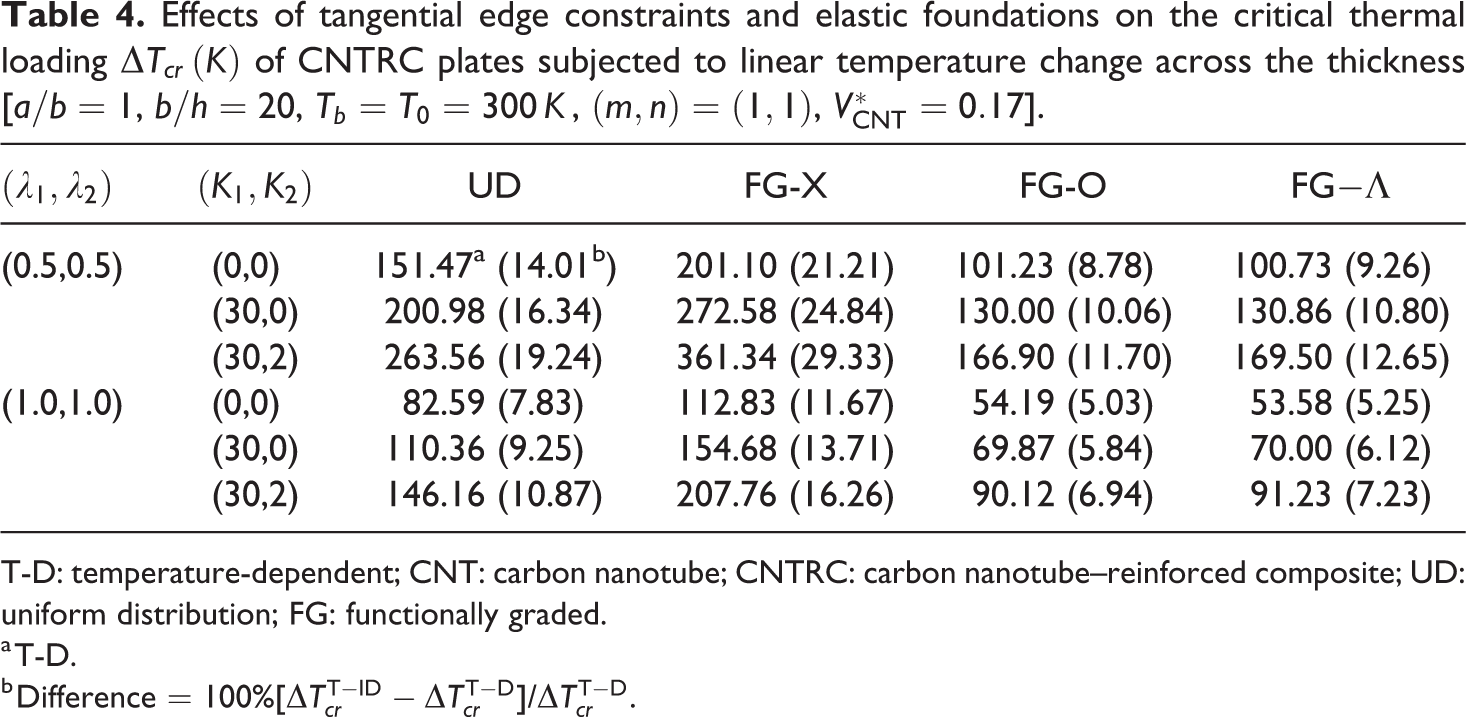
T-D: temperature-dependent; CNT: carbon nanotube; CNTRC: carbon nanotube–reinforced composite; UD: uniform distribution; FG: functionally graded.
a T-D.
b Difference = 100%[
Thermal postbuckling analysis
In what follows, the postbuckling behavior of geometrically perfect and imperfect CNTRC plates under two types of thermal loads are graphically analyzed. Figure 3 indicates the effects of five CNT distribution types on the postbuckling behavior of perfect CNTRC plates with immovable edges subjected to the UTR. In general, FG-X and FG-O types gives the highest and lowest equilibrium paths, respectively, in small region of postbuckling response. It is very worth to note from Figure 3 that the FG-Λ and FG-V plates have the strongest and weakest postbuckling strengths, respectively, in the deep region of postbuckling response (i.e. large deflection region), although the buckling temperatures of these plates are the same (as also shown in Table 3). Subsequently, the effects of CNT distribution types on the load–deflection equilibrium paths for perfect and imperfect CNTRC plates with immovable edges under the LTC are depicted in Figure 4. It is clear that the buckling temperatures and load carrying capability of CNTRC plates are the highest and lowest for FG-X and FG-O types, respectively, and variation trend of temperature–deflection paths is relatively regular.
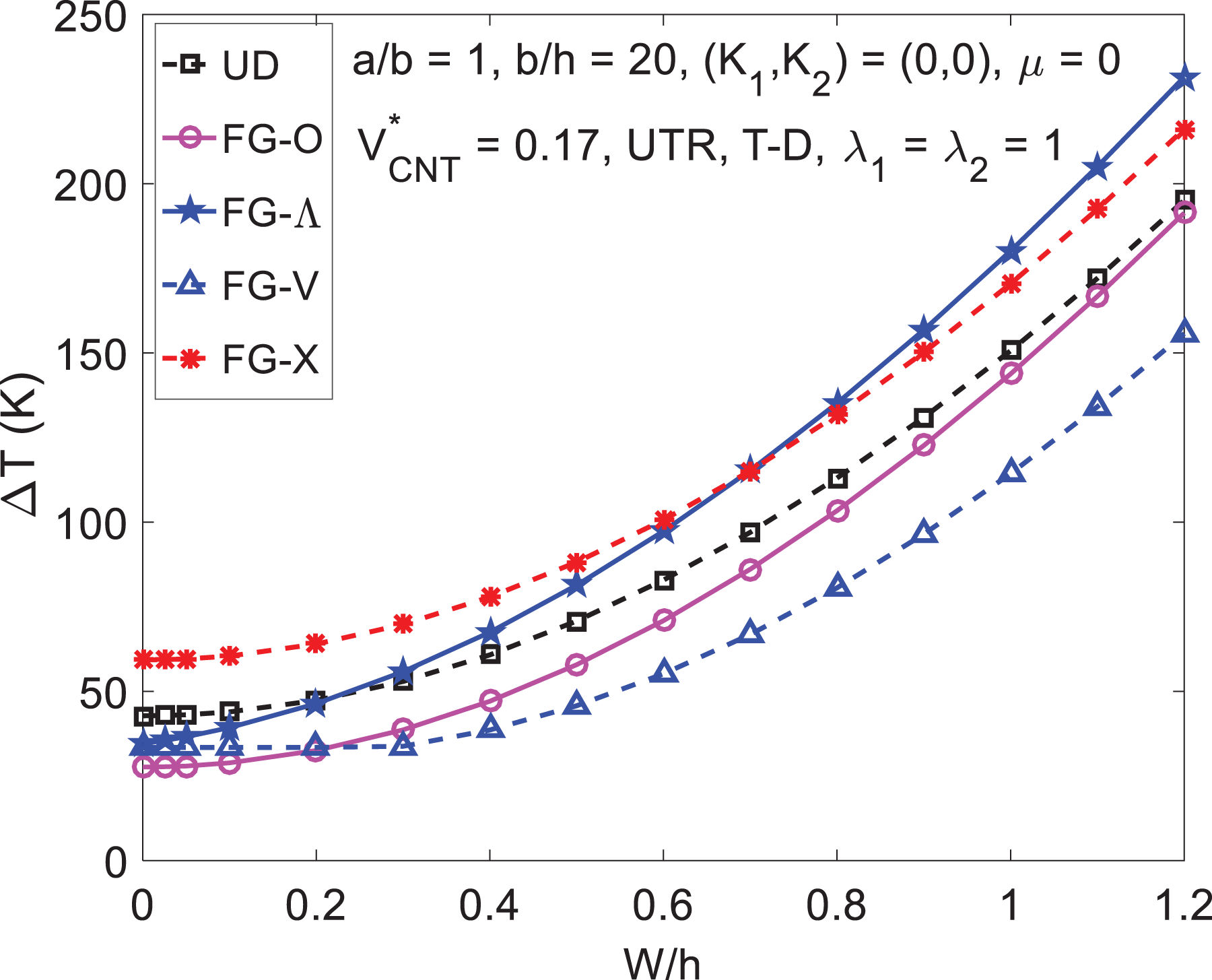
Effects of CNT distribution types on the postbuckling behavior of perfect CNTRC plates with immovable edges subjected to the UTR. CNTRC: carbon nanotube–reinforced composite; CNT: carbon nanotube.
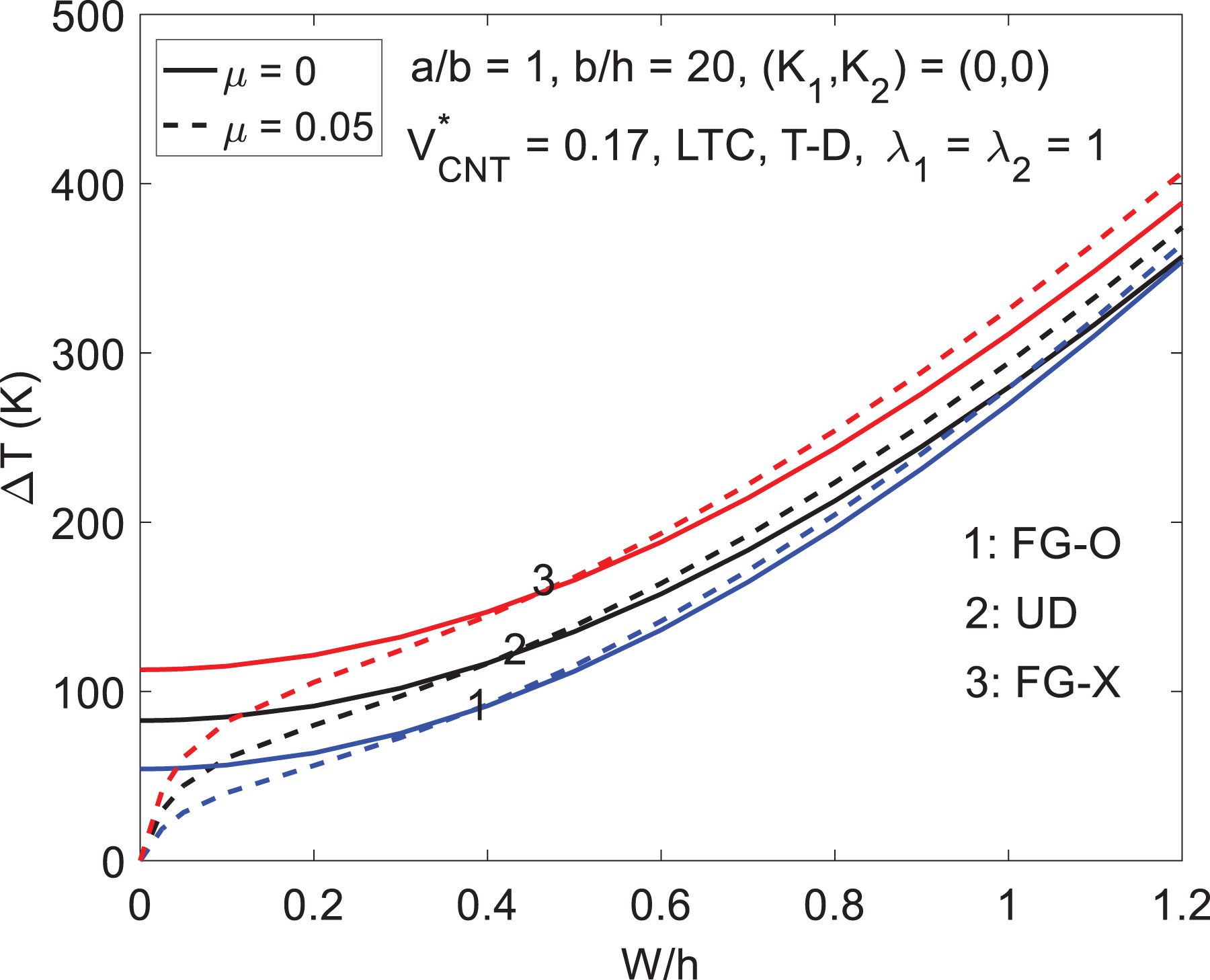
Effects of CNT distribution types on the postbuckling behavior of CNTRC plates with immovable edges subjected to the LTC. CNTRC: carbon nanotube–reinforced composite; CNT: carbon nanotube.
The effects of CNT distribution types and T-D properties on the postbuckling behavior of perfect CNTRC plates with nearly immovable edges (
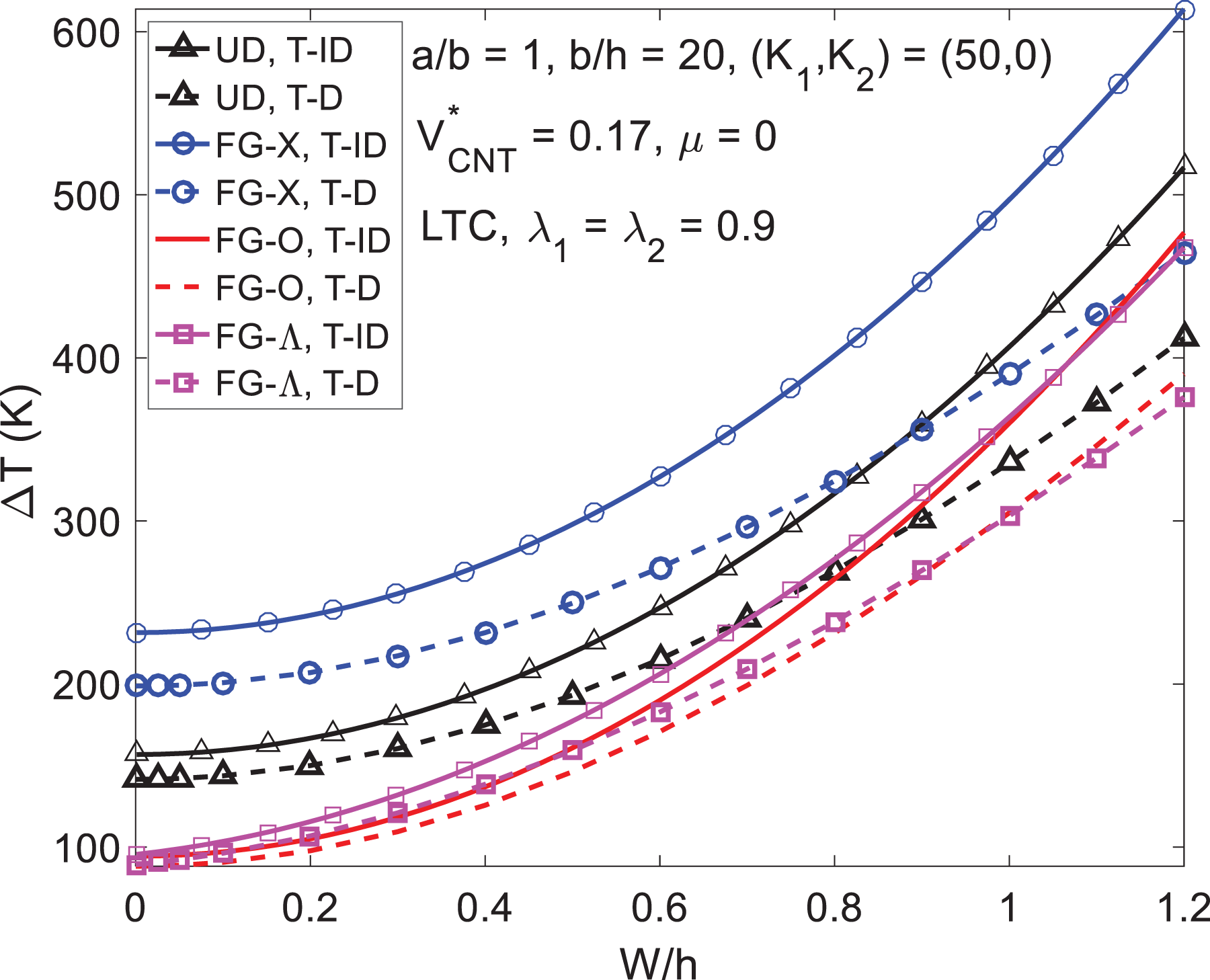
Effects of CNT distribution and T-D properties on the postbuckling behavior of CNTRC plates on Winkler foundation under the LTC. CNTRC: carbon nanotube–reinforced composite; CNT: carbon nanotube; T-D: temperature-dependent.
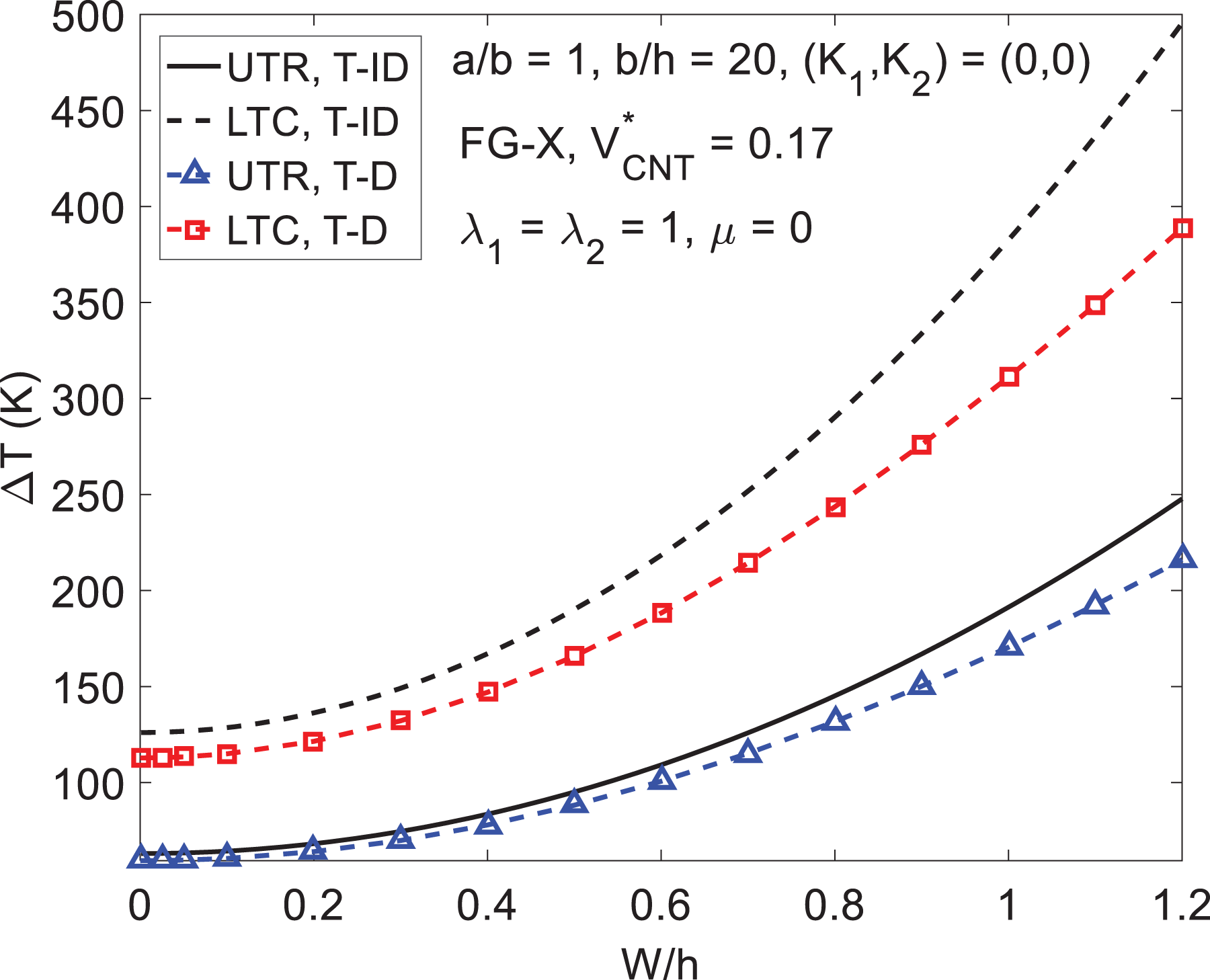
Effects of T-D properties on the postbuckling behavior of FG-CNTRC plates with immovable edges under two types of thermal loading. T-D: temperature-dependent; FG-CNTRC: functionally graded carbon nanotube–reinforced composite.
An analysis of thermal postbuckling behavior of perfect FG-CNTRC plates with various degrees of tangential edge constraints under the UTR is carried out in Figure 7 plotted with different three couples of values
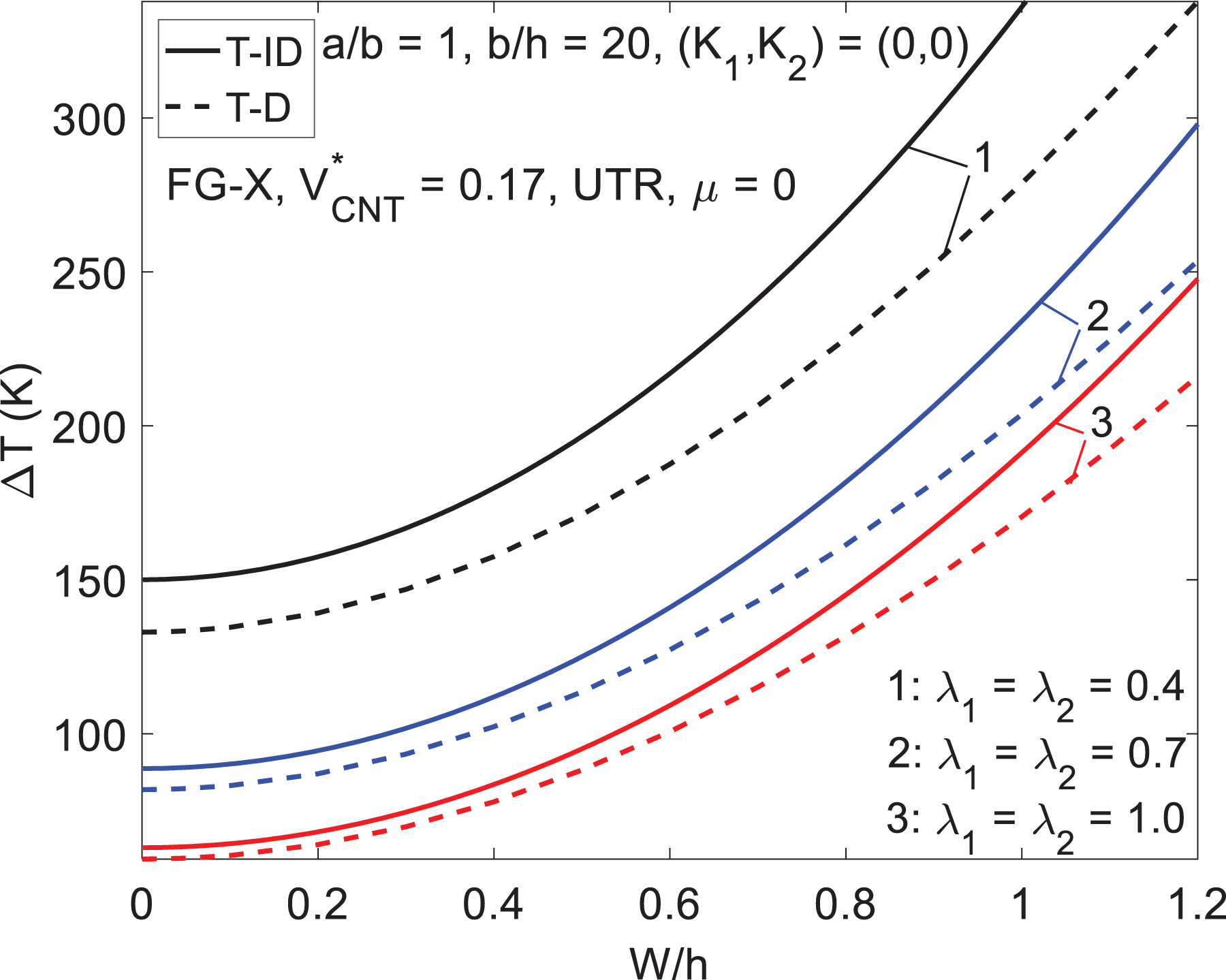
Effects of tangential edge constraints on the postbuckling behavior of FG-CNTRC plates under the UTR. FG-CNTRC: functionally graded carbon nanotube–reinforced composite.
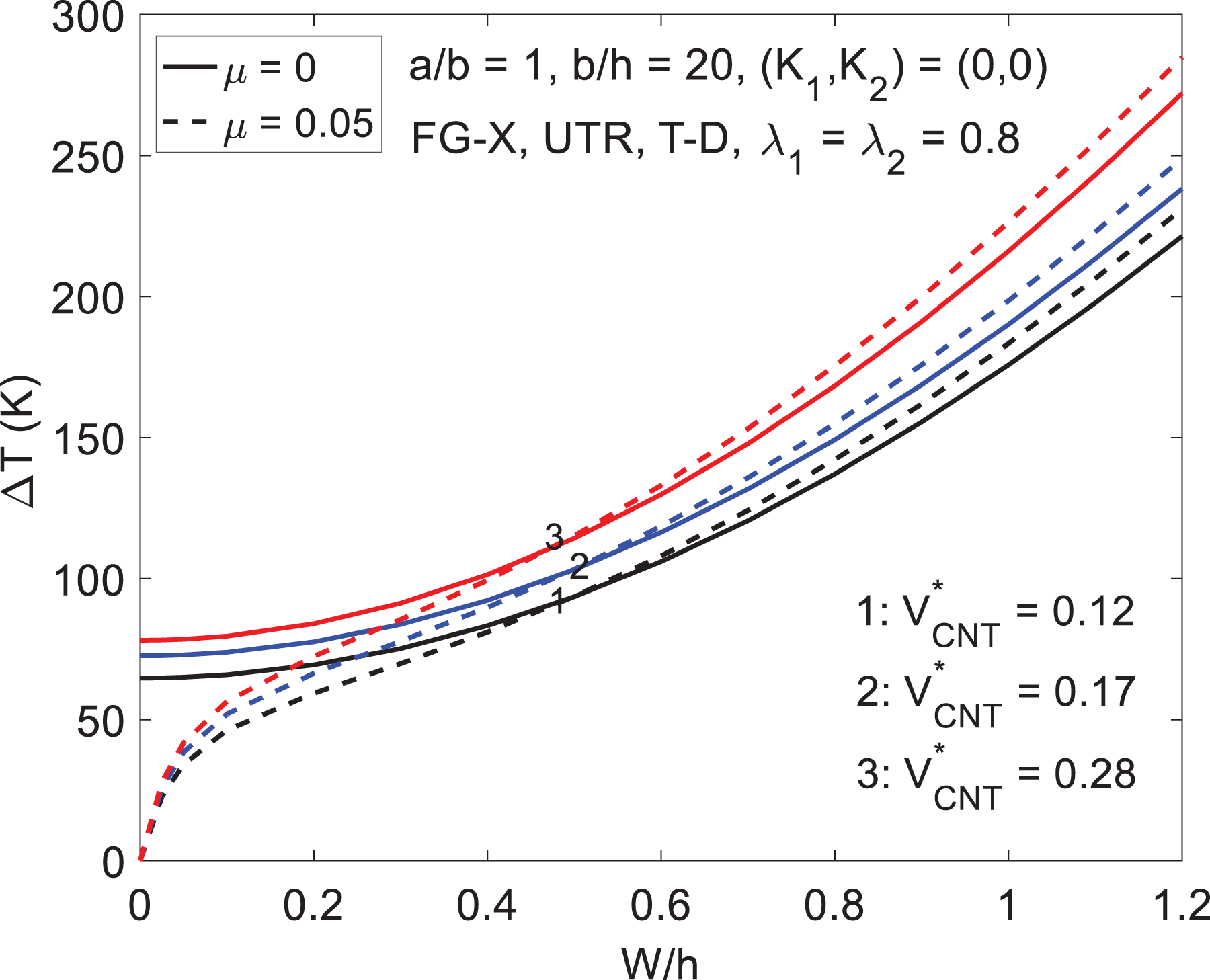
Effects of CNT volume fraction on the postbuckling behavior of FG-CNTRC plates with partially movable edges under the UTR. CNT: carbon nanotube; FG-CNTRC: functionally graded carbon nanotube–reinforced composite.
Next, Figure 9 shows the effects of elastic foundations on the postbuckling behavior of FG-CNTRC plates with partially movable edges under the LTC. It is evident that elastic foundations, especially Pasternak type foundations have very beneficial effects on the thermal postbuckling behavior of the plates. However, there is a considerable difference between temperature–deflection curves in two cases of T-D and T-ID properties due to the presence of elastic foundations.
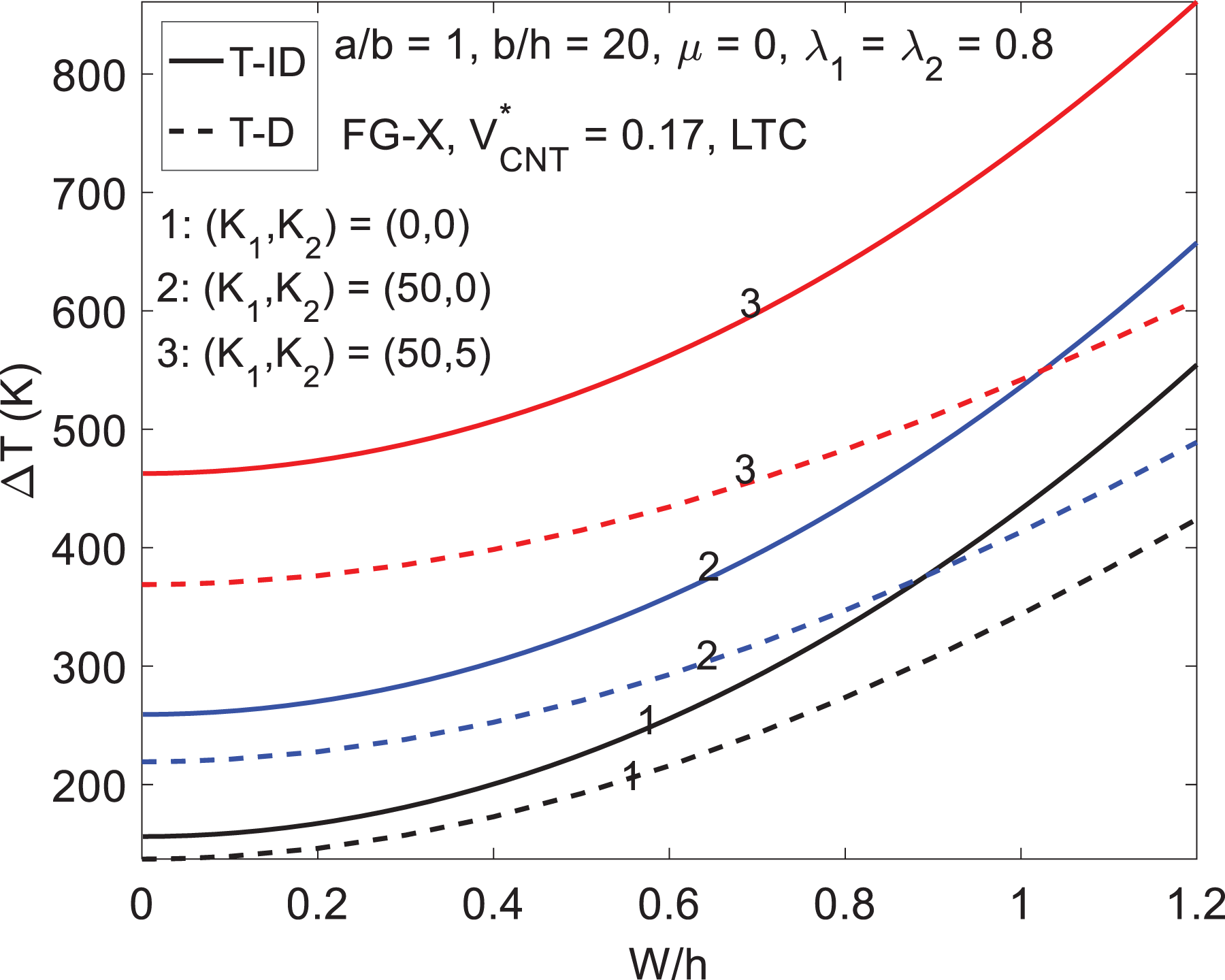
Effects of elastic foundations and T-D properties on the postbuckling behavior of FG-CNTRC plates with partially movable edges under the LTC. T-D: temperature-dependent; FG-CNTRC: functionally graded carbon nanotube–reinforced composite.
Finally, the effects of geometrical ratios
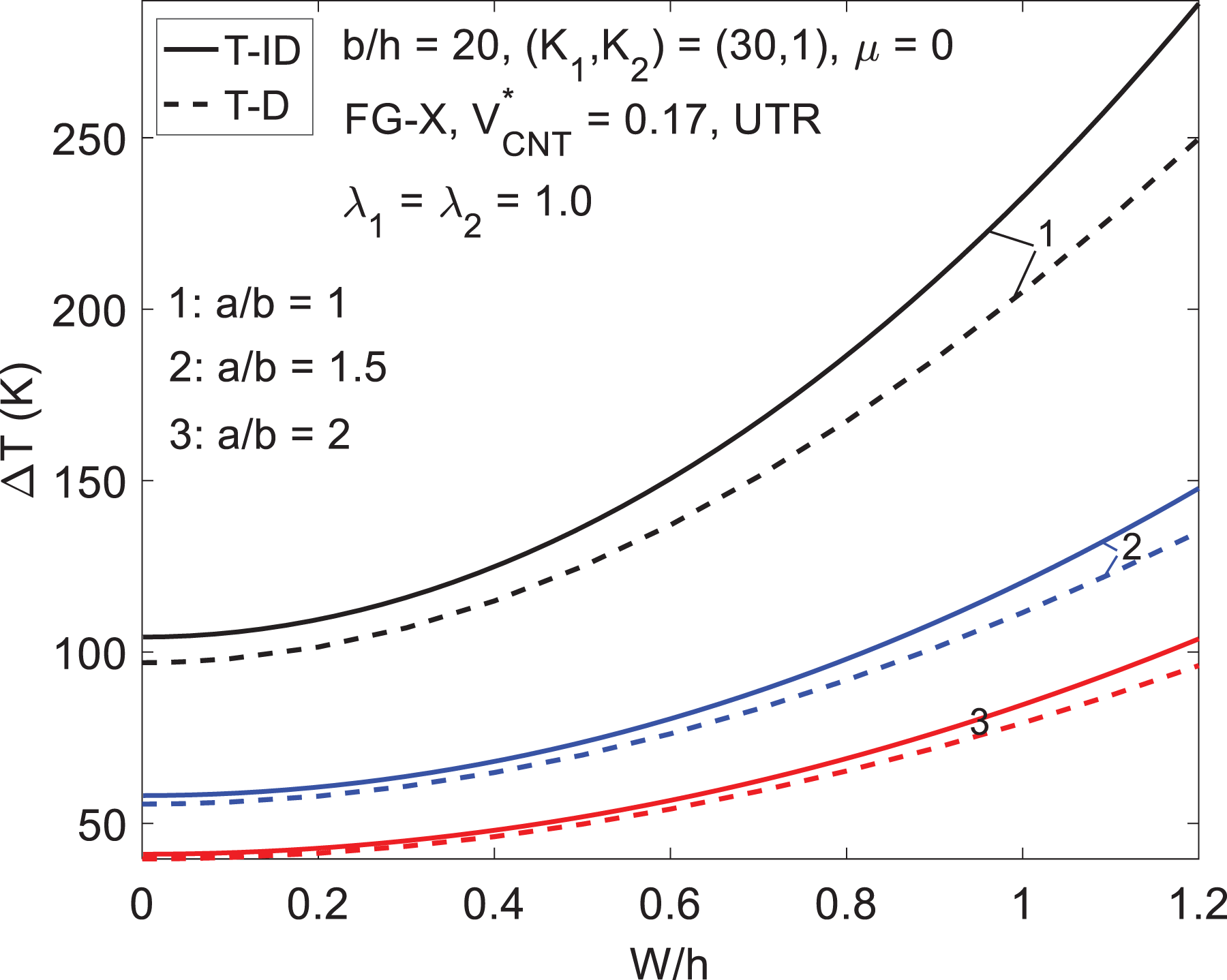
Effects of aspect ratio and T-D properties on the postbuckling behavior of FG-CNTRC plates on elastic foundation under the UTR. T-D: temperature-dependent; FG-CNTRC: functionally graded carbon nanotube–reinforced composite.
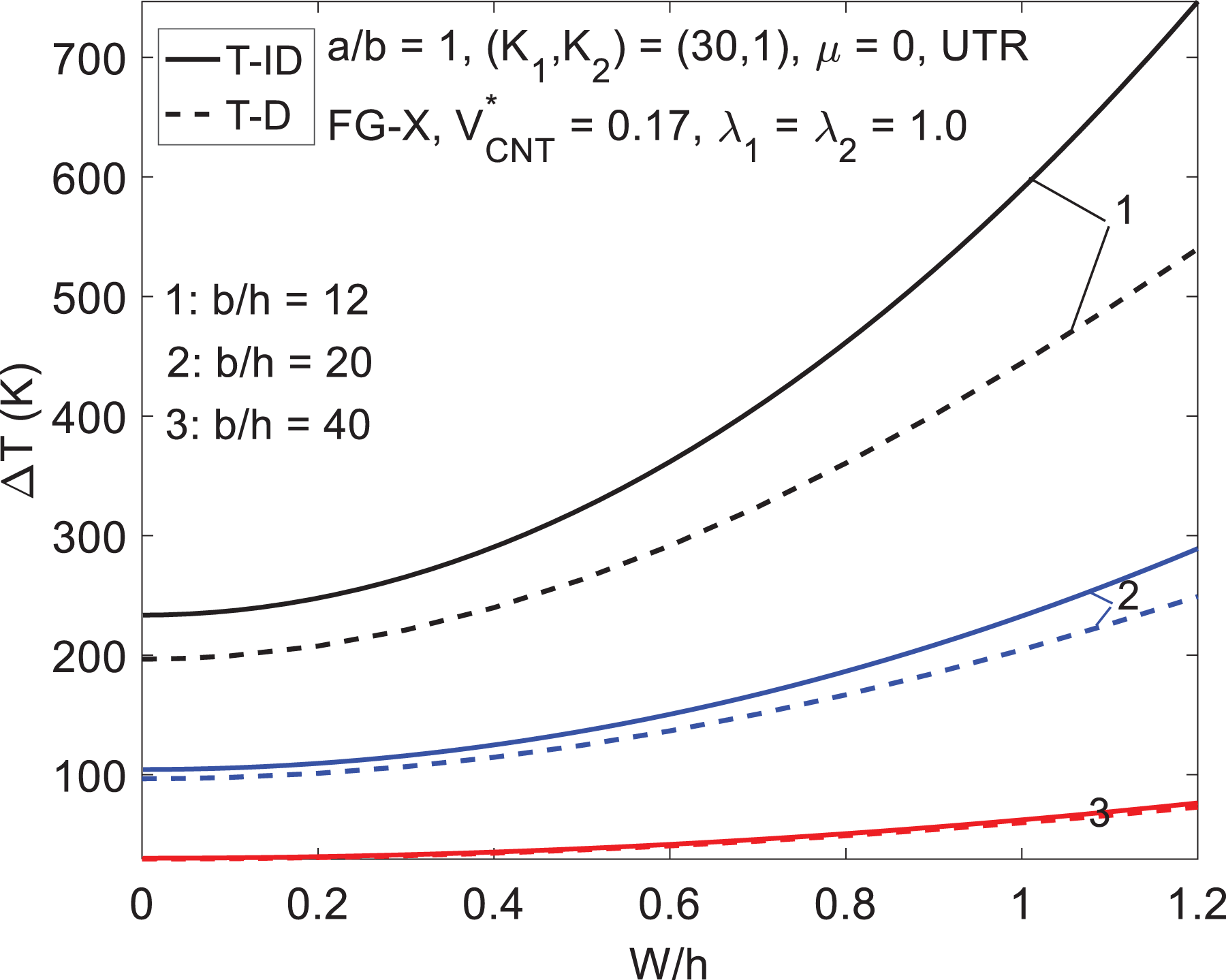
Effects of side-to-thickness ratio and T-D properties on the postbuckling behavior of FG-CNTRC plates on elastic foundation under the UTR. T-D: temperature-dependent; FG-CNTRC: functionally graded carbon nanotube–reinforced composite.
Concluding remarks
Based on an analytical approach with Galerkin method and an iteration algorithm, the buckling and postbuckling behaviors of moderately thick CNTRC plates with tangentially restrained edges resting on elastic foundations and subjected to two types of thermal loading have been presented. From above analysis, the following remarks are reached: Tangential constraints of boundary edges have the most pronounced influences on the thermal postbuckling behavior of the CNTRC plates, and the buckling temperatures and postbuckling strength of the plates are considerably reduced as tangential restraint of edges become more rigorous. In general, the FG-X type of CNT distribution gives the best postbuckling behavior of thermally loaded CNTRC plates. In particular, under UTR, the FG-Λ and FG-V plates have the highest and lowest equilibrium paths, respectively, in the deep region of postbuckling response, although the buckling temperatures of these plates are the same. The thermal postbuckling behavior of the CNTRC plates is much better in case of the LTC. Unlike in case of the UTR, the FG-Λ plates have no advantage of buckling resistance and postbuckling loading capacities under the LTC. Detrimental influences of the T-D properties become more severe in the following conditions/situations, especially as these are combined: partially movable edges, linear temperature change across the thickness, FG-X type of CNT distribution, shorter and thicker plates, and stiffer elastic foundations. In contrast, the effects of T-D properties become immaterial for longer and thin CNTRC plates with immovable edges and without foundation interaction, especially in case of the UTR. The critical buckling temperatures and temperature–deflection equilibrium paths are benignly enhanced as the volume percentage of CNT reinforcement is higher. In other words, the CNT volume fraction has no remarked effect on the thermal postbuckling behavior of the CNTRC plates. In another direction, the elastic foundations have sensitive and beneficial influences on the thermal postbuckling response of the CNTRC plates.
Accordingly, on the engineering point of view, CNTRC plates with intermediate value of CNT volume fraction, partially movable boundary edges, CNT-rich surfaces and elastic foundation interaction can exhibit optimal thermal postbuckling response.
Footnotes
Funding
The author(s) disclosed receipt of the following financial support for the research, authorship, and/or publication of this article: This research is funded by Vietnam National Foundation for Science and Technology Development (NAFOSTED) under grant number 107.02-2017.11.
