




Abstract
Buckling and postbuckling behavior of thin composite cylindrical shells reinforced by carbon nanotubes (CNTs), surrounded by elastic media and exposed to uniform temperature rise, are investigated in this article. CNTs are reinforced into isotropic matrix phase through uniform distribution or functionally graded distributions across the thickness direction. Material properties are assumed to be temperature dependent, and effective elastic moduli of CNT-reinforced composite are determined according to extended rule of mixture. Formulations are based on the classical thin shell theory taking Von Karman–Donnell nonlinearity, surrounding elastic media and elastic constraints of boundary edges into consideration. Multi-term solutions of deflection and stress function are assumed to satisfy simply supported boundary condition, and Galerkin method is applied to obtain nonlinear relation of thermal load and deflection. An iteration algorithm is used to determine buckling temperatures and postbuckling paths. Numerical examples are given to analyze the effects of volume fraction and distribution type of CNTs, geometrical parameters, degree of tangential edge constraint, buckling mode, and surrounding elastic media on the buckling temperatures and postbuckling strength of thermally loaded nanocomposite cylindrical shells.
Keywords
Introduction
Due to superior mechanical, thermal and electrical properties and very large aspect ratio, carbon nanotubes (CNTs) are usually embedded into isotropic matrix to form nanocomposite known as CNT-reinforced composite (CNTRC). 1 –3 The concept of functionally graded CNT-reinforced composite (FG-CNTRC) is introduced to obtain optimal distribution of CNTs and desired response of nanocomposite structures. 4 The generation of FG-CNTRC material has motivated investigations on the static and dynamic responses of structural components made of this new class of advanced materials.
Linear buckling behavior of FG-CNTRC plates under mechanical compressive loads has been studied in works 5 –9 based on numerical approaches and 10 using a semi-analytical approach. Kiani 11,12 used Chebyshev–Ritz method to deal with linear buckling problem of FG-CNTRC rectangular plates subjected to shear and parabolic loadings. Kiani and Mirzaei 13 also studied buckling behavior of FG-CNTRC skew plates under shear load. Based on a numerical approach, the nonlinear resonant dynamics of CNTRC beams and plates have been analyzed by Gholami et al. 14,15 Gholami and Ansari 16 –20 used numerical methods to deal with the nonlinear resonance and bending and stability problems of shear deformable nanocomposite annular and rectangular plates. Buckling behavior of FG-CNTRC cylindrical panels under axial and shear loads has been analyzed in the work of Macias et al. 21 utilizing shell finite elements. Based on an analytical approach, Nasihatgozar et al. 22 investigated the linear buckling behavior of FG-CNTRC cylindrical panels under axial compression. Using adjacent equilibrium criterion and generalized differential quadrature method, Jam and Kiani 23 presented a linear buckling analysis for FG-CNTRC conical shells subjected to lateral pressure.
Postbuckling behavior of FG-CNTRC plates under mechanical loads has been analyzed in the work of Zhang and Liew 24 using an element-free approach. Shen and Zhu 25 investigated postbuckling of sandwich plates with FG-CNTTRC face sheets under compressive and thermal loads. Making use of asymptotic solutions and a perturbation technique, Shen and Xiang 26 –28 presented investigations on the nonlinear stability of FG-CNTRC cylindrical panels resting on elastic foundations and subjected to mechanical loads in thermal environments. Similarly, postbuckling behavior of higher order shear deformable FG-CNTRC circular cylindrical shells under axial compression, lateral pressure, and combined mechanical loads in thermal environments has been addressed in the works of Shen and Xiang. 29 –31 Hieu and Tung 32 used an analytical method to conduct the results of postbuckling analysis for thin FG-CNTRC cylindrical shells surrounded by elastic media under combined mechanical loads in thermal environments. Based on an analytical approach, Ansari et al. 33 considered the effects of piezoelectric layers on postbuckling response of FG-CNTRC cylindrical shells under mechanical loads. Recently, the postbuckling response of FG-CNTRC cylindrical shells with piezoelectric layers subjected to torsional load has been examined by Ninh 34 employing Galerkin method.
Thermal buckling and postbuckling behavior of nanocomposite plates and shells are problems of considerable importance. Shen and Zhang 35 used asymptotic solutions and a two-step perturbation technique to analyze postbuckling behavior of thick FG-CNTRC plates subjected to uniform temperature rise and in-plane temperature variation. Based on Ritz method and first-order shear deformation theory, Mirzaei and Kiani 36,37 treated the linear buckling problem of FG-CNTRC rectangular and skew plates subjected to uniform temperature rise. Mirzaei and Kiani 38 made use of singular discrete convolution method to solve linear stability equations for thermal buckling analysis of FG-CNTRC conical shells. Thermal postbuckling problem of FG-CNTRC plates and sandwich plates with FG-CNTRC face sheets has been considered in the works of Kiani 39,40 using Chebyshev–Ritz method. Shen and Xiang 41 investigated the thermal postbuckling of FG-CNTRC cylindrical panels resting on elastic foundations. Postbuckling behavior of FG-CNTRC cylindrical shells subjected to uniform temperature rise has been analyzed by Shen 42 using a higher order shear deformation theory and asymptotic solutions. Recently, thermal buckling and postbuckling behavior of FG graphene-reinforced composite laminated plates have been analyzed in works 43 –46 using different approaches.
Tangential elasticity of boundary edges is inherent in practical situations and dramatically influences the behavior of composite structures as mentioned in previous works relating to FG material plates and shells. 47 –50 Zhang et al. 51,52 used element-free approach to analyze the large deformation and mechanical postbuckling responses of FG-CNTRC plates with elastically restrained edges. Based on an analytical approach, the nonlinear stability problems of FG-CNTRC plates and cylindrical panels with tangentially restrained edges under thermal, mechanical, and thermomechanical loadings have been dealt with in the works of Tung and Trang. 53 –58 Recently, Hieu and Tung 59 presented an analytical investigation on nonlinear stability of FG-CNTRC toroidal shell segments subjected to uniform external pressure taking effects of tangential restraints of boundary edges into consideration. More recently, thermal and thermomechanical postbuckling responses of CNTRC sandwich plates with elastically restrained edges have been studied by Long and Tung. 60,61 Shen’s study 42 is the only work examining thermal postbuckling of CNTRC cylindrical shells with immovable edges and without surrounding elastic media. However, in practical situations, the cylindrical shells may be surrounded by elastic media and their edges are elastically restrained. Evident lack of investigations on thermal postbuckling of nanocomposite cylindrical shells with elastically restrained edges and surrounding elastic media motivates the present work.
The present article investigates the buckling and postbuckling behavior of thin CNTRC circular cylindrical shells surrounded by elastic media and subjected to uniform temperature rise. Material properties of constituents are assumed to be temperature dependent and effective elastic moduli of CNTRC are estimated according to extended rule of mixture. The classical thin shell theory is used for formulations in which Von Karman–Donnell nonlinearity, surrounding elastic medium–shell interaction, and elasticity of tangential edge constraints are taken into consideration. Multi-term solutions of deflection and stress function are assumed to satisfy simply supported boundary conditions and Galerkin method is adopted to obtain nonlinear relation between temperature and deflection. The effects of distribution types and volume fraction of CNTs, degree of tangential edge constraint, buckling mode, geometrical ratios, and elastic foundations on buckling temperatures and postbuckling temperature-deflection paths are analyzed through numerical examples. As shown in review articles of Du et al. 62 and Gohardani et al., 63 although there are some key problems of CNT/polymer composites such as orientation of CNTs, dispersion of CNTs within polymer matrix, imperfect bond between CNTs and matrix, and contacts between individual CNTs, nanocomposites have many practical applications in diverse fields, especially in aerospace sciences.
CNT-reinforced composite cylindrical shell surrounded by an elastic medium
Consider a circular cylindrical shell of length L, curvature radius R, and thickness h defined in a coordinate system
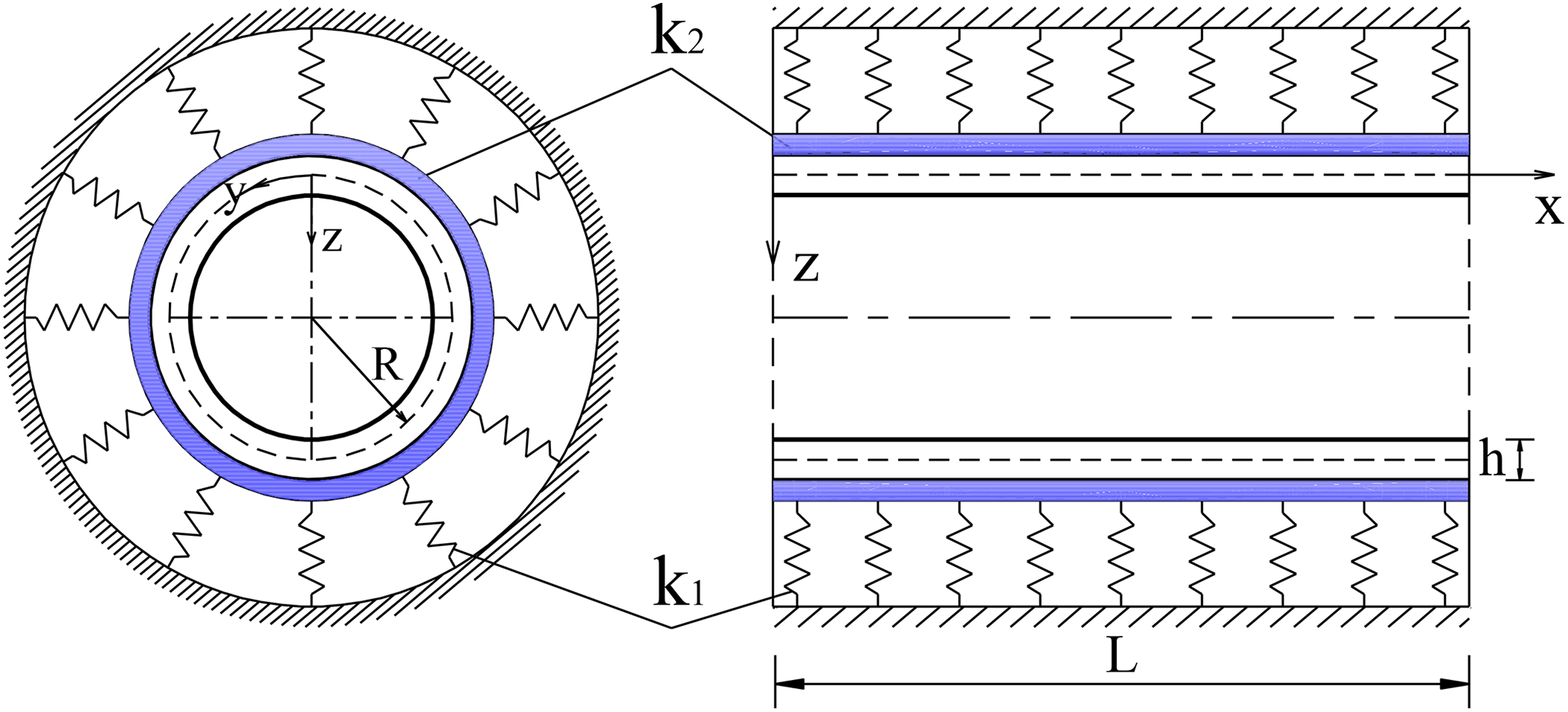
Configuration and coordinate system of a cylindrical shell surrounded by an elastic medium.
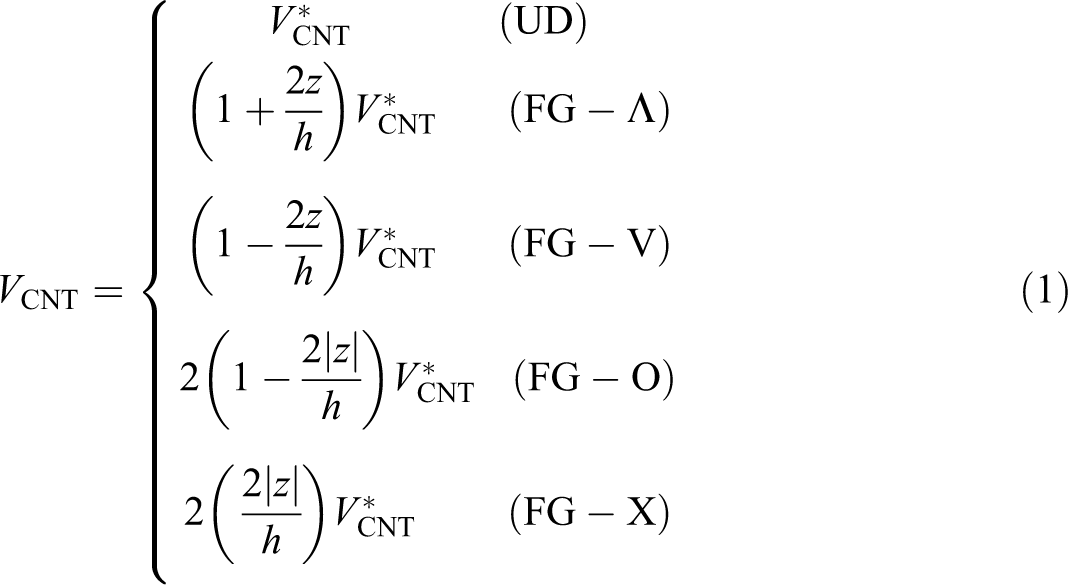
where



where
Effective Poisson ratio of CNTRC is assumed to be independent of position and temperature and determined as

where


where
Formulations
In the present study, nanocomposite cylindrical shells are assumed to be thin and geometrically perfect, and the classical shell theory (CST) is used for formulations. Based on the CST, nonlinear strains in Von Karman–Donnell sense are expressed as

where

in which
The CNTRC shell is assumed to be exposed to a heated environment temperature of which is uniformly raised from reference value

where

Force and moment resultants in the CNTRC cylindrical shell are calculated through the stress components as

From equations (8), (10), and (12), the force and moment resultants are expressed as follows

where coefficients
Based on the CST, nonlinear equilibrium equation of the CNTRC cylindrical shell surrounded by an elastic medium modelled as a Winkler–Pasternak foundation has the form

where
From equations (9) and (13), strain compatibility equation of the CNTRC cylindrical shell has the form

where coefficients
In the present study, two boundary edges of the CNTRC cylindrical shell are assumed to be simply supported and tangentially restrained, and corresponding boundary conditions are expressed as

where

in which c is average stiffness of tangential constraint and

It is indicated from equation (17) that the values of
For circular cylindrical shell, the following circumferential closed condition must be satisfied

From equations (9), (13) and definition of stress function, the following expressions are obtained


To satisfy boundary conditions (16), multi-term solutions of deflection and stress function are assumed as


where
Next, introduction of solutions (22) and (23) into equation (21) and placing the resulting expression into equation (19) yield the average circumferential stress as follows

where

Similarly, putting the solutions (22) and (23) into equation (20) and substituting the obtained expression into equations (17) and (18) give the following result of the fictitious compressive force resultant

where

It is clear from equation (26) that
Now, solutions (22) and (23) are substituted into the equilibrium equation (14), then applying Galerkin method on whole region of the cylindrical shell (



where the details of coefficients
From equations (28) and (29), it is deduced that


where coefficients
Introduction of equations (31) and (32) into equation (30) leads to the following nonlinear relation

in which coefficients
By setting

and critical buckling thermal load
It is clear from equation (22) that maximum deflection of the CNTRC cylindrical shell is

From equations (31), (32), and (35), the non-dimensional value of maximum deflection is determined as

Equations (33) and (36) are used to analyze postbuckling behavior of CNTRC cylindrical shells under uniform temperature rise. Due to temperature dependence of material properties, critical buckling thermal loads and postbuckling temperature-deflection paths are determined through an iteration process detailed steps of which have been described in the work 47 and are omitted here for the sake of brevity.
Results and discussion
Numerical results are presented in this section for circular cylindrical shells made of poly(methyl methacrylate), referred to as PMMA, as matrix material and reinforced by (10,10) single-walled CNTs (SWCNTs). The temperature-dependent properties of the PMMA are
Validation
To validate the proposed approach, the buckling behavior of simply supported thin CNTRC cylindrical shells under uniform temperature rise is considered. Shen’s work 42 is the only study on the subject of thermal buckling and postbuckling of CNTRC cylindrical shells in the literature. The critical buckling temperatures of thin CNTRC cylindrical shells with immovable edges and without surrounding elastic foundations are shown in Table 1 in comparison with results reported by Shen 42 using asymptotic solutions and a perturbation technique. As can be seen, a good agreement is achieved in this comparison.
Comparisons of critical buckling temperatures
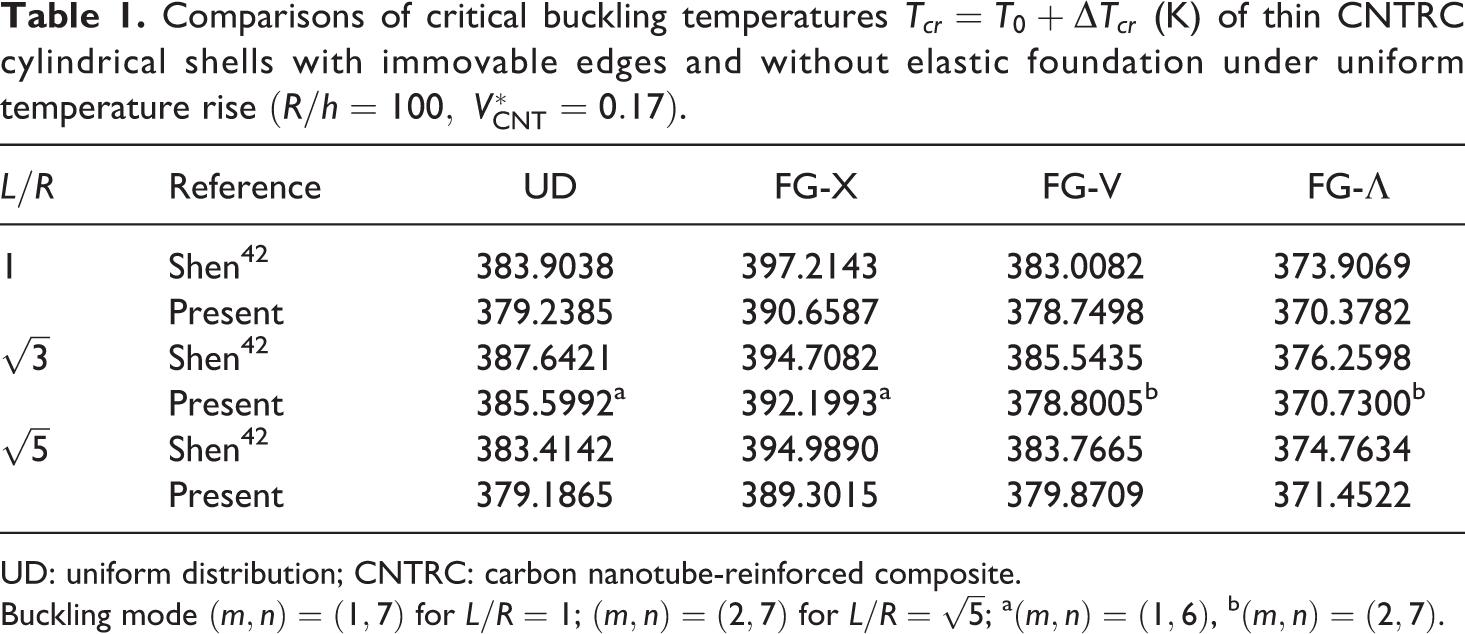
UD: uniform distribution; CNTRC: carbon nanotube-reinforced composite.
Buckling mode
In what follows, buckling and postbuckling behavior of thin CNTRC cylindrical shells with tangentially restrained edges surrounded by elastic media and subjected to uniform temperature rise will be analyzed in tabular and graphical forms. To measure degree of tangential constraints of boundary edges in a more convenient way, non-dimensional tangential stiffness parameter
Thermal buckling analysis
The effects of CNT volume fraction
Comparisons of critical buckling temperatures
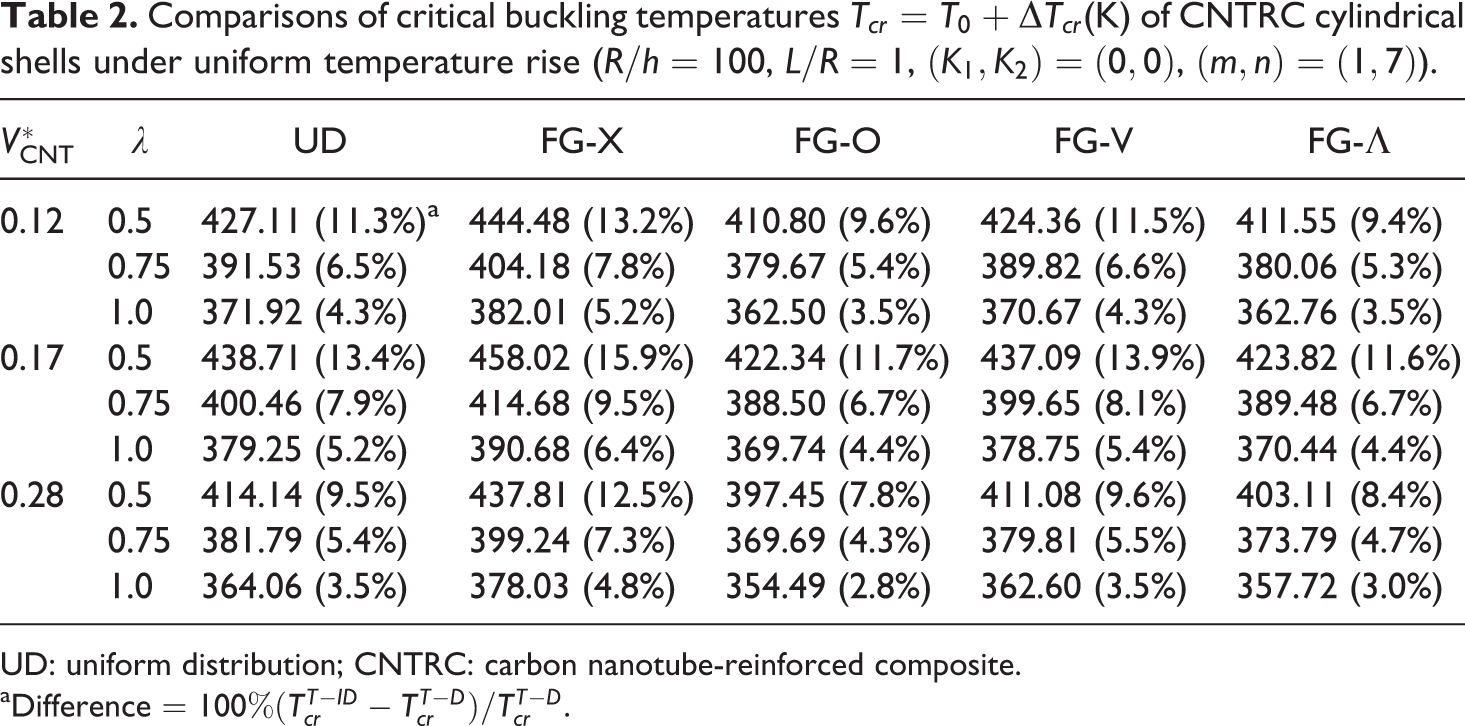
UD: uniform distribution; CNTRC: carbon nanotube-reinforced composite.
aDifference =
Subsequently, the effects of geometrical ratios and surrounding elastic media on the critical buckling temperatures of FG-CNTRC cylindrical shells with immovable edges are considered in Table 3. As shown, although buckling mode
Effects of geometrical ratios and elastic media on the critical buckling temperatures
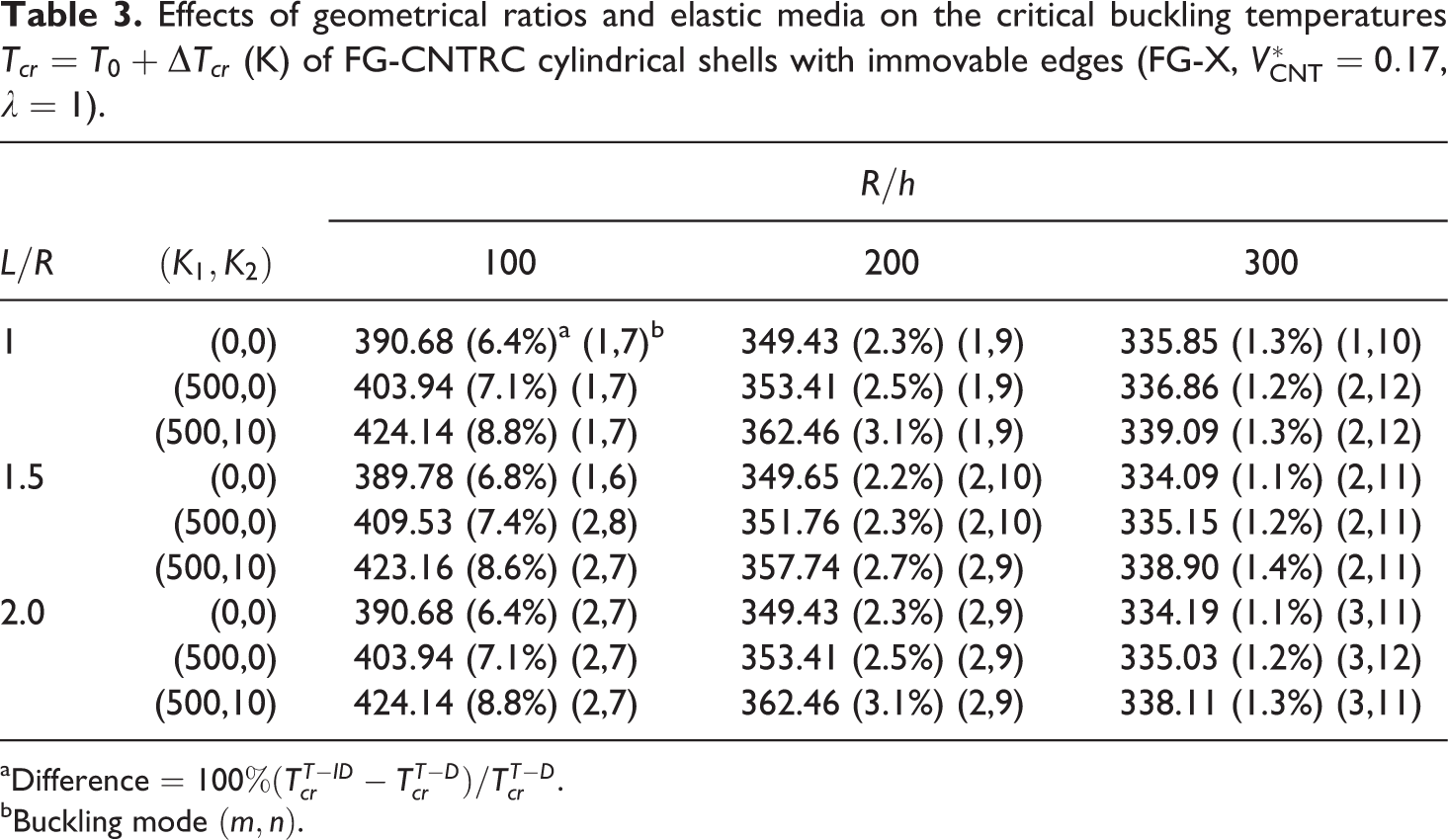
aDifference =
bBuckling mode
The effects of CNT volume fraction and degree of tangential edge constraint on the critical buckling temperatures of FG-CNTRC cylindrical shells with T-D and T-ID properties are graphically displayed in Figure 2. As mentioned, the critical temperature is the lowest as CNT volume fraction is the highest, and the critical temperatures are rapidly decreased as edges are more rigorously restrained in tangential displacement. Furthermore, difference between critical temperatures corresponding to cases of T-D and T-ID properties become smaller for higher values of
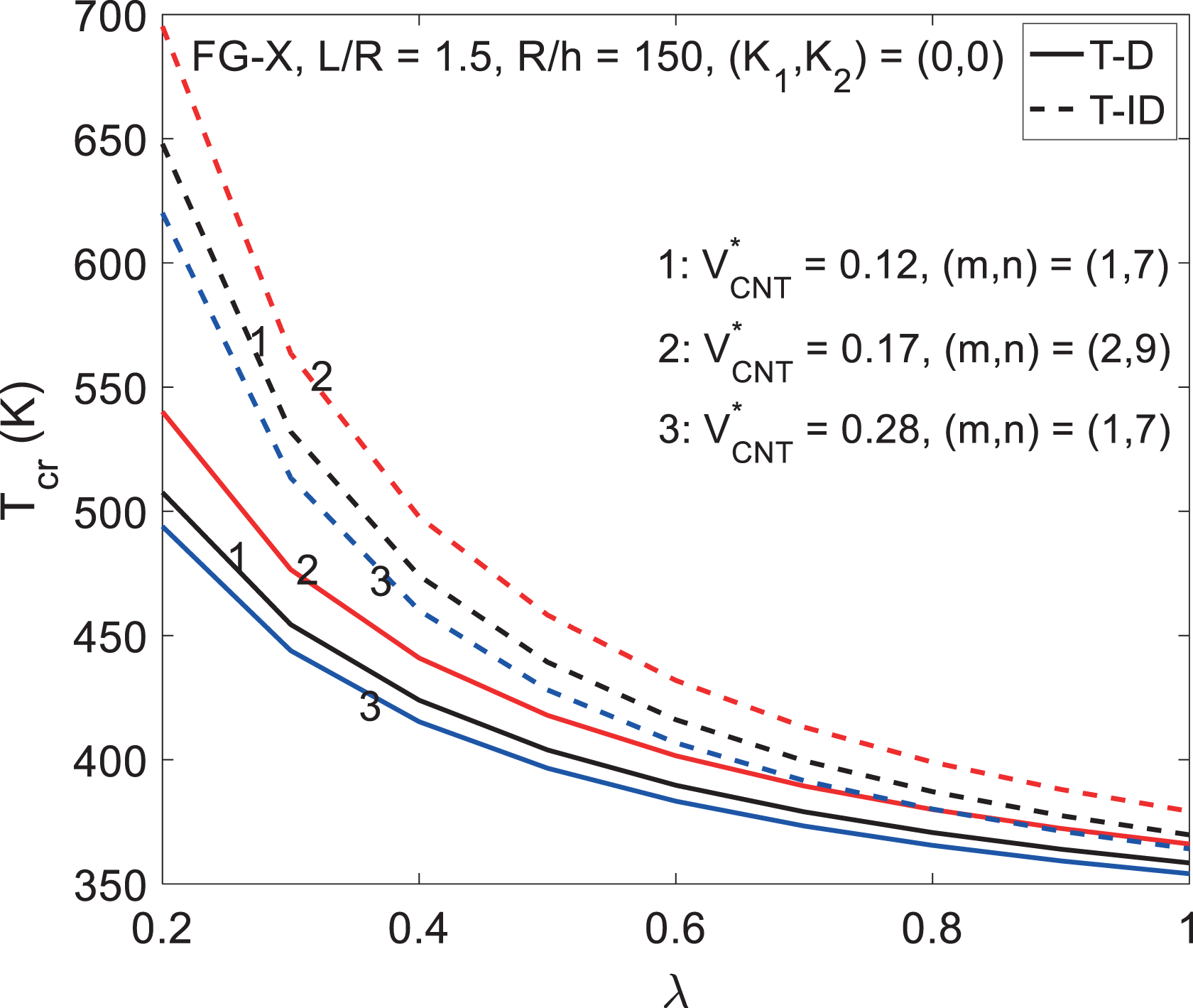
Effects of tangential edge constraint and CNT volume fraction on the critical buckling temperature of FG-CNTRC cylindrical shells with T-D and T-ID properties.
Thermal postbuckling analysis
First example for thermal postbuckling analysis is shown in Figure 3 considering the effects of CNT distribution types on the postbuckling behavior of CNTRC cylindrical shells with immovable edges under uniform temperature rise. It is evident that the FG-X distribution gives the strongest postbuckling response of thermally loaded CNTRC cylindrical shells and postbuckling path corresponding to FG-V pattern of CNT distribution is higher than postbuckling paths corresponding to four the remaining types of CNT distribution in small region of deflection. It is realized that, unlike case of mechanically loaded CNTRC cylindrical shells,
32
the postbuckling equilibrium paths of thermally loaded CNTRC cylindrical shells are relatively stable. Next, the effects of buckling mode
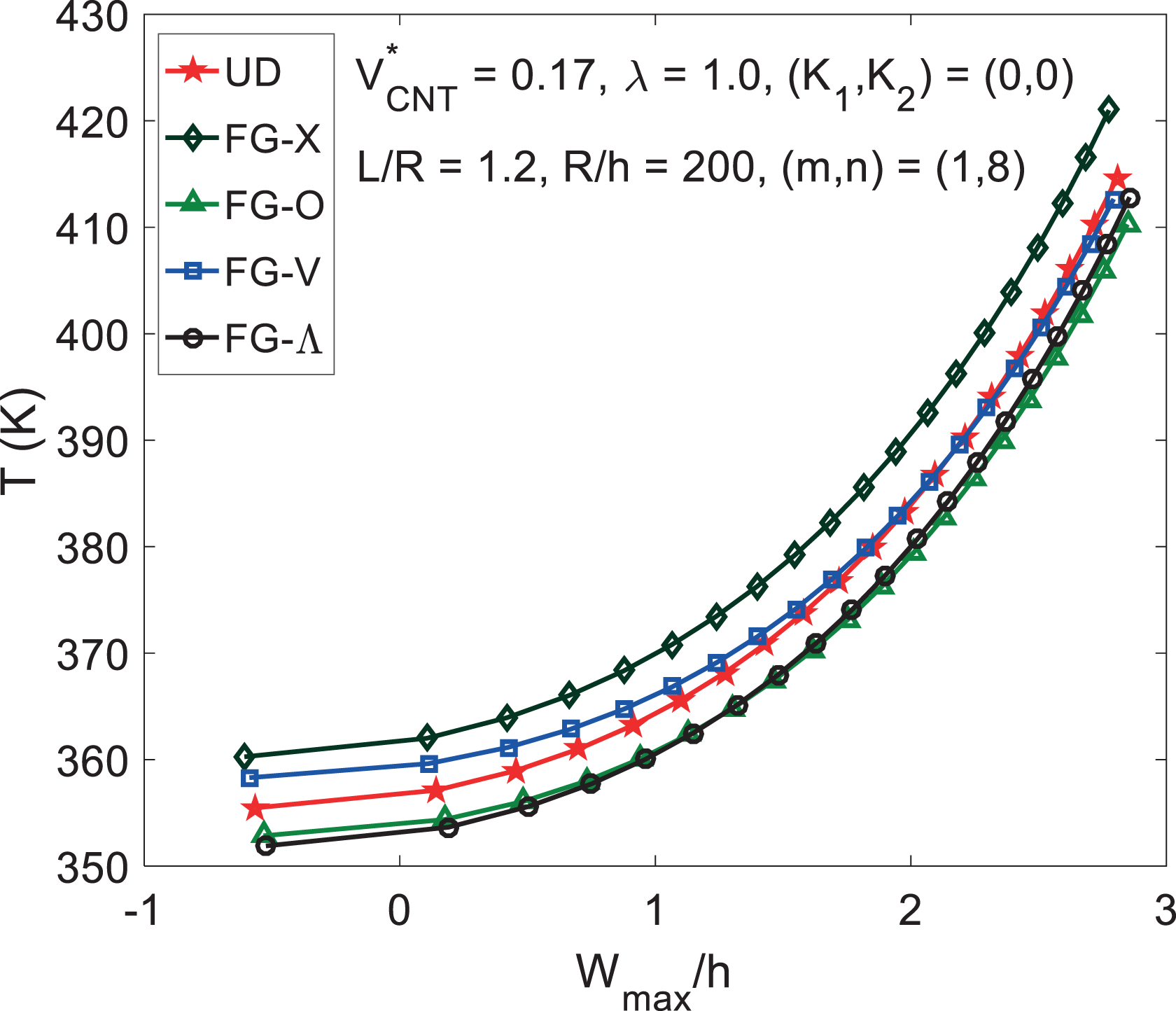
Effects of CNT distribution types on the thermal postbuckling behavior of CNTRC cylindrical shells with immovable edges.
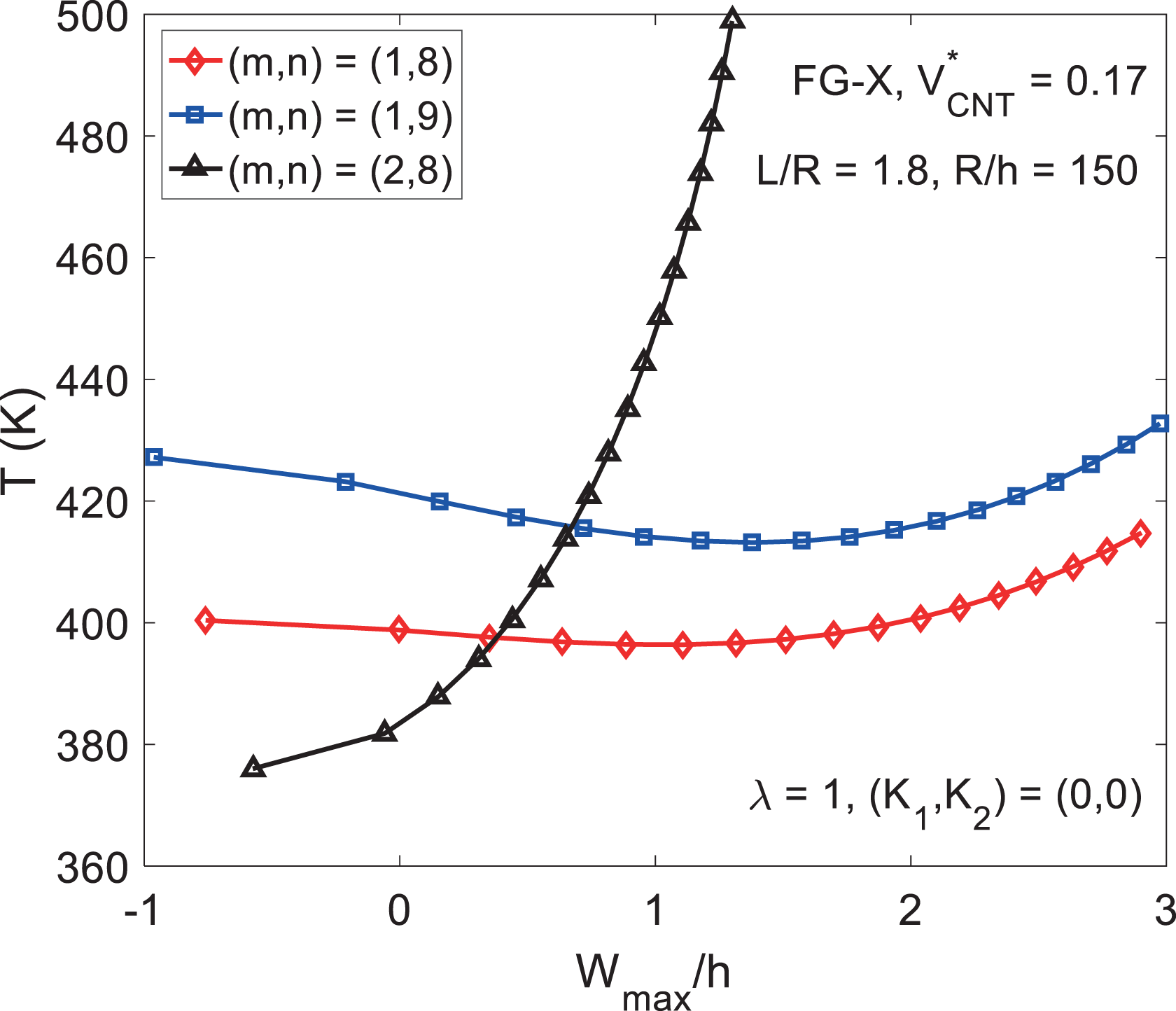
Effects of buckling mode (m, n) on the thermal postbuckling behavior of FG-CNTRC cylindrical shells with immovable edges.
Subsequently, the effects of tangential constraint of boundary edges on the thermal postbuckling behavior of FG-CNTRC cylindrical shells are illustrated in Figure 5. As can be observed, buckling temperatures and postbuckling curves of the shells are considerably dropped as tangential stiffness parameter
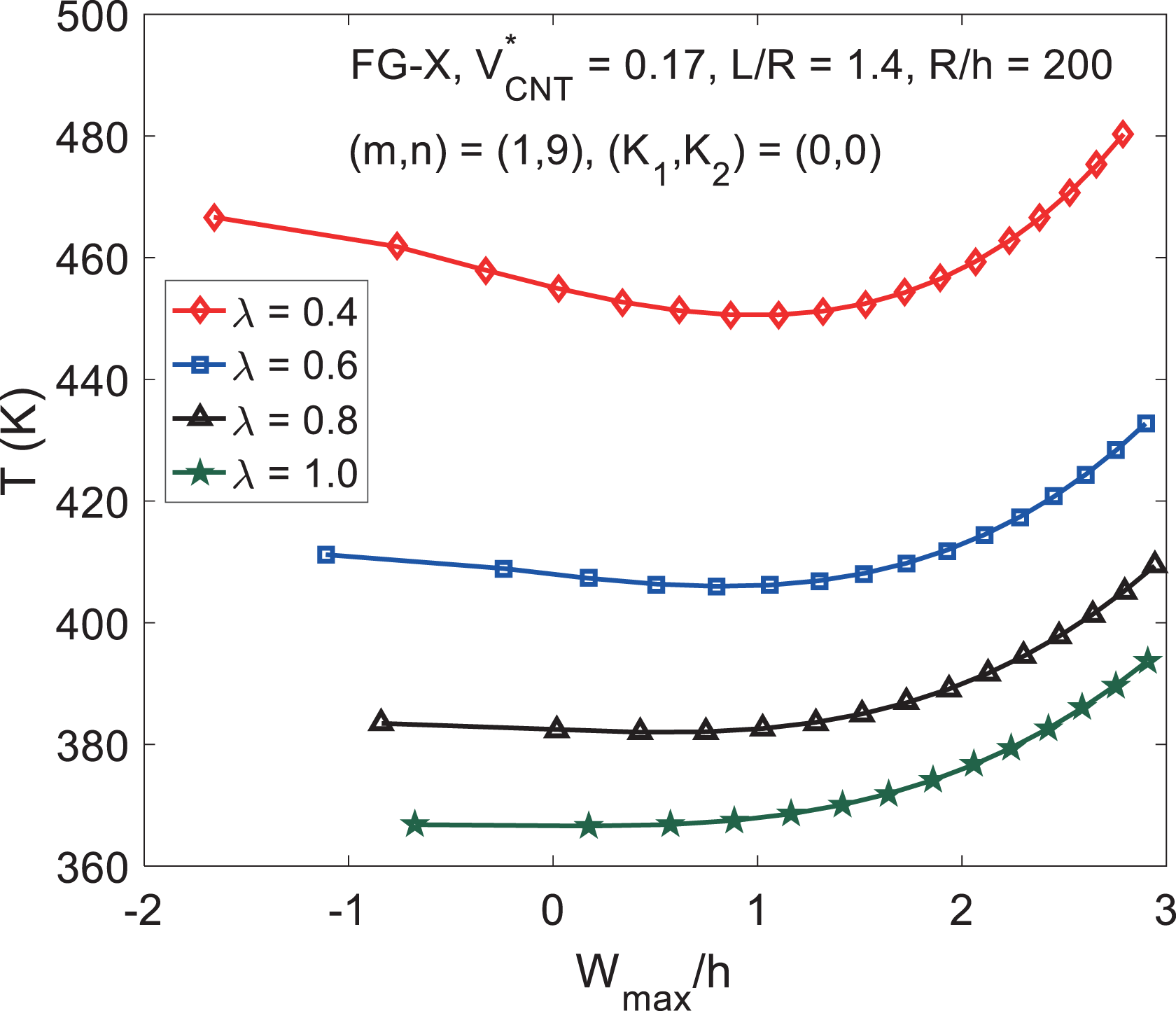
Effects of tangential constraint of boundary edges on the thermal postbuckling behavior of FG-CNTRC cylindrical shells under uniform temperature rise.
Next, thermal postbuckling paths of FG-CNTRC cylindrical shells corresponding to different values of CNT volume fraction
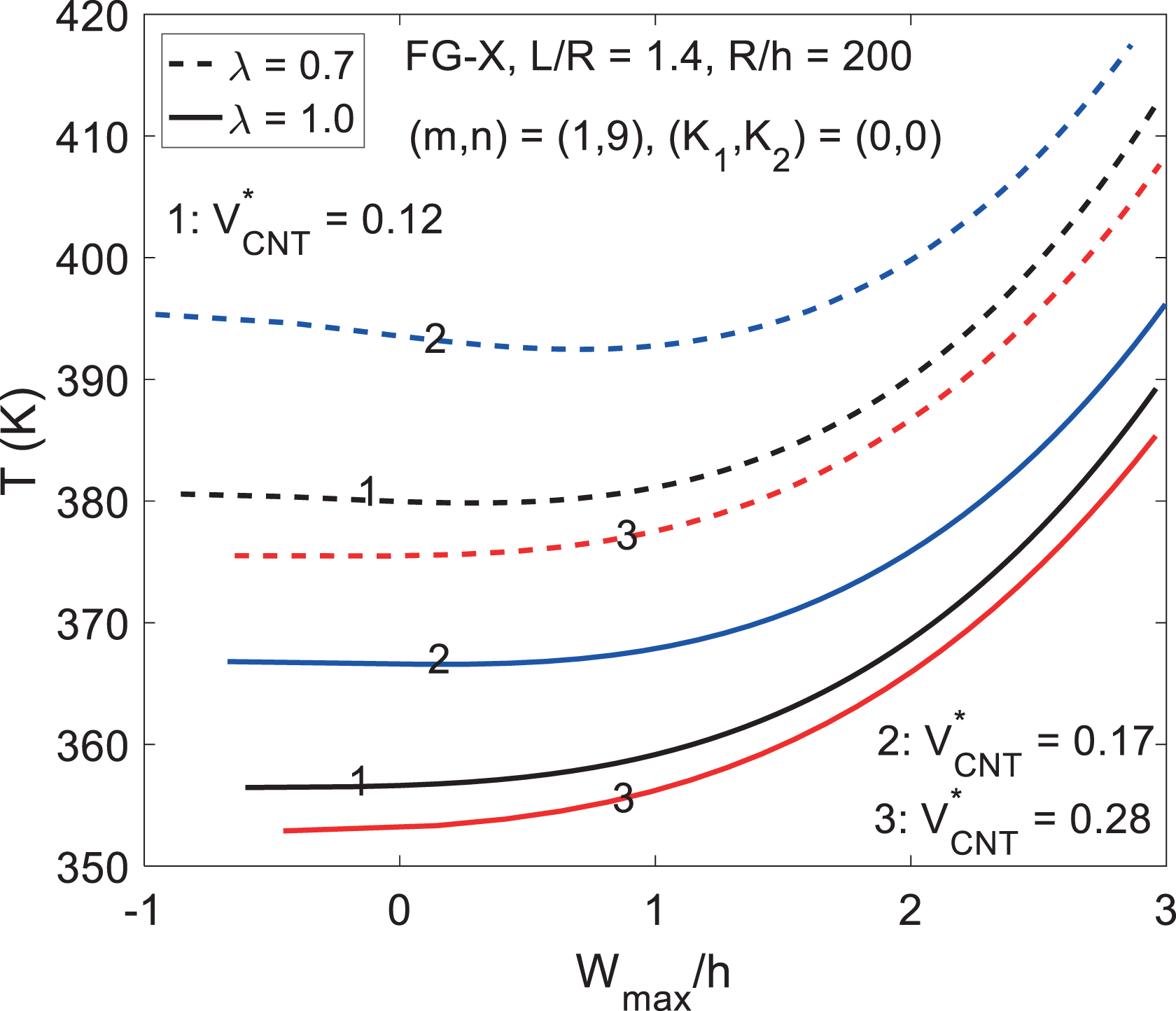
Effects of CNT volume fraction on the thermal postbuckling behavior of FG-CNTRC cylindrical shells with various degrees of tangential edge constraint.
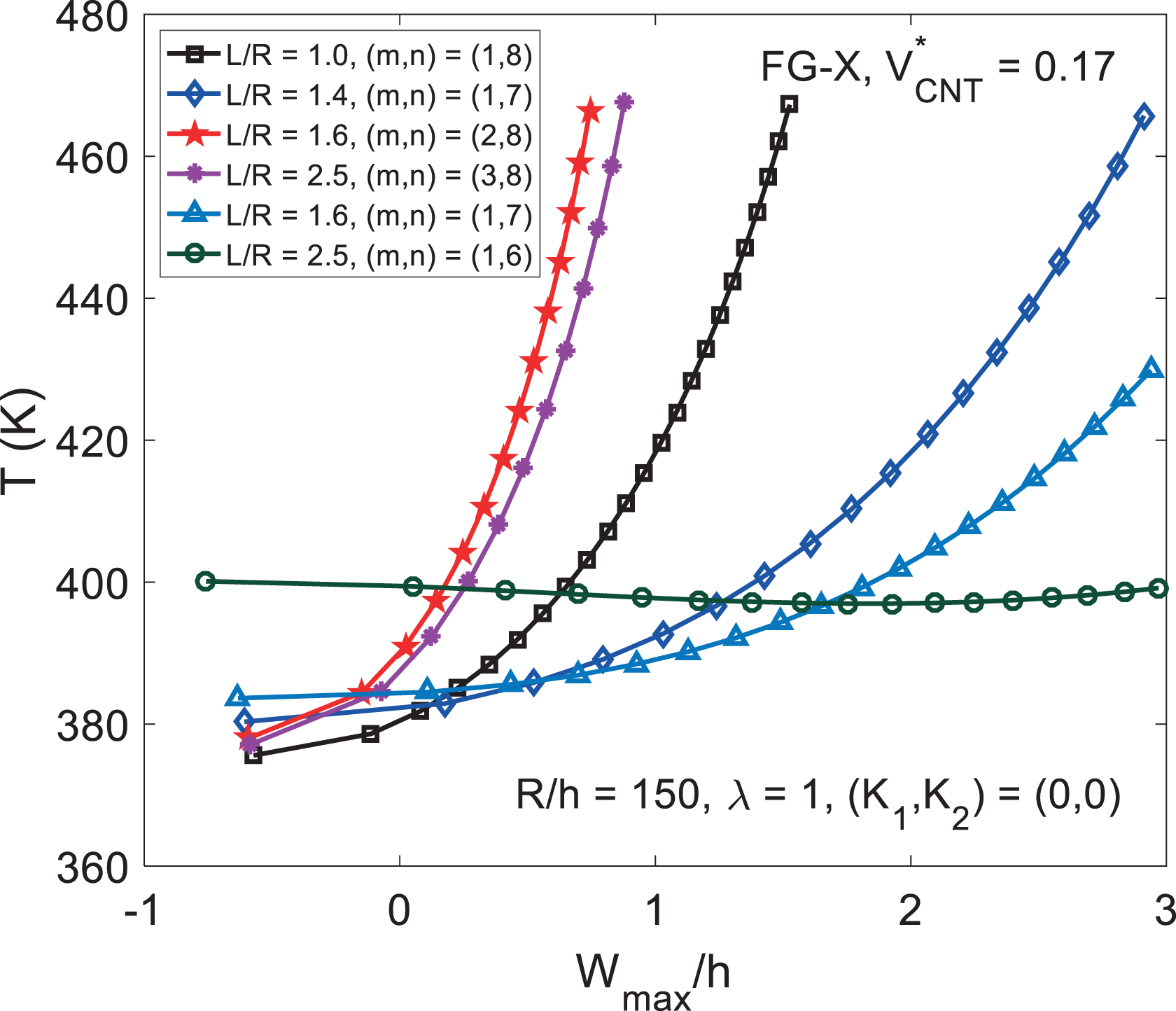
Effects of L/R ratio on the thermal postbuckling behavior of FG-CNTRC cylindrical shells with immovable edges under uniform temperature rise.
Subsequently, Figure 8 considers the effects of radius-to-thickness
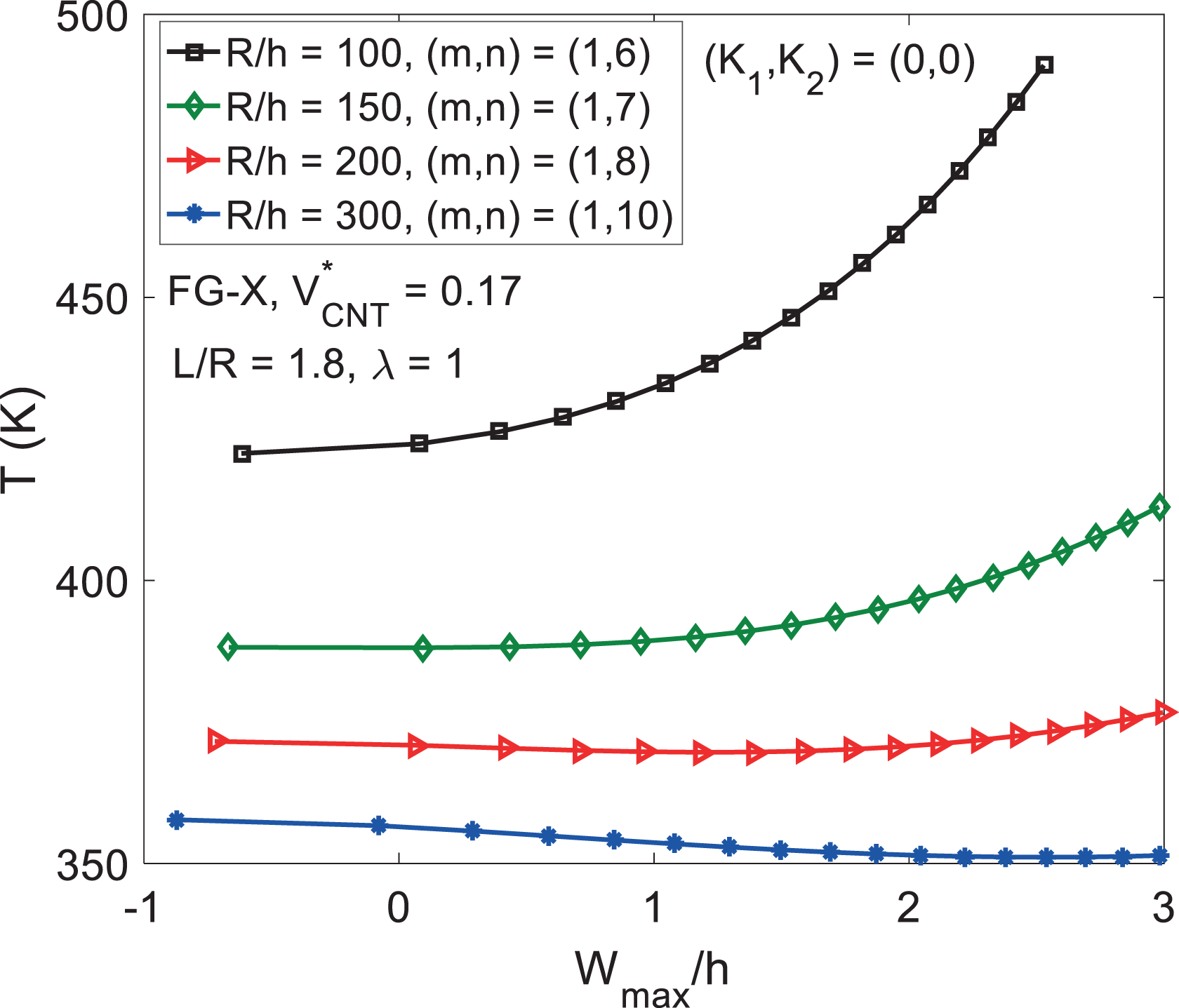
Effects of R/h ratio on the thermal postbuckling behavior of FG-CNTRC cylindrical shells with immovable edges under uniform temperature rise.
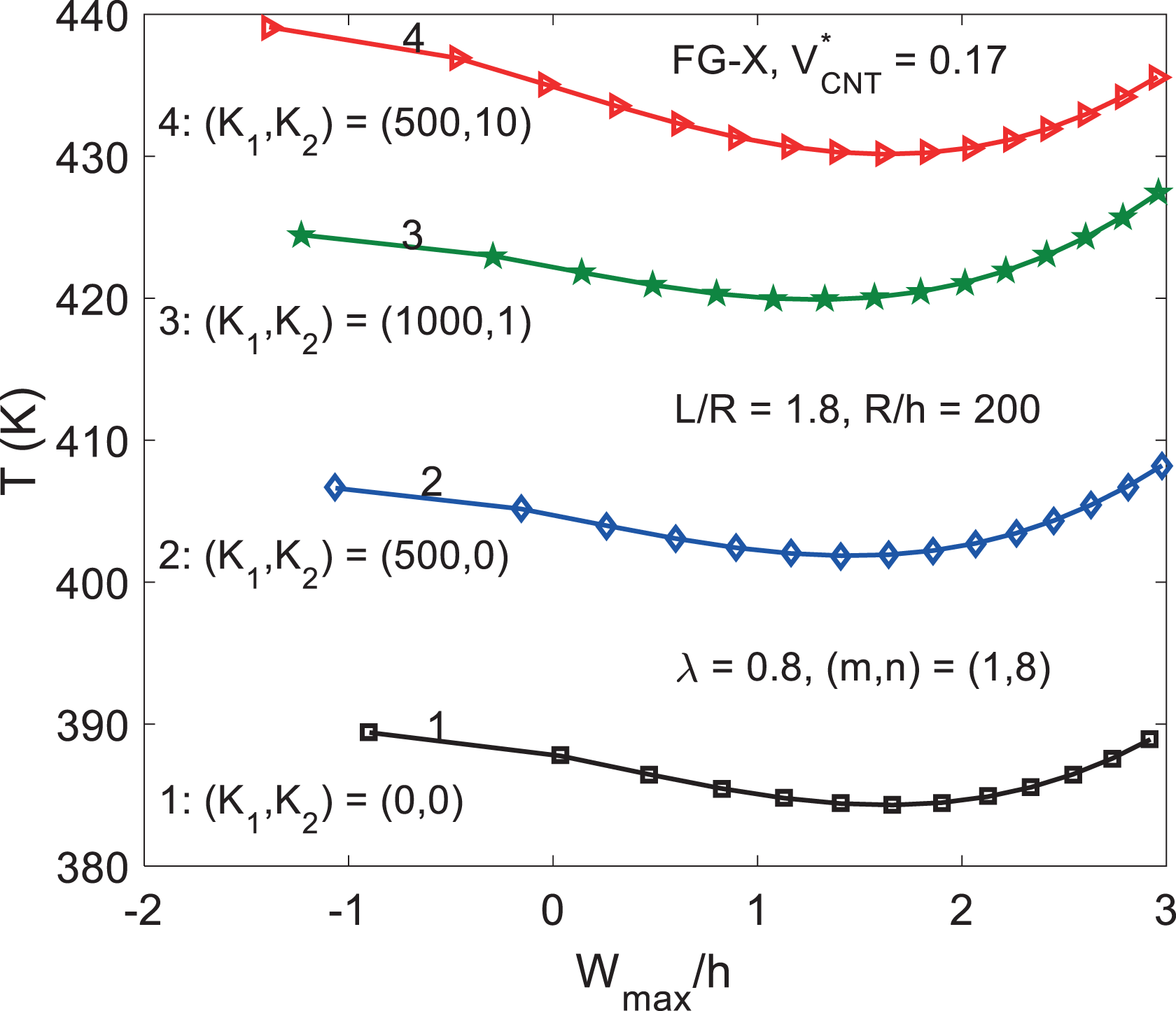
Effects of surrounding elastic media on the thermal postbuckling behavior of FG-CNTRC cylindrical shells with partially movable edges under uniform temperature rise.
Concluding remarks
The buckling and postbuckling behavior of thin CNTRC cylindrical shells with simply supported and tangentially restrained edges subjected to uniform temperature rise have been presented. Multi-term solutions and Galerkin method are used to solve nonlinear governing equations, and an iteration procedure is adopted to determine critical buckling temperatures and postbuckling temperature-deflection paths. The results indicate that an average value of CNT volume percentage can lead to the best capacities of buckling resistance and postbuckling load carrying of thermally loaded CNTRC cylindrical shells. In addition, FG-X type distribution of CNTs gives the highest buckling temperatures and postbuckling paths. The study also reveals that buckling temperature, postbuckling strength, intensity of snap-through response, and prebuckling negative deflection are considerably reduced as boundary edges are more rigorously restrained in tangential displacement. Furthermore, surrounding elastic foundations effectively improves buckling loads and postbuckling strength of thermally loaded CNTRC cylindrical shells.
Footnotes
Funding
The author(s) received no financial support for the research, authorship, and/or publication of this article.
Appendix 1
The details of coefficients
in which
and
Appendix 2
Specific definitions of coefficients
The details of coefficients