




Abstract
This paper explores the interplay of temporality and the built environment in diverging discourses of belonging at Claremont Court, a modernist housing scheme in Edinburgh which was designed in 1958 by Sir Basil Spence, a key figure of post-war architecture. It explores belonging to place as a complex temporal process, in which the individual is connected to the built environment through various material–temporal registers. While existing analyses of belonging demonstrate that it is a fundamentally temporal experience, not enough is known about belonging as a temporal phenomenon. To fill this gap, our analysis reveals how multiple temporalities of the built environment are entwined with residents’ biographies, everyday life and future aspirations, which shape their varied sense of belonging. To conclude, we argue not only for theorising the temporal nature of belonging, but also how the temporality of the built environment shapes people’s sense of belonging. In doing so, we extend the literature on belonging by theorising the relationship between temporality and the built environment with the help of the concept of material–temporal registers.
Introduction
This paper builds on the growing field of interest in temporality in the social science literature which demonstrates that temporality is not a fixed or neutral category, but is constituted through changing social contexts, discourses and human interactions (see, e.g. Davies, 1994, 1997; Dawdy, 2016; Lahad, 2017; Øian, 2004; Sharma, 2014; Slobodin, 2018; Rahman, 2015). We bring this work on temporality together with a sociological analysis on belonging, which shows that belonging is made up of different facets that are inextricably linked, so we cannot talk of one, such as belonging to place, without necessarily talking about other aspects as well, such as belonging to a sociocultural world (May and Muir, 2015). While analyses of belonging demonstrate that it is a fundamentally temporal experience, there has been little research to date on belonging as a temporal phenomenon. Attempts to make sense of the fluidity and dissonance of time as experienced in everyday life remain under-explored (Rahman, 2015) in relation to belonging, with the exception of May’s (2016, 2017) work which shows that time itself is a source of belonging and an interpretive resource. To contribute further to knowledge about the temporal nature of belonging, this paper engages with work on materiality in order to explore how time and the built environment interact as people form a sense of belonging.
Theoretical work on material culture shows that the world is not merely a place filled with things which humans perceive as external to themselves, but rather that the life worlds of persons and things are fundamentally entangled (Ingold, 2011). These things ‘are always enmeshed within a moment of change, flux, transition, rather than fixed, essential or somehow in a “permanent” state of being’ (Casella and Croucher, 2013: 92), and the agency of things in the past shapes our everyday lives in the present (Dawdy, 2016). Furthermore, objects are not only materially and socially constituted but are the ‘crystallisations of histories, projections into the future, powerful forbears of that which is to come and painful reminders of that which has been’ (Harvey and Knox, 2013: 10). In other words, objects have temporal qualities that require theoretical attention. Therefore, we argue that in order to understand belonging to the built environment, it is necessary to theorise the relationship between materiality and temporality. To this end, our analysis focuses on the temporal reasoning (Ringel, 2013) that people employ at the intersection of shared temporal frameworks, personal biographies and the temporal qualities of the material environment. The result of such temporal reasoning, we propose, is varying forms of material–temporal registers of belonging.
In this paper, we examine contrasting accounts of belonging among residents living in Claremont Court, a modernist housing scheme in Edinburgh, UK. Our argument unfolds as follows. We provide a brief background to the study, followed by discussions of how people’s experiences of time have been theorised, making use of Sharma’s (2014) argument about the political dimensions of time, Rahman’s (2015) notion of time as relational and Ringel’s (2013) conceptualisation of temporal reasoning. We then extend such theories of temporality by exploring the ways in which the material environment may influence how people experience time. After outlining the methods of our study, we present our analysis of three case studies which have been chosen because they illuminate different ways in which temporality and the built environment were interwoven in accounts of belonging. First, Martin’s strong sense of belonging was the result of significant temporal elasticity as he knitted together his own biography with the building’s past, present and future. Second, Matthew’s belonging to the Court was more tentative, expressed through a focus on the present and a concern for the material viability of the building. Third, Steven and Anna’s rather conflicted sense of belonging was characterised by temporal complexity. They referred back to the 1960s aesthetic of the building as significant for their sense of belonging, in contrast to its present stigmatised identity. At the same time, they described the impossibility of re-creating the building’s past meanings in the present, which acted as a temporal constraint that limited their ability to envision a future belonging. All three case studies demonstrate how the different temporal layers of the building impinge on residents’ sense of belonging to Claremont Court, making some things possible, and others not. Our paper thus allows for new understandings about the complex interplay between temporality and materiality which informs various material–temporal registers of belonging.
Claremont Court: From optimism to disinvestment
The data for this paper derive from an AHRC-funded study which brought together architects and social scientists from sociology, anthropology and social work to study the relationship between the built environment and residents’ sense of place and belonging (see Lewis et al., 2018, for more information on the broader study). The present analysis is based on the social science element of the project that investigated how residents made sense of Claremont Court. The housing scheme was built as part of the City of Edinburgh Corporation Housing Committee’s post-war housing drive. Designed by Basil Spence and Partners, Claremont Court is a loose grouping of 63 dwellings in a composition of 4 mid-rise slab-blocks and 2 blocks of cottages around 2 landscaped courtyards (Figures 1 and 2).
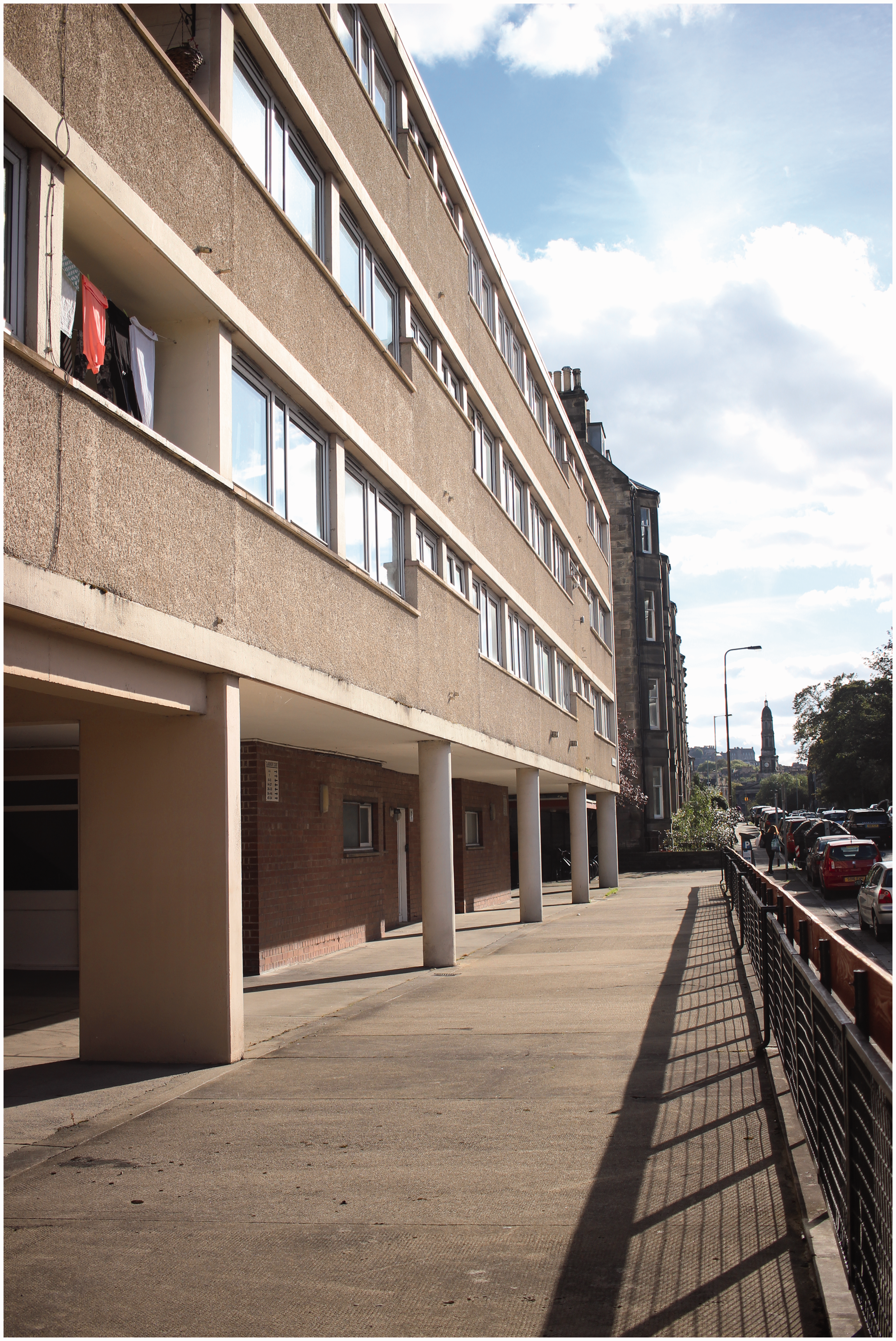
Claremont Court taken from East Claremont Street.
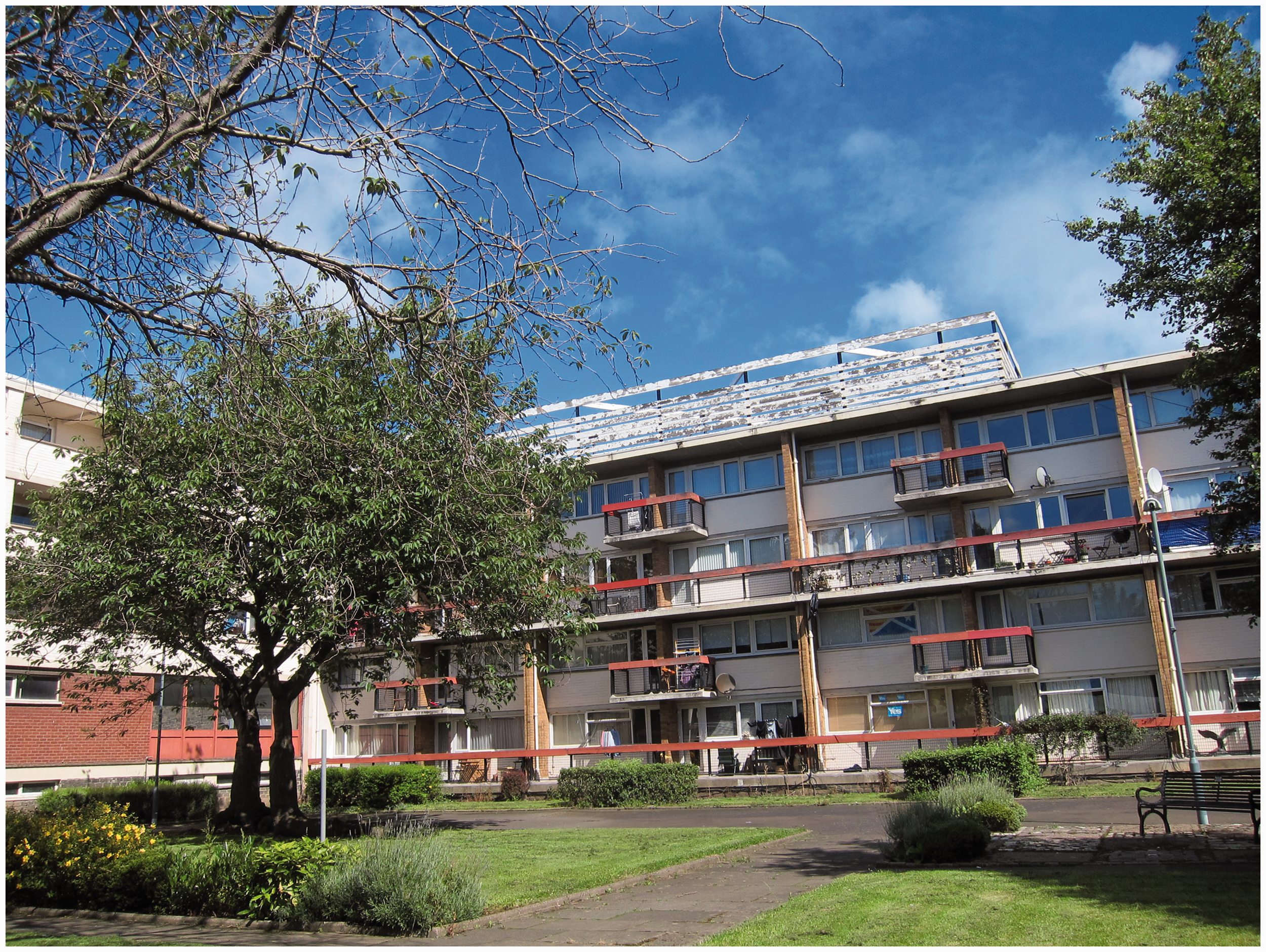
Claremont Court image taken from courtyard.
Like many post-war buildings, Claremont Court has suffered from long-term de-investment and poor maintenance (see also Jacobs et al., 2008). In the early 2000s, repair work was carried out on the roofs by contractors employed by the council. However, on three of the blocks, this repair work was done incorrectly, resulting in water damage eroding the paint work (see Figure 3). Residents described water leaking into flats and mould on interior walls, as well as pools of water and cracked concrete in communal spaces (see Figure 4). Running somewhat counter to the material and financial disinvestment in Claremont Court, in 2011, Historic Environment Scotland designated Claremont Court as a Category C listed building due to its local significance as an example of post-war modern architecture (Gillon and McDowell, 2016).
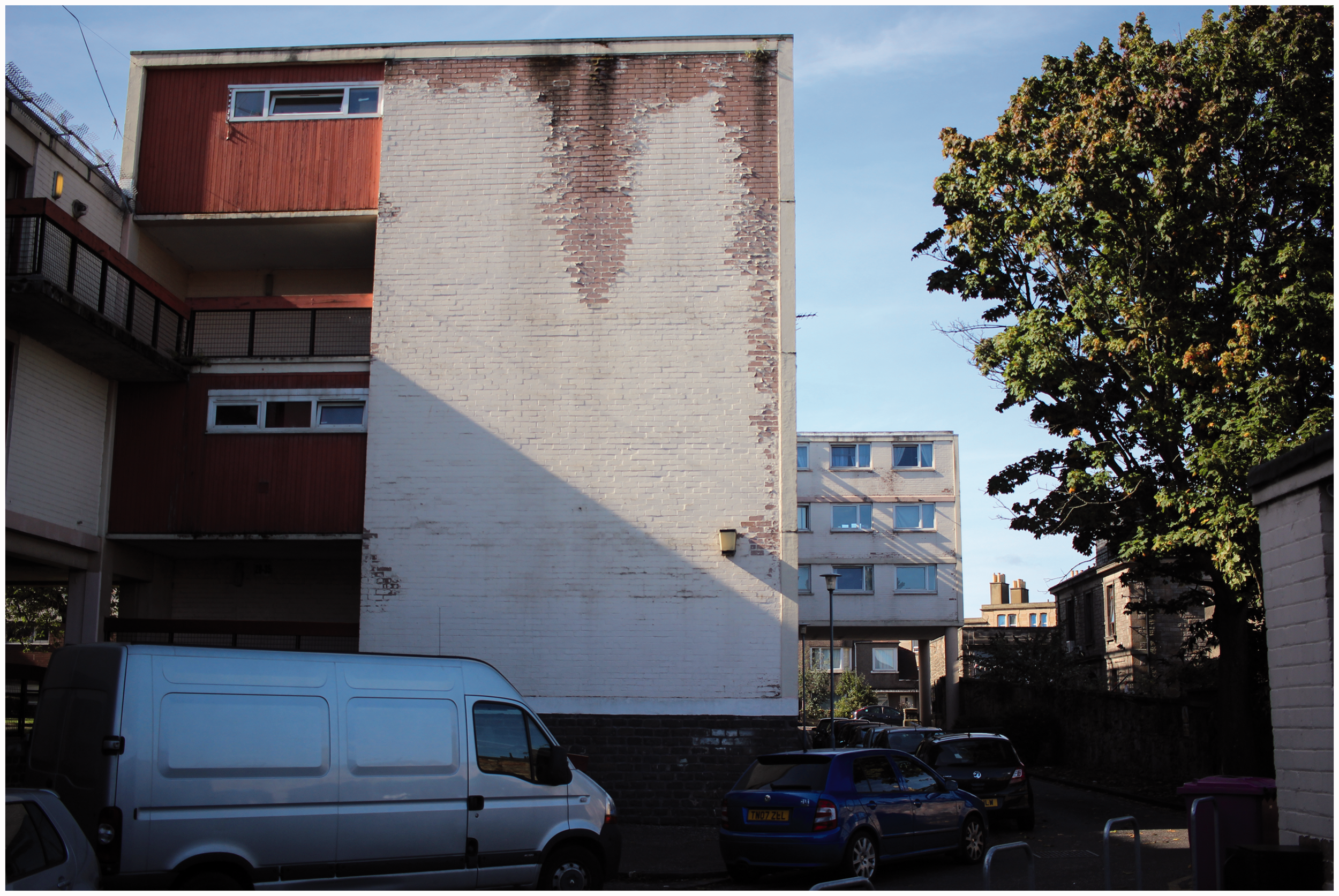
Flaking paint caused by water damage from the roof.
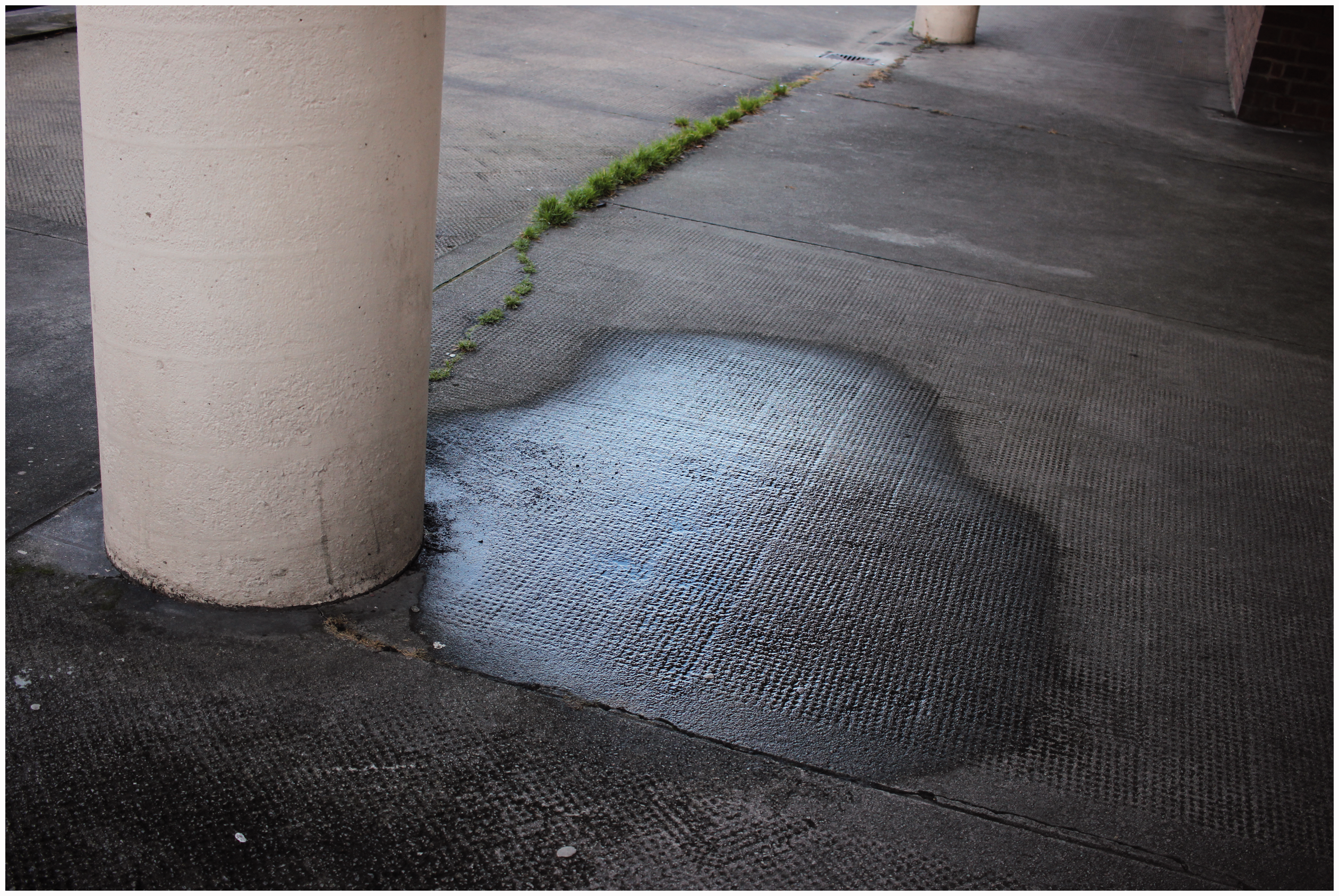
Water damage on landing at Claremont Court.
While modernist architecture has of late garnered general attention and interest, residents of modernist housing estates tend to be depicted as unruly and as damaging the fabric of their environment (Hicks and Lewis, forthcoming; Thoburn, 2018). In response, recent empirical research on such housing schemes has highlighted both the absence of residents’ voices from relevant public debates and the importance of understanding how they frame their relationship to the built environment in which they live (Jacobs et al., 2008; Thoburn, 2018). We conducted interviews with 17 residents as a way of gaining insight into residents’ experiences of living at the Court, including questions concerning how they felt about and used particular spaces. The interviews were conducted in residents’ homes or in a place where they felt comfortable. Participants were then invited to take part in a follow-up interview. Three filled out an activity diary and seven residents took part in a walk-along interview in which they guided researchers on a tour of their home. The aim of the walk-along interviews was to explore how our research participants related to the built environment and their spatial practices. Talk about Claremont Court invariably led to discussions about life in the past, present and future. Our analysis explores residents’ sense of (non-)belonging as expressed through their connection to the built environment. Our findings demonstrate that residents articulated various material–temporal registers of belonging that were shaped at the intersection of shared temporal frameworks, personal biographies and the temporal qualities of the material environment.
Our analysis focuses on three case studies involving interviews with four residents (two of whom were a couple and were interviewed together). These cases were selected because they highlight contrasting types of material–temporal registers of belonging. On the surface, these participants appear similar, as they were all owner-occupiers working in middle-class occupations. Their choice to buy a flat at the Court was influenced by the relatively cheap prices as well as the design of the flats. However, on closer examination, our analysis reveals radically different types of belonging to the Court due to the participants’ backgrounds, residential histories and future aspirations. We argue that these differences can be explained with reference to how personal biographies and the material environment are entwined.
In all of the interviews, two shifts were described as pivotal in the history of the Court. The first shift followed the 1980 Housing Act, which gave council tenants the right to buy their properties at a sizeable discount (known as the Right to Buy scheme). Since then, Claremont Court has become a mixed-tenure community, with residents from a range of socioeconomic backgrounds. Claremont Court thus reflects the general trend in the UK of the privatisation of council stock. The second shift was taking place as increasing numbers of young professionals were moving in, taking advantage of the relatively affordable prices. The gentrification of the Court was reported as creating a generational divide, between the ‘original tenants’ and incoming young professionals who tended to be of higher socioeconomic status. The following analysis demonstrates that these two shifts were interpreted differently, depending on the biographies, present life and future aspirations of the residents. We analyse these shifts as temporal fault lines, which have different significance and meaning for residents’ sense of belonging.
Experiencing time
Time is socially constructed and therefore multiple and heterogeneous, as demonstrated in a number of studies, including Dawdy’s (2016) work on ruins in New Orleans and Lahad’s (2017) analysis of how women’s experience of time is shaped by their marital status. A growing body of work has emerged which challenges the assumption that time has a common, universal form which is ‘linear, regular, absolute, marching from left to right, from the past through the present to the future’ (Davies, 1994: 277). For example, Karen Davies’ (1994) research on care work in a Swedish nursery reveals the rich and multi-layered nature of temporality where clock time sits alongside experiential senses of time. Michele Davies (1997) also illustrates people’s ability to develop alternative ways of conceiving time when a crisis shatters their pre-existing temporal assumptions. These studies demonstrate not only that time is ‘tacitly understood as the platform from which we live our lives and the means by which control over its course can be exercised’ (Davies, 1997: 561) but also that people interpret and construct their experiences through different definitions of time (Øian, 2004), and can do so in quite creative ways, making time elastic by bending and shaping it.
Sharma, however, warns us against ‘individualistic accounts of time’ and argues that it is important to keep in mind the temporal forms of social and relational power in the frame when analysing how people experience time (2014: 14). In other words, people are positioned within a larger economy of ‘temporal worth’ where the meaning and experience of time is in large part structured and controlled by both institutional arrangements and the time of others. To account for this relational nature of temporality, we engage with Rahman’s (2015) work on time and everyday life, which captures the flux and flow of time as ‘lived experience’. This is an image of time ‘where the neat sequential categories are dislodged and the past, present and future rub up against each other in the moment mingling and combining with each other and giving each moment its distinctive hue’ (Rahman, 2015: 4).
We further complicate Sharma’s reading of the politicisation of time by drawing from Ringel’s (2013) use of the term ‘temporal reasoning’. Originally developed by Guyer, temporal reasoning refers to the ‘the process of implicating oneself in the ongoing life of the social and material world’ (Guyer, 2007: 409, cited in Ringel, 2013: 26). Ringel defines temporal reasoning as ‘the multiple ways in which people position themselves in time’ (2013: 27). Further developing Crapanzano’s (2007) critique of Guyer, Ringel argues that because people are subject to a variety of ‘temporal references and frameworks’, they are able to exercise ‘temporal complexity and temporal flexibility’ in their temporal reasoning (2013: 26). In practice, this means that people have scope to challenge dominant temporal frameworks, or what Sharma (2014) above has called the larger economy of temporal worth, and thereby to ‘creat[e] and propagate[e] their own critical temporal insights’ (Ringel, 2013: 32).
Material–temporal registers of belonging
Our analysis extends the work of Sharma, Rahman and Ringel by exploring the relationship between the material environment and people’s temporal reasoning, which has hitherto received less attention in the literature. Even though it is now well recognised that ‘life is spatial as well as temporal’ (Massey, 2005: 29), much social research on, for example, urban change has examined transformations in spatial and social patterns within relatively fixed time frames (Degen, 2018). As a result, there has been only limited theorising of the connections between temporality, belonging and the built environment, with the majority of studies on temporality focusing on memory, genealogy and history (Bastian, 2014) or belonging, temporality and nationhood (Golden, 2002). To fill this gap, we argue that paying attention to how materiality and temporality are interwoven in material–temporal registers of belonging allows for new sociological insights into belonging.
In the case of Claremont Court, we propose that the building itself is a temporal entity, one whose history helps inform the types of temporal reasoning utilised by residents. It is a physical structure which reflects a particular era and architectural aesthetic, namely 1960s modernism, while also carrying, for some, the stigma of social housing. As Dawdy (2016) describes, the narratives that things like buildings give rise to can be unpredictable as the meanings attached to them are rarely stable and often contested. Furthermore, Claremont Court is an ageing building which exhibits the material signs of poor repair. As Casella and Croucher describe, all materials exist within a ‘perpetual state of decay’ as ‘the process of erosion, decay and transformation await all things’ (2013: 95). They go on to note that processes of maintenance can provide a ‘stabilising effect’ on the built environment, whether through plastering, repainting, cleaning or dusting. However, our analysis reveals that residents disagree about who is responsible for the Court’s upkeep and what type of maintenance is best for the building. Therefore, the building is felt to be in a constant state of neglect, which places demands on residents, which in turn restricts their sense of belonging.
We draw on Melly’s (2010) analysis of the temporalities of buildings in her study of a neighbourhood in Dakar, Senegal, in which she examined the construction of ‘not-yet houses’, funded by Senegalese migrants living and working abroad. Melly observed that these unfinished and unlived-in houses were ‘houses-in-process’ which could not be considered ‘a stable object’ because they were ‘caught up in very literal and ongoing processes of construction and deconstruction’ (2010: 53). Though ostensibly ‘completed’, we argue that Claremont Court can analogously be understood as a ‘building-in-process’ as poor repair and maintenance make the future of the building seem uncertain for residents. Following Melly, we argue that Claremont Court is not a static entity. As her analysis suggests, building a house is not a linear process, ‘but instead involve[s] many stops and starts, simultaneous creation and deterioration, revised histories and fantastic ideas of future possibility’ (Melly, 2010: 52). We similarly explore how the multiple temporalities of the material environment are entwined with residents’ personal biographies, that is, their past experiences, present life and future aspirations, which in turn our participants expressed as contributing to or restricting their sense of belonging.
More specifically, we explore the various ways in which the residents of Claremont Court understand the past, present and future of the building and its political dimensions, and how these different temporalities informed their sense of (not) belonging there. In doing so, we use May’s (2016) notion of the temporal location of belonging whereby people’s sense of belonging is not necessarily built in the here and now, but can incorporate a mixture of temporal horizons as memories of the past and hopes for the future are used to enliven the present (see also May and Muir, 2015). We now go on to discuss the three case studies to explore the different ways in which residents construct material–temporal registers of belonging.
Martin: Elastic temporal reasoning
We first explore two interviews with Martin, a Claremont Court resident in his 50s, who, together with his wife, bought a two-bedroom maisonette in the early 2000s. The analysis reveals temporal flexibility (Ringel, 2013) in the form of simultaneous expressions of different forms of temporal reasoning. While he held a deep sense of belonging to Claremont Court, describing a strong historical sense of community and an appreciation of its 1960s modernist design, this was complicated by the fact that he felt that the building was falling into a state of disrepair and social relations were fragmenting. Thus, in Martin’s account, the temporalities of the social and material fabric of the Court were closely interlinked, because the crumbling material infrastructure meant that social relations could not be performed in an ideal way.
In both his biographical and diary interviews, Martin made frequent references to the past, recounting growing up in a ‘tough’ working-class neighbourhood, and telling us how, upon first moving to Claremont Court and meeting his ‘older neighbours’, he was struck by the similarities between the Court and his childhood neighbourhood, which made him feel ‘instantly at home’: cause where I came from in [city] there’s a bit of that kind of community spirit, no matter how rough the area was … so yeah, I was quite happy to meet these ladies who had a kind of history of the ’60s and the ’70s, being a fan of that, having grown up through that period I had something in common with them, I could talk to them about a world that they would remember, you know?
While the ‘community spirit’ at the Court was similar to the one Martin had experienced as a child, the built environment was radically different. Martin was fascinated by the building as a temporal entity. He saw the Court as a living monument to the ‘shock of modernity’ which modernist housing represented in the 1960s. He explained how housing schemes such as the Court meant a break from traditional ways of living and offered an improvement in living standards for working-class people. I would love to have seen it in the ’60s, I would love to have seen it when people first went in, it would be such a–, an aesthetic shock to them. I would have loved to have just seen what it did … the shock of modernity must have been, you know, must have been something to see for people to come out of tenements and come in here.
Martin feared that the social ethos and aesthetic of the 1960s were crumbling in front of his eyes and his sense of belonging was at risk of being lost in time (Lewis, 2016; May, 2017). Martin remarked that the Court’s convivial atmosphere had begun to disappear because residents no longer pulled together and could not reach a consensus about how the communal spaces should be maintained. In his opinion, the disrepair of the building was not a result of design faults, but was due to the inattention of some of the residents, which further exacerbated the problems caused by the faulty roof repair. For Martin, the 1980 Housing Act comprised a temporal fault-line, after which a significant proportion of dwellings at Claremont Court became the property of private landlords. He contrasted owner-occupiers and council tenants, who had ‘lived here for years’, with short-term private tenants. While Martin felt that the more permanent residents had ‘invested back … They’ve invested their lives here and being part of it [the community]’, private tenants had ‘no incentive really to be part of that community ‘cause you just live in a flat, investment, belongs to someone else, it’s not theirs’. In addition, he said that absentee landlords were ‘destroying communities’ because they were only interested in ‘a quick turnover for a few bucks, nothing else invested, other than what I can get out of that space’. This lack of investment, Martin told us, was visible as a lack of care of the built environment.
A further temporal fault-line, related to generational shifts in attitudes, was evident in Martin’s account. In contrast to the traditional ethos of ‘community support’ that resulted in ‘a kind of unspoken support network’ that he had encountered upon first moving to Claremont Court, Martin described the ‘problem’ being younger private tenants’ assumption ‘that someone else will do it’, which was having a further negative impact on the social and material fabric of Claremont Court. Martin also identified a tension that had arisen between older residents who believed that the council should still bear responsibility for maintaining the built environment and younger owner-occupiers, who felt that it was unwise to wait for the council to repair things.
While Martin could sympathise with the (former) council tenants at the Court, having himself grown up on a council estate, he also felt that the residents should figure out a sustainable way of maintaining the building now that the City Council was no longer solely responsible. He said he could understand why older residents found it difficult to acclimatise to social change, but simultaneously, he accused them of nostalgia, suggesting that when people focused too much on an overly ‘romantic’ version of the past as a way of protecting themselves against an ‘uncertain future’, they become alienated from the present. By positioning himself at the intersection of the different forms of temporal reasoning evident at Claremont Court, which were reflections of broader temporal frameworks, Martin was exercising what Ringel (2013) calls temporal flexibility, that is, an ability to view issues related to the Court from different perspectives, and showing sympathies with each, but not fully aligning himself with any. We propose that in Martin’s case, the notion of elasticity best describes the way in which he bends and stretches time to form a sense of belonging.
We argue that Martin’s resultant material–temporal register of belonging mixed past-oriented nostalgia with what we term ‘present realism’ or even pessimism, and that his sense of belonging spanned and was anchored in the past, present and the future. At the same time, the material and social characteristics of the building were entangled in Martin’s account of the gradual degradation of the built environment. Martin’s view was that the relationship between the inhabitants and the building had become strained, due to the rapid change in occupancy, generational shifts in how communal living is viewed and the physical deterioration of the building, all of which were interlinked. The social changes were, in Martin’s estimation, threatening the original meanings ascribed to the modernist design of Claremont Court. While Martin’s temporal horizons extended far into the past and the future (he told us that he hoped to live out his life at Claremont Court), our following case study, that of Matthew, exemplifies a material–temporal register of belonging that, because it is focused almost exclusively on a problematic present, is much more precarious.
Matthew: Constricted temporal reasoning
For Matthew, a man in his 40s who lived alone in a two-bedroom flat he had bought in the 1990s, the physical and social deterioration of the Court and problems with the general upkeep of the communal areas of the building were of particular concern. In both his biographical and activity diary interviews, he made frequent references to the declining fabric of the building, including the flaking paintwork on the hand rails, graffiti in public spaces and damp and stagnant water corroding the concrete. Matthew had bought his flat because of its location and price. He enjoyed living there, describing his home as spacious, comfortable and easy to maintain. Matthew was nevertheless unsure how long he would stay living at the Court. Compared to Martin’s sense of belonging which was constructed through a sophisticated temporal elasticity, Matthew’s was much more rigid and precarious. Martin integrated past and present in a malleable fashion, in order to create a continuous narrative of self, whereas Matthew’s narrative was disrupted and truncated. He did not see his own biography in relation to other residents, perhaps partly because he had not grown up in council housing, and his account was limited in terms of details about his personal life. The absence or omission of his biographical history may, in part, be explained by his sense of temporal discontinuity with the physical environment. We argue that the dilapidation in the built environment and weakening social ties at the Court contributed to Matthew’s inability to imagine a future there, which in turn troubled any sense of belonging he experienced in the present.
Compared to Martin, whose strong sense of belonging to Claremont Court was partly rooted in ideas about the past, as well as frequent contact with a range of neighbours and knowledge about their lives, Matthew’s expressions of belonging were rather more tentative and conflicted. Reflecting on the process of filling out his activity diary in the second interview, Matthew commented that he thought that he had less contact with other residents compared to his neighbours. He occasionally socialised with people at the Court, mostly to talk about practical matters arising from Residents’ Association meetings related to the upkeep of the building. The interviews therefore revealed that his sense of belonging was based on routine interactions rather than strong social ties.
Overall, Matthew described his involvement in the Residents’ Association as unrewarding because everyone’s efforts had to be focused on the roof issues, which in turn meant that plans for developing a stronger sense of community had fallen by the wayside: Frustrating mostly. It’s, erm–, it’s because–, I mean we’ve all–, we’ve kind of–, when we first formed–, reformed the association, we had some sort of bright ideas about neighbourliness and developing more of a sense of community but we’ve found that because we started out to deal with the problem [of the roof] and we can’t deal with the problem–
For Matthew, the ongoing dispute over the roof was not the only thing preventing a sense of community developing at the Court. What preoccupied him was the question of who was responsible for the material upkeep of the building. The building was first designed as social housing to be overseen by the council. But becoming a mixed tenure estate as a result of the Right to Buy scheme had meant changes to the relationship between the tenants and the building. New questions around responsibility had arisen which remained unresolved. When asked whether he felt optimistic about the future of Claremont Court, Matthew stated ‘I am not’ and went on to explain that this was because the council was reducing the previous levels of responsibility for the management of Claremont Court due to decreasing funds: And I realise that they don’t have a huge amount of money but they do more or less have a policy of if they can–, if they can get rid of a responsibility that they currently have that saves them money so they will get rid of that responsibility. Because it’s necessary for a community to live as a community rather than each person being left to do their own thing because in situations like shared stairwell living that just doesn’t work.
We can, to an extent, make sense of Matthew’s precarious material–temporal register of belonging with the help of existing work on temporalities which points to the power dynamics involved in the experience of time. There was a sense of Matthew feeling unable to align himself with dominant experiences of time as productive and future-oriented. This is reminiscent of Øian’s (2004) research with unemployed people, some of whom found themselves trapped in the experience of a non-moving, empty time. In other words, Martin’s and Matthew’s cases studies highlight the significance of being able to harness the flow of time in one’s temporal reasoning in order to construct a sense of belonging. The next case study, that of Anna and Steven, adds further layers to our understanding of the nature of material–temporal registers of belonging. Their narrative shows simultaneous temporal flexibility and temporal constraints.
Anna and Steven: Complex temporal reasoning
Anna and Steven, a married couple in their 30s, had bought their flat in the previous year. They were interviewed together twice. The first interview was a biographical interview, followed by a walk-along interview around the Court and their home. Anna and Steven recounted how they were initially sceptical about the external appearance of the Court, because they thought that it looked like any another ‘ex-council’ building. But upon entering the flat, they were impressed by the lighting and the views. Claremont Court’s main draw for them was its modernist design, which they found ‘intriguing’ and ‘cool’. While they held a deep sense of attachment to their home, their relationship to Claremont Court remained somewhat conflicted. They associated the Court on the one hand with a ‘golden era’ of architectural design, but on the other hand with the stigma attached to council housing. They also described the ‘original’ tenants as getting in the way of development and progress. We argue that their account shows temporal complexity (Ringel, 2013) in that it is characterised by a combination of temporal flexibility that enabled this somewhat conflicted material–temporal register of belonging and temporal constraint that restricts their future belonging.
Anna and Steven’s relationship to the building as a temporal entity was rather different from Martin’s or Matthew’s. While Matthew expressed no particular relationship to the building’s origins – indeed, the past was largely absent from his account – for Martin, Claremont Court stood as a monument to, or physical reminder of, a 1960s working-class community ethos and political ideals of social equality and mobility. For Steven and Anna, Claremont Court’s history meant something different. Anna and Steven mobilised the building’s past to counter the building’s stigmatised identity as council housing. They placed great value on Claremont Court’s ‘original aesthetic’, indicating that if handled correctly, the modernist design elements could lend added distinction to the building, thus improving the monetary and symbolic value of the Court (and thereby also the experience of being a resident there). The couple’s keenness to emphasise this aspect of the building’s past is understandable in the context of the fashionable cachet that modernist architecture has in the eyes of middle-class, aspirational house-buyers. It is not surprising, therefore, that the listed status of Claremont Court was of great significance to them.
Anna and Steven were irritated by the lack of attention and care shown towards the building by the council, saying that ‘you’d think they’d want to protect it more’ because Basil Spence was ‘quite an important architect’ (Anna). They seemed to imply that this continued lack of care was due to Claremont Court being classified only as a grade C listed building. They described this as a ‘weak’ classification, and hypothesised that this was the result of the Court being a ‘poor’ example of Spence’s work compared to the architect’s other designs located in Edinburgh (Steven) and ‘not like one of his important buildings’ (Anna). They believed that if the Court had been given an ‘A’ listing, the council would direct more attention and funding to it, in addition to which, heritage organisations, such as Historic Environment Scotland, could lobby on residents’ behalf to ensure that the building was sufficiently well maintained.
The couple were keen to make sure that the Court was protected in the future. They felt that it was important to preserve the appearance and ‘original aesthetic’ of the building. For example, they planned to remove the satellite dish that a previous occupant had installed, because they felt it ruined the look of the building. Bell argues that the act of listing a building can result in residents feeling obliged to retain historical characteristics, thus marking out the building as ‘a-temporal’ as it must be preserved in a ‘timeless state for communities yet to come’ (2011: 230). Our analysis of Claremont Court is somewhat different, as exemplified by Anna and Steven’s flexible interpretation of what preserving the Court’s original design entailed. For example, they felt that painting the building white, instead of the original grey, would enhance its appeal. This analysis reveals how the perception of something as antique, ancient or retro is a cultural judgement (Dawdy, 2016: 31). Furthermore, we draw from Rahman’s (2010: 74) argument that the past should not be understood through a ‘storage model’ where pieces of the past are preserved intact for conscious retrieval in the present. Instead, the past is fragmented and made present through differing layers of perception and recollection.
Discussing conservation, Casella and Croucher (2013) describe how temporal and material changes reveal how ‘objects out of time’ gather alternative meanings. They describe how archaeologists continually have to manage the ‘nexus of temporality’ as time and decomposition act on material remains (Casella and Croucher, 2013: 100). Our findings similarly show residents of Claremont Court had to manage the ‘nexus of temporality’ around the dilapidation of the building and how tensions arose as they came to differing conclusions over how to prioritise the building’s social and material history. Anna and Steven were saddened that their appreciation of the architectural significance of Claremont Court was not widely shared among the residents. The couple referred to rifts between different groups over various plans which they thought would improve life in the Court. They described the greatest differences as having emerged between owner-occupiers – particularly young professionals like themselves – and (former) council tenants, who were all older. Anna and Steven indicated that as owner-occupiers, they were more invested in the building than council tenants, and therefore were more interested in maintaining it. Steven said: we as private owners have more of a vested interest in ensuring that this is a maintained and lovely place to live or–, well that sounds horrible to say we have more but we have a financial investment and choice
An interesting paradox emerged concerning Steven and Anna’s expressed preference for a return to the building’s ‘original’ appearance. They spoke in nostalgic terms about how striking the building must have looked in the 1960s and about the sense of community they envisaged to have existed there in the past. But at the same time, they were critical of the long-standing residents who lived at the Court, and of their sense of nostalgia about former ways of living, which the couple saw as a barrier to the realisation of the Court’s future aesthetic potential. As Melly points out, the ‘future possibilities’ of a building influence how residents evaluate the present (2010: 53), and, we argue, the past. For Anna and Steven, Claremont Court’s past as a modernist building was an integral part of its future possibility, which is why they wanted to ensure that their vision of the original aesthetic was safeguarded, for example, by painting the building white. The couple’s case exemplifies that ‘belonging is a process that is rooted in both present circumstances and future possibilities’ (Melly, 2010: 62), and that these are interwoven with interpretations of the past. The improvements they had hoped for at Claremont Court had not been realised. Thus, Anna and Steven, among the more highly educated and affluent of our research participants, came to experience that their sense of belonging was challenged at Claremont Court, perhaps partly because they had no way of sharing in the building’s working-class history. These factors likely contributed to the fact that Anna and Steven did not see themselves as part of the future life of Court but instead actively imagined their futures elsewhere.
Anna and Steven’s case therefore offers a type of temporal complexity that differs from the temporal elasticity expressed by Martin. We suggest that this difference is perhaps partly explained by the fact that the origins of Claremont Court were located in a time that Anna and Steven had not experienced, nor did they share the temporal frameworks of older residents. Martin’s temporal reasoning placed him simultaneously inside and outside the different temporal frameworks evident at Claremont Court, offering him a sense of shared belonging in the past and present social life of the Court. In contrast, Anna and Steven challenged the temporal reasoning of other, more established and older, residents. Somewhat differently to the flexibility which Ringel (2013) talks of, Anna and Steven were faced with temporal limitations or challenges as they felt that their appreciation for the original aesthetic of the building was not shared by others, nor were their hopes for the building’s future. As a consequence, they felt that their sense of belonging to place was contested. Our analysis shows how the past has very different meanings for residents, who use it in varying ways to construct diverging and at times competing material–temporal registers of belonging.
Conclusion
The three empirical case studies discussed in this paper illustrate the temporal nature of the complex entanglement of people and the built environment. Although our participants seemed uneasy about any sense of non-belonging, our claim here is not about the normative benefits of stable belonging, but instead to highlight the significance of both time and materiality in how people construct and claim a sense of belonging to place. We have done so by understanding time as political (Sharma, 2014) and relational (Rahman, 2015), and by focusing on the temporal reasoning employed by people in their accounts of place belonging. As Ringel (2013: 34) has pointed out, a focus on temporal reasoning allows for understanding the varying ways in which members of the same group or society orient towards the world: manifold forms of temporal reasoning are enacted out of particular positions in specific social fields and situations and with specific repercussions … Forms of temporal reasoning are neither predetermined nor spontaneous nor arbitrary, but embedded in continuous political and epistemological processes. These processes are influenced by current socioeconomic changes.
We argue that paying attention to such material–temporal registers of belonging allows for new sociological insights into belonging. Residents’ sense of belonging was interwoven with the fabric of the building, the physicality of which was caught up in the very literal and ongoing processes of deterioration and repair. Furthermore, an ability to anchor belonging across time emerged as important, as evidenced by Matthew’s precarious sense of belonging, which we propose at least partly stems from his inability to extend his material–temporal register of belonging into the past or the future. Our argument is that when trying to understand (not) belonging to place, an appreciation of the complex temporality of the built environment is vital. Our analysis has thus illuminated not only the temporal nature of belonging, but also how the temporality of the built environment informs people’s sense of belonging. The diverging views of the building’s past, present and future were not just about aesthetics and design but involved fundamental differences concerning norms defining collective and individual responsibility in communal living. The temporal, in the shape of overarching economies of temporal worth or temporal frameworks, operates as a form of social power and a type of social difference (Sharma, 2014) between residents. The very physical make-up of Claremont Court came to stand for these conflicting ideas. These various temporalities are important to consider as the future of modernist buildings remains contested, partly because of the essential (and costly) maintenance work that post-war buildings continue to require. A better understanding of the possible and actual tensions and conflicts in belonging evident in many places may be gained through understanding competing material–temporal registers of belonging.
Footnotes
Author’s Note
Camilla Lewis is now affiliated with the School of Architecture, Planning and Landscape, Newcastle University, UK.
Acknowledgements
We thank Kinneret Lahad for her helpful comments on an early draft of this paper and the residents of Claremont Court for making this research possible.
Declaration of Conflicting Interests
The author(s) declared no potential conflicts of interest with respect to the research, authorship, and/or publication of this article.
Funding
The author(s) disclosed receipt of the following financial support for the research, authorship, and/or publication of this article: This work was supported by the Arts and Humanities Research Council (AHRC) of the United Kingdom (Award number AH/N002938/1). The project team included Sandra Costa Santos (PI), Nadia Bertolino, Stephen Hicks (Co-I), Camilla Lewis and Vanessa May (Co-I).