




Abstract
This article explores the possibilities of using innovative, interdisciplinary methods for understanding home-making. Drawing on a study of Claremont Court (1959–1962), a post-war social housing scheme designed by Sir Basil Spence in Edinburgh, we discuss the methodological potentials of combining architectural and social science methods to study the home. Claremont Court was built in the post-war era as part of Scotland’s social housing drive. It was designed following the principles of ‘cross-class’ living in order to foster a sense of community. In subsequent years, inhabitants of the court have adapted their dwellings in numerous ways and the population of the court has changed dramatically. But, while meanings of home and understandings of the division between public and private have been reconfigured, the spatial layouts of the dwellings continue to shape residents’ sense of home. To explore how residents make home at Claremont Court, we use ‘facet methodology’, which opens up new ways of thinking about the research process through a ‘playful’ approach to epistemology. In doing so, we develop an innovative approach which combines architectural methods (including survey drawings and visual mappings of both dwellings and communal areas) with social science methods (including ‘traditional’ interviews and walk-along interviews). To conclude, we discuss the possibility of widening the scope of qualitative research by bringing architectural and social science methods into dialogue through visual methods, in order to attend to spatial and material aspects of the home. We argue that our novel cross-disciplinary approach broadens understandings of home, by bringing attention to the unspoken dimensions of physical space, embodied elements of home and what people said about their homes, all of which are central to home-making.
Introduction
This article explores the possibilities of a new interdisciplinary methodology that combines methods and evaluation processes from architectural theory with biographical and walk-along interviews from the social sciences (influenced by approaches from sociology, anthropology and social work). The aim of the article is to contribute to the discussion about how interdisciplinary methods, data collection and analysis may produce new understandings about the home. The discussion draws on an empirical study of Claremont Court housing scheme in Edinburgh which was completed in 1962. The central question driving our research was how residents make a sense of home. In order to explore this question, we set out to examine what happens when the intentions of architects meet residents’ everyday spatial practices, over time. Our approach was two-fold. First, we devised a series of visual architectural methods in order to analyse aspects of the home, including the interior fittings and domestic objects such as furniture and the way they are arranged. Second, we conducted different types of interview with residents to explore their biographical histories and experiences of living at Claremont Court. By bringing together these different disciplinary approaches, our aim was to attend to the spatial features of the dwelling and explore how they shaped the understandings of the home and everyday lives at the housing scheme. This article offers a detailed discussion of this research process and makes an original contribution to the literature by suggesting that by combining architectural and social scientific methods, it is possible to advance studies of home-making.
Our work is situated within the methodological turn in the social sciences to the visual (Emmerson et al., 2012; Rose, 2016; Seago and Dunne, 1999), material (Jacobs et al., 2012; Woodward, 2016) and sensory (Cooper, 2006 [1995]; Pink, 2006). We propose a new methodology called a ‘visual narrative’ which is influenced by architectural theory, in order to extend current approaches to the home in the social sciences. Our approach is influenced by Woodward’s (2016) argument that while there are many social science methods which centre upon people’s verbal accounts, it is also important to think critically about what these accounts allow us to understand about material practices. Woodward explores the vitality and capacity of ‘things’ to provoke new disciplinary encounters. She proposes that using multiple methods is one way to understand the heterogeneity of entangled material and social worlds (cf. Law, 2004) and also to ‘pave the way for thinking creatively about possible sociological methods’ (Woodward, 2016: 363).
Our interdisciplinary collaboration also takes inspiration from research within material cultures studies, such as Jacobs et al.’s (2012) ‘High Rise’ project which views architecture as a ‘building event’. The authors contend that architecture is not a formal, fixed thing but instead is,‘eventful, vital and performative’ (Jacobs et al., 2012: 128) and consequently much more than simply a built context for human action or a mere product of human action. In a similar vein, we attend to the material environment in order to explore the home as something ‘processual’ rather than static because homes are built, maintained and modified to suit the needs of their occupants (Carsten and Hugh-Jones, 1995) and vice versa. We expand on this further by bringing architectural and social science methods into dialogue. The architectural methods in the study demonstrate that the material environment also acts upon residents, such that they modify their everyday practices according to the demands of the space. We suggest that visual methods influenced by architectural theory offer a useful tool for attending to the spatial and the material aspects of the home, which other methods may gloss over.
The methods in our project were also developed in response to recent work outlining the challenges of understanding and representing everyday life in domestic settings. As Pink and Leder Mackley (2014) describe, everyday life is on-going and continually changing, yet the difficulty for researchers is to represent both what people do and feel and the environments in which they act. Furthermore, the authors suggest that much of what people do in everyday life is obscured from the view of traditional research methods. Home is the place where ‘intimate and mundane aspects of our lives play out and where private parts of lives take place, which we may not tell anyone about because they do not seem worth sharing’ (Pink et al., 2017: 3). In a traditional interview setting, therefore, we may not get to see what people do (practices/activities), what they feel (emotions/affects) or the situatedness of these practices and emotions in relation to others (relationships) in their everyday lives. Pink and Leder Mackley (2014) argue that one important reason why, for example, people’s relationship with their everyday material environment remains ‘invisible’ and difficult to articulate is because this engagement is something that people do not necessarily consciously think about and take for granted. The authors suggest that visual methods offer a helpful tool for studying aspects of everyday life that are ‘hidden’, rarely spoken about, and therefore, under-acknowledged and under-researched (Pink and Leder Mackley, 2014: 147).
The overall aim of the study was to shed light on everyday practices within the home. We suggest that residents may not be explicitly aware of aspects of the material environment that influence these practices. We argue that some spatial and material characteristics that are important dimensions of the lived experience of the home are not necessarily noticed by residents, perhaps because some elements of the dwelling are fleeting and momentary and therefore not brought up by them in an interview. By bringing together architectural visual methods that attend to the spatial and material, and social science interview methods that explore people’s relationships to their built and social environment, our intention is to explore the unspoken elements of people’s lives. Also, these methods enable us to examine the mutual influence between the layout of the dwelling and residents’ living patterns. We suggest, therefore, that our novel methodology which combines a focus on the spoken and the unspoken, brings the tacit and explicit elements of home-making into simultaneous view. Our visual narrative approach, which combines different types of data, adds a new dimension to previous studies of home-making.
In bringing together these various methodological strands, we have been inspired by Mason’s (2011) ‘facet methodology’, which seeks to open up new ways of thinking about the research process through a ‘playful’ approach to epistemology. According to Mason, because social phenomena are complex and multidimensional, we cannot hope to ‘capture’ them in their entirety. Instead, she proposes that researchers think of the relationship between their research methods and the social phenomenon they are studying much like the light that hits the facets of a gemstone. The facets reflect, refract and intensify the light, thus creating flashes of depth of colour, as well as patches of shadow. In research, the facets are both methodological and substantive. In other words, they constitute both what is being studied and how it is studied and can be understood as ‘mini investigations’ that focus on ‘related questions, puzzles and problematics’ (Mason, 2011: 79). A facet thus comprises both a way of looking at a phenomenon as well as the different dimensions that make up the phenomenon in question. The aim of facet methodology, which combines two or more such mini investigations, is to produce insights about how the different dimensions of a social phenomenon are connected and entwined. We return to this methodological orientation throughout the article, exploring what our architectural and social science facets have illuminated about our central research problematic, namely the relationship between the built environment and how residents live in and feel about this environment, as well as the meanings they accord it. In other words, our interdisciplinary methodology aims to explore: how do various spatial and social dimensions intertwine to make up processes of home-making?
For Mason, facet methodology necessarily involves an approach to epistemology which troubles existing disciplinary assumptions. Similarly, Spiller et al. (2015) argue that further attention should be paid to ‘doing’ qualitative multi-disciplinary research. This involves elements of ‘letting go’ and ‘coming together’, in order to develop new perspectives and knowledge that might not have been encountered in a singular disciplinary context (Spiller et al., 2015: 559). In other words, by moving outside disciplinary boundaries, it is possible to conceive of issues in new ways. In line with such thinking, rather than following a predetermined approach, our methodology was exploratory and unfolding. In this article, we discuss bringing together methodological approaches and analysis from different disciplinary backgrounds – architecture, sociology, social work and anthropology – and reflect on the possibilities that these offer for generating new understandings about home-making. Our discussion below focuses on the methods used and what these tell us about the multidimensional qualities of the home, particularly the relationship between the spatial layout of the dwelling and people’s understandings of the home. In order to allow sufficient space for methodological reflection, we focus primarily on one of the households in our study.
The article is structured as follows. First, we offer a brief introduction to the project, explaining how our interdisciplinary collaboration came about. Second, we describe the methodological rationale behind our chosen architectural and sociological approaches. Third, we discuss our interdisciplinary approaches in relation to one dwelling, which is home to a couple we refer to as Nicola and David. The discussion focuses on two facets of home-making, namely the layout of the home and the threshold of the flat. To conclude, we discuss the possibility of widening the scope of social science research methods to incorporate visual methods influenced by architectural theory more broadly, in order to deepen understandings of home-making. In doing so, we argue that combining architectural and social science methods extends current visual, sensory and material methods by bringing together the unspoken dimension of physical spaces which help shape our spatial practices which in turn are central to home-making.
Background of the project
The collaboration for this project came about through an Arts and Humanities Research Council (UK)–funded research project, ‘Place and belonging: What can we learn from Claremont Court housing scheme?’ which brings together architects and social scientists from sociology, anthropology and social work. Claremont Court in Edinburgh was chosen as the focus of the study because of the architectural intentions that supported the design of the housing scheme, which were underpinned by the principle of fostering a sense of belonging to a community (Campbell et al., 2012), a topic that unites the research interests of the project team. The housing scheme was built as part of the City of Edinburgh Corporation Housing Committee’s post-war housing drive. Different dwelling types, including flats, maisonettes and cottages were combined around two landscaped courtyards, reflecting an architectural proposal that followed the idea of a planned community (Costa Santos et al., 2018).
Designed by Basil Spence & Partners, the Court is a loose grouping of 63 dwellings in a composition of four mid-rise slab-blocks and two blocks of cottages around two landscaped courtyards. Spence was influenced by the ethos of ‘planned communities’ (Costa Santos et al., 2018), a principle that argued that the spatial arrangement of dwellings could influence social behaviour. In particular, the enclosed arrangement of housing schemes was thought to foster a sense of belonging to a community (Smithson and Smithson, 1968 [1962]). Furthermore, landscaped courtyards, open-access decks, and a series of balconies overlooking shared gardens were all designed to encourage social interaction between neighbours. These design elements were influenced by the avant-garde principles of community design of Team X, which were popular among European architects from the 1950s to the 1960s. During the post-war period, Scottish housing policy encouraged architects to experiment with new spatial layouts, which aimed to provide better living conditions than the slums left behind as a legacy of the Industrial Revolution. The Scottish government regarded housing as one of the fundamental pillars of the welfare state and a vital part of the reconstruction of national identity (Glendinning and Muthesius, 1994; Swenarton, 2011). The Scottish government encouraged new architectural exploration of spatial layouts, aiming to redefine modern living patterns.
The Court was originally a social housing scheme but today is mixed with residents from a range of socio-economic backgrounds. Anecdotally, we were told by residents that in 2016, when fieldwork took place, dwellings at Claremont Court were equally divided between council tenants, private renters and owner occupiers. The houses were gradually bought by residents from 1980 onwards, when the Housing Act gave some council tenants the right to buy their properties at a sizable discount (known as the ‘Right to Buy’ scheme). In 2011, Historic Environment Scotland commissioned an assessment of the Court and recommended that it should be listed, due to its stylistic significance as an example of post-war orthodox modernist architecture (Gillon and McDowell, 2011). The listing status has raised the profile of the court and attracted new residents who are interested in modernist architecture. The Court’s appeal to potential buyers, particularly first-time buyers, is further enhanced by the relatively low prices of the flats, compared to the rest of the city centre. As this brief background of Claremont Court suggests, it is important for studies of particular housing schemes to consider the historical context in which housing is designed because each generation of architects has a different pattern of use in mind (Madigan and Munro, 1991). In addition, housing policy also influences general attitudes towards ‘home’ and the people who live there. We now go on to discuss how our interdisciplinary approach has helped us to understand the complexities involved as past and present meanings interweave in how contemporary residents make home at Claremont Court.
An interdisciplinary approach to studying home-making
During the summer of 2016, the project team carried out fieldwork over a period of 3 months at Claremont Court, with some follow-up interviews taking place in the autumn. The researchers carried out semi-structured biographical interviews, lasting between 1 and 2 hours, with 17 residents across 12 households. The interviews were conducted in the homes of the interviewees or alternatively, in a place where they felt comfortable such as their workplace. One of these interviews was conducted as a combined biographical and walk-along interview (see below) outside the participant’s flat. The questions included how residents had come to live at Claremont Court and their first impressions of it. We were also interested in finding out about residents’ sense of community and belonging (or lack thereof). We asked our participants what they felt about the design of the building, and what they had done to their flat in order to make it feel like home. Finally, the questions addressed the topic of atmosphere, and whether Claremont Court had a particular ‘feeling’. The questions asked were purposefully open so as to allow participants to be able to speak at length about their experiences. Consequently, the exact shape and content of the interviews varied according to the interests or preoccupations of each resident.
Participants were then invited to take part in a follow-up interview. Six agreed to do a walk-along interview, taking the researcher to significant places around Claremont Court. We specifically asked them to include places in their home and also the communal areas of the court, including a favourite place, a favourite view, a place they tended to avoid, the stairwell or access to their flat and their front door. They were asked questions about memories that they associated with particular places. During the walk-along, the interviewer asked further questions about whether particular atmosphere or feelings were triggered there. Our intention was to use walk-along interviews as a way of exploring how our research participants relate to the built environment and the spatial practices that they engage in (for example, their routine habits in their flats and their customary routes through the court). Compared to traditional sit-down interviews, walk-along interviews can offer an alternative means of expression, particularly on topics or aspects of being that are difficult to verbalise (Croghan et al., 2008; Kusenbach, 2003). They offer a way of immersing the researcher in participants’ everyday local geographies so as to explore their relationship to place and the everyday practices they engage in (Cannuscio et al., 2009; Carpiano, 2009). The interactions that occur during such interviews can allow for the production of concrete and situated knowledge about elusive and intangible aspects of social reality. This is because moving through space means encountering people, sounds, sights, smells and so on, which can help to open up the possibility of noticing the unseen and of remarking on the taken-for-granted (Brown and Durrheim, 2009; Hall et al., 2008).
Kusenbach (2003) argues that if one is interested in examining people’s lived experiences and their everyday lives, it is important to conduct walk-along interviews. She suggests following participants ‘into their familiar environments and track outings they would go on anyway as closely as possible’ as a way of ‘uncovering aspects of individual lived experience that frequently remain hidden’ in other types of interview (Kusenbach, 2003: 463). Vergunst (2010) has also suggested that walk-along interviews allow the body of the researcher and participant to fall into a rhythm with one another as walking creates a common form that becomes familiar to both. Others are more cautious however, suggesting that supposedly ‘innovative’ methods such as walk-alongs are not necessarily superior to ‘stationary’ interviews when it comes to exploring such issues (Housley and Smith, 2010) as the sit-down interviews were also highly sensory in nature. We discuss the possibilities and limitations of walk-along interviews in further detail in another paper (see May and Lewis, forthcoming).
The architectural methods used in our study, conducted in parallel with the social science methods were based on the theory of nonverbal communication which describes how people generate the meaning of a place through ‘personalisation’ (Cooper, 2006 [1995]; Rapoport, 1982: 21; Riggins, 1994; Shields, 2002) of their environment. The commonalities and divergences between the ways that different residents ‘inhabit’ the architectural space were explored using a series of charts to visualise their dwellings. These charts were used to map their spatial practices via two different drawing-based methods: architectural drawings that focussed on the layout of the flats themselves (space) and contextual mapping that focussed on the material content of the homes (how space was made into place). We made use of technical drawings produced by Spence and Partners (between 1958 and 1962) which were accessed through Historic Environment Scotland’s archive. These were compared to the architectural surveys of the dwellings that we carried out, which involved sketching, measuring and photographing the homes and communal areas. The overall aim was to identify significant alterations to the original architectural design and to understand how residents have appropriated the space, in relation to Spence’s original plans.
Contextual mapping involved observing visual evidence of the residents’ spatial practices in the dwellings, in order to make inferences about how they inhabit their homes. This included examining how furniture was arranged, which materials were used for interior fittings (such as carpets or wood), the colours chosen for the interior decoration and the choice of soft furnishings (such as curtains or rugs) in order to explore how residents had shaped their physical environment in relation to their living patterns (Cooper, 2006 [1995]). By examining how a dweller had modified architectural features and organised architectural fittings, the aim was to analyse living patterns. For example, we examined the thresholds of dwellings, including the balcony, in order to explore how residents create distinctions between private and public areas. In the final stage of our data analysis, we combined the architectural drawings and mappings with the social science data (more on which below) to develop visual narratives. These visual narratives combined both textual and visual data with the aim of visualising and interpreting the architectural and sociological facets of home-making. In line with the facet methodology approach, we sought to follow flashes of insight so as to understand the connections between these different facets. Following the principles of facet methodology, we remained attuned to the fact that what we see or come to know about our research problematic is always a combination of ‘what we are looking at – the thing itself, the ontology and how we are looking’ (Mason, 2011: 77).
In this article, we suggest that combining architectural and social science methods, which bring the entanglements of the material and the social into view, offers a particularly valuable addition to the methodological literature on the nature of home. In discussions about qualitative methods, some authors have questioned the validity of the traditional interview due to its perceived inability to access everyday practices and ‘ordinary life’ (Hall et al., 2008: 1024). Furthermore, Jerolmack and Khan (2014) question the importance placed on the interview by sociologists, arguing that they routinely presume that they are able to uncover durable and ‘real’ attitudes without analysing or observing social action. In their view, sociologists routinely proceed to draw conclusions about people’s behaviours based on what they tell us in interviews. In other words, sociologists have a tendency to conflate self-reports with behaviour and to assume that there is a consistency between attitudes and action. Jerolmack and Khan suggest that what people say is often a poor predictor of what they do and that social scientists commit an ‘attitudinal fallacy’ by simply surmising that talk accords with action. Instead, they call for ethnographic research that analyses how unconscious cognitive and behavioural dispositions may shape action.
There have also been discussions about the limits of the interview as a method for exploring the meaning of home. Most notably, Miller’s (1998) research examined the manner in which tenants living on a London council estate decorated and altered their kitchens. He used interviews and also photographed kitchen interiors, in order to identify how identical facilities provided by the council were altered by households. Miller was interested in how residents started with the same blank canvas but engaged in self-design through various appropriation strategies. His aim was to detect patterns or a lack of them in these transformations and to account for them. Exploring the potential of various visual methods further, in his later work, Miller (1998) described how ethnography places particular emphasis on careful observations about what people actually do and in particular what they do with things. He argued that ethnographers are often faced with considerable discrepancy between what people say matters and what they actually give their attention to. Miller’s (1998) argument follows that language is often taken to be merely a form of legitimation, but ethnography should be used to explore ‘mattering’, which is ‘designated as much by what they choose to do as what they say’ (p. 14). In a similar vein, Pink et al. (2017) argue that researchers studying the home should not rely on traditional research methods such as the interview because they are limited in terms of the types of embodied, sensory and atmospheric experiences, memories, imaginaries and aspirations that they might reveal or imply. In order to explore the embodied elements of home, Pink (2007) pioneered using video tours as a way of giving participants the opportunity to tell and demonstrate performatively, with examples of things that had or could happen in the home, how things ‘usually’ were.
While we agree with Miller and Pink that in some cases interviews may be limited in their ability to be able to shed light on some of the mundane aspects of everyday life which are unspoken, the rationale behind our methodological approach is rather different. Our research seeks to understand how processes of home-making are shaped by material practices, rather than consumption (Miller, 1998) or embodiment (Pink, 2007, Pink et al., 2017), which is why we devised visual methods influenced by architectural theory in order to draw attention to the layout of the dwelling. We suggest that by layering different types of data through a facet methodology approach, it is possible to develop a more sophisticated methodological approach that draws attention to the material dimensions of the home, and thus deepen our understanding of the home. Furthermore, we argue that perceiving what people say and do as distinct is rather simplistic, as they are actually part of the same thing and therefore, connected. Using architectural visual methods allows us to highlight some of what can be missed in spoken interviews. Rather than conflating the spoken with ‘reality’ or as a straightforward way of accessing thoughts, feelings and actions, we attend to the mundane aspects of people’s lives, through observational work on the dwelling. Thus, by bringing architectural and interview data together, in conversation with one another through visual methods, it is possible to look across different facets of the home in new ways. We therefore argue that it is important to think about creative methods of accessing, analysing and understanding these aspects of domestic space, which is where the promise of combining architectural approaches with the social sciences lies.
The layout of the home
To ensure that we have sufficient space in this article to discuss the methodological potentials of our research, we focus on one household that of a married couple called Nicola and David. They were among the residents who had lived at the Court for the shortest length of time. On their first visit to the Court, Nicola and David had been very unsure about its appearance, which they found to be unimpressive because it looked like any other ‘ex-council’ building. But after seeing the inside of the flat, they were won over and were particularly impressed by the lighting and the views. The couple explained how their decision to buy a flat at the Court was a ‘compromise’, as they had originally wanted to find a home with a combined kitchen and dining room but one they were happy to make because the flat was at the lower end of their budget, which meant that they had more money to spend on making alterations to the interior.
To examine the process of home-making, through the layout and decor, the architects working on the team developed two interrelated visual methods in three stages as described above: architectural drawings, contextual mapping and visual narratives. The focus lay on both the architectural (fixed) elements and the personal (unfixed) ways through which the original space was appropriated and inhabited by the residents.
The visual methods were then developed as follows. As shown in Figure 1, a dwelling chart was created through a series of drawings which summarised the main ways in which residents had appropriated their flats through what has been described as ‘personalisation’ (Rapoport, 1982) or ‘familiarisation’ (Lang, 1985). When read horizontally, the chart reveals how the dwelling has transformed over time. The first drawing indicates the original layout of the duplex dwelling designed in 1958 and is based on the original architectural drawings found in the archive. The second drawing shows the current layout of the dwelling, highlighting the major changes affecting the ‘physical space’ as implemented by the users. These are represented through simplified graphic symbols. In Nicola and David’s maisonette, these include:
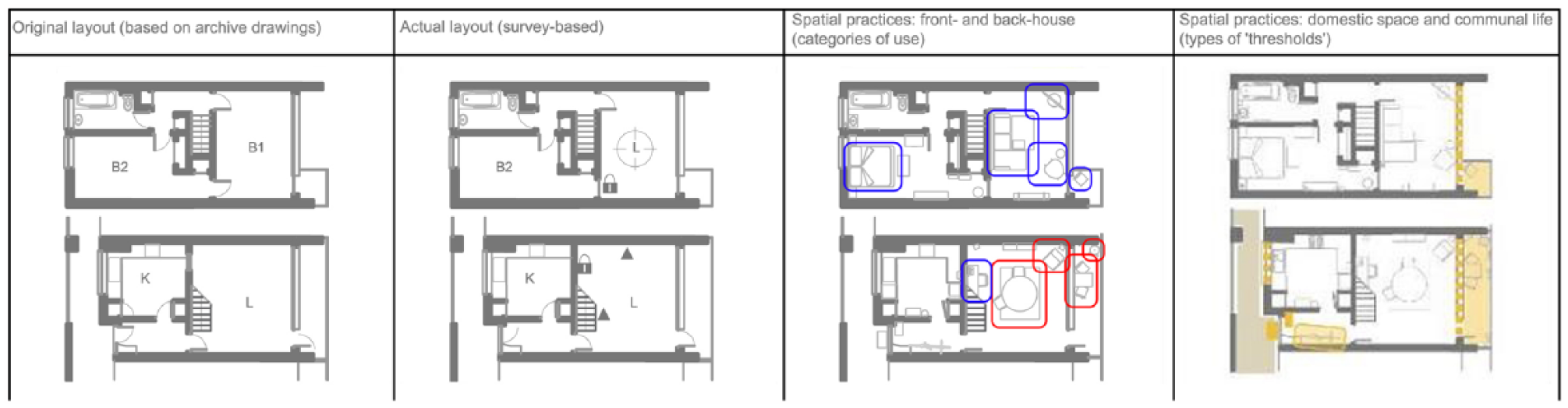
Dwelling chart showing the process ‘from space to place’ in Nicola and David’s flat.
 Minor demolition/removal (gas fire in living room and stair handrail).
 Permanent closures (hatch removal in living room and second door between B1/B2 permanently closed/unused).
 Change of use (upstairs B1 used as private family living, and downstairs L used as a dining room).
The third and fourth drawings each show a different type of spatial practice related to the dwelling. Residents construct their sense of home through ‘place interaction’ or ‘living patterns’, which may be analysed through visual evidence. For example, the furniture and furnishings in the main living room, such as the dining table and chairs, indicate where Nicola and David rest, eat, socialise, work and so on. Representing the data visually allowed us to explore ‘place’ from two different types of drawings depicting spatial practice and to reflect on the different ways in which residents ‘appropriate’ and ‘inhabit’ architectural space.
In the second stage (see Figure 2), each dwelling was analysed through contextual mapping. The contextual mapping includes the fixed ‘tangible’ architectural elements related to the character of the physical space, and also furniture, interior finishes and belongings. These elements indicate personalisation by the residents and also hint at the ‘intangible’ atmosphere of the place (Costa Santos et al., 2018). Furthermore, contextual mapping allows us to visualise our findings and to see how living patterns and spatial appropriation take place at home.
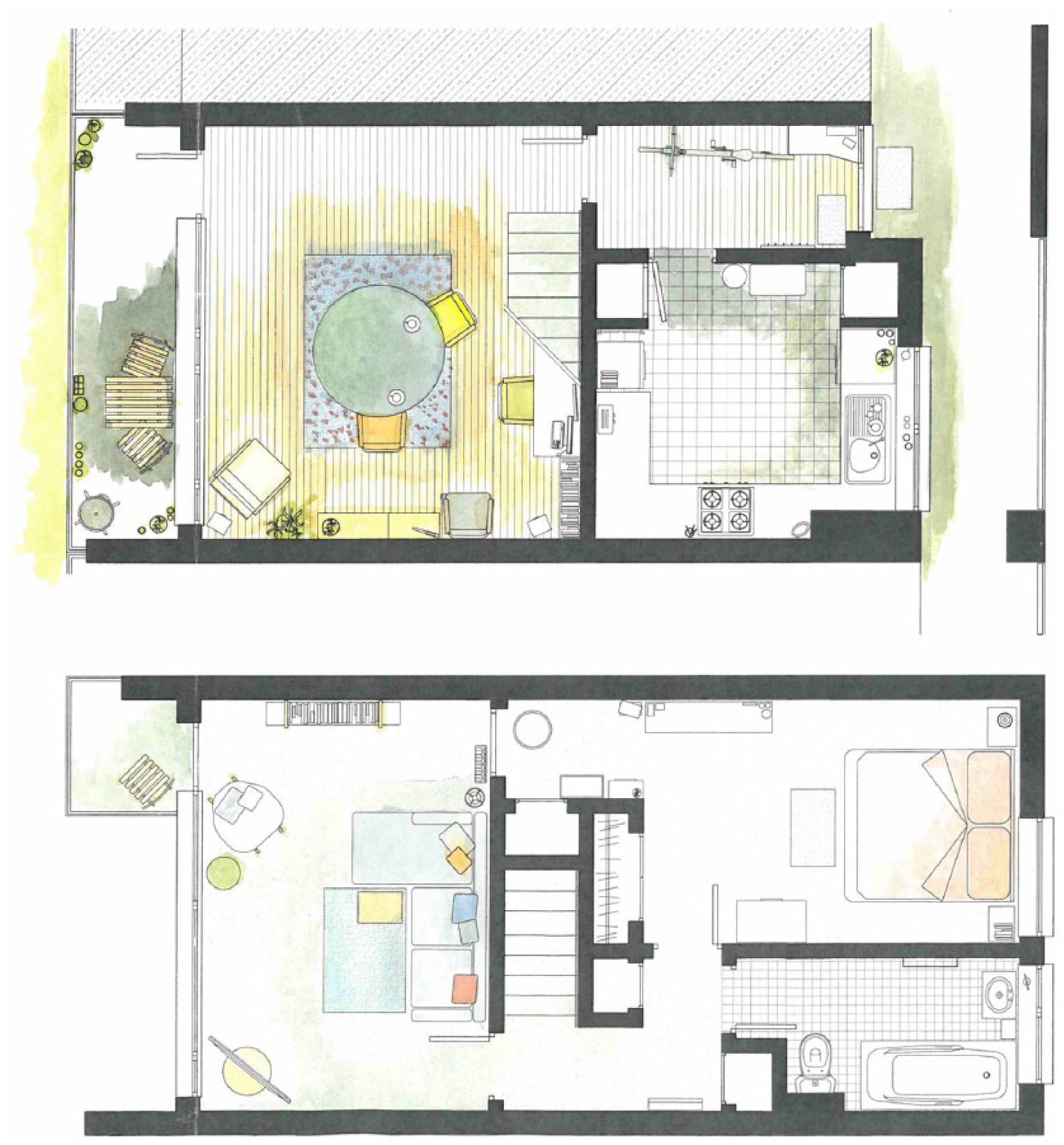
Contextual mapping, showing spatial practice and atmosphere of place in Nicola and David’s flat.
When analysing the two types of visual representation in relation to the interview and walk-along interview carried out with the couple, it became apparent that Nicola and David organised the layout of their home rather differently to Spence’s original design. As Figure 1 shows, the front-house (represented in red) corresponds to the public realm of the home, while the back-house (represented in blue) relates to the private domestic realm. Nicola and David decided to turn one of the two bedrooms upstairs into a living space rather than using the main room downstairs. They positioned the sofa facing the large window so they could enjoy the best views of the city from the upper floor which they described as ‘nicer’ and ‘brighter’ than the room downstairs which was originally designed as the living room. Rather than having a smaller table in the kitchen, they decided to use the front room for dining and for working from home. Their choice of moving the living space upstairs shows how the boundary between the public and the private realms in the home is not necessarily comprised merely of the outside wall, but sometimes also of an upstairs–downstairs division (Rybczynski, 1986). These findings reflect how home-making involves the creation of a material environment in such a way that it imparts the ‘right atmosphere’ (Cieraad, 2010).
Bringing together the contextual mapping with our interview data allowed us to analyse how the objects and layout of the dwelling contribute to a particular understanding of home relating to understandings of the division between the public and private. The visual representations allowed us to explore this facet of home-making, from a number of different perspectives or ‘methodological-substantive planes or surfaces’ (Mason, 2011:79). The architectural methods provide insights into how broader socio-cultural understandings of the home (e.g., the distinction between private and public spaces) were appropriated by Nicola and David. In British houses, the upstairs generally provides the same floor space as the downstairs, while the functions of the different rooms are by convention very clearly designated. Traditionally, upstairs was designated as the location of private bedrooms, while downstairs was seen as daytime, public space (Madigan and Munro, 1991).
The interview data provide insight into how Nicola and David interpreted the architectural design of the flat and the reasons why they had made alternations to the intended design of their dwelling. In the first interview, Nicola describes how they wanted to have ‘a nice table to eat at’ and how it was important that they had a ‘dining space’ for entertaining friends which a small kitchen table would not allow for. Another reason for including a dining table in the main living room was so they could enjoy the views of the city and create an ‘entertaining space’. The contextual mapping clearly illustrates how the dining table downstairs had been positioned at the centre of the room as a place to entertain. The downstairs therefore has a more public character than the upstairs, where the couple spend time relaxing on their own in their living room.
By bringing together these different types of data on the home, it is possible to show how it is not only how individuals talk about their flats but also the layout of the dwelling and the significance of objects such as dining tables and sofas which shape the way that residents make home at Claremont Court. Architectural methods can draw attention to these features which residents may not fully consciously be aware of. Our research shows that while home is critical in the presentation of the self and in establishing belonging to a collective identity (Rapoport, 1982), sometimes people have to negotiate with particular elements of the physical landscape, the meanings of which they may not have explicit knowledge of, as they aim to present themselves in a particular way. By combining the interview findings alongside the architectural methods, it is possible to explore the spoken and unspoken in relation to one another. By bringing them into dialogue, we gain a multidimensional understanding of how the built environment and the meanings and practices that this gives rise to interact with each other. In making home, residents can, unknowingly, create new meanings unintended by the architects, for example, in relation to the distinction of private and public, which is discussed in the following section about the threshold. The social science methods reveal how the dwellings at Claremont Court have been adopted over time and the meaning of home to residents.
The threshold
In this section, we describe how by combining different types of data, we were able to shed novel light on the distinction between the public and private domains of the home. These insights emerged in relation to the third stage of our approach, which involved producing visual narratives about the threshold of the home, focusing on the balcony. We now go on to discuss the role that both the architectural and social science data played in producing the visual narratives and the iterative process that was involved as we brought these different types of data into dialogue with each other. The visual narratives were created using a mixed-technique collage combining drawings, photos and interview excerpts. We decided to focus on the threshold as a facet because when we brought together the mapping and interview data, we found these contained some overlaps but also some interesting contradictions, which required further analysis and explanation. By representing the findings using a visual narrative, we hoped to unpack ideas about the threshold further by examining the spatial features of the balcony alongside the interview data.
In the visual narratives, we used drawing as a way of ‘communicating a plot, revealing a situation’ (Troiani and Carless, 2015: 270), thereby developing an approach that allowed us to decode the meaning of the designed space based on the patterns of use and spatial practices which are adopted by residents. The visual narrative is therefore ‘a method of textual analysis’ (Troiani and Carless, 2015: 269). The visual narrative method was devised not as a ‘realistic’ image but as an out-of-scale representation of space. The project team selected phrases from the interviews with Nicola and David, with key words highlighted in bold to emphasise how they spoke about the various architectural spaces. The layout of Nicola and David’s balcony appeared, on first analysis, to indicate that they felt a sense of connection between their dwelling and the communal spaces. Our initial interpretation is reflected in the first iteration of the visual narrative (Figure 3(a)). For example, the position of the table and chairs facing the courtyard and the presence of a barbeque, suggest that the couple used the space for communal, outdoor dining.
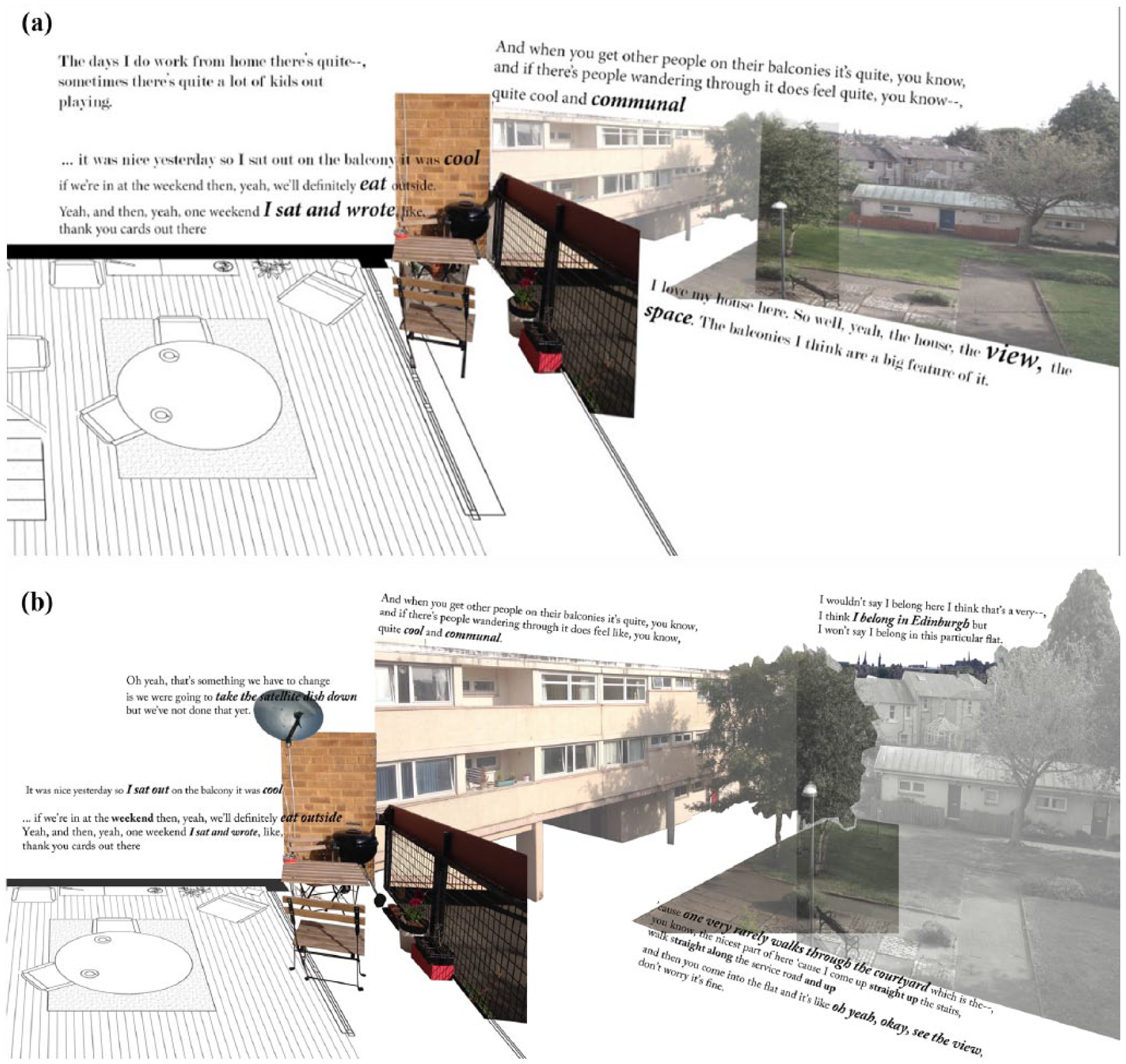
(a) Visual narrative: Nicola and David’s downstairs balcony and (b) Revised visual narrative: Nicola and David’s downstairs balcony.
However, on further analysis of the interview transcripts, it became evident that the couple experienced a more complex sense of (dis)connection to the Court. In the first interview, Nicola and David recounted how, on their first few visits to look around the Court, they had been concerned about the appearance of some elements of the building, which they associated with anti-social behaviour, such as litter and graffiti. Despite their initial concerns, they decided that the Court was a safe enough place to live and decided to buy the flat, but they mentioned that they were anxious about what their friends and family would think when they came to visit. Nicola, for example, was keen to put a ‘positive spin’ on the building, by telling visitors that maintenance and painting was going to take place in the future. Also, when visitors came to their flat, Nicola advised them to walk up the well-lit, cleaner central stairwell rather than the staircase on the inside of the court, as she was concerned that the poorly maintained, often litter-filled stairwell would give a bad first impression. Nicola and David continued to feel that the building looked like the ‘ugly duckling’ on the street because of its ‘brutal squareness’ and that it stood out compared to the ‘beautiful stone’ of the older tenements. During the walk-along interview, Nicola described the communal areas as something she ‘blocked out’ and told us that she did not derive pleasure from walking through them.
The interview data also showed that for Nicola and David, the main benefit of their balcony was not that it allowed a way to connect to the Court (as was the case for some other residents). Instead, the foremost reason why Nicola and David felt positive about their balcony was because of the views it afforded of the iconic landmarks and buildings of Edinburgh, such as the Castle, Calton Hill and Arthur’s Seat. The importance of this sense of connection to Edinburgh at large is apparent in the sheer number of times that the couple mentioned the stunning views that their flat afforded (21 times in total across the two interviews). In our analysis of the interview data, we were interested in the ways that our research participants constructed narratives about their home. In order to reflect the tensions and contradictions in how Nicola and David accounted for their sense of place belonging and how these figured in their relationship to the threshold space of the balcony, we reworked the visual narrative to include both visuals of views of the city beyond the Court, as well as extracts from the interviews where the couple spoke of these views (see Figure 3(b)). Focusing on the visual narrative, it is possible to see how the balcony at the ‘front’ of the maisonette offers Nicola and David the possibility of projecting their dining area outwards, over the courtyard and into the skyline of the city and its landmarks.
In order to understand the significance of how Nicola and David felt about the different spaces, their flat, the Court and Edinburgh, we turn to work that demonstrates how important not only the home but also the neighbourhood can be for a person’s sense of self (Reimer and Leslie, 2004). This is perhaps best described as a form of place belonging, whereby an individual’s sense of self is at least partly derived from where they live (May V, 2013). Our analysis, in line with previous work on the effects of territorial stigmatisation (Slater and Anderson, 2012; Wacquant, 2007), shows how feelings of alienation towards place detract from such belonging. Nicola and David referred numerous times to the negative elements of the communal spaces of Claremont Court which appeared to threaten their sense of connection to the Court. At the same time, as the quotations on the first visual narrative show (see Figure 3(a)), the couple also made frequent references to the parts of their home that they liked, including the balconies, the courtyards and the views. The contrast between how the couple felt about the inside of their flat compared to what lay outside it was clearly described by David who felt a great sense of relief when he crossed the threshold to his home:
It is for me I always feel better when I come into the flat. Yeah. And I think ‘cause you often–,’cause one very rarely walks through the courtyard which is the–, you know, the nicest part of here ‘cause I come up–, straight up the stairs, walk straight along the service road and up and then you come into the flat and it’s like oh yeah, okay, see the view, yeah that’s fine, okay, don’t worry it’s fine. Everything is okay [all laugh]. So…
Passing through the front door, or, ‘the ceremony of coming home’ (Busch, 1999: 44) brings Nicola and David into a safe environment, where the windows and balconies project them towards a pleasant and familiar view of the landscape courtyard and the city. This is also evident in the way that they organised the spatial layout of their flat. As the visual narrative shows, no objects were placed in the sightline of the window sill and also, the balcony was arranged for cooking and eating and enjoying the view.
The architectural approach to the visual narrative brings attention to how Nicola and David’s maisonette has a ‘front’ that faces the courtyard and a ‘back’ to the side of the open-deck access. Here, it is important to consider the principles which shaped Spence’s original design in the 1950s. In the post-war period, conventions around what constituted the ‘front’ of the house were challenged in modernist designs. Open plan layouts which included the mechanisation of a lot of kitchen work as well as clean and stylish kitchen and bathroom surfaces, meant that there was no longer any part of the house too disgraceful to be seen (Ravetz and Turkington, 1995: 167). The ‘affluent worker’ (presumed at the time to be male) in a new council house in the later 1950s recognised what it did for his status when he said; ‘We’ve moved to the front’ (Zweig, 1961: 5). In essence, the convergence of the affluent working-class home and the middle-class home meant that the meaning and function of the ‘front’ changed. As architectural class codes were being replaced by modernist notions that the whole house was to be available for living in and, other taboos aside, accessible to anyone who entered the house. The weakening of strict status divides in housing did not however mean that aspects of the interior which existed in order to signify status were no longer important. Rather, personal style and expression replaced the class codes dominant in the age of the scullery and parlour (Ravetz and Turkington, 1995). Understanding the historical precedent of various architectural trends enabled us to understand the design principles behind the layout of Claremont Court. This understanding, brought together with the other methods, allowed the research team to examine how residents make space in their dwellings.
Conclusion
This article has explored two facets of home-making: the spatial layout of the dwelling and the division of public and private space, focusing on the threshold. We have conceived of these facets as ‘methodological-substantive planes or surfaces’ (Mason, 2011: 79), analysing both how residents make home at Claremont Court and how our methods help to understand these practices of home-making. By exploring these facets of the dwelling, it is possible to open up the dwelling as a site through which to explore the fluid process of home-making. To conclude, we discuss the potential of incorporating visual methods influenced by architectural theory within qualitative research methods, in order to extend understandings of home-making. In doing so, we examine the potential of bringing together architectural and social science approaches through visual methods which attend to the spatial construction of home. We argue that our novel cross-disciplinary approach broadens understandings of home, by bringing simultaneously into view the unspoken dimensions of physical space and embodied elements of home as well as the spoken and conscious elements of home, all of which are central to home-making. By doing this, we are also able to tap into how residents may unintentionally change the meanings of ‘home’ as intended by the architects. Our aim has been to gain new understanding of how people make home through attending to the spatial, material and visual, as well as to the meanings that residents attach to these, and by engaging with the different ways in which architects and social scientists see and interpret these different dimensions. Using visual and interview methods, our approach draws attention to how dwellers organise space and how this in turn organises their spatial practices, which then creates spaces with particular meanings of home attached to them. Combining and analysing our findings using visual methods has enabled us to draw attention to this process, allowing the spatial and material dimensions of social life to come to the fore.
Our use of visual methods reflects how different facets of home are inextricably linked. Each facet provided telling insights into how home is lived and experienced by residents at Claremont Court. Since home is imbued with multidimensional ideas and practices, we have explored two manifestations of home-making, seeing these as fluid facets of a whole that can never fully be captured. One of the challenges but also possibilities of using facet methodology is how different methods can, at times, produce conflicting data, which may then spur scholars to rethink their taken-for-granted disciplinary perspectives. For example, in our study, engaging with facet methodology in the development of the visual narrative gave us a more nuanced analysis of Nicola and David’s relationship to Claremont Court, which examining only the interview data would not have revealed.
Our research has explored the ways in which architects ‘encode’ meaning in elements of the home such as the size, layout and features of rooms, with the intention of designing meaning into an environment through its scale, material and form (Rapoport, 1982). Furthermore, our findings show the diverse ways in which spaces are appropriated and personalised, revealing how architects and inhabitants have both overlapping and diverging understandings about the dwelling and how it can or should be used to make a home. Our visual methods have shown how there are objects and elements of the dwelling which are not spoken about in the interviews but nevertheless form an important backdrop of the lives of the inhabitants and the way that they interact with the physical environment.
The article concludes with a broader call for further attention to the potentials of visual and sensory methods to study aspects of everyday life that are ‘hidden’, never spoken about, and therefore, under-acknowledged and under-researched (Pink and Leder Mackley, 2014: 147), such as spatial practices of the home. Developing methods such as the visual narratives we constructed in our study may allow researchers to represent spatial practices and living patterns in relation to the threshold, representing the liminal space where the private and public realms overlap. By bringing the data into dialogue, it has been possible to explore a variety of perspectives on the relationship between physical space and home-making. In doing so, it is possible to develop new research questions on the home and to ‘operate horizontally – surveying a field, examining the fissures and boundaries, the folds and overlaps, the tears and rips, the points where disciplines fall apart and come together’ (Rendell, 2013: 129). Our research suggests that by using visual methods to represent the homes of our participants, we are also able to draw attention to embodied knowledge, that is, those spatial practices of which people are not necessarily aware. These may include, for example, unspoken elements of everyday life which do not come up in interviews but may be important to analyse in relation to what is said about home-making.
Architectural methods have enabled us to record spatial practices and the material culture of place, highlighting the personal ways through which space is appropriated and inhabited by dwellers. Our methods extend understandings of home-making as multidimensional, made up of a combination of spatial and social facets. The design intentions of the architect are no guarantee of how a home will be used by residents, but nonetheless shape the physical layout of the space. One of the lessons for developing methodological approaches on the home that we must examine is how people relate to spaces, use and adapt them and at the same time, how spatial organisation can influence dwellers’ living patterns. Moreover, social science approaches to the home may benefit from architecturally informed approaches in order to explore the impact of the material and spatial on processes of home-making. Conversely, architectural approaches to the home may benefit from methods developed in the social sciences that allow for an exploration of how social meanings are understood in everyday life in the dwelling and how the intentions of the architects are understood and lived with by residents.
Footnotes
Acknowledgements
The authors would like to thank the residents of Claremont Court for making this research possible.
Author note
Sandra Costa Santos is affiliated with University of Dundee, UK.
Declaration of conflicting interests
The author(s) declared no potential conflicts of interest with respect to the research, authorship and/or publication of this article.
Funding
The author(s) disclosed receipt of the following financial support for the research, authorship, and/or publication of this article: This work was supported by the Arts and Humanities Research Council (AHRC) of United Kingdom.
