




Abstract
This paper examines the role that light and dark play in how residents of Claremont Court, a modernist housing scheme in Edinburgh, Scotland, form a sense of atmosphere of place. Our findings show that the design of Claremont Court affords particular experiences of light and dark and of related warmth and cold that are meaningful to how residents experience and feel about the Court. While atmospheres tend to be conceptualised as spatially and temporally singular, our analytical focus on light and dark allows us to conceptualise the atmosphere of Claremont Court as made up of simultaneously held but distinct micro-atmospheres, which interact, overlap and even contradict each other. Furthermore, speaking to residents about their home environment revealed the role that memory plays in how people perceive atmosphere. Drawing from Mason’s concept of socio-atmospherics, we theorise atmospheres not as spatially contained, but as trajectories through space, where the experience of atmosphere is one of intertwining (and at times contradictory) atmospheres past and present.
Introduction
The focus of this paper is on the role that sensory experiences of light and dark play in people’s sense of atmosphere. In particular, we explore everyday entanglements with light and dark among residents of Claremont Court, a modernist housing scheme in Edinburgh, Scotland. It is only in the last few decades that scholars have attended to light and dark as social phenomena. 1 Qualities of light and dark are ‘much more than a “background” within which action takes place’. 2 Atmospheres are created in ‘the interplay between intensities of light, darkness glow and shadows’ 3 which shape how people ‘feel, practice, and conceive of [their] quotidian environments’. 4 Sensory experiences of light and dark are thus an important dimension of the felt atmosphere of a place.
Our analysis draws inspiration from recent work by Bille 5 and Pink, 6 who have focused on how atmospheres of home are made and curated through routine lighting practices. This means paying attention to not only light but also dark. 7 Pink and Leder Mackley describe light as ‘part of the way the atmosphere of home “feels”’. 8 While Pink and Leder Mackley’s work focuses on movement in the home, we are guided by Bille’s analysis of the relationship between ‘outside’ and ‘inside’. 9 People let in or shut out light from the outside to stage the atmosphere of the home, and are aware that the lighting in their home, as seen from the outside by neighbours, can contribute to a sense of community. Somewhat differently, our analysis explores how movement across private and communal spaces contributes to residents’ sense of atmosphere. Pink and Sumartojo’s distinction between automated and non-automated light 10 allowed us to recognise that the degree to which residents are able to control lighting levels at home and in communal spaces plays a part in how they experience atmospheres. Their distinction between natural and artificial light is also instructive. In contrast to the above work by Bille and by Pink and Leder Mackley, our paper is not about staging atmosphere in the home through artificial lighting, but rather about the contrasts that our participants drew between the abundant daylight they experienced in their flats, thanks to modernist architectural design, and the comparative darkness of communal spaces.
We build upon these insights to explore how a focus on how light and dark can contribute to theorising atmospheres. More specifically, our question is how focusing on a place that combines private and public spaces, on different types of lighting (natural/artificial and automated/non-automated) and on experiences of a place over time can help extend our understanding of the nature of atmospheres.
In the following section, we offer a critical overview of the tendency of theories of atmosphere to present atmospheres as spatially and temporally singular phenomena in the here and now. We draw on Mason’s recent work on socio-atmospherics which provides a broader analytical perspective that attends to social and temporal complexity. 11 This is followed by an overview of the empirical study on which this paper is based. Our analysis begins by providing some background on how the architectural design of Claremont Court made sunlight and weather key dimensions of how residents experienced the atmosphere of the Court. Exploring the role of natural light in giving rhythm to residents’ everyday routines in the home makes visible not only the dynamic nature of atmosphere but also that at Claremont Court, light is both something that people see in and see. Expanding our analysis to the communal spaces of the Court brings into view the interplay between different types of lighting and the contrasts between light and dark, which helps create distinct micro-atmospheres of dis/comfort. Finally, we explore how residents’ memories of Claremont Court over time shape their experiences of atmosphere in the present. In the concluding section, we explain how our conceptualisation of atmosphere as spatially and temporally complex contributes to current understandings of atmosphere.
From atmosphere to socio-atmospherics
Bille defines atmospheres ‘as tempered spaces emerging as the continuous co-presence, and co-productive potentials of subject(s) and objects’. 12 Thibaud describes ambience as a situated experience that results from ‘an immersion within the surrounding world’, in the ‘immediacy of sensing’ of an ‘immediate environment’. 13 These quotes capture well two key components of how atmospheres tend to be defined in the literature, namely as spatial and as something that emerge in the here and now. Key to the experience of atmosphere is ‘bodily presence in relation to persons and things’. 14 Böhme’s work in particular emphasises the spatial qualities of atmospheres, which he describes as ‘spatial bearers of moods’. 15 He describes how atmospheres fill spaces ‘with a certain tone of feeling’. 16 As summarised by Anderson, atmospheres have ‘a characteristic spatial form’ and are ‘generated by bodies – of multiple types – affecting one another as some form of “envelopment” is produced’. 17
While atmospheres have been conceptualised as indeterminate, there is nevertheless a tendency to present atmospheres as spatially and temporally singular, as an experience of ‘intensive space-time’. 18 For example, among the main qualities that Thibaud assigns to ambience are ‘its indivisibility, its pervasiveness’, 19 the consequence of which is that ambience is characterised ‘as a whole, both spatially and temporally: it is here and now’. 20 There might be an apparent paradox in the fact that atmospheres are also understood as multiple in the sense that they are constituted by ‘a multiplicity of relations between techniques, technologies, practices, materiality, sociality and much more’. 21 But through a slight of hand, this multiplicity becomes an ‘overall tonality’, 22 the atmosphere of a neighbourhood or city, a situation/event or an artwork. This singularity is perhaps related to the imagery that the word ‘atmosphere’ evokes. Atmosphere has been described as an enveloping sphere, or as ‘an enveloping resonance – an all-pervading atmosphere’ 23 that ‘emanates’ from the multiplicity of bodies in a space, 24 and that is experienced as an ‘environmental immersion’. 25
Inspired by Bille’s work on the interplay of light and dark, which invariably directs our attention to the changing times of day and season, our analysis is focused on the temporal nature of atmospheres. 26 As Anderson points out, an atmosphere is never ‘finished, static or at rest’ but is instead ‘perpetually forming and deforming, appearing and disappearing’. 27 Although there is on the one hand a recognition of atmospheres as dynamic, on the other hand atmospheres are conceived of as something that exist in the here and now. Put simply, an atmosphere emerges as bodies interact in this space right now. For example, Böhme speaks of a person ‘sensing the atmosphere s/he is bodily present in a certain way’ 28 and Bille describes atmospheres as the contemporaneous existence of bodies that ‘creates an affective presence of things’. 29
In our analysis, we take heed of Massey’s definition of space not as a ‘static contemporaneity’ but as ‘a dynamic multiplicity’ of trajectories. 30 This dynamic multiplicity of trajectories is brought clearly into view in our data because these comprise Claremont Court residents’ accounts of their experiences of atmosphere over time. Böhme describes atmospheres as having a ‘peculiar intermediary status . . . between subject and object’, 31 meaning that they belong partly to both. While much of the work on atmospheres tends to de-centre the subject, 32 we follow the approach taken by Bille 33 and Pink and Leder Mackley 34 who take the perceiving subject as the starting point of analysis. Interviewing people about their experiences of atmosphere reveals a longitudinal understanding of how perceptions of the present are layered with memories of that same space (and nearby spaces) across time. Memories help produce what Thibaud calls ‘reflective ambiances’, that is, ambiances that ‘are addressed by thought’, as opposed to ‘experienced ambiances’ that are ‘experienced by the senses’. 35 Furthermore, Claremont Court is our participants’ home, a well-known place where there is ample opportunity for such layering of atmospheric experiences over time.
Our analysis also draws inspiration from Mason’s work on atmosphere and place. Mason introduces the notion of ‘socio-atmospherics’ in order to highlight that atmospheres are indivisible from ‘forces that we might think of as to do with “the social” or “the cultural” or indeed “the historical”’. 36 Many others, including Edensor and Bille, have also pointed to the role that cultural meanings play in informing people’s experiences of atmospheres. 37 Furthermore, Mason speaks of atmospherics, as a way of emphasising that atmospherics are relational, made in connection, rather than necessarily spatially contained. Mason encourages a move away from thinking of places as containers that ‘simply house, corral or contain all of these elements . . . they are more like conduits for them’. 38 Moving away from a ‘static sense of inhabited place’, Mason draws attention to ‘the relational forces and energies that animate and entwine’ places. 39 Mason critiques ‘conventional assumptions about places as material territories, . . . weather as external and free floating, and people and living as divisible from these’. 40 She also highlights the importance of being attuned to more than ‘“just” the emergent qualities of a physical or even temporal place, or of atmospheres’ because encounters with places and atmospheres ‘involve more than the corporeal or bodily reception of these things’. 41 This is because people ‘engage with places in both a here and now way, and a way that involves sensory-kinaesthetic memories’. 42 In other words, a person’s experience of a place is always ‘layered with their memories’ of that and other places. 43
Mason’s work helps us to think beyond the singularity of atmospheres in the here and now. Our analysis therefore moves away from the metaphor of atmosphere as an enveloping sphere, and instead attends to the trajectories and connections that help constitute atmospheres. This allows us to bring into view how the atmosphere of place is made up of simultaneous interacting, overlapping and sometimes contradictory ‘micro-atmospheres’ which arise from a mixture of present embodied interactions with space and objects combined with memories of that place.
Our study
This paper is based on analysis of data from an Arts and Humanities Research Council (UK) funded programme of research, ‘Place and belonging: What can we learn from Claremont Court housing scheme?’, which brought together architects and social scientists from sociology, anthropology and social work (grant reference AH/N002938/1). Designed by Sir Basil Spence and Partners and built in 1962, the Court comprises 63 dwellings in a composition of four mid-rise slab-blocks and two blocks of cottages around two landscaped courtyards. Originally a social housing scheme, today it comprises council tenants, private tenants and owner-occupiers. Claremont Court is an example of modernist architecture underpinned by the principle of using design to foster a sense of community. 44 Such post-war housing has since become labelled ‘a failure’ and associated with fragmented communities, antisocial behaviour and urban decline. 45
The data for this paper derive from the social science element of the ‘Place and belonging’ project. 46 During the summer of 2016 the social science team (Stephen Hicks, Camilla Lewis and Vanessa May), carried out 3 months of fieldwork at Claremont Court, with some follow-up interviews and field visits in the autumn. Initial contact was made through key members of the Claremont Court Residents’ Association, who helped us distribute letters to all 63 properties, inviting residents to take part in the study, as well as introducing us to a handful of their neighbours. We also used door-knocking as a recruitment technique, 47 as well as snow-balling. We have anonymised all excerpts from the interview transcripts quoted below. The study was granted ethical approval by Northumbria University’s Ethics Committee.
We interviewed a total of 17 individuals living in 12 households, ranging in age from their 30s to their 50s. Two of the households taking part in our study were council tenants; the remaining 10 households were owner-occupiers, including one couple who bought their council flat under the Right to Buy scheme introduced by the Housing Act 1980. All of our participants were White Scottish, White English or White European. We conducted a semi-structured biographical interview with all 17 participants; three of these were conducted as joint couple interviews. The majority of the interviews took place in participants’ flats at Claremont Court, but one was carried out in the interviewee’s place of work, one was conducted as a walk-along interview in the communal areas of the Court and two were interviews with former residents conducted in their current homes. The questions included how residents had come to live at Claremont Court and their first impressions of the Court; their sense of community and belonging (or lack thereof); what they felt about the design of the building; how they had made their flat feel like home and what kind of atmosphere they felt the Court had.
Ten participants took part in a follow-up interview: seven in a walk-along interview and three in an activity diary elicitation interview. During the walk-along interviews, we asked participants for a tour of their flat, Claremont Court and its immediate environs. The walk-along interviews allowed us to explore how residents related to and their situated knowledge of the built environment, 48 though also our sit-down interviews proved to be fruitful in this regard. 49 Three of the participants filled in an activity diary over the course of one week. In the follow-up diary interview, we went through the diary entries, and asked participants to elaborate on the activities, places and people involved. We draw the reader’s attention to the varied insights we gained through the different types of data in the analysis sections below.
We analysed the data using the qualitative analysis software Quirkos. After an initial read-through of the interviews, the social science team agreed upon a rough coding framework that reflected the core research questions of the project as well as emergent themes introduced by our research participants. These codes included ‘atmosphere’ and ‘the sensory’. Each member of the team then in turn coded a third of the transcripts and fine-tuned the coding framework. This process revealed that sensory experiences, and particularly light and dark, were important topics for our participants. All of our research participants spoke unprompted about light at Claremont Court, and some of them did so at length. 50 We then went back to the interview transcripts and read them again, focusing more closely on how our participants spoke about light and dark, in relation to which topics, and the meanings that they ascribed to these sensory experiences. We found that all of our participants used light and dark to describe the atmosphere of their flats and of Claremont Court, and that this talk about atmosphere was connected to their attachment to place.
We now move on to discuss the findings and our analysis. We begin by examining the use of light as a ‘building material’ in modernist architecture, and how this was experienced by the residents of Claremont Court, followed by a discussion about how they lived with light. We then explore the temporal dimensions of atmospheres and place by discussing how our participants understood the contrast between light and dark. In the conclusion we argue that people’s sense of and attachment to place is spatially and temporally intertwined because they can experience place as made up of micro-atmospheres that change with the time of day, week or year.
Light as a building material
This first empirical section explores the connections between architecture and light. When asked to describe their first impressions of Claremont Court, the majority of our participants told us, unprompted, about the abundance of light in their flats and the views of Edinburgh landmarks. Jess’s description is typical: I really liked the space and the light when I came in. . . . But yeah, I really liked the view and the light and the rooms. I loved the bedroom, the view from the bedroom seemed amazing. (Jess, owner-occupier, 30s)
It is notable that some of the principles of modernist design were identified as such by our participants. Thanks to new building technologies which gained popularity in the 1960s, including the use of glass, concrete and steel,
51
modernist architects reconceptualised daylight ‘as an integral building material’.
52
The residents we spoke with attributed the abundance of natural daylight and the views of the city to conscious architectural design. Fiona, for example, spoke of the positioning of the windows and the size of the rooms, which combined to make them feel ‘bright and airy’, and made reference to the intentions behind Basil Spence’s design: I think the way that he [Basil Spence]—, well, for our particular flat obviously, that’s all he had in mind was the actual aspect to the sun from here . . . We get the sun for most of the day, so that’s been great to see the light come in. (Fiona)
Flooding the insides of buildings with daylight had a further symbolic meaning for modernist architects, who associated light with ‘cleanliness, hygiene and uncluttered space’, 53 aspirations which also informed the design of Claremont Court. 54 Fraser (owner-occupier, 50s) spoke at length about his appreciation for the modernist aesthetic of Claremont Court, comparing the Court to the neighbouring Georgian dwellings with adjectives such as ‘fresher’, ‘clean’ and ‘uncluttered’. Some of our participants also alluded to these design features as adding positive value to Claremont Court in contrast to the stigma they felt was attached to the building due to its social housing origins. 55
Mason depicts ‘living in the world’ as ‘an ecological activity and process’ whereby human lives are understood as entwined with ‘things, places, environments, weather’, 56 while Edensor describes light as ‘part of the weather of place’. 57 Furthermore, atmospheres are sensed through the body in a tactile way, involving all the senses at once. 58 Many of our participants noted that the amount of sunlight and associated warmth at Claremont Court was unusual for Edinburgh and for Scotland, a country more commonly associated with cloudy and rainy weather. Catherine (owner-occupier, 40s) contrasted ‘the light, the views’ of Claremont Court with the ‘grey’ of Edinburgh, a city which she thought has ‘got everything but the sun’. Sunlight offered also warmth, referred to by our participants as an important part of their wellbeing that was aided by the design of Claremont Court. We were told numerous times about the joys of sitting on the well-shielded south-facing balconies. Andrew (owner-occupier, 30s) described the balcony of his flat as ‘just roasting . . . Well relatively speaking in Scotland it’s as hot as it can be in Scotland’. Sunlight also offered thermal comfort indoors. Jack said of his flat that it was ‘like a greenhouse at the moment . . . we haven’t actually been using the heating at all’.
The above experiences point to how architectural design can amplify experiences of light and warmth. Instead of seeing the building as merely a ‘fixed entity’ or ‘material solidity’ 59 or atmosphere as contained in a space, such examples encourage us to attend to the connective charges that flow between weather, the built environment and people. Weather, often glossed over in sociological accounts, and rarely included in accounts of atmosphere, ‘is not “just” a device or a backdrop’; weather permeates and ‘is the weave of’ everything, including people’s sense of place. 60
Although the architectural principles of ‘orchestrating’ daylight ‘to produce distinctive effects, moods, and meanings in interior spaces’ in order to foster ‘a profound sense of being in place’ 61 seem to have been largely successful at Claremont Court, it is nevertheless important to keep in mind that the atmospheres that are created in the interaction between human and non-human bodies are not always predictable. Bissell proposes that atmospheres offer ‘relational potential for things to act or change in a particular space’ and are therefore best thought of as propensities. 62 These propensities can be brought to life through residents’ everyday habitual movements, which Pink and Leder Mackley describe as ‘co-design processes’ that contribute to the making of atmosphere. 63 It is to these questions we now turn by exploring how residents lived with and deployed light in their everyday lives.
Living with light
The interview excerpts quoted above indicate the importance of light for wellbeing and mood. But daylight also provides a rhythm to our days, as encapsulated by Hauge’s observation that like plants, humans ‘auxinate’, that is, ‘turn to the sun’. 64 One important aspect of auxination is that daylight provides rhythm to our daily lives, something that was clearly brought to the fore as we spoke with residents about their interaction diaries that detailed their daily routines. We explore in more depth the temporal nature of living with light with the help of our interviews with Jack, an owner-occupier in his 30s.
While reflecting on the entries in his activity diary, Jack described how light guided his routines at home. He explained that he would often eat his breakfast on the balcony during the warmer months because ‘yeah eight o’clock or something, eight, nine, you get full sun on the balcony which is nice’, but the sun would be gone by 11 am. Jack worked at home most days and described his study as a good room in which to work because ‘you get to see the view and it gets a lot of light’. By the end of the day, ‘we get the sun on the other side and then it blinds me in my office, so we’ve got–, we put up some blinds the other day so that I can work without being blinded’. Jack spoke of the joys of being able to follow the sun through the day which created for him a sense of time passing and of being attuned ‘with the cycle of the day’. He described how the sun on the balcony ‘wakes you up into the day, which is not something that I’ve had anywhere else really’ and how seeing ‘the sun going down in front of you, you kind of feel like okay that’s the end of the day now’. Respondents in Hauge’s study similarly spoke of ‘enjoying following the sun’ in their daily lives in an effort to maximise their time in sunlight. 65
Jack’s example illustrates how people can use light ‘in tacit, normally unspoken about ways to make, maintain and improvise atmospheres of home’. 66 People make small adjustments to their homes – such as pulling blinds up and down – ‘depending on the activity and atmosphere being sought’. 67 This means that ‘light is something you do’ as a way of shaping moods and atmospheres. 68 Thus it is residents’ routine engagements – for example, trying to limit or enhance the amount of sunlight in their flats – and the particular affordances of the building that help make atmosphere. It is notable that in contrast to Pink’s and Bille’s work on how people ‘orchestrate’ atmospheres through artificial lighting, our participants spoke almost exclusively about natural sunlight as a feature of Claremont Court.
Edensor describes the ‘modes of practice’ people adopt in relation to light as ‘rarely conscious’ because their experience of light ‘takes place in the unremarkable settings of everyday realms’ which form ‘an unquestioned backdrop’, giving rise to what he calls ‘unreflexive belonging’. 69 Pink and Sumartojo similarly propose that light is ‘taken for granted, never usually spoken about, and therefore not usually accounted for’ and that light is something that is ‘in the background of everyday life’. 70 Bille argues, somewhat differently, that while people might not often think about the lighting practices in which they are engaged, they can nevertheless easily reflect on their use of light when asked to do so and in this sense, are ‘very aware that they orchestrate spaces with light’. 71 Ingold states that ‘we do not see light, but we do see in light’ 72 In contrast, our analysis above shows that our research participants were highly aware of the role that light played in their lives at Claremont Court and spoke of it unprompted. Rather than an ‘unreflexive backdrop’, light was seen and constituted a potent charge or energy that gave rise to strong experiences of affinity with place. 73 We suggest that at Claremont Court, this awareness is likely heightened due to the building’s design that bathes the flats in unusual (for Edinburgh) amounts of light.
Micro-atmospheres of place
The atmosphere of Claremont Court is however not simply created by the abundance of light in the flats. Our participants contrasted how their flats felt with the feel of some of the communal spaces that for many gave rise to a sense of unease or discomfort. A uniting feature of these descriptions was the relative darkness of these spaces. As noted by both Hauge and Bille, light can only be made sense of in relation to dark, and vice versa. 74
Apart from the courtyard, which most of our participants described as attractive and quiet, the communal spaces, particularly the stairwells and the storage cages located underneath the flats, as well as the garages at night, were frequently referred to as dark, enclosed, eerie and foreboding (though as we discuss below, not everyone necessarily experiences these spaces in the same way). Thomas et al. have noted that secluded spaces ‘in which “the social” is absent’ are experienced as ‘“creepy”, “scary”, “eerie”, “spooky”, “horrible”’. 75 In our analysis below, we take an absence of ‘the social’ to mean an absence of positive social interactions.
Thomas et al. propose that ‘blind spots’ are key to explaining why people experience some dark spaces as threatening. 76 At Claremont Court, such spaces included the garages, some of the stairwells and the storage cages below the flats (see Figure 1).
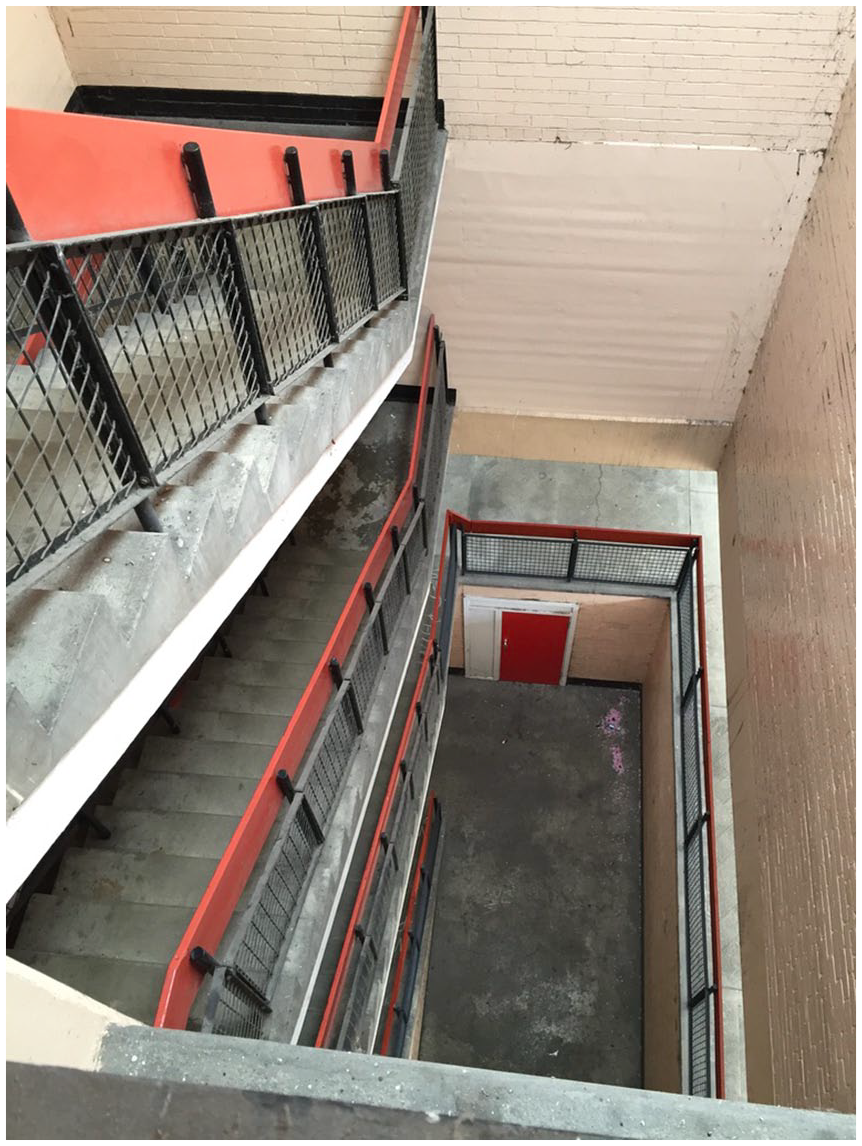
Stairwell.
When asked whether there were any areas of Claremont Court that she consciously avoided, Fiona responded: ‘Spooky dark places. Usually the–, you know, I don’t think I would ever go into the cellars at night, just cause I don’t even know if the electricity works through the night.’
Fiona’s walk-along interview was particularly useful in illustrating the intersensory nature of how she experienced the atmosphere of these ‘spooky dark places’.
77
As she led the researcher down into the storage cages, she described these ‘a bit spooky’ and ‘kind of dark, quite miserable’. She referred to the space as ‘one of my try-to-avoid spots’, and, with a palpable sense of disgust, described how smells and dirt intermingled with the dark: it’s mostly used as a toilet down here. . . . And as you can see . . . it like just has all sorts of rubbish that comes into this bit here. . . . there’s quite a dirty bit here. . . . this is probably a horrible one for you because it’s really dark, you see and a bit dingy. . . . sometimes it’s pretty smelly down here.
Other spaces that Fiona tries to avoid, such as a stairwell, were similarly described as ‘dark, out of the way, secluded, isolated’ (see Figure 1). The walk-along interview ended with a tour of Fiona’s flat. She described her feeling of homecoming whenever she steps from the darkness of the open-deck access to the lightness of her flat: it’s, well, homely, I guess . . . when you come in here and usually it’s still sunny for this time of year and it’s like going again from the dark north side into the south side.
No doubt, our participants who spoke of their unease in and even fear of dark communal spaces were drawing from culturally informed meanings. In Western cultures, darkness has many negative connotations, such as danger, deviance and disorder,
78
while light is associated with goodness. Atmospheres in other words entwine sensations with ‘the social’, ‘the cultural’ and ‘the historical’.
79
But light and dark also take on special meanings in relation to local knowledge about particular spaces. For example, in the joint interview with married couple Jack and Catherine, we asked them about areas of Claremont Court that they did not like. Like many other participants, they spoke of their dislike of the garages and particular stairwells. Catherine said that while she would not go as far as calling the area around the garages ‘dodgy’ or ‘scary’ and she did not feel ‘vulnerable’ there, she nevertheless felt that ‘it has got that funny feeling’ and ‘it’s a bit strange’. Jack said that these spaces were ‘closed off’ and had an ‘ominous feel’ that he found difficult to put into words: It’s in the area where the people with problems [laughter]–, people who cause problems are. So that’s got a bit of a feeling. And then around the garages–, I don’t know what it is about that, really. Maybe it’s just so many cars and–, it just doesn’t feel very open.
Shaw offers one potential explanation for such feelings by stating that people can feel entrapped in spaces where they are not able to control their experiences. 80 An important dimension that emerged from many of our interviews with residents at Claremont Court was that in the communal spaces they were anxious about encountering various forms of anti-social behaviour. The potential danger they associated with particular communal spaces were no doubt coloured by their past experiences of problematic encounters with other residents and perhaps also by the ‘local rumours/stories’ 81 that circulated at Claremont Court about certain residents. During fieldwork we were made aware of collective narratives about certain residents who caused a disturbance. Many of our participants described a few of the flats as ‘problem flats’ associated with antisocial behaviour such as drug taking in communal spaces, loud fights and inebriated groups of people congregating in stairwells. Some of our participants experienced this as threatening enough to curtail their movements around Claremont Court. Andrew (owner-occupier, 30s) said he would not leave his flat when he heard commotion outside: ‘there’s a couple of flats where there are issues . . . there are times still where I take the dog out at night and there’s–, I would walk straight back into the flat if I can hear something happening’. Others said they avoided certain stairwells altogether as these were near the ‘problem flats’.
Our findings demonstrate that experiences of different ‘affective charges’ 82 can exist simultaneously as part of the quotidian atmosphere of place. These affective charges derive from how safe and comfortable people feel in a particular space, which in turn is informed by broader cultural readings of light and dark and the nature of different types of space, as well as local knowledge about what goes on in them. We adapt Gandy’s term ‘micro-geographies’ 83 in proposing that places are made up of a number of micro-atmospheres, which when combined help make up the atmosphere of place. In the final section, we turn to explore how an analysis of the temporal nature of these micro-atmospheres extends theorisation of atmosphere.
The temporal layering of atmospheres
As the above interview extracts indicate, our participants often referred to the temporal nature of light, the amount of which fluctuates across different times of day and year. These shifts in the quality and quantity of light and dark mean that the same space can acquire different atmospheres, as described by Fraser: For example behind you right now the sun’s coming through the window, right, and it’s creating that–, for me in terms of that kind of square shape and you just think it changes constantly, with the sun comes out and you just think, wow, what a different space, it never feels samey (Fraser, owner-occupier, 50s)
To explore the complex temporal nature of atmospheres in more detail, we turn to the case of Anne. She and her husband Tom, both in their 50s, originally moved to the Court almost three decades ago as council tenants and had since bought their flat under the Right to Buy scheme. During the interview, Anne repeatedly expressed concern over safety, particularly in the communal spaces. What is relevant to our analysis is that Anne’s concerns hinged on shifting levels of light: areas in which she felt comfortable during the day became ominous in the dark. One such space was the courtyard, which in daylight Anne associated with positive experiences, such as happy memories of looking on as her children played there (see Figure 2).
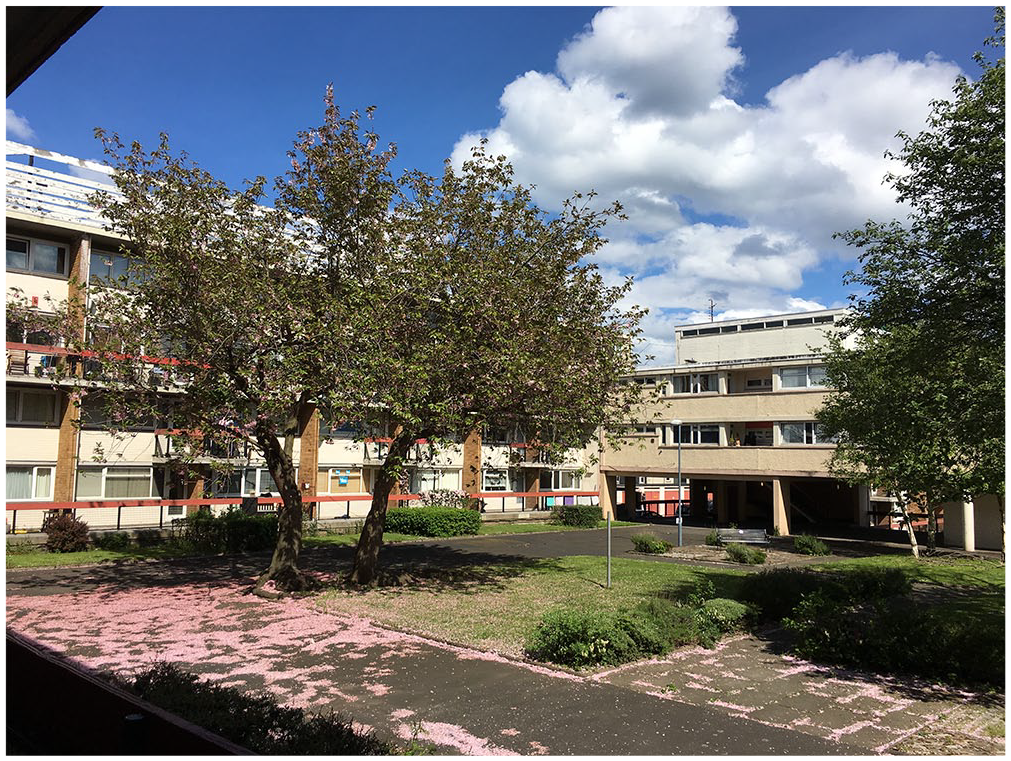
The courtyard in daylight.
In the dark, the courtyard became a menacing place for Anne, potentially hiding threatening people. When describing what a difference the new brighter lights installed in the courtyard had made, Anne told us that when her children were small, the lighting had been so dim that after nightfall, the courtyard became too dark for children to play there (see Figure 3).
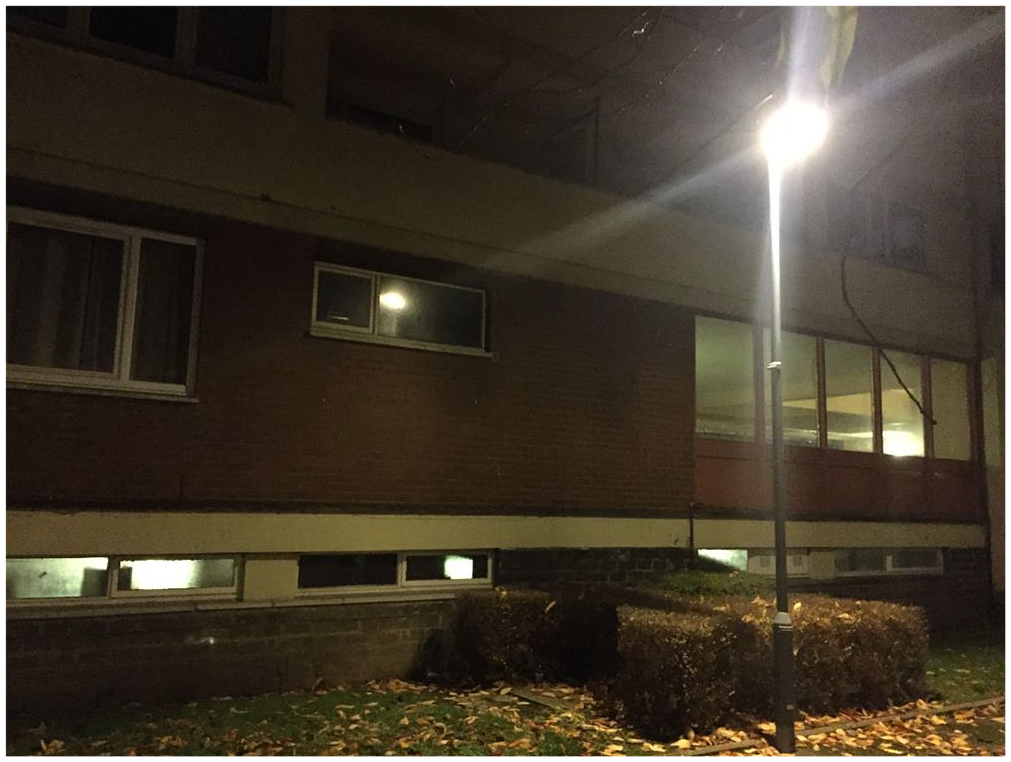
The courtyard after dark.
Anne remarked that the old lights had made it impossible to identify a person sitting on the bench in the courtyard in the dark (referring to seeing us frequently sitting on the bench during fieldwork): So if you were sitting on that bench as you do, I wouldn’t ken [know] it was you. Ken [you know] it’s when you’re looking and you think, who is that?
Anne was clearly concerned about the potential threat that such anonymous people might pose: throughout the interview, she made reference to antisocial behaviour taking place in the communal spaces of Claremont Court after dark, including loud groups of people drinking and taking drugs, and the possibility of women being ‘jumped on’. The association made by Anne between darkness and threatening behaviour brings to mind Shaw’s argument that while the ability to see other people in the light offers us ‘a protective field which holds objects at a distance from the self’, in the dark, ‘we become significantly more open to the “other” . . . reducing our sense of bounded selves’. 84 That Anne’s sense of vulnerability seems to be accentuated in the dark is perhaps also explained by the fact that artificial lighting in the communal spaces of Claremont Court is either automated 85 or non-existent, meaning that lighting levels are beyond the control of individual residents. In these spaces, residents are unable to curate the atmosphere.
Our point here is not that everyone experiences the dark as foreboding. Men are known to feel less at risk than women while out in public spaces after dark.
86
This was illustrated by Anne’s husband Tom, who in contrast to her assured us that he felt no trepidation in any of the communal spaces, night or day. For some, such as for the young people who would according to David congregate in Claremont Court’s warren-like design, the dark can offer some protection, even against the police: ‘There used to be groups of youths would sit at the end of the stair . . . I’ve seen one officer run that way and an officer run this way and I’ve seen the guy running between them and off he goes.’ (David, owner-occupier, 40s)
The point we are making with the help of Anne’s example concerns the dynamic nature of atmospheres. As has been previously observed, ‘the variegated play of light’ has ‘myriad effects’ on our surroundings, 87 meaning that an atmosphere is never ‘finished, static or at rest’, but instead ‘perpetually forming and deforming, appearing and disappearing’. 88 But there is a further layer of temporal complexity that Anne’s case brings to the fore. When she talks about the courtyard, and the different atmospheres that it can hold, Anne does so from a longitudinal perspective, layering decades’ worth of memories of this space. She remembers that when her children were small, the courtyard was a safe space for them to play in during daytime. But as the sun set, the children were called indoors for fear of what might happen to them in the dark. Anne contrasts this memory of how foreboding the courtyard felt after dark in the past with the improved sense of security that the improved lighting offers her. In other words, for Anne, the atmosphere of the courtyard does not emerge merely in the here and now as her body interacts with other bodies in that space. Building on Thibaud’s distinction between ‘reflective’ and ‘experienced’ atmospheres, 89 we argue that when theorising atmosphere, it is necessary to attend to the role that memory plays in how people experience atmospheres.
Concluding discussion
This paper has explored how light can be orchestrated by architectural design, and how this, together with everyday practices of living with light and dark, shapes the felt atmosphere of place. Our argument contributes to theorising of light and dark and of atmosphere in four ways.
First, we contribute to theories of how people experience and live with light and dark. The unique design and location of Claremont Court meant that most of the residents we spoke with perceived the amount of sunlight in their flats as out of the ordinary for Edinburgh. We argue that this helps explain why light was something that all of our participants brought up spontaneously in conversation with us. In contrast with Edensor’s 90 assertion about light being an unseen backdrop, our findings show that in some settings, light is noticed and can become a phenomenon in its own right, and something that people engage with in a reflexive manner. Furthermore, we argue that at Claremont Court, light is both something people see in and see.
Second, what is distinctive about our data is that they allow us to consider the interplay between natural and artificial as well as automated and non-automated light across private and public spaces. When speaking of the atmospheres of their homes, our participants focused on natural light rather than how they staged atmospheres through artificial lighting as is the case in studies by Bille and by Pink. 91 Furthermore, Pink’s work concerns lighting in the home, and in Bille’s work, where the relationship between the home and community is considered, the latter is perceived or imagined from within the home. In contrast, our participants spoke of experiencing the interplay of light and dark as they moved between private and public spaces. They stepped into public space from their front doors, and they could see and hear what was going on in communal spaces from within their flats. In the words of Gandy, there exists a ‘spatial porosity of atmospheres’ and an ‘uncertain distinction between what constitutes “inside” and “outside”’. 92 Attending to these different types of light and spaces brings into view the importance of attending to atmosphere as both made, as in staged by residents, and experienced, that is, something that individual residents do not have control over.
Third, we contribute to theories of atmosphere by demonstrating that atmospheres are experienced as spatially and temporally multiple. Although the literature on atmospheres understands these as never standing still, a certain singularism (this space) and presentism (this space now) is nevertheless apparent. In contrast to many of the examples presented in the literature – this garden as serene, this party as tense, this street as melancholy – talking to people about where they live, a place they have known intimately over a period of time, produces a rather different picture of atmosphere. Our research participants spoke of the atmosphere of Claremont Court as made up of a number of interlinked micro-atmospheres that intertwined and coloured each other. These combined to create a sense of atmosphere at Claremont Court that could include contradictions: the feel of ‘cleanliness’ and openness afforded by the light in the flats (reflecting the principles of modernist design), which felt safe and homely, contrasted with the darkness and dankness of the communal spaces and the attendant feelings of danger and unhomeliness these gave rise to.
Finally, Claremont Court, or any place for that matter, is never fixed, instead shifting according to levels of light and gloom, warmth and cold. Atmospheres are always in the making. Edensor describes landscapes as ‘alive with energies . . . continuously undergoing change, as elements from near and far are entangled and folded together in a continual making’ such that ‘landscape seethes with multiple rhythms and temporality’. 93 The built environment similarly is eternally fluid, both spatially and temporally. What we wish to highlight is that these shifts and changes leave residues in people’s memories, which then inform how they experience the atmosphere of those spaces in the present. Atmospheres must be conceived as not merely emanating from the bodies present in a particular space, perceived in the here and now, but as including past experiences. In sum, atmospheres can be understood as trajectories through space, where the experience of atmosphere is one of intertwining (and at times contradictory) atmospheres past and present.
Footnotes
Funding
The author(s) disclosed receipt of the following financial support for the research, authorship, and/or publication of this article: This research was funded by the Arts and Humanities Research Council (UK), grant reference AH/N002938/1. The research team comprised Sandra Costa Santos (PI), Nadia Bertolini, Stephen Hicks (Co-I), Camilla Lewis and Vanessa May (Co-I).
Ethics statement
The study was granted ethical approval by Northumbria University’s Ethics Committee and adheres to the ethical guidelines of the British Sociological Asociation.
