




Abstract
In this article the authors ask what it would mean to think sociologically about the window as a specific material and symbolic object. Drawing on qualitative analysis of a series of comparative interviews with residents in three different streets in a diverse local area of Glasgow, they explore what the use and experience of windows tells us about their respondents’ very different relationships to the places where they live. On the one hand, the window, as a material feature of the home, helps us grasp the lived reality of class inequality and how such inequality shapes people’s day-to-day experience. On the other hand, windows are symbolically charged objects, existing at the border of the domestic and public world. For this reason, they feature in important ways in local debates over the appearance, ownership and conservation of the built environment. The article explores these struggles, and shows what they reveal about the construction of belonging in the neighbourhood, a process which is both classed and racialised at one and the same time.
Introduction
In this article we explore what it might mean to undertake a sociology of the window. Drawing on evidence from a qualitative study of the dynamics of class and racialisation in the Glasgow neighbourhood of Pollokshields, we identify the glass window as a particularly significant material and symbolic object. In interviews conducted with residents from three contrasting streets in the area, windows emerged as the subject of extensive comment, discussion and contestation.
The window as a physical object serves as an index of inequality, illuminating the local materialisation of profoundly unequal histories of housing, residence and belonging. At the same time, windows have featured heavily in the ‘reading’ of local space in ways that have often reproduced particular classed and/or racialised understandings of those inequalities and their causality. Thus the data discussed within this article demonstrate how a seemingly aesthetic response to the built environment is never as ‘pure’ as it appears. Reflecting on this evidence we argue that windows are good to look through, sociologically speaking, drawing attention both to the ways in which social relations of domination are materially experienced, and to the symbolic reading and misreading of such relations.
Thinking sociologically about the window, in specific historical and social contexts, also requires us to give consideration to the sociology of the window per se, as a particular kind of object. This is not mere formalism. Rather, the specificity of the window as an object conditions its sociological meaningfulness in important ways. Crucially, windows exist at the border between what is thought of as inner, domestic space and the exterior world and they are therefore figuratively significant in questions of private and public interaction within local areas. Simmel (1909/1994) famously explored relationships of this sort in his essay ‘Bridge and Door’, in which he analysed the human will to connect and its confrontation with spatial separation. For Simmel, the door, as an object, provides evidence of the fact that separating and connecting are two sides of precisely the same act. The door forms a linkage between the space of human beings and everything that remains outside, transcending the separation between the inner and the outer and creating what Simmel describes as a permanent interchange. Although in this essay Simmel himself argues for a distinction between the window and the door, on the grounds that our attention to the former is directed almost exclusively from inside to outside (‘it is there for looking out, not for looking in’ [1909/1994, p. 8]), other writers have read this relationship the other way around. Bachelard, for example, takes the window – and the lit window, specifically – as that which is seen from without, providing the external viewer with a promissory image of enclosure or intimacy (1958/2014, pp. 54–57). Bachelard’s account generalises this experience in an unwarranted way, in our view, glossing over precisely the experiential and material effects of inequality that we consider it important to address. Nevertheless, the very fact that Simmel and Bachelard can approach the window in such opposed directions – inside out and outside in, respectively – makes evident something which is also demonstrated in the findings from our study: i.e. that it is precisely the connective or bordering quality of the window which is crucial to its sociological meaningfulness. It is not for nothing that Henri Lefebvre, seeking purchase on the complicated histories and rhythms of urban life, its inequalities and intersections, argued that a window is a peculiarly auspicious vantage point, granting the viewer a perspective ‘simultaneously inside and outside’ that life, and from which its rhythms and character become discernible in new ways (1992/2004, p. 27).
In short, our research demonstrates that windows are subject to contestation precisely because they are the object by virtue of which the intimate touches on the exterior, or which render the border between our domestic and public lives transparent. For this reason, then, we begin this article by first exploring the history and conceptualisation of ‘the window’ as a specific part of material culture, before moving to an account of the qualitative methodology which we adopted in our study. We then proceed to a discussion of our findings, aimed at demonstrating just what it might mean to think sociologically of and through the window.
A history of windows
The history of the window as a feature of the modern home is entangled with social and political debates over voyeurism and secrecy, shelter and exposure, opportunity and danger. These oppositions find expression in the formal qualities of the window. On the one hand, windows are functional objects: they keep out the weather, let in the light and prevent intruders. At the same time, they are aesthetic objects, integral to the appearance of buildings, reflecting the practice and taste of particular regions or periods. Windows in this respect have the distinctive quality of establishing what we might call a ‘publicity of the private’: they can illuminate personal choices towards the outside world through the display of national flags, political posters, religious symbols and seasonal decorations. Like all material objects, windows decay through weathering, vandalism and infestation, all of which may lead to a need for repair or even replacement, a fact which – as we will see – is important to the way in which they figure in debates over conservation and legislation (Tutton, Hirst, Louw, & Pearce, 2015). While, then, they may appear as a mundane part of the modern home, windows are complex and highly contested forms.
Evidence of the first windows produced from glass can be found in the Roman era, although glass was difficult to make and expensive. The etymological roots of the English word ‘window’ come from the Old Norse word vindauga, a compound made up of vindr ‘wind’ and auga ‘eye’ meaning ‘wind eye’. As this vivid metaphor suggests, when the first Scandinavian settlers arrived in Britain windows contained no glass and therefore left the householder unprotected. By the time of the Middle Ages large glass windows were often associated with wealth and status, and would usually only be viewed collectively in the form of the impressive stained glass windows of cathedrals and churches. Such windows were significant objects of religious communication, frequently telling a story, or being read as an eye of God or as an emblem of communion between the secular and spiritual worlds (Markus, 1967). In the Renaissance period, however, windows also became central to the revolution in linear perspective: in the 1400s, ‘Alberti’s window’ was used as a device to help tutor artists in the new found rules of perspectival composition. Nature could now be captured visually through the geometry of the window (Edgerton, 2009). It is telling that the window plays this conceptual role in the emergence of modern visual culture and the associated rise of modern subjectivity: the bourgeois individual is imagined, we might say, in the archetypal form of the private home-owner gazing out of their window upon a separate public world. This division between inner and outer worlds, Sennett (1992) argues, is central to modern society and to modern social relations. The glassed window might thus be seen as the architectural analogue of the novel in Iain Watt’s famous thesis (1957): both, in their different ways, played an expressive role in the emergence of a bourgeois ‘worldview’ (literally so, in the case of the window).
The spread of glassed windows was uneven: Braudel reports that late in the eighteenth century they had become commonplace in Paris, but were rejected in provincial towns on the grounds that oiled paper provided a softer light (Braudel, 1981, p. 297). In the British context it was during the early industrial revolution that glass windows became a key feature of the home, increasingly associated with the protection of private property (Vickery, 2008). However, the mass production of glass windows was soon followed by the implementation of the Window Tax in both English and Scottish law in the eighteenth and nineteenth centuries. Parliament declared levies on both glass and non-glass windows in properties, to be paid by the resident rather than the owner. Wealth was therefore publicly measured and controlled through windows and the tax was a source of considerable unrest. Charles Dickens (1850, p. 461) wrote:
Neither air nor light have been free since the imposition of the window-tax. We are obliged to pay for what nature lavishly supplies to all, at so much per window per year; and the poor who cannot afford the expense are stinted in two of the most urgent necessities of life.
Indeed, the tax meant that residents throughout England and Scotland boarded or bricked up windows to avoid payment. Moreover, newly constructed dwellings economised in drastic ways on the number of windows while, conversely, elites multiplied the number of windows in their properties as a means of displaying their wealth. These were not merely symbolic differences: the absence of natural light had seriously adverse effects on human health, with a series of studies finding that the unsanitary conditions resulting from the lack of proper ventilation encouraged the propagation of disease (Oates & Schwab, 2015). Thus, if windows were expressive of an emergent bourgeois view of the modern world, they were no less implicated in the relationships of exploitation and inequality which characterised that world. Following the repeal of the tax in 1851, glass windows became a staple feature of the modern home, but in their form, presence or absence, they remained a marker of class inequalities.
This was also a period of rapid development in terms of glass production processes. The construction of the Crystal Palace in 1851 utilised an unprecedented 400 tons of glass, amounting to one-third of England’s total production only a decade earlier (McQuire, 2013). Here, as in other contexts, changing technological possibilities came with profound symbolic implications. In this case, the combination of glass and steel facilitated the overt display of imperial accumulation, but in a way that also suggested order and control – both ‘glorifying’ and ‘domesticating’ empire at once (Greenhalgh, 1988, p. 54). At the same time, the new technological potentiality of glass inspired avant-garde thinkers of the early 1900s and the mass production of glass was extolled for its revolutionary attributes. Eisenstein, the great Russian revolutionary filmmaker, began to prepare a film centred on the contradictions of a society that was now able to see through all walls but maintained a moral code that prevented it from doing so. The film, entitled Glass House, was rejected by its prospective producers; yet Eisenstein’s project was indicative of a wider avant-garde interest in the ways in which new technologies might unsettle notions of domestic privacy and make transparent the hidden relations of bourgeois society (McQuire, 2013).
Other avant-garde writers were similarly fascinated by the opportunities that a new glass culture offered, no more so than the German surrealist poet Scheerbart, who wrote a manifesto on glass architecture in 1914. This argued that if we want our culture to rise to a higher level, our architecture must change and we must ‘take away the closed character from the rooms in which we live’. Such a transformation can only be made, Scheerbart claimed, with the introduction of glass architecture, which ‘lets in the light of the sun, the moon and the stars’, creating a paradise on earth (1914/1972, p. 2). However, there was also real opposition within the architectural profession to the modernism of glass. For example, the British architect Ballie Scott in 1912 attacked the fashion for bigger windows in suburban villas, reporting that ‘Inside, [there is] a pitiless blinding light that destroys all peace and sense of security’ (McQuire, 2013, p. 109).
It was just this self-satisfied sense of security and stability that revolutionary surrealists intended to challenge, a fact powerfully expressed in the writings of Walter Benjamin (himself inspired by Scheerbart’s vision of a revolutionary new glass culture). Glass promised to expose the bourgeois interior, and was celebrated by Benjamin as the enemy of secrets and possessions, envisaged as an architectural means by which to shatter domestic sensibilities and seclusion (1929/1978). However, glass was not removed from the contradictions of the commodity form that Benjamin highlighted. The glass window was, after all, pivotal in the emergence of the Paris arcades with which Benjamin was so fascinated, and in the forms of mass consumption of which they were forerunners. Earlier on, reflecting on his experience of attending the Berlin Trade Exhibition of 1896, Simmel had noted how the amassing of goods in that context had the effect of stripping objects of their qualitative uniqueness. The modern experience is characterised, for Simmel, by our sense that both things and people have taken on a ‘shop-window quality’ (1896/1991, p. 122).
The conservative defence of the sanctity of the bourgeois home has found a new expression in recent years, and one in which the window has, once again, been accorded a particular symbolic role courtesy of the theory of the ‘broken window’. Wilson and Kelling (1982, p. 30) argue in a widely cited thesis that ‘if a window in a building is broken and is left unrepaired, all the rest of the windows will soon be broken’. They continue: ‘Window-breaking does not necessarily occur on a large scale because some areas are inhabited by determined window-breakers whereas others are populated by window-lovers; rather, one unrepaired broken window is a signal that no one cares, and so breaking more windows costs nothing’. Similarly, Skogan (1992) writes that disorder, represented by broken windows, is the first step in what he terms the ‘downward spiral of urban decay’. The thesis of ‘broken windows’ has therefore been used as a justification for a ‘zero tolerance’ approach to crime and policing, and the broken window serves as a ‘visual cue’ for representations of neighbourhood disorder (Sampson & Raudenbush, 2004).
The focus on the window within these discussions draws on historical associations between the breaking of windows and working class resistance (Thompson, 1963). As Rudé (1959) demonstrates, elite commentators responded to the breaking of windows in the eighteenth century with the pejorative imagery of the property-destroying ‘mob’. A final formal quality of the window that we need to consider, then, is its susceptibility to destruction, to ‘smashing’. It is, in part, that quality which makes the window so significant (as we shall see) in conservative narratives of potential decline. In one sense, what such narratives reveal is an enduring anxiety over the fragility of private property. But in another sense, these fears are also revelatory: they rest on the implicit sense that beneath the thin veneer of domesticity lurks a social order whose core injunction is ‘not to care’. All it takes to start to reveal this disconcerting truth about the moral economy of bourgeois society, as it turns out, is a single broken pane of window glass.
Methodology
The qualitative research which we now discuss was conducted in Pollokshields, a local neighbourhood in the Southside of Glasgow, which is diverse in both ethnic and class terms. The area itself is widely understood as being divided into East and West Pollokshields. Within the East 53% of the population are from an ethnic minority, far higher than the Glasgow (or indeed Scottish) average, with white British or Irish, Pakistani and Indian being the largest ethnic groupings indicated in the 2011 Census. Parts of the area also suffer from housing overcrowding, and over 33% of children in the area are in poverty (5% higher than the Glasgow average). Within West Pollokshields there is also a large proportion of people from an ethnic minority, although at 37% the West is much whiter than the East. In contrast to the East, levels of income deprivation in West Pollokshields are 62% lower than the Glasgow average, and child poverty is similarly low. The West of Pollokshields is more generally understood as a richer, middle class neighbourhood and includes some of the most expensive housing in the city (Understanding Glasgow, 2012).
This socio-geography of the area was self-evident to our respondents. Here, for example, Li, a local resident, provides an overview of Pollokshields: ‘You got the Asian bit, this is the scheme bit [a local term for an area of former council housing, with the same connotations as “estate” in parts of England], and then you got millionaires road down there. That’s what it’s classed as. And obviously the millionaires you don’t see them over here, do they hell.’ Li lives in a rented flat, in what he describes as the ‘scheme bit’ of the area, situated at the border of East and West Pollokshields. Other residents emphasised, in particular, the class division between these two areas (sometimes also called ‘upper Pollokshields’ and ‘lower Pollokshields’).
The divide is especially pertinent to the politics of location in the area and was deliberately established in the nineteenth-century planning of the suburb (Pacione, 2011). Although this broad division has remained in place, increased costs and a lack of domestic servants in the postwar period gave rise to the first subdivision of some of the larger villas as well as some conversions to institutional use. Moreover, to the north of Nithsdale Road, the established pattern of villas was ‘disrupted’ and some of the earliest properties were demolished to make way for high density modern housing developments. During the late 1950s and early 1960s Glasgow Corporation began a programme of compulsory purchase, buying villas for residential redevelopment. At the same time as this was occurring Indian and Pakistani immigrants were moving into Pollokshields, replacing Jewish residents who were gradually moving out.
Within our study, we interviewed 30 residents from three different streets in Pollokshields about their lives and about their views on, and memories of, the area. We adopted a qualitative approach involving the recruitment of an equal number of respondents from two representative streets – one in East Pollokshields, and one in the West – and from the local housing association properties in the ‘scheme’ which Li mentions. Interviews were loosely structured, following a schedule of questions intended to explore respondents’ lived experience in the area and their sense of the politics and history of local space. Transcripts were manually coded in a way that was guided, in part, by these thematic concerns, but also was open to the emergence of previously unidentified issues, or to expressions of themes which we had not anticipated.
It was in this way that we came to identify, as we analysed the data, how often responses to processes of social and historical change were interpreted in terms of localised conceptions of ‘heritage’. Early on in the study we undertook extensive archival research with local heritage organisations and it was clear that these groups often mobilised around specific features of the built environment. For example, the local heritage organisation has an ongoing campaign against the public display of satellite dishes which, according to the group, are inimical to the character of the area. It was with this context in mind that we came to identify just how frequently windows emerged as symbolically charged objects in accounts of the area, and we became particularly interested in what these debates over windows revealed about everyday contestations over the meaning, use and access to local space.
In our analysis, then, we approach the window as a specific material object which opens up a perspective on wider issues of race, class and belonging. Our methodology rests on the assumption that the window, as a form, really does allow us to ‘see’, critically speaking, revealing aspects of the historical and contemporary playing-out of unequal relations and the effects of structured inequalities, as well as the way in which these are construed (and misconstrued) in the reading of the neighbourhood and its buildings.
Findings
Most straightforwardly, our interviews made evident that windows are experienced in varying ways, shaped by unequal social and material relations. Indicatively, then, we interviewed two men who lived together in a housing association rented tenement flat (a form of low cost social housing). Ahmed had received refugee status and so was able to rent the flat, and he allowed his undocumented friend to live with him. Asked if he was happy with his flat, Ahmed replied:
Honestly I don’t like but it’s better than nothing because always the street dirty … When raining my roof … over the windows and my bedding, dropping, water dropping. I must put these towels there.
The windows in Ahmed’s rented flat were therefore experienced as problematic objects, partly because they were not functional, allowing the rain to leak inside, and partly as a result of other factors which made decisions about opening and shutting the window uneasy ones, as he noted:
So the weather is not good, if I open the window it would be very cold. It’s high ceiling, so I must pay a lot of money for gas to warm here. But it’s closed, so if I cook something, all the steam cover the windows, after there’s water coming on the floor. And the smell … maybe you feel that smell because you’re new coming … The heater is on … So I just told them [the council], change for me because I have asthma, this for me in the winter especially I … In the morning I … how to say, my breath not coming well, you know … But they didn’t really talk to me.
Opening the window is thus connected to the experience of coldness, to heating and to money: it is something profoundly conditioned by an awareness of economic vulnerability. At a later stage in the interview, Ahmed and his friend described the dirtiness of the area in which they live and the fact that the windows in their flat allow associated problems to encroach on their day-to-day lives: ‘because we get pigeons and seagulls and stuff because of the meat [their flat overlooks a butcher’s shop] … If we leave the window open they’ll coming inside.’ In this context, then, windows encapsulate a kind of impossible choice. Rather than being experienced as a technology of control, which is often how they are conventionally imagined – allowing residents to make unproblematic decisions about the nature and degree of the relation between public and private – for Ahmed and his flatmate, windows expressed what we might describe as (literally) an aporia: left open, they allow dirt, weather and animals into the privacy of the home, but if shut they trap the fumes of cooking and heating in the domestic space.
In this example, then, the window encapsulates the problems of everyday experience, in ways that are deeply shaped by economic inequality. In a different interview in a nearby street, windows are discussed in relation to a far more unusual and tragic event. Paul was interviewed as one of the residents within the block of flats built – initially as council housing – in the 1960s. Paul doesn’t like where he lives, stating ‘they’re bigger, they’re four and five apartments so you can imagine how many kids they’ve got in them and they’re all running mad’. He then pointed to the flats opposite, where the windows were boarded up and where temporary residents were being housed before the planned demolition of the building. Paul explains: ‘A wee boy fell out the window up that third storey there … He got killed … Aye he died. In fact see the daffodils on that tree over there? It used to be covered in daffodils and messages but this mob aren’t letting them do it now for some reason.’ Contemporary newspaper reports document that in 2013 a four-year-old boy fell 60 feet from the third floor of the block and died (Daily Record, 11 March 2013). In one report a neighbour is recorded as saying: ‘A few years ago another wee boy fell out of a window in the same block. He pulled through but he only fell from the second floor’ (Express, 9 March 2013). Other interviewees commented that the windows in these properties open outwards from the bottom, so the young boy could easily have pushed it open. The family are reported as having previously voiced concerns about the security of the windows in this regard: ‘My sister was having nightmares about him falling from the window’, the boy’s aunt is reported as saying, ‘and then it happened. His room was at the highest point of the building. She was worried about the security of the windows because there wasn’t locks on them. She felt the catches were inappropriate’ (Scottish Mail on Sunday, 2 June 2013).
This tragedy is also, of course, profoundly connected to class inequality. The idea of the house as the space in which we are most ourselves, as a space of creative freedom – as represented, for example, by Bachelard’s image of home that ‘allows one to dream in peace’ (1958/2014, p. 28) – expresses the particular classed location from which it emerges. In this case, by contrast, the house is a space shaped and arranged by the choices and decisions of others, and one which is thus associated, not with daydreaming or peace, but with a sense of unease or vulnerability. As for Ahmed and his flatmate, although in a different and more desperate sense, windows make evident the ways in which class inequalities profoundly inflect the experience of the home.
In these cases, inequality is expressed in the way in which badly maintained or poorly designed windows (within homes which residents had little choice but to accept) made the border between internal and external, home and world, something hard to control, discomforting or dangerous. Nevertheless, that bordering quality of the window means that, as an object, it is often also associated with a kind of imaginative juxtaposition: it is by looking through a window that one might establish a contrast between ‘what is’ and ‘what might be’, between ‘here’ and ‘there’. Thus, for example, John – a resident in the same estate – describes his move to his flat:
Well I served my time in a wee place just round the corner as an engineer [and then] I bought a flat down there (points to nearby) and when you looked out the window you could actually see them building these, starting to build them, so I says, right, I want one of them, and then the building [he was in] cracked right up the middle. It started to sink and I says, I better get out. You want to have seen some of the houses – a caravan up in Pollock and all that? No, no, I want one of them (points to his own flat now).
It is notable that John specifically remembers viewing his future flat through the window of his old property, even though his hopes that this home would be better than others he had seen were disappointed: the ‘worst mistake of my life right enough’, is how he now describes his decision to move.
In a similar way, albeit looking in, rather than looking out, Sarah, a tenement resident within the East Pollokshields, talks about the beauty of West Pollokshields, with its villas, wide streets and greenery. She comments:
I just walk here, I just go out and I just walk around because I love the buildings so much … and I’m really quite nosey. Like I try not to, but I end up staring into people’s houses to see all the beautiful plants and art and things, so I do that, I just go walk for half an hour or so.
In this case, there is a sense that the transparency of the window has a somewhat different effect, allowing Sarah to gaze into the wealth of the villas and to glimpse the beauty of the household objects within. It is, we might say, as if the window allows a tantalising illusion that the viewers are themselves the possessor of this wealth, a kind of momentary, proxy possession of cultural capital.
Yet this illusion is always shadowed, of course, by reality: the transparency of the window does not make it any less of a border in this regard. It is telling, then, that Sarah goes on to juxtapose this experience with that of living on her own street, within East Pollokshields:
… some of the shops are quite rundown, they’re not very well looked after. I feel that brings the tone of the area down. They don’t look particularly … well, they just look like money-making shops, they’re not presented nice, so they don’t add to the area. They’re just sort of put together with whatever they’ve got in it. It’s not really considered, like there are a few shops about ten minutes from here, and they’re so nice, like people have really put the effort … Q: Like the ones in West Pollokshields? A: Yes, they’re so nice. You just walk in there and they’re really … they add something to the area, you know, like the windows look really nice and I think these shops have a bit more money, but even at that, a lot of the ones, especially in this street here, they’re just really slapdash.
The contrast which she establishes in this case rests on a differential aesthetic reading of shop windows. Within the East the shops and the windows are ‘slapdash’ while in the West the windows reflect the wealth of the area. In that regard, it is a reading of windows which allows Sarah to articulate a division between the desirable and undesirable parts of the area.
This is not an issue that Sarah raises alone, and a number of participants noted their dislike of the appearance of these same shops. Moreover, Glasgow Council in their Conservation report on East Pollokshields claim that the ‘lack of quality in shop frontages and signs’ has been:
… detrimental to the character and townscape of the Conservation Area. Many signage displays in the commercial area of East Pollokshields are constructed in non-traditional materials and do not reflect the original proportions of traditional shopfronts. Commercial premises throughout East Pollokshields are essential to the vitality of the area. The proliferation of unsympathetic shopfront designs however, has a detrimental effect on the architectural integrity of the buildings. (Glasgow City Council, 2011)
Here again, these distinctions are couched in somewhat vague aesthetic terms: ‘unsympathetic’ shopfronts and ‘slapdash’ windows. Yet these judgements rest on an implicit assumption about the identity and heritage of the area, and about what belongs or is ‘in keeping’ with its imagined identity. They therefore constitute what Pierre Bourdieu describes as a ‘call to order’ (1977, p. 15), re-inscribing the force of the existing, and unequal, arrangement of social relations. What is telling in this case is that this ‘order’ is one shaped both by class and by racialised ideas of belonging. By and large, the shops in question here are those which cater to Scottish Asian residents of Pollokshields, and the racialising force of the council’s narrative of belonging is thus evident in the summoning of a ‘traditional’ or ‘original’ order of things – architecturally, or aesthetically – from which these shop-owners are said to have departed.
There is a reminder here of the need to broaden out Bourdieu’s critical insight as regards the seemingly disinterested judgements of ‘taste’. It is taste, he argued, which is central to the enactment of these ‘calls to order’, making possible the ‘transmutation of things into distinct and distinctive signs [and raising] the differences inscribed in the physical order of bodies to the symbolic order of significant distinctions’ (1984, p. 174). But while Bourdieu’s analysis is rigorously attuned to the resulting distinctions of class, it pays much less attention to those of ‘race’. What we can see in this instance is how the critical, aesthetic reading of shop windows – as ‘things’ – in East Pollokshields plays its part in the making and remaking of a racialised order of belonging in local space.
Tensions over ideas of heritage often emerged within the interviews, and anxieties about these issues were frequently represented through discussion of windows and their conservation. Both East and West Pollokshields fall within the ‘recognised status’ boundaries of a local Conservation Area and planning control is ‘directed at maintaining the integrity of the entire area and enhancing its special character’, with strict regulations for windows outlined in a 23-page document (Glasgow City Council, 2011). Historic windows within the conservation area which are publicly visible must match the historic design ‘exactly’ in terms of materials, proportions, profiles and dimensions of frames and astragals and methods of opening. For affected properties PVC is not considered a suitable window frame material. The council argue that particularly in the East of Pollokshields, a ‘wholesale improvement in maintenance levels is required together with monitoring of works affecting the Conservation Area’ to ‘reverse the incremental erosion of the special character of the area’, and the ‘inappropriate replacement’ of windows is identified as a key problem (see Figures 1 and 2).
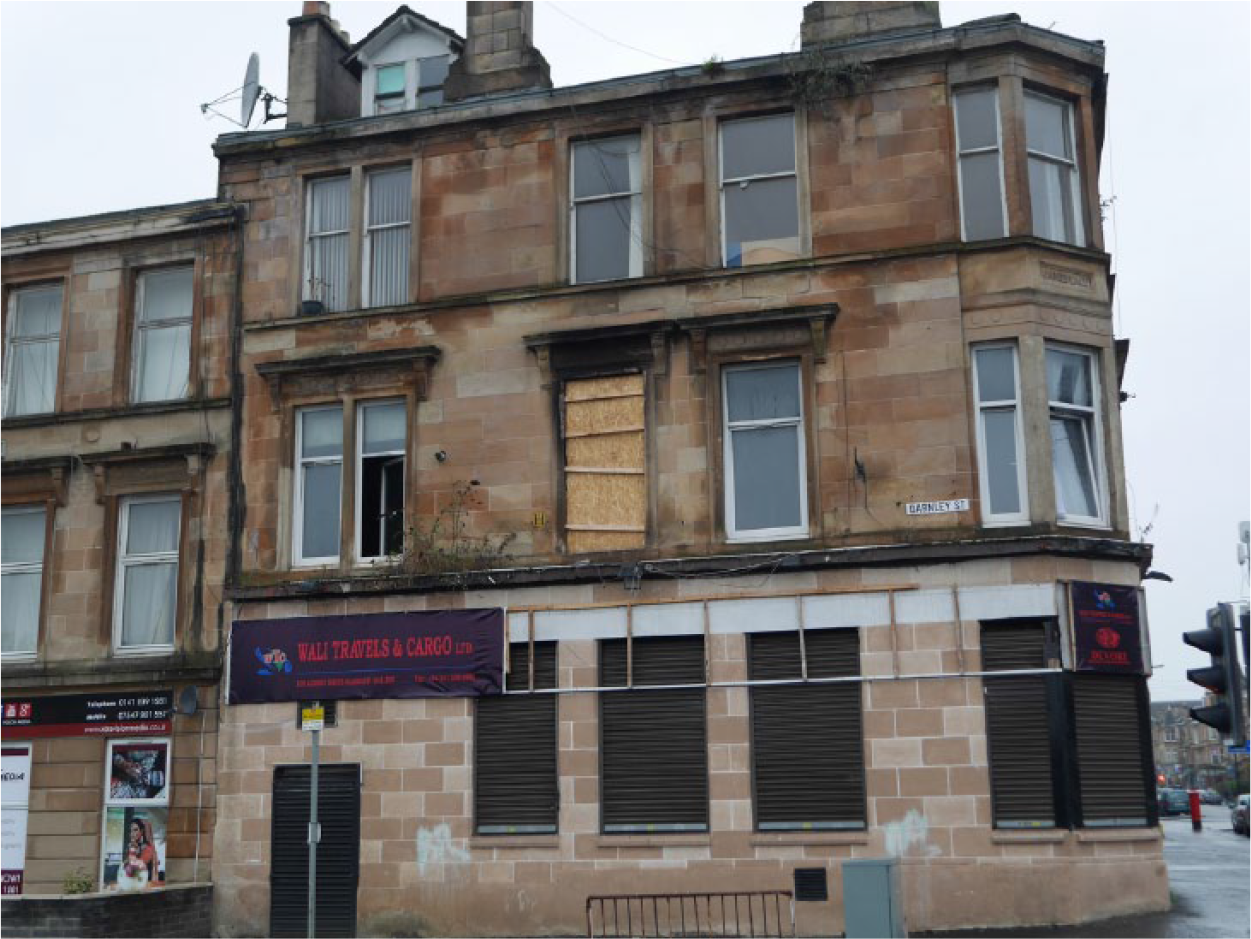
Some of the run down windows in East Pollokshields, although not of the actual street from which we recruited participants for this study. Photograph taken by one of the authors.
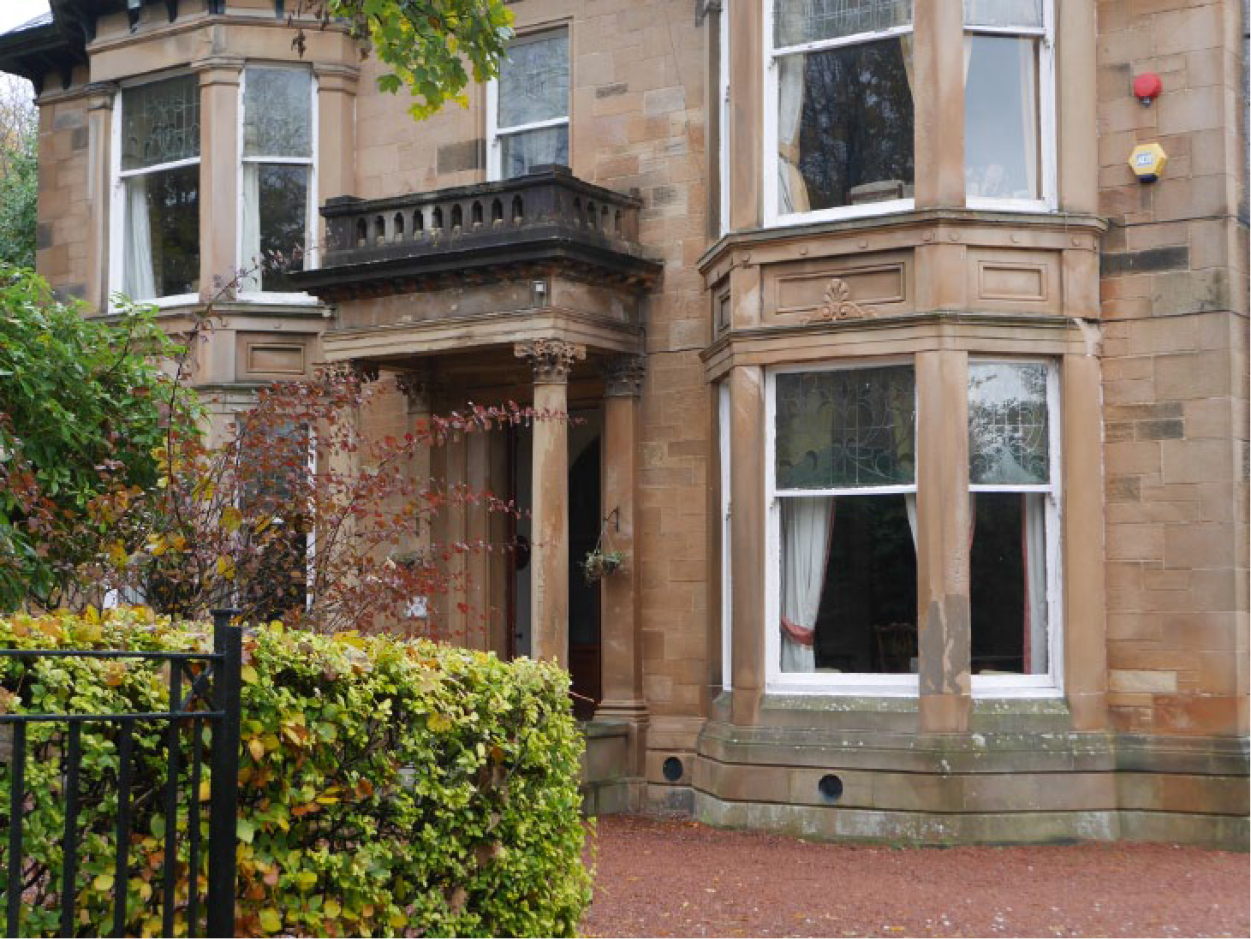
Windows in the detached villas, within the West of Pollokshields, again not of a house from which we recruited participants for this study. Photograph taken by one of the authors.
There was a noticeable feeling of uncertainty among many of our respondents over the stability of this ‘recognised status’, and this was particularly evident among members of the local ‘Pollokshields Heritage’ group, who organise to protect the ‘historical integrity’ of the area. Housing within Pollokshields is described by the society as being ‘in essence defined by the dignity of individuality within a spacious framework. It owes this personality to the individuals who built houses they wanted to live in, and with respect for the character and conditions specified by the visionary architect of our neighbourhood, Sir John Maxwell’ (Pollokshields Heritage Newsletter, 1994). The long and multiple histories of immigration to the area are, for the most part, written out of these accounts, acknowledged only in cursory and veiled remarks. Instead, the focus on conservation imputes a stable and coherent ‘character’ to the area, associated with middle class virtues of individual dignity and private space. The historical records of the Pollokshields Heritage group reveal, more than once, periods of alarm associated with the threat of discontinuity or disruption. The 1960s, for example, are portrayed as a decade of particular tension associated with the change of ownership tenure within Pollokshields in this period, as buildings were bought by Glasgow Corporation and a new wave of immigrants began buying and renting properties. One newsletter, looking back, states that the 1960s were:
… a time when houses lay empty, windows smashed, gardens run riot and values dropped so drastically that when the owners of neighbouring properties wanted to sell, the only buyer they could find was the (then) Glasgow Corporation. (Pollokshields Heritage Newsletter, 1993)
Notably, the class anxieties expressed here, which find their index in the decline of property values, are symbolically associated with smashed windows. In the narrative that follows, this moment of crisis is averted and Pollokshields is saved through the formation of the Pollokshields Property Development Association in 1965, the ‘brainchild’ of a local councillor, alongside a group of ‘professional and business residents, to preserve and improve the district’. The Corporation was persuaded to sell back the houses they had brought; many villas were split into upper and lower conversions, the district became attractive again and house prices began to rise. Despite this resolution, the threat of disruption is something that is invoked as constant. The heritage newsletter goes on to note:
… some of the oldest housing stock in St Andrew’s Drive and nearby Maxwell Drive was wiped off the face of it to make way for multi-storey and dense, terraced housing. A variety of random misfits have been allowed in the past. But since designation an improvement has been sustained. We have held the line. Now large, previously institutionally used villas are being returned and in some cases, single dwelling use. (Pollokshields Heritage Newsletter, 1993)
What is telling about this account is the ambiguity of the term ‘misfits’, and the way in which it refers, at one and the same time, to both undesirable residences and undesirable residents. Indeed, it was just this ‘double coding’ which characterised our interviews with many of those who lived in the most expensive properties in the area. While participants in these contexts would occasionally discuss undesirable residents, it was much more common to talk about the protection of buildings and to consider the history of the area in terms of these architectural changes. This is exactly that ‘transmutation’ of ‘things’ into ‘signs’ that we have seen Bourdieu discuss.
More specifically, windows often emerged within these discussions as a particular point of focus in struggles over preservation. Jane, a resident within the villa street, here explains the problems with simply relying on council regulation:
… of course what has happened and I suppose what happens quite a lot in the East is that things would be done, windows would be changed, this, that, and the other without any planning permission being sought …
Jane went on to express her unease at other residents’ strictness with regard to the enforcement of planning requirements in relation to windows but she also said that she could understand this tendency, noting:
I think what began to worry people was if places were being pulled down what was going up instead of it and I think it was the look of the place and I think it was also the value of their own homes, in other words would they want to live next door to that?
This symbolic struggle over the style of windows thus returns us to the wider themes of our analysis: the window as a material object is invested in a particular version of tradition or character, and preservation of this character is strongly asserted by numerous villa owners. Ruth, another villa owner and heritage group member, puts a stronger case for the window enforcement in the area. In a discussion over the ‘problems’ of Pakistani immigration and housing regulation, Ruth notes: ‘And then these wretched windows!’ Although she then went on to acknowledge that this was not a problem solely within the ‘Asian community’ of the area, the association of the wrong windows with the arrival of migrant communities recurred frequently in her account of the area. When she was asked what she liked about Pollokshields, Ruth responded:
But the things I think that I like now, and things that I always did like, and probably the fact that we’ve held the line, things haven’t got any worse, and some things are probably better. But it all sits on the cusp of not quite right. One of the things that has really deteriorated, for example, is that the enforcement was not made on the window policy, but again you had people who wanted, they’d put in these PVC windows, and then it becomes the practice, and now it’s very, very hard to stop.
Holding the line in this case represents a great deal of things for Ruth. The introduction of PVC framed windows is associated with a feeling that the area is losing its respectability, and her dislike for the demographic speed of change. Her father, she explained, fought against the council’s buying of properties in the area, and she has continued this tradition, with her own attempts to ‘hold the line’. Windows, in this sense, becomes a tangible focus for more general anxieties associated with social change. That the ‘line’ in question is a racialised one was made clear in a later anecdote:
Well I did have a neighbour, quite a rich Pakistani neighbour, I think he’s moved back to Pakistan now. But it was quite funny, he was very angry with me for a while, because I reported him to the council for having the PVC windows, and he had to replace them with the timber frames, haha, finally a victory!
Despite the report of these ‘victories’, Ruth’s account reveals a uneasy sense of permanent embattlement: ‘I think we just constantly felt that we were battling against things like, things that the council could and should have done something about were the windows, the lamp posts, things like that, that still goes on.’ The narrative of conservation of the ‘Old Pollokshields’ implicitly associates the area with respectability, and with middle class, white residency. Moreover, the martial language in which these accounts are framed – holding the line, victories over neighbours – make clear something about the extent to which these struggles are understood as territorial ones, as struggles over the control of access to, and belonging, in, space.
In contrast to Ruth’s account, a male villa owner of Pakistani ethnicity had a very different sense of the conservation regulations. He notes:
Yeah very, very strict. Like the windows, they are very strict. Especially the front of my house. I wanted to get new PVC but it has to remain wood sash windows. But wood sash windows after a certain amount of years so much rain, damp, they crumble. They should allow everybody to use PVC, looks smarter looks cleaner. Q: Why don’t they allow it? A: You ask them, this is the million dollar question.
Read together, these divergent responses suggest something about how and why issues such as the framing of windows come to have the significance that they do. Those who consider themselves the defenders of ‘Old Pollokshields’ cannot absolutely rely on economic inequalities to ‘hold the line’ for them. Where economic capital is no longer sufficient – when ‘it all sits on the cusp of [being] not quite right’ – it is to cultural capital that the elite have recourse. In that context, issues of aesthetics and design become significant battlegrounds over symbolic control and make possible the tacit expression of claims about ownership and belonging. This does not imply that such assertions of good taste are not truly ‘felt’ but that a deep-rooted part of their sociological meaningfulness rests in the extent to which they serve to reproduce lines of division between ‘types’ of people: those who ‘fit’ and those who are ‘misfits’. These distinctions can take class form or racialised form or, frequently, both at once. Struggles of this kind over residence and belonging have been well addressed in existing research on the postcolonial city (e.g. Clayton, 2008) and in research on Glasgow specifically (e.g. McGarrigle & Kearns, 2009). What we note, in particular, is the symbolically significant position that the window – the bordering object par excellence – plays in these processes of local bordering.
By final contrast, we can note the response of residents within the ‘scheme’ to the introduction of PVC double glazing. Since the flats in this area are not deemed historically or ‘intrinsically’ of value in conservation terms, many planning regulations do not apply to these properties and, in general, most residents welcomed the introduction of new windows:
Jim: It’s a council flat aye. I’ve been there for 22 years. It’s alright. When I first moved in there it was all aluminium windows and all single glazed. Now it’s double glazed. It’s been so long I can’t even remember what they were like you know the aluminium windows, but they were a lot worse.
Nevertheless, these improvements were ones enacted as part of the upkeep of properties by the council or, latterly, by local housing associations. Although tenants felt the benefit of them, they also exemplified an absence of control over their homes and over the appearance of their homes. In that respect, the residents within the ‘scheme’ were excluded altogether from the symbolic struggle over windows which was the focus of so much discussion within the conservation area or were required to accept, in Bourdieu’s felicitous phrase, a ‘choice of the necessary’.
Conclusion
Our analysis here has been informed in certain respects by Bourdieu’s famous sociological critique of the supposed neutrality of ‘taste’ but we have sought to qualify his approach in two significant ways. First, Bourdieu’s account tends to flatten out the formal properties of particular cultural objects, such that they figure only as various means of engaging in the symbolic struggles of the cultural field. By contrast, we have argued that it is important to understand the specific properties of distinctive cultural forms as these govern how they may be appropriated, experienced or used. As we saw in our historical account, the glassed window signifies in particular ways: by virtue of its transparency, for example (what the poet McCrum [2012] describes as the ‘alchemy’ of glass, in which ‘dirt’ is changed ‘into something fluid, strong and beautiful’), but also by virtue of its bordering qualities or its fragility. It is thus situated in particular ways in the struggles over display and concealment, personal self and public being, and in narratives of conservation, heritage and decline.
Second, Bourdieu’s account has little to say regarding the racialising properties of the judgements of taste. By contrast, again, we have shown how frequently judgements about the look and style of residencies transmuted into racialising judgements about residents, imputing particular qualities to the former through a seemingly neutral reading of the latter, or being used in ways that sought to mark racialised lines of belonging in local space. The article has therefore explored the ways in which we might look through the window, sociologically speaking, as a way of exploring social divisions within local areas and also within wider society. Through an analysis of qualitative data we have seen how the window – both in its materiality and as a symbolic object – is entailed in everyday experiences and expressions of inequality.
Footnotes
Acknowledgements
Many thanks to our colleagues on this project, Professor Satnam Virdee, Professor Gwilym Pryce, Dr Sue Easton and to Isabel Gordon for visiting some of the windows, houses and participants with Shirin.
Funding
This work was funded by the Economic and Social Research Council (ESRC) through the Location Dynamics and Ethnicity in Scotland (LDOES) project, part of the Applied Quantitative Methods Network: Phase II, Grant Number ES/K006460/1, and through the work of the research Centre on the Dynamics of Ethnicity, funded by the ESRC under Grant ES/K002198/1.