




Abstract
Mercury (Hg) is widely distributed in the environment and oral exposure is a main route in the general population. In this study, we estimated the dietary intake of Hg and its relationship with blood Hg levels in Korean adults. The study subjects were recruited from three different districts (rural: 189, coastal: 208 and urban: 184). We used a general questionnaire to collect information about demographic factors, lifestyles and diet. Dietary habits were studied using the 24-h recall method. The estimation of Hg intake was performed using the database of Hg contents in 128 Korean foods based on the previous studies. Blood Hg was analyzed using Direct Mercury Analyzer with the gold-amalgam method. Daily intake of Hg by diet was estimated at 13.57 μg (0.22 μg/kg body weight). The geometric mean Hg concentration in whole blood was 3.92 μg/L. Blood Hg level and Hg intake by diet was higher in coastal areas than in urban or rural areas, respectively. Blood Hg level correlated with the intake of Hg consumed from diet. Seafood was highly responsible and account for 75.6% of total dietary Hg intake. In this study, blood Hg concentrations were found to be significantly affected by sex, age, individual lifestyles and especially the amount of seafood intake, which might play an important role in determining blood Hg levels in Korean adults.
Introduction
Mercury (Hg) is a well-known environmental toxic metal worldwide, which is not necessary in the biological process of the human body. In the environment, Hg can be found from natural products and iatrogenic activities, such as medicine, agriculture and manufacturing. 1 Therefore, not only workers in industrial sectors are exposed to Hg but the general population can also be exposed through other means. Workers in industry could be exposed to Hg by inhalation of elemental or inorganic types. The major source of Hg in the general population comes from diet, especially seafood as organic Hg mainly, and sometimes elemental and inorganic Hg from dental amalgam, thermometers, batteries, pesticides, mines, incineration plants and so on. Inorganic Hg from natural sources or pollutions can be converted into organic Hg by microorganisms and eventually results in bioaccumulation through the food chain. 1,2 Historical epidemics of Hg poisoning are well known in Japan from the consumption of Hg contaminated fish/shellfish and in Iraq from the intake of bread containing Hg. 3 –6 Both epidemics provided evidence that methyl Hg induces various neurological abnormalities in poisoned individuals and prenatal exposure to methyl Hg caused damages of the nervous system resulting in delayed development, motor impairment and cerebral palsy. In addition, neurodevelopmental deficits in children, who were exposed to methyl Hg through mother’s consumption of high levels of fish and whales containing Hg, were associated with prenatal exposure to Hg. 7,8 Therefore, the guideline for fish consumption was suggested to children, pregnant women and women in their child-bearing years. They were recommended to limit total fish intake to no more than twice of 6 ounce per week and to maintain blood Hg level below 5.8 μg/L in pregnant women. 9,10
However, the health effects of organic Hg have been reported not only in neonates and children but also in adults. Namely, studies have continuously suggested that exposure to Hg could be associated with health effects such as neurodegenerative diseases, cardiovascular diseases and reproduction in adults. 11 –14 Several studies have reported that seafood consumption is associated with blood Hg level. 15 –17 However, most of those studies referred to the relationship between the frequency of fish intake and the blood Hg level. However, there has been limited study regarding the relationship between the amounts of fish consumption and the blood Hg concentrations in individuals.
To assess the exposure to Hg in Korean adults, information on the contributing factors to the body burden of Hg is needed. Therefore, we estimated the daily intake of Hg through diet and analyzed whether fish consumption is associated with blood Hg levels and determined the contributing factors such as demographics and lifestyles to the body burden of Hg.
Materials and methods
Study subjects
This study was performed with 581 Korean adults (245 males and 336 females) older than 20 years of age, who have not been exposed to Hg occupationally. This study recruited 184, 189 and 208 subjects from three selected areas representing inhabitants with different lifestyles, namely, urban, rural and coastal areas (Table 1) during 2007/2008. Study subjects were informed about the study aim and detailed study process including contents of questionnaire, blood sampling and others individually, who were willing to participate in this study. Followed by this, written consents were obtained from every participant who singed-in and followed a questionnaire survey and blood sampling. The study protocol was approved by the Chung-Ang University Ethical Committee for Medical Research and Other Studies Involving Human Subjects.
Distribution of study subjects by demographic characteristics

NS: nonsignificant.
Personal interview and sample collection
Personal interviews were performed with a questionnaire prepared by trained personnel who are educated for the study goal, questionnaire and interview skill and so on. The questionnaire included demographic characteristics, smoking habit, alcoholic drinking, occupation, duration of residence at study areas, past medical histories and dietary habits. Dietary habits were studied by the 24-h recall method. Diet questionnaire consisted of 24 h time tables in which participants recorded all their dietary intakes including breakfast, lunch, dinner and others consumed during the last 24 h, which was prepared using various types of food models and beverages. The intakes of beverages were expressed as weight units from volume intakes. Whole blood was sampled from subjects with trace metal free and heparin-treated vacutainer tubes and stored at −80°C until analysis.
Hg analysis in whole blood
Concentration of total Hg in whole blood was determined using Direct Mercury Analyzer-80 (DMA-80, Milestone, Italy) with the gold-amalgam method. In brief, 100 μL of whole blood was put into the sample boat and proceeded through three stages of drying, ashing and atomizing. Hg content was calculated from the standard calibration curve with standard Hg (1000 ppm, Aldrich, St. Louis, Missouri, USA). The limit of detection was 0.1 μg/L in blood, and the recovery rate was 98.2–102.8% for the standard added to the samples. The coefficients of variation for pooled samples prepared in our laboratory were 9.44% and 4.57% for total Hg with mean concentrations of Hg 1.52 μg/L and 3.63 μg/L, respectively. The standard reference material (SRM, Bio-Rad, Irvine, California, USA) was used for validation in the analysis.
Estimation of Hg intake
Dietary intake of Hg was estimated from participants’ food consumption based on the 24-h recall method using a questionnaire prepared with various types of food models. A total of 128 specific food species were included, which were categorized into 16 food groups. The Hg contents in these specific foods were obtained from 18 papers reported in Korea, which were selected from the peer-reviewed journals such as the benefit accredited journals, candidate journals for accredited by the National Research Foundation of Korea and from the official reports of Korean government. Estimation of daily Hg intake was calculated based on the amount of food consumption and the concentration of Hg in each food.
Statistical analyses
Statistical analyses were performed with SPSS version 17.0. The concentration of Hg in blood was log-transformed for the statistical analyses. The different groups of study subjects according to demographic factors were compared by chi-square test. Statistical evaluation for mean values was performed by analysis of two-tailed t test or analysis of variance (ANOVA) following multiple-comparison tests using Duncan’s method. Relationships among groups were analyzed by Pearson’s correlation and risk factors were determined by multiple regression analysis. The level of statistical significance was set at p < 0.05.
Results
No significant differences were shown in distributions by district and age groups between males and females. The number of smokers and alcoholic drinkers were higher in males than in females (Table 1). Agriculture, service industry and fishery were major job categories in the study subjects of rural, urban and coastal areas, respectively, with the exception of housekeeper in females (data not shown).
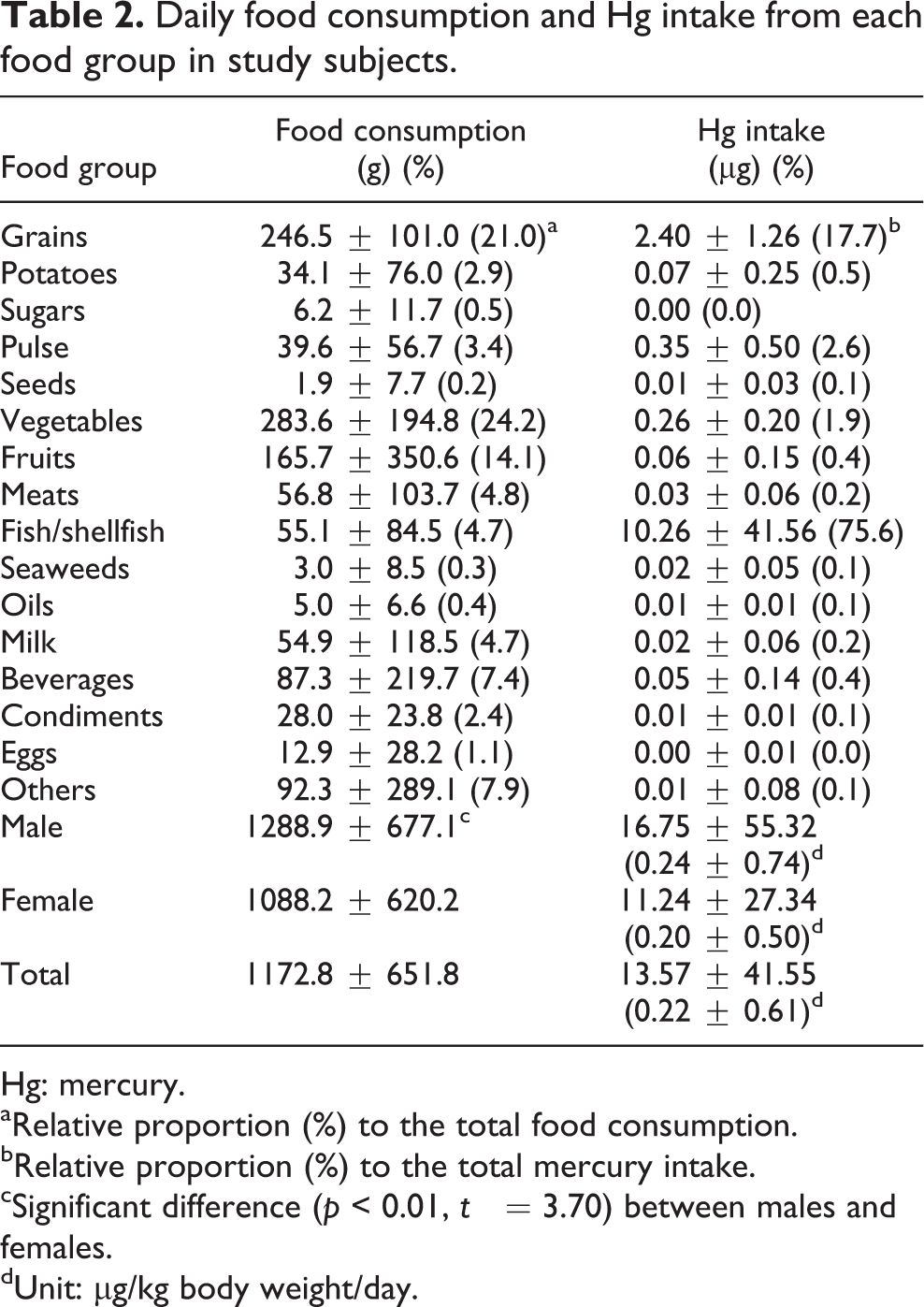
In this study, daily total food consumption and Hg intake from diet was estimated at 1172.8 g and 13.57 μg (0.22 μg/kg body weight), respectively (Table 2). The amount of daily food consumption was higher in males (1288.9 g) than in females (1088.2 g), however, daily Hg intake was not statistically significant between males (16.75 μg, 0.24 μg/kg body weight) and females (11.24 μg, 0.20 μg/kg body weight). However, 75.6% of daily Hg intake from diet accounted for fish/shellfish (10.26 μg), followed by grains (17.7%, 2.40 μg) and pulse (2.6%, 0.35 μg).
Daily food consumption and Hg intake from each food group in study subjects
Hg: mercury.
aRelative proportion (%) to the total food consumption.
bRelative proportion (%) to the total mercury intake.
cSignificant difference (p < 0.01, t = 3.70) between males and females.
dUnit: μg/kg body weight/day.
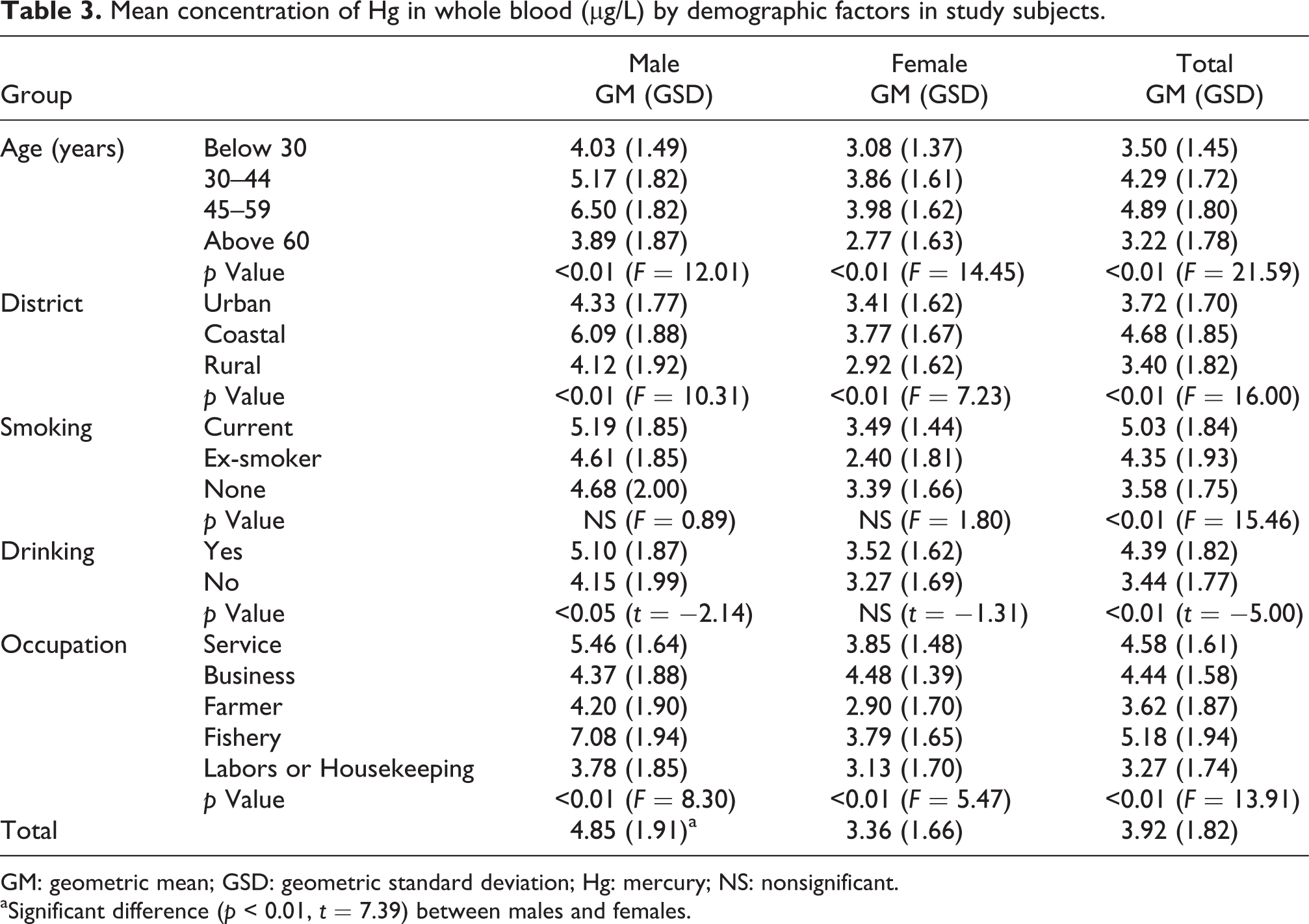
Table 3 represents the blood levels of total Hg by demographic factors in the study subjects. The geometric mean concentration of Hg in blood was 3.92 μg/L and was higher in males (4.85 μg/L) than in females (3.36 μg/L). Blood Hg levels were different by age groups, in which the highest blood Hg level was observed in the 45–59 years age group for both males and females. In males, blood Hg was higher in drinkers compared with nondrinkers but it was not significant between smokers and nonsmokers. No differences were observed in smoking and drinking habits in females. Blood Hg level was different by the resident districts of the study subjects. Thus, the mean concentrations of blood Hg were highest in the coastal area for both males and females. Moreover, blood Hg was statistically significant according to the job category, which was highest in fishery for males while in business for females. In addition, blood Hg was positively correlated with total food consumption and Hg intake from diet, especially with a specific food group of fish/shellfish (Table 4). Namely, the Hg level in blood increased according to the amount of fish/shellfish consumption (Table 5).
Mean concentration of Hg in whole blood (μg/L) by demographic factors in study subjects
GM: geometric mean; GSD: geometric standard deviation; Hg: mercury; NS: nonsignificant.
aSignificant difference (p < 0.01, t = 7.39) between males and females.
Pearson’s correlation coefficients between blood Hg concentration and daily food consumption or Hg intake from each food group in study subjects

Hg: mercury.
a p < 0.01.
b p < 0.05.
Mean concentrations of Hg in whole blood according to the levels of consumption of fish/shellfish

Hg: mercury; GM: geometric mean; GSD: geometric standard deviation.
aTest for trend.
bSignificant difference compared with below 50 g group.
cSignificant difference compared with below 50, 50–99 and 100–199 g groups.
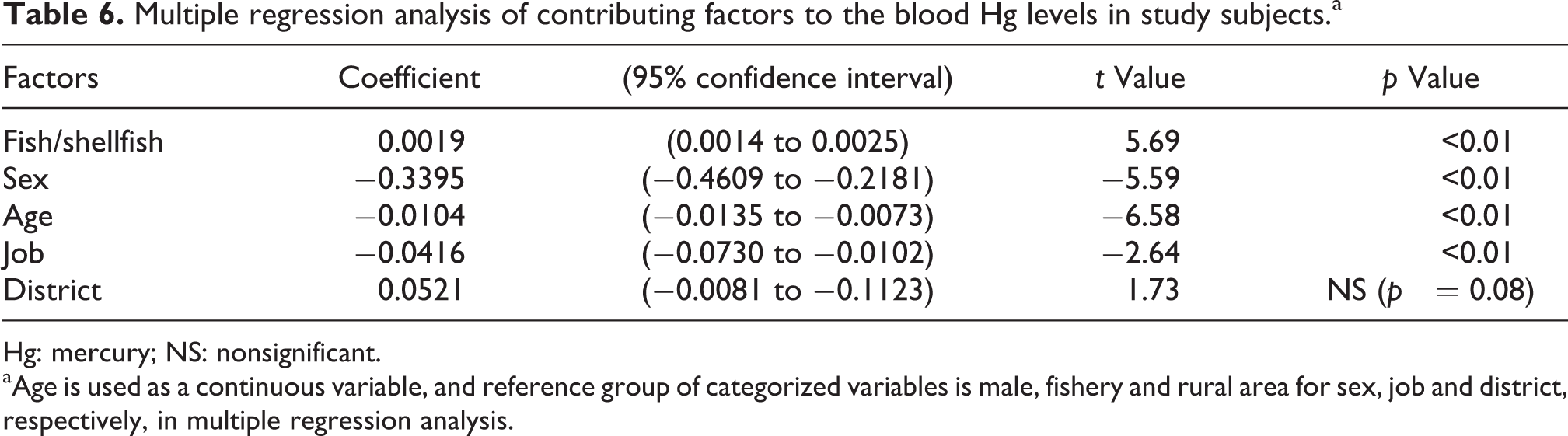
In multiple regression analysis, sex, age, fish/shellfish consumption and job were determined to be significant factors associated with blood Hg levels (Table 6).
Multiple regression analysis of contributing factors to the blood Hg levels in study subjectsa
Hg: mercury; NS: nonsignificant.
aAge is used as a continuous variable, and reference group of categorized variables is male, fishery and rural area for sex, job and district, respectively, in multiple regression analysis.
Discussion
In this study, we evaluated the dietary exposure of Hg in Korean population from three independent districts by measuring blood Hg concentrations and daily Hg intake in Korean adults who have not experienced occupational exposure to Hg. The mean concentration of Hg in blood was determined at 3.92 μg/L, and daily Hg intake from diet was estimated at 13.57 μg( 0.22 μg/kg body weight/day).
In the present study, total Hg was analyzed in blood, which has been used as a good biomarker for Hg exposure in epidemiological studies. Blood Hg reflects recent methyl Hg exposure and is a good indicator of Hg levels in the brain and body burden. 16,18 The blood Hg levels observed in the Korean subjects were lower than those reported in Japan (18.2 μg/L for woman and 5.18 μg/L for pregnant woman), 19,20 Egypt (8.5 μg/L) 21 and Taiwan (9.1 μg/L) 22 but was similar with those reported in China. 23 In contrast, the Korean subjects showed approximately three to six times blood Hg higher levels than those in the United States (0.82 μg/L in 2003; 1.02 μg/L in 2005 and 0.83 μg/L in 2009), 16,24,25 Canada (1.2 μg/L in 2006 and 0.76 μg/L in 2008), 13,26 Germany (0.58 μg/L) 27 and Poland (1.6 μg/L). 28 These wide variations in blood Hg might be contributed by several factors such as geographical contamination, race, nutritional status and lifestyles including dietary habits. 25,29,30
There have been reports about the possible adverse health effects in adults exposed to relatively high levels of Hg through high consumption of fish. 31 However, there have been increasing concerns regarding health effects in adults who are under low levels of Hg exposure in the environment. Furthermore, there was a suggested possibility of the association between increasing blood Hg levels and decreasing neurobehavioral performance in adults with a median blood Hg level of 2.1 μg/L. 32 The positive association between blood Hg and systolic blood pressure increase was reported in a case report of woman in the United States, who did not consume fish but had a blood Hg concentration of 0.8 μg/L. 24 In addition, reduced fecundability was observed at Hg levels of over 1.2 μg/L in maternal blood below the Hg reference dose. 13 Although there are yet limited evidence for association between adverse health effects and low level of Hg exposure, previous reports suggest the possibility of noxious effects on human health by chronic exposure to low level of Hg. Therefore, it is necessary to maintain a low blood level of Hg, if possible.
In this study, the proportion of subjects with blood Hg concentrations over 5.0 μg/L was 32.2% (187/581), 47.8% in males and 20.8% in females, which is the recommended in the health guideline for the general population by the German Human Biomonitoring Commission. 33 In addition, blood Hg levels from this study are similar with the previously reported studies over the last decade in Korea. 30,34,35 These findings suggest that Korean people are continuously exposed to Hg and thus probably need an intervention and/or reduction from the Hg exposure for disease prevention and health promotion in adults. However, blood Hg from this study might be limited for a representativeness of Korean adult because of study subjects from selected areas.
In the present study, blood Hg level is associated with demographic factors, such as sex, age, alcohol intake, resident districts and job in Korean adults. Namely, concentrations of Hg in blood were higher in males than in females. The gender-related differences in blood Hg among general populations are still controversial. 30,36 –38 Some studies reported that blood Hg levels were higher in males than in females, 30,36 not different between males and females or higher in females compared to males. 37,38 Blood concentration of Hg increased based on age and peaked at the 45–59 years age group and decreased thereafter. This finding is consistent with previous reports. 25,39,40 Wennberg et al. reported that the increase of blood Hg level with increasing age is probably because young subjects have a lower intake than older subjects. 39 In addition, this pattern might be partially attributed to economic activity and energy intakes by diet according to the age group. 41 The positive relationship between blood Hg concentration and daily dietary intake was observed in our study (p < 0.05; Table 4). High level of blood Hg in fishery could be due to the higher intake of fish/shellfish compared with other jobs. Moreover, fishery was the most popular job category as 43% of the subjects were from the coastal area (data were not presented). In addition, the proportion of subjects with more than 5.0 μg/L blood Hg was high in males, 45–59 years age group and fishery, respectively, in the study subjects. In the present study, blood Hg level was higher in drinkers than in nondrinkers but was not influenced by smoking, those findings are concurrent results with previous studies. 30,37,42,43
In this study, daily food consumption and Hg intake was estimated at 1172.8 g and 13.57 μg, respectively. Although daily consumption of fish/shellfish was approximately 55 g, corresponding to 4.7% of total diet consumption, which was responsible for the highest Hg exposure from diet at 75.6% of total daily Hg intake, followed by grains and pulse at 17.7% and 2.6%, respectively. We observed significantly positive correlations of blood Hg concentration with individual daily Hg intake from diet, which suggest that blood Hg well reflects Hg intake from diet. A statistically significant positive relationship was observed between blood Hg concentrations and individual consumption of fish/shellfish. In addition, the level of Hg in blood increased according to the amount of fish/shellfish consumption and was higher by 1.8 times in the fish/shellfish consuming group of more than 200 g daily than in the group consuming less than 50 g. Our data are concurrent with the recent reports in Korea 44,45 and support the previous reports that stated fish/shellfish is the primarily source of Hg contaminant from food. 17,39,40,46
In this study, we presented quantitative data for Hg intake based on the amount of food consumption and the concentration of Hg in each food in individuals. However, daily Hg intake estimated in this study may be attributed to the limited diet study. Namely, the 24-h recall method could be associated with a potential of recall bias and did not reflect long-term Hg intake. Otherwise, the quantitative data of Hg intake from 24-h recall study might be valuable in evaluating Hg exposure with blood Hg levels in population studies. Blood Hg level can be maintained in a steady state in frequent fish consumers because of its relatively long clearance half-life of 50–60 days in blood. 32 In addition, a steady state is possible since dietary habits usually do not vary in adults. Previously, a negative correlation between blood Hg and fruit consumption was reported, 36 which was not observed in our study.
From the present study, the estimated daily intake of Hg, 13.57 μg, 0.22 μg/kg body weight/day, represents 31% of the Provisional Tolerable Weekly Intake (5 μg/kg body weight/week for total Hg) by Joint FAO/WHO Expert Committee on Food Additives. 47 Hg intake in Korean adults was higher than the intake estimated in England (3.0 μg/day), 48 France (9.7 μg/day) 49 and the United States (1.95 μg/day for women and 2.59 μg/day for men at 6–65 years), 50 otherwise was below the values reported in Spain (18 μg/day) 51 and Japan (15.3 μg/day for women). 52 It is difficult to directly compare between countries at international levels because great variations are expected from the methods and database used to estimate dietary intake of Hg. 17 However, those data of blood Hg and dietary Hg intakes show a similar tendency between blood levels and food consumption of Hg. Despite the risk of Hg, fish is a one of requisite diets in adults as well as child-bearing aged woman and young children, which contains high levels of polyunsaturated fatty acids and essential minerals that might improve cognitive function and protect from the cardiovascular risk factors. 53 –55 In addition, there needs to be a careful weighting of the benefits from fish/shellfish against the risk imposed by low levels of Hg in these foods. Therefore, it is necessary to provide a guideline recommended for consumption of fish/shellfish consumption or restriction based on Hg contamination data by the type of fish in each country. Multiple regression analysis was performed to evaluate contributing factors in determining blood Hg concentrations. Blood Hg was significantly affected by sex, age, fish/shellfish consumption and job in this study. This finding also suggests that fish/shellfish consume habit is the most influencing behavior factor on blood Hg as well as demographic factors of sex and age.
Results from this study suggest that the general population has been exposed to Hg continuously, and blood Hg concentrations are significantly affected by sex, age and individual lifestyles, especially seafood consumption. Hg exposure in the general population of Korea might be higher than the United States and western countries, while less than Japan.
Footnotes
Conflict of interests
The authors declared no conflicts of interest.
Funding
This research was supported by Basic Science Research Program through the National Research Foundation of Korea (NRF) funded by the Ministry of Education, Science and Technology (2008-0061280).