




Abstract
Diet plays an important role in modulating the risk of arterial and venous thrombosis. Several lines of evidence attest that consumption of fish and its compounds, especially omega-3 fatty acids, may be effective to decrease the cardiovascular risk. Since the pathogenesis of arterial and venous thrombosis share some common aspects, we performed a systematic review of published clinical studies that investigated the association between fish intake and venous thrombosis. An electronic search was carried out in Medline, Scopus, and ISI Web of Science using the key words “fish” OR “seafood” AND “venous thromboembolism” OR “deep vein thrombosis” OR “pulmonary embolism”, with no language or date restriction. Overall, 6 studies (5 prospective and 1 case–control) were finally identified. In only 1 small case–control study, a larger intake of total fish was found to be negatively associated with the risk of venous thromboembolism. No association was found in 4 large prospective studies, whereas a positive association was observed in the remaining. No substantial difference was also noticed between intake of fatty or lean fish. Taken together, the current epidemiological evidence does not support the existence of a significant effect of total fish consumption on the risk of venous thromboembolism.
Introduction
Venous thromboembolism (VTE), which conventionally entails deep vein thrombosis and/or pulmonary embolism, is a relatively frequent disorder, whose prevalence approximates 422 per 100 000 in the general population. 1 The frequency of VTE is even higher in hospitalized patients (ie, ∼3.8%) and represents the leading cause of morbidity and death in these patients. 2
The pathogenesis of VTE is clearly multifaceted and multifactorial, wherein several acquired prothrombotic conditions interplay with a discrete number of genetic abnormalities. 3,4 Among the various risk factors, diet seems to play a noticeable role, in that a number of nutrients and dietary supplements interplay with primary and secondary hemostasis, thus exerting a positive or negative influence on platelet biology and blood coagulation. 5 Several lines of evidence now attest that fish consumption may be associated with a lower risk of cardiovascular disease. A recent meta-analysis including 11 prospective cohort and 8 case–control studies totaling 408 305 participants proved the existence of an inverse association between fish intake and risk of acute coronary syndrome, since an additional 100 g serving of fish per week was found to be associated with a 5% (95% confidence interval CI, 3%-8%) reduced risk of coronary heart disease. 6 A modest and inverse association between fish intake and cerebrovascular disease was also reported in another recent meta-analysis of 26 prospective cohort and 12 randomized trials totaling 794 000 participants, 7 in which total fish consumption of ≥5 servings per week was associated with a 12% (95% CI, 4%-19%) lower cerebrovascular risk compared to the intake of 1 serving per week.
The beneficial influence of fish consumption on cardiovascular risk has been mostly attributed to the presence of omega-3 fatty acids, which are seemingly effective to produce a wide spectrum of favorable effects, including reduction in total and low-density lipoprotein cholesterol and increase in high-density lipoprotein cholesterol and platelet inhibition. 8 Since the pathogenesis of arterial and venous thrombosis share some common and partially overlapping aspects (eg, thrombophilia, age, obesity, diabetes, and smoking), 9 we performed a systematic review of published clinical studies that investigated the association between fish intake and VTE.
Search Methodology
An electronic search was performed in Medline (with PubMed interface), Scopus, and ISI Web of Science using the key words “fish” OR “seafood” AND “venous thromboembolism” OR “deep vein thrombosis” OR “pulmonary embolism” in “Title/Abstract/Keywords”, with no language or date restriction. All articles identified according to the search criteria were systematically reviewed by 2 authors (GL and CM). The references of selected articles were also hand-searched to identify other pertinent documents.
Results
A total number of 26 publications could be identified after elimination of replicate documents among the 3 scientific databases. Twenty documents were excluded after accurate reading of title, abstract, and full text (when available; Figure 1). Therefore, 6 studies (5 prospective and 1 case–control) were finally selected for this systematic literature review (Table 1). 10 –15 Interrater agreement was absolute (κ statistics, 1.00).
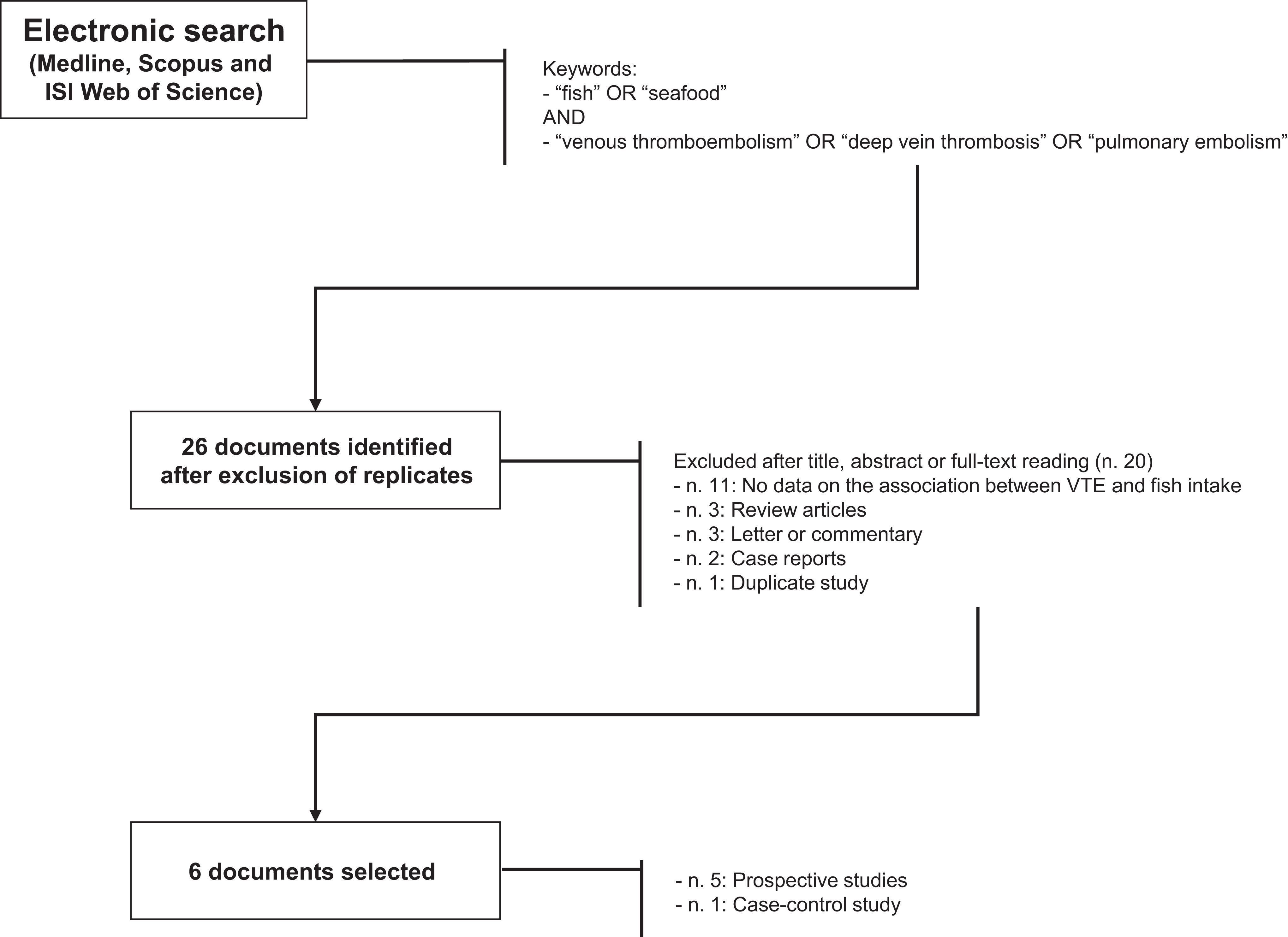
Description of results of the search methodology.
Description of Prospective and Case–Control Studies Investigating the Association Between Fish Intake and Risk of VTE.
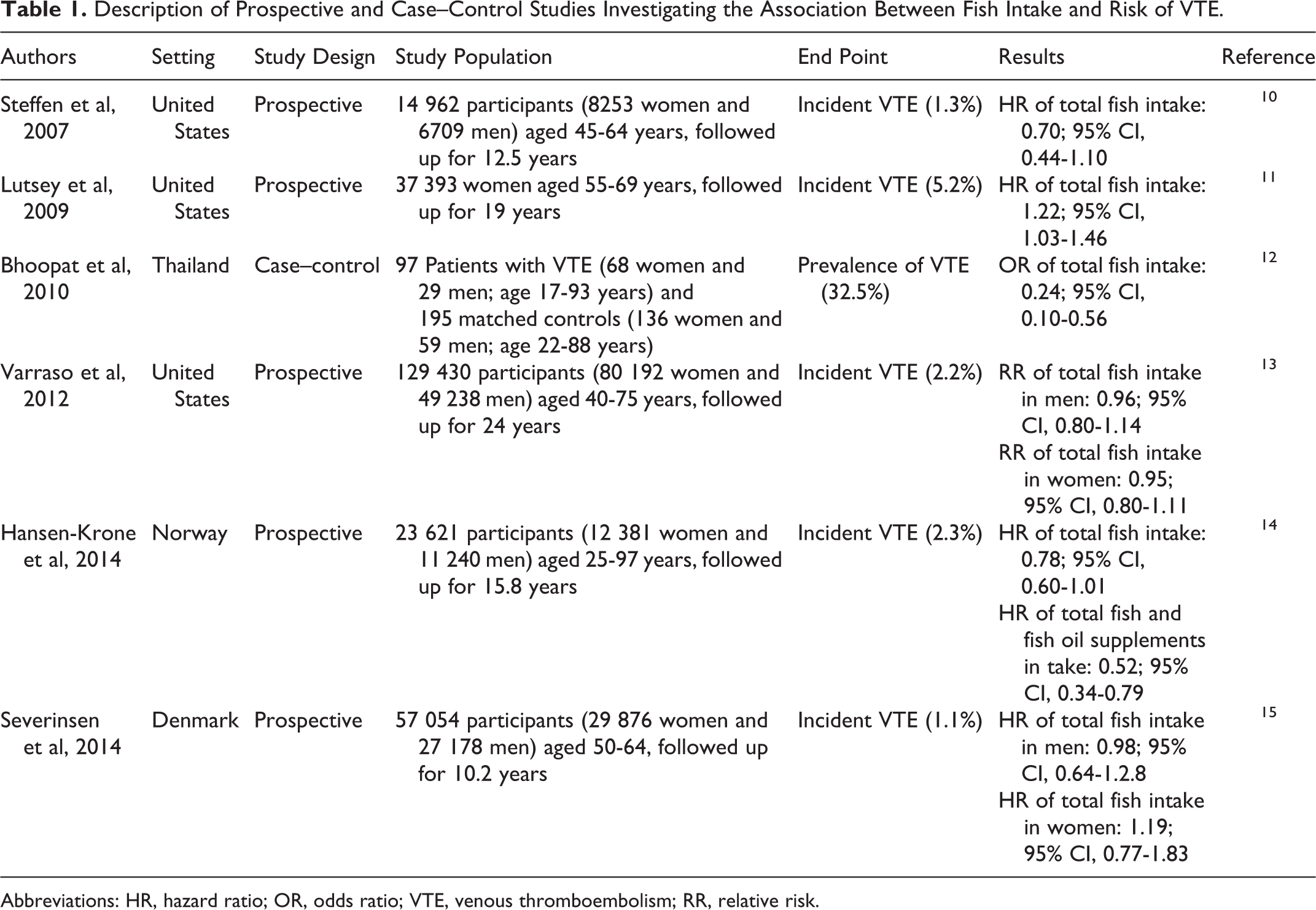
Abbreviations: HR, hazard ratio; OR, odds ratio; VTE, venous thromboembolism; RR, relative risk.
Steffen et al carried out a prospective trial including 14 962 middle-aged participants (8253 women and 6709 men) of the Atherosclerosis Risk in Communities study, who were followed up for 12.5 years. 10 Overall, 197 VTE events were recorded during follow-up (VTE rate: 1.3%). After classification of the study population in quintiles of daily food intake, the VTE risk of participants in the highest quintile of total fish intake was not significantly different from that of participants in the lowest quintile (hazard ratio [HR], 0.70; 95% confidence interval [CI], 0.44-1.10). A larger consumption of omega-3 fatty acids was also found to be ineffective for lowering the risk of VTE (HR of highest vs lowest quintile of intake: 0.70; 95% CI, 0.43-1.13). Results were similar after excluding idiopathic VTE from analysis.
Lutsey et al carried out a prospective study including 37 393 women aged 55 to 69 years who participated in the Iowa Women’s Health Study and were followed up for 19 years. 11 A total number of 1950 cases with VTE were recorded during follow-up (VTE rate: 5.2%). Women consuming ≥2.5 servings per week of total fish exhibited a significantly higher risk of VTE compared to those reporting an intake <0.5 servings per week (HR, 1.22; 95% CI, 1.03-1.46). The association was not modified when VTE events were stratified by type (idiopathic and secondary).
A case–control study was performed by Bhoopat et al, who enrolled 97 patients with VTE (68 women and 29 men; age 17-93 years) and 195 matched controls (136 women and 59 men; age 22-88 years). 12 Total fish intake was found to be marginally higher in cases than in controls (1.34 ± 1.82 vs 1.27 ± 1.94; P < .001). Nevertheless, the risk of VTE was found to be significantly lower in participants consuming >2.64 servings per day of total fish compared to those reporting an intake <0.42 servings per day (odds ratio (OR), 0.24; 95% CI, 0.10-0.56).
Varraso et al performed a prospective trial including 129 430 participants (80 192 women and 49 238 men) aged 40-75 years, who participated to the Nurses’ Health Study and Health Professionals Follow-up Study and were followed up for 24 years. 13 Overall, 2892 VTE events were recorded during follow-up (VTE rate: 2.2%), with no distinction between provoked or idiopathic. After stratification of the study population for quintiles of intake, participants in the highest quintile of total fish consumption did not exhibit a different risk of VTE than those in the lowest quintile (relative risk [RR], 0.95; 95% CI, 0.85-1.07). The association between VTE risk and fish intake remained nonstatistically significant in men (RR; 0.96; 95% CI, 0.80-1.14) or women (RR, 0.95; 95% CI, 0.80-1.11).
Hansen-Krone et al carried out a prospective investigation including 23 621 participants (12 381 women and 11 240 men) aged 25 to 97 years who participated in the Tromsø Study and were followed up for 18.8 years. 14 A total number of 536 VTE events were recorded during follow-up (VTE rate: 2.3%), 225 (42%) of which were classified as unprovoked. After classification of the study population according to total fish intake, participants consuming fish ≥3 times/week did not exhibit a different risk of VTE compared to those consuming fish less that once a week (HR, 0.78; 95% CI, 0.60-1.01). No substantial differences were observed when the analysis was limited to fatty fish (HR, 0.80; 95% CI, 0.59-1.08) or lean fish (HR, 0.89; 95% CI, 0.73-1.09). At variance with these findings, participants consuming fish and fish oil supplements ≥3 times/week exhibited a significantly lower risk of VTE compared to those consuming fish and fish oil supplements less that once a week (HR, 0.52; 95% CI, 0.34-0.79). This association remained significant when the analysis was limited to fatty fish (HR, 0.50; 95% CI, 0.29-0.88) but not lean fish (HR, 0.76; 95% CI, 0.56-1.04) intake. Interestingly, higher fish intake was found to be associated with a significant decreased risk of provoked VTE (P for trend = .04) but not of idiopathic VTE (P for trend = 0.7).
Finally, Severinsen et al performed another large prospective study including 57 054 participants (29 876 women and 27 178 men) aged 50 to 64, who participated in the Danish follow-up study Diet, Cancer and Health, and were followed up for 10.2 years. 15 Overall, 641 VTE events were recorded during follow-up (VTE rate: 1.1%). No significant association was found between total fish intake and VTE risk (highest vs lowest quintile) in both the male (HR, 0.98; 95% CI, 0.64-1.28) and the female (HR, 1.19; 95% CI, 0.77-1.83) cohorts. No substantial differences were also appreciated when the analysis was limited to intake of fatty or lean fish in both the male (fatty fish: HR 0.98; 95% CI, 0.69-1.37; lean fish: HR, 0.93; 95% CI, 0.66 -1.31) and the female (fatty fish: HR, 0.86; 95% CI, 0.57-1.30; lean fish: HR, 1.30; 95% CI 0.85-1.99) cohorts, nor in the whole cohort of patients with unprovoked thrombosis (men: HR, 0.74; 95% CI, 0.46-1.22; women: HR, 0.97; 95% CI, 0.50 -1.87).
Discussion
Larger consumption of fish has been recently encouraged for primary and secondary prevention of cardiovascular disorders. 6,7 Due to the fact that thrombosis is a common hallmark of both arterial and venous occlusive disorders, the potential interplay between fish consumption and risk of VTE deserves scrutiny. According to our systematic literature review (Table 1), in only 1 small case–control study a larger intake of total fish was found to be negatively associated with the risk of VTE. 12 No association was found in 4 large prospective studies, 10,13,14,15 whereas a positive association was observed in the remaining prospective trial. 11 No substantial difference was also found between consumption of fatty or lean fish. The results of the large and well-conducted study by Hansen-Kroone et al deserve special focus. 14 The authors found a borderline positive effect of fish consumption on VTE risk, whereas the association appeared strongly positive for the combination of fish and fish oil supplements. This is of particular interest and in some contrast with arterial findings, in which fish oil supplements seemed more recently equivalent to the controls 16 and to recent data emerged from publications in atrial fibrillation 17 and in diabetes, 18 supporting the notion that fish oil supplementation would not seemingly reduce the risk of these conditions.
Interestingly, the setting of the studies was largely heterogeneous, with 3 of them carried out in the United States, 2 in Northern Europe, and the remaining in Thailand (Table 1). The type of fish consumed in these countries and the ratio between lean and fatty fish were hence predictably different. It is also noteworthy that the total intake of fish was quantified with different approaches across studies (ie, g/day, servings/day, and times/week). Due to these important drawbacks, it was hence impossible to pool data and perform a meta-analysis.
There are some plausible biological explanations that support these findings. Although it is undeniable that arterial and venous thromboses share some common pathogenetic features, 9 these 2 processes also display remarkable differences. An arterial thrombus is conventionally defined as “white,” typically onsets in an atheromatous area of a vessel with high shear stress, and mainly consist of platelets with a relatively modest amount of fibrin or red blood cells. Conversely, a venous thrombus is conventionally defined as “red,” develops in low flow vessels, and is mainly composed by red blood cells and fibrin. 19 The favorable influence of fish, fish oil, or omega-3 fatty acids administration on cardiovascular risk is mediated by a large number of biological effects, which include antiarrhythmic effects, vasodilation, decreased blood pressure, decreased inflammation, reduced atherosclerosis, plaque stabilization, lowered collagen deposition and decreased platelet hyperreactivity, among others. 20 It is hence not surprising that these favorable effects on atherosclerosis and platelet biology may be somehow less important in the setting of venous thrombosis. Several lines of evidence now attest that dyslipidemia (ie, the leading risk factor for cardiovascular disease) has little influence on the risk of VTE. 21 Accordingly, the treatment of hypercholesterolemia by means of statins does not significantly lower the risk of VTE. 22 Platelets play an important role in the development of both arterial and venous thromboses, although their contribution is indeed broader in the former condition. This is also confirmed by the evidence that antiplatelet agents are much more effective for preventing arterial than venous thrombosis. 23,24 Therefore, the putative inhibitory effect of fish or omega-3 fatty acids on platelets (ie, decreased platelet aggregation and adhesiveness) 25 may be overall attenuated in the pathogenesis of VTE. Reliable evidence in support of this concept was also brought by Andriamampandry et al 26 who showed that a diet supplemented with omega-3 fatty acids was more effective to prevent arterial than venous thrombosis in mice. More recently, Reiner et al 27 also showed that the administration of omega-3 fatty acids in mice was ineffective to prevent venous thrombosis in models of inferior vena cava stenosis or endothelial injury.
Conclusion
In conclusion, the current literature data do not support the evidence that a large consumption of fish may be associated with a lower risk of VTE in the general population. It is also noteworthy that higher fish consumption is commonplace in participants with healthier lifestyle as well as in those who follow a healthier diet (ie, Mediterranean diet, greater intake of olive and nuts), spend more time on exercising, and smoke less so that these confounders may be accurately taken into account when evaluating the relationship between fish consumption and health risks.
Footnotes
Declaration of Conflicting Interests
The author(s) declared no potential conflicts of interest with respect to the research, authorship, and/or publication of this article.
Funding
The author(s) received no financial support for the research, authorship, and/or publication of this article.