



Abstract
While the European Union (EU) increasingly strengthens its social integration, opposition towards this process can also be observed, here defined as ‘welfare Euroscepticism’. To better understand this newly defined policy paradigm, this article aims to explain longstanding cleavages in both social policy and EU research: socioeconomic status (SES) divides. Contrary to the literature on public support for European integration, this article argues that higher SES groups are more likely to be welfare Eurosceptics than lower SES groups. This argument and its underlying explanations are examined through a multilevel approach using European Social Survey data from 18 EU member states, using the example of a potential EU-wide minimum income scheme. First, the results demonstrate that welfare Euroscepticism is indeed more prevalent among higher SES groups than lower SES groups (measured through occupation, education, income, and employment). The results indicate robust self-interest patterns among higher SES groups that do not want to carry (perceived) financial burdens of EU social policies. The opinion patterns also emphasize the multidimensionality of attitudes towards EU policies since the SES cleavages can reverse, depending on the policy in focus. Overall, the results indicate much potential to mobilize the larger proportion of the public to support EU social policies, that is, lower SES groups. However, potential conflicts may arise when the EU expands on policies that their traditional supporters – higher SES groups – are more likely to oppose. The article also shows that welfare solidarity on the individual and the country level can mitigate such conflicts. This is because higher levels of welfare generosity and lower levels of welfare chauvinism on the individual and the country level are related to smaller SES cleavages.
Keywords
Introduction
Since the 1990s the European Union (EU) has been increasingly expanding on a relatively new policy dimension, ‘Social Europe’, to support and complement national welfare states and foster better socioeconomic outcomes for European citizens (Hemerijck, 2019). As explained in the introduction of this special issue (Eick and Leruth, 2024), the future of a Social Europe or even a European Social Union (see, Vandenbroucke, 2013) is still uncertain. Welfare Euroscepticism is defined in this article as the opposition towards Social Europe, or more specifically, the opposition towards harmonizing social policies across the EU and/or particular redistributive programmes. This newly defined policy paradigm can have significant implications for the future of Social Europe. This is especially the case because the increasing political weight given to social policy harmonization carries the risk of fermenting ideological divisions within the bloc (Corti, 2022). These divisions are likely to grow as Social Europe becomes more salient to the public as welfare Euroscepticism combines two persistent phenomena: on the one side, Euroscepticism (see, for example, Hakhverdian et al., 2013; Leruth et al., 2018; Taggart, 1998) and on the other side welfare opposition (see, for example, Armingeon et al., 2016; Häusermann et al., 2022; Svallfors, 2010). As discussed in the special issue introduction, unlike other paradigms surrounding welfare policy opposition, the causes and consequences of welfare Euroscepticism are under-theorized in the literature and have not been the focus of academic debates.
This article examines welfare Euroscepticism in the public for one concrete policy proposal in order to refine the theory and empirics. Precisely, the article focuses on the public opinion towards one potential redistributive policy measure – a means-tested European minimum income (EMI) benefit. Articles have examined different predictors of public opinion on an EMI benefit (Baute and Meuleman, 2020; Roosma and Van Oorschot, 2020; Reinl et al., 2023). However, a focus on welfare Euroscepticism is still lacking. This is surprising, as the proposed EMI benefit implies a cross-border European budgetary transfer mechanism. The redistributive component would impose a completely new way of risk-sharing for poverty among all EU citizens, thus redrawing the boundaries of solidarity. Therefore, the proposal can be expected to be more controversial in public debates than national or non-compensatory EU social policies (Vandenbroucke et al., 2018).
An EMI benefit proposal is part of the European Pillar of Social Rights developed by the European Commission and formally proclaimed by the European Parliament and the Council in 2017. All EU member states already have some form of regulated and non-contributory minimum income benefits, particularly social assistant schemes. However, the EU aims to support and complement national welfare states with their EMI benefit schemes, as not all of them provide enough financial support to actually lift individuals out of poverty. As of 2021, more than 95 million individuals in the EU were at risk of poverty or social inclusion and around 20% of jobless individuals were at risk of poverty without being eligible to receive any income support (European Commission, 2022). Therefore, the EU proposal includes, among others, improving the adequacy, coverage and take-up of income support at the latest by 2030 (for more information on this policy proposal, see, for example, Seeleib-Kaiser, 2017; Van Lancker et al., 2020).
The article argues that two public opinion literatures are of particular relevance to understanding the opposition to an EMI benefit: Euroscepticism and welfare opposition. One of the most relevant and increasingly strong predictors in both of these literatures are socioeconomic status (SES) cleavages. While higher SES groups are the traditional supporters of the EU (Leruth et al., 2018; Marks and Steenbergen, 2004; McLaren, 2006) it is the lower SES groups that are the traditional supporters of generous welfare states (Svallfors, 2010) and vice versa. The article argues that the welfare dimension of the EMI proposal outweighs the EU dimension and theorizes that higher SES groups oppose an EMI benefit more than lower SES groups.
Examining this argument is also linked to the question of whether the future implementation (or non-implementation) of this proposal is legitimate or not. Higher SES groups have overall more influence on EU policymaking than lower SES groups and often claim to speak on behalf of majorities or larger groups (Schakel et al., 2020). It is therefore often claimed that EU policies are driven by European elites and not so much by the larger public across the EU (Katz, 2001; Sorace, 2018). This can also explain the change of heart of the EU Commission to be closer to lower SES group’s preferences for a Social Europe (policy-wise) after the Great Recession and even more so after COVID-19, for example, via the European instrument for temporary support to mitigate unemployment in an emergency (SURE) that specifically supports lower SES. An unprecedented ideological division on EU social policy between higher and lower SES groups would therefore present a dilemma for the EU.
Overall, this article aims to explore the following main research question: What is the relationship between welfare Euroscepticism and SES? The article also aims to explore a subquestion: What individual and contextual factors shape this relationship? In order to examine these questions, the article uses 2016–2017 European Social Survey (ESS) data from 18 EU countries. The survey has – so far – the item with the most detailed definition of features that the EMI benefit proposal encompasses and SES can be operationalized in multiple ways, including in terms of occupation, education, income, and unemployment. The data structure also allows for the exploration of factors that shape the relationship on the individual and contextual level. The article focuses on two of these: welfare generosity and welfare chauvinism (that is, the opposition towards social policies for migrants). Hereby, the article is able to show that (1) welfare Euroscepticism is more prevalent among higher SES groups than lower SES groups but (2) welfare solidarity on the individual and the country level can mitigate this cleavage.
Welfare Eurosceptic attitudes and socioeconomic status
Welfare Eurosceptic attitudes and their relationship to SES are complex to disentangle theoretically. This is because they are both EU and welfare attitudes and follow different theoretical mechanisms. Specifically, while it is usually the higher SES groups that support the EU more (Hakhverdian et al., 2013; Marks and Steenbergen, 2004), welfare policies usually receive more support from lower SES groups (Svallfors, 2010).
As far as European integration is concerned, the utilitarian model of public support for European integration suggests that EU citizens in different SES positions experience different costs and benefits from integrative policy (Gabel, 1998). According to the utilitarian model, higher SES groups are usually referred to as the so-called ‘winners’ and the lower SES groups as the so-called ‘losers’ of European integration, oftentimes extrapolated to the process of globalization (Brinegar et al., 2004; De Vries, 2018; Gabel, 1998). Unsurprisingly, research has shown that higher SES groups are usually the main supporters of European integration and vice versa (Hakhverdian et al., 2013). This is because these groups perceive their life chances as enhanced in an integrated European market and can use their knowledge, skills and capital to benefit from the freedoms that the process of Europeanization offers (Kriesi et al., 2008). In line with this, ideology theory also defines higher SES groups as the most cosmopolitan and pro-migrant groups, including when it comes to welfare chauvinism, that is, the opposition towards social policies for migrants (Eick, 2024; Teney et al., 2014). In contrast, lower SES groups are often seen as opposing the elites and bureaucracy in the EU (Bang et al., 2015).
In the specific case of support for the social dimension of the EU, the SES cleavages might be reversed, though, and the higher SES groups might feel that such social policies would pose a disadvantage to them. Domestically, it is already known that lower SES groups are usually more pro-welfare for economic self-interest reasons, as these groups tend to benefit more directly from welfare policies than higher SES groups do (Jensen, 2012; Moene and Wallerstein, 2003; Rehm, 2009). Since the core objective of Social Europe is to protect social rights and fight poverty, means-tested policies such as an EMI benefit would mainly benefit lower SES groups that are increasingly vulnerable and at greater risk of poverty (Häusermann et al., 2015; Gingrich and Häusermann, 2015). Accordingly, lower SES groups should be the most vigorous supporters of Social Europe, as they are more likely to benefit from its policies.
This cleavage reversal requires further research. So far, when examining support for Social Europe the literature finds mixed results. Some studies indicate that lower SES groups are indeed more supportive of EU-level social policy (Baute and Meuleman, 2020; Mau, 2005; Roosma and Van Oorschot, 2020), while other studies have found that SES factors have no significant effect on the Europeanization of social policy (Baute et al., 2018; Gerhards et al., 2016; Meuleman et al., 2020). The latter studies argue that, rather than objective positions, it is a subjective experience and social disposition that shape one’s stance on Social Europe. However, these studies either focus on support for the overall extension of the EU’s social policy dimension or do not focus on SES groups. While in many cases the public will support Social Europe as a whole, some member states may support/oppose only certain policies that concern their country. In other words, European integration could mean different arrangements for individuals in different countries. In policy, this may lead to differentiated arrangements that could hypothetically create exemptions (for instance in the form of temporary or permanent opt-outs) without hindering the process of European integration (Leruth et al., 2019; Otjes and Katsanidou, 2017). A hypothetical scenario could concern the EMI benefit proposal, from which some member states or specific SES groups within these member states may wish to opt out.
The EMI benefit proposal is a particularly sensitive initiative as it implies a cross-border European budgetary transfer mechanism that redraws solidarity lines. Compensatory policies (here defined as cash-benefit based, such as unemployment benefits, social assistance, and child benefits) are known to be less popular with the public in general and also when directed at non-citizens (Eick and Larsen, 2022). In addition, one would expect that higher SES groups should be particularly sceptic of an EMI benefit. Häusermann et al. (2022) argue that higher SES groups oppose such compensatory policies more than other policies, and are more in favour of social investment policies (here defined as service-based, such as education, active labour market policies, and childcare). First, this could be due to the so-called ‘Matthew effect’ among higher SES groups, they appear to benefit more from social investment policies, possibly due to the policy design or because this group knows better how to utilize such policies than lower SES groups do (Bonoli and Liechti, 2018; Cantillon, 2011; Pavolini and Van Lancker, 2018). Second, on the contrary, compensatory policies might appear to be more expensive to the higher SES groups since the perceived link between tax or insurance payment and social investment is more indirect. This is because most people have a hard time calculating the value of social investment policies in comparison to compensatory policies (see Eick, 2024). Third, it is also possible that lower SES groups are more in need of immediate poverty relief, which would be in the form of compensatory benefits such as an EMI benefit, while higher SES groups can literally afford to prioritize more future-oriented policies that they hope may lead to more egalitarian-universalistic outcomes (Häusermann et al., 2022). Consequently, the article derives its first hypothesis: H1: Welfare Euroscepticism is more prevalent among higher SES groups than among lower SES groups.
The role of welfare opposition and welfare chauvinism
The article also aims to explore what factors can mitigate the SES cleavages on welfare Euroscepticism. Both individual- and national-level factors are likely to be decisive here and the article considers two prominent literatures: welfare generosity and welfare chauvinism. The overall assumption is that more welfare solidarity is connected to smaller SES cleavages.
The effect of individual-level attitudes
Welfare states are exposed to significant change and crises and try to adapt to these challenges (Hemerijck, 2019). Research on welfare state recalibration shows that welfare states place increasing emphasis on individual responsibilities in terms of the welfare state. For example, policymakers are putting more emphasis on means-tested policies, social investment and welfare-to-work policies, such as labour market activation. These developments are also reflected in attitudes towards welfare policies over the past decades. The public appears to support compensation policies, such as unemployment benefits, less over time (Eick, 2023). The notion of individual responsibility is also reflected in the literature on migrants’ social rights as welfare states are at the core of national understandings of identity and citizenship (Geddes, 2003; Mau, 2005). Over the past decades, welfare chauvinism has become a salient policy paradigm that is related to both a lack of solidarity for migrants and terms of expecting migrants to work and contribute to the societies they enter.
Overall, public opinion literature has shown that solidarity in welfare states is reliant on the (perceived) socioeconomic and national membership. Therefore, attitudes toward welfare generosity and welfare chauvinism could play an important role for welfare Euroscepticism, and particularly the opposition to an EMI benefit. This is because lower SES and migrant groups are usually perceived as the main beneficiaries of such policies (Eick and Larsen, 2022). To be clear, an EMI benefit is not about migrants benefiting per se, but it is about sharing welfare with individuals from different member states, that is, non-nationals.
The literature has already found that individuals who have more inclusive welfare attitudes are more likely to support the social dimension of the EU (Baute and Meuleman, 2020). This is important as it might indicate that attitudes towards Social Europe (and the related attitudinal mechanisms) could be more related to welfare state attitudes via spillover effects rather than support for European integration, which might also hint at a lack of information and understanding which the public has about the EU (Bang et al., 2015; Katz, 2001). However, this article refines this argument and argues that welfare Euroscepticism is more prevalent among individuals who support more generous, universal welfare arrangements (vs means-tested). This is because individuals who prefer a universal welfare system may not want to extend such a system to all EU member states since that would further redraw the boundaries of solidarity and require even more trust towards others. There is some evidence from Vandenbroucke et al. (2018) supporting this argument as their study on EU-wide unemployment provisions shows that the public prefers such a policy to be more conditional and less universal too. In line with this, studies have also shown that more welfare chauvinist individuals are more likely to be Eurosceptic (De Vreese and Boomgaarden, 2005; Lubbers and Scheepers, 2010; McLaren, 2006). It can therefore be assumed that welfare Euroscepticism is more prevalent among individuals who are more welfare chauvinist too.
Specifically, one can imagine that welfare Euroscepticism is more prevalent among higher SES groups who oppose more generous welfare arrangements (here more universal) and support welfare chauvinism. As discussed in the previous section, higher SES groups perceive even more so than lower SES groups that ‘they’ have to pay for ‘them’. On the contrary, lower SES groups would benefit from an EMI benefit without having to compete with ‘others’. Thus, the next two hypotheses are as follows: H2a: Welfare Euroscepticism is more likely among higher SES groups who oppose more generous welfare arrangements. H2b: Welfare Euroscepticism is more likely among higher SES groups who support welfare chauvinism.
The effect of country-level policies
A vast amount of research demonstrates that there is a dynamic relationship between attitudes and institutional structures (Larsen, 2008; Svallfors, 2010). The generosity of national welfare and migration policies could also operate as a yardstick to evaluate whether an EMI benefit is desirable. It is already well understood that welfare state policies and institutions have strong policy feedback effects on politics, both on the level of material resources (empowering or disempowering specific social policy constituencies) and on the level of cognitive and normative resources, effectively limiting the range of policy options perceived as ‘feasible’ (Busemeyer et al., 2021; Pierson, 1993). According to this theory, country level welfare state policies should have a major effect on public opinion, indicating a significant degree of cross-national variance in attitudes that are systematically tied to different welfare state types.
Some studies on Social Europe politics have begun to investigate these types of feedback effects. Several studies on Social Europe in general (Burgoon, 2009; Kumlin, 2009) and the EMI benefit proposal in particular (Baute and Meuleman, 2020) demonstrate that larger national-level welfare state efforts decrease support for EU-level social policies. This is because individuals in more generous welfare states are less reliant on the social dimension of the EU and might even perceive that the harmonization of social policies and redistributive social programmes on the EU level could harm their national welfare arrangements. The relationship between EU social policy interventions and welfare chauvinism is still unexplored but a similar argument could be applied to migration policies: generally, research has found that more inclusive social policies for migrants on the national level are related to more positive attitudes towards including migrants in national welfare arrangements (see, for example, Gaucher et al., 2018). This article assumes that more inclusive EU-level social policies could be perceived as a threat to national migration policies and boundaries of solidarity. Therefore, it can also be assumed that more inclusive migration policies are related to higher levels of welfare Euroscepticism among the public.
Investigating how welfare spending and welfare chauvinism on the country level can affect the relationship between welfare Euroscepticism and SES adds another layer to this discussion. Starting with welfare generosity, there are two possible theories that are of an exploratory nature: higher SES groups are (1) less or (2) more welfare Eurosceptic in more generous welfare states/less welfare chauvinist countries. The first theory would basically mean that welfare solidarity can mitigate the existing SES cleavages, at least to some extent. More welfare solidarity can normalize including others and this could be seen, for example, in the Nordic, socio-democratic welfare states. At least until fairly recently, these generous welfare systems generated support among the broad spectrum of SES groups. Higher levels of deservingness perceptions for different welfare recipient groups paired with lower levels of selectivism and stigmatization created relatively small SES cleavages related to welfare support in those countries (Larsen, 2008). Possibly this sentiment spills over to the EU level as well, basically further extending the welfare community.
Considering self-interest rationales, extending the welfare community to the EU-level might also be of advantage for the higher SES groups. An EMI benefit could help them to externalize or share (perceived) welfare burdens in their own member states. For example, individuals living in more generous welfare states might think that uplifting social rights for individuals living in less generous welfare states would lead to lower levels of immigration from these countries. This would likely be perceived by the public as a relief for their national welfare state (for welfare chauvinism literature concerning Eastern European workers in western member states, see Eick and Larsen, 2022). Such ways of thinking also appear in other contexts, such as the EU–Turkey Joint Action Plan during the so-called refugee crisis of 2015–2016, which permitted the denial of entry to refugees who were arriving by way of the Aegean Sea and consequently kept millions of refugees outside the EU, and particularly outside more generous welfare states (Gürkan and Coman, 2021). This leads to two additional hypotheses: H3a: In countries with more generous welfare policies the SES cleavage on welfare Euroscepticism is smaller. H3b: In countries with less welfare chauvinist policies the SES cleavage on welfare Euroscepticism is smaller.
The second theory would imply that welfare solidarity increases the existing SES cleavages, at least to some extent. It is possible that individuals in member states with higher levels of social expenditure feel more protective about their (national) welfare community and thus put sovereignty at the forefront (Burgoon, 2009). This is also in line with individuals from countries that are net contributors to the EU budget showing higher levels of Euroscepticism (Marks and Steenbergen, 2004). Considering self-interest rationales, it has already been outlined above that the higher SES groups might perceive a particular financial burden in more inclusive welfare systems which could explain an even higher opposition to Social Europe policies. This theory can also be connected to feedback effects between policy and public opinion as too much policy is theorized to trigger a backlash and vice versa (Pierson, 1993) and this might particularly apply to the higher SES groups when they do not benefit directly from these policies. Thus, the last two hypotheses for this article are: H4a: In countries with more generous welfare policies the SES cleavage on welfare Euroscepticism is larger. H4b: In countries with less welfare chauvinist policies the SES cleavage on welfare Euroscepticism is larger.
Data
The data that is available to test the hypotheses is round eight of the European Social Survey (ESS8), held in 2016 and 2017 (European Social Survey ERIC, 2017). The sample includes 18 EU member states (N = 35,450): Austria (AT), Belgium (BE), Czech Republic (CZ), Estonia (EE), Finland (FI), France (FR), Germany (DE), Hungary (HU), Ireland (IE), Italy (IT), Lithuania (LT), the Netherlands (NL), Poland (PL), Portugal (PT), Slovenia (SI), Spain (ES), Sweden (SE) and the United Kingdom (UK) which was a member of the EU until January 2020. The survey contains responses obtained via face-to-face interviews conducted among probability samples of the population aged 15 and over, resident in private households. National response rates in the ESS 2016–2017 range from 30.6% in Germany to 69.6% in Poland.
Variables
As mentioned before, this article examines welfare Euroscepticism through the opposition towards one potential redistributive policy measure, an EMI benefit. The ESS item mentions three relevant characteristics of this policy: (1) the purpose is to guarantee a minimum standard of living for all poor people in the EU, (2) the level of social benefits people receive will be adjusted to reflect the cost of living in their country, (3) the scheme would require richer EU countries to pay more into it compared with poorer EU countries. Respondents were asked ‘Overall, would you be against or in favour of having such a European Union-wide social benefit scheme?’ The respondents answered the question on a four-point scale, ranging from 1 = ‘strongly against’ to 4 = ‘strongly in favour’. In order to facilitate the interpretation of the results, the main part of this article uses a dummy variable for the analysis to indicate either (1) ‘welfare Euroscepticism’ (categories 1–2) or (0) ‘no welfare Euroscepticism’ (categories 3–4). Robustness checks confirm that the coding does not compromise the results (see methods section).
SES is measured through four different indicators, in order to test whether there are differences related to the measurement of SES: (1) Occupation, based on Oesch’s class scheme (Oesch, 2006), using a dummy variable for (1) professional/managerial and (0) not professional/managerial. (2) Education, based on the International Standard Classification of Education, using a dummy variable for (1) tertiary education and (0) no tertiary education. (3) Income, based on the subjective measure, using a dummy variable for (1) living comfortably on present income and (0) not living comfortably on present income. And finally (4) unemployment, using a dummy variable for (1) not unemployed and (0) unemployed.
The ESS includes a question that can capture the support for means-tested versus universal welfare policies (see also Van Hootegem et al., 2023), which is ideal to measure welfare generosity for this article: ‘Would you be against or in favour of the government providing social benefits and services only for people with the lowest incomes, while people with middle and higher incomes are responsible for themselves?’ The following answer categories are provided: (1) strongly against; (2) against; (3) in favour; (4) strongly in favour. For this analysis, a dummy variable was used to indicate either ‘no special support for lower-income groups’ (1) (category 3–4) or ‘special support for lower-income groups’ (0) (category 1–2).
There is one variable in the ESS to measure welfare chauvinism: ‘Thinking of people coming to live in [country] from other countries, when do you think they should obtain the same rights to social benefits and services as citizens already living here?’ The following answer categories are provided: (1) immediately on arrival; (2) after living in [country] for a year, whether or not they have worked; (3) only after they have worked and paid taxes for at least a year; (4) once they have become a citizen; and (5) they should never get the same rights. For this analysis, a dummy variable was used to indicate either ‘no welfare provisions for immigrants’ (1) (category 4–5) or ‘(conditional) welfare provisions for immigrants’ (0) (category 1–3).
The analysis includes a number of additional individual-level variables that have been proven to shape public opinion of Social Europe and shape the effect of socioeconomic characteristics on public opinion of Social Europe (Baute and Meuleman, 2020; Roosma and Van Oorschot, 2020). First, a number of relevant socioeconomic controls are included in the analysis: age (measured in years), gender (measured through a dummy variable including men and women) and migration background (measured through country of birth, country of parents’ birth and citizenship). Second, the analysis included a range of ideological controls: Euroscepticism (measured through a dummy variable including the preference for their country to leave the EU or stay in the EU), EU improves welfare (measured through a dummy variable including the question ‘If more decisions were made by the European Union rather than by national governments, do you think the level of social benefits and services provided in [country] would become higher or lower?’), and anti-immigrant attitudes (measured through a dummy variable including not allowing migration from poorer countries and allowing it).
A range of country-level variables are additionally included in this analysis: first, the two main national variables for welfare generosity and welfare chauvinism. To measure welfare generosity on the country level, the analysis employed the average social expenditure from the year before the survey was conducted, namely 2015, using Eurostat data. To measure welfare chauvinism on the country level, this article applied an aggregated measure of seven different migration policies from 2014 using the MIPEX index, including (1) labour market mobility, (2) family reunion, (3) education, (4) political participation, (5) permanent residence, (6) access to nationality, and (7) anti-discrimination. Finally, sensitivity tests include the country-level control variables from Eurostat (2015): based on the presented theories, it can be assumed that countries with more need for an EMI benefit show higher levels of support and vice versa. Hence, welfare Euroscepticism should be higher in countries with a higher GDP per capita, a lower unemployment rate and lower levels of income inequality (measured using the Gini coefficient). Immigrant numbers are also tested for exploratory reasons, as explained before, higher levels could lead to more solidarity or to more conflict. Additionally, data from Marchal et al. (2019) was used to test whether welfare Euroscepticism is higher in countries with more generous minimum income provisions.
Tables A1–3 include the summary statistics of all variables and Tables A4–6 show that multicollinearity is not a concern for the analysis.
Methods
After exploring some descriptive statistics, two-level random slope logistic regression models were used for the analysis (Hox et al., 2017). Such a multilevel approach is justified, as 15.7% of the variance in the dependent welfare Euroscepticism variable is attributable to country-level differences. The first group of models examined the class divide between the higher and lower SES groups on welfare Euroscepticism without and with individual-level control variables. In the second step, the country-level measures and cross-level interaction terms were included. The relatively low number of level-two units (countries) restricted the degrees of freedom needed for adding control variables at the country level. Hence, one context-level variable was included in each model (Stegmueller, 2013). All variables in this analysis were group-mean centred and z-standardized. This was critical for the effective interpretation of the findings, particularly the interaction coefficient. The melogit function of Stata 14 was used for all models. In order to further prove the rigorous nature of this analysis and strengthen the results, the Appendix includes a number of robustness checks, including additional descriptive data and regression models that will be mentioned throughout the results sections.
Results I: Descriptive results
On average, every third respondent in the sample of the 18 EU member states can be considered as being welfare Eurosceptic (33.2%). While these results show that welfare Euroscepticism is not a majority concern in most EU countries in the sample, one should remember that one third of the EU population equates to around 150 million people. Also, sizable cross-national differences exist, with welfare Euroscepticism ranging from 9.9% in Portugal to 52% in Austria. To reiterate why it is important to further examine the opposition: the opposition to the EMI benefit proposal is as prevalent as the welfare chauvinist attitudes in the same data set (the SES gaps shown in the next step also have a similar size, see Appendix Figures A1–2) and the scheme has not even been implemented (yet). Notably, respondents in southern and eastern EU member states are less likely to support welfare Euroscepticism, whereas those in the north and west are more ambiguous (see Appendix Figure A3). These results confirm existing studies on Euroscepticism, Social Europe and welfare states which show that regional divergence is observable (Lubbers and Scheepers, 2010). These regional differences also reiterate potential conflicts since the net-contributors to the EU budget are less willing to support the policy.
What is important is that welfare Euroscepticism is significantly more likely across higher SES groups among almost all member states (Figures A4–8). On average, higher SES groups are 6% more likely to support welfare Euroscepticism than lower SES groups (again, this size resembles the SES cleavages in other welfare/EU-related variables). These divides vary significantly across the 18 EU member states, between −10.6 and 20%. Hence, there is a solid reason to believe that national contexts can explain some of this variation.
Results II: Individual-level results
Hypotheses tests
Multilevel logistic regression models on welfare Euroscepticism, EU improves welfare and Euroscepticism – individual characteristics.
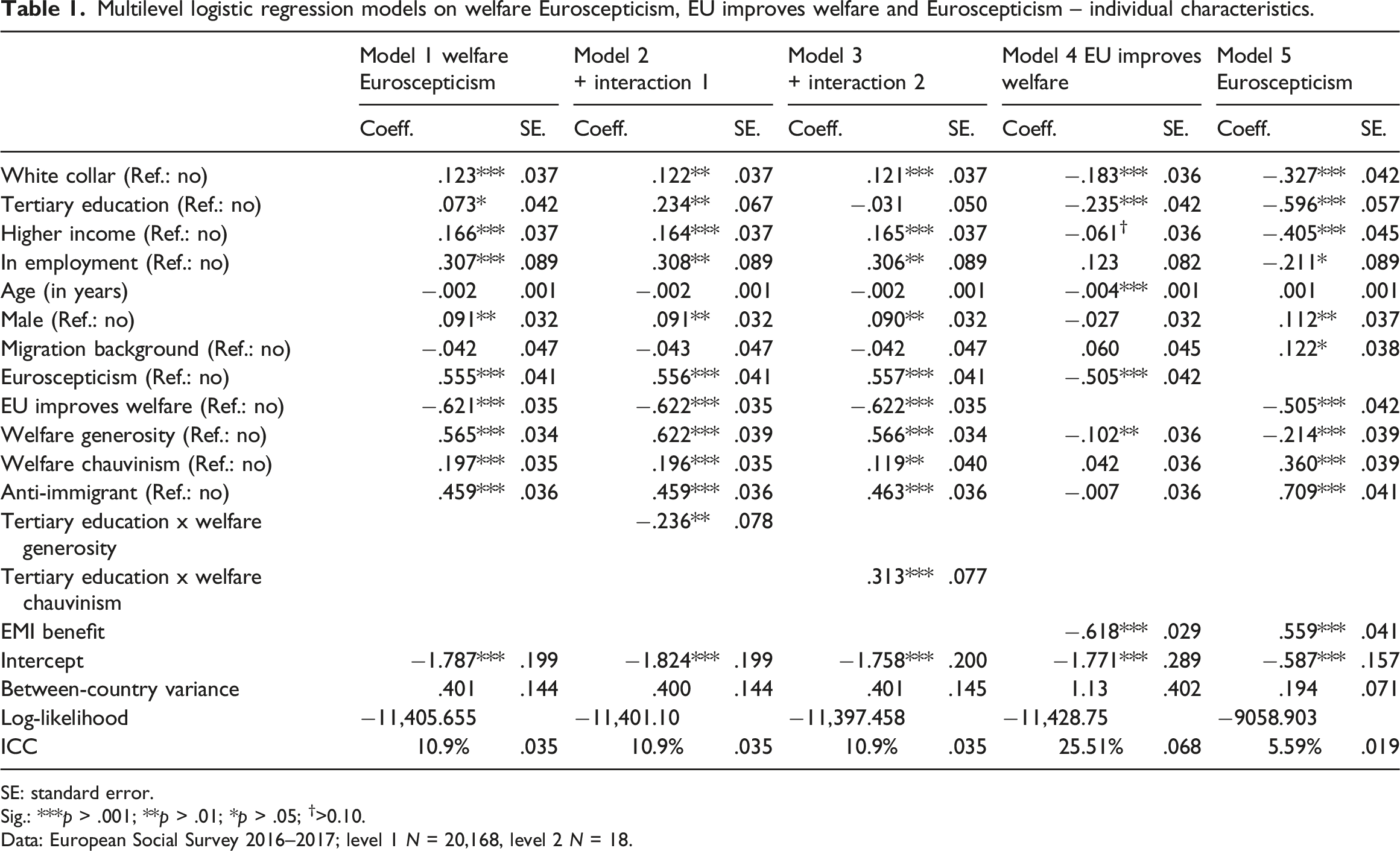
SE: standard error.
Sig.: ***p > .001; **p > .01; *p > .05; †>0.10.
Data: European Social Survey 2016–2017; level 1 N = 20,168, level 2 N = 18.
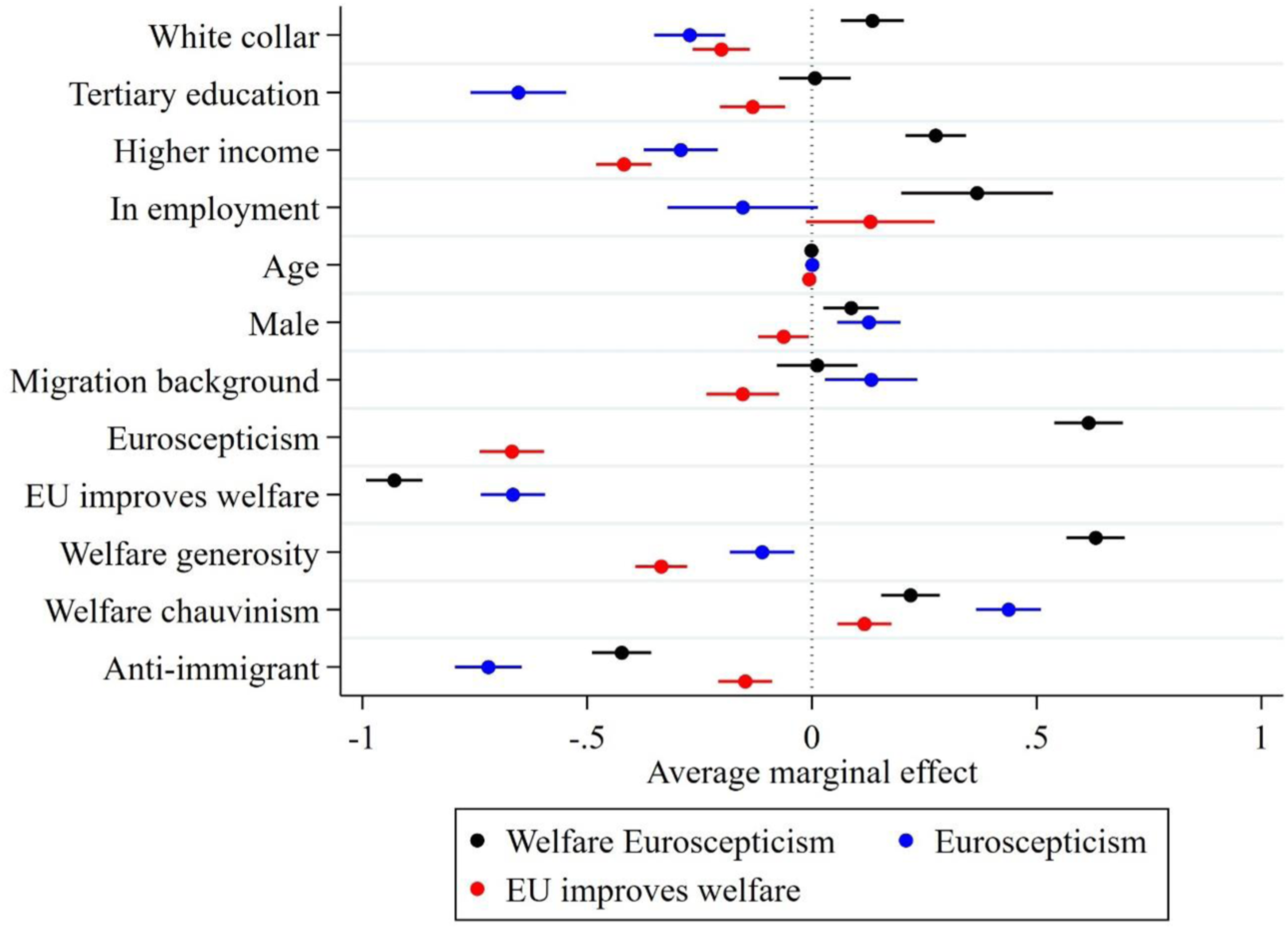
Average marginal effects for results of models 1, 4 and 5 in Table 1.
Table 1, Models 2–3 focus on the interactions between educational groups and welfare generosity and welfare chauvinism on the individual level. Due to space limitations, the main part of the article presents the results for the education cleavages only, as these seem the most surprising considering that the tertiary educated have been the most pro-EU group across member states for decades (Hakhverdian et al., 2013). The interaction terms confirm H2a and H2b according to which welfare Euroscepticism is more likely among the tertiary educated who oppose more generous welfare arrangements and welfare chauvinism. This pattern is significant for education and also for occupation, and income groups but not for employment groups (see Appendix Tables A7–1 and A7–2).
Robustness tests
To further emphasise that attitudes dynamics towards an EMI benefit proposal are more in line with welfare attitudes than traditional EU attitudes, Table 1, Models 4–5 include different dependent variables. Model 4 shows that higher SES groups are also less likely to believe that EU involvement would improve their national welfare state generosity than lower SES groups. This is important, as the latter can also be seen as a form of welfare Euroscepticism. Model 5 shows that the cleavages reverse with Euroscepticism as the dependent variable, that is, higher SES support EU membership more. These dilemmas in public opinion on general EU attitudes versus EU social policy attitudes are also visualized in Figure 1 through the marginal effects.
Regarding the control variables, Table 1, Model 1 shows that individuals who support universal welfare arrangements, are welfare chauvinist and oppose migrants from lower-income countries are more likely to be welfare Eurosceptics. And respondents who trust the EU less and respondents who do not believe that the EU improves the national welfare state are also more likely to support welfare Euroscepticism than otherwise. These results are in line with theoretical expectations. Regarding age and migration background, the results showed no significant differences. Gender affected welfare Euroscepticism significantly, with male respondents being more likely to support this policy paradigm. These effects are also visualized in Figure 1.
While Table 1 only includes logistic regression models, the results are robust using linear models too (Table A8).
Results III: Country-level results
Hypotheses tests
In the final part of the analysis, the country-level results are evaluated. Panels c–d in Figure 2 confirm H3a and H3b (and reject H4a/b) according to which the education cleavage on welfare Euroscepticism is smaller in countries with more generous and less welfare chauvinist welfare states. In particular, welfare Euroscepticism is less likely among higher SES groups in more generous and less welfare chauvinist welfare states. This pattern is also significant for occupation, and income groups but again not for employment groups. Additional Figures for these variables and the complete tables can be found in the Appendix (Figure A9, Tables A9–1 to A9–2). Multilevel logistic regression on welfare Euroscepticism – macro-level effects and interactions for tertiary education, average marginal effects with 95% confidence interval. Notes: (a) Overall effect of social expenditure, (b) Overall effect of migration policy (MIPEX), (b) Social expenditure × tertiary education, (d) Migration policy (MIPEX) × tertiary education. The models control for all individual variables included in Table 1, model 1. Data: European Social Survey 2016–2017; level 1 N = 20,168, level 2 N = 18.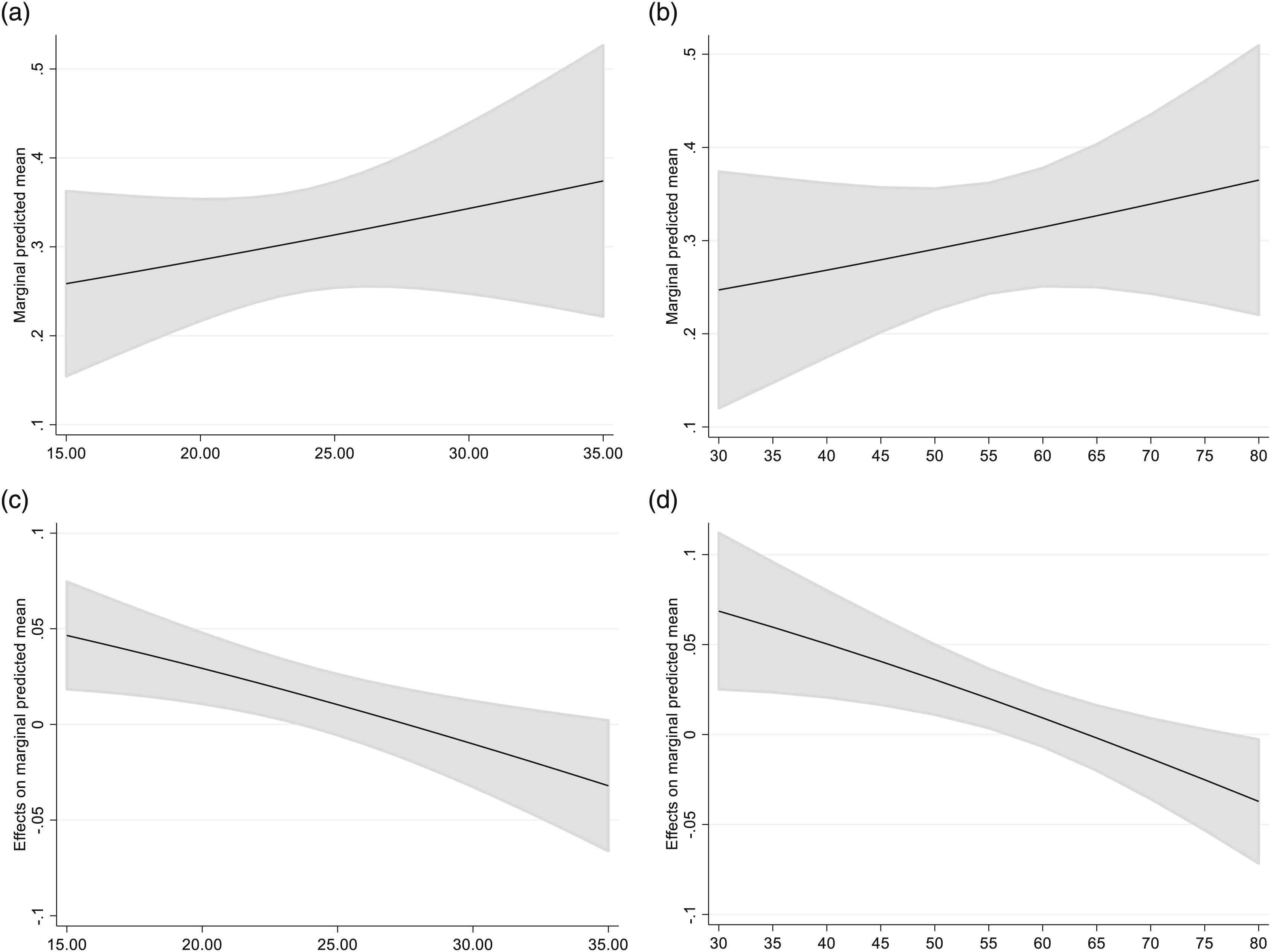
Robustness tests
Figure 2, panels a–b demonstrate that welfare Euroscepticism is more likely in countries with more generous and less welfare chauvinist welfare states which confirms the theoretical assumptions. However, these results are not significant (Table A9–1 and A9–2).
The findings from testing additional macro-level variables, including unemployment rate, GDP per capita, minimum income provision, immigrant numbers, and income inequality (Appendix, Table A10) additionally demonstrate the importance of self-interest patterns and national contexts: countries with more need for an EMI benefit show higher levels of support and vice versa. The interaction effects for these variables are not significant though.
Additional tests show that these same mechanisms around welfare generosity and welfare chauvinism do not apply to Euroscepticism as an interaction variable (Appendix, Table A11). Therefore, it can further be established that unique mechanisms apply to welfare Euroscepticism.
Discussion and conclusion
There is still little knowledge about public attitudes towards EU social policy proposals. By focusing on one of these (the possible introduction of an European minimum income benefit), this article examined the factors underlying SES conflicts regarding welfare Euroscepticism and how individual and national factors shape these. The article, therefore, contributes to the broader debate surrounding Social Europe and Euroscepticism by providing insights into how solidarity can be created related to the social legitimacy of a specific Social Europe proposal. Such research is lacking so far, mainly because of missing data that critically examines (attitudes towards) Social Europe. The article also adds a unique contribution to the special issue on welfare policy opposition since it offers new theories and empirics to this broader phenomenon that is at the heart of current political conflicts.
Scholars rarely assume that higher SES groups may hinder the extension of welfare and/or EU policies. However, the theoretical assumptions underlying this effect, namely self-interest and ideology theories, can be readily violated, particularly when the higher SES groups do not benefit from certain policies or even feel their status quo is being threatened. This article argues that welfare Euroscepticism among the higher SES groups is underestimated in many academic narratives. Thus, this study aimed to supplement the theory by (1) examining variations in the impact of SES on welfare Euroscepticism and (2) explaining the effect of SES divides on welfare Euroscepticism through individual and cross-national variation in attitudes and policies towards welfare generosity and welfare chauvinism.
The core finding is that self-interest patterns persist. First, lower SES groups favour an EMI benefit that could help lift them out of poverty and social exclusion. This finding nuances previous research that shows that lower SES groups are typically more Eurosceptic and thus indicates that there is untapped political potential for progressive, redistributive social policies on the EU level. Implementing an EMI benefit could be an opportunity to increase the EU’s perceived legitimacy among SES groups that often feel left behind by European integration. On the contrary, the findings also reveal that the traditional supporters of the EU – the higher SES groups – are more likely to oppose an EMI benefit. Hence, welfare Euroscepticism might not be an issue among the general public, but specifically among higher SES groups. This means potential conflicts may arise once the EU expands on policies that the higher SES groups are more likely to oppose.
The results have important implications for the validity of the utilitarian model. While it is traditionally the lower SES groups who are defined as the losers of European integration, this group is the winner of a European Social Union and the higher SES groups are the losers. This expands the scholarship of Brinegar et al. (2004), Gabel (1998), and De Vries (2018) on the EU and emphasizes the multidimensionality of attitudes towards the EU. The results of this article also contradict previous research arguing that ideology and cosmopolitan affinities affect redistribution on the EU level related to bailouts more than self-interest (Bechtel et al., 2014). This further emphasizes the need to look at Social Europe as a distinctive dimension of the EU that requires special attention in public opinion research. In particular, it appears as if welfare attitude patterns matter more than general EU attitude patterns when examining public opinion towards Social Europe (see also literature on differentiated integration in the EU, Leruth et al., 2019). Considering the social dimension of the EU will likely be increasingly salient in future EU Parliament elections, it will be important to monitor whether traditional voting cleavages change as a result.
Second, attitudes and policies towards welfare generosity and welfare chauvinism significantly act as a shaping factor in the relationship between SES and welfare Euroscepticism. In particular, support for more generous welfare policies and welfare chauvinism further increase welfare Euroscepticism among the higher SES groups and thus increase SES divides. Hereby, the article adds not only to the studies that try to explain public attitudes towards an EMI benefit (Baute and Meuleman, 2020; Roosma and Van Oorschot, 2020) but also to the wider institutional literature that argues that governments have the power to shape public opinion (Larsen, 2008; Svallfors, 2010). This is especially important today because studies show changes in European welfare states place greater emphasis on individual responsibilities and future policies often disregard the needs that lower SES groups have (Cantillon, 2011). Furthermore, studies also show increasing polarization regarding lower income groups and migrants’ inclusion into European welfare states (Eick, 2024). In this context, the results demonstrate the importance of tackling negative outgroup attitudes and inclusive institutions across the EU, in particular in times of increasing inequality and crisis. This, once again, speaks for strengthening an inclusive Social Europe where solidarity is at the forefront and needs to be extended beyond national borders. However, the public might prefer a less universal Social Europe, that relies on conditionality.
This article aimed to address some limitations of previous studies in the field by theorizing and modelling interactions that can take into account the multilevel structure of the data. However, certain limitations remained since important relationships could be established in this article but not the causality of the theoretical mechanisms. The ESS question on the EMI benefit proposal is also not ideal as it only covers a few dimensions of this proposal. For example, the proposal includes particular action points for improving EMI adequacy, coverage and take-up (European Commission, 2022). It would be meaningful to understand which specific dimensions different SES groups across member states oppose. Furthermore, given that the ESS only includes one EU-level policy, the analysis did not allow for testing whether the same mechanisms apply to other policies. One can speculate that higher SES groups are more likely to reject compensatory and universal social policies and rather support social investment and means-tested policies on the EU level while the opposite is the case for lower SES groups. Regardless, self-interest would still be the main rationale, and thus, this article could unveil hidden nuances regarding the public and, particularly, SES divides in the EU that are frequently overlooked in current academic and public discourse. More research is needed to understand welfare Euroscepticism better, and this study aims to showcase an example of such research.
Supplemental Material
Supplemental Material - Welfare Euroscepticism and socioeconomic status
Supplemental Material for Welfare Euroscepticism and socioeconomic status by Gianna M Eick in Journal of European Social Policy.
Footnotes
Acknowledgements
Previous versions of this article were presented at the Council for European Studies Conference in June 2021 (online), at the European Network for Social Policy Analysis Conference in August 2021 (online) and the EUSOCIALCIT Winter School ‘Social Europe after the pandemic: rights and policies’ in October 2022 in Milan. I am especially grateful for valuable comments from Alexandre Afonso, Francesco Corti, Benjamin Leruth, Hanna Schwander and the anonymous reviewers.
Declaration of conflicting interests
The author(s) declared no potential conflicts of interest with respect to the research, authorship, and/or publication of this article.
Funding
The author(s) received no financial support for the research, authorship, and/or publication of this article.

Supplemental Material
Supplemental material for this article is available online.
References
Supplementary Material
Please find the following supplemental material available below.
For Open Access articles published under a Creative Commons License, all supplemental material carries the same license as the article it is associated with.
For non-Open Access articles published, all supplemental material carries a non-exclusive license, and permission requests for re-use of supplemental material or any part of supplemental material shall be sent directly to the copyright owner as specified in the copyright notice associated with the article.
