




Abstract
The economic crisis and the unequal degree to which it has affected European Union (EU) member states have fuelled the debate on whether the EU should take responsibility for the living standards of European citizens. The current article contributes to this debate by investigating for the first time public support for an EU-wide minimum income benefit scheme. Through an analysis of data from the European Social Survey 2016, our results reveal that diverging national experiences and expectations are crucial in understanding why Europeans are widely divided on the implementation of such a benefit scheme. The analysis shows that (1) welfare state generosity and perceived welfare state performance dampen support, (2) those expecting that ‘more Europe’ will increase social protection levels are much more supportive, (3) the stronger support for a European minimum income benefit in less generous welfare states is explained by more optimistic expectations about the EU’s domestic impact and (4) lower socioeconomic status groups are more supportive of this policy proposal. These findings can be interpreted in terms of sociotropic and egocentric self-interests, and illustrate how (perceived) performance of the national welfare state and expectations about the EU’s impact on social protection levels shape support for supranational social policymaking.
Keywords
Introduction
Although the European Union (EU) was initially envisaged as an economic project, over recent decades, the union has gradually begun to intervene in social policy. Political leaders of the EU increasingly believe that a ‘Social Europe’ is indispensable for the survival of the European project. In this regard, former president of the European Commission, Jean-Claude Juncker, trumpeted the ambition to achieve a ‘social triple-A rating’ for the EU, putting social issues higher on the agenda. Due to the economic crisis and new economic governance, European national welfare states are facing increasing difficulties in maintaining their social protection systems (Hemerijck, 2012). As a result, there has been an intensification of the debate about whether the EU should take responsibility for the living conditions of European citizens, and on the necessity and feasibility of redistributive welfare mechanisms at the EU level.
One potential redistributive policy measure that is discussed in particular relates to the EU’s role in minimum income protection (Vandenbroucke et al., 2013). About 85 million Europeans (16.9% of the EU population) are currently living below the poverty line (60% of the equivalent national median disposable income after social transfers: Eurostat, 2018). To fight poverty, an adequate minimum income has been set as a priority in the European Pillar of Social Rights, stipulating that ‘everyone lacking sufficient resources has the right to adequate minimum income benefits ensuring a life in dignity at all stages of life, and effective access to enabling goods and services’ (European Commission, 2017). All EU countries 1 have developed some form of regulated, non-contributory minimum income benefit, provided to those in or at risk of poverty and lacking other means of subsistence (European Economic and Social Committee (EESC), 2013). Nevertheless, most of these national minimum income schemes are inadequate to lift people out of poverty (Frazer and Marlier, 2016). One proposal to improve the minimum income level across all EU countries suggests establishing an EU-wide minimum income benefit (Peña-Casas and Bouget, 2014).
A European minimum income (EMI) benefit might have far-reaching consequences for the redistribution of welfare within and across European societies. The implementation of such an EU-level social policy would fundamentally redraw the boundaries of solidarity along geographical, socioeconomic and institutional lines. Supranational redistributive mechanisms affect countries and categories of citizens differentially, and can give rise to new structural and political conflicts (Ferrera, 2005). Consequently, a new integration–demarcation conflict (Kriesi et al., 2008) between the so-called winners and losers from European integration is likely to emerge and to structure citizens’ preferences regarding an EMI. In this emerging conflict, the ‘losers’, who anticipate that EU involvement in social policy could decrease their current level of social protection, might advocate strict demarcation of social protection. By contrast, the ‘winners’, who are more optimistic about the impact of the EU on social welfare, might be strong supporters of an EMI.
This raises the prominent question of how we can understand the factors underlying citizens’ support for a specific policy proposal such as the EMI, and what role national institutions, experiences and expectations play in this. Concretely, the current article addresses the following two research questions: (1) To what extent is citizens’ support for an EMI structured by welfare state generosity, citizens’ evaluations of welfare state performance and expectations concerning the EU’s impact on social protection levels? (2) To what extent is the impact of welfare generosity on support for an EMI benefit mediated by expectations about the EU’s impact on social protection? To answer these questions, we analyse data from the round 8 of European Social Survey (ESS8) 2016 – the first cross-national survey to measure popular support for an EMI – by means of multilevel structural equation modelling. In doing so, this study contributes to the emerging field of opinion research on EU social policy (Baute et al., 2018b; Burgoon, 2009; Kuhn et al., 2017) and provides relevant insights into how national arrangements (and citizens’ evaluations of them) shape the social legitimacy of an EMI as a potential policy instrument for a Social Europe.
This article starts with a discussion of the policy proposal for an EMI benefit, reviewing relevant literature and formulating specific hypotheses on the drivers of public support for an EMI. Subsequently, we describe the data and methodology used and report the individual and contextual factors that shape popular support for an EMI. The last section summarizes our findings and raises some points of discussion that require further research.
Towards an EMI benefit?
In the aftermath of the economic crisis, the EU has been increasingly criticized for being preoccupied with economic policy and lacking a strong social dimension (Bailey, 2017; Fernandes and Rinaldi, 2016). In response to this criticism and to address concerns about rising populism and Euroscepticism, several policy options are being discussed, including a European unemployment benefit, an EU-wide basic income and an EMI benefit. With respect to the last of these, there is increasing awareness among policymakers that stronger coordination of minimum income schemes between EU member states would be beneficial to lifting citizens out of poverty and social exclusion. 2 To give meaning to the European Pillar of Social Rights and its principle concerning minimum income, hard law (comprising legally-binding measures) is deemed necessary (EMIN, 2017). In this respect, the EESC (2013) and social non-governmental organizations such as the European Anti-Poverty Network (EAPN) (2014) have proposed an EU Framework Directive on adequate minimum income schemes, setting common standards and indicators. This directive would establish a threshold for minimum income support that would serve as a reference point for all EU countries (European Parliament, 2017b). Different variants of this threshold are conceivable, for example, 40% or 60% of the national median equivalized income in each member state (Peña-Casas and Bouget, 2014). 3 The use of a threshold relative to the national income would allow the level of the benefit to vary across member states, taking into account the cross-national diversity in economic development (incomes and costs of living).
Crucially, a binding EU framework on minimum income protection would require unequal redistributive efforts from member states, since sizable cross-national differences exist in the current level of national minimum income benefits (Frazer and Marlier, 2016). The redistributive costs of closing the poverty gap would place the greatest burden on eastern and southern member states (Vandenbroucke et al., 2013), raising questions about whether a particular degree of European solidarity is desirable or feasible. Accordingly, to compensate member states for the unequal burden, current EMI proposals go beyond a merely regulative role for the EU and would instead establish supranational redistributive mechanisms to support less developed member states in their implementation of minimum income protection (Peña-Casas and Bouget, 2014). The European Parliament (2017b) is at present investigating the possibility of moving towards such a benefit, supported by a European Fund. In sum, an EMI would be financially supported by EU member states, depending on their national income, with the aim of providing a means-tested cash benefit based on a common threshold and guaranteeing a decent standard of living for all European citizens. This EMI system would not require full harmonization of national social security systems across Europe (the so-called ‘one-size-fits-all model’). Member states could still set higher standards and top up the EMI with national payments.
The potential consequences of this policy proposal are twofold. On the one hand, an EMI would strengthen social rights and EU social citizenship (Seeleib-Kaiser, 2017) and raise the profile of the EU as provider of social protection. On the other hand, the implementation of an EU-funded minimum income benefit implies a cross-border European budgetary transfer mechanism. It might therefore be more controversial than non-redistributive EU policies. The redistributive component would impose a new way of risk sharing for poverty among all Europeans, therefore partly redrawing the boundaries of solidarity. This double-sided nature of the EMI raises the question of how the policy would be perceived by citizens.
Diverging public support for an EMI benefit
A (partial) shift of the boundaries of solidarity from the national to the supranational level has far-reaching repercussions that affect citizens and countries differentially. New policy measures such as an EMI might therefore give rise to new societal conflicts between advocates of the demarcation of welfare systems along national lines and proponents of the integration of European welfare systems (Kriesi et al., 2008). The purpose of the current article is to gain deeper insight into the conditions under which citizens would support or oppose an EMI system. Because social protection is predominantly a nationally driven policy area, the desirability of such a system is likely to be evaluated through a national lens. Therefore, we focus on the importance of the generosity of national welfare systems, citizens’ evaluations of the performance of the welfare state and expectations about the EU’s impact on national welfare.
To understand the impact of welfare generosity, expectations and perceived welfare state performance, we rely on a long-standing research tradition stressing that individuals’ support for European integration is fundamentally driven by economic self-interest (Anderson and Reichert, 1996; Gabel, 1998; Gabel and Whitten, 1997). The rationale for this is that European integration profoundly affects citizens’ economic life chances (Marks and Hooghe, 2003). People who expect that European integration will benefit their personal situation and the living conditions of their fellow citizens are more likely to see further integration in a positive light. Previous research indeed confirms that subjective evaluations of the costs and benefits of European integration are strong determinants of support for European integration (Abts et al., 2009; McLaren, 2006). By extension, this implies that a person’s subjective assessment of whether EU involvement constitutes a threat or an opportunity for national social welfare could be a crucial driver of support for an EMI. The establishment of an EU-level minimum income benefit is likely to be popular among those expecting that ‘more Europe’ will improve social benefits. This argument is supported by previous work showing that support for European decision-making regarding welfare policies is much lower when citizens fear that integration will result in a loss of social protection (Mau, 2005). We therefore hypothesize that support for an EMI is greater among citizens who expect that more EU decision-making will increase the level of social protection (H1).
Also in line with arguments based on self-interest, attitudes towards an EMI will be formed taking into consideration existing national provisions, since national welfare states are currently the primary providers of social welfare. The generosity of national provisions in particular could operate as a yardstick to evaluate whether an EMI is desirable. The more generous provisions are, the greater the extent to which citizens will feel protected by their national welfare state, and will consequently consider EU-level benefits less effective or needed. This theory is supported by previous studies showing that citizens are less supportive of EU competences over social policy in EU member states where social spending is higher (Beaudonnet, 2013; Eichenberg and Dalton, 2007; Mau, 2005; Ray, 2004). Similarly, citizens give much lower priority to social objectives as an EU agenda item if they live in a country with higher net replacement rates for the long-term unemployed and higher government spending on policies targeting labour market risks (Burgoon, 2009). Based on these findings, we hypothesize that in more generous national welfare states, support for an EMI benefit scheme is lower (H2a). The mechanism that drives this effect is that citizens in generous welfare states are more fearful of a detrimental effect from Europeanization on domestic social protection (Baute et al., 2018a; Ray, 2004). Therefore, we further hypothesize that negative expectations about the EU’s impact on social protection act as a mediating factor in the relationship between objective welfare generosity and support for an EMI benefit scheme (H2b).
Building on the idea that attitudes towards EU social policies are formed in the light of existing national provisions, popular support for an EMI is likely to be shaped not only by the objective generosity of a country’s welfare state, but also by the subjective evaluations individuals make of its performance. The cost–benefit ratio of an EU-level minimum income benefit is considered most favourable if citizens evaluate their national welfare provisions as inadequate. In this case, people are likely to be more open to transferring social competences to the European level, and thus consider the EMI as an opportunity to enhance social protection. By contrast, if people believe that their national welfare system provides enough coverage, the implementation of an EMI may symbolize a threat to institutionalized national solidarity. By consequence, we hypothesize that positive evaluations of the performance of the national welfare state will diminish support for an EMI (H3). H2a and H3 thus both refer to the role of the national welfare state in shaping support for an EMI, but they operate at different levels. Whereas H2 involves the objective institutional context at the country level, H3 relates to subjective evaluations of the institutional context. 4
Subjective evaluations and experiences do not develop independently from the wider social structure, but are embedded within social-structural factors that can in turn shape support for an EMI. Self-interest theory traditionally considers individuals with higher levels of income, education and occupational skills as the so-called winners from European integration (Brinegar et al., 2004; Gabel, 1998). These people can easily use their skills, knowledge and capital to benefit from the opportunities offered by Europeanization and see their life chances as enhanced in an integrated European market (Kriesi et al., 2008). In the specific case of support for an EMI, however, the relationship with SES may be reversed. Given that the objective of an EMI is to protect social rights and fight poverty, this policy would mainly benefit socioeconomically vulnerable groups and those at greater risk of poverty. Accordingly, lower SES groups should be the strongest defenders, as they are more likely to be beneficiaries of an EMI. Previous research suggests that those at greater risk of poverty, unemployment and illness are typically more in favour of government spending on social policies (Hasenfeld and Rafferty, 1989; Svallfors, 1997) and we assume that the same logic can be extrapolated to support for an EU-level minimum income protection scheme. Therefore, we hypothesize that citizens with lower SES (measured by education, occupational status, income and welfare dependency) are more in favour of an EMI (H4).
Public attitudes towards an EMI may furthermore be structured along a political left–right divide regarding the desirability of redistribution and the role of the government. In this respect, Vandenbroucke (2013) argues that national welfare states and a European Social Union ultimately aim to achieve similar objectives, and that Europeanization should support the substantive development of national welfare states. In line with this logic, support for domestic redistribution can spill over to support for EU-level redistributive policies (Baute et al., 2019). A large number of studies have focused on the relationship between left–right ideology and support for EU social policymaking, and have found that left-leaning people and those with stronger egalitarian values are indeed more enthusiastic about the Europeanization of social policy (Baute et al., 2019; Ciornei and Recchi, 2017; Gerhards et al., 2016; Ray, 2004; Vandenbroucke et al., 2018). Accordingly, we expect that egalitarian values increase support for the establishment of an EMI (H5).
Finally, identity and a sense of belonging are important elements in citizens’ willingness to share with others (Börner, 2013). The development of formal systems of solidarity within nation states implied locking in insiders and preventing outsiders from entering. The internal bonding of insiders was aided by means of external bounding vis-à-vis outsiders (Ferrera, 2005; Rokkan, 1975). Similarly, EU-wide solidarity would be facilitated by a European shared identity that overrides different economic interests (Büchs, 2007; Dougan and Spaventa, 2005). Building on this identity approach, previous empirical studies confirm that citizens with a more pronounced European identity are more willing to support equal social rights for EU citizens (Gerhards and Lengfeld, 2015), member state solidarity (Kuhn et al., 2017; Stoeckel and Kuhn, 2017) and European decision-making over social policy in general (Berg, 2007; Mau, 2005). We therefore hypothesize that citizens with a stronger European identity are more willing to support an EMI (H6).
Data and methods
Data
To test the hypotheses, we use data from round 8 of the European Social Survey (ESS8), held in 2016 (www.europeansocialsurvey.org; European Social Survey Round 8 Data, 2016). Because the survey question on an EMI scheme explicitly refers to the EU as the implementing body, this item was not fielded in the participating non-EU countries. This results in our sample including 18 of the 23 countries in the ESS8 (N = 35,450): Austria (AT), Belgium (BE), Czech Republic (CZ), Estonia (EE), Finland (FI), France (FR), Germany (DE), Hungary (HU), Ireland (IE), Italy (IT), Lithuania (LT), the Netherlands (NL), Poland (PL), Portugal (PT), Slovenia (SI), Spain (ES), Sweden (SE) and the United Kingdom (UK). The survey contains responses obtained via face-to-face interviews conducted among probability samples of the population aged 15 and over, resident in private households. National response rates in the ESS8 range from 30.6 percent in Germany to 69.6 percent in Poland.
Variables
Individual-level variables
The ESS8 included, for the first time, an item assessing support for an EMI. The question wording (read out to the respondent as well as displayed on a show card) mentions three important features of this benefit scheme: (1) The purpose is to guarantee a minimum standard of living for all poor people in the EU, (2) The level of social benefits people receive will be adjusted to reflect the cost of living in their country, (3) The scheme would require richer EU countries to pay more into it compared with poorer EU countries. Respondents were asked ‘Overall, would you be against or in favour of having such a European Union-wide social benefit scheme?’ Answers were given on a 4-point scale, ranging from 1 = ‘strongly against’ to 4 = ‘strongly in favour’.
Citizens’ expectations about the EU’s impact on social security are measured by the following item: ‘If more decisions were made by the European Union rather than by national governments, do you think the level of social benefits and services provided in [country] would become higher or lower?’ Responses were made on a 5-point scale, and recoded to range from 1 = ‘much lower’ to 5 = ‘much higher’.
In line with previous research, we measure subjective welfare state performance by means of the perceived standard of living of different welfare target groups (Haugsgjerd and Kumlin, 2019; Van Oorschot and Meuleman, 2012). A latent variable is constructed of the evaluated overall standard of living in the country of (1) pensioners and (2) the unemployed. Responses were given on 11-point scales ranging from 0 = ‘extremely bad’ to 10 = ‘extremely good’.
We use four different indicators of socioeconomic status (SES). First, education is categorized as low (lower-secondary or less), medium (upper-secondary) or high (advanced vocational and tertiary), based on the International Standard Classification of Education (ISCED) classification for the highest educational qualification achieved. Second, occupational status is included as a categorical variable based on a slightly modified version of the Erikson-Goldthorpe-Portocarero (EGP) scheme (Ganzeboom et al., 1992), comprising (1) higher service class, (2) white collar, (3) blue collar, (4) self-employed, (5) unemployed and (6) a residual category including those who are retired and other non-employed people. Third, the income level of respondents is assessed by equivalent household income, using the Organisation for Economic Co-operation and Development (OECD)-modified equivalence scale (OECD, 2005). To enable comparisons of income between countries, the variable is categorized per country into four quartiles (as well as a category for missing values). This operationalization captures the relative income position of households within countries. Fourth, welfare dependency is measured by a dummy indicating whether respondents’ main income is a social benefit. This includes unemployment/redundancy benefits or any other social benefits, but excludes pensions.
Egalitarianism is operationalized as a latent variable consisting of three items. Respondents were asked to indicate to what extent they agree with the following statements: (1) ‘Large differences in people’s incomes are acceptable to properly reward differences in talents and efforts’; (2) ‘For a society to be fair, differences in people’s standard of living should be small’; and (3) ‘The government should take measures to reduce differences in income levels’. Responses range from 1 = ‘agree strongly’ to 5 = ‘disagree strongly’ and were recoded so that high scores indicate stronger endorsement of egalitarianism. The validity of the measurements of ‘egalitarianism’ and ‘perceived welfare state performance’ was tested by means of confirmatory factor analyses (CFA). The fit of the CFA model is adequate and all factor loadings have values larger than 0.49, indicating that the items are sufficiently valid and are reliable indicators of the concepts they are intended to measure (see Supplemental Appendix Table B).
European identity is measured by an 11-point scale tapping into citizens’ emotional attachment to Europe, where 0 = ‘not at all emotionally attached’ and 10 = ‘very emotionally attached’.
Finally, we control for age and gender (0 = man). Descriptive statistics of individual-level variables are provided in Supplemental Appendix Table A.
Country-level variables
We measure the generosity of the national welfare system by the minimally guaranteed net disposable income for a non-working single person as a percentage of the median equivalized net income for each country. This is taken from CSB-Minimum Income Protection Indicators dataset for the year closest to the ESS data collection: 2017 (Marchal et al., 2019). Because Italy did not have a national minimum income scheme at the time, it was excluded from the multilevel analysis. As a robustness check including Italy, we used social spending as a percentage of gross domestic product in 2016 (Eurostat code: spr_exp_sum) as an alternative indicator of welfare state generosity. Given that the wealthier member states are less likely to benefit from EU-level redistributive policies, we control for national economic wealth, measured by gross domestic product per capita in 2016 (Eurostat code: nama_10_pc). Descriptive statistics of the country variables are provided in Supplemental Appendix Table C.
Statistical modelling
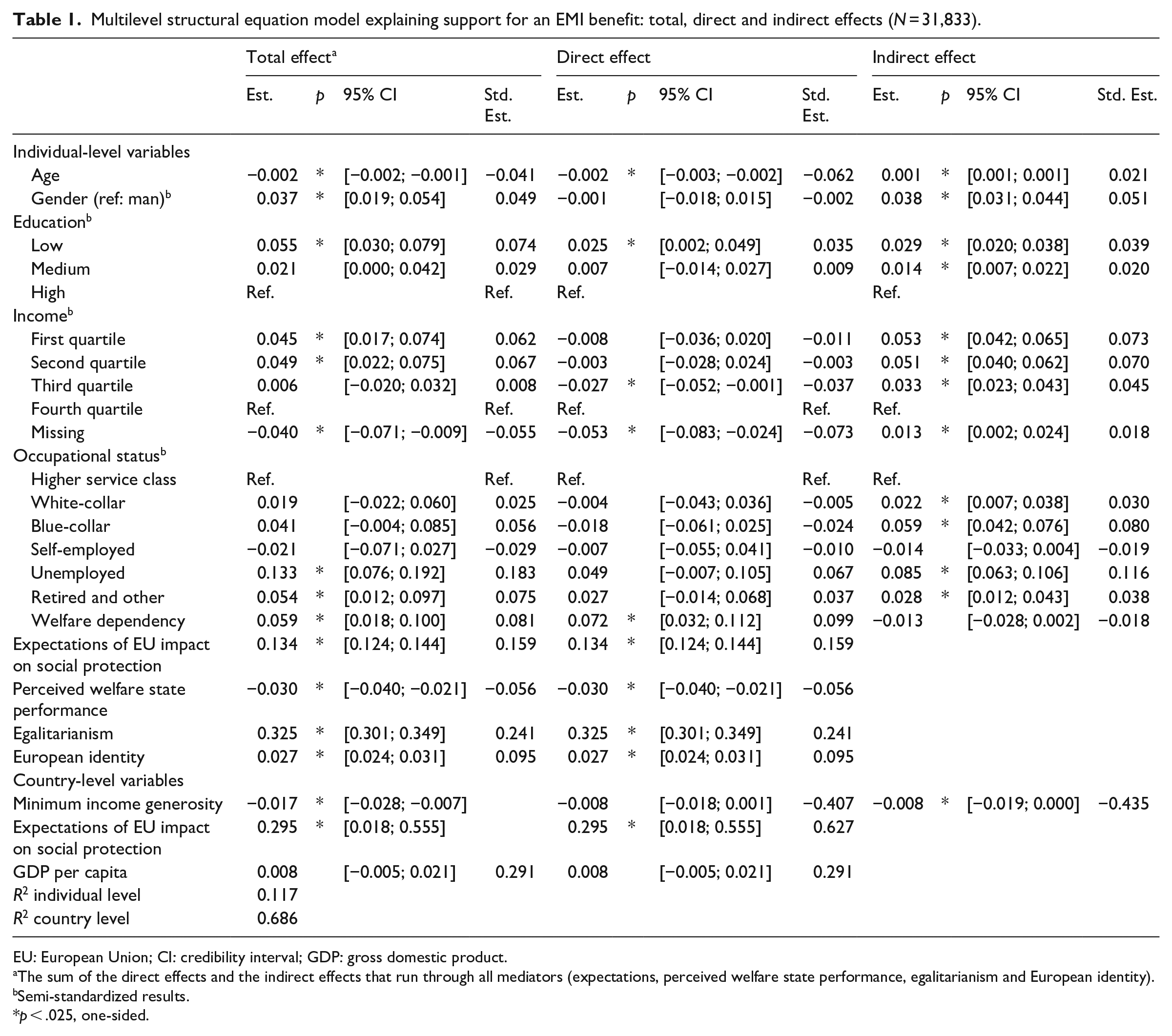
Multilevel structural equation modelling (MSEM) is an appropriate technique to model the two-level mediation relationships implied by the hypotheses (Meuleman, 2019). 5 In a multilevel setting, mediation models can be more accurately estimated using a structural equation modelling (SEM) approach compared with traditional stepwise approaches (Preacher et al., 2010). An additional advantage of SEM over traditional regression modelling is that it allows estimation of latent variables, thereby correcting for random measurement error in the model (Byrne, 2012). A multilevel approach is warranted, as 12.33 percent of the variance in the dependent variable is attributable to country-level differences. As the analysis is based on only 18 countries, a Bayesian estimator (with non-informative priors) was used, in order to improve the accuracy of the parameter estimates and standard errors (Hox et al., 2012). The Bayesian approach yields credibility intervals that have better coverage than maximum-likelihood based confidence intervals, especially in the case of a small N at level 2 (Bryan and Jenkins, 2015). For the Bayesian estimation, two chains of the Gibbs sampler were requested and the Gelman-Rubin criterion was used to determine convergence (the cut-off value was set to 0.01) (Gelman et al., 2014). The number of iterations was set to 10,000 to facilitate convergence, and a thinning factor of 50 used to reduce autocorrelations. Because the Bayesian approach provides little information about the global model fit, we re-estimated the model using robust maximum likelihood estimation to obtain an indication of fit indices. The fit indices of the model estimated using maximum likelihood show that the model fits the data adequately (χ2 = 362.876; df = 56; CFI = 0.946; SRMRwithin = 0.010; SRMRbetween = 0.103; RMSEA = 0.019). All the analyses were performed using Mplus version 7.3 (Muthén and Muthén, 2012). We include citizens’ expectations about the EU’s impact on social protection, perceived welfare state performance, egalitarianism and European identity as mediating variables at the individual level because they are embedded within social-structural variables (see Figure 1). 6 Table 1 shows the total effects, the direct effects and total indirect effects that run through the mediating variables.
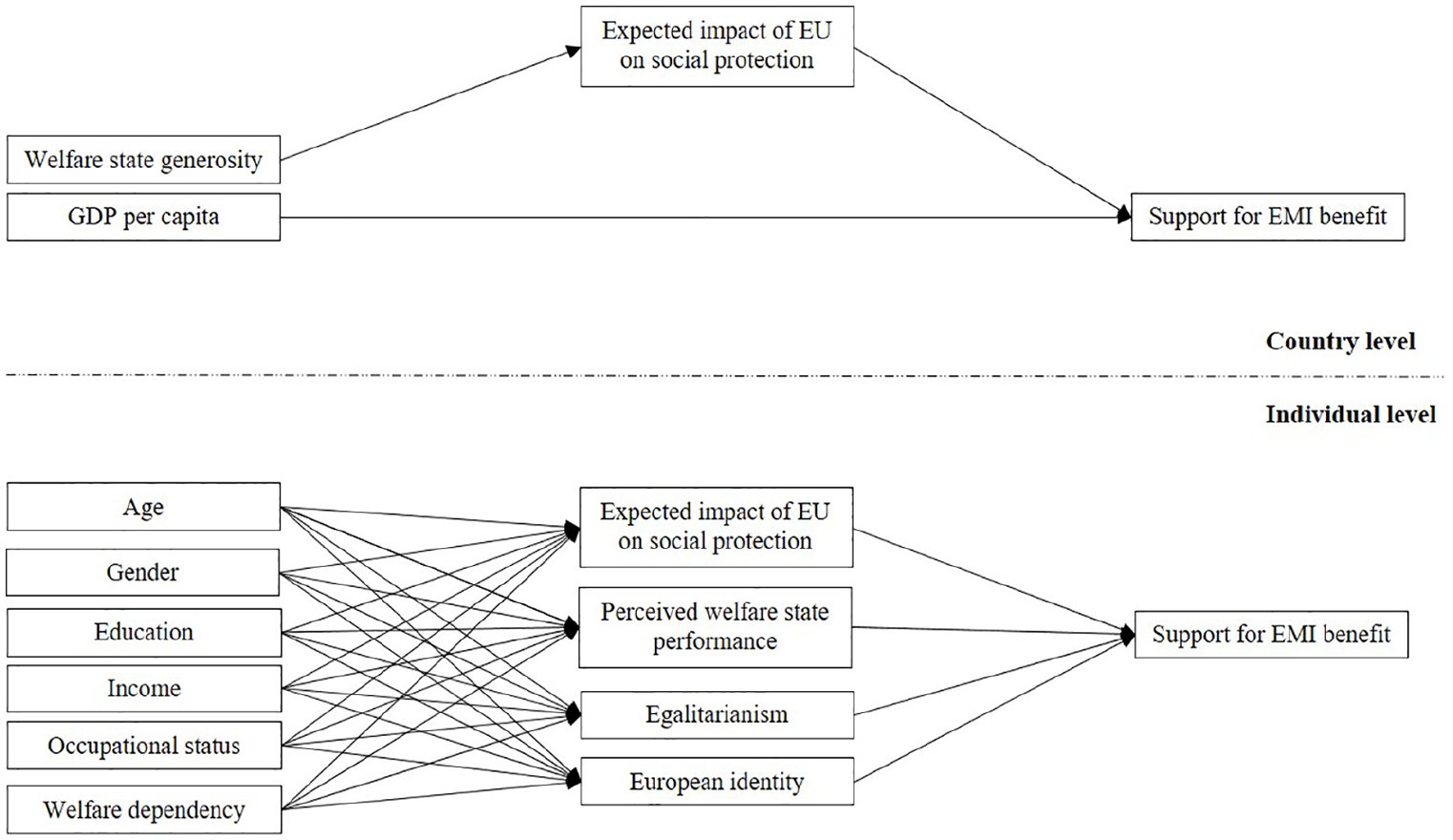
Multilevel structural equation model of support for a European minimum income benefit.
Multilevel structural equation model explaining support for an EMI benefit: total, direct and indirect effects (N = 31,833).
EU: European Union; CI: credibility interval; GDP: gross domestic product.
The sum of the direct effects and the indirect effects that run through all mediators (expectations, perceived welfare state performance, egalitarianism and European identity).
Semi-standardized results.
p < .025, one-sided.
Results
The majority of respondents in the 18 EU member states express support for an EMI benefit: 66.7 percent are (strongly) in favour of this policy measure. Nevertheless, as Figure 2 illustrates, sizable cross-national differences exist, with support for an EMI scheme ranging from 48 percent in Austria to 91.1 percent in Portugal. The general pattern is that respondents in southern and eastern EU countries are the most supportive of an EMI, whereas those in the north and west are more ambiguous.
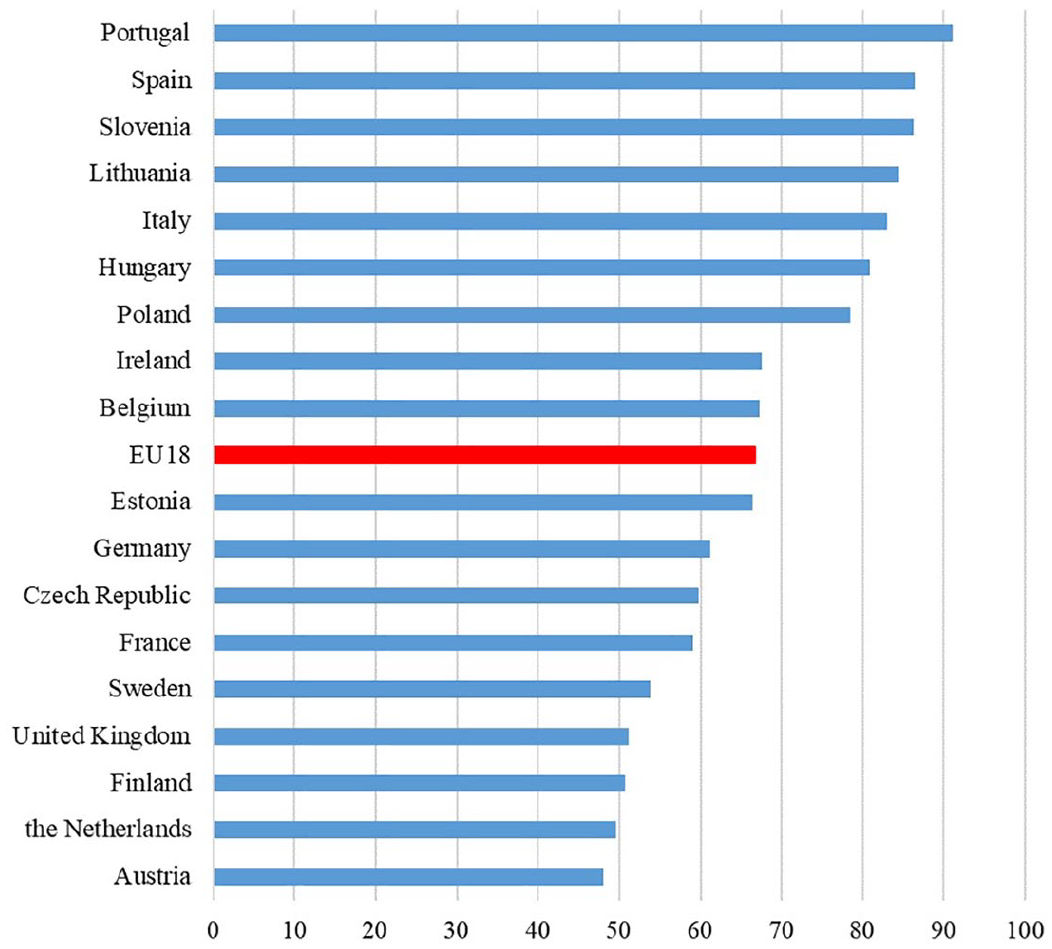
Percentage in favour or strongly in favour of a European minimum income benefit.
Table 1 displays the results of the MSEM, showing the (un)standardized parameter estimates (the median of the posterior distributions), a one-sided significance test and 95 percent credibility intervals. Fully standardized estimates are presented for the continuous variables. These can be interpreted as the expected number of standard deviations by which the dependent variable changes for an increase of one standard deviation in the independent variable. For the effects of categorical variables, semi-standardized estimates are shown (thus indicating by how many standard deviations of support a particular category differs from the reference category). For convenience, we first discuss the results of the individual-level variables and subsequently discuss those at the contextual level.
The results show that subjective expectations about the EU’s impact on national welfare are an important driver of support for an EU-wide social benefit scheme. Those who believe that more European decision-making will increase the level of social benefits and services in their country are significantly more willing to support this measure (β =−0.159; one-sided p < 0.001). This confirms hypothesis 1 and indicates that hopes and fears about the EU’s impact on national welfare are a crucial factor in understanding public contestation over Social Europe.
The strongest effects are found at the contextual level. The generosity of the current national minimum income benefit has a negative total effect, meaning that in countries where more generous minimum income protection exists, popular demand for the establishment of an EMI benefit is weaker (H2a). Figure 3(a) illustrates this relationship. For instance, in the Netherlands, Finland and Austria, relatively high minimum income levels are combined with relatively low levels of support for an EMI.
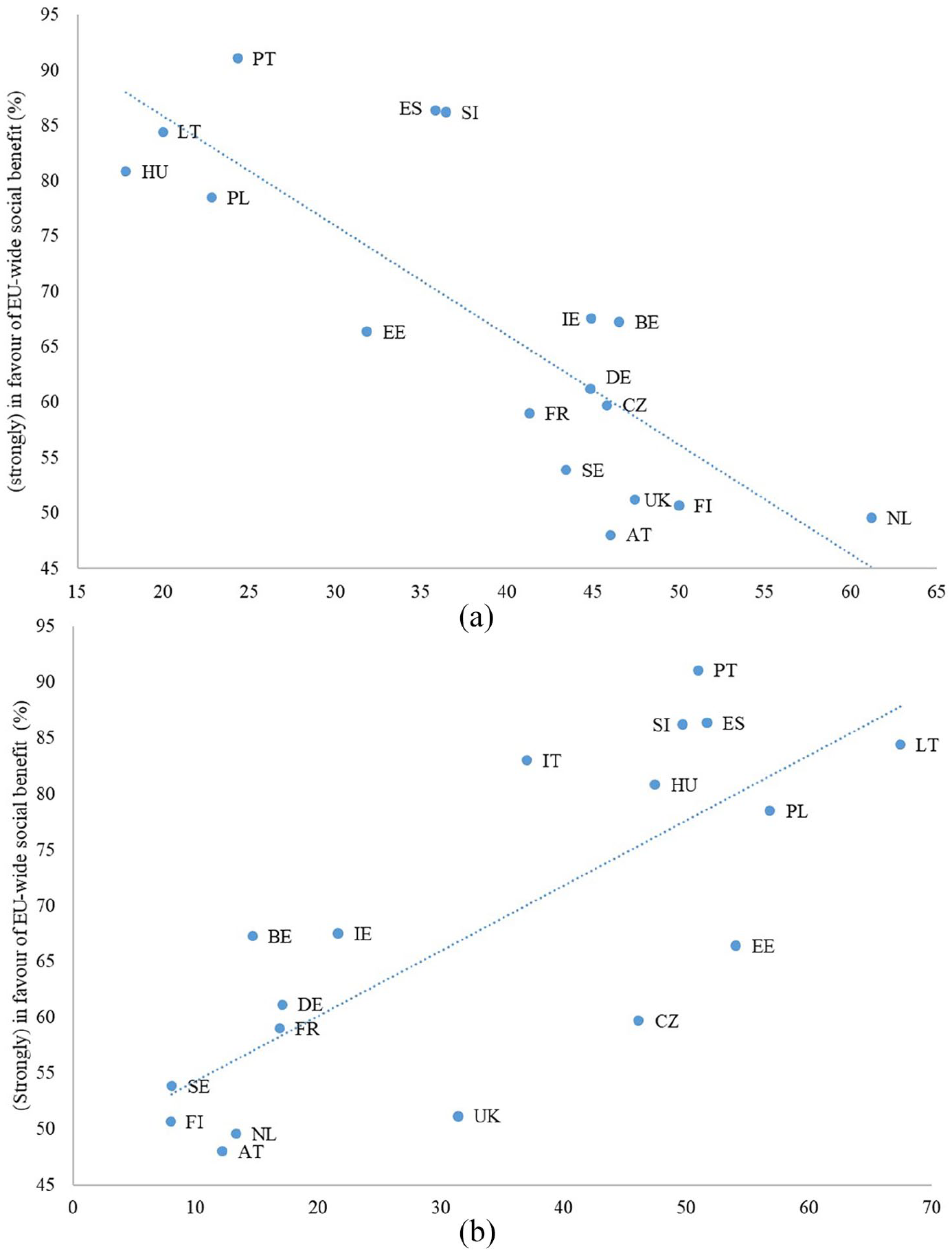
Country means of support for an EU-wide social benefit scheme by (a) Net minimum income for a non-working single person as percentage of the median equivalized net income and (b) Level of social benefits and services will become (much) higher if more decisions are made by the EU (%).
The strong relationship between welfare state generosity and support is, however, fully mediated by the average expectations of the EU’s impact on social security in a country (H2b). This is indicated by the strong indirect effect (β =−0.435; one-sided p = 0.021) and the absence of a significant direct effect. The negative relationship between the generosity of a country’s existing minimum income scheme and support for an EMI can thus be explained by the fact that in welfare states with the least generous minimum income protection, expectations of an upwards convergence in social protection levels due to European integration are much more widespread. Figure 3(b) illustrates that in the strongly developed Nordic welfare states (Sweden and Finland), few respondents expect Europeanization to increase social protection levels, whereas in the eastern and southern European countries, respondents more often see the EU as an agent that could improve social protection. In these countries, high expectations of the EU’s potential clearly go hand in hand with high levels of support for an EMI. 7
At the same time, differences in support for an EMI are also explained by individual evaluations of national welfare state performance. Citizens who perceive the standard of living of target groups as adequate are significantly less in favour of an EU-wide benefit scheme (H3).
Furthermore, the total effects of SES indicators show that SES has only a moderate explanatory power. The effects nevertheless all point in the same direction: citizens with a lower SES are those most in favour of an EMI (confirming H4). The low-educated are significantly more in favour of an EU-wide social benefit scheme compared with higher educated citizens. Furthermore, citizens with lower income levels are more supportive than those belonging to the highest income quartile in their country. The unemployed and the ‘retired and others’ group are also significantly more in favour of an EU-wide benefit scheme compared with higher service class workers. Finally, citizens who are dependent on a social benefit as their main income show higher levels of support for implementing an EMI. It should be noted that the effects of SES are partly mediated by differences in expectations about the impact of EU decision-making on social protection, perceived welfare state performance, egalitarianism and European identity, as indicated by the significant indirect effects. Specific indirect effects of SES indicators via each of these mediating variables are reported in Supplemental Appendix Table D.
With regard to the role of ideology, the results show very clearly that citizens with stronger egalitarian values are much more supportive of an EU-wide benefit scheme than those with less egalitarian values. This finding is in line with our expectations (H5) and confirms previous empirical research, which has found a spillover effect of egalitarian values to support for various EU social policy instruments (Baute et al., 2019; Ciornei and Recchi, 2017). Finally, citizens’ support is much higher if they have a strong European identity (H6). This implies that if citizens do not identify as Europeans, far-reaching EU policies have little chance of receiving strong public support. Overall, the model explains only 11.7 percent of the individual variance in support for an EMI, whereas it explains 68.6 percent of the country-level variance.
Discussion
Against the backdrop of rising Euroscepticism, various policy proposals have been made to strengthen the social dimension of the EU and raise its profile as a provider of social protection. Nevertheless, there is little knowledge about public attitudes towards EU social policy instruments. Using data for 18 countries from the 2016 ESS, we examined the factors underlying citizens’ support for a proposed EMI benefit. Our study contributes to the wider debate surrounding ‘Social Europe’ by providing insights into the role of national welfare institutions and expectations about the EU-welfare nexus in creating social legitimacy for a specific EU-level social policy proposal.
Our results reveal that citizens’ expectations, welfare state generosity and subjective welfare state performance evaluations are crucial factors in explaining the conditions under which Europeans would support the establishment of an EMI. The findings resonate with economic self-interest theory (Gabel, 1998) in three different ways. First, subjective expectations about the EU’s impact on social protection levels are a major driver of public support. This is in line with previous work that shows general support for European integration is strongly influenced by subjective evaluations of its costs and benefits (Abts et al., 2009; McLaren, 2006). If citizens expect that ‘more Europe’ will increase social protection levels, the establishment of an EMI is considered more attractive. Expected gains or losses with regard to social protection levels translate into diverging levels of support for an EMI within as well as between EU countries. Second, welfare state generosity and perceived welfare state performance can dampen support for an EMI. At the individual level, positive evaluations of welfare state performance go hand in hand with a stronger reluctance to support an EMI. At the contextual level, support for an EMI is lower in more generous welfare states, a finding that is explained by the more pessimistic expectations about the EU’s domestic impact in the latter. By contrast, less generous national minimum income systems tend to instigate positive expectations about the EU’s potential to increase social protection, which in turn creates a support base for the EU’s engagement in providing adequate minimum incomes. Third, the lower SES groups – who are more likely to gain from an EMI – are indeed more supportive of this policy proposal. However, the explanatory power of SES is relatively modest, which is consistent with previous studies on citizens’ attitudes towards EU social policymaking (Gerhards et al., 2016; Mau, 2005).
When we compare the self-interest mechanisms behind support for an EMI, it appears that expectations about the EU’s potential impact on the welfare system explain more than (perceived) welfare state performance and objective SES indicators. Citizens evaluate the desirability of an EMI – and possibly their willingness to share risks and resources with other Europeans more generally – from a sociotropic point of view. They thus consider it mainly in the light of the collective benefits for their overall welfare system, rather than for themselves as individuals. This finding suggests that SES, which is often used to measure egocentric self-interest, may not be the best way to assess whether cost–benefit considerations structure public attitudes towards European integration issues.
This study furthermore makes an important empirical and methodological contribution by applying a multilevel structural equation modelling framework. Previous research that has analysed the impact of the institutional context on public opinion towards social policy typically has not modelled the underlying mechanisms, in our case, the expectations that prevail in a country about the EU’s impact on domestic social protection. We therefore strongly encourage researchers to conduct analyses that unravel the causal chain of how national context influences public opinion, for which a multilevel structural equation approach is well-suited (Preacher et al., 2010). Given the benefits of using a Bayesian estimator in studies with a small number of level-2 units (Hox et al., 2012), we also strongly recommend its use in future studies. In addition, future research could further explore to what extent the national context moderates the impact of perceived welfare state performance, expectations and SES.
Finally, this study reveals important implications for the EU’s role in income protection. The large cross-national variation in support indicates that European decision-making in social policy will remain contested, given the diversity of national welfare systems within the EU. Moves towards further harmonization of social welfare are blocked by precisely the existing diversity in protection systems, leaving policymakers in a catch-22 situation. Our findings indicate that diverging expectations about how the EU will affect social protection levels in the future are the crucial factors challenging the legitimacy of the integration process in the social area. Creating more optimistic expectations about the EU’s potential to strengthen social protection is a necessary condition for European leaders to secure public support for EU social policy measures such as an EMI. At the same time, our finding that lower SES groups are more in favour of an EMI benefit nuances previous research that shows lower SES groups are typically more Eurosceptic, and indicates that the implementation of such a policy could offer an opportunity to increase the EU’s perceived legitimacy among social groups that may feel left behind by the European project.
Supplemental Material
Baute_supplementary – Supplemental material for Public attitudes towards a European minimum income benefit: How (perceived) welfare state performance and expectations shape popular support
Supplemental material, Baute_supplementary for Public attitudes towards a European minimum income benefit: How (perceived) welfare state performance and expectations shape popular support by Sharon Baute and Bart Meuleman in Journal of European Social Policy
Footnotes
Funding
The author(s) disclosed receipt of the following financial support for the research, authorship and/or publication of this article: This work was supported by the International Research Infrastructure programme of the Research Foundation FWO – Flanders (Grant Number: I001519 N) and the H2020 Marie Skłodowska-Curie Actions (Grant Number 840191).
Supplemental material
Supplemental material for this article is available online.
Notes
References
Supplementary Material
Please find the following supplemental material available below.
For Open Access articles published under a Creative Commons License, all supplemental material carries the same license as the article it is associated with.
For non-Open Access articles published, all supplemental material carries a non-exclusive license, and permission requests for re-use of supplemental material or any part of supplemental material shall be sent directly to the copyright owner as specified in the copyright notice associated with the article.
