



Abstract
In the twentieth century national social policies stabilized the European state systems, favouring domestic concordance and citizens’ support to the nation-building process. Welfare institutions have historically served this key political function also in federal systems, where social citizenship has been used as a tool to foster unity. In contrast, even though the EU devotes a consistent part of its (however limited) budget to social cohesion and inclusion programmes, it takes little credit for such efforts. Building on original survey data on public opinion collected in 2019 across ten EU countries, this article shows that, indeed, only a limited number of citizens are aware of the social role played by the EU in their local community. On the other hand, it demonstrates that citizens’ awareness of EU programmes strengthens the individual perception of power resources stemming from euro-social initiatives, the feeling of ‘being heard’ by the EU and, ultimately, the support for the European integration project as a whole. By implication, increasing the relevance and visibility of euro-social programmes could possibly reinforce the very foundations of the EU.
Introduction
Since its launch in the 1980s, Cohesion Policy (CP) constitutes one of the most relevant and tangible expressions of the social dimension of the European Union (EU) (Ferrera, 2005; Donati, 2018). EU investments in regional cohesion and social inclusion are addressed in particular to the so-called ‘losers’ of European integration: lower-skilled individuals who risk being penalised by the development of the internal market (Bachtler et al., 2013). However, the EU seemingly fails to win the hearts of the left behind and of EU citizens more broadly. Although research on the matter has reached mixed results, a recent study found a negligible effect of the intensity of CP on the degree of regional support for the EU: citizens’ perception of the European project is not nurtured by the amount of EU funds spent in the region where they live (López-Bazo, 2022). In other words, even though the EU devotes a consistent part of its (however limited) budget to programmes aimed at enhancing social cohesion and inclusion, little credit goes to the EU directly for its efforts in the social sphere (Madama, 2019).
Why is this the case? And what are the consequences for citizens and for the European integration process? In this article, we claim that this is not necessarily due to a lack of effectiveness of these programmes, nor to a lack of appreciation on the part of European citizens for supranational social policies. Rather, we point to the low visibility of CP and, consequently, to citizens’ limited awareness of its existence. 1 Despite the presence of European programmes aimed at benefiting (vulnerable) citizens, the EU remains largely invisible to them, also because of the limited reach of regional funding (Schraff, 2019). Therefore, it misses out on a major source of socio-political stabilisation and self-legitimation.
While there is an exhaustive strand of literature on the impact of CP on the economic development of regions (for example, Becker et al., 2010) and on the position of political parties regarding EU integration (Gross and Debus, 2018), the limited visibility of EU social programmes has been largely overlooked in the academic debate. Conversely, EU institutions are well aware of the issue (Eurobarometer, 2019, 2021). Therefore, the European Commission (EC) has become extremely active on this front to ‘communicate Europe to its citizens’. Ensuring the visibility of EU-funded projects is among the priorities of the EU CP 2021–2027. In August 2020, EC President Ursula von der Leyen in her letter to MEPs wrote that ‘the Commission will keep a watchful eye on how Member States and other recipients of EU funding will communicate and raise the visibility of the Union’. Overall, the EC is making special efforts to strengthen the visibility of its social programmes, as well as its reach over front-line partners, by financing the creation of a community of stakeholders grouping together EU-level NGOs and EU institutions, partner organisations and national managing authorities.
Against this backdrop, this article addresses the question of whether and how citizens’ awareness of EU social programmes can foster support for the European integration project. Specifically, by building on Ferrera et al. (2023: this special issue), we emphasise that, in the multi-level institutional setting of the EU, programme visibility is crucially bound to instrumental resources that make EU social rights concrete in local welfare provision, thus enabling EU citizens to become aware of the existence of the European social dimension. The visibility of EU social programmes strengthens individuals’ awareness of power resources stemming from EU social rights, while nourishing citizens’ perception of being heard by the EU and, ultimately, possibly contributing to make them more loyal and supportive of the EU.
We empirically test this theoretical construct through original survey data collected in the framework of the research project ‘Reconciling Economic and Social Europe – The Role of Values, Ideas, and Politics’ (REScEU). Empirical results lend support to our main expectations: awareness of EU-funded programmes relates to greater levels of citizens’ perception of having a wider range of rights and opportunities thanks to the EU (social power resources) and of being heard by EU institutions (supranational political efficacy), which translates into diffuse EU support.
The article is structured as follows. The second section reviews the empirical literature on CP and support for the EU and develops a heuristic schema to spell out the implied causal mechanism. The third section substantiates this analytical framework with theoretical insights from the power resources approach proposed by Ferrera et al. (2023) and formulates the hypotheses. The fourth section details the data and methods. The fifth section illustrates the empirical findings, while the final section discusses them and elaborates on broader implications.
Euro-social programmes and support for the European Union: unveiling a complex causal mechanism
Delivered through different funds, CP aims at reducing social and territorial inequalities in Europe. It does so by promoting employment and social inclusion through investments in programmes to enhance citizens’ skills and job matching and to integrate disadvantaged people into society. All in all, CP is one of the most significant areas of EU activities, accounting for around a third of its total budget. 2 Hence, it is not surprising that, in the face of the increased politicisation of the EU in domestic arenas (Hooghe and Marks, 2009), in recent decades scholars have started to investigate whether and how the perceived benefits of euro-social programmes influence public opinion towards the EU.
The bulk of the empirical work on this topic focused on the impact of CP on citizens’ perception of the European integration process as a whole. In their pioneering study on the impact of macro-economic outcomes on citizens’ evaluation of European integration, Duch and Taylor (1997: 66) recognised that ‘European issues are of low saliency to the average citizen’ since they tend to be perceived as second-order issues in respect to national matters — just as it happens with elections (Reif, 1984). Therefore, they argued, ‘we should not expect evaluations of [EU] institutions to be shaped by policy outcomes’ (Duch and Taylor, 1997: 65), or at least we should be careful in theorising a link between macro-level EU policy intervention and micro-level individual attitudes.
To address this issue, we rely on the ‘Coleman boat’ heuristic (Coleman, 1986), which essentially serves to ‘make macro causal claims more secure by finding the underlying causal mechanism’ (Ylikoski, 2021: 7). Figure 1 breaks down the mechanism underlying the relationship between EU programmes and support for the EU. Box A refers to euro-social programmes like those included in CP. Such programmes are supposed to be positively associated with aggregate support for the EU on the side of countries receiving EU funds (arrow 4 to box D). This macro-level link necessarily implies fundamental micro-level steps. That is, citizens must be aware of euro-social programmes (arrow 1 to box B) in order to feel ‘heard by’ and empowered with new social rights from the EU (arrow 5 to box E), and, ultimately, closer to the EU itself (arrow 2 to box C).
3
Heuristic schema of the mechanism linking EU CP with individual support for the EU through awareness of EU programmes.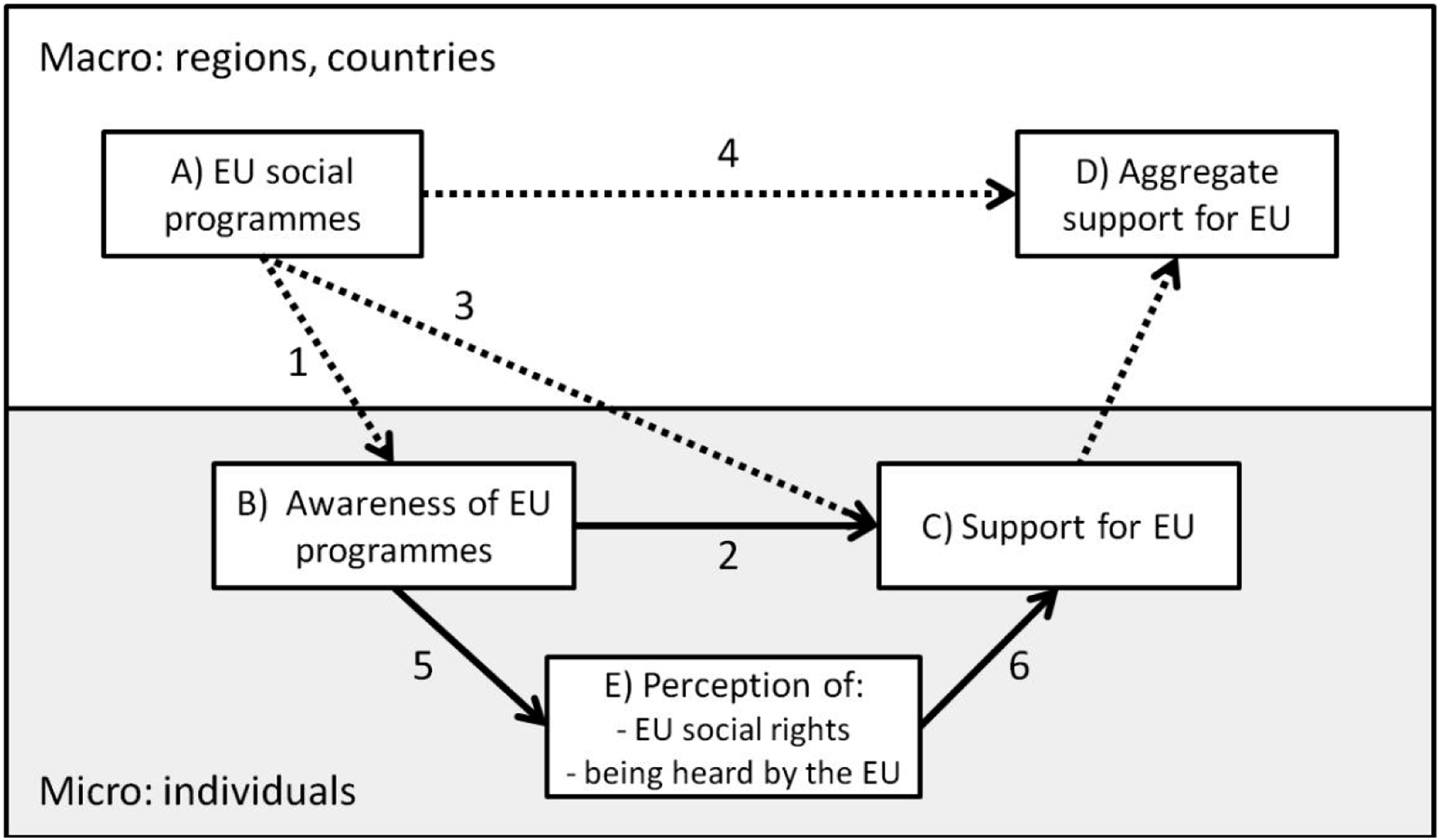
Prior research focused on separate links of this causal mechanism taken alone, often neglecting the other, intertwined ones. Moreover, no consideration has been given so far to the intermediate dimensions that plausibly mediate the effect of programme awareness on individual support for the EU (that is, box E and arrows 5 and 6 in Figure 1). This could explain the inconclusive results to which research on the impact of the EU CP on support for the integration project has come (for example, López-Bazo, 2022). A first stream of empirical research focused on the macro-macro link only (arrow 4), by simply aggregating individual attitudes towards the EU at the regional level. Duch and Taylor (1997) found no positive correlation between regional development funds per capita and aggregate support for the EU across the years 1983 to 1989. This result has been recently matched by López-Bazo (2022), who found that a greater amount of EU funds spent in a region does not stimulate support for the Union over time when the socio-economic context is considered. By contrast, Dąbrowski et al. (2019) identified a positive association between the size of the regional European Structural and Investment Funds and the image that residents have of the EU. All these works, however, fall short of directly testing the micro-foundations of their hypothesised analytical models.
A second stream of studies turned to analyse the macro–micro relationships between the regional allocation of EU Structural Funds and individual attitudes towards the EU (arrow 3 in Figure 1). In this respect, Osterloh (2011) found a positive correlation for the period 1995–1999. However, he showed that this effect varies significantly across population sub-groups and is mediated by individual awareness of EU programmes. Notably, highly educated individuals are more aware of EU programmes and react more positively to the Structural Funds spent in the region than lower-educated people. Building on this, other studies delved deeper into the conditional nature of the effect at stake and confirmed that the macro–micro relationship between EU fund allocation and individual support for the EU is moderated not only by education but also by communal European identity (Chalmers and Dellmuth, 2015). Moreover, the different policy fields to which EU funds are allocated also matter (Dellmuth and Chalmers, 2018). On the other hand, Verhaegen et al. (2014) observed a smaller probability that respondents support European integration in Member States that receive more Structural Funds. Recently, Schraff (2019) showed that the probability of a Eurosceptic vote is highest in regions that receive insufficient compensation, that is, middle-income regions that are not targeted by the funding as well as some of the poorest regions.
Studies exploring the multi-level relationship between EU programmes and individual attitudes exhibit analytical weaknesses in that they disregard a crucial micro-level link in the hypothesised causal mechanism. The association between EU initiatives and individual attitudes, if present at all, runs through citizens’ awareness of EU programmes (which crucially depends on the visibility of the latter). If citizens did not know about euro-social programmes — the theoretical solidity of arrow 3 in Figure 1 would collapse, as the implied mechanism would certainly be spurious to several other factors situated in between the macro explanans and the micro explanandum. Moreover, awareness of EU programmes such as CP does not necessarily lead to increased support for the EU. In fact, strongly Eurosceptic individuals may not change their mind based on CP, nor care about being heard by the EU or about having new rights stemming from it. Similarly, some people may take an a priori stance against EU meddling in their local social affairs and, therefore, dislike the presence of EU programmes in the area where they live. In other words, a number of individual-level factors may intervene to alter the hypothesised mechanism.
To the authors’ knowledge, the work by Osterloh (2011) is the only one presenting evidence for the full multi-level transmission process, including the relationship between citizens’ awareness and support for the EU. However, Osterloh’s contribution was based on public opinion data collected in the 1990s, when the EU was smaller and more homogeneous, economic integration was less developed, and the euro crisis still had not come. Furthermore, it stopped short of singling out the intermediate factors that could filter the latter micro-level association.
Starting from these considerations, we delve deeper into the micro-foundations of the complex relationship between European social programmes and individual perceptions of the EU. To move beyond Osterloh (2011), we build on the resource-based conception of social rights proposed by Ferrera et al. (2023). In this framework, programme visibility is closely linked with ‘instrumental resources’, that is, effective resources aimed to make the material provision of social rights concrete, from the basic information about social programmes to minimise non-take-up, to the necessary administrative capacity to provide, for example, quality job-search and training services. The knowledge of EU social instruments should be key to boosting European citizens’ perception of being able to benefit from EU power resources. This helps us conceptualise the intermediate dimensions that lie in between the independent (that is, awareness of EU programmes) and the dependent variable (that is, support for the EU): citizens’ perception of being provided with new social rights and opportunities from the EU, and of ‘being heard by Brussels’ (box E in Figure 1, with arrows 5 and 6 indicating the indirect effect of awareness of EU programmes on support for the EU). The next section elaborates more on this and puts forward a set of theoretical expectations based on the power resources approach.
Theorising the linkages between the visibility of social programmes, individual power resources, and support for the EU
As discussed above, studies exploring the multi-level relationship between EU programmes and individual attitudes disregard the micro-foundations of the relationship between, broadly speaking, EU social rights and individual perceptions of the EU. We seek to substantiate this mechanism by relying on Ferrera et al. (2023), who provide an original theoretical and analytical framework to unpack the notion of social rights into its internal components. In doing so, they shed light on the relevance of instrumental resources, namely those that provide support and procedural channels for making and satisfying social claims. We start from an aspect that is intrinsically connected to instrumental resources and which we consider particularly relevant to guarantee access and realisation of social rights in the European multi-level setting: the visibility of social programmes.
The visibility of the welfare state, intended as the ease with which citizens can become aware of its presence, is a fundamental feature of social programmes because it allows citizens to connect their distributive preferences to a fair evaluation of what government and elected officials are doing for them (Gingrich, 2014). The overall investment in social programmes and, thus, their comprehensiveness clearly affects programme visibility. But it is also true that different institutional arrangements structure the type and amount of information on which citizens rely to assess government performance and party positioning on social policy (Gingrich, 2014: 565). In this regard, the EU's peculiar multi-level ‘social space’ is problematic (Ferrera, 2005), as it is characterised by (a) supranational social interventions (binding regulatory standards, cohesion funds, spending programmes such as the various ‘social guarantees’ (Ferrera et al., 2023), aspirational protocols and charters, and so on); (b) the European social governance, elaborating a specific social policy agenda and promoting convergence among domestic welfare systems through soft law and the socio-economic governance architecture to co-ordinate national policies (that is, the European Semester); and (c) national welfare states, often complemented by sub-national social systems. Supra-national interventions such as cohesion funds require the collaboration of multiple levels of government to be put into effect, as they are managed and implemented by regional or even municipal actors. Within this multi-level governance setting, resources are dispersed in a multiplicity of funds, intermeshed with other financing sources, and are often put to the service of local political agendas (see, for example, Kemmerling and Bodenstein, 2016). Therefore, it is likely that citizens have different knowledge of how EU social policy works compared to more ‘unitarian’ settings, not least because different levels of government may have different, and even conflicting, interests regarding the types of information to supply to citizens (Madama, 2019).
Building on this, we argue that the visibility of social programmes is important everywhere, but it becomes crucial in the EU multi-level setting, whereby citizens are unlikely to be aware of EU initiatives. We advance a series of hypotheses to empirically test this claim by breaking it down into intermediate steps, going from citizens’ awareness of social programmes to general support for the EU, through the feeling of empowerment possibly generated by EU social rights. The association between EU initiatives and individual attitudes should run through citizens’ awareness of the former – the first crucial micro-level link that most empirical studies fail to recognise. Programme visibility affects the possibility of citizens acquiring basic information on the existence of social entitlements, and more specific information regarding eligibility conditions and application procedures, which are necessary for potential claimants to become aware of their social rights (Van Oorschot, 1994). As the EU does not implement its social programmes directly, awareness of the existence of EU social initiatives depends heavily on efforts made to ensure programme visibility through, for example, investments in successful communication strategies, branding, and customised storytelling (PERCEIVE, 2017). The knowledge of the existence of EU programmes is crucial to make citizens aware of their social rights bound to EU citizenship, which, in turn, may improve their living conditions and opportunities across Europe, reduce the asymmetries in individual life chances, and make people less dependent on their market positions. 4 Accordingly, we hypothesise that:
The awareness of EU social programmes is positively associated with citizens’ perception of the range of rights and opportunities they enjoy in the EU. Second, we claim that the visibility of social policies also contributes to structuring, stimulating, and stalling political participation, as some policies draw citizens into public life and others induce passivity (Mettler and Soss, 2004). Here, our main argument is that the knowledge of the existence of social entitlements may act as a ‘multiplier of power resources’ (Vandenbroucke et al., 2021), affecting individual perceptions of relational power vis-à-vis other individuals and, most notably, vis-à-vis political institutions. Citizens who are aware of EU funds spent in their area will plausibly perceive that they are better represented and cared for by the current EU institutions, that their voice is heard, and that their interests are pursued effectively at the EU level. This is likely to positively affect the individual perception of having the ability to participate and be heard by EU institutions. In other words, we argue that the awareness of EU-funded social programmes enhances supranational ‘political efficacy’ – that is, ‘citizen’s self-perception as a knowledgeable, active, and self-confident participant in political life’ (Gabriel, 2011: 716). More specifically, our focus here is on external efficacy, which denotes the individuals’ conviction that political institutions and leaders are responsive to them (Karp and Banducci, 2008: 318). Therefore:
The awareness of EU social programmes is positively associated with citizens’ perception of being able to participate in EU politics (supranational political efficacy). Third, and finally, we claim that citizens’ awareness of EU social programmes has further, direct and indirect, consequences. Social programmes have historically served a key political function: guaranteeing the socio-political viability of political institutions by consolidating their legitimacy (Ferrera, 2005). In the twentieth century, national social policies stabilised the European state systems, favouring domestic concordance and citizens’ support of the nation-building process. This is true also in federal systems, where social citizenship has been used as a tool to foster unity (Seeleib-Kaiser, 2019). Programme visibility, however, is fundamental to the functioning of this major source of socio-political stabilisation and institutional self-legitimation. In other words, we claim that knowledge of EU social initiatives at the local level has an (unexploited) potential for enhancing EU support (Madama, 2019). By the same token, this is also an indirect result of improving the perception of enjoying more rights and opportunities thanks to the EU and of supranational political efficacy, which is known to be a key predictor for diffuse support for the EU (McEvoy, 2016). Accordingly, we expect that:
Awareness of EU social programmes increases citizens’ support for the EU (both directly and indirectly). To sum up, in this article we aim to test, first, whether citizens’ awareness of the existence of EU social rights (box B in Figure 1), which crucially depends on the visibility of EU social programmes, leads back to ‘power resources’ stemming from Social Europe. Individual power resources refer to both citizens’ rights and opportunities (that is, social resources, H1) and their perceived ability to influence the political arena (that is, political resources, H2). In addition, we want to verify if social and political resources are key determinants of support towards the EU integration process. If the ultimate objective of Social Europe is that of bolstering the social foundations of the EU, the knowledge and the fruition of effective EU social instruments should be crucial to boosting the perception of European citizens of being empowered by EU social rights and of being an active part of the EU and, ultimately, to their support for the European project as a whole.
Data and methods
The empirical analysis takes advantage of the second wave of the REScEU Survey, an original public opinion survey that covers ten European countries: Finland, France, Germany, Greece, Hungary, Italy, the Netherlands, Poland, Spain and Sweden (Donati et al., 2021). These Member States were selected to maximise variation across geographic, cultural, political, and economic features (see the Appendix for details on the survey).
In the following, we investigate the association between individual awareness of EU social programmes and citizens’ perception of (a) their range of rights and opportunities in the EU (social resources), (b) their ability to influence EU politics (supranational political efficacy), and (c) the European integration project as a whole. We do that with the help of path analysis (Menard, 2010) because it allows us to test simultaneously for both direct and indirect effects of our main explanatory variable — awareness of social programmes funded by the EU in the area where the respondent lives — on our main endogenous variable: support for the EU. This choice is substantiated by the fact that previous works have already shown how supranational political efficacy is a relevant factor in predicting Euroscepticism. For example, McEvoy (2016: 1159) showed that ‘citizens who feel their voice is represented in the EU are more likely to maintain support for the EU even when their perceptions of the economy are poor’. We believe the same holds true for our second dependent variable: believing that EU citizenship widened the rights and opportunities of people. The model was fitted using the software STATA 17. We refer to the appendix for a detailed description of the coding rules.
Explanatory variable
Our main explanatory variable is based on a question 5 that reads: ‘Europe provides financial support to regions and cities so that they can improve their social and economic situation. Have you heard about any EU co-financed projects to improve the area where you live and cater the needs of people like you?’ Available answers are: ‘Yes’, ‘No’, and ‘Don’t know’.
Dependent variables
In the following, we evaluate the association between citizens’ awareness of EU regional policy on EU support directly and indirectly through the (partial) mediation of two factors: EU social resources and external efficacy. To this end, we resort to three different variables. To test H1, we measure EU social resources through agreement disagreement on a 4-point Likert scale on with the following statement: ‘EU citizenship has widened the range of rights and opportunities of people’. The question directly taps an aspect that is crucial in Ferrera et al.’s (2023) theoretical framework, that is, citizens’ feeling of additional ‘power resources’ provided by EU (social) rights. This does not necessarily entail the knowledge of the content of EU citizenship, only the perception that the latter has expanded the rights and opportunities of respondents. The second indicator is a measure of supranational external political efficacy based on a question validated in previous works (for example, McEvoy, 2016) asking respondents whether they agree/disagree with the statement: ‘The voice of people like me counts in the EU.’
Finally, we measure EU support asking whether European integration has already gone too far (0) or should be pushed further (10), based on a 0–10 response scale.
Controls
We controlled for the impact of awareness of EU social programmes on support for the EU by including alternative explanatory factors of EU support (see Table A1 in the online appendix for summary statistics). We controlled for respondents’ Left–Right self-placement (categorical). To control for alternative rationales of EU support, we included a binary variable for exclusive national identity (identity approach), respondents’ trust in the national government and the retrospective evaluation of the national economy (second-order model). We also controlled for immigration attitudes: the average position of respondents on the perception of immigration as an economic or cultural threat. Moreover, we included political interest, a variable associated with both knowledge of EU programmes and support for the EU. Finally, we controlled for the socio-demographic profile of respondents: gender, age, education, and occupation. Regarding the latter, we resorted to three binary variables aimed at capturing the so-called ‘losers’ of EU integration and globalisation: the unemployed, service and production workers, and welfare recipients, respectively. Eventually, we controlled for the economic status of respondents’ households. The model also includes country dummies (the reference being Germany) to separate out context-specific factors. Controls are included as predictors for the three endogenous variables we consider. Given that some of our items are not normally distributed, we conduct the path analysis using the maximum likelihood estimation so that standard errors are estimated without assuming normality. The model allows for the correlation between the residuals of our parallel partial mediators (EU social resources and political efficacy).
Results
This section investigates the extent to which citizens’ awareness of the existence of EU funded social programmes affects individual perception of having ‘power resources’ in the EU and whether this, in turn, has an impact on citizens’ support for the EU integration process. We start by inspecting the antecedents of our main independent variable ‘awareness of EU programmes’. As shown in Figure A1 in the online appendix, EU programme awareness is higher in Eastern European countries — Hungary and Poland — which are also the countries that receive a larger amount of funds from the EU. In all other sample countries, either the relative (Greece) or the absolute majority of respondents (the remaining countries) does not know about any programme funded by the EU in their area of residence, a result that suggests that much can be done to improve citizens’ awareness of the role played by the EU.
In terms of social stratification, some categories of citizens stand out as significantly more informed about EU programmes in their area. Figure A2 in the online appendix reports the average marginal effects of basic socio-demographic factors from a logistic regression on awareness of EU programmes. Males are more likely than females to be aware of EU co-financed projects that improve regions they live in. In line with previous findings (Chalmers and Dellmuth, 2015; Osterloh, 2011), respondents who spent more years in education are more likely to say that they have heard of EU co-financed projects. Turning to occupational status, employers, self-employed, socio-cultural specialists, and inactive respondents (mainly students) are more knowledgeable about EU co-financed projects than those who are unemployed. Finally, respondents in bad economic circumstances, those living in rural areas, and those not interested in politics are less informed about EU co-financed projects compared to their counterparts.
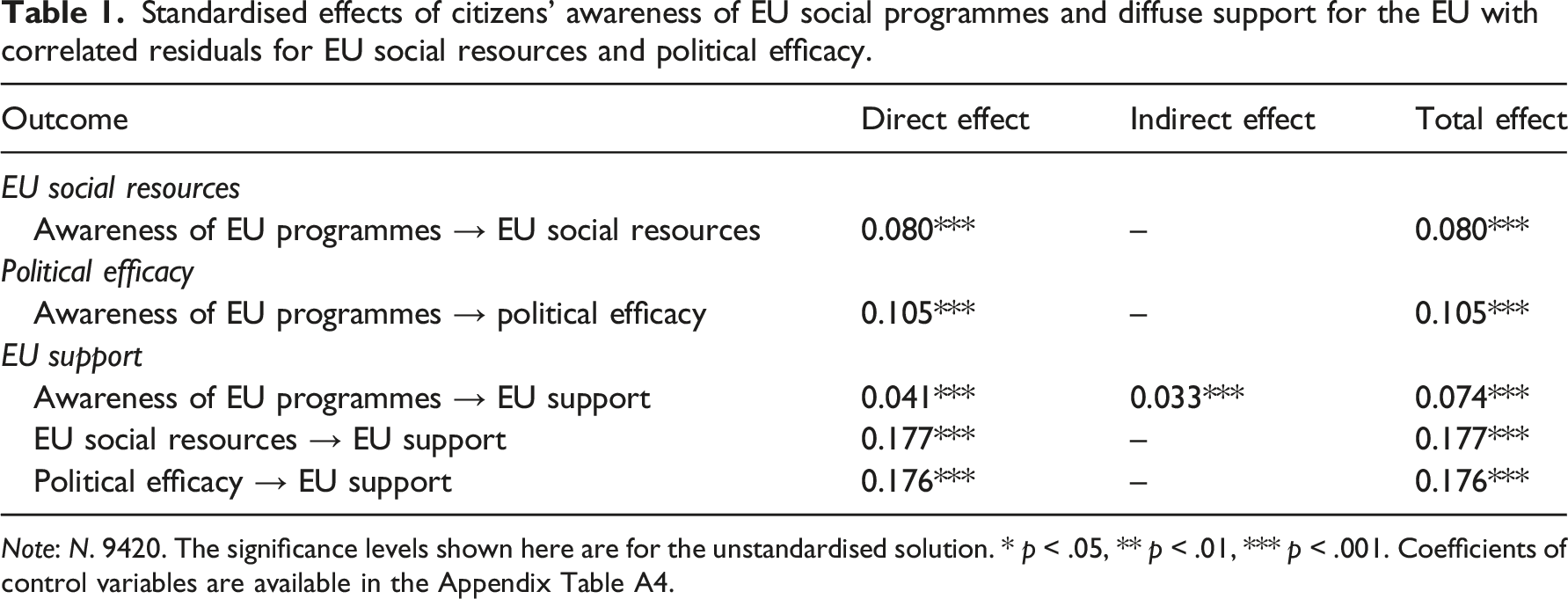
As to our empirical analyses, we present a summary of the results in Figure 2 and in Table 1, while we refer to the Appendix in Table A4 for full model coefficients.
6
Figure 2 reports the structure of the recursive path analysis model fitted along with the standardised coefficients for the direct effects as well as the correlation of the error terms. We report the R2 for each endogenous variable and the sample size. Table 1 shows instead the direct, indirect, and total effects of our main explanatory variable on the three endogenous variables. The significance levels are based on the unstandardised solutions. The model explains about 24% of the variance of EU social resources, 19.5% of the variance of political efficacy, and slightly more than 40% of diffuse support for EU integration (Figure 2). Standardised estimates for awareness of EU social programmes and support for the EU with correlated errors. Note: N= 9420. The significance levels shown here are for the unstandardised solution. * p < .05, ** p < .01, *** p < .001. Coefficients of control variables are available in the Appendix Table A4. Standardised effects of citizens’ awareness of EU social programmes and diffuse support for the EU with correlated residuals for EU social resources and political efficacy. Note: N. 9420. The significance levels shown here are for the unstandardised solution. * p < .05, ** p < .01, *** p < .001. Coefficients of control variables are available in the Appendix Table A4.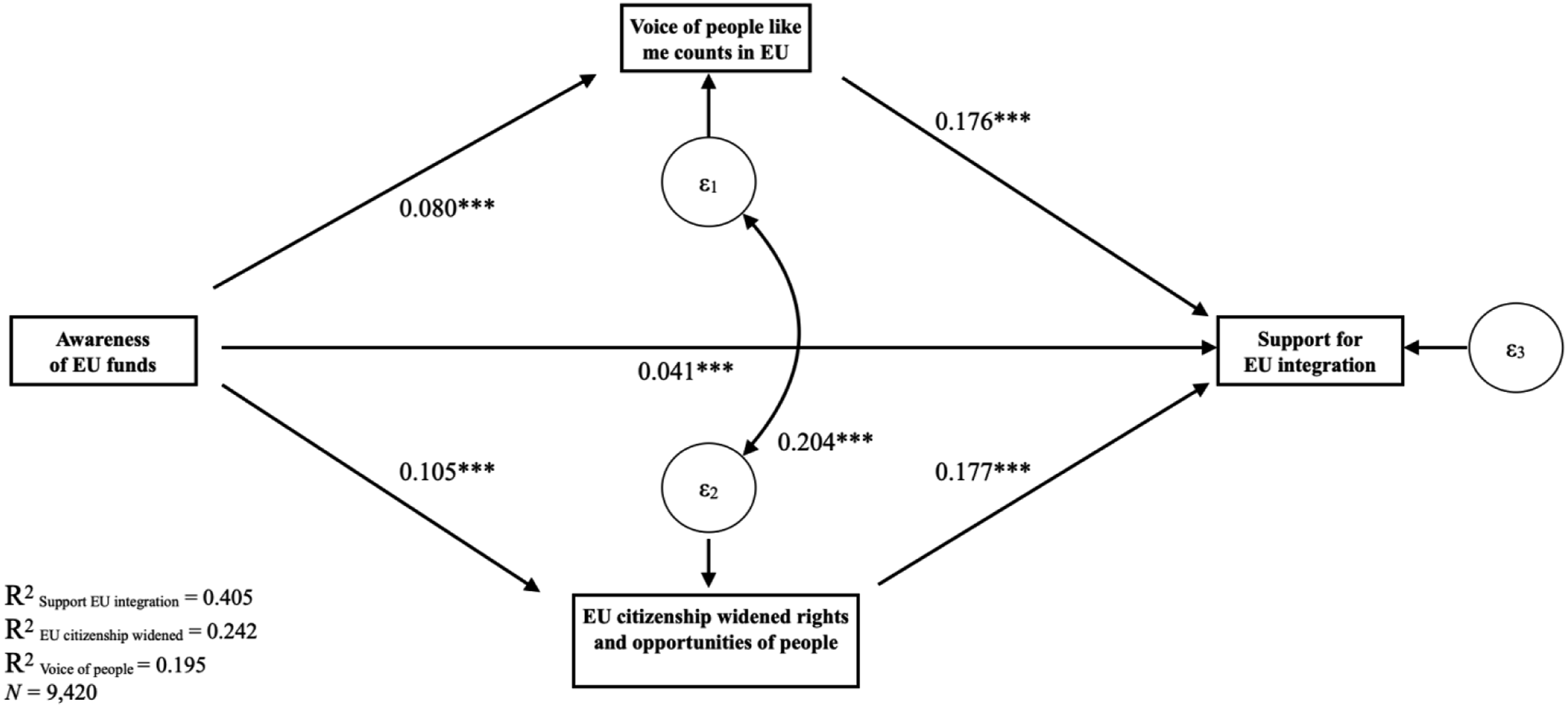
Hypothesis 1 argued that the awareness of social programmes allows EU-funded social entitlements to strengthen individual power resources by improving the living conditions of European citizens, reducing the asymmetries in individual life-chances, and making them less dependent on their market positions. From the coefficient of the bottom left arrow of Figure 2, we see that the awareness of EU social programmes is positively and significantly associated to agreement with the statement that EU citizenship has widened the rights and opportunities of people across the EU. This result supports the idea that knowledge of the EU programmes devoted to catering to the needs of the area in which respondents reside is relevant to make citizens aware of their social rights coming from EU citizenship.
Hypothesis 2 argued that the awareness of EU social policies also contributes to structuring political participation. Citizens aware of EU funds spent in their area will perceive that they stand to gain from European integration. Thus, they may feel that they are better represented and cared for by the current EU institutions and that their interests are pursued effectively at the EU level. Also here, empirical results support our claim. The awareness of EU funds is indeed associated significantly and positively with the perception that the voice of the respondent counts in EU institutions. This result lends support to the idea that knowledge of the presence of EU-funded social programmes positively affects individuals’ self-perception that one has the ability and competence to participate in and influence EU politics. Knowledge of EU programmes is thus associated with greater social and political power resources perceived by citizens across the EU. The third hypothesis argued that the awareness of EU social programmes has a further direct consequence on support for EU integration. Also in this case, we find a positive and statistically significant coefficient going directly from awareness of EU funds to support for EU integration. This means that, on average, those who know about EU social programmes devoted to their area of living tend to support further strengthening of EU integration. Therefore, citizens’ awareness of EU programmes (and, by implication, programme visibility) has the potential to function as a source of institutional legitimation and socio-political stabilisation. Moreover, the association between awareness of EU funds and support for further EU integration also runs through the two (partial) mediators we considered: EU social resources and supranational political efficacy. From the standardised coefficients reported in Table 1, we understand that the total effect of awareness of EU funds on support for the strengthening of the EU is 0.073. The direct component of this total effect is 0.041, which means that 55.9% of the association between awareness of EU programmes and support for the EU is direct after controlling for both EU social resources and supranational political efficacy (and other socio-economic, demographic, and attitudinal controls). By contrast, the indirect effect is 44.1%. Even after controlling for our mediators, most of the relationship between awareness of EU programmes and support for the EU is direct, but the mediating role of EU social and political resources is not negligible. The indirect association that is mediated by the perception that the EU expanded the rights and opportunities of people is 0.0142, while the indirect effect that is mediated by being heard by EU institutions is 0.018: about 19% and 25% of the total effect of citizens’ awareness of EU social programmes, respectively. Briefly commenting on controls (see Table A4), we found that more vulnerable EU citizens tend not to recognise the EU as a significant provider of social resources, feel that the EU does not respond to their needs, and are relatively more sceptical about further integration steps. This is the case for the unemployed (on EU support and on EU social resources), welfare recipients (on EU support), and those in a situation of economic deprivation (on EU social resources and political efficacy). Considering these results in combination with the social stratification of the awareness of EU social programmes (recall Figure A2) brings us to a less positive note. Citizens in a situation of economic insecurity and at risk of deprivation are indeed among the typical ‘losers of EU integration’, exactly those social categories that tend to be less sympathetic towards the integration project, and which the EU should primarily target through social and cohesion programmes to boost its legitimacy and consolidate its social foundations. However, our findings show that the awareness of EU programmes is lower among more vulnerable groups that should therefore become the target not only of (more) EU social policies, but also of targeted investments to boost the visibility of such programmes to increase awareness. Our findings also lend support to the identity and second-order heuristics. National identity, opposition to immigration (identity), negative evaluation of the national economy and distrust in national government (second-order) all reduce awareness of the EU as a provider of social resources, feel worse represented by EU institutions, and oppose further integration.
Conclusions
This article investigated the consequences of the ‘invisibility’ of Social Europe – or, more precisely, of the low awareness among European citizens of social programmes co-financed by the EU in the area where they live. We delved into the micro-foundations of the relationship between EU social programmes and support for the integration project by building on the power resources approach developed by Ferrera et al. (2023). Specifically, we tested whether citizens’ programme awareness has a direct effect on EU support and whether this is complemented by an indirect association that goes through citizens’ feeling of empowerment due to additional rights and opportunities provided by the EU (social power resources) and their perception of ‘being heard’ by the EU (external political efficacy).
Our empirical analysis lends support to our hypotheses and shows that in 2019 the knowledge of EU social programmes was significantly associated to diffuse support for the EU, both directly and indirectly, through EU social resources and political efficacy. More in detail, the direct effect of programme awareness on support for the EU appears slightly bigger than the indirect one, which is mediated by individual perception of enjoying more rights and opportunities thanks to the EU and of supranational political efficacy. This finding implies that citizens’ awareness of EU programmes (which depends on their visibility) has the potential to function as a source of institutional legitimation. In the words of Ferrera et al. (2023), the visibility and accessibility of EU social and cohesion programmes may play a crucial role as an ‘instrumental resource’ and shore up the socio-political foundations of the EU. This is even more important considering that the awareness of EU-funded programmes is very low among European citizens. Not surprisingly, it is higher in Eastern Europe (Hungary and Poland), that is, in the countries receiving the larger amount of EU funds. In all other sample countries, a majority of respondents does not know about any programme funded by the EU in their area of residence (recall Figure A1; see also Eurobarometer, 2019, 2021).
This result points to a lost opportunity for the EU. There seems to be potential for CP to boost societal support for the integration project, which, however, remains unexploited due to the low visibility of such programmes and, consequently, the limited awareness of these kinds of EU initiatives among citizens. This is consistent with recent contributions pointing out the relatively modest scope of European regional redistribution and its ineffectiveness in taming Eurosceptic voting in those areas that remain cut off from the bulk of the funding (Schraff, 2019). To counteract Eurosceptic tendencies, therefore, it would be important to invest more resources in CP and to make EU social citizenship more visible and its content more substantial, for example by introducing a clearly identifiable ‘EU Social Card’ (Ferrera, 2019), or by ensuring the effectiveness of programmes such as the Social Climate Fund, which sets out to provide direct income support for vulnerable households negatively affected by the green transition.
To conclude, this article argued that awareness of EU social programmes is substantively important for understanding the legitimacy of the EU. Still, our analysis leaves a number of issues open for future research. More effort is needed to inspect whether the association of programme awareness with support for the EU varies across individuals and countries. First of all, specific population sub-groups have proven particularly sceptical towards the EU: lower-skilled individuals and the so-called ‘losers’ of EU integration, but also those who feel their identity is threatened by the integration process. Second, is programme awareness necessarily good for EU support? This may not be the case, for example, in Northern Europe, where EU intervention in national social policy matters is generally distrusted, so that euro-social initiatives may have the unintended effect of boosting (already high) Euroscepticism. In this respect, the use of survey items measuring precisely positive/negative evaluation of EU programmes, instead of simply ‘awareness’ as done in this article, may help to further refine the causal mechanism. Another empirical consideration is also due. With a limited sample of ten countries (albeit chosen to maximise the economic, political, and cultural differences), we could only identify a few meaningful correlations. One could argue that citizens sharing a positive attitude towards the EU will tend to evaluate EU-level policies more positively and may therefore have a higher awareness of social cohesion programmes. To make stronger claims about the relevance of the knowledge of EU programmes in shaping citizens’ image of the EU and exclude reverse causality, further longitudinal and cross-sectional research is needed.
Supplemental Material
Supplemental Material - Invisible social Europe? Linking citizens’ awareness of European cohesion funds, individual power resources, and support for the EU
Supplemental Material for Invisible social Europe? Linking citizens’ awareness of European cohesion funds, individual power resources, and support for the EU by Marcello Natili, Stefano Ronchi, and Francesco Visconti in Journal of European Social Policy.
Footnotes
Declaration of conflicting interests
The author(s) declared no potential conflicts of interest with respect to the research, authorship, and/or publication of this article.
Funding
The author(s) disclosed receipt of the following financial support for the research, authorship, and/or publication of this article: Marcello Natili and Stefano Ronchi acknowledge financial support by the European Research Council under the Synergy Grant number 810356. Francesco Visconti acknowledges financial support from the European Research Council (Grant number 340534).

Supplemental Material
Supplemental material for this article is available online.
Notes
References
Supplementary Material
Please find the following supplemental material available below.
For Open Access articles published under a Creative Commons License, all supplemental material carries the same license as the article it is associated with.
For non-Open Access articles published, all supplemental material carries a non-exclusive license, and permission requests for re-use of supplemental material or any part of supplemental material shall be sent directly to the copyright owner as specified in the copyright notice associated with the article.
