



Abstract
This conceptual article and special issue introduction argues for the importance of studying three policy paradigms surrounding welfare policy opposition. The first is welfare populism, the opposition to welfare policies that do not benefit the ‘common people’. The second is welfare chauvinism, the opposition to welfare policies for non-natives within a nation-state. The third is welfare Euroscepticism, the opposition to welfare policies at the European Union level. These paradigms have distinct causes and consequences that should be studied in more detail across different political actors. And while welfare policy opposition may not lead to a complete farewell to welfare, they have been shaping and will continue to shape welfare state recalibration. This article offers summaries of the special issue contributions with empirical snapshots of welfare policy opposition and concludes with avenues for future research.
Keywords
Introduction
Welfare support can be an opportunity to stimulate policy renewal and reinforcement after three decades of cuts and privatization. In fact, reactivating welfare solidarity might be Europe’s best chance to reconcile social cohesion and economic resilience in times of crisis and recovery (Greve, 2023). The most recent global crises, such as COVID-19, Russia’s invasion of Ukraine and the subsequent cost of living crisis have highlighted these different degrees and flaws in current welfare state arrangements (or the non-existence thereof). Notably, in times of crisis welfare spending levels usually increase significantly as does the public support for these actions. However, once the crises are over, these levels basically return to the normal level or even tend to decrease, often due to austerity politics (Eick, 2023). Furthermore, even though governments spend significant amounts of their budget on welfare state policies, incomes decline, inequality and poverty increase, and working arrangements become more precarious (Taylor-Gooby et al., 2017).
This article and the special issue examine the principles behind opposition to welfare, which constitutes a significant part of the problem in current welfare states and needs more theorization and more refined empirical analyses. Importantly, if welfare states are to successfully transition to a more solidary and sustainable approach, there is an urgent need to understand and address existing and emerging patterns of welfare policy opposition, which we define as an umbrella term covering different forms of protest towards existing welfare policies financed by governments. We argue that three policy paradigms of welfare opposition stand out. The first one is welfare populism, which we define for this article as the opposition to welfare policies that do not benefit the ‘common people’. The second one is welfare chauvinism, which we define as the opposition to welfare policies for non-natives within a nation-state. The third one is welfare Euroscepticism, which we introduce in this article to the academic literature as a new policy paradigm and define as the opposition to welfare policies at the European Union (EU) level. We elaborate on these definitions and their origins later in the article.
Welfare policy opposition is a phenomenon that manifests itself across the public sphere and has gained increasing influence in politics over the past decades. For example, welfare populism, although an almost exclusive feature of populist parties, has been increasingly used in light of the ever-expanding anti-elitist argument made by political actors (Abts et al., 2021). Welfare chauvinism has become popular among mainstream political elites who have gradually used the rhetoric once solely used by populist radical right movements with the aim of making electoral gains (e.g., Koning, 2017; Lefkofridi and Michel, 2017; Schumacher and Van Kersbergen, 2016). And while welfare Euroscepticism is not as salient as the other paradigms in party discourses yet, parties across the political spectrum have pronounced opposition to the social dimension of the EU (see, e.g., Vesan and Corti, 2019). Generally, with Eurosceptic parties consolidating or even strengthening their place in domestic and European political arenas and sometimes influencing the rhetoric of mainstream parties, this paradigm of welfare policy opposition should not be underestimated.
While these three paradigms have, to date, been studied independently from each other, our article and the special issue as a whole aim at reconciling different streams of the literature on welfare policy and attitudes to demonstrate that welfare policy opposition is a multifaceted phenomenon that is being increasingly advocated by political actors across the political spectrum, and that have multiple ramifications across the society.
In particular, this article and special issue aim to demystify the concept of welfare policy opposition by exploring different policy paradigms and their interrelations across different political actors, countries and governance levels. Three interconnected research questions will be addressed: 1. How and why do different public actors advocate welfare policy opposition? 2. How can we explain the varying influence of welfare policy opposition across Europe? 3. What role does welfare policy opposition play in shaping the transformation of welfare states across Europe?
After this introduction, the second section defines the concept of welfare policy opposition before diving into the three different patterns of welfare populism, welfare chauvinism and welfare Euroscepticism in the third section. The article closes with some reflections about the above-mentioned research questions and avenues for future research.
Defining welfare policy opposition
Comparative research on the welfare state and the opposition to implementing welfare policies is as old as the welfare state itself and can be traced back to the mid-nineteenth century (Mares, 2009). When Western European societies started to implement their first welfare policies, there was a broad consensus across different political actors, including publics and elites, and welfare states soon expanded to other regions in Europe and beyond the continent. And while the initial evolution of the welfare state increased solidarity, there have always been conflicts about particular questions that are still being debated today: Which welfare policies and welfare recipients should be prioritised? How much should the welfare state be expanded and to what extent should private welfare alternatives stay in place? And which governance level should make these decisions and administer these policies?
The literature exploring welfare opposition has expanded at a dramatic pace over the past four decades, in line with the expansion of welfare policies themselves. Welfare states across Europe and beyond have been under pressure to adapt to significant societal changes, including demographic changes, labour market transformations, globalisation, digitalisation, the rise of the radical right and the emergence of new social risks (Taylor-Gooby, 2004). Additionally, over the last decades, a range of crises have increased inequalities across and within countries, including the Great Recession of 2007–09, the so-called refugee crisis of 2015–16, COVID-19 in 2020–23, Russia’s invasion of Ukraine and the cost of living crisis since 2022, and the ongoing climate crisis. All of these changes and challenges have reassorted and further complicated the needs, demands, and strategies of the welfare state and made clear that there are certain trade-offs in the process of welfare state recalibration.
Welfare policy opposition is best defined as an umbrella term covering different forms of protest towards existing or future welfare policies provided across different governance levels (local, national, supranational). We argue that welfare policy opposition can be found across different stages of the policy process and, therefore, covers strong discursive and attitudinal dimensions that ultimately aim at shaping electoral and policy outcomes. As such, welfare policy opposition can be considered as a political strategy used to promote fundamental social (policy) change across societies.
Welfare policy opposition does not necessarily imply support for the ‘implosion’ of the welfare state as we know it. For example, welfare policy opposition can be selective and usually targets specific recipients or policies. Historically, the unemployed have been one of the main targeted groups, with policies and policy preferences on unemployment benefits becoming stricter (e.g., Houtman, 1997). As welfare states are subjected to more neoliberalisation, spending for the unemployed and public attitudes towards supporting the unemployed are decreasing even further (Eick, 2023). Welfare policy opposition does not focus on the fundamental principles behind welfare redistribution (which is the focus of most welfare criticism studies, see e.g., Meuleman and Delespaul, 2020); instead, we argue that welfare policy opposition is generally related to reforms that fit a specific policy agenda promoted by political actors. Welfare opposition can also be part of a broader ‘politics of opposition’ by non-governing political parties and their supporters, by calling for major reforms or alternatives to existing welfare policies that serve the party’s ideology or interests (Jensen and Seeberg, 2015). Political support coalitions for welfare states have also been reconfigured over the past decades, increasingly difficult for parties to appease their electorate (see, e.g., Gingrich and Häusermann, 2015). Overall, welfare opposition calls for change to serve specific interests over others, thereby having an impact on existing cleavages and solidarities within the society (Svallfors, 2012).
Figure 1 summarises our proposal for an analytical framework to study welfare policy opposition, including two key dimensions: the breadth and depth of welfare coverage. On the one side, the debates around welfare coverage are about who should be included in the welfare solidarity community (see, e.g., deservingness literature, Van Oorschot, 2006). The opposition could argue that welfare should be more selective and less universal. On the other side, the debates are about how much coverage should be provided. Hence, the opposition could argue that welfare generosity should be more limited and less generous. To formulate it as a question: Who deserves welfare support and how much welfare support do welfare recipients deserve? Of course, welfare policy opposition can also mean selective but generous coverage or universal but limited coverage. And to make it more complex, this can vary across different dimensions, including policies, countries, administration levels, beneficiary groups, political actors and time. For this reason, more research is needed to better understand where the three policy paradigms we cover in this article could be allocated in this framework. Analytical framework for welfare policy opposition.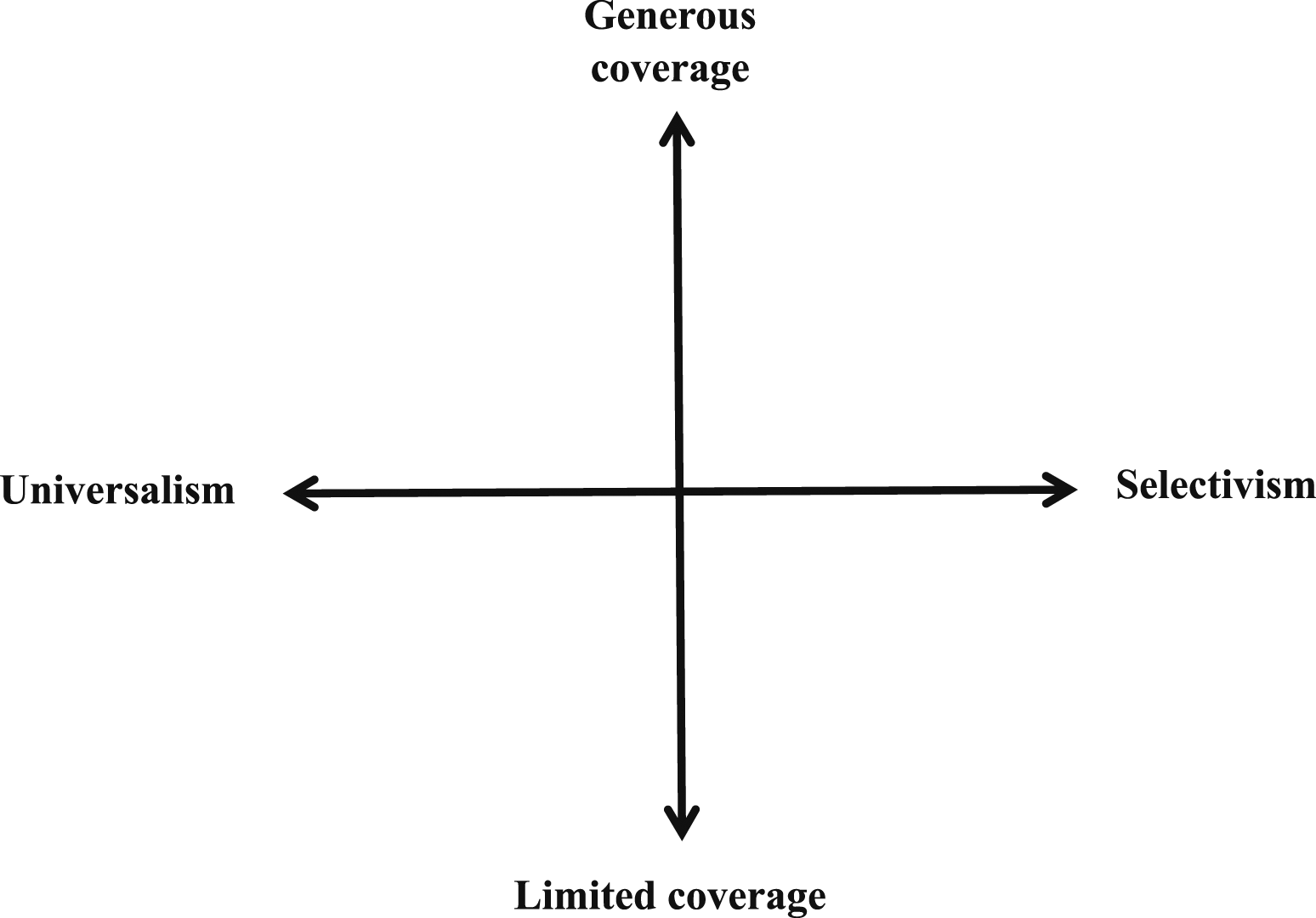
Beyond its discursive nature, welfare policy opposition is exemplified by welfare retrenchment and austerity measures, in the form of welfare cuts, to reduce growing levels of public debt (Ferrera and Rhodes, 2000; Pierson, 1994; Schäfer and Streeck, 2013). Austerity is generally crisis-induced, as a response to an economic shock, for instance, and has a short-term dimension. Such measures were particularly popular by governments as a response to the Great Recession. Austerity responses varied significantly between countries, based on the depth of the recession and governmental ideology (Armingeon et al., 2016). Another example are conditions under which welfare policies further increase inequalities in society as they do not benefit everyone equally. Particularly, more market-oriented or human-capital-oriented social policies (often referred to as social investment policies), such as education, childcare or active labour market integration policies, have been found to suffer from the so-called ‘Matthew effect’ (Cantillon, 2011). Such policies tend to benefit higher socioeconomic status groups relatively more than lower socioeconomic status groups, hereby creating welfare states geared at the middle class.
Defining paradigms of welfare policy opposition
Welfare policy opposition is far from being a new phenomenon and can take a wide range of forms in the public sphere. Much in line with the general politics of opposition, public actors have developed and adopted different strategies to push for their own policy preferences and political agenda. In this article, we focus on three policy paradigms that we argue have emerged and grown in influence over the past four decades in academic and public discourses: welfare populism and welfare chauvinism which are both well-established patterns of welfare policy opposition (see e.g., De Koster et al., 2013; Eick 2024). Additionally, we introduce welfare Euroscepticism as a new paradigm to the academic literature in this article. We call them paradigms because they constitute ‘a theoretical tool to specify and understand the guiding principles, or ideas, for creating public policy, why the various actors involved are involved, and why they pursue the strategies they do’ (Hogan and Howlett, 2015: 3).
Three policy paradigms of welfare opposition.
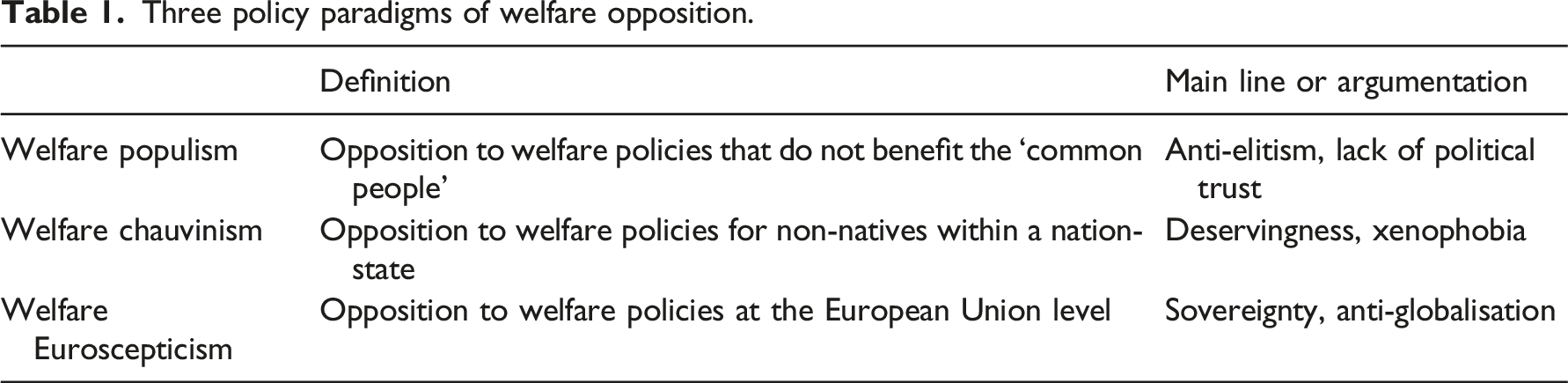
These three paradigms are not mutually exclusive, although they have different roots and implications for the welfare state. One of the core objectives of this conceptual article and the special issue is to bring together different strings of welfare policy studies that have, to date, been studied separately from each other. While we focus on the three above-mentioned paradigms, it is worth noting that other related concepts co-exist and have been picked by scholars. For instance, according to the so-called anti-welfare liberal argument, some welfare policies might undermine the competitiveness of the economy by increasing labour costs (Meuleman and Delespaul, 2020).
Welfare populism
Welfare populism, the oldest of the three paradigms analysed in this special issue, has been used and conceptualized in different ways in the existing literature (see e.g., Abts et al., 2021; De Koster et al., 2013; Greve, 2019). In the context of social policy, welfare populism blames traditional political elites and bureaucrats for creating inefficient welfare states that are not taking care of those in need: for example, access to welfare provisions is hindered by lengthy and complex administrative processes that make it harder for recipients to access benefits and services provided by the state. Additionally, the welfare state might focus on policies that do not provide sufficient safety nets for those living in poverty (see e.g. the debate on social investment, Cantillon, 2011). Welfare populism’s main line of argument is, therefore, a strong anti-elitist stance in line with the ‘pure people versus corrupt elites’ dichotomy used by several populist radical right parties and their electorate. Within the framework of this special issue, we define welfare populism as a form of welfare policy opposition according to which welfare provisions and their administration do not benefit the ‘common people’. This definition largely draws on Cas Mudde’s (2004: 543) seminal work on populism, which he defines as ‘an ideology that considers society to be ultimately separated into two homogeneous and antagonistic groups, “the pure people” versus “the corrupt elite”, and which argues that politics should be an expression of the volonté générale (general will) of the people’.
In this special issue, Enggist and Häusermann argue based on survey analysis that radical right voters support welfare populism more than any other electorate. However, welfare populism is less divisive amongst the electorate than welfare chauvinism, which we will describe next.
Welfare chauvinism
Out of the three, welfare chauvinism is the paradigm that has attracted the most attention over the past three decades and has been defined in different ways in the literature (see, e.g., Andersen and Bjørklund, 1990; Kitschelt and McGann, 1997). Within the framework of this article, we define welfare chauvinism as opposition to giving non-natives access to welfare policies within a nation-state. Non-natives are perceived as such by political actors and could have the status of non-citizens, individuals with migration backgrounds, ethnic minorities or refugees. Welfare chauvinism offers a clear division between two groups: the ‘deserving’ natives on the one hand, and the ‘undeserving’ migrants on the other (Eick, 2024; Mewes and Mau, 2012; Van der Waal et al., 2013). In other words, welfare chauvinism is often framed around the issue of deservingness (Van Oorschot, 2006). In line with our definition of welfare policy opposition as a qualified and selective form of opposition, Eick and Larsen (2022) demonstrate that welfare chauvinism varies significantly across different social policies, and unsurprisingly, the public prefers more market-oriented social policies (in-kind services or social investment policies) for migrants than cash-benefits.
Welfare chauvinism is a multifaceted paradigm of welfare policy opposition that is being investigated by several contributions in this special issue, especially from a discursive and attitudinal approach. Leruth, Taylor-Gooby and Győry analyse discourses of welfare chauvinism and introduce four dimensions used by citizens and political elites: temporal, selective, functional and cultural, each having the potential of yielding different outcomes.
Haenraets and Roosma expand our understanding of welfare chauvinism by identifying the impact that the political rhetoric on cultural diversity and immigration have on chauvinistic attitudes. Their survey findings reveal that radical right mobilization and negative discourse on cultural diversity significantly contribute to an increase in exclusionary attitudes among citizens, highlighting the importance of contextual factors in understanding welfare chauvinistic attitudes.
Afonso and Negash look at the relationship between welfare chauvinistic attitudes and preferences for closing borders for immigrants. Their survey analysis reveals that this relationship varies significantly across countries and socioeconomic status groups.
Two contributions focus on how welfare chauvinism shapes policy in Germany, a popular destination country for people from different backgrounds. Naumann, Brinkmann and Möhring use a factorial survey experiment to analyse attitudes towards pension policies. Their findings indicate that, even under a performance-based system, respondents grant lower pensions to migrants than to natives, regardless of other factors such as contributions to the pension system.
Focusing on the city of Hamburg as a case study, Afscharian, Bruzelius and Seeleib-Kaiser look at the role of individual agencies and institutional resources in enforcing and promoting welfare chauvinistic policies. Through process tracing, the article reveals the core role played by city administrations and, most notably, Hamburg’s mayor, through effective lobbying and strong political networks.
Welfare Euroscepticism
Within the framework of this article, we aim to introduce welfare Euroscepticism as a new paradigm. In line with the scholarly literature on Euroscepticism as a persistent phenomenon (see e.g., Leruth et al., 2017; Taggart, 1998; Usherwood and Startin, 2013), we define welfare Euroscepticism as the opposition to welfare policies and policy initiatives at the European Union level. For example, this opposition is sometimes directed at the setting of minimum social standards or the harmonisation of welfare policies, as commonly done through a Directive, such as the EU Work–life Balance Directive. This opposition is sometimes also directed at (temporal) redistributive measures, such as the Support to mitigate Unemployment Risks in an Emergency (SURE).
Many studies of (party-based) Euroscepticism use a simple conceptualization offered by Szczerbiak and Taggart (2000), who distinguish opposition to specific policies or aspects of the process of European integration (‘soft Euroscepticism’) from outright rejection of the entire project of European integration to the point of advocating an exit from the EU (‘hard Euroscepticism’). We argue that welfare Euroscepticism, therefore, constitutes a form of ‘soft’ Euroscepticism, although it can also be advocated by actors favouring a full withdrawal of their country from the EU. Welfare Euroscepticism can affect well-established policies or common policy objectives established by European institutions, or oppose ideas or proposals that are put on the table, especially since the social policy competence of the EU (the so-called ‘Social Europe’) is still evolving. To be clear, while scholars have written about the challenges of Social Europe before, we argue that this issue requires more focussed attention in the literature.
Theorising and studying welfare Euroscepticism as a genuine policy paradigm is timely. Since the 1990s the EU has been elevating social policies in the EU, in order to support and complement national welfare states, foster better socioeconomic outcomes for European citizens and combat Euroscepticism (Hemerijck, 2012). Most particularly, successive presidencies of the Council of the European Union have put welfare policy harmonization and targeted financial welfare instruments repeatedly on top of their agendas over the last decades. The European Commission’s response to the COVID-19 pandemic had a particularly strong social policy dimension, for example, with NextGenerationEU (2021, funded with €800 billion). However, after decades of investment, this social integration is still being criticised for lacking teeth and unsuccessful outcomes in some domains because of its frequent soft law character (De la Porte and Pochet, 2012). Thus, it is important to investigate why the future of a Social Europe or even a European Social Union (see Vandenbroucke, 2013) is still uncertain.
As a form of welfare policy opposition, welfare Eurosceptics argue that the development of the social dimension of the EU could not only threaten national sovereignty, but also threaten the sustainability of established social security regimes through ‘welfare tourism’ (Gago, 2021; Nielsen, 2016), by creating a ‘race to the bottom’ following successive enlargement rounds (Kvist, 2004; Scharpf, 2002), or through the EU’s association with neoliberal policies especially after the Great Recession (Taylor-Gooby et al., 2017). A link between welfare populism and welfare Euroscepticism could also be made when Eurosceptic actors justify their positions based on an anti-elitist rhetoric, accusing the ‘corrupt Brussels elite’ of threatening the wellbeing of the ‘common people’.
The implications of welfare Euroscepticism can be quite significant as different political actors have pronounced opposition towards Social Europe. In particular, as it is no longer uncommon to see Eurosceptic parties join (or even lead) governments across the European Union, the increasing political weight given to social policy harmonization carries the risk of fermenting ideological divisions within the bloc (Corti, 2022). In the Council of the EU, unanimity is usually required when it comes to decisions around social policy, which also explains the relatively slow progress made on the matter over the past decades. Yet, welfare Eurosceptic voices could ultimately lead to an increase in the use of differentiated mechanisms of integration in the EU, under which a core group of pro-integrationist national governments grant opt-outs to reluctant member states (Gänzle et al., 2019). This would carry the risk of (further) creating a multi-tier Europe in which European citizens are no longer being treated equally across the bloc (see e.g., Leruth et al., 2019).
And while welfare Euroscepticism is not as salient as the other paradigms in party discourses yet, parties across the political spectrum (and in a range of member states) have pronounced opposition to the social dimension of the EU at least to some degree already (see, e.g., Vesan and Corti, 2019). This is also problematic in light of Eurosceptic parties basing their welfare Eurosceptic stances along two lines, based on their broad ideology: concerns over national sovereignty for (radical) right-wing parties, and concerns over the EU’s neoliberal agenda for (radical) left-wing parties (Halikiopoulou et al., 2012). Generally, with the radical right entering at full pace the national parliaments across Europe and potentially the EU parliament in the 2024 elections, welfare Euroscepticism should not be underestimated.
In this special issue, Eick demonstrates through cross-national survey analysis that the traditional EU supporters – higher socioeconomic status groups – are particularly reluctant to support a redistributive policy initiative on the EU level. These new cleavages in EU policies emphasize even more how important it is to introduce this policy paradigm to the welfare opposition family, especially in times when the EU is making historically high investments in welfare policies.
Welfare Euroscepticism is further discussed by Corti and Huguenot-Noël who investigate official documents and expert interviews to find out whether SURE constitutes a policy instrument that was able to overcome this paradigm.
Conclusions and avenues for future research
As discussed throughout this article, welfare policy opposition does not entail a literal ‘farewell to welfare’, as the title of the article provocatively suggests. Instead, it challenges the welfare state as we know it and poses significant threats which, as this special issue argues, must be studied altogether in order to understand what we would call the new politics of welfare opposition affecting the whole policy process.
Recall the three broad research questions investigated within the framework of this special issue. First, how and why do different public actors advocate welfare policy opposition? Essentially, public actors tend to use the same mechanisms that have been explored in the literature on welfare attitudes and policy formulation, although these tend to be refined to address specific policies: self-interest, ideology, and the institutional environment under which they operate. Importantly, welfare opposition is not restricted to particular actors or parts of the public and, therefore, represented throughout society. Several contributions in our special issue underpin these arguments. For example, Leruth, Taylor-Gooby and Győry argue that the public has a more multidimensional understanding of welfare chauvinism than previously conceptualized. Enggist and Häuermann argue that different voter groups might be inclined to support different types welfare policy opposition. Afscharian, Bruzelius and Seeleib-Kaiser argue that politicians might have alternative motives for opposing certain welfare policies.
Second, the special issue explores the following question: How can we explain the varying influence of welfare policy opposition across Europe? As hinted above and throughout the special issue, the context under which political actors and the public operate is of crucial importance. Unsurprisingly, context matters: the level, relevance and influence of welfare policy opposition is shaped by crises of all kinds, which might be used by political actors to make gains (in line with the argument made in this introduction that welfare policy opposition is a political strategy). In our special issue we have a range of articles that look at cross-national data. For example, Haenraets and Roosma argue that the politicisation of welfare chauvinism tends to be more popular in the public where radical right political actors are successful. Eick argues that socioeconomic status cleavages on welfare Euroscepticism are smaller in countries where welfare generosity is higher and where welfare chauvinism is lower. What is particularly interesting to note is that the three paradigms of welfare policy opposition investigated within the framework of this special issue cut across all examined countries, thereby confirming that no country is immune to such patterns of opposition.
Finally, what role does welfare policy opposition play in shaping the transformation of welfare states across Europe? Overall, the article and special issue have demonstrated that a public welfare policy opposition is of relevance for national and European-level policymaking and has the potential to further grow and further increase inequalities. Some of the main challenges we identify are the (1) mainstreaming of far-right narratives that pose a threat to democracy, (2) deservingness perceptions that are increasingly based on market and border logics, (3) further polarization in society and across countries and (4) a lack of commitment to changes that are needed to make welfare states fit for the current challenges and crises. To give some examples from our special issue contributions, the results from Afonso and Negash hint that higher levels of welfare chauvinism could lead to more closed borders. The results from Naumann, Brinkmann and Möhring hint that welfare policies for migrants could become even more selective. And the results from Corti and Huguenot-Noël hint that a way to overcome welfare Euroscepticism could be an emphasis on the advantages that welfare instruments have for everyone in the community.
We also want to propose three avenues for future research since there are still many open questions and gaps in the research on welfare policy opposition. First, studies that analyse welfare opposition and the three paradigms more systematically across different dimensions, including political actors, countries and time. Recently, there has been a plethora of new studies focusing almost exclusively on welfare chauvinism. One of the core goals this article and special issue hope to reach is that instead of focusing on one such specific paradigm, the phenomenon of welfare policy opposition should be studied as a whole in order to understand how different political and policy strategies are part of a broader narrative. In a similar vein, within the framework of this special issue and other recent works (see e.g., Rathgeb and Busemeyer, 2022), the radical right has been a core focus of welfare policy opposition; however, the phenomenon is not limited to these political actors, especially since populist, chauvinistic and Eurosceptic rhetoric has been copied by mainstream parties for electoral gains. Such a line of research is also important to understand the cleavage dilemmas we have identified (such as traditional EU supporters being more welfare Eurosceptic), trade-offs and underlying causalities of these paradigms.
Another avenue for future research are studies that look into countering or overcoming welfare opposition and into creating more sustainable policies that work in the long-term and are more resilient to welfare opposition. The strategies advocated by most political actors aim at making political gains and influencing public policy in the short run, but the impact of these rhetoric on the long-term sustainability of the welfare state tend to be overlooked by elites and the public. For example, we can still see a denial of the scale of the climate emergency in current (welfare) policies. Think of the inevitable increase of ‘climate refugees’ in the coming decades: what impact will this have on welfare chauvinist rhetoric?
Finally, it may be intuitive to start researching welfare opposition in contexts where already existing welfare arrangements are at stake. Still, there is a lack of research on welfare policy opposition in the countries that would most benefit from a (more generous) welfare state, particularly developing countries (see also Mares, 2009). Considering the importance of structural factors, mobilization based on self-interests and ideologies, political institutions and discourses around policies and their (potential) recipients, it would be important to see how these play out outside of the European context on which we focused in the special issue.
To close this article, we want to emphasise that welfare opposition is here to stay and welfare states need to decide how to respond to it. This means, in particular, whether welfare states will give in to the welfare critiques and adjust to their exclusionary and often neoliberal logic or whether they will be guided by the principles of equality of opportunity, equitable distribution of wealth, and public responsibility for people in need.
Footnotes
Declaration of conflicting interests
The author(s) declared no potential conflicts of interest with respect to the research, authorship, and/or publication of this article.
Funding
The author(s) received no financial support for the research, authorship, and/or publication of this article.
