



Abstract
The recent enactment of the European Pillar of Social Rights (EPSR) has significantly strengthened the social dimension of the European Union (EU), including the social investment (SI) elements of that social dimension. What is not known, however, to what extent the priorization of SI is supported by the broader public. To address this research gap, we investigate public opinion on 15 different policy areas from the EPSR using Eurobarometer data from 2020 across all EU countries, asking whether the public rather prefers these policies to be delivered at EU or national level. A principal finding is that the public indeed supports more SI than CP policies with respect to EU-level social policy, and more CP than SI policies with respect to national-level social policy. We also investigate whether socioeconomic status (SES) and welfare state effort can explain this phenomenon. We find that higher socio-economic status and more generous welfare states are associated with more support for SI policies on both EU and national levels and vice versa. The findings emphasize the importance of what policies are provided versus who provides them but also pose a puzzle for trade-offs in multilevel governance settings. Hence, the article has important implications for future research on public opinion and Social Europe.
Introduction
‘I believe it is time to… adapt the social rulebook. A rulebook which ensures solidarity between generations. A rulebook which rewards entrepreneurs who take care of their employees. Which focuses on jobs and opens up opportunities. Which puts skills, innovation and social protection on an equal footing.’ (EU Commission President Ursula von der Leyen, 20 January 2021).
The rulebook to which von der Leyen refers in this quote is the European Pillar of Social Rights (EPSR), developed by the European Commission and formally proclaimed by the European Parliament and the Council in 2017. The EPSR sets out 20 key principles that provide a guideline to EU member states in moving towards a more institutionalized and more ambitious ‘Social Europe’. As explained in the introduction of this Special Issue, these EPSR initiatives can be seen as elements of what we call ‘normative power’, normative commitments in law and regulation to the provision of social rights that are important in shaping social citizenship in the EU. This article builds on the broad perspective of power resources and social citizenship developed in this Special Issue, focusing on the role of public opinion in individuals’ preferences in both reflecting and shaping the contours of ‘Social Europe’.
Understanding individuals’ preferences towards Social Europe requires clarifying support for or opposition to particular kinds of Social Europe. Existing research has shown that the notion of Social Europe enjoys high levels of public support across the EU (Gerhards et al., 2016). However, the literature in this domain rarely looks at particular social policy areas (Baute and Meuleman, 2020; Eick, 2023), that is, whether individuals support not only ‘more’ Social Europe, but also particular versions thereof. Most obviously, there is a crucial distinction in social policy between social investment (SI) versus compensation (CP) policies (Ferrera, 2017; De la Porte and Palier, 2022). Broadly speaking, social investment policies are meant to ‘create, mobilize and preserve skills/human capital/capabilities’ (Garritzmann et al., 2018: 37) and are typically associated with policy areas such as education and training, active labour market policies, childcare and work–family reconciliation policies. In contrast, compensatory (also called consumptive) social policies are rather geared at compensating individuals for income losses associated with the manifestation of more traditional social risks such as unemployment, old age or illness. These policies are, therefore, less oriented towards long-term investment goals, but more towards short-term compensation.
Scholarship on public opinion on social policy has revealed significant differences in public attitudes towards SI as compared to CP in welfare state reforms (Garritzmann et al., 2018). However, this work focuses mainly on the national, not the EU, level, and not on the interplay between the national and EU levels, for instance, whether SI policies might in fact be (even more) supported once and if provided by supranational entities such as the EU.
As a result of these skews in the existing scholarship, it remains unclear whether public support for Social Europe depends on whether one considers SI versus CP provisions at the national versus the EU level of governance. And it remains unclear whether and to what extent different individual and contextual factors influence these attitudes. This lack of clarity is particularly important in times when Social Europe is still in the process of being built and European polities’ scarce social and financial resources need to be distributed carefully. This article’s contribution is to shed light on just these issues by exploring individual attitudes towards European social policy with a focus on the contrast between SI and CP at the European and national levels of governance. Our article aims to answer, particularly, the following research questions: (1) What policy preferences (SI versus CP policies) does the public have for national versus EU-led welfare states? (2) How do lower/higher SES groups (measured through objective education and unemployment and subjective income and class) differ in their priorities? And (3) how does national welfare state generosity shape these different priorities? We deduce some answers to these questions based on the existing study of contemporary European social policy and then test these expectations through a range of analyses of a novel Eurobarometer data set from 2020 that covers public support for 15 different EPSR policy areas on the EU and national levels.
Our key findings are that individuals in the EU generally tend to embrace a Social Europe; at the same time, they prefer particular kinds of national-level and EU-level social provisions: Individuals in the EU tend to prefer EU-level social provisions that are more SI than CP-oriented but national-level social provisions that are more CP than SI-oriented. We find that higher SES status and more generous welfare states are associated with more support for SI policies on both EU and national levels and vice versa. Hereby we reveal important cleavages that are important for our understanding of the contemporary restructuring of European welfare states. To develop all these findings, we first briefly lay out our theoretical expectations and then more extensively present and analyse the survey data.
Literature review and theory
Understanding the political development of the EPSR requires building on two sets of social policy literatures, on SI and CP policies on the one hand and public opinion on Social Europe on the other. Starting with the former, the distinction between SI and CP policies is by now well-established in welfare state scholarship (Bonoli, 2013; Morel et al., 2011; Hemerijck, 2017).
In recent research on public attitudes towards the welfare state, the distinction between SI and CP policies is quite prominent. There is, for instance, evidence that SI policies are generally more supported than CP policies (Bremer and Bürgisser, 2023; Garritzmann et al., 2018). This research also shows that the political coalitions of SI policies are distinctly different from CP policies: the latter are rooted in the historical class conflict between capital and labour, pitting those with high incomes and wealth (critical of redistribution) against poorer individuals who demand more support from the welfare state. In contrast, the cleavage lines on SI policies are partly orthogonal to these coalitions, putting the ‘old’ middle classes working in traditional sectors of the economy against the emerging ‘new’ middle classes working in knowledge-intensive, creative and person-centred occupations, often in the public sector (Häusermann, 2012). What is less studied in this part of the literature is the role of inter- and supranational institutions as actors promoting SI or compensatory policies. This is partly a consequence of the data that is being used, which is usually collected at the national level.
Complementing these studies, there is a substantial literature on public opinion towards EU social policy development – that is, Social Europe. This literature builds particularly on how any development of the social dimension of the EU must deal with how these developments may affect and are affected by national-level welfare state provisions – which are among the most cherished realms of national political sovereignty (Leibfried, 1994; Ferrera, 2003; Hemerijck, 2012). Indeed, studies of public opinion have explored how individual attitudes towards general policy competencies at the national versus EU levels of governance and solidarity generally (for example, Sánchez-Cuenca, 2000; De Vries, 2018; Kuhn and Kamm, 2019), and social policy or social protection in particular (for example, Burgoon, 2009; Gerhards and Lengfeld, 2013), play out and interact. This literature’s conceptualization and operationalization of European social policy, however, has tended to be very general, with only a modest set of studies aiming to disentangle attitudes towards particular aspects of what Social Europe would mean (for example, Baute et al., 2018; Eick, 2023). And even fewer studies have given any attention to attitudes towards social investment-oriented policies compared to compensation- or consumption-oriented provisions in Social Europe (Vandenbroucke et al., 2018; Burgoon et al., 2022). These recent studies demonstrate that EU-wide unemployment provisions, including those that are administered at the EU level, garner more public support if the EU provisions are made conditional upon national and European-level SI policies, that is, a combination of training, education and activation. These exceptions, however, remain narrowly focused on unemployment competencies, and do not clarify broader patterns of support for SI versus CP oriented social provisions at the EU versus national levels of provision. To fill these gaps, we need to develop and then empirically test our own theoretical expectations about public opinion with respect to these dimensions of detail in Social Europe.
The EU versus the national level
The starting point of our theoretical discussion is to argue that the public may systematically distinguish between the EU level and the national level when thinking about social policy priorities. Individuals’ views on what exactly constitutes ‘Social Europe’ and the broader knowledge about the content of the EPSR among the general public is likely to be limited. However, individuals should have more well-formed views of their national welfare states, and these views might colour perceptions of EU developments and policy competencies related to welfare state provisions.
The emergence of the modern welfare state is historically closely intertwined with the consolidation of nation-states as sources of identity formation (Mau, 2005; Ferrera, 2003). Social citizenship rights were first defined and identified at the national level (Marshall, 1964). It is also well-known that welfare state policies and institutions exert strong policy feedback effects on politics: on the level of material resources (empowering or disempowering particular social policy constituencies); and on the level of cognitive and normative resources, effectively circumscribing the range of policy options perceived as ‘feasible’ (Pierson, 1993). Because of these historical legacies, we posit that the public will typically associate traditional welfare state policies such as unemployment compensation, social transfers, pensions and healthcare with the national welfare state. Given that these kinds of social policies almost exclusively continue to remain in the hands of national welfare states and that the public has direct experiences of interaction with these institutions and programmes, we expect that the public should also prioritize the national level when thinking about the general propriety and expansion of CP policies. Furthermore, the prospect of developing social policy competencies relative to these respective substantial national and modest EU-level status-quo competencies can be expected to awaken concerns that substantial CP-oriented social provisions at the national level might be eroded or crowded out by new EU-level competencies.
In contrast, the expansion of the SI pillar of the welfare state could be more associated with the EU level from the point of view of the public for several reasons. The first is the converse of the logic with respect to CP-oriented provisions. Given the close connection in people’s minds between the traditional welfare state and the nation-state, the emergence of a ‘new’ welfare state model focused on SI could be associated with the emergence of a new governance space beyond the nation-state. And the relative newness of SI provisions also at the national level (relative to CP social transfers and buffer-insurance provisions) should mitigate worries that new EU-level SI competencies might erode national competencies. Second, the fact that SI policies also aim at improving access to the labour market and the education system might reasonably be associated by the public with the strengthening of market mechanisms in the context of the EU’s Single Market project. Third and finally, the political cuing and framing of social policies by the EU’s policymaking elites might also play a role. The EU’s decades of emphasis on the promotion of what amount to SI policies, particularly education and gender rights in the workplace, might well influence individuals’ views about the EU in the long term – making the EU level, more than the national level of provision, the province of SI policy development. All these mechanisms motivate our first hypothesis:
The European public should tend to prioritize SI over CP on the EU level, but CP over SI on the national level.
The role of socioeconomic status
In the next two subsections, we delve deeper into explaining the variation in attitudes towards social policies at the EU and national levels. First, we discuss the role of individual-level factors, in particular key measures of socioeconomic status (SES), in shaping attitudes on SI and CP at the EU and national levels. A common finding in studies of opinions towards social policy is that low SES individuals are more likely to be pro-welfare and pro-social protection out of economic self-interest, as these individuals tend to benefit more directly from welfare policies than do high SES individuals (Mau, 2005). However, when examining support for Social Europe, the literature produces more mixed results. Some scholars argue and find evidence that lower SES individuals are also more supportive of EU-level social policy (Mau, 2005; Eick, 2023), while other studies have found that SES factors have no significant effect on the Europeanization of social policy (Baute et al., 2018; Gerhards et al., 2016). The latter studies argue that, rather than objective positions, subjective experience and social disposition are what shape one’s stance towards Social Europe.
The offsetting logics and findings also apply to the issue of how SES relates to support for SI provisions. A range of studies focused on national level of social policymaking has shown that the traditional SES-related (class) cleavage remains a strong predictor of attitudes towards compensatory policies, but less so in the case of SI policies, which are more broadly supported (Busemeyer, 2012; Garritzmann et al., 2018). SI policies, in particular those directly focused on the promotion of human capital, are particularly supported by the well-educated and those working in knowledge-intensive occupations (Busemeyer, 2012; Häusermann et al., 2021). The latter might be due to so-called ‘Matthew effects’ of some SI policies, which tend to benefit higher SES individuals relatively more than lower SES individuals (Cantillon, 2011; Van Lancker, 2013). Furthermore, it is also possible that lower SES groups are more in need of immediate poverty relief, which would more readily invoke them to support CP rather than SI policies. In comparison, higher SES groups can afford to prioritize more future-oriented SI policies that may lead to more egalitarian–universalistic outcomes than do the more redistributive CP policies. These broad cleavage patterns could also hold up in the context of the debate of the Europeanization of social policy.
The contrasting argument would suggest that the SES cleavage differs between the national and the EU levels. We develop two possible theories here: first, as covered above, the political debate about the extensiveness and the nature of welfare state policies is well-entrenched on the national level, being connected to a long legacy of class struggles (that is, strong SES cleavages). On the EU level, this is still a developing policy area and there is less knowledge about the issues that are contested (see, for example, Crombez, 2003, on the democratic deficit of the EU). Particularly EU social policy as a field is less salient than on the national level. Therefore, it could be assumed that the SES cleavages stay the same but to a weaker degree on the EU level.
Second, it could be assumed that the public prefers to get their more immediate social policy needs covered by the governance level that they trust more and have past experience with and vice versa. On the contrary, the public might prefer to get more overarching or abstract issues (for them) covered by a governance level they trust less. There is a wealth of literature explaining lower levels trust in the EU or Euroscepticism that can be summarized in utilitarian, identity, as well as cue-taking and benchmarking approaches (see literature review in Hobolt and De Vries, 2016). In the end, these rationales boil down to the perception of the EU as a threat to the status quo (Kriesi, 2007). Hence, as covered above, since lower SES groups are more likely to need and support CP policies, they can be assumed to request these policies from their national government and leave SI to the EU. Higher SES groups benefit the most from SI policies and use them for a longer time (for example, education). Hence, one can assume that higher SES groups are more likely to request these policies from their national government and leave CP to the EU. Notably, we also know from the literature that the levels of trust in national governments are higher than the levels of trust in the EU across the board (Hobolt and De Vries, 2016).
Given such offsetting logics and empirical patterns, we believe it to be an open and empirical question of whether the SES-related cleavage in social policy attitudes about SI versus CP are the same on the EU and national levels or whether they can be expected to be different. For the empirical analysis, we approach this issue in an exploratory manner, guided by two competing sub-hypotheses to be probed further below:
The role of SES in shaping individuals’ attitudes towards the prioritization of SI versus CP should not differ depending on the question of whether these policies would be located at the EU or national level.
The role of SES in shaping individuals’ attitudes towards the prioritization of SI versus CP should differ depending on the question of whether these policies would be located at the EU or national level.
The role of welfare state contexts
Finally, we discuss and theorize the potential role of welfare state contexts on public attitudes towards SI and CP at the EU/national level. Again, we rely on theories of policy feedback (Pierson, 1993; Busemeyer et al., 2021) to develop our argument. From this perspective, national level welfare state policies should strongly influence the views of the public, implying a significant degree of cross-national variation in attitudes that is systematically related to different welfare state types. Some work on the politics of Social Europe has started to explore these kinds of feedback effects. For instance, several studies (Burgoon, 2009; Kumlin, 2009; Baute and Meuleman, 2020) argue that national-level welfare state efforts can dampen support for EU-level social policy interventions. Burgoon’s (2009) analysis suggests a tension between the EU and national levels. These results show that more generous reliance on EU level proto-social provisions such as the European Social Fund may leave support for national assistance unscathed, but the existence of generous national welfare states may depress support for EU-level social policy. Furthermore, Kumlin (2009) shows that dissatisfaction with national public services has negative effects on EU trust in most EU countries and that this effect is stronger in larger welfare states. What this scholarship does not yet do is explore the association between the specific institutional set-up of the welfare state and its impact on public priorities on SI and CP.
In theorizing policy feedback, we distinguish between self-reinforcing and self-undermining feedback (Busemeyer et al., 2021). In welfare state research, the notion of self-reinforcing feedback is dominant, going back to Pierson’s (1993) claim that generous welfare states will create and empower their own supporting constituencies, resulting in a high degree of institutional stability and resistance against change (Brooks and Manza, 2006). In contrast, recent research also claims the existence of self-undermining feedback, that is, the emergence of public opposition against existing institutions if these no longer function adequately (Weaver, 2010). Applied to our research question, we posit – in line with scholarship on the social investment welfare state – that newly emerging social risks and the rise of the knowledge economy have put traditional welfare states under pressure to expand their provision of SI policies. Furthermore, as the provision of SI is blocked in underperforming welfare states either because of a lack of administrative capacities, fiscal resources or simply political will due to powerful policy legacies, public demand for a prioritization of SI policies at the EU level should increase in these contexts. Vice versa, individuals living in well-endowed welfare states with generous funding for SI policies should be less inclined to prioritize these policies at the EU level. This theory would assume no difference in terms of preferences on the EU and national levels.
The contrasting argument would suggest that welfare state effort shapes individuals’ attitudes towards the prioritization of SI versus CP differently, depending on the governance level. Our theory here follows the same logics that we have already lined out for the role of SES: first, due to the lack of knowledge/salience of Social Europe in the public, the role of the welfare state should stay the same but to a weaker degree on the EU level. Second, the public might prefer to get their more immediate social policy needs covered by the governance level that they trust more, and be less enthusiastic about having their immediate needs covered by the level they trust or know less. In member states with lower levels of welfare spending the priority of the public is to have a safety net through CP. So we can assume that the public wants to have sovereignty over shaping these policies according to their needs. The opposite might be the case for member states with higher levels of welfare spending, usually combined with a relative stronger focus on SI that these member states can afford. Considering SI shapes life courses and (service-based) economies significantly (Hemerijck, 2017), we can assume that the public wants to have sovereignty over shaping these policies.
Hence, our last hypotheses are:
The role of welfare state effort in shaping individuals’ attitudes towards the prioritization of SI versus CP should not differ depending on the question of whether these policies would be located at the EU or national level.
The role of welfare state effort in shaping individuals’ attitudes towards the prioritization of SI versus CP should differ depending on the question of whether these policies would be located at the EU or national level.
Data and methodology
Data
To explore public support for national and EU-level Social Europe and to test our three hypotheses about such support, we use data from the Special Eurobarometer 509 (wave EB94.2) that is particularly suited to our focus. This survey was carried out by the Kantar network in the 27 member states of the European Union between 20 November and 21 December 2020: Belgium, Bulgaria, Czechia, Denmark, Germany, Estonia, Ireland, Greece, Spain, France, Croatia, Italy, Republic of Cyprus, Latvia, Lithuania, Luxembourg, Hungary, Malta, the Netherlands, Austria, Poland, Portugal, Romania, Slovenia, Slovakia, Finland, Sweden; 27,213 individuals from different social and demographic categories were interviewed face-to-face, by telephone or online in their native language. Table A1 includes more information on the specific country sample and the response rate.
Variables
Individual-level variables
The Eurobarometer included, for the first time, items assessing support for the EPSR policies on the EU and the national level. Respondents were asked the following questions: ‘In which of the following areas do you think the (nationality) government should take action to prepare the future of Europe?’ and afterwards ‘In which of the following areas do you think the European Union should take action to prepare the future of Europe?’ For both of these questions, respondents could choose up to three items from a list of 15 items. The same question was asked for national welfare states. From these 15 items, we created our two latent variables for the support for EU/national government CP versus SI policies. We decided to use a conservative measure for SI, thus not including policies that cover social protection/transfer policies across the EU. For CP, we included eight policies: wages, health and safety at work, social protection, minimum income, old-age income and pensions, healthcare, the inclusion of persons with disabilities, housing and assistance for the homeless. For SI, we included seven policies: education, active support to employment, childcare and support for children, work–life balance, gender equality, equal opportunities, social dialogue and involvement of workers.
There are three potential issues with these items, which we address in our analysis: first, the wording ‘up to three’ items means that respondents can choose no more than three but fewer items, which might lead to a systematic bias. However, we cannot find such bias in additional tests (see Table A4). Second, since the definition of these CP and SI policies can vary or change (see Hemerijck et al., 2016; Ferrera, 2017), and because of the way the question was asked, no meaningful factor analysis or alpha test was possible. Thus, we ran analyses for adjusted versions of the indexes and include the results for the separate 15 policies on EU and national levels too (see Table A9–A10). Furthermore, with the ‘up to three’ items, a respondent can pick items that are both from the SI and the CP paradigm (which is not a problem per se, but we want to mention it for clarity). Third, one could argue that respondents are not expressing genuine preferences for EU versus national social policies and not simply some genuine preference for ‘more social policy’ in one area, independent of the level. Hence, for additional robustness tests, we created two additional items that capture whether respondents change their preference from SI/CP on the national level to SI/CP on the EU level. We used these items for additional robustness checks (see Table A6).
Objective SES is measured through the dummy variables having (no) tertiary education and (not) being unemployed. Subjective SES is measured through the following two questions ‘During the last twelve months, would you say you had difficulties to pay your bills at the end of the month…?’ Responses were made between (1) most of the time, (2) from time to time, (3) almost never/never. And ‘Do you see yourself and your household belonging to…?’ Responses were given on a 5-point scale ranging from 1 = working class of society to 5 = higher class of society.
Additionally, we add a range of individual-level control variables. We measure EU support by the following item: ‘Is the EU membership of your country a good or a bad thing?’ Responses were recoded into (1) a good thing and (0) neither a good thing nor bad thing/a bad thing. We also include the question ‘How important or not is a social Europe to you personally (that is to say, a Europe that cares for equal opportunities, access to the labour market, fair working conditions, and social protection and inclusion)?’ for which respondents were given a 4-point scale ranging from 1 = very important to 4 = not at all important. This item we include in one model as the dependent variable to test for whom Social Europe matters in the first place and where. Political ideology is measured through the following item: ‘In political matters people talk of “the left” and “the right”. How would you place your views on this scale?’ Responses were given on a 10-point scale ranging from 1 = left to 10 = right. Finally, we control for age (in years) and gender (0 = man). Descriptive statistics of individual-level variables are provided in Table A2–A3.
Country-level variables
This article operationalizes welfare effort using three different ways: first, for our main analysis, we included public social expenditure as a percentage of GDP. Second, in Table A7–A8 we operationalize welfare effort also in public social expenditure for a SI investment policy from the EPSR: Active Labour Market Support. This way, we can test whether the public would turn to the EU level in case of an undersupply of SI policies on the national level. Third, Table A7–A8 also show the results for social expenditure outcomes, since these could be more salient to the public than expenditure. Here, we focus on income poverty (relative poverty rates from the entire population) and income inequality (Gini at disposable income post taxes and transfers). Table A8 also includes additional control variables on the country level. The data is from 2019 and was taken from the Comparative Social Citizenship Database (see Eick et al., 2021).
Statistical modelling
For the multivariate analysis, logistic regression models and two-level random intercept logistic regression models were used (Hox et al., 2017). The first group of models examined the SES divides on support for our various dependent variables with individual-level control variables through the logistic regression models. In the second step, the contextual-level measures were included in the two-level random logistic regression models. Such models can offer insight into whether national contexts could explain some of the variations in our six dependent variables with individual-level control variables. The relatively low number of level-two units (countries) restricted the degrees of freedom needed for adding control variables at the country level. Hence, one context-level variable was included in each model (Stegmueller, 2013). This was critical for the effective interpretation of the findings. Stata 16 was used for all models.
Descriptive results
Figure 1 shows that Social Europe is important to the majority of respondents (overall: 87%; very important: 42%; fairly important: 45%). This means that Social Europe is an important dimension of the EU and that it is meaningful to further explore which exact policy preferences respondents have for the EU level. We also explored some related questions from the Eurobarometer survey, to give context to this finding. First, only 12% of respondents think that there will actually be a more Social Europe in 2030, which makes it all the more important for the EU to fulfil their promises about the future (see Figure A1 for more detailed results). Another question also reveals a significant lack of information and understanding the public has about Social Europe. Only 8% of the respondents have heard about the EPSR and know what it is (see Figure A2). On a positive note, of this minority, 88% totally agree or tend to agree that the EPSR will strengthen employment and inclusion across the EU (see Figure A3). Either way, these results hint at the theory we outlined, about SES cleavages potentially being weaker at the EU level due to lacking knowledge of Social Europe. Future policy preference for the importance of Social Europe and CP vs SI on EU vs national level (in percentage). Data: Eurobarometer 509, 2020; N = 25,145.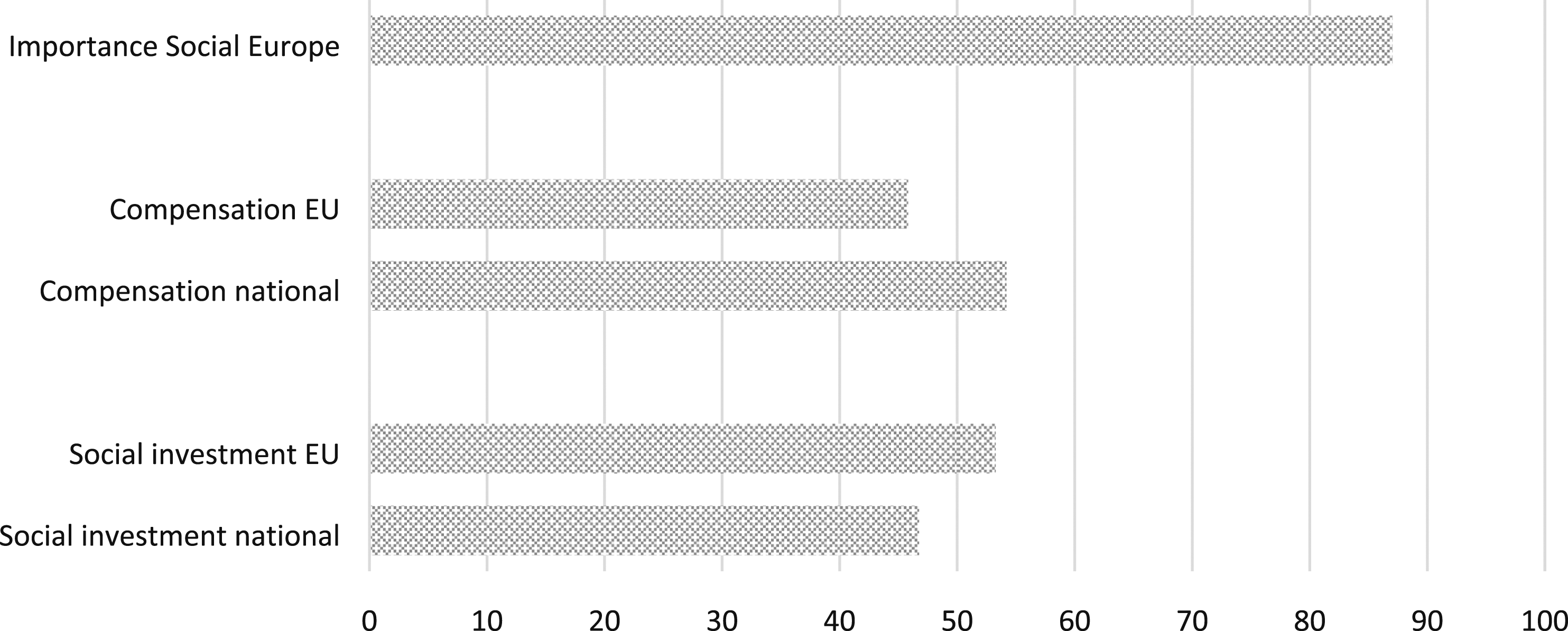
Notably, the majority of respondents does not change their policy preference for CP versus SI policies depending on whether the question is about the EU or the national level (87% for CP and 75% for SI). This is an important finding by itself as it might indicate that attitudes towards Social Europe could be more related to general welfare state attitudes via spillover effects rather than support for European integration, which might also hint once again at a lack of information and understanding the public has about the EU. Still, the respondents who do change their preference depending on which level the question is about prioritizing SI policies on the EU level (53%) more often than on the national level (47%). The opposite is the case for CP policies. Here, the respondents prioritize CP policies on the national level (54%) rather than on the national level (46%). This finding also applies across EU member states (see Table A3). The disaggregated descriptives demonstrate that these results can also be found for specific policies that the EPSR is promoting (see Figure A4). These patterns are in line with our first expectation in H1 – that publics will tend to prefer CP-oriented national-level social provisions and SI-oriented EU-level social provisions, although the size of the effect is not huge. Nevertheless, these are important tendencies, especially considering that the EU is currently further expanding the SI paradigm.
Individual-level results
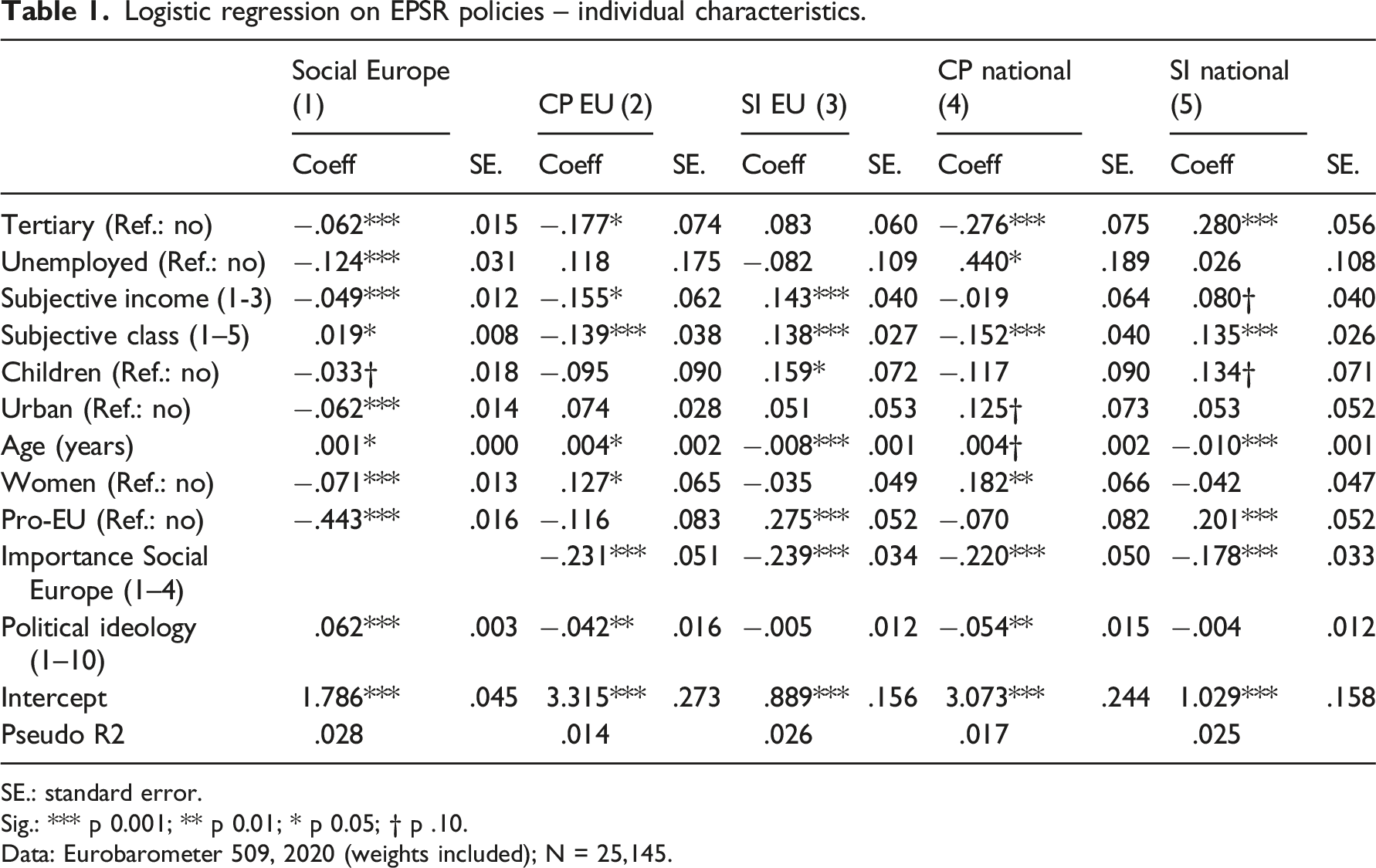
The next step in the analysis is to systematically examine these descriptive results through multilevel analysis, starting with the individual-level effects. This allows us to test Hypotheses 2a/b on how individual SES is related to support for national versus EU social policy. More generally, however, model 1 demonstrates that lower SES groups evaluate Social Europe overall as more important than higher SES groups. This result is in line with expectations, considering that other studies show higher levels of support from lower SES groups for specific EU social policies, such as an EU-wide minimum income benefit (Baute and Meuleman, 2020; Eick, 2023). The result also demonstrates again that attitudes towards Social Europe might be more in line with general welfare attitudes rather than with attitudes towards European integration. Slight variances across different SES groups also emphasize the need to examine particular EPSR policy areas and SES groups in more detail.
Logistic regression on EPSR policies – individual characteristics.
SE.: standard error.
Sig.: *** p 0.001; ** p 0.01; * p 0.05; † p .10.
Data: Eurobarometer 509, 2020 (weights included); N = 25,145.
Overall, these individual-level results hint at national priorities being reflected in what matters most to the respective group. The results for H2a are further supported by analysing additional depending variables in Table A6 and the 15 separate EPSR policies on EU and national levels in Table A9–A10. Generally, the standard errors and magnitude of the associations are in line with the public opinion literature in this field and do not change our interpretation of the results. And while there is naturally some overlap between the variables, they are still relevant as the mechanisms partly change between the models (in line with our theoretical expectations).
Additional tests of our theory (using interaction terms) reveal that higher SES groups who have heard about the EPSR are relatively more likely to prioritize SI over CP on the EU level (significance = 0.05). This result hints again at the theory that knowledge about Social Europe affects the SES cleavages.
Furthermore, higher SES groups that are pro-EU and are relatively more likely to prioritize SI over CP on the EU level too. Theoretically, this could be explained by the fact that higher SES groups, particularly the tertiary educated, can benefit from SI policies on the EU level, such as the Erasmus programme that provides opportunities for studying in another EU member state. However, the results are statistically weak (0.10) and should be replicated using different data in the future.
The control variables in the models 1–5 in Table 1 reveal additional findings. For example, respondents who have children are more likely to support Social Europe and prioritize SI on EU and national levels which is in line with the desired SI outcomes. Women are more likely to support Social Europe and prioritize CP on EU and national levels. Older respondents are less likely to support Social Europe and prioritize CP on EU and national levels. Respondents who are less Eurosceptic support Social Europe more and prioritize SI on EU and national levels. And, respondents who are more right politically support Social Europe less and prioritize CP on EU and national levels. These latter results fit well with our hypothesis since higher SES groups are known to be more pro-EU and more left politically (Kriesi et al., 2008).
Macro-level results
Figure 2 focuses on how national welfare state contexts shape support for SI and CP at the national and the EU level. Largely, it corroborates H3a, according to which the public prioritizes CP on both EU and national levels more in less generous welfare states, while the public prioritizes SI on both EU and national levels more in more generous welfare states. These results are further supported by two additional items for welfare state effort in Table A7. Furthermore, these results are robust, even when additional macro-level variables in the models are included (see Table A8). The results hint at the context mirroring the individual SES group dynamics, where policy priorities matter more than who provides these policies in a multilevel governance setting. Multilevel logistic regression on EPSR policies – contextual characteristics, marginal predicted means. The models control for all individual variables included in Table 1. Data: Eurobarometer 509, 2020; level 1 N= 25,145, level 2 N = 27, Comparative Social Citizenship Database, 2019 (weights included).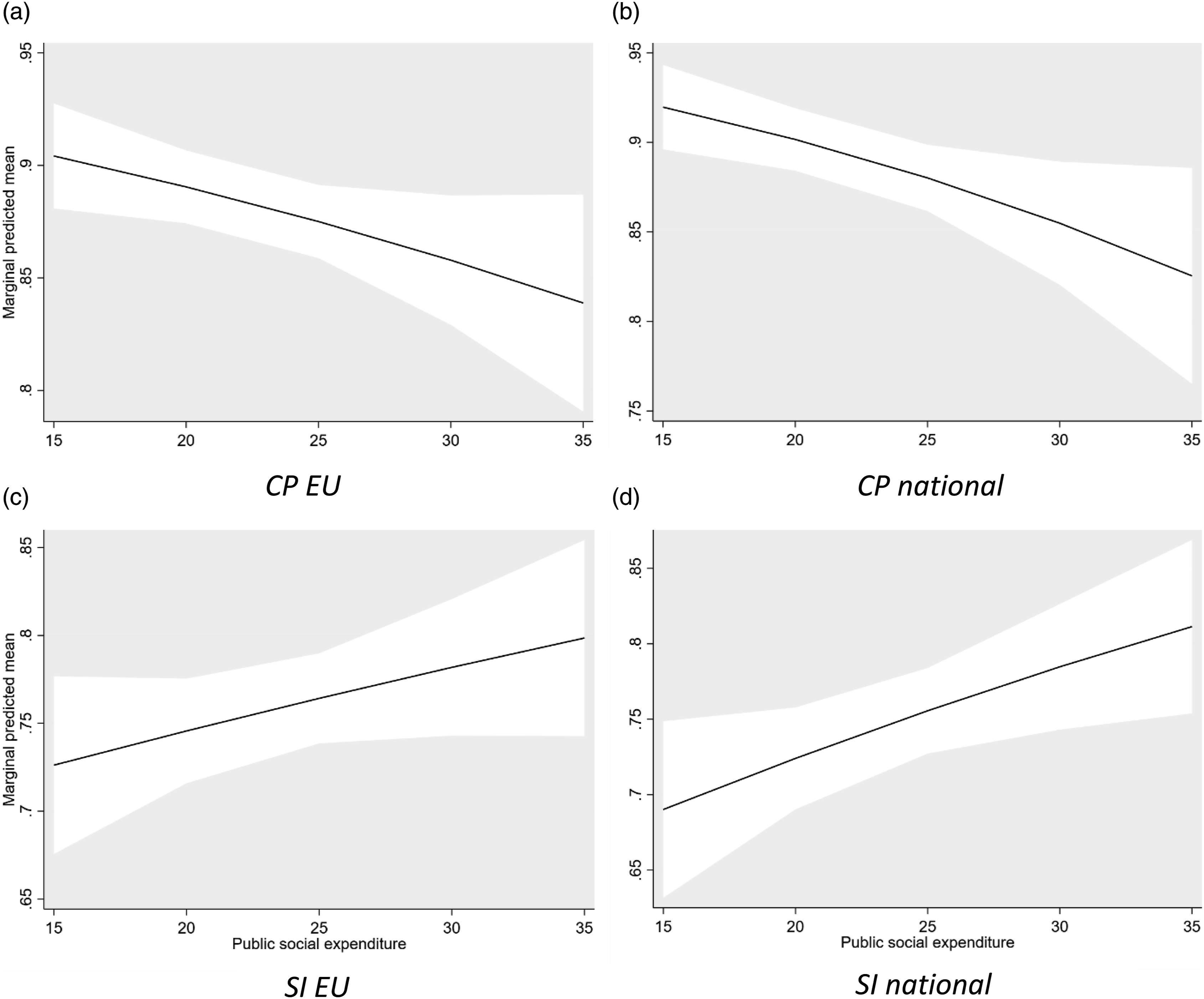
Interestingly, we tested how EU support shapes these relationships again and found that the part of the public that is pro-EU/heard about the EPSR in more generous welfare states is relatively more likely to prioritize SI over CP on the EU level (significance = 0.05). Hence, the role of knowledge about Social Europe and EU support definitely deserves more attention in future research.
Summary and conclusion
In the last decades, the EU has developed various policy proposals to strengthen its social dimension, many of which are directly linked to the newly emerging welfare state paradigm of social investment. So far, there is little knowledge about public attitudes towards these specific EU social policy proposals, in particular, whether the European public supports the EU in prioritizing SI over CP and how this support might depend on national welfare state contexts. In this article, we examined this question, using survey data from the Eurobarometer. Related to the research agenda of this Special Issue, we are also interested in whether the public, in general, supports a stronger involvement of the EU in social policy or not.
Our core findings are three-fold: first, we found robust evidence for differentiated attitudes regarding the priorities of social policymaking on the EU versus the national level. At the national level, respondents tend to prioritize a more compensation-orientated social protection system rather than one associated with social investment (even though overall support for SI policies remains high). In contrast, individuals prefer to give priority to SI policies at the EU level. A thorough explanation for this finding needs further research, but our intuition is that such an explanation would involve a tendency of individuals to follow market-friendly social policy cuing by EU actors as well as a tendency to see SI provisions as a more discretionary face of Social Europe not yet covered by and complementary to hard-won national-level compensatory provisions.
Second, on both EU and national levels, lower SES groups express higher support for CP on EU and national levels which could help lift them out of poverty and social exclusion. On the contrary, higher SES groups express higher support for SI on EU and national levels, being able to prioritize more future-oriented SI policies. This finding nuances previous research that shows that lower SES groups prefer CP on the national level (Häusermann et al., 2021) and could thus far not be replicated for the EU level.
Third, the same mechanisms apply to countries with lower levels of welfare generosity: the public prioritizes CP on both EU and national levels more in less generous welfare states. Vice versa, the public prioritizes SI on both EU and national levels more in more generous welfare states, indicating self-reinforcing rather than self-undermining effects. Overall, the results hint that policy preferences may be more relevant than who provides these policies in a multilevel governance setting is an important finding and reveals political cleavages in Social Europe.
Broadly speaking, our article adds both to the literature on public attitudes towards Social Europe (Mau, 2005; Gerhards et al., 2016; Baute and Meuleman, 2020), welfare states in multilevel governance settings (Bonoli et al., 2019; Luigjes and Vandenbroucke, 2020) as well as to the broader literature on policy feedback effects (Busemeyer et al., 2021; Mau, 2004; Larsen, 2008). Against the background of this Special Issue, an important additional finding that emerges from our analysis is that the public is not sufficiently informed about Social Europe and may have a hard time differentiating between social policies on the EU versus national level. Hence, for the future of European welfare states and current recalibration processes, it is important that the EU addresses the lack of understanding about the EU’s political institutions and decision-making processes (Crombez, 2003). We still find sufficient evidence to confirm that public priorities are at least partly congruent with the focus of the EU’s social policymaking elites on prioritizing social investment (De la Porte and Palier, 2022; Ferrera, 2017). At the same time, our analysis also shows that the public continues to cherish compensatory policies, in particular at the national level. Hence, the EU should also become a ‘holding environment’ (Hemerijck, 2019) for national welfare states in the sense that EU initiatives both in economic and social policy complement rather than supplement national welfare state efforts.
We see a few avenues for future research. For one, the Eurobarometer measurement of policy priorities and their distribution across different levels in the Eurobarometer is far from ideal. Novel survey instruments should be developed that are more dedicated and focused on measuring these priorities while also taking into account fiscal and policy trade-offs (Bremer and Bürgisser, 2023). Second, because no longitudinal dimension was included, the results might not hold for earlier periods, and further studies should be conducted in the future to address this issue, particularly in light of the current crises in Europe. Finally, the research around Social Europe is still in its early stages and at least partly undertheorized. Still, this article could unveil hidden nuances regarding the public and, particularly, socioeconomic/reform divides in the EU that are frequently overlooked in current academic and public discourse. We particularly find it intriguing that knowledge about Social Europe and support for the EU reinforced cleavages within and across countries. Overall, more research is needed to better understand the multilevel character of Social Europe, and this study can lay the groundwork for new theoretical mechanisms that should be considered in future studies.
Supplemental Material
Supplemental Material - Public preferences for social investment versus compensation policies in Social Europe
Supplemental Material for Public preferences for social investment versus compensation policies in Social Europe by Gianna M Eick, Gianna M Eick, and Marius R Busemeyer in Journal of European Social Policy
Footnotes
Acknowledgement
Previous versions of this paper were presented at the Council of European Studies Conference in June 2022 in Lisbon and at several EUSOCIALCIT events. We wish to thank the participants for their helpful comments. We are especially grateful for valuable input from Francesco Corti, Maurizio Ferrera, Maarten Keune, Marcello Natili, and the anonymous reviewers.
Declaration of conflicting interests
The author(s) declared no potential conflicts of interest with respect to the research, authorship, and/or publication of this article.
Funding
The author(s) disclosed receipt of the following financial support for the research, authorship, and/or publication of this article: This work was supported by funding from the European Union's Horizon 2020 research and innovation programme 'The Future of European Social Citizenship' (EUSOCIALCIT) under grant agreement No 870978 
Supplemental Material
Supplemental material for this article is available online.
References
Supplementary Material
Please find the following supplemental material available below.
For Open Access articles published under a Creative Commons License, all supplemental material carries the same license as the article it is associated with.
For non-Open Access articles published, all supplemental material carries a non-exclusive license, and permission requests for re-use of supplemental material or any part of supplemental material shall be sent directly to the copyright owner as specified in the copyright notice associated with the article.
