



Abstract
The term ‘welfare chauvinism’ has achieved a certain currency in social science research and is used widely. Yet, the concept is not without its critics, who claim that welfare chauvinism is ‘loaded’ or ‘ambiguous’. This article reviews empirical studies of welfare chauvinism, from the 1990s to the present day, drawing primarily from party politics and attitudes research. We identify differences in how the concept is used, defined, operationalized and measured. We emphasize the importance of a unified language, operationalization and measurement, and identify promising directions for future research.
Introduction
Thirty years ago, Andersen and Bjørklund used the term ‘welfare chauvinism’ to describe the belief of voters for the Progress parties in Norway and Denmark that ‘welfare services should be restricted to our (country’s) own’ (1990: 212). The term has taken root, and in the following years many researchers have endeavoured to uncover its complex causes and consequences. However, the term is not without its critics. Carmel and Sojka (2021: 646) argue that welfare chauvinism is an ‘ambiguous’ concept, while Albrekt Larsen (2020: 48) considers it ‘loaded’.
Such criticism notwithstanding, as of 2021, the term has been used in over 5000 English-language scholarly documents identified by Google Scholar. It is thus high time to take stock of the welfare chauvinism empirical literature where ‘welfare chauvinism’ is either the dependent or independent variable (for a review on healthcare consequences of welfare chauvinism, see Rinaldi and Bekker, 2021). We review studies published in academic journals with an impact factor above 1, or as books or chapters in edited volumes by reputed publishers, and exclude those texts where welfare chauvinism is not measured or conceptualized fully (see Table A1 online appendix).
After identifying the most enduring definitions of the concept, we provide an overview of findings from three empirical literatures: party politics, individual-level attitudes and policy reforms. We find that although most studies use similar definitions, they adopt diverse operationalization and measurement strategies. We conclude by discussing possible avenues for research.
Initial studies and definitions
Welfare chauvinism catapulted into the political sociology vocabulary in the 1990s, as scholars examined the success of populist radical-right parties (henceforth PRRPs) in Western Europe. Andersen and Bjørklund (1990) observed that Progress parties’ voters support redistribution but disagree that immigrants should receive benefits. Although their seminal article did not identify the extent to which one person would hold the two attitudes simultaneously, it labelled ‘welfare chauvinism’ as the observed preference that ‘welfare services should be restricted to “our own”’ (p. 211). The link between the two attitudes was clarified by Kitschelt and McGann (1995), who found that voters and parties can adopt different positions on the economic (pro-welfare) and socio-cultural (anti-immigrant) dimensions of political conflict, and that these dimensions interlink. Their definition of welfare chauvinism captures parties’ and voters’ ideological positions that the welfare state is ‘a system of social protection for those who belong to the ethnically defined community and who have contributed to it’ (p. 22).
Following these initial studies, two central strands of empirical literature on welfare chauvinism have emerged, one focused on parties’ ideological positions and a second on individual attitudes. A third strand has begun to consider how policy reforms change the welfare state to exclude immigrants, but many studies in this strand do not use the term welfare chauvinism per se. The next section presents their main findings.
Empirical studies: Findings and contributions
Parties, policies and welfare chauvinism
The new ‘winning formula’: The populist radical right and welfare chauvinism
The first scholars used ‘welfare chauvinism’ within the context of the challenge posed by socio-structural changes to traditional linkages between voters and parties (Andersen and Bjørklund, 1990; Kitschelt and McGann, 1995). They argued that a new cultural cleavage between ‘left libertarians’ and ‘right authoritarians’ was responsible for the emergence of ‘new left’ parties and PRRPs. For these scholars, ‘welfare chauvinism’ complemented the authoritarian values of blue-collar workers whilst satiating their desire for generous redistribution. Further investigations (Afonso and Papadopoulos, 2015; Afonso and Rennwald, 2018; Röth et al., 2017) found that welfare policies that exclude immigrants have become the cornerstone of PRRPs’ socio-economic policy agenda both in election campaigns (Ennser-Jedenastik, 2018; Koning, 2017) and in power (Chueri, 2020).
Other studies, however, question the commitment of PRRPs to protect welfare for natives. Rather, PRRPs appear to strategically support certain welfare policies, for example, social consumption over social investment (Enggist and Pinggera, 2021; Otjes et al., 2018) or workfare-ist over generous welfare benefits (Abts et al., 2021; Ennser-Jedenastik, 2016). Recent demand-side studies reinforce the idea that PRRP supporters harbour strong preferences for workfare-ism and judge welfare benefits recipients in terms of their deservingness (Busemeyer et al., 2021), independent of immigration attitudes (Attewell, 2021). Furthermore, PRRPs may espouse other socio-economic policies, such as pro-market, anti-taxation solutions to economic policy, that limit bureaucracy and financing of political elites (as shown in Swiss and Austrian cases, see Lefkofridi and Michel, 2017; Rathgeb, 2021). Thus, as famously argued by Kitschelt and McGann (1995), welfare chauvinism alone cannot fulfil the ‘winning formula’ for PRRPs wanting to attract a wider electorate, particularly if they are concerned about keeping office (Afonso, 2015).
Using in-depth analyses of frames, positions and issues, a second strand of party politics scholarship considers not whether, but how PRRPs use welfare chauvinism. Ennser-Jedenastik (2018) argues that PRRPs are more likely to use welfare chauvinist discourse where systems of redistribution follow a ‘need’ or ‘equality’ logics, such as child benefit or social assistance, compared to contribution-based schemes such as unemployment insurance (see also Lefkofridi and Michel, 2017). Studies drawing from the Nordic experience also illustrate the different uses of welfare chauvinist argumentation: the Danish People’s Party’s legitimation of welfare chauvinism builds upon the shift towards conditionality in flexicurity policies, and the recalibration of the welfare state from universal to reciprocal justice principles (Bak Jørgensen and Thomsen, 2016), while the Swedish Democrats articulate their welfare chauvinism through the defence of the Swedish Folkhem, harking back to the origins of the ethnically homogenous and universal Nordic model, against the mainstream shift to multiculturalism (Norocel, 2016).
Mainstreaming welfare chauvinism
The spillover of welfare chauvinist positions into mainstream party politics has also attracted scholarly attention. Informed by the wider literature on the effect of PRRPs on mainstream party positions on immigration (Abou-Chadi, 2016; Akkerman, 2015), the socio-cultural dimension (Abou-Chadi and Wagner, 2020) and welfare politics (Krause and Giebler, 2020), the crux of populist contagion theories are demand-centred: fearing electoral penalties, mainstream parties incorporate PRRP positions into their electoral manifestos (Lefkofridi and Michel, 2017; Schumacher and Van Kersbergen, 2016).
Yet, there are evident scope conditions accounting for the absence of welfare chauvinism from many mainstream parties, even when PRRPs are popular. In the Netherlands, for example, welfare chauvinism is only marginally used in the 2012 election by the centre-right conservative liberals. Koning (2017) finds that Christian Democratic parties are less likely than Conservative parties to support the disentitlement of immigrants from welfare. Schumacher and Van Kersbergen (2016) show that Left and Right respond differently to the welfare chauvinist positions of PRRPs. The former become more restrictive vis-à-vis immigration, while the latter become more generous in their welfare politics, particularly when in opposition or pursuant electoral loss.
Welfare chauvinism in individual-level studies
Seeking to understand the motivations behind welfare chauvinist attitudes, individual-level studies mirror discussions around the ideological positioning of PRRPs along the economic and cultural axes of political conflict.
Determinants of welfare chauvinist attitudes
Economic factors
Realistic group conflict and ethnic competition theories explain welfare chauvinist attitudes as the result of conflictual relationships between in- and out-groups premised on actual or perceived competition for scarce coveted resources, or on perception of risk, and have found consistent support: precarious income, low occupational status and perceived economic insecurity are systematically correlated with welfare chauvinist attitudes (Ford, 2016; Hjorth, 2016; Kros and Coenders, 2019; Mewes and Mau, 2012). Several vignette-based survey experiments nuance the mechanisms at work. For example, sensitivity to economic threat moderates the effect of identity cues on welfare chauvinist attitudes (Hjorth, 2016; Ford, 2016), and ‘residential ethnic diversity does not undermine welfare state solidarity unconditionally but rather stimulates welfare chauvinism’ (van der Meer and Reeskens, 2021: 100). Kros and Coenders (2019) found that ethnic threat is the factor that carries the effect of objective and subjective economic risk on welfare chauvinist preferences.
Ideological factors
Studies attributing welfare chauvinist attitudes to identity, political sophistication or values posit that self-identification or the views about society translate into views about out-group/in-group relationships, and therefore shape one’s willingness to extend the protective social net over individuals unlike oneself. Social identity and group belonging have been found to be powerful predictors of welfare chauvinist attitudes (Eger and Breznau, 2017; Ford, 2016; Hjorth, 2016). Marx and Naumann (2018) explained the increase in welfare chauvinist attitudes across the supporters of all parties in Germany in the aftermath of the 2015 so-called ‘refugee crisis’ as ‘general psychological disposition to respond to growing population heterogeneity with in-group favouritism’ (2018: 115, our emphasis).
Competing hypotheses originating in ideology-based or threat/conflict theories revealed support for both explanations (Ford, 2016; Hjorth, 2016) and found that when authoritarian views are controlled for, many economic factors become insignificant. Interestingly, not all economic factors are affected equally: the effect of objective economic factors (income) disappears, but subjective or ‘perceived’ economic risk remains significant (Mewes and Mau, 2012; van der Waal et al., 2010).
The welfare state and redistributive principles
Several studies have enquired whether welfare states affect welfare chauvinist attitudes. A positive answer is given by Van der Waal et al. (2013), who corroborate an earlier finding of Crepaz and Damron (2009) that citizens in social-democratic welfare states hold the least welfare chauvinist attitudes. Their detailed analysis found that levels of welfare chauvinism vary with the capacity of welfare regimes to deal with income inequality. Reeskens and Van Oorschot (2012) found that likelihood to exclude immigrants from welfare access is associated with support for needs-based redistribution, which is most prevalent in liberal welfare states.
Consequences of welfare chauvinist attitudes
The demand-driven expectations of party politics hold that voters for PRRPs (and potential swing voters) hold welfare chauvinist attitudes. A handful of studies directly address the question of the welfare chauvinist attitudes’ consequences on electoral politics. Häusermann and Kriesi (2015) argue that welfare chauvinism is part of a new universalism–particularism cleavage triggered by globalization-related processes, and find that on the right side of the scale, only the voters of right-wing populist parties take a position on this cleavage. Jylhä et al. (2019) found that voters with strong welfare chauvinist attitudes left the Social Democratic party for the Swedish Democrats (the PRRP in Sweden). However, de Koster et al. (2013) do not find this in the Netherlands: although the supporters of Dutch new-rightist parties display both welfare populism and welfare chauvinism, only the former drives support for these parties. This echoes findings in research on deservingness (Attewell, 2021) and authoritarian welfare attitudes (Busemeyer et al., 2021) that PRRP voters do not support unfettered redistribution, but prefer workfare and consumption policies over social investment.
The effects of welfare chauvinism on the design of the welfare state
The studies we reviewed so far use welfare chauvinism either as a dependent or independent variable. The concept is also increasingly used in studies focusing on the macro-level puzzle of explaining reforms to welfare states themselves. While Chueri (2020) and Careja et al. (2016) use ‘welfare chauvinism’ to capture the conditionalities embedded in the labour market and social security reforms targeting immigrants, several studies use terms such as welfare state ‘generosity’, ‘access’ or ‘exclusion’ when analysing welfare state provision for residents with an immigration background, and attribute observed changes to welfare chauvinism.
It is important to consider what processes this literature uncovers, as the exclusion of immigrants from certain services/benefits may be, in effect, a reduction in inclusiveness without affecting generosity, that is, the financial amounts/or the service provision to individuals who qualify (including immigrants). From this angle, most of the studies we examined focus on immigrants’ access as specified in existing legislation. Schmitt and Teney (2019) use MIPEX data to analyse access to social security and housing. Banting and Koning (2017), on the contrary, talk about ‘exclusion’ from general social benefits. In addition to rules for access based on the category of migration and benefit-specific conditions, the authors point out that immigrants’ own insufficient knowledge and linguistic skills generate ‘informal exclusion’.
Römer (2017) and Gschwind (2021) are concerned with how immigrants are treated by ‘generous welfare systems’, where generosity is a composite characteristic of the system including coverage, qualifying periods for eligibility and replacement rates (see Scruggs et al., 2014). However, they reach different conclusions. Römer (2017) focuses on immigrants’ access to social assistance benefits (quantifying the conditions in place) and finds that in countries with more generous welfare systems, immigrants have more access to these benefits (less stringent conditions). Gschwind (2021) distinguishes between formal rights and de-facto benefit receipt (p. 3). He finds that the uptake of unemployment benefit is much lower for foreign-born unemployed individuals. However, not all immigrants are equally affected: the strongest negative effects are observed in the case of recent arrivals, and the gap between citizens and immigrants is widest in contexts of high generosity.
In a different take on generosity, Careja et al. (2015) examine immigrants’ treatment in the UK and Denmark, and find not only that immigrants had reduced access to certain benefits, but also that the size or amount of benefit available to them has been targeted in recent legislation. For example, Denmark has significantly cut the amount granted to recognized asylum seekers, and introduced a benefit ceiling for social assistance (decoupling it from number of household members, including children) and child allowance.
Although there is relatively little overlap between the periods covered, countries included, and benefits and services analysed, and although the results point in quite different directions, these studies suggest that under the influence of a welfare chauvinist zeitgeist, the welfare systems are being changed in multiple and complex ways. To what extent such changes follow or challenge the original design of the welfare regimes is still an open question.
Discussion
Conceptualization and measurement
Conceptualization and measurement in welfare chauvinism studies.
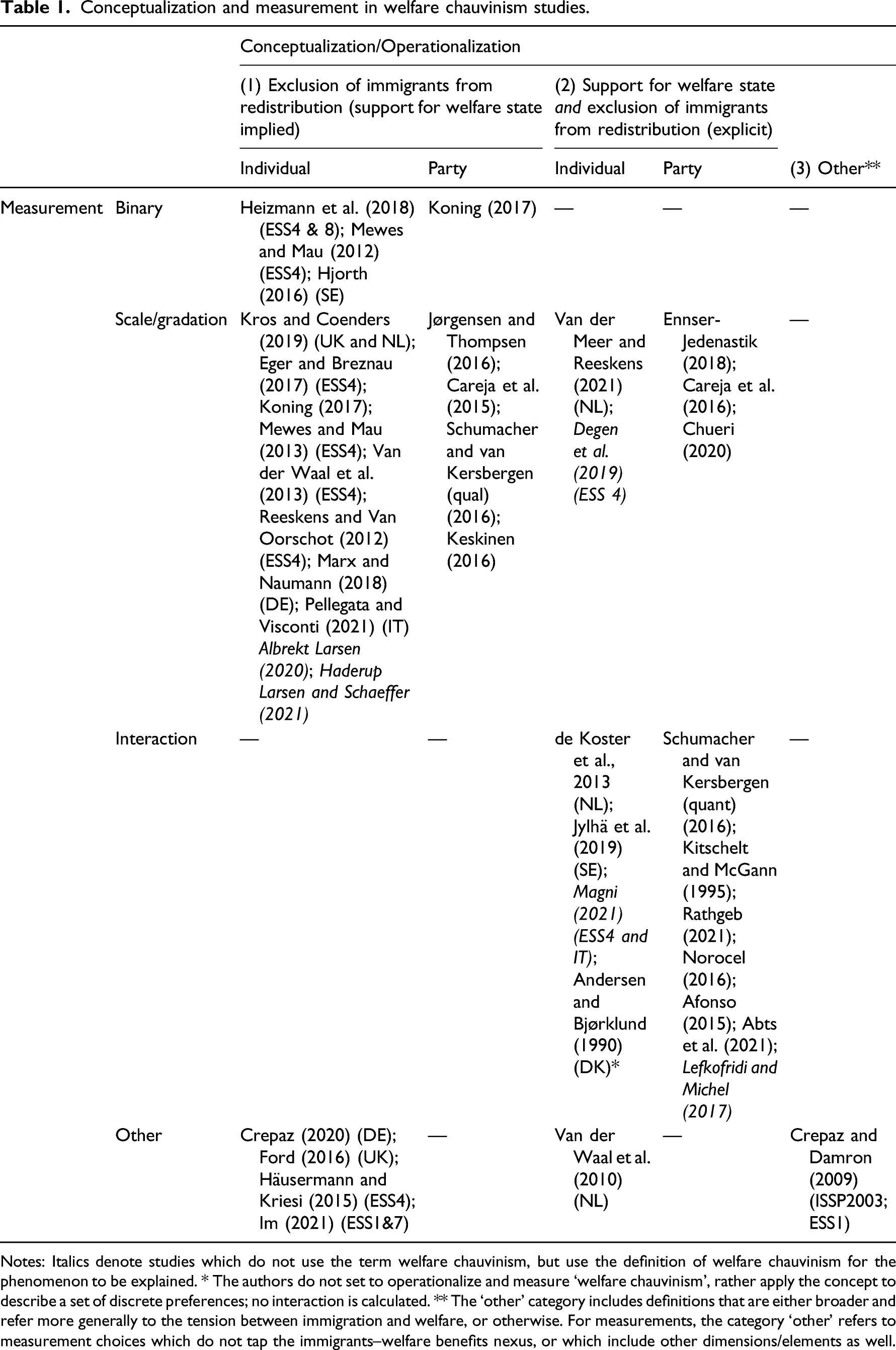
Notes: Italics denote studies which do not use the term welfare chauvinism, but use the definition of welfare chauvinism for the phenomenon to be explained. * The authors do not set to operationalize and measure ‘welfare chauvinism’, rather apply the concept to describe a set of discrete preferences; no interaction is calculated. ** The ‘other’ category includes definitions that are either broader and refer more generally to the tension between immigration and welfare, or otherwise. For measurements, the category ‘other’ refers to measurement choices which do not tap the immigrants–welfare benefits nexus, or which include other dimensions/elements as well.
First, there are visible differences in the conceptualization and operationalization of welfare chauvinism. Most empirical studies conceptualize welfare chauvinism following the definitions of Anderson and Bjørklund (1990) or Kitschelt and McGann (1995), which emphasize the exclusion of immigrants from a pre-existing system of redistribution. However, not all these studies operationalize the concept in the same way. While many operationalize welfare chauvinism in terms of support for the ‘exclusion’ of immigrants from welfare benefits (see Table 1, column 1), without explicitly mentioning the support for the welfare state, several studies operationalize welfare chauvinism as a combination of support for redistribution and preference for excluding immigrants from it (see Table 1, column 2). Examples of such bi-dimensional operationalizations are offered by de Koster et al. (2013), ‘a combination of strong support for economic redistribution with resistance toward distributing welfare services to immigrants’ (p. 6) or Careja et al. (2016), ‘a strong pro-welfare state position [combined] with explicit exclusion of non-natives’ (p. 436). Among the examined studies, one opted for a complex definition and operationalization (see Table 1, column 3): Crepaz and Damron (2009) argue that ‘Welfare chauvinism […] captures the material dimension of conflict’ between foreigners and citizens (p. 439) and include in their definition, perceptions of immigrants taking jobs away and abusing the welfare state.
Second, while these conceptualization strategies can certainly each be defended, they carry consequences for research outcomes. The first regards connections across research areas, particularly given that most individual-level studies opt for an operationalization built on (degrees of) exclusion from redistribution (Table 1, column 1), whereas party studies tend to adopt more varied operationalization decisions (column 2). Should scholars of party positions hold both dimensions to be equally important, they are limited in the inferences they can draw about voters from studies with one-dimensional approaches to welfare chauvinism. Researchers seeking to explain party positions or voter-demand by connecting these two levels of analysis should thus take note of the operationalization-driven potential disconnect in the empirical outcomes of these two literatures. The second is that the existence of three different conceptualizations may lead to conceptual stretch, as it becomes unclear, as forewarned by Sartori (1970) and Goertz (2006), which theoretical building blocks constitute the concept. For example, support for economic egalitarianism (resulting from evaluations of income inequalities) is used as a predictor of welfare chauvinism in some studies (Kros and Coenders, 2019), whereas, as we show above, the support for redistribution is a major component of the concept itself in others (studies in column 2). Perhaps most noteworthy is that conceptualizations not following either common definitions (column 3) may confound comparative researchers further, as they incorporate factors which other studies identify as determinants of welfare chauvinism, such as stereotypes and prejudices about immigrants (Goldschmidt, 2015; Hjorth, 2016) or own (economic) insecurity (Cappelen and Mitdbø, 2016; Heizmann et al., 2018).
Third, there are different strategies to measure the concept. Few studies adopt a binary measurement, while most subscribe to the view that welfare chauvinism is a matter of degree. A third group of studies use more complex measurement approaches. In attitudes research, most studies measure welfare chauvinism as a continuous or ordinal variable, on a scale from ‘no exclusion’ to ‘full exclusion’ (Table 1, row 2). This is often measured with the ESS question (or similar) that asks respondents to choose one of several statements describing ‘when [immigrants] should obtain the same rights to social benefits and services as citizens already living here’. This item has been criticized (Mewes and Mau, 2012). Some studies re-construct this variable to a binary measure (Table 1, row 1), where only the instances in which immigrants are explicitly excluded from benefits are considered instances of ‘welfare chauvinism’. The studies using this measurement tend to follow the first conceptualization which focuses on immigrant exclusion from the welfare state only.
Other studies, following the second conceptualization, measure welfare chauvinism through the intersection of support for redistribution and the exclusion of immigrants (Table 1, row 3). For example, De Koster et al. (2013) interact views on egalitarianism and support for ethnic redistribution to measure welfare chauvinism, while Jylhä et al. (2019) create an index by combining statements concerning support for redistribution and opinions about immigrants’ cost for the welfare system. Yet other studies propose alternative measurements, departing from the focus on welfare redistribution (Table 1, row 4). For example, Häusermann and Kriesi (2015) use an evaluation of whether immigrants receive more/less than they contribute, while Crepaz (2020) proposes a measure composed of items which capture extension of social rights to immigrants, support for immigrants’ access to jobs and concern with an overwhelmed social security system.
In the party politics and policy literature, the scholars who adopt an exclusion-driven conceptualization (see column 1) typically measure welfare chauvinism by evaluating the wording of parties’ statements or the exclusivity of policies themselves. This results in distinctions between ‘strong’ and ‘weak’, ‘direct’ and ‘indirect’ welfare chauvinism (Bak Jørgensen and Thomsen, 2016; Careja et al., 2016). Others prefer a bi-dimensional approach to measuring welfare chauvinism, and, using either qualitative or quantitative approaches, assess whether support for redistribution and exclusion of immigrants occurs simultaneously. For example, Rathgeb (2021) shows that the Austrian Freedom Party (FPÖ) promoted the protection of the welfare benefits for the working classes and ‘selective cuts in the benefit entitlements of non-citizens’ separately (p. 653). Quantitative scholars face several limitations given the absence of a comparable cross-country measure for party positions on exclusion of different groups from the welfare state. Some scholars acknowledge this problem and calculate welfare chauvinism positions from proxy items provided by the Manifesto Project or Chapel Hill Expert Survey. Schumacher and van Kersbergen (2016), for example, multiply positions on welfare and multiculturalism (as immigration positions are not identified separately) from party manifestos. This approach, however, has been criticized by other scholars (Ennser-Jedenastik, 2018) who argue that this strategy cannot capture whether social policy statements are ‘nativist’, which is a key condition for welfare chauvinist discourse.
This variety of measurement approaches is arguably largely driven by data availability. Although many measurement decisions are justified, their diversity is likely responsible for the observed difference in effects across studies. More relevant, however, is that if welfare chauvinism is measured too differently across party and attitudes literatures, these studies cannot be convincingly used as mutually supportive evidence. As striving for better operationalization and measures is an inherent feature of social science scholarship, we argue that it is of the utmost importance that all operationalization and measurement choices are harmonized with the conceptualization of welfare chauvinism. Moreover, given the current diversity within and across research areas, we encourage future discussions on measurement to find solutions that embrace both party and attitudes research. This will likely help this field of research to develop organically and coherently.
The same phenomenon – different terms
While some scholars propose to abandon the term altogether and adopt a different theoretical take (Carmel and Sojka, 2021), others see benefit in studying the phenomenon as defined by Andersen and Bjørklund (1990), but opt for using terms other than ‘welfare chauvinism’. For example, Degen et al. (2019) prefer ‘welfare state restrictiveness’, which they associate with ‘whether and under which conditions immigrants should be granted access to social benefits’ (p. 2), and measure with the same ESS item used by many scholars to measure welfare chauvinism, while Albrekt Larsen (2020) uses ‘welfare nationalism’ as a synonym for welfare chauvinism to mitigate for the latter’s perceived normativity, and measure it with an ESS-like item. Other scholars add qualifying adjectives to ‘solidarity’. Lefkofridi and Michel (2017) claim that parties promote ‘inclusive’ or ‘exclusive’ solidarity, and define the latter as a ‘strictly restrictive concept of redistributive politics’ (p. 3), in which citizens are generously redistributed to, and non-natives are not. Koning (2019a: 15) uses the concept of ‘selective solidarity’ (see also Albrekt Larsen, 2020; Magni, 2021), which he defines as ‘general support for a redistributive welfare state, but also a desire to restrict its benefits to native-born citizens’.
Thus, essentially, these scholars conceptualize the phenomenon along the same lines as scholars who use the term ‘welfare chauvinism’, and measure it in very similar ways (see Tables 1 and A1). The adoption of a ‘solidarity’ perspective arguably enables them to better account for the diversity in immigrants’ access to social rights as opposed to ‘exclusion’, which suggests a dichotomy. However, it must be noted that apart from very few instances, which indicated that the concept ‘welfare chauvinism’ is ‘loaded’, ‘ambiguous’ or invokes ‘associations’ among readers (Koning, 2013: 3; Albrekt Larsen, 2020: 49; Carmel and Sojka, 2021: 646), these authors do not satisfactorily explain their movement away from this concept. Given that these studies refer to the same phenomenon as the studies which use the term ‘welfare chauvinism’, stem from the same definitional roots and use similar measures, we argue that their use of different concepts should be explicitly elaborated upon. In particular, clarifying the relationship between the terms preferred by the authors and the term ‘welfare chauvinism’ will result in a more coherent field of research.
Conclusion: Quo vadis, welfare chauvinism?
In this article, we set out to offer an overview of the empirical welfare chauvinism literature, and highlight the issues and challenges facing scholars of immigration and welfare state research who employ the term or similar ones. Welfare chauvinism’s association to PRRPs has led a few scholars to shy away from the concept. However, it remains widely used, and this review has highlighted valuable theoretical and empirical insights that the rich research on welfare chauvinism has brought to the fields of party politics, public opinion and social policy. We argue for the continued, yet reflective, use of the concept, and in favour of a reflective approach to its operationalization and measurement.
This overview has identified possible directions and open questions for future research. First, the cross-country variation of mainstream responses to PRRPs’ welfare chauvinism needs further research. The studies which took a step in this direction suggest that the path is complex and various scope conditions apply (Koning, 2017; Schumacher and Van Kersbergen, 2016). In particular, the difference between party families, and across welfare states, and the relevance of different groups of migrants, may explain variation in party politics, but these research avenues require further investigation. The social democratic parties’ solutions to address the ‘progressives’ dilemma’, the trade-off they face when considering welfare expansion in times of backlash against multiculturalism (Kymlicka, 2015), may prove illuminating for scholars of changes to party systems, too. Furthermore, extending research to non-democracies and states from the Global South would enrich this Europe-centric literature. Better data on party positions would aid this goal, and steps in this direction have already been taken, such as the Immigration in Party Manifestos Dataset (Dancygier and Margalit, 2020).
Second, we argue that future research should endeavour to implement more longitudinal designs. The current dominance of cross-sectional approaches in public opinion research is undoubtedly driven by the existing data. But cross-sectional designs have limited ability to test causal arguments. The few studies that implement survey experiments, which produce methodologically convincing evidence concerning the causes of welfare chauvinism, rely on single-country samples and are not replicated. Therefore, their findings remain limited to the national context where they have been observed. We encourage the scholarly community to identify opportunities to include measures of welfare chauvinist attitudes in (ideally multi-country) panel datasets.
Finally, our review has found that most of the empirical literature so far has focused on individual attitudes and party positions. We suggest that the question of how and why welfare states have changed to include/exclude immigrants requires further investigation. We identify two possible directions. First, as discussed in the second section (the subsection on the effects of welfare chauvinism on the design of the welfare state), coverage and generosity of existing welfare programmes have been reformed to exclude immigrants in different ways. It is thus reasonable to ask whether and to what extent such changes have affected (differently) the component parts that make up distinct welfare regimes (Esping-Andersen, 1990). Future studies should incorporate welfare-state design as a dependent and not only independent variable in welfare chauvinism research to explore this further. Second, although a number of factors were identified in the second section (the subsection on the effects of welfare chauvinism on the design of the welfare state), future research should examine the causal link between micro, meso and macro ‘welfare chauvinism’ from individual attitudes to party strategies and policy reform outcomes (see also Emmenegger and Klemmensen, 2013). By building upon systematic and detailed longitudinal data on party positions on immigration such as those provided by projects like the Immigration in Party Manifestos dataset (Dancygier and Margalit, 2020), or using data on immigrants’ rights in legislation as provided by datasets such as the Immigrants' Social Rights Index (Koning, 2019b), MIPEX (Solano and Huddleston, 2020) or the Migrant Social Protection Index (MigSP) (Römer et al., 2021), new avenues of research in this direction can be embarked upon.
Supplemental Material
sj-pdf-1-esp-10.1177_09589287211068796 – Supplemental Material for Thirty years of welfare chauvinism research: Findings and challenges
Supplemental Material, sj-pdf-1-esp-10.1177_09589287211068796 for Thirty years of welfare chauvinism research: Findings and challenges by Romana Careja and Eloisa Harris in Journal of European Social Policy
Footnotes
Acknowledgements
The authors would like to thank members of the BIGSSS Migration and Refugee Studies Group, particularly Jakob Henninger and Kristin Noack, for their feedback on an earlier version of this article. Thanks should also be given to the YERUN mobility funding, which enabled the authors to develop the ideas for this article and to Thi Phuong Linh Truong for her excellent research assistance. Finally, we would like to thank two anonymous reviewers for their insightful comments.
Declaration of conflicting interests
The author(s) declared no potential conflicts of interest with respect to the research, authorship, and/or publication of this article.
Funding
The author(s) disclosed receipt of the following financial support for the research, authorship, and/or publication of this article: Eloisa’s PhD research has received funding from the European Union’s Horizon 2020 research and innovation programme under the Marie Sklodowska Curie grant agreement No.713639 and the Deutsche Forschungsgemeinschaft (DFG, German Research Foundation) – Projektnummer 374666841 – SFB 1342.

References
Supplementary Material
Please find the following supplemental material available below.
For Open Access articles published under a Creative Commons License, all supplemental material carries the same license as the article it is associated with.
For non-Open Access articles published, all supplemental material carries a non-exclusive license, and permission requests for re-use of supplemental material or any part of supplemental material shall be sent directly to the copyright owner as specified in the copyright notice associated with the article.
