



Abstract
Welfare chauvinism is largely understood as the view that the benefits of the welfare state should primarily be given to the native population, and not shared with the immigrant populations. Using a multilevel approach, we analyse welfare chauvinism in Europe and test to see how different contextual and macro-economic conditions may influence welfare chauvinistic attitudes in Europe, with a particular focus on different nuances of unemployment. We also test how individuals’ subjective perceptions of the economic development in their society may influence welfare chauvinism in Europe. The analysis finds that welfare chauvinistic attitudes have increased in strength in Central-Eastern European welfare states, whereas the most exclusionary form of welfare chauvinism is near non-existent in the Nordic welfare regimes. We further find that it is the subjective perceptions of the macro-economic conditions and the strength of far-right populism, rather than the actual objective reality of a society’s economic situation that drives welfare chauvinistic attitudes in Europe.
Introduction
In the twenty-first century, as several European welfare states have seen increases in their immigrant populations, debates surrounding immigrants and their place in society have, in many ways, become entrenched in the European welfare states (Dennison and Geddes, 2019; Green-Pedersen and Otjes, 2019). A central point in these debates is the question of when immigrants are to be afforded the benefits and services that living in a welfare state entails. This has seen the development of what Andersen and Bjørklund (Andersen and Bjorklund, 1990: 212) termed ‘Welfare Chauvinism’, defining it rather briefly as the idea that ‘the welfare state should be restricted to our own’. Originally, the term was used to explain the structural changes and new cleavages of Western European politics in the 1990s, when right-wing nationalist parties became supportive of the idea that the welfare state should exist primarily for the native population, and that it should exclude immigrants from receiving its benefits (Andersen and Bjørklund, 1990; Kitschelt and McGann, 1995).
The link between left-wing economic positions and right-wing value and cultural positions have become a staple of populist radical right parties throughout Europe (Schumacher and Van Kersbergen, 2016). In response, some of the scholarship on welfare chauvinism has shifted in part from focusing on political parties to focusing on the development of welfare chauvinistic attitudes (Crepaz and Damron, 2009; Van der Waal et al., 2010; Careja and Harris, 2022). Although other terms have been used to describe the exclusion of immigrants from receiving the benefits and services of the welfare state (see, for example, Koning’s (2013, 2019) work on selective solidarity), throughout this study, we will refer to the phenomenon as welfare chauvinism.
Research on welfare chauvinistic attitudes has increased manyfold since its conceptual establishment in the 1990s (Ziller and Careja, 2022). With increased research attention on welfare chauvinism, several contextual factors have also been explored. These factors often explore, for example, how the size of different minority populations influences welfare chauvinistic attitudes in European societies (Gorodzeisky and Semyonov, 2009; Reeskens and Van Oorschot, 2012; Cappelen and Peters, 2018; Heizmann et al., 2018). Moreover, economic factors, such as GDP per capita (Mewes and Mau, 2012), social inequality (Van der Waal et al., 2013), social expenditure (Reeskens and Van Oorschot, 2012) and globalization (Mewes and Mau, 2013), have all been found to influence welfare chauvinistic attitudes in Europe. Furthermore, individuals’ subjective feelings of economic security are found to play a much larger part in explaining welfare chauvinistic attitudes than the objective reality of an individual’s economic situation (Heizmann et al., 2018; Kros and Coenders, 2019). One aspect that has not received as much attention is how these subjective feelings relate to macroeconomic aspects of a country may play a part in the development of welfare chauvinistic attitudes. This is particularly of interest as individuals often have a flawed perception of reality (Citrin and Sides, 2008; Bussolo et al., 2021). Europe has seen a considerable rise in populist far-right parties in the preceding decades, and as Caiani and Graziano (2019) explain, these parties often construct specific failure stories in line with the public’s sentiment and transform them into a perceived crisis. The distortion of reality by these parties and with individuals’ flawed perceptions of reality may then be important drivers for European welfare chauvinism. This will be one of the main aspects which this study investigates.
Several of the former studies have used data from the 2008 European Social Survey (ESS) as it was one of the few datasets that included a measure on welfare chauvinism. In 2016, the ESS released a similar dataset containing the same measure of welfare chauvinism. From 2008 to 2016, there have been several salient crises, including the 2008 financial crisis and the so-called refugee crisis in 2015–2016. These crises may have significantly changed perceptions towards immigrants (see, for example, Talò, 2017; Isaksen, 2019). It is therefore of relevance to test whether several of these contextual factors still have an effect for explaining welfare chauvinism in European societies and how subjective perceptions regarding these economic aspects may also be of influence.
Additionally, an economic factor that has received somewhat ambiguous results is how the unemployment rate of a country affects welfare chauvinistic attitudes. Some studies have found that a higher unemployment rate leads to a higher level of welfare chauvinism (Mewes and Mau, 2012; Goldschmidt and Rydgren, 2018; Ziller and Careja, 2022), whereas several others have found no relationship between the two (Mewes and Mau, 2013; Van der Waal et al., 2013; Eger and Breznau, 2017; Heizmann et al., 2018). Noteworthy changes in unemployment since 2008 combined with inconclusive results means that it is also pertinent to focus on different aspects of a country’s unemployment with a more in-depth analysis of its effect on welfare chauvinism. This study therefore aims to explore, on both a macro and a micro level, how different factors may influence welfare chauvinistic attitudes, with a particular emphasis on economic factors and different nuances of unemployment. Another contribution of this study is that it includes how individuals’ perceptions of these macro-level aspects may affect welfare chauvinistic attitudes.
This article is divided into several interrelated parts, beginning with an explanation of realistic threat theories before reviewing previous studies of welfare chauvinism and looking at how different contextual factors have played a part in affecting welfare chauvinism. This is followed by an explanation of the data and methods used in this study before we present the results and concluding discussion.
Theory and previous research
Most studies on welfare chauvinistic attitudes tend to rely on aspects of intergroup threat theory (see, among others, Blumer, 1958; Blalock, 1967; Quillian, 1995; Stephan et al., 2016), with particular emphasis on the realistic threat aspect of the theory. Intergroup threat is experienced when members of one group perceive that another group is in a position to cause harm toward them. Realistic threats can be described as threats to a group’s power, resources and general welfare (Stephan et al., 2016). These types of threat are also often referred to as material (Ben-nun Bloom et al., 2015), or economic threats (Schmuck and Matthes, 2015). A typical example of realistic threat can be the perception that immigrants are stealing the jobs of the native population, thus inducing a feeling of realistic threat, which in turn can lead to prejudice towards immigrants. An essential part is that realistic threat does not have to be a real threat, but it needs to be perceived as real by the individual. Individuals can then perceive these threats where none exists. This is important, as perceived threats have actual consequences, regardless of whether the perception of threat is accurate or not.
Another important aspect to clarify is that an individual can experience these realistic threat perceptions at both a group, and an individual level (Stephan et al., 2016). An individual who is unemployed, can perceive immigrants as competitors for jobs or welfare benefits, and therefore develop an individual perception of realistic threat. However, an individual who is employed, can also develop a similar type of threat perception, but on a group level. They may view immigrants as a threat to their group as they could perceive immigrants to take the jobs or benefits that should be awarded to the native population, meaning that their group should be prioritized over immigrants when it comes to unemployment benefits and jobs in the society (Blumer, 1958; Stephan et al., 2016).
Economic determinants of welfare chauvinism
It is argued that when there is a more precarious economic situation in a society, majority populations will feel more threatened by immigrants, as they fear that their own economic advantage will be damaged through increased competition with the minority group (Quillian, 1995). With welfare chauvinism, different economic factors have been found to have an influence. Economically weaker countries (measured by GDP per capita) tend to be more welfare chauvinistic (Mewes and Mau, 2012), and more social inequality in a country also leads to higher levels of welfare chauvinism. Magni (2020) found that social inequality leads to higher support for redistribution, but not redistribution towards immigrants, and Van der Waal et al. (2013) also found that inequality enhances welfare chauvinism, arguing that in more unequal societies, the wealthy are more likely to perceive minority groups as deviant and therefore less entitled to welfare.
Moreover, countries with a higher social protection expenditure tend to have lower levels of welfare chauvinism (Mewes and Mau, 2013; Reeskens and Van Oorschot, 2012). This may be a consequence of what Larsen (2008) calls the institutional logic of welfare attitudes. He empirically argues that the line between ‘us’ and ‘them’ melts away as universal benefits help define everyone within the nation state as belonging to one universal group rather than a recipient group and a contributor group. Therefore, the deservingness criteria are more lenient in social democratic regimes than in liberal regimes. Further research has also found that this applies to immigrants. Citizens of more encompassing welfare states are more welcoming to immigrants and less welfare chauvinistic (Crepaz and Damron, 2009).
Using Esping-Andersen’s (1990) three welfare regimes as units of analysis, Van der Waal et al. (2013) found two different ‘worlds of welfare chauvinism’: social democratic welfare chauvinism and conservative/liberal welfare chauvinism. They further find that these regime differences in welfare chauvinism can be fully attributed to the differences in social inequality between the regimes. On the individual level, Kros and Coenders (2019) found that in the Netherlands and Great Britain, individuals who subjectively felt more financially secure were less welfare chauvinistic, and that individuals who were recipients of welfare benefits and therefore experienced a more objective economic risk were not significantly more welfare chauvinistic than individuals who were not receiving welfare benefits. This follows Heizmann et al. (2018), who found clear support that subjective perceptions of deprivation are important predictors of welfare chauvinism. Subjective perceptions therefore seem to be more important for understanding welfare chauvinism than real or objective factors.
Against this background, we investigate how the objective economic risk of being unemployed may affect welfare chauvinistic attitudes. Furthermore, we also investigate subjective perceptions in the form of satisfaction with one’s own income and how an individual’s welfare chauvinistic attitudes are linked to his or her perceptions of the economic situation in the country. As several studies have found, individuals often blame immigrants for the problems and issues that arise on a macro-level (Bello, 2017; Cecchi, 2019; Isaksen, 2019). Therefore, individuals who are dissatisfied with the state of their society may regard immigrants as a cause for these issues and have a higher likelihood of developing feelings of realistic threat. In turn, they may therefore believe that granting immigrants the benefits of the welfare state will further exhaust it. Based on the previous studies we develop our first hypothesis.
Individuals who are dissatisfied with the economy and health services of their country, will exhibit a more welfare chauvinistic attitude. An important aspect to also highlight in how these perceptions may be shaped is by populist politicians. European populism is predominantly exclusive in its form. As Mudde and Kaltwasser (2013) explain, European populists primarily focus on protecting the conditions of the welfare state, which they consider to be under threat from outside forces, often immigrants. Several scholars also argue that populist political actors can construct failure stories and ‘spectacularize’ failures on the macro level so as to create a sense of crisis and discontent (Moffitt, 2015; Caiani and Graziano, 2019). The exclusionary nature of European populism and their framing of a society in crisis may therefore increase welfare chauvinistic attitudes in Europe. In line with this argument, our second hypothesis investigates whether the strength of far-right populists in a country can indeed be connected to welfare chauvinism.
Countries with a stronger presence of far-right populist parties will be more welfare chauvinistic.
Unemployment and welfare chauvinism
On the contextual level, unemployment rates have been found to influence attitudes towards the welfare state and redistribution (Blekesaune and Quadagno, 2003; Blekesaune, 2007; Burgoon, 2014; Eger and Breznau, 2017). It has also been found to influence anti-immigrant attitudes (Hjerm, 2009; Meuleman et al., 2009; Kunovich, 2017; Hoxhaj and Zuccotti, 2021). As welfare chauvinism has its basis in both attitudes towards redistribution and attitudes towards immigrants, it is not inconceivable to reason that unemployment rates may influence welfare chauvinistic attitudes. Still, the effects of unemployment on welfare chauvinism are somewhat contentious, as several studies have found no significant effects on welfare chauvinism (Mewes and Mau, 2013; Van der Waal et al., 2013; Eger and Breznau, 2017; Heizmann et al., 2018). There are, however, studies that have found this link. Mewes and Mau (2012) found that a higher unemployment rate leads to more welfare chauvinism, and they argue that higher levels of unemployment trigger perceptions of economic uncertainty, which in turn increases the desire to exclude immigrants from the benefits of the welfare state. Ziller and Careja (2022) also found this link, arguing that citizens are acutely aware of broad economic developments in their country, rendering economic conditions (that is, unemployment) as relevant explanations for the development of welfare chauvinistic attitudes.
Several classical social psychology studies reveal ingroup favouritism and the tendency to show greater concern and favour one’s own group’s wellbeing when resources are allocated (Tajfel, 1970, 1982; Tajfel and Turner, 1979). Immigrants may also be perceived as competitors for resources (Blalock, 1967; Greve, 2020). In this study, we therefore test whether native populations in countries with higher levels of native unemployment will be more welfare chauvinistic. Following realistic threat theory, we may expect that individuals, when many of their own native group are unemployed, will not want immigrant outgroups to have the same opportunity to receive the benefits of the welfare state as this may threaten the level of unemployment benefits for the native population. These sentiments are addressed in our third hypothesis.
Countries with higher levels of native unemployment will have higher levels of welfare chauvinistic attitudes. Another aspect of unemployment that may be crucial is the level of foreign-born unemployment. When there is a higher level of foreign-born individuals who are unemployed, immigrants may be seen more as a burden for the welfare state than in countries with lower foreign-born unemployment. Immigrants in these contexts may to a greater extent be viewed as threats to the welfare state. High foreign-born unemployment may also fuel stereotypes of the ‘lazy unemployed immigrant’ (on stereotypes and welfare chauvinism, see Hjorth, 2016), which in turn would make native populations less willing to give immigrants the benefits of the welfare state. Goldschmidt and Rydgren’s (2018) study is, to our knowledge, the only other investigation of how foreign-born unemployment affects welfare chauvinistic attitudes; however, their unit of analysis is on a neighbourhood level, whereas our study focuses on differences between countries. They found that neighbourhoods with a higher level of foreign-born unemployment do indeed have higher levels of welfare chauvinism. We explore whether a similar effect may be detected on a country level – as expressed in our fourth hypothesis.
Countries with higher levels of foreign-born unemployment will have higher levels of welfare chauvinistic attitudes. The final aspect of unemployment that may be of interest is how the gap between the foreign-born and native unemployment rates may influence welfare chauvinism. We borrow from Burgoon’s (2014) study of how different gaps between native and foreign-born populations affect attitudes towards redistribution. One of these gaps was in unemployment, finding that economic non-integration, including a higher gap in unemployment, more so than sociocultural values, helps explain the negative effects of immigration on support for redistribution and the welfare state. A measure on this gap helps contextualize the relationship between native and immigrant populations in regards to unemployment. A higher gap between native and foreign-born unemployment may lead to feelings of discontent as the native population believes that their group in large part finances an unnecessary burden on the welfare state. Because of the higher number of immigrants who are unemployed compared to the native population, this may induce a feeling of realistic threat towards immigrants as a burden to the welfare state. The answer to the higher gap would therefore be to limit immigrants’ opportunity to acquire the benefits of the welfare state. These sentiments are addressed on the country level in our fifth hypothesis.
Countries with a higher gap in unemployment between the native and foreign-born population will have higher levels of welfare chauvinism.
Data and methods
Our main data source for this study is the European Social Survey (ESS) from 2016. 1 The assumption of the study is that individuals’ preferences about immigrants’ access to welfare benefits and services can be explained by different economic aspects on a macro and micro level in a society. We therefore employ a multilevel regression model to analyse economic effects captured on both a country and an individual level. 2 The dataset includes around 44,000 respondents distributed across 23 countries. 3 However, as our main focus of study is welfare chauvinism in European countries in the EU along with countries who cooperate closely with the EU, Israel and Russia were cut from the analysis. Due to data limitations on several of the contextual independent variables, Lithuania was also cut from the regression analyses, and Spain was such an outlier with regard to unemployment that it too was removed from the regression analyses. The omission of Lithuania and Spain will be commented on in more detail in the section describing the country-level variables.
Foreign-born individuals were also removed from the analysis (around 4000 individuals). Consequently, we ended up with 27,633 respondents across 19 countries. For the large majority of countries, the respondents numbered between 1000 and 2000, with the minimum number being 825 (Iceland) and the largest number being 2555 (Germany). As the sample sizes are not the same in each country, we generate a weight by dividing the mean by the N of each country; this is further multiplied by the ESS design weight so that each country contributes equally to the final analyses. We also begin the analysis with a comparison of the ESS data from 2008 with the ESS data from 2016 to illustrate if European attitudes have changed regarding the question of welfare chauvinism since 2008.
Dependent variable
The dependent variable used in this study is based on the question ‘Thinking of people coming to live in [country] from other countries, when do you think they should obtain the same rights to social benefits and services as citizens already living here?’ 4 The respondents could then choose between five different answers: (1) Immediately on arrival; (2) After living in [country] for a year, whether or not they have worked; (3) Only after they have worked and paid taxes for at least a year; (4) Once they have become a [country] citizen; (5) They should never get the same rights. We use linear multilevel regression to analyse the variable, as we regard it as measuring the degree of welfare chauvinism (that is, making it continually more difficult for immigrants to receive the benefits of the welfare state). The variable is often used in studies of welfare chauvinistic attitudes (see Careja and Harris, 2022, for review).
Country-level variables
For the analysis, we use nine country-level variables. A rule of thumb when using country-level variables is to use the year prior to when data was collected on the individual level to allow for a time lag in the effects of macro-level factors on individual attitudes. We therefore use numbers from 2015 to get more reliable results. The main focus on the contextual level is on the nuances of unemployment and its effects on welfare chauvinism. The four measures of unemployment are: unemployment rate (OECD, 2021a), native unemployment rate (OECD, 2021b), foreign-born unemployment rate (Data from OECD, 2021c), 5 gap between native- and foreign-born unemployment rate. It is measured as the percentage of unemployment among the labour force. Gap in unemployment is calculated by the authors as the ratio between native- and foreign-born unemployment rates. A higher number indicates a greater proportion of foreign-born unemployment when compared to the native-born population. A point to note is that one may expect that countries with a high level of foreign-born unemployment would also have a high level of native unemployment, rendering the differentiation of the variables unnecessary, however as can be seen in Appendix A2 this seems not to be the case.
There are a few caveats required in connection with the unemployment data from the OECD. There are missing data on native- and foreign-born unemployment in Lithuania and as the introduction of these two variables, along with the gap between them, is one of the aspects that makes this study novel, we decided that Lithuania should be cut from the regression analysis. Finally, there is the issue of Spain. Spain has by far the largest unemployment rate of the countries included in this sample. With an unemployment rate of 22.1 percent, it is 9.1 percentage points larger than the country with the second-largest unemployment rate, Portugal. Comparatively, the difference between Portugal and the country with the lowest level of unemployment, Norway, is 8.5 percentage points. This ratio can also be found in the native- and foreign-born unemployment figures. 6 This makes Spain such an outlier that it severely influences the regression analysis. We therefore decided to exclude Spain from the regression analyses. 7
Additionally, we include a variable measuring the strength of populist far-right parties in the countries. To classify which parties can be defined as populist and far-right we use the PopuList dataset (Rooduijn et al., 2019) which classifies political parties in 31 European countries into populist, far-right, far-left and/or Eurosceptic. Once the far-right populist parties were identified, we calculated the percentage of votes that far-right populist parties received in the most recent election before the ESS data was collected. 8 The strength of far-right populist parties in each country is measured at the basis of the percentage of far-right populist party votes. A full overview over the percentage of votes for the far-right populist parties can be found in Appendix A4.
Furthermore, we include four contextual variables that were all previously found to have an influence on welfare chauvinistic attitudes in 2008 (Mewes and Mau, 2012, 2013; Reeskens and Van Oorschot, 2012; Van der Waal et al., 2013). 9 These are GDP per capita ($), which is downloaded from the World Bank and is divided by 1000 to make the results more readable. A higher number indicates a higher GDP per capita. We also measure the size of the immigrant population, as realistic threat theory posits that a higher number of immigrants would increase the perception of competition and threat (Blalock, 1967). However, previous studies have found weak links between immigration and welfare chauvinism (Reeskens and Van Oorschot, 2012). A higher immigrant population may also lead to lower levels of welfare chauvinistic attitudes, as contact with a minority can also be associated with more positive attitudes towards that outgroup (Allport, 1954; Pettigrew and Tropp, 2006). We use data from the UN International Migrations Stock and calculate the percentage for immigrants of each country.
Furthermore, we measure social inequality by using the Gini coefficient from the World Bank, where a higher number indicates that a country has more social inequality. The last contextual variable is collected from Eurostat and measures how much a country spends on social protection benefits (per capita), as a higher expenditure of social protection benefits has been found to decrease welfare chauvinism (Reeskens and Van Oorschot, 2012; Mewes and Mau, 2013).
The analysis begins with an overview of the dependent variable across different welfare regimes, in this part Spain and Lithuania are included. That means that this part of the analysis consists of 21 countries, while in the regression analyses, we use separate models to analyse the effects of the country-level data in 19 countries. We separate the models as the general rule of thumb requires 10 level-2 units per level-2 variable (Stegmueller, 2013; Mehmetoglu and Jakobsen, 2016).
Individual-level variables
For individual-level variables, we use several variables that have previously been explored. Gender (Female = 1), age (in years), urbanization (1 = Farm/countryside, 5 = A big city) and education (in years) have all been found to influence attitudes towards immigrants (see Ceobanu and Escandell, 2010, for review) and are therefore included in the analysis. As immigrants may be viewed as economic threats (Stephan et al., 2016), we include satisfaction with income (4 = Living comfortably on present income) and a dummy variable to measure whether the individual is unemployed and actively looking for a job (1 = Unemployed).
Attitudes towards redistribution have also been found to influence welfare chauvinistic attitudes (Grdešić, 2019; Bell et al., 2022). We therefore create a scale for measuring attitudes towards welfare benefits using four questions where the respondents were asked if they disagree strongly (=1) or agree strongly (=5) with the following statements concerning social benefits/services: (1) Social benefits/services cost businesses too much in taxes/charges; (2) Social benefits/services make people lazy; (3) Social benefits/services make people less willing to care for one another; (4) Social benefits/services place too great a strain on the economy. The scale has a Cronbach’s alpha value of 0.74.
Additionally, we include two measures on satisfaction with the state of the country. As immigrants are often used as scapegoats for issues arising on the macro-level (Bello, 2017; Cecchi, 2019), we expect individuals who are more dissatisfied with the state of the country will be more likely to blame immigrants for the problems of the welfare state and therefore be less willing to share the benefits of the welfare state with immigrants. The two variables included are satisfaction with the state of the economy (10 = extremely satisfied) and their view of the state of the health services in the country (10 = extremely good). Importantly, this provides additional information, as it measures the subjective perception of the economic situation of the country. We therefore control for the objective macro-economic conditions, while at the same time examining how the populations subjectively perceive the economic conditions of their country.
Results: welfare chauvinism in different welfare regimes
We begin the analysis with some simple distributions, as we believe it is important to also investigate the level of welfare chauvinistic sentiment that can be found across Europe. We have grouped the countries according to their welfare regimes to simplify the interpretation. The same figures using the countries instead of the regimes can be found in Appendices A5 and A6. We group them into Nordic, Central European, Anglo-Saxon, Southern and Central-Eastern welfare state regimes 10 (for detailed overview of the regimes, see Kangas and Kvist, 2018; Clegg, 2018; Bochel, 2018; Petmesidou, 2018; Saxonberg and Sirovátka, 2018).
Figure 1(a) shows the difference between the levels of the most exclusionary form of welfare chauvinism in 2008 and 2016. The two main takeaways from Figure 1(a) are the relative stability in the Nordic and Anglo-Saxon countries and that there was a moderate increase in southern and central Europe. The largest difference can be seen in the Central-Eastern countries, where the most exclusionary form of welfare chauvinism almost doubled from 8.6 to 15.3 percent. (a): Welfare chauvinism in different European welfare regimes.1. (b): Inclusionary and exclusionary attitudes in different regimes in Europe1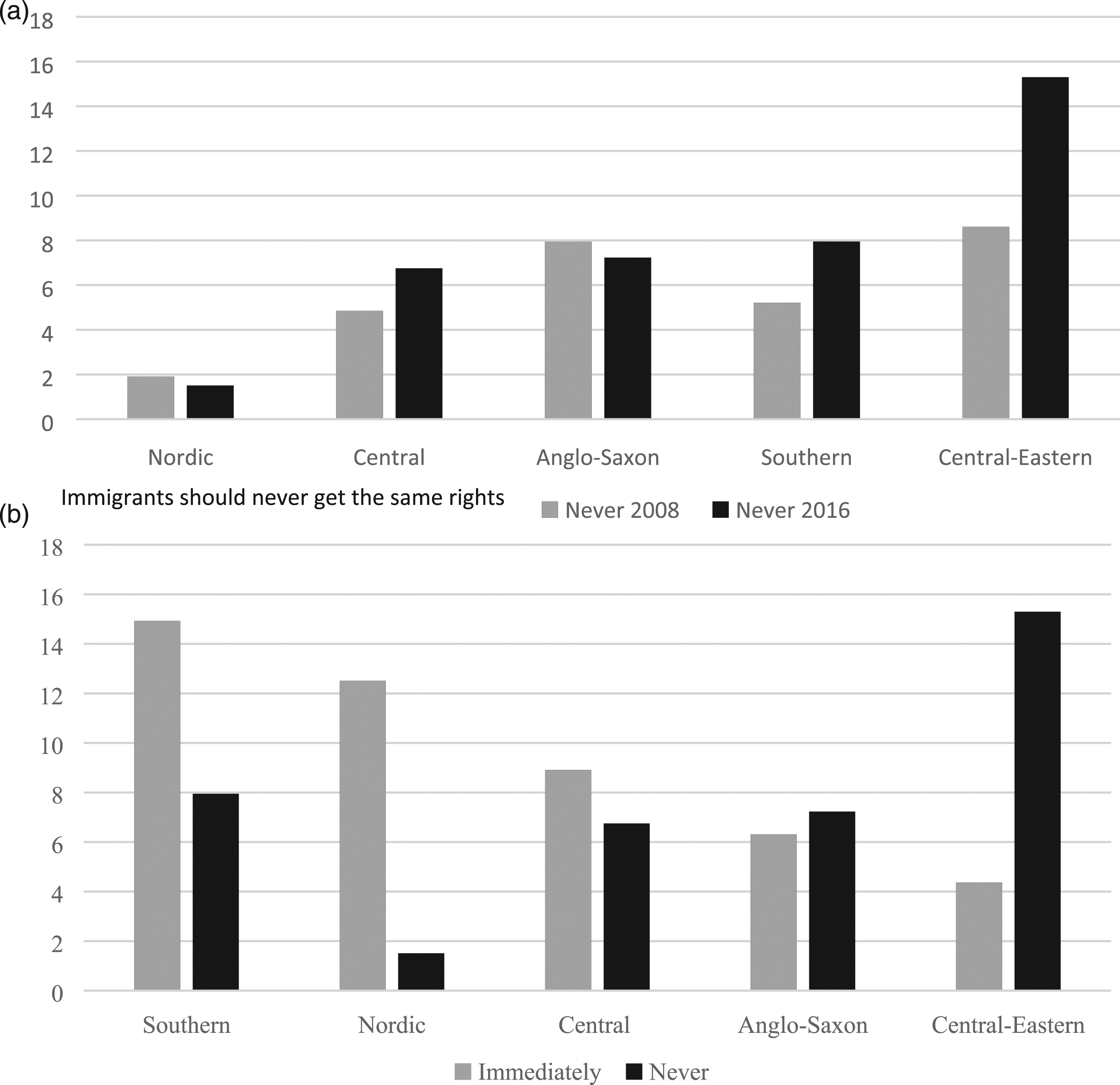
Figure 1(b) shows both the most inclusionary and exclusionary values for 2016, and it confirms quite clearly that Central-Eastern European welfare chauvinism is a separate phenomenon. The figure resonates with several previous studies, inter alia, Grdesic’s (2020) study of welfare chauvinism in Eastern Europe. He found that the typical explanations for welfare chauvinism in Western Europe have less of an effect in Eastern Europe. Several other studies also indicate that exclusionary attitudes in Eastern Europe are much more prevalent than in Western Europe (Gorodzeisky and Semyonov, 2019; Bell et al., 2021).
Figure 1(b) shows, somewhat surprisingly, however, that it is in Southern Europe where one can find the most individuals believing that immigrants should receive the benefits of the welfare state immediately upon arrival. Such attitudes increased considerably from 2008 to 2016 (see Appendix A7). This increase in inclusionary attitudes is combined with the above-mentioned moderate increase in exclusionary forms of welfare chauvinism, which may indicate a possible polarization developing in the Southern European countries.
When it comes to the most exclusionary form of welfare chauvinism, the Anglo-Saxon, Central and Southern European welfare regimes all seem to be rather similar. This exclusionary form of welfare chauvinism is near non-existent in the Nordic countries, showing that although the Southern European countries may be slightly more open to giving immigrants access to the same rights immediately, the lack of exclusionary welfare chauvinism in the Nordic countries does separate them from the rest of the European countries. We would also wish to emphasize that there are differences within each of these regimes in terms of the level of welfare chauvinist attitudes, which can be viewed in Appendix A5.
Multilevel regression of welfare chauvinism in Europe
Moving to the regression analyses, we begin by analysing the variables on the contextual level. It is clear that a higher GDP per capita significantly makes a country less welfare chauvinistic, confirming previous research (Mewes and Mau, 2012). Our analysis also suggests that a large immigrant population and a higher expenditure on social protection benefits both correlate with lower levels of welfare chauvinism. This corroborates findings from previous studies (Mewes and Mau, 2013; Reeskens and Van Oorschot, 2012). However, both the size of the immigrant population and the level of expenditure on social protection benefits are only significant at the 0.1 level (both variables having a p-value of 0.052), so we therefore caution the interpretation of these two variables in our models.
The social inequality of a country, as measured by the Gini coefficient, seems to have no significant influence on welfare chauvinistic attitudes. Furthermore, despite the strong theoretical assumptions of how different forms of unemployment can affect welfare chauvinistic attitudes, none of the variables measuring any form of unemployment seem to have a significant effect on welfare chauvinistic attitudes in Europe. Additionally, being unemployed also has no effect on welfare chauvinistic attitudes.
To further examine whether the different forms of unemployment may have an effect, we tested the same statistical models without the Central-Eastern European countries, as some scholars have argued that attitudes to immigrants in Eastern Europe should be analysed separately from Western European countries since the theoretical models do not necessarily have the same effects in both parts of Europe (Vala and Pereira, 2018; Grdešić, 2020; Bell et al., 2021). This yielded the same results, in that none of the unemployment variables had an effect. Additionally, we tested an interaction effect between being unemployed and the different forms of unemployment, as we expected that being unemployed in a country with high unemployment, including the general unemployment rate, as well as the native- or foreign-born unemployment or the gap between the two, would amount to becoming more welfare chauvinistic. This also had no statistically significant effect. 11 Hypotheses 3–5 are therefore, to our surprise, rejected. However, one contextual variable that seems to have an effect on welfare chauvinistic attitudes in Europe is the strength of far-right populist parties. A stronger presence of far-right populism is associated with higher levels of welfare chauvinistic attitudes which confirms Hypothesis 2.
For the individual-level analysis, we begin by focusing on background variables, such as gender, age and education. At this point, our findings are again in line with previous studies. Females and individuals with more education can be said to have significantly less welfare chauvinistic attitudes, whereas older individuals and individuals who are more sceptical of welfare benefits are significantly more welfare chauvinistic.
Finally, we wish to focus particularly on the economic variables. As previously mentioned, being unemployed cannot be said to significantly impact a welfare chauvinistic attitude. Yet, the subjective satisfaction of one’s own income does indeed have an effect on welfare chauvinism, as being more satisfied with one’s own income indicates being less welfare chauvinistic. This indicates, as in previous studies before ours, that it is an individual’s subjective perception of economic risk, rather than the objective economic risk, that determines welfare chauvinistic attitudes (Heizmann et al., 2018; Kros and Coenders, 2019).
Multilevel regression of welfare chauvinism in Europe.
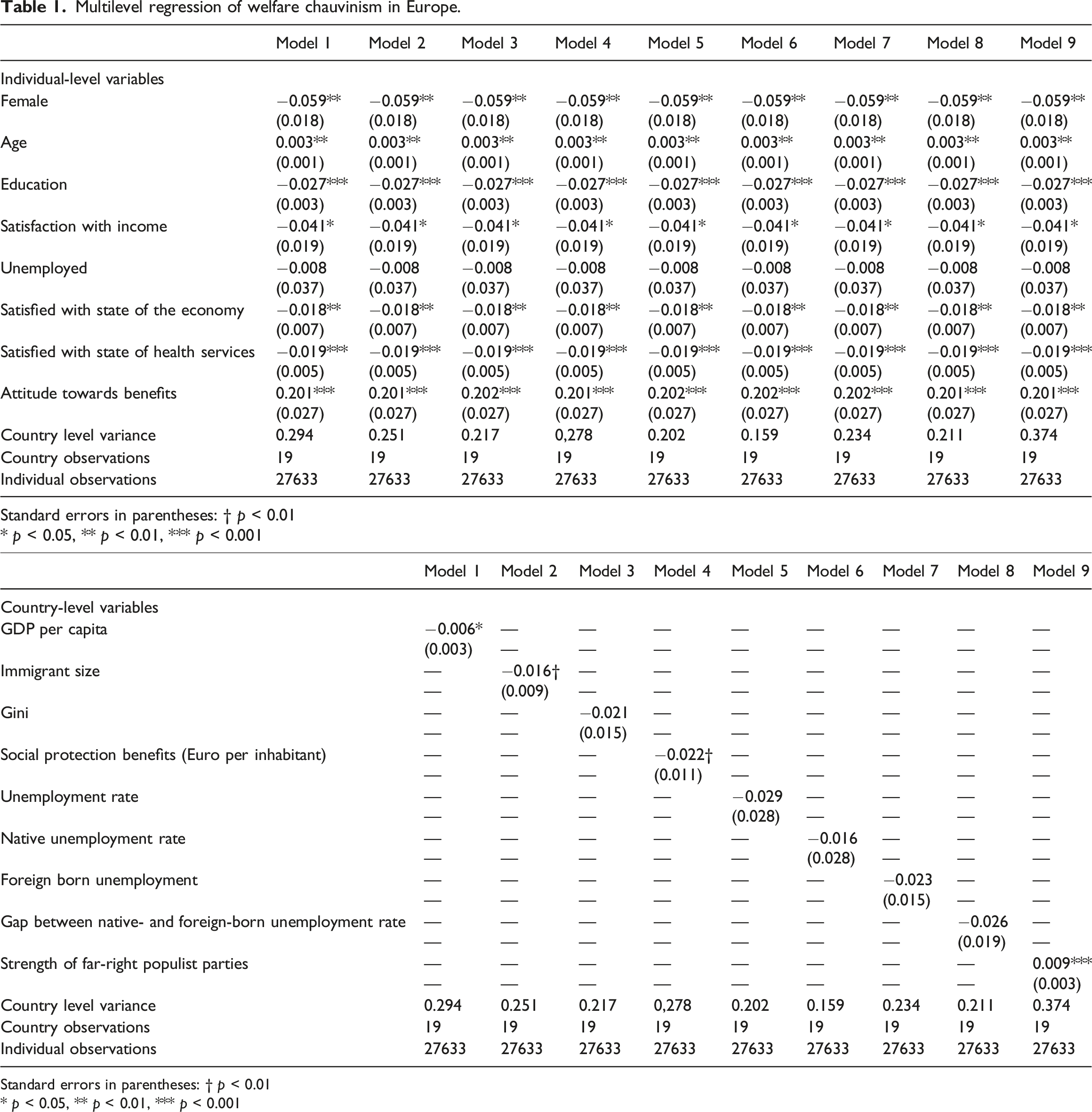
Standard errors in parentheses: † p < 0.01
* p < 0.05, ** p < 0.01, *** p < 0.001
Concluding discussion
There are several aspects surrounding our results that are intriguing. Across Europe, the most exclusionary form of welfare chauvinism, which expresses a desire to exclude immigrants from the welfare state, has remained somewhat stable. The exception is in the Central-Eastern countries, which have seen a substantial rise since 2008 in the number of individuals who wish to exclude immigrants from the welfare state which may be related to the strength of the populist far-right parties in Central-Eastern Europe. As our analysis shows, the strength of far-right populism in a country is significantly associated with higher levels of welfare chauvinism. Ágh (2016) explains that populism has been a ‘megatrend’ in the region since the onset of systematic changes in 1989. He further argues that, especially since the 2008 global financial crisis, the region has seen a transformation from ‘soft’ to ‘hard’ populism which has threatened some of the fundamental principles of liberal democracy, such as, for example, the protection of minority rights. The increasing trend of hard exclusionary populism in the region may therefore to some extent explain the more welfare chauvinistic attitudes in these countries. Additionally, other studies have also found that there has been an increasing trend in hostility towards immigrants in Eastern Europe (Bell et al., 2021).
The lack of results from the other contextual-level variables can also tell us some important aspects surrounding welfare chauvinism. The first of these is that unemployment simply cannot be seen as a measure of realistic threat theory for explaining welfare chauvinistic attitudes. This is clear, seeing as none of our measures of unemployment can be said to have a significant effect on welfare chauvinistic attitudes in Europe. This also shows that welfare chauvinistic attitudes comprise a distinct attitude that is separate from both attitudes towards redistribution and anti-immigrant attitudes, which have both been found to be influenced by the contextual unemployment rate (Blekesaune and Quadagno, 2003; Burgoon, 2014; Kunovich, 2017; Hoxhaj and Zucotti, 2021.
This study has also highlighted the important difference between objective risks and subjective perceptions, and their influence on welfare chauvinism. Out of eight measures of objective economic risks on a macro and a micro level, only GDP per capita had a significant effect, with a p-value of under 0.05, whereas all three of the measures of subjective economic risk were found to influence welfare chauvinistic attitudes. This indicates that if a country were to develop economically, it would not necessarily lead to a decrease in welfare chauvinistic attitudes. Instead, it is how individuals perceive these economic conditions that play a part in the development of welfare chauvinism. This is important, as individuals often have a flawed perception of reality, and can be swayed by populist politicians to believe false information. The results regarding these perceptions therefore need to be viewed along with our findings on the strength of far-right populism in countries, as we have shown that a stronger presence of far-right populism in countries has a significant effect on welfare chauvinistic attitudes. These parties often effectively articulate and amplify fears about globalization and immigration (Brusis, 2016), creating distorted views of reality and a sense of crisis among populations (Caiani and Graziano, 2019).
To our knowledge, this is the first study to point out how the perception of economic conditions may be more important for understanding welfare chauvinistic attitudes than the more objective macro-economic situation. We would therefore welcome further research into the relationship between how populist actors shape these perceptions and how these perceptions relate to welfare chauvinism.
Supplemental Material
Supplemental Material - Perceptions and realities: Explaining welfare chauvinism in Europe
Supplemental Material for Perceptions and realities: Explaining welfare chauvinism in Europe by David Andreas Bell, Marko Valenta and Zan Strabac in Journal of European Social Policy.
Footnotes
Acknowledgements
The authors would like to thank the participants in the panel ‘Equality and Equity’ at the ECPR conference in Innsbruck 2022 for their feedback. Particularly Eva Fernández gave valuable comments on an early draft of the paper which helped improve the study.
Declaration of conflicting interests
The author(s) declared no potential conflicts of interest with respect to the research, authorship, and/or publication of this article.
Funding
The author(s) received no financial support for the research, authorship, and/or publication of this article.

Supplemental Material
Supplemental Material for this article is available online
Notes
References
Supplementary Material
Please find the following supplemental material available below.
For Open Access articles published under a Creative Commons License, all supplemental material carries the same license as the article it is associated with.
For non-Open Access articles published, all supplemental material carries a non-exclusive license, and permission requests for re-use of supplemental material or any part of supplemental material shall be sent directly to the copyright owner as specified in the copyright notice associated with the article.
